
Regular practice with AP Inter 2nd Year Physics Study Material Chapter 11 Dual Nature of Radiation and Matter Questions and Answers helps students stay prepared for examinations.
AP Inter 2nd Year Physics 11th Lesson Dual Nature of Radiation and Matter Questions and Answers
I. Multiple Choice Questions
Question 1.
The energy of a photon of wave length 500nm Is approximately [ ]
1) 1.24eV
2) 2.48eV
3) 3.1eV
4) 4.96eV
Answer:
2) 2.48eV
The energy of photon is E = \(\frac{\text { hc }}{\lambda}\) = \(\frac{1240}{500}\) = 2.48eV
Question 2.
In a photoelectric experiment, stopping potential is 2V. The maximum kinetic energy of emitted photoelectrons is [ ]
1) 1eV
2) 2eV
3) 3eV
4) 4eV
Answer:
2) 2eV
The maximum KE = eVs = e × 2V = 2eV
Question 3.
Which of the following represents the variation of photoelectric current with intensity of incident light? [ ]
1) Straight line passing through origin
2) Parabola
3) Saturation curve
4) Exponential curve
Answer:
1) Straight line passing through origin
Photo electric current is directly proportional to the number of photoelectrons emitted per second. So, the required graph is a linear straight line through the origin.
Question 4.
A light of wavelength 4000A is incident on a metal surface of work function 2eV. The maximum kinetic energy of emitted electrons is [ ]
1) 1.1eV
2) 2.1eV
3) 0.1eV
4) 3.1eV
Answer:
1) 1.1eV
Given λ = 4000 A, work function φ = 2eV
Energy, E = \(\frac{\mathrm{hc}}{\lambda}\) = \(\frac{12400}{4000}\) = 3.1eV
From Einstein’s equation Kmax = E – φ = 3.1 – 2 = 1.1eV

Question 5.
The threshold frequency of a metal surface is 5 × 10¹⁴ Hz. If light of frequency 1015 Hz is incident, the maximum speed of emitted photoelectrons is [ ]
(h = 6.63 × 10⁻³⁴J⋅s, me = 9.1 × 10⁻³¹ kg):
1) 5.9 × 10⁵ m/s
2) 8.5 × 10⁵ m/s
3) 1.2 × 10⁶ m/s
4) 2.4 × 10⁶ m/s
Answer:
2) 8.5 × 10⁵ m/s
According to Einstein’s equation, kmax = hv – hv0 = h(v – v0)
= 6.63 × 10⁻³⁴(10 × 1014 – 5 × 10¹⁴) = 33.15 × 10M-20J
Also Kmax = \(\frac{1}{2} \mathrm{mv}_{\max }^2\) ⇒ vmax = \(\sqrt{\frac{2 \mathrm{~K} \max }{\mathrm{~m}}}\) = \(\sqrt{\frac{2 \times 33.15 \times 10^{-20}}{9.1 \times 10^{-31}}}\) = 8.53 × 10⁵ m/s
Question 6.
An electron has de-Broglie wavelength equal to that of a photon of wavelength 5000A. The ratio of the momentum of the electron to that of the photon is: [ ]
1) 0
2) 1
3) >1
4) <1
Answer:
2) 1
The de-broglie wavelength λ = \(\frac{\mathrm{h}}{\mathrm{p}}\) ⇒ pλ = h = constant ∴ Pe : Pp = 1 : 1
Since the wavelengths λ are equal, the corresponding momenta p must also be equal.
Question 7.
Work function of a photo-sensitive surface is 2.2 eV. If the maximum kinetic energy of photoelectrons is 0.8eV, the incident radiation frequency is approximately (h = 6.63 × 10⁻³⁴J⋅s): [ ]
1) 6 × 10¹⁴Hz
2) 7 × 10¹⁴Hz
3) 8 × 10¹⁴Hz
4) 9 × 10¹⁴Hz
Answer:
2) 7 × 10¹⁴Hz
Using Einstein’s equation, E = Kmax + φ = 0.8 + 2.2 = 3eV = 3 × 1.6 × 10-19J = 4.8 × 10⁻¹⁹J
Now E = hv ⇒ v = \(\frac{E}{h}\) = \(\frac{4.8 \times 10^{-19}}{6.63 \times 10^{-34}}\) = 7.24 × 10¹⁴Hz = 7 × 10¹⁴Hz
Question 8.
In a photoelectric effect, if the intensity of incident light is doubled, then: [ ]
1) maximum kinetic energy of electrons is doubled
2) stopping potential is doubled
3) number of emitted electrons is doubled
4) threshold frequency is doubled
Answer:
3) number of emitted electrons is doubled
Intensity is directly proportional to the number photons hitting the surface per second. Here intensity is doubled then no. of emitted electrons aslo doubles.
II. Fill in the Blanks
Question 1.
The energy of a photon interms of frequency is given by the relation E = ___.
Answer:
hv
According to Planck’s quantum theory, E = hv.
Question 2.
The photoelectric effect was explained successfully by ____.
Answer:
Albert Einstein
Albert Einstein successfully explained die photoelectric effect using Planck’s quantum hypothesis.
Question 3.
The minimum frequency of incident radiation required to eject electrons from a metal surface is called the ___ frequency.
Answer:
threshold
Minimum frequency of incident radiation required to eject electrons from a metal surface is called the threshold frequency.
Question 4.
The work function of a metal is the minimum ___ required to eject an electron from it surface.
Answer:
energy
The work function of a metal is the minimum energy required to eject an electron from its surface.
Question 5.
According to de-Broglie, the wavelength associated with a moving particle is given by λ = ___.
Answer:
h/p
According to de-Broglie, the wavelength associated with a moving particle is given by λ = h/p.
Question 6.
According to photoelectric equation the maximum kinetic energy of emitted photoelectrons is given by Kmax = ____.
Answer:
hv – φ.
According to photoelectric equation the maximum kinetic energy of emitted photoelectrons is given by Kmax = hv – φ
Question 7.
The velocity of photo electrons depends only on the ____ of incident light.
Answer:
frequency
The velocity of photo electrons depends only on the frequency of incident light.
III. One Word Answer Questions
Question 1.
Give the expression for momentum of photon interms of wavelength ‘λ.’ and Planck’s constant ‘h’.
Answer:
Momentum p = \(\frac{\mathrm{h}}{\lambda}\) [∵ λ = \(\frac{\mathrm{h}}{\mathrm{p}}\)]
Here h is Planck’s constant and λ is wave length.
Question 2.
What is the effect of intensity of incident light on the energy of emitted photoelectrons?
Answer:
There is no effect of intensity of incident light on the energy of emitted photo electrons. Intensity just increases the number of emitted electrons but no effect on energy.
Question 3.
What happens to the kinetic energy of photo electrons, if the frequency of incident light increases?
Answer:
If the frequency of incident light increase, the kinetic energy of photo electrons also increases.
Question 4.
Name the scientist who proposed the dual nature of matter?
Answer:
Louis de Broglie, proposed the dual nature of matter.
Question 5.
Which fundamental constant connects the energy of a photon with its frequency?
Answer:
Planck’s constant connects the energy of photon with its frequency.
Question 6.
The maximum kinetic energy of photoelectrons depends on what?
Answer:
The maximum K.E. of photo electrons depends on frequency of incident light.
Question 7.
If an electron is accelerated by 100 V potential. What is its energy?
Answer:
Energy E = Vq = 100eV = 100 × 1.6 = 1019J = 1.6 × 10⁻¹⁷J.
Question 8.
If the intensity of light is doubled, what happens to photoelectric current?
Answer:
If the intensity of light is doubled, photoelectric current is also doubled. Since photoelectric current is directly proportional to intensity.
Question 9.
What is the slope of the graph drawn between stopping potential (Y-axis) and frequency of incident light (X-axis).
Answer:
Slope = \(\frac{\mathrm{h}}{\mathrm{e}}\) Here h is Planck’s constant, e is charge of electron.
Question 10.
What is the charge of photon?
Answer:
The charge of photon is zero because photons are electrically neutral.
IV. Very Short Answer Questions
Question 1.
What are cathode rays?
Answer:
Cathode Rays are streams of electrons.
These rays are emitted from cathode of a discharge tube, when the gas in it is subjected to low pressure (0.001 mm of Hg) and strong electric field.
Question 2.
What important fact did Millikan’s oil drop experiment establish?
Answer:
Millikan’s experiment established the fact that electric charge is quantised.
Millikan found the value of charge of electron is e = 1.602 × 10⁻¹⁹ C.
Question 3.
What is photoelectric effect?
Answer:
Photoelectric Effect is the emission of electrons from a metal surface when it is illuminated by electro magnetic radiation of sufficient frequency.
The electrons emitted in photoelectric effect are called photoelectrons.
Question 4.
Define work function. Give an expression for it.
Answer:
Work Function: The minimum energy required by an electron to escape from the surface of a metal is called work function (φo) of the metal.
Expression: (φo = hvo Here h is planck’s constant and vo is threshold frequency.
Question 5.
Give examples of photosensitive substances. Why are they called so?
Answer:
Alkali metals like lithium, sodium, potassium, cesium and rubidium are photosensitive substances. Because, these alkali metals emit electrons when they are illuminated by light.
Question 6.
Write down Einstein’s photoelectric equation. Explain the terms in it?
Answer:
Einstein’s Photoelectric Equation : Kmax = hv – φo
Here Kmax is maximum kinetic energy of the photoelectron, h is Planck’s constant, V is the frequency of incident light and φo is the work function of the metal.
Question 7.
Write down de-Broglie’s relation and explain the terms therein.
Answer:
De Broglie’s relation : Wavelength λ = \(\frac{h}{p}\) = \(\frac{\mathrm{h}}{\mathrm{mv}}\)
Here h Planck’s constant and p = mv is the momentum of the particle
Question 8.
Define 1 electron volt.
Answer:
An electron volt is a tiny unit of energy, defined as the kinetic energy gained by a single electron when it accelerates through a potential difference of 1 volt in vaccum.
The value of leV= 1.6 × 10⁻¹⁹ J
Question 9.
Which physical quantities are conserved in photon-particle collisions in photoelectric effect?
Answer:
In a photon- particle collision, the total energy and total momentum are conserved. Here, the photon transfers its energy to the electron to overcome the work function of the material, and the remaining energy appears as the kinetic energy of the electron.
V. Short Answer Questions
Question 1.
What are different types of physical processes to obtain free electrons from the metal surface.
Answer:
Types of physical processes:
- Thermionic Emission: By suitably heating, sufficient thermal energy can be imparted to the free electrons to enable them to come out of the metal. Ex: Vacuum tubes, CRT & X rays tubes these are the applications of this emission.
- Field Emission: By applying a very strong electric field to a metal, electrons can be pulled out of the metal, as in a spark plug. Ex: Sparkplugs, field emission microscopes, cold cathode devices are these applications.
- Photoelectric Emission: When light of suitable frequency illuminates a metal surface, photo electrons are emitted from the metal surface. Ex: Photoelectric cells, solar panels and light sensors are the applications of this emission.
- Secondary Emission: When high speed ‘primary’ particles like electrons strike a metal surface they transfer their kinetic energy to the electrons within the metal, causing ‘secondary’ electrons to be knocked out of the surface. Ex: Photo multiplier tubes, image intensifiers are the applications of this emission.
Question 2.
Define (i) Threshold frequency
(ii) Work function and give the relation between them and define stopping potential.
Answer:
i) Threshold frequency: It is the minimum frequency of incident radiation required to liberate electrons from the metal surface. It’s value depends on the nature of the metal.
ii) Work function: It is the minimum amount of energy required just to liberate an electron from the given metal surface. Work function of a metal is a physical constant.
iii) Relation between work function and threshold frequency:
The work function (φ) is directly proportional to the threshold frequency (v0) of the metal. Work function φ = hv0, h is planck’s constant.,
A metal with a higher work function holds onto its electrons, meaning it requires a higher threshold frequency of light to knock those electrons free.
iv) Stopping’ Potential: It is the minimum negative potential given to the collector plate for which the photocurrent stops or becomes zero.
Question 3.
What are the laws of photoelectric effect.
Answer:
Laws of photoelectric effect:
- Threshold Frequency: For a given photosensitive surface, there exists a minimum frequency called threshold frequency (v0), below which photoelectric emission does not take place, whatever may be the intensity of incident light.
- Intensity: The photoelectric current is directly proportional to the intensity of incident light, provided the frequency is greater than threshold frequency.
- Kinetic Energy : The maximum kinetic energy of emitted photoelectrons depends on the frequency of incident radiation and is independent of the intensity of light. Kmax = hv – φ
- Instantaneous Emission: The photoelectric emission is instantaneous. There is no measurable time lag between the incidence of light and the emission of photoelectrons.
Question 4.
Explain graphically that the stopping potential is independent of intensity of incident light.
Answer:
Stopping Potential: It is the minimum negative potential given to the collector plate for which the photocurrent stops or becomes zero.
When light of the same frequency but different intensities falls on a photosensitive metal surface, the number of emitted photoelectrons changes, but their maximum kinetic energy remains the same. Thus the stopping potential V0 does not depend on the intensity of incident light.
Graphical Explanation:
We plot the photocurrent (I) versus the collector potential (V) for light of same frequency and different intensities (I1.I2.I3).
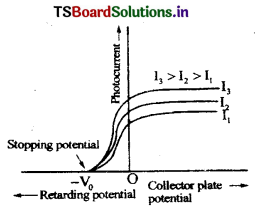
From the graph it is clear that as intensity increases (I3 > I2 > I1), the saturation current increases because more photons incident on the surface, releasing more electrons.
The 3 curves converge at a negative voltage points on the x-axis which is nothing but the stopping potential V0.
Because all the 3 curves share the exact same stopping potential it proves that V0 is completely independent of the light’s intensity.
Question 5.
Write Einstein’s photo-electric equation.
How Millikan proved the validity of Einstein’s photoelectric equation.
Answer:
Einstein’s photoelectric equation: hv = φ + \(\frac{1}{2} m v_{\max }^2\)
Here h = Planck’s constant, v = frequency of incident radiation, φ = work function of the metal
\(\frac{1}{2} m v_{\max }^2\) = maximum kinetic energy of emitted photoelectrons
Since maximum kinetic energy is related to stopping potential V0
\(\frac{1}{2} m v_{\max }^2\) = eV0
Therefore, Einstein’s equation can also be written as:
hv = φ + eV0 ⇒ V0 = \(\frac{\mathrm{h}}{\mathrm{e}}\)v – \(\frac{\phi}{\mathrm{e}}\) ⇒ hv = φ + eV0
Millikan’s Verification of Einstein’s Photoelectric Equation:
Robert Andrews Millikan experimentally verified Einstein’s photoelectric equation in 1915.
Experiment:
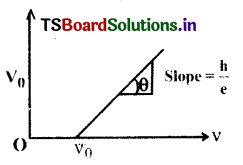
Millikan measured the stopping potential V0 for different frequencies of incident light.
He plotted a graph between stopping potential V0 and frequency v
Observations:
- The graph was a straight line.
- The slope of the graph was equal to h/e.
- The intercept on frequency axis gave the threshold frequency v0.
Conclusion:
The experimental results exactly matched the equation V0 = \(\frac{h}{e}\)v – \(\frac{\phi}{e}\)
Thus, Millikan proved the validity of Einstein’s photoelectric equation.
He also determined the value of Planck’s constant from the slope of the graph.
Question 6.
What is de Broglie’s wavelength?
Answer:
According to de Broglie’s hypothesis, matter has dual nature. It states that every moving particle experiences a wave like nature.
de Broglie’s wavelength λ = \(\frac{\mathrm{h}}{\mathrm{p}}\) = \(\frac{\mathrm{h}}{\mathrm{mv}}\).
Here m is the mass of particle, v is the speed of particle, p is the momentum of particle, h is the planck’s constant, λ, is the de Broglie wave length.
This equation is called de Broglie’s relation.
For a microscopic particle like electron, the mass of the particle is extremely small.
Then the value of λ, becomes very high as the mass m is in the denominator of the formula. Hence, the moving particle behaves like a wave.
Question 7.
Explain why macroscopic objects do not show significant wave-like properties when compared to sub-atomic particles.
Answer:
Macroscopic objects do not show significant wave properties, because their mass is incredibly large making their associated de Broglie wavelength is very small.
De Brogue wavelength = \(\frac{\mathrm{h}}{\mathrm{P}}\)
Every moving particle has a wave nature, with a wave length λ calculated by the equation λ = \(\frac{h}{m v}\)
Here h is planck’s constant, m is mass of the particle, v is the velocity of the object. Macroscopic objects fail to show wave properties because, the numerator (h) is small, the macroscopic mass (m) is larger than the wavelength close to zero.
VI. Long Answer Questions
Question 1.
Describe Einstein’s explanation of the photoelectric effect on the basis of the quantum theory of light. Derive an expression for the maximum kinetic energy of photoelectrons in terms of frequency of incident light and work function of the material.
Answer:
a) Einstein’s Explanation of Photoelectric Effect:
Albert Einstein explained the photoelectric effect using Planck’s quantum theory of radiation. According to Einstein:
- Light consists of tiny packets of energy called photons or quanta.
- The energy of each photon is directly proportional to the frequency of light.
Here, E = energy of photon, h = Planck’s constant, v = frequency of incident radiation - A single photon transfers its entire energy to a single electron in the metal surface.
- Part of the photon energy is used to overcome the force binding the electron to the metal surface. This minimum energy is called the work function (φ)
- The remaining energy appears as the kinetic energy of the emitted photoelectron.
- If the frequency of incident light is less than the threshold frequency photoelectric emission does not occur because the photon energy is insufficient to liberate electrons.
b) Derivation of Einstein’s Photoelectric Equation:
Let hv = energy of incident photon
φ = work function of the metal
Kmax = maximum kinetic energy of emitted photoelectron
According to the law of conservation of energy,
Energy of photon = Work function + Maximum kinetic energy
∴ hv = φ + Kmax
Hence, Kmax = hv – φ ….(1)
This is Einstein’s photoelectric equation.
If Vmax is the maximum velocity of emitted photoelectrons, then Kmax = \(\frac{1}{2} m v_{\max }^2\) ….. (2)
Frorn (1) & (2), Kmax = \(\frac{1}{2} m v_{m a}^2\) = hv – φ = hv – hvo = h(v – vo) [∵ φ = hv0]
∴ Kmax = h(v – v0) where v0 is the threshold frequency of the metal.
Question 2.
State de-Broglie’s hypothesis of matter waves. Derive an expression for the de-Broglie wavelength of a particle of mass ‘m’ moving with velocity ‘v’. Calculate the de-Broglie wavelength of an electron accelerated through 100 V.
Answer:
According to de Broglie’s hypothesis, matter has dual nature. It states that every moving particle experiences a wave like nature.
de-Broglie explained the reason for this as nature was symmetrical and two basic physical entities, matter and energy, must have symmetrical character.
Expression for de-Broglie wavelength de Broglie’s wavelength λ = \(\frac{h}{p}\) = \(\frac{\mathrm{h}}{\mathrm{mv}}\).
Here m is the mass of particle, v is the speed of particle, p is the momentum of particle, h is the planck’s constant, λ is the de Broglie wave length.
This equation is called de Broglie’s relation.
From above equation it is clear that 1 is smaller for a heavier particle (large m) or more energetic particle (large v)
Problem: Accelerated potential V = 100 V

Textual Solved Problem
Question 1.
Monochromatic light of frequency 6.0 × 10¹⁴ Hz is produced by a laser. The power emitted is 2.0 × 1o-3 W.
(a) What is the energy of a photon in the light beam?
(b) How many photons per second, on an average, are emitted by the source?
Answer:
Given frequency of light v = 6.0 × 10¹⁴ Hz, Planck’s constant h = 6.63 × 10⁻³⁴Js, P = 2.0 × 10⁻³ W
a) Energy of photon E = hv = (6.63 × 10⁻³⁴) (6.0 × 10¹⁴) J = 3.98 × 10⁻¹⁹
b) Number of photons per second(n) = \(\frac{\mathrm{n}}{\mathrm{t}}\) = \(\frac{P}{E}\) [∵ P = \(\frac{n E}{t}\) ⇒ \(\frac{\mathrm{n}}{\mathrm{t}}\) = \(\frac{P}{E}\)]
= \(\frac{2.0 \times 10^{-3}}{3.98 \times 10^{-19}}\) = 50 × 1015 photons per second
Question 2.
The work function of caesium is 2.14 eV. Find
(a) the threshold frequency for caesium, and (b) the wavelength of the incident light if the photocurrent is brought to zero by a stopping potential of 0.60 V.
Answer:
Given Work function φ0 = 2.14 eV = 2.14 × 1.6 × 10-19J, Stopping potential V0 = 0.60 V
Planck’s constant h = 6.63 × 10⁻³⁴ Js,
a) φo = hv0 ⇒ Threshold frequency v0 = φ0/ h = \(\frac{2.14 \times 1.6 \times 10^{-19}}{6.63 \times 10^{-34}}\) = 5.16 × 10¹⁴ Hz
b) Einstein’s photoelectirc equation eVo = hv – φo ⇒ hv = eV0 + φo ⇒ \(\frac{\mathrm{hc}}{\lambda}\) = eV0 + φo
⇒ λ = \(\frac{\mathrm{hc}}{\left(\mathrm{eV}_0+\phi_0\right)}\) = \(\frac{\left(6.63 \times 10^{-34}\right)\left(3 \times 10^8\right)}{(0.60+2.14) 1.6 \times 10^{-19}}\) = 4.54 × 10⁻⁷ nm
Question 3.
What is the de Brogue wavelength associated with (a) an electron moving with a speed of 5.4 × 10⁶ m/s, and (b) a hail of mass 150 g travelling at 30.0m/s?
Answer:
a) For Fiectron: Mass m = 9.11 × 10⁻³¹ kg, velocity v = 5.4 × 10⁶ m/s, h = 6.63 × 10⁻³⁴ Js, λ = ?
Formula: de Brogue wavelength λ = \(\frac{\mathrm{h}}{\mathrm{mv}}\) = \(\frac{6.63 \times 10^{-34}}{9.11 \times 10^{-31} \times 5.4 \times 10^6}\) = 0.135 × 10⁻⁹m
b) For Ball: Mass m = 150 = 0.15 kg, velocity v = 30.0 m/s, h = 6.63 × 10⁻³⁴Js, λ =?
Formula: de Brogue wavelength λ = \(\frac{\mathrm{h}}{\mathrm{mv}}\) ⇒ λ = \(\frac{6.63 \times 10^{-34}}{0.15 \times 30.0}\) = 1.47 × 10⁻³⁴m
Exercise Problem
Question 1.
Ultraviolet light with wavelength of 230 nm strikes on a metal with a work function of φ = 1.30 ev. Find the maximum kinetic energy.
Answer:
Given wavelength λ = 230nm = 2300A, φ = 1.30 eV

From Einstein photoelectric equation Kmax = E – φ = 5.39 – 1.30 = 4.09eV = 4.1 eV
Question 2.
Light of frequency 7.2 × 10¹⁴ Hz is incident on a metal surface with a work function of 1.9 ev. Calculate the stopping potential value in terms of volts.
Answer:
Given frequency of light v = 7.2 × 10¹⁴ Hz, Work function φ = 1.9eV
Planck’s constant h = 6.6 × 10⁻³⁴, Charge of electron e = 1.6 × 10⁻¹⁹ C
From Einstein photoelectric equation eV0 = hv – φ0
⇒ eV0 = (4.136 × 10-15 × 7.2 × 1014) – 1.9 = 2.978 – 1.9 = 1.078 V
Question 3.
The work function of a metal is 4.3 eV. What is the threshold wavelength?
Answer:
Given work function φ = 4.3 eV = 4.3 × 1.6 × 10-19 = 6.88 × 10⁻¹⁹J
Planck’s constant h = 6.6 × 10⁻³⁴, Speed of light c = 3 × 10⁸ m/s ,
∴ Threshold wavelength λ0 = \(\frac{\mathrm{hc}}{\phi}\) = \(\frac{12400}{4800}\) = 2883.7A = 288.37 × 10⁻⁹ m = 288.37nm.
Question 4.
Will light of wavelength 480nm causes emission of electrons from a metal with a work function of 1.8 eV?
Answer:
Given wavelength λ = 480nm, work function φ = 1.8eV we know hc = 12400
Planck’s constant h = 6.6 × 10⁻³⁴, Speed of light c = 3 × 10⁸ m/s
Energy of phòton E = \(\frac{\mathrm{hc}}{\lambda}\) = \(\frac{12400}{4800}\) = 2.58eV ….(1)
But given work function φ = 1.8eV….(2)
From (1) & (2) E >φ. Thus energy of incident photon is greater than work function.
Hence the photon has enough energy to knockout an electron. So, emission is possible
Question 5.
When light of wavelength 2200A fall on Cu, photoelectrons are emitted from it. The work function for Cu is φ0 = 4.65 eV. Find (a) the threshold wavelength in terms of A and (b) the stopping potential.
Anser:
Given incident wavelength λ = 2200A, work function φ0 = 4.65 eV,
a) Threshold wavelength λ0 = \(\frac{\mathrm{hc}}{\phi_0}\) = \(\frac{12400}{4.65}\) = 2671.61A
b) Energy of incident photon E = \(\frac{\mathrm{hc}}{\lambda}\) = \(\frac{12400}{2200}\) = 5.64eV
From Einstein photoelectric equation, eV0 = E – φ0 = 5.64 – 4.65 = 0.99eV = 1eV
⇒ V0 = \(\frac{1 \mathrm{eV}}{1 \mathrm{v}}\) = 1V ∴ Stopping potential V0 = 1V
Question 6.
A particle has a momentum of 1.5 × 10⁻²⁷ kg m/s. What is its de-Broglie wavelength?
Answer:
Given momentum of the particle p = 1.5 × 10⁻²⁷ kg m/s, Planck’s constant h = 6.626 × 10⁻³⁴,
∴ de-Broglie wave length λ = \(\frac{h}{p}\) = \(\frac{6.626 \times 10^{-34}}{1.5 \times 10^{-27}}\) = 4.4173 × 10⁻⁹m = 441.73 × 10⁻⁹m = 441.73 nm
Question 7.
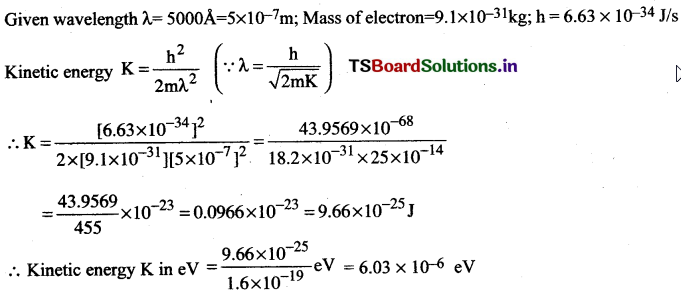
What is the kinetic energy of an electron whose de-Broglie wavelength is 5000A ?
Answer:
Question 8.
Calculate the (a) momentum and (b) de-Brogue wavelength of the electrons accelerated through a potential difference of 56 V.
Answer:
Given mass of the electron m = 9 × 10-31m; Potential difference V = 56V
For an electron accelerated through a potential difference V,

Objective Questions
Question 1.
In a discharge tube ionization of enclosed gas is produced due to collisions between
1) neutral gas atoms/molecules
2) positive ions and neutral atoms/molecules
3) negative electrons and neutral atoms/ molecules
4) photons and neutral atoms/molecules.
Answer:
3) negative electrons and neutral atoms/ molecules
Question 2.
Who evaluated the mass of electron indirectly with help of charge?
1) Thomson
2) Millikan
3) Rutherford
4) Newton
Answer:
1) Thomson
Question 3.
In a discharge tube at 0.02 min. there is formation of
1) Crooke’s dark space
2) Faraday’s dark space
3) both space partly
4) none of these.
Answer:
1) Crooke’s dark space
Question 4.
In which of the following, emission of electrons does not take place
1) thermionic emission
2) X-rays emission
3) photoelectric emission
4) secondary emission ’ ‘
Answer:
2) X-rays emission
Question 5.
Thermions are
1) protons
2) electrons
3) photons
4) positrons.
Answer:
2) electrons
Question 6.
Photoelectric emission occurs only when the incident light has more than a certain minimum
1) power
2) wavelength
3) intensity
4) frequency
Answer:
4) frequency
Question 7.
In photoelectric emission process from a metal of work function 1.8 eV, the kinetic energy of most energetic electrons is 0.5 eV. The corresponding stopping potential is
1) 1.8 V
2) 1.3 V
3) 0.5 V
4) 2.3 V
Answer:
3) 0.5 V
Question 8.
A 5 watt source emits monochromatic light of wavelength 5000 A°, When placed 0.5 m away, it liberates photoelectrons from a photosensitive metallic surface. 4hen the source is moved to a distance of 1.0 m, the
number of photoelectrons liberated will be reduced by a factor of
1) 8
2) 16
3) 2
4) 4
Answer:
4) 4
Question 9.
When ultraviolet rays incident on metal plate then photoelectric effect does not occur, it occurs by incidence of
1) infrared rays
2) X-rays
3) radio wave
4) micro wave.
Answer:
2) X-rays
Question 10.
A photo-cell is illuminated by a source of light, which is placed at a distance d from the cell, If the distance become d/2, then number of electrons emitted per second will be
1) remain same
2) four times
3) two times
4) one-fourth.
Answer:
2) four times
Question 11.
Number of ejected photoelectrons increases with increase
1) in intensity of light
2) in wavelength of light
3) in frequency of light
4) never
Answer:
1) in intensity of light
Question 12.
When the energy of the incident radiation is increased by 20%, the kinetic energy of the photoelectrons emitted from a metal surface increased from 0.5 eV to 0.8 eV The work function of the metal is
1) 0.65eV
2) 1.0eV
3) 1.3 eV
4) 1.5 eV
Answer:
2) 1.0eV
Question 13.
Two radiations of photons energies 1 eV and 2.5 eV, successively illuminate a photosensitive metallic surface of work function 0.5 eV. The ratio of the maximum speeds of the emitted electrons is
1) 1 : 4
2) 1 : 2
3) 1 : 1
4) 1 : 5
Answer:
2) 1 : 2
Question 14.
The threshold frequency for a photosensitive metal is 3.3 × 10¹⁴ Hz. If light of frequency 8.2 × 10¹⁴ Hz is incident on this metal, the cut-off voltage for the photoelectron emission is nearly
1) 1 V
2) 2 V
3) 3 V
4) 5 V
Answer:
2) 2 V
Question 15.
The photoelectric work function for a metal surface is 4.125 eV. The cut-off wavelength for this surface is
1) 3000 A°
2) 2062.5 A°
3) 4125 A°
4) 6000 A°
Answer:
1) 3000 A°
Question 16.
Photoelectric work function of a metal is 1 eV. Light of wavelength λ = 3000 A° falls on it. The photo electrons come out with a maximum velocity
1) 10 metres/sec
2) 102 metres/ sec
3) 104 metres/sec
4) 106 metres/sec
Answer:
4) 106 metres/sec
Question 17.
Ultraviolet radiations of 6.2 eV falls on an aluminium surface. Kinetic energy of fastest electron emitted is (work function = 4.2 eV)
1) 3.2 × 10⁻²¹ J
2) 3.2 × 10⁻¹⁹J
3) 7 × 10-25 J
4) 9 × 10-32 J
Answer:
2) 3.2 × 10⁻¹⁹J
Question 18.
The threshold frequency for photoelectric effect on sodium corresponds to a wavelength of 5000 A°. Its work function is
1) 4 × 10-19J
2) 1 J
3 ) 2 × 10-19 J
4) 3 × 10-19 J
Answer:
1) 4 × 10-19J
Question 19.
A 200 W sodium street lamp emits yellow light of wavelength 0.6 pm. Assuming it to be 25% efficient in converting electrical energy to light, the number of photons of yellow light it emits per second is
1) 1.5 × 10²⁰
2) 6 × 10¹⁸
3) 62 × 1020
4) 3 × 10¹⁹
Answer:
1) 1.5 × 10²⁰
Question 20.
Momentum of photon of wavelength λ is
1) \(\frac{\mathrm{h} v}{\mathrm{c}}\)
2) zero
3) \(\frac{\mathrm{h} \lambda}{\mathrm{c}^2}\)
4) \(\frac{\mathrm{h} \lambda}{\mathrm{c}}\)
Answer:
1) \(\frac{\mathrm{h} v}{\mathrm{c}}\)
Question 21.
The wavelength of a 1 keV photon is 1.24 × 10⁻⁹ m. What is the frequency of 1 MeV photon?
1) 1.24 × 10¹⁵
2) 2.4 × 10²⁰
3) 1.24 × 10¹⁸
4) 2.4 × 10²³
Answer:
2) 2.4 × 10²⁰
Question 22.
A radio transmitter operates at a frequency 880 kHz and a power of 10 kW. The number of photons emitted per second is
1) 1.72 × 1031
2) 1.327 × 1025
3) 1.327 × 1037
4) 1.327 × 1045
Answer:
1) 1.72 × 1031
Question 23.
An electron is accelerated from rest through a potential difference of V volt. If the de Broglie wavelength of the electron is 1.227 × 10⁻² nm, the potential difference is
1) 10V
2) 102 V
3) 103 V
4) 104 V
Answer:
4) 104 V
Question 24.
An electron is accelerated through a potential difference of 10,000 V. Its de Broglie wavelength is, (nearly) (m = 9 × 10-31 kg)
1) 12.2 nm
2) 12.2 × 10⁻¹³ m
3) 12.2 × 10⁻¹² m
4) 12.2 × 10⁻¹⁴ m
Answer:
3) 12.2 × 10⁻¹² m
Question 25.
If the kinetic energy of the particle is increased to 16 times its previous value, the percentage change in the de Broglie wavelength of the particle is
1) 25
2) 75
3) 60
4) 50
Answer:
2) 75
Question 26.
1) The wavelength λe of an electron and λp of a photon of same energy E are related by
1) λp ∝ \(\sqrt{\lambda_{\mathrm{e}}}\)
2) λp ∝ \(\frac{1}{\sqrt{\lambda_{\mathrm{e}}}}\)
3) λp ∝ \(\lambda_{\mathrm{e}}^2\)
4) λp ∝ λe
Answer:
3) λp ∝ \(\lambda_{\mathrm{e}}^2\)
Question 27.
If the momentum of an electron is changed by P, then the de Broglie wavelength associated with it changes by 0.5%. The initial momentum of electron will be
1) 200P
2) 400P
3) P/200
4) 100P
Answer:
1) 200P
Question 28.
The interplanar distance in a crystal is 2.8 × 10⁻⁸ m. The value of maximum wavelength which can be diffracted
1) 2.8 × 10⁻⁸ m
2) 5.6 × 10⁻⁸ m
3) 1.4 × 10⁻⁸ m
4) 7.6 × 10⁻⁸ m
Answer:
2) 5.6 × 10⁻⁸ m