
Regular practice with AP Inter 1st Year Chemistry Study Material Chapter 1 Some Basic Concepts of Chemistry Questions and Answers helps students stay prepared for examinations.
AP Inter 1st Year Chemistry 1st Lesson Some Basic Concepts of Chemistry Questions and Answers
I. Multiple Choice Questions
Question 1.
The drug Azidothymidine(AZT) is used in the treatment of
1) Cancer
2) AIDS
3) Bronchitis
4) Ulcer
Answer:
2) AIDS
Azidothymidine (or) Zidovudine used in the treatment of HIV/AIDS.
Question 2.
Which one of the following pairs of the compounds illustrate the law of multiple proportions?
1) H2O & Na2O
2) MgO & Na2O
3) Na2O & BaO
4) SnCl2 & SnCl4
Answer:
4) SnCl2 & SnCl4
SnCl2 and SnCl4 pair used to illustrate the law of multiple proportions. Here two elements combine to form more than one compound.
Question 3.
Chemical equation is balanced according to the law of
1) Multiple proportions
2) Reciprocal proportions
3) Conservation of mass
4) Definite proportion
Answer:
3) Conservation of mass
Chemical equations are balanced by law of conservation of mass.
Question 4.
If the abundances of isotopes of iron, 54Fe, 56Fe and 57Fe are 5%, 90% and 5% respectively, the atomic mass of Fe can be
1) 55.85
2) 55.95
3) 55.75
4) 56.05
Solution:
2) 55.95
Average atomic mass of Fe = Σ% of isotope × Atomic mass of isotopes
= (\(\frac{5}{100}\) × 54) + (\(\frac{90}{100}\) × 56) + (\(\frac{5}{100}\) × 57)
= (0.05 × 54) + (0.9 × 56) + (0.05 × 57) = 55.95
Question 5.
The density of gas at STP is 1.25 gL. The molecular mass of the gas is
1) 14 u
2) 28 u
3) 16 u
4) 32 u
Solution:
2) 28 u
d = \(\frac{m}{v}\)
At STP 1 mole of gas occupies 22.4 L of volume
∴ Molecular mass = d × v = 1.25 × 22.4 = 28 u

Question 6.
2.4 × 10²² atoms of a diatomic element weighs 1.32 g. It’s molecular mass is
1) 33 u
2) 16.5 u
3) 66 u
4) 40 u
Solution:
3) 66 u
Atomic wt of element is X.
2.4 × 10²² atoms 1.32g.; 6 × 10²³ atoms ……… ? x(g)
x = \(\frac{1.32 \times 6 \times 10^{23}}{2.4 \times 10^{22}}=\frac{132 \times 6 \times 10^{21}}{24 \times 10^{21}}=\frac{132}{4}\) = 33
∴ Diatomic element (X2) Molecular mass = 66 u.
Question 7.
Two elements X and Y form two compounds X2Y3 and X2Y. 0.5 mole of X2Y3 weighs 38 g and 0.1 mole of X2Y weighs 4.4 g. The atomic mass of X and Y could be
1) 20 u, 15 u
2) 31 u, 16 u
3) 14 u, 16 u
4) 16 u, 27 u
Solution:
3) 14 u, 16 u
0.5 moles of X2Y3 weighs 38 g.
∴ No. of moles = \(\frac{\text { weight }}{\text { GMW }}\) ⇒ 0.5 = \(\frac{38}{\text { GMW }}\)
GMW of X2Y3 = 76
2M(X) + 3M(Y) = 76 …..(1)
0.1 mole of X2Y weighs 4.4g.
∴ No. of moles = \(\frac{\text { weight }}{\text { GMW }}\) ⇒ 0.1 = \(\frac{4.4}{\text { GMW }}\)
GMW of X2Y = 44
2M(X) + M(Y) = 44 ………… (2)
Solving Eq. (1) and Eq. (2)
2M(X) + M(Y) = 44
-(2M(X) + 3M(Y) = 76)
– 2M(Y) = -32 ⇒ M(Y) = 16
Substituting in Eq. (2)
2M(X) + 16 = 44 ⇒ 2M(X) = 28 ⇒ M(X) = 14
∴ Atomic masses of X and Y = 14 u and 16 u.
Question 8.
Which of the following contain more number of molecules ?
1) 448 L of O2 at STP
2) 440 L of CO2
3) 22.4 L of water at STP
4) 2.24 L of H2 at STP
Solution:
1) 448 L of O2 at STP
From options
1) 448 L of O2 at STP
1 Mole – 22.4L
20 Mole – 448 L
∴ No. of molecules = 20 × 6.022 × 1023
2) 440 L of CO2 at STP
1 mole – 22.4L
19.64 mole – 440 L
∴ No. of Molecules = 19.64 × 6.022 × 1023
3) 22.4 L of H2 at STP
1 Mole – 22.4L
∴ No. of Molecules = 6.022 × 10²³
4) 2.24 L of H2 at STP
1 mole – 22.4L
0. 1 mole – 2.24L
∴ No. of molecules = 0.1 × 6.022 × 1023
Question 9.
Which one of the following will have the largest number of atoms?
1) 1 g Au(s)
2) 1 g Na(s)
3) 1 g Li(s)
4) 1 g Cl2(g)
Solution:
3) 1 g Li(s)
In 1 g. of Au, the No. of moles = \(\frac{\text { Weight }}{\text { Atomic mass }}\) = \(\frac{1}{197}\) = 0.00508 mol
In 1 g. of Na, the No. of moles = \(\frac{1}{23}\) = 0.0435 mol
In 1 g.of Li, the No. of moles = \(\frac{1}{7}\) = 0.1429 mol
In 1 g.of Cl2, the No. of moles = \(\frac{1}{35.5}\) = 0.028 mol
II. Fill in the Blanks
Question 1.
One amu is numerically equal to __________
Answer:
1.661 × 10⁻¹⁸ micrograms (or) 1.661 × 10⁻²⁴ grams
Question 2.
The numerical value of Avogadro number is _______
Answer:
6.022 × 10²³
Question 3.
The number of atoms present in 64 g of sulphur (S8) is ___________
Solution:
(1.2044 × 1024 atoms
Number of moles persent in 64 g of S8 = \(\frac{64}{8 \times 32} \frac{(\mathrm{wt})}{(\mathrm{GMW})}\) = \(\frac{1}{4}\)
No.of Atoms present in 64g.of S8 = 8 × \(\frac{1}{4}\) × 6.022 × 1023 = 12.044 × 1023 = 1.2044 × 1024 atoms
Question 4.
The molar volume of any gas at STP is _______
Answer:
Molar volume of any gas at STP = 22.4 L
Question 5.
When 20 grams of sugar (C12H22O11) is dissolved in water to make a final volume of 2 litre molarity of sugar solution is ________.
Solution:
Molarity = \(\frac{\mathrm{w}}{\mathrm{GMW}} \times \frac{1}{\mathrm{~V}(\mathrm{~L})}\) = \(\frac{20}{342} \times \frac{1}{2}\) × (GMWC12H22O11 – 342) = \(\frac{10}{342}\) = 0.0292 moles/lit.
III. One Word Answer Questions
Question 1.
How many litres are present in 1 mL ?
Answer:
1 L = 1000 ml
∴ 1 ml = 0.001 L.
Question 2.
What is the basicity of hypophosphorus acid (H3PO2) ?
Answer:
Hypo phosphorous acid H3PO2 :
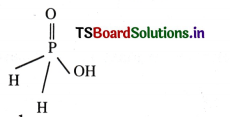
Basicity = no.of replaceble OH = 1
Question 3.
In the given reaction, NaOH + H2SO4 → NaHSO4 + H2O; what is the equivalent weight of H2SO4?
Answer:
Equivalent weight of H2SO4 = \(\frac{\mathrm{GMW}}{\text { Basicity }}\) = \(\frac{98}{2}\)
Question 4.
Write the relation between Kelvin scale and Celsius scale of temperature.
Answer:
°K = °C + 273.
(Kelvin Scale) = (Celcius Scale) + 273
Question 5.
How many molecules are present in 1 cc of N2 gas at STP?
Solution:
1 mole of N2 at STP occupies 22.400 cc of volume; ? ← 1 cc of volume
No. of moles = \(\frac{1}{22400}\) = 4.4 × 10⁻⁵
No. of molecules = 4.4 × 10-5 × 6.022 × 1023 = 2.64 × 10¹⁹ molecules.
IV. Very Short Answer Questions
Question 1.
How many moles of glucose are present in 540 g of glucose?
Solution:
Number of moles = \(\frac{\text { Weight }}{\text { G.M.W }}\) = \(\frac{540}{180}\)
= 3[GMW (C6H12O6) = 180 ⇒ 6(12) + 12(1) + 6(16) = 180]
In 540 g of glucose 3 moles are present.
Question 2.
Calculate the weight of 0.1 mole of sodium carbonate.
Solution:
Number of moles = \(\frac{\text { Weight }}{\text { G.M.W }}\)
Weight = GMW × Number of moles
= 106 × 0.1 [GMW(Na2CO3) = 106 ⇒ 2(23) + 12 + 3(16) = 106]
= 10.6g
Question 3.
How many molecules of glucose are present in 5.23 g of glucose?
Solution:
No. of moles of glucose = \(\frac{\text { Wt. of glucose }}{\text { G.M.W }}\) = \(\frac{5.23}{180}\)
No. of molecules = No. of moles ×Avogadro’s number
= \(\frac{5.23}{180}\) × 6.022 × 1023 = 1.75 × × 1022 molecules
Question 4.
The empirical formula of a compound is CH20. It’s molecular mass is 90. Calculate the
Solution:
Molecular formula = empirical formula × n ⇒ n = \(\frac{\text { M.Wt. }}{\text { Empirical formula wt. }}\) Empirical formula weight of CH2O = 12 + 2 +16 = 30
n = \(\frac{90}{30}\) = 3
Molecular formula = (CH2O)3 = C3H6O3
Question 5.
Calculate the volume of O2 at STP required to completely burn 100 mL of acetylene.
Solution:
C2H2 → \(\frac{5}{2}\) O2 → 2 CO2 + H2O
To bum 22400 ml. of C2H2, the volume of O2 required is 22400 × \(\frac{5}{2}\)
For burning 100 ml. of C2H2, the volume of O2 requires
100 × 22400 × \(\frac{5}{2}\) × \(\frac{1}{22400}\) = 250 ml.
Question 6.
Calculate the mass percent of the different elements present in sodium sulphate (Na2SO4).
Solution:
Molecular weight of Na2SO4 = 142
142 gm of Na2SO4 contain 46 gms of sodium
∴ 100 gm of Na2SO4 contain \(\frac{100 \times 46}{142}\) = 32.38%
142 gm of Na2SO4 contain 32 gm of sulphur
∴ 100 gm of Na2SO4 contain \(\frac{100 \times 32}{142}\) = 22.54%
142 gm of Na2SO4 contain 64 gm of oxygen
∴ 100 gm of Na2SO4 contain \(\frac{100 \times 64}{142}\) = 45.08%
Question 7.
What do you mean by significant figures?
Answer:
Significant figures are meaningful digits which are known with certainity.
Eg : If we write 11.2 ml., the 11 is certain and 2 is uncertain and the uncertainly may be ± 1 in the last digit. So the significant figure is 2.
Question 8.
How many significant figures are present in the following?
i) 0.0025
ii) 208
Answer:
i) 0.0025 has two significant figures.
ii) 208 has three significant figures.
Question 9.
Define and explain molar mass.
Answer:
Molar mass : The mass of one mole of any substance in grams is called its molar mass.
Eg: Molar mass of sulphuric acid = 98 g.
Molar mass of hydrogen
= one gram for a gm atomic mass.
= two grams for a gm molecular mass.
Thus molar masses are atomic weights, molecular weights, formula weights etc. expressed in grams.
Gram atomic weight is atomic weight expressed in grams. Gram molecular weight is molecular weight expressed in grams.
Gram atom : One gram atomic weight of a substance is known as gram atom.
Gram molecule : One gram molecular weight of a substance is known as gram molecule.
Mole : It is the mass of a substance which contains Avogadro number of structural units.
1 mole = 1 gram molecule
= 1 gram molecular weight
= Mass of 6.022 × 10²³ molecules in grams.
1 mole = 1 gram atom
= 1 gram atomic weight
= Mass of 6.022 × 10²³ atoms in grams.
Question 10.
What volume of CO2 (in L) is obtained at STP by heating 4g of CaCO2?
Solution:
Calcium carbonate decomposes on heating.
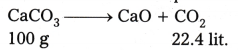
According to the reaction,
1 mole of CaCO3 on heating gives 1 mole of CO2
Mol. wt. of CaCO3 = 100
∴ 100 gm of CaCO3 on heating gives 22.4 lit.
4 gm of CaCO3 on heating gives ?
\(\frac{4 \times 22.4}{100}\) = 0.896 lit.
V. Short Answer Questions
Question 1.
How much minimum volume of CO at STP is needed to react completely with 0.112 L of 02 at 1.5 atm pressure and 127 °C to give CO2?
Solution:
Reaction between CO and O2
2 CO + O2 → 2CO2
Moles of O2 = \(\frac{\mathrm{PV}}{\mathrm{RT}}=\frac{1.5 \times 0.112}{0.0821 \times 400}\) = 5.11 × 10⁻³
According to the reaction, for every one mole of O2 reacts with two moles of CO2.
The minimum volume of CO required at STP = 5.11 × 10-3 × 2 = 10.22 × 10⁻³
⇒ 10.22 × 10-3 × 22400 = 229.32 ml.
Question 2.
Chemical analysis of a carbon compound gave the following percentage composition by weight of the elements present, carbon = 10.06%, hydrogen = 0.84% and chlorine = 89.1%. Calculate the empirical formula of the compound.
Solution:
| Symbol of the element | % Composition | Atomic weight | Atomic ratio | Simple ratio |
| C | 10.06 | 12 | \(\frac{10.06}{12}\) = 0.84 | \(\frac{0.84}{0.84}\) = 1 |
| H | 0.84 | 1 | \(\frac{0.84}{1}\) = 0.84 | \(\frac{0.84}{0.84}\) = 1 |
| Cl | 89.1 | 35.5 | \(\frac{89.1}{35.5}\) = 2.51 | \(\frac{2.51}{0.84}\) = 3 |
∴ Empirical formula of the compound = CHCl3.
Question 3.
Dinitrogen and dihydrogen react with each other to produce ammonia according to the following chemical equation.
N2(g) + 3H2 (g) → 2 NH3 (g).
i) Calculate the mass of ammonia produced, if 2.00 × 10³ g of dinitrogen reacts with 1.00 × 10³ g of dihydrogen.
ii) Will any of the two reactants remain unreacted?
Solution:
i) Given equation,
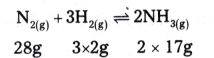
2.00 × 10³ g + 1.00 × 10³ g → ? ; No. of moles of N2 = \(\frac{2 \times 10^3}{28}\) = 71.4 mole
No. of moles of H2 = \(\frac{1 \times 10^3}{2}\) = 5 × 10² moles (or) 500 moles
1 mole of N2 reacts with 3 moles of H2
71.4 moles of N2 reacts with 214.2 moles of H2
1 mole of N2 produce 34 g of NH3
71.4 mole of N2 produce ?
71.4 × 34 = 2427.6g = 2.427 ×10³g
ii) Yes, Here no.of moles of H2 are more than required
∴ Hydrogen remains unreacted
The no.of moles of H2 unreacted = 500 – 214.2 = 285.8
Question 4.
Calculate the empirical formula of a compound having percentage composition potassium (K)=26.57, Chromium (Cr) =35.36, Oxygen (O) = 38.07 (Given the atomic weights of K, Cr, and O are 39,52, and 16 respectively).
Answer:
| Symbol of the element | % Composition | Atomic weight | Atomic ratio | Simple ratio |
| K | 26.57 | 39 | \(\frac{26.57}{39}\) = 0.68 | \(\frac{0.68}{0.68}\) = 1 × 2 = 2 |
| Cr | 35.36 | 1 | \(\frac{35.36}{52}\) = 0.68 | \(\frac{0.68}{0.68}\) = 1 × 2 = 2 |
| O | 38.07 | 16 | \(\frac{38.07}{16}\) = 2.38 | \(\frac{2.38}{0.67}\) = 3.55 × 2 = 7 |
∴ Empirical formula of the compound = K2Cr2O7
Question 5.
A carbon compound contains 12.8% Carbon, 2.1% Hydrogen and 85.1% Bromine. The molecular mass of the compound is 187.9 u. Calculate its molecular formula.
Answer:
| Symbol of the element | % Composition | Atomic weight | Atomic ratio | Simple ratio |
| C | 12.8 | 12 | \(\frac{12.8}{12}\) = 1.067 | \(\frac{1.067}{1.067}\) = 1 |
| H | 2.1 | 1 | \(\frac{2.1}{1}\) = 2.1 | \(\frac{2.1}{1.067}\) = 2 |
| Br | 85.1 | 80 | \(\frac{85.1}{80}\) = 1.067 | \(\frac{1.067}{1.067}\) = 1 |
∴ Empirical formula of the compound = C1H2Br1
Empirical formula weight = 1 × C + 2 × H + 1 × Br = 1 × 12 + 2 × 1 + 1 × 80 = 94
Molecular weight = 187.9
∴ n = \(\frac{\text { Molecular weight }}{\text { Empirical formula weight }}=\frac{187.9}{94}\) = 2
Molecular formula = Empirical formula × n = C1H2Br1 × 2 = C2H4Br2.
Question 6.
Calculate the amount of 90% H2SO4 required for the preparation of 420 Kg HCl as per the given equation.
2 NaCl + H2SO4 → Na2SO4 + 2HCL
Solution:
No. of moles of HCl to be prepared = \(\frac{420 \times 10^3}{36.5}\) = 11.5 × 10³
According to the reaction, for every two moles of HCl one mole of H2SO4 is required.
Therefore the no. of moles of H2SO4 required is \(\frac{11.5}{2}\) × 103 = 5.75 × 10³
Wt. of H2SO4 = 5.75 × 103 × 98 = 563.5 kg
Since the given H2SO4 contain only 90%.
The weight to be taken as \(\frac{563.5 \times 100}{90}\) = 627 kg.
Question 7.
When 50 g of sample of sulphur was burnt in air 4% of the sample was left over. Calculate the volume of air required at STP containing 21% of oxygen by volume.
Solution:
Amount of Sulphur given = 50 gm
Wt. of sulphur left = 4% = 2 gm
Wt. of sulphur reacted = 50 – 2 = 48 gm
Sulphur bums in air according to the reaction, S + O2 → SO2
Moles of Sulphur = \(\frac{48}{32}\) = 1.5
Moles of Oxygen required =1.5
Volume of oxygen at STP = 22.4 × 1.5 = 33.6 lit.
Volume of air = \(\frac{33.6 \times 100}{21}\) = 160 lit.
(∵ Air contains of 21% O2)
Question 8.
Calcium carbonate reacts with aqueous HCl to give, CaCl2 and CO2 according to the reaction. CaCO3(s) + 2HCl (aq) → CaCl2(aq) + CO2 (g) + H2O (l)
What mass of CaCO3 is required to react completely with 250 mL of 0.75 M HCl ?
Solution:
CaCO3(s) + 2HCl(aq) → CaCl2(aq) + CO2(g) + H2O (l)
No.of moles of HCl = \(\frac{250 \times 0.75}{1000}\) = 0.1875 (∵ V = 250ml, M = 0.75M)
1 mole of CaCO3 reacted with 2 mol. of HCl with 0.1875 mol. of HCl no.of moles of CaCO3 – ?
\(\frac{0.1875}{2}\) = 0.09375
Weight of CaCO3 = No. of moles × GMW of CaCO3 = 0.09375 × 100 = 9.375g.
Question 9.
Calculate the volume of 0.1M KMnO4 required to react with 100 mL of 0.1M H2C2O4.2H2O solution in presence of H2SO4.
Solution:
Potassium permanganate reacts with oxalic acid according to the reaction
2 KMnO4 + 5H2C2O4 + 3H2SO4 → K2SO4 + 2 MnSO4 + 8 H2O + 10 CO2
Volume of KMnO4, (V1) = ?
Volume of H2C2O4, (V2) = 100 ml.
Molarity of KMnO4, (M1) = 0.1 M
Molarity of H2C2O4, (M2) = 0.1
No. of moles of KMnO4, (n1) = 2
No. of moles of H2C2O4, (n2) = 5
\(\frac{\mathrm{V}_1 \mathrm{M}_1}{\mathrm{n}_1}=\frac{\mathrm{V}_2 \mathrm{M}_2}{\mathrm{n}_2}\) ⇒ V1 = \(\frac{\mathrm{V}_2 \mathrm{M}_2}{\mathrm{n}_2} \times \frac{\mathrm{n}_1}{\mathrm{M}_1}\) = \(\frac{100 \times 0.1}{5} \times \frac{2}{0.1}\) = 40 ml.
Question 10.
Calculate the amount of carbon dioxide that could be produced when
i) 1 mole of-carbon is burnt in air
ii) lmole of carbon is burnt in 16g of dioxygen.
Solution:
i) 1 mole of carbon is burnt in air

1 mole of carbon burnt in air, 44g of CO2 produced
ii) 1 mole of carbon is burnt in 16 g of dioxygen
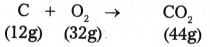
12 g. of ‘C’ + 32 g. of O2 gives 44 g. of CO2
16 g. of dioxygen (limiting reagent) gives 22 g. of CO2
∴ 22g of CO2 is produced.
VI. Long Answer Questions
Question 1.
The aproximate production of sodium carbonate per month is 424 × 106 g, while that of methyl alcohol is 320 × 106 g. Which is produced more in terms of moles?
Solution:
Moles of sodium carbonate produced per month = \(\frac{424 \times 10^6}{106}\) = 4 × 10⁶
Moles of methyl alcohol produced per month = \(\frac{320 \times 10^6}{32}\) = 107
So, methyl alcohol produced in terms of moles is more.
Question 2.
0.188 g of an organic compound having an empirical formula CH2Br displaced 24.2 cc. of air at 14°C and 752 mm pressure. Calculate the molecular formula of the compound. (Aqueous tension at 14°C is 12 mm)
Solution:
Pressure of dry gas = Pressure of gas – aqueous tension = 752 – 12 = 740 mm
According to ideal gas equationm PV = \(\frac{\mathrm{W}}{\mathrm{M}}\) RT.
W = 0.188; V = \(\frac{24.2}{1000}\) Lit.; M.wt = ?; P = \(\frac{740}{760}\); T = 273 + 14 = 287K Substituting these values in ideal gas equation,
Molecular weight = \(\frac{0.188 \times 0.0821 \times 287 \times 760 \times 1000}{740 \times 24.2}\) = 188
Empirical formula of the compound = CH2Br
Empirical formula wt. of the compound = 12 + 2 + 80 = 94
\(\frac{\text { M.W }}{\text { Empirical formula } \mathrm{wt} .}=\frac{188}{94}\) = 2
Molecular formula = Empirical formula × 2 = (CH2Br)2 = C2H4Br2.
Question 3.
An astronaut receives the energy required in his body by the combustion of 34g of sucrose per hour. How much oxygen he has to carry along with him for his energy requirement in a day?
Solution:
Wt. of sucrose required per day = 34 × 24 = 816 gm
Moles of sucrose = \(\frac{\mathrm{W}}{\mathrm{M} . \mathrm{Wt}}=\frac{816}{342}\) = 2.385
Sucrose react with oxygen as follows.
C12H22O11 + 12 O2 → 12 CO2 + 11 H2O
According to the above reaction,
1 mole of sucrose requires – 12 moles of O2
2.385 moles requires = \(\frac{2.385 \times 12}{1}\) = 28.63
Wt. of oxygen = No. of moles × Mol. Wt. = 28.63 × 32 = 916.2 gm.
Question 4.
Calculate the volume of H2 liberated at 27° C and 760 mm of Hg pressure by action by 0.6g magnesium with excess of dil HCl.
Solution:
Magnesium reacts with dilute hydrochloric acid as, Mg + 2 HCl → MgCl2 + H2
No. of moles of Mg = \(\frac{0.6}{24}\) = 0.025
No. of moles of H2 = 0.025 (∵ 1 mole Mg liberates)
Ideal gas equation PV = nRT
P = 760 mm = 1 atm; T = 27 + 273 = 300 K; V = ?; n = 0.025; R = 0.0821
Substituting these values in ideal gas equation.
Volume of H2, V = \(\frac{\mathrm{nRT}}{\mathrm{P}}\) = \(\frac{0.025 \times 0.0821 \times 300}{1}\) = 0.615 L
Question 5.
Calculate the mass of sodium acetate (CH3COONa) required to make 500 mL of 0.375 molar aqueous solution. Molar mass of sodium acetate is 82.0245 g mol-1.
Solution:
Molar mass of CH3COO Na = 82.0245 g mol-1 ; 1 mol = 82.0245 g
0.375 mol = ?
0.375 × 82.0245 gm 1000 m
1000 ml. contain 0.375 × 82.0245 g
500 ml. contain ?
= \(\frac{500}{1000}\) × 0.375 × 82.0245 = 15.375 gm.
∴ The mass of CH3COONa present in 500 ml. = 15.375 gm.
Some Basic Concepts of Chemistry Class 11 NCERT Solutions
Question 1.
Calculate the molar mass of the following.
i) H2O
ii) CO2
iii) CH4
Answer:
i) Molecular mass of H2O = 2 × Atomic mass of hydrogen + 1 × Atomic mass of oxygen
= 2 × 1.0079 amu + 1 × 16.00 amu = 18.016 amu
ii) Molecular mass of CO2 = 1 × Atomic mass of carbon + 2 × Atomic mass of oxygen
= 1 × 12.01 amu + 2 × 16.00 amu – 44.01 amu
iii) Molecular mass of CH4 = 1 × Atomic mass of carbon + 4 × Atomic mass of hydrogen
= 1 × 12.01 amu + 4 × 1.008 amu = 16.042 amu
Question 2.
Calculate the mass percent of different elements present in sodium sulphate (Na2SO4).
Answer:
Molecular weight of Na2SO4 = 142
142 gm of Na2SO4 contain 46 gms of sodium
∴ 100 gm of Na2SO4 contain \(\frac{100 \times 46}{142}\) = 32.38%
142 gm of Na2SO4 contain 32 gm of sulphur
∴ 100 gm of Na2SO4 contain \(\frac{100 \times 32}{142}\) = 22.54%
142 gm of Na2SO4 contain 64 gm of oxygen
∴ 100 gm of Na2SO4 contain \(\frac{100 \times 64}{142}\) = 45.08%
Question 3.
Determine the empirical formula of an oxide of iron, which has 69.9% iron and 30.1% dioxygen by mass.
Answer:
| Element | Symbol | % by mass | Atomic mass | Relative no.of moles of element | Simplest molar ratio | Whole number ratio |
| Iron | Fe | 69.9 | 55.85 | \(\frac{69.9}{55.85}\) = 1.25 | \(\frac{1.25}{1.25}\) = 1 | 1 × 2 = 2 |
| Oxygen | O | 30.1 | 16.00 | \(\frac{30.1}{16.00}\) = 1.88 | \(\frac{1.88}{1.25}\) = 1.5 | 1.5 × 2 = 3 |
∴ Empirical formula is Fe2O3.
Question 4.
Calculate the amount of carbon dioxide that could be produced when
i) 1 mole of carbon is burnt in air.
ii) mole of carbon is burnt in 16 g of dioxygen.
iii) 2 moles of carbon are burnt in 16 g of dioxygen.
Answer:
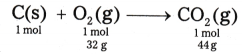
i) According to the equation given above, when 1 mole of carbon is burnt completely, the amount of carbon dioxide produced is 44 g.
ii) As 1 mole of carbon requires 32 g of dioxygen from the equation and only 16 g of dioxygen gas is available. Therefore, the dioxygen is a limiting reagent. Hence CO2 produced = 22 g.
iii) In this case also, dioxygen is the limiting reagent and therefore, 16 g of dioxygen can react with only 0.5 mole of carbon and thus, CO2 produced = 22 g.
Question 5.
Calculate the mass of sodium acetate (CH3COONa) required to make 500 mL of 0.375 molar aqueous solution. Molar mass of sodium acetate is 82.0245 g mol-1.
Solution:
Molarity (M) = \(\frac{\mathrm{W}}{\mathrm{GMW}} \times \frac{1000}{\mathrm{~V}(\mathrm{ml})}\)
W = \(\frac{\mathrm{M} \times \mathrm{GMW} \times \mathrm{V}}{1000}=\frac{0.375 \times 82.0245 \times 500}{1000}\) = 15.379 g.
Question 6.
Calculate the concentration of nitric acid in moles per litre in a sample which has a density, 1.41 g mL-1 and the mass percent of nitric acid in it being 69%.
Solution:
Mass percent of 69% nitric acid means 69 g of nitric acid dissolved in 100 g of solution.
Volume of solution = \(\frac{100 \mathrm{~g}}{1.41 \mathrm{~g} \mathrm{ml}^{-1}}\) = 70.92 ml [∵ Density = \(\frac{\text { Mass }}{\text { Volume }}\)]
Now, Molarity (M) = \(\frac{\text { Mass of solute (w) }}{\text { Molar mass of solute } \left.\left(\mathrm{M}^{\prime}\right) \times \text { Volume of solution (V) (in } \mathrm{L}\right)}\)
= \(\frac{69 \times 1000}{63 \times 70.92}\) [∵ Molecular mass of HNO3 = 1 + 14 + 3 × 16 = 63 g mol-1] = 15.44 mol/litre.
Question 7.
How much copper can be obtained from 100 g of copper sulphate (CuSO4) ?
Solution:
1 mole of CuSO4 contains 1 mole of Cu.
∵ Molar mass of CuSO4 = 1 × 63.5 u + 1 × 32.0 u + 4 × 16u = 159.5 g mol-1
∴ Cu obtained from 159.5 g of CuSO4 will be 63.5 g.
Hence, Cu obtained from 100 g of CuSO4 = \(\frac{63.5}{159.5}\) × 100 = 39.81 g.
Question 8.
Determine the molecular formula of an oxide of iron, in which the mass percent of iron and oxygen are 69.9 and 30.1 respectively.
Answer:
| Element | Symbol | % by mass | Atomic mass | Relative no.of moles of element | Simplest molar ratio | Whole number ratio |
| Iron | Fe | 69.9 | 55.85 | \(\frac{69.9}{55.85}\) = 1.25 | \(\frac{1.25}{1.25}\) = 1 | 1 × 2 = 2 |
| Oxygen | O | 30.1 | 16.00 | \(\frac{30.1}{16.00}\) = 1.88 | \(\frac{1.88}{1.25}\) = 1.5 | 1.5 × 2 = 3 |
∴ Empirical formula is Fe2O3.
Empirical formula mass = (2 × 55.85) + (3 × 16.00) = 159.7 g mol-1
n = \(\frac{\text { Molar mass }}{\text { Empirical formula mass }}=\frac{159.7}{159.7}\) = 1
Thus, molecular formula of the compound is also Fe2O3.
Question 9.
Calculate the atomic mass (average) of chlorine using the following data.

Solution:
Given, % of natural abundance of 35Cl = 75.77
Molar mass of 35Cl = 34.9689
% of natural abundance of 37Cl = 24.23
Molar mass of 37Cl = 36.9659
Average atomic mass = \(\frac{(75.77 \times 34.9689)+(24.23 \times 36.9659)}{75.77+24.23}\)
= 35.4527 amu.
Question 10.
In three moles of ethane (C2H6), calculate the following.
i) Number of moles of carbon atoms.
ii) Number of moles of hydrogen atoms.
iii) Number of molecules of ethane.
Answer:
i) 1 mole of C2H6 contains 2 moles of carbon atoms.
∴ 3 moles of C2H6 will contain = 3 × 2, = 6 moles of carbon atoms.
ii) 1 mole of C2H6 contains 6 moles of hydrogen atoms.
∴ 3 moles of C2H6 will contain = 3 × 6, = 18 moles of hydrogen atoms.
iii) 1 mole of C2H6 contains 6.022 × 10²³ molecules of ethane.
∴ Number of ethane molecules in 3 moles of C2H6 = 3 × 6.022 × 1023 = 1.807 × 1024.
Question 11.
What is the concentration of sugar (C12H22O11) in mol L-1 if its 20 g are dissolved in enough water to make a final volume up to 2 L ?
Solution:
Given, Mass of solute = 20 g; Volume of solution = 2 L
Molar mass of sugar (C12H22O11) = 12 × 12u + 22 × 1u + 11 × 16u = 342 g
As we know that,
Molarity = \(\frac{\text { Mass of solute }}{\text { Molar mass of solute } \text { × } \text { Volume }(\mathrm{L})}=\frac{20}{342 \times 2}\) = 0.0293 moles/litre.
Question 12.
If the density of methanol is 0.793 kg L-1, what is its volume needed for making 2.5 L of its 0.25 M solution ?
Solution:
Given, density = 0.793 kg L-1 = 0.793 × 10³ g L-1
If we assume volume of solution = 1 L, then
Mass of tnethanol (w) = 0.793 × 10³ g
Molar mass of methanol (CH3OH) = 32 g mol-1
Now, Molarity (M1) = \(\frac{0.793 \times 10^3}{32 \times 1}\) = 24.781 mol L-1
Final volume (V2) = 2.5 L
Final molarity (M2) = 0.25 M
On applying the equation, M1V1 = M2V2
We get, 24.781 × V1 = 0.25 × 2.5
V1 = \(\frac{0.25 \times 2.5}{24.781}\) = 0.02522 L = 25.22 mL.
Question 13.
Pressure is determined as force per unit area of the surface. The SI unit of pressure, pascal is as shown below.
1 Pa = 1 N m-2
If mass of air at sea level is 1034 g cm-2, calculate the pressure in pascal.
Solution:
Pressure is the force or weight acting per unit area.
Given, mass of air = 1034 g cm-2
Weight = 1034 g cm-2 × 9.8 ms-2
Pressure = \(\frac{\text { Force }}{\text { Area }}\) = \(\frac{1034 \mathrm{~g} \mathrm{~cm}^{-2} \times 9.8 \mathrm{~ms}^{-2}}{\mathrm{~cm}^2} \times \frac{1 \mathrm{~kg}}{1000 \mathrm{~g}} \times \frac{100 \mathrm{~cm}}{1 \mathrm{~m}} \times \frac{100 \mathrm{~cm}}{1 \mathrm{~m}} \times \frac{1 \mathrm{~N}}{\mathrm{~kg} \mathrm{~ms}^{-2}} \times \frac{1 \mathrm{~Pa}}{1 \mathrm{Nm}^{-2}}\)
= 1.0132 × 10⁵ Pa.
Question 14.
What is the SI unit of mass ? How is it defined ?
Answer:
The SI unit of mass is kilogram (kg).
Unit of mass is defined by taking the fixed numerical value of the Planck’s constant (h) to be 6.62607015 × 10⁻³⁴. When expressed in the unit Js, which is equal to kgm2s_1, where the metre and the second are defined in terms of C and AVCS.
Question 15.
Match the following prefixes with their multiples.
| Prefixes | Multiples |
| i) micro | 10s |
| ii) deca | 109 |
| iii) mega | 10-6 |
| iv) giga | 10-15 |
| v) femto | 10 |
Answer:
micro = 10-6, deca = 10, mega = 106, giga = 106 and femto = 10-15.
Question 16.
What do you mean by significant figures ?
Answer:
The meaningful digits known with certainty are called significant figures.
Question 17.
A sample of drinking water was found to be severely contaminated with chloroform, CHCl3, supposed to be carcinogenic in nature. The level of contamination was 15 ppm (by mass).
i) Express this in percent by mass.
ii) Determine the molality of chloroform in the water sample.
Solution:
i) 15 ppm (by mass) means 15 parts in one million (106) parts
∴ Percent by mass = \(\frac{15 \times 100}{10^6}\) = 1.5 × 10⁻³ %
ii) 1.5 × 10⁻³ percent means 1.5 × 10⁻³ g of chloroform present in 100 g of sample water.
Molar mass of CHCl3= 1 × 12 u + 1 × 1 u +3 × 35.5 u = 119.5 g mol-1
Now, Molality (m) = \(\frac{\text { Mass of solute }(\text { in } \mathrm{g}) \times 1000}{\text { Molar mass of solute } \text { × } \text { Weight of solvent (in g) }}\)
= \(\frac{1.5 \times 10^{-3} \times 1000}{119.5 \times 100}\) = 1.255 × 10⁻⁴ m
Question 18.
Express the following in the scientific notation :
i) 0.0048
ii) 234,000
iii) 8008
iv) 500.0
v) 6.0012
Answer:
i) 4.8 × 10⁻³
ii) 2.34 × 10⁵
iii) 8.008 × 10⁻³
iv) 5.000 × 10²
v) 6.0012 × 100
Question 19.
How many significant figures are present in the following ?
i) 0.0025
ii) 208
iii) 5005
iv) 126,000
v) 500.0
vi) 2.0034
Answer:
i) 2
ii) 3
iii) 4
iv) 3
v) 4
vi) 5
Question 20.
Round up the following upto three significant figures. .
i) 34.216
ii) 10.4107
iii) 0.04597
iv) 2808
Answer:
i) 34.2
ii) 10.4
iii) 0.0460
iv) 2810
Question 21.
The following data are obtained when dinitrogen and dioxygen react together to form different compounds.
| Mass of dinitrogen | Mass of dioxygen | |
| i) | 14 g | 16 g |
| ii) | 14 g | 32 g |
| iii) | 28 g | 32 g |
| iv) | 28 g | 80 g |
a) Which law of chemical combination is obeyed by the above experimental data ? Give in statement.
Fill in the blanks in the following conversions. .
i) 1 km = ______ mm = ________ pm
ii) 1 mg = ________ kg = ________ ng
iii) 1 mL = ________ L = _______ dm3
Answer:
a) When the mass of dinitrogen is fixed as 28 g, then in the given four oxides, the masses of dioxgen combined are 32, 64, 32 and 80. These are in the simple whole number ratio, i.e., 2 : 4 : 2 : 5. Thus, the given data obey the law of multiple proportions.
Law of Multiple Proportion : It states that “if two elements can combine to form more than one compound, the masses of one element that combine with a fixed mass of the other element, are in the ratio of small whole numbers.”
b) i) 1 km = 1 km × \(\frac{1000 \mathrm{~m}}{1 \mathrm{~km}}\) × \(\frac{100 \mathrm{~cm}}{1 \mathrm{~m}}\) × \(\frac{100 \mathrm{~mm}}{1 \mathrm{~cm}}\) = 106 mm
1 km = 1 km × \(\frac{1000 \mathrm{~m}}{1 \mathrm{~km}} \times \frac{1 \mathrm{pm}}{10^{-12} \mathrm{~m}}\) = 1015 pm.
ii) 1 mg = 1 mg × \(\frac{1 \mathrm{~g}}{1000 \mathrm{mg}} \times \frac{1 \mathrm{~kg}}{1000 \mathrm{~g}}\) = 10-6 kg.
∴ 1 mg = 10-6 kg = 106 ng
iii) 1 mL = 1 mk × \(\frac{1 \mathrm{~L}}{1000 \mathrm{~mL}}\) = 10-3 L.
1 mL = 1 cm3 = 1 cm3 × \(\frac{1 \mathrm{dm} \times 1 \mathrm{dm} \times 1 \mathrm{dm}}{10 \mathrm{~cm} \times 10 \mathrm{~cm} \times 10 \mathrm{~cm}}\) = 10-3 dm3
∴ 1 mL = 10-3 L = 10-3 dm3.
Question 22.
If the speed of light is 3.0 × 10⁸ ms-1, calculate the distance covered by light in 2.00
Solution:
Given, speed = 3.0 × 10⁸ ms-1
time = 2.00 ns = 2.00 × 10⁻⁹ s
Distance covered = Speed × Time = 3 × 10⁸ ms-1 × 2.00 × 10-9 s = 0.6 m
Question 23.
In a reaction : A + B2 → AB2
Identify the limiting reagent, if any, in the following reaction mixtures.
i) 300 atoms of A + 200 molecules of B.
ii) 2 mol A + 3 mol B.
iii) 100 atoms of A + 100 molecules of B.
iv) 5 mol A + 2.5 mol B.
v) 2.5 mol A + 5 mol B.
Answer:
According to the given equation, A + B2 → AB2
i) 200 molecules of B2 will react with 200 atoms of A and 100 atoms of A will be left in excess. Therefore, B is the limiting reagent.
ii) 2 moles of A will react with 2 moles of B and 1 mole of B will be left in excess. Therefore, A is the limiting reagent.
iii) 100 atoms of A will react with 100 molecules of B. Thus, both will get consumed. So, no limiting reagent.
iv) 2.5 moles of B will react with 2.5 moles of A, therefore, B is the limitjfig reagent.
v) 2.5 moles of A will react with 2.5 moles of B, therefore, A is the limiting reagent.
Question 24.
Dinitrogen and dihydrogen react with each other to produce ammonia according to the following chemical equation.
N2(g) + 3H2(g) → 2NH3(g)
i) Calculate the mass of ammonia produced if 2.00 × 10³ g dinitrogen reacts with 1.00 × 10³ g of dihydrogen.
ii) Will any of the two reactants remain unreacted ?
iii) If yes, which one and what would be its mass ?
Answer:
i)

Since, 28 g of N2 reacts with 6 g of H2.
∴ 2000 g of N2 will react with \(\frac{2000 \times 6}{28}\) = 428.57 g of H2.
Hence, N2 limits the amount of ammonia produced.
Now, 28 g of N2 produces 34 g of NH3.
Therefore, 2000 g of N2 will produce = \(\frac{34}{28}\) × 2000 = 2428.57 g of NH3
ii) H2 is present in excess, so it will remain unaffected.
iii) Amount of H2 remains unreacted = 1000 – 428.57 = 571.43 g.
Question 25.
How are 0.50 mol. Na2CO3 and 0.50 M Na2CO3 different ?
Answer:
Molar mass of Na2CO3 = (2 × 23 + 12 + 3 × 16) = 106 g mol-1
∵ 1 mol of Na2CO3 = 106 g mol-1 (M = Molarity)
∴ 0.5 mol of Na2CO3 = 53 g of Na2CO3
0.50 M Na2CO3 means 53 g of Na2CO3 is present in 1 L of the solution.
Question 26.
If 10 volumes of dihydrogen gas reacts with five volumes of dioxygen gas, how many volume of water vapour would be produced ?
Answer:
According to the given question,

According to Gay Lussac’s law, 2 volumes of H2 react with 1 volume of O2 to produce 2 volumes of water vapour. Thus, on reaction of 10 volumes of H2 with 5 volumes of O2 will produce 10 volumes of water vapour.
Question 27.
Convert the following into basic units.
i) 28.7 pm
ii) 15.15 pm
iii) 25365 mg
Solution:
i) 28.7 pm = 28.7 pm × \(\frac{10^{-12} \mathrm{~m}}{1 \mathrm{pm}}\) m = 28.7 × 10⁻¹¹ m.
ii) 15.15 pm = 15.15 pm × \(\frac{10^{-12} \mathrm{~m}}{1 \mathrm{pm}}\) = 1.515 × 10⁻¹¹ m.
iii) 25365 mg = 25365 mg × \(\frac{10^{-6} \mathrm{~kg}}{1 \mathrm{mg}}\) = 2.5365 × 10⁻² kg.
Question 28.
Which one of the following will have the largest number of atoms ?
i) 1 g of Au(s)
ii) 1 g of Na(s)
iii) 1 g of Li(s)
iv) 1 g of Cl2(g)
Answer:
In 1 g. of Au, the No. of moles = \(\frac{\text { Weight }}{\text { Atomic mass }}\) = \(\frac{1}{197}\) = 0.00508 mol
In 1 g. of Na, the No. of moles = \(\frac{1}{23}\) = 0.0435 mol
In 1 g.of Li, the No. of moles = \(\frac{1}{7}\) = 0.1429 mol
In 1 g.of Cl2, the No. of moles = \(\frac{1}{35.5}\) = 0.028 mol
Question 29.
Calculate the molarity of a solution of ethanol in water, in which the mole fraction of ethanol is 0.040 (assume the density of water to be one).
Solution:
Given, mole fraction of ethanol = 0.040
n(C2H5OH) = \(\frac{\mathrm{n}_{\left(\mathrm{C}_2 \mathrm{H}_5 \mathrm{OH}\right)}}{\mathrm{n}_{\left(\mathrm{C}_2 \mathrm{H}_5 \mathrm{OH}\right)}+\mathrm{n}_{\left(\mathrm{H}_2 \mathrm{O}\right)}}\) = 0.040
Number of moles in 1 L in H2O = \(\frac{1000}{18}\) = 55.55 mol
0.040 = \(\frac{\mathrm{n}_{\left(\mathrm{C}_2 \mathrm{H}_5 \mathrm{OH}\right)}}{\mathrm{n}_{\left(\mathrm{C}_2 \mathrm{H}_5 \mathrm{OH}\right)}+\mathrm{n}_{\left(\mathrm{H}_2 \mathrm{O}\right)}}\) = \(\frac{\mathrm{n}_{\left(\mathrm{C}_2 \mathrm{H}_5 \mathrm{OH}\right)}}{\mathrm{n}_{\left(\mathrm{C}_2 \mathrm{H}_5 \mathrm{OH}\right)}+55.5}\)
∴ nC2H5OH – 0.040 nC2H5OH = (55.5 × 0.040)
nC2H5OH – 0-040 nC2H5OH = 55.5 × 0.040
nC2H5OH = \(\frac{55.5 \times 0.040}{(1-0.040)}\) = 2.31 mol
Now, molarity is defined as the moles of solute (ethanol) in 1 L of the solution. Therefore, molarity of the solution = 2.31 M.
Question 30.
What will be the mass of one 12C atom in g ?
Answer:
Mass of one atom of 12C = \(\frac{\text { Atomic mass of } \mathrm{C}}{\text { Avogadro’s number }}=\frac{12 \mathrm{~g}}{6.022 \times 10^{23}}\) = 1.993 × 10⁻²³
Question 31.
How many significant figures should be present in the answer of the following calculations?
i) \(\frac{0.02856 \times 298.15 \times 0.112}{0.5785}\)
ii) 5 × 5.364
iii) 0.0125 + 0.7864 + 0.0215
Answer:
i) \(\frac{0.02856 \times 298.15 \times 0.112}{0.5785}\) = 3 significant figures, as the least precise term i.e., 0.112 has 3 significant figures.
ii) 5 × 5.364 = 4 significant figures, as 5 is exact number but the other term, i.e., 5.364 has 4 significant figures.
iii) 0.0125 + 0.7864 + 0.0215 = 0.8204, i.e., 4 significant figures as the least number of decimal place is 4.
Question 32.
Use the data given in the following table to calculate the molar mass of naturally occurring argon isotopes.

Solution:
Molar mass of Ar = \(\frac{0.337 \times 35.96755+0.063 \times 37.96272+99.600 \times 39.96924}{0.337+0.063+99.600}\)
= 39.948 g mol-1.
Question 33.
Calculate the number of atoms in each of the following.
i) 52 moles of Ar
ii) 52 u of He
iii) 52 g of He
Solution:
i) 1 mol of Ar contains 6.022 × 10²³ atoms
Therefore, 52 mol of Ar = 52 × 6.023 × 1023 = 3.131 × 1025 atoms of Ar.
ii) 1 mol of He contains 4 u of He or 1 atom of He
∴ 52u of He = \(\frac{1}{4}\) × 52 = 13 atoms of He.
iii) 4 g of He contains 6.022 × 10²³ atoms
∴ 52 g of He = \(\frac{6.022 \times 10^{23}}{4}\) × 52 = 7.8286 × 1024 atoms.
Question 34.
A welding fuel gas contains carbon and hydrogen only. Burning a small sample of it in oxygen gives 3.38 g of carbon dioxide, 0.690 g of water and no other products. A volume of 10.0 L (measured at STP) of this welding gas is found to weigh 11.6g. Calculate (i) empirical formula, (ii) molar mass of the gas, and (iii) molecular formula.
Solution:
44 g of C02 contains 12 g of carbon, 3.38 g CO2 = \(\frac{12}{44}\) × 3.38 = 0.9218 g of carbon g
18 gof H2O contains 2 g of hydrogen, 0.690 g H2O = \(\frac{2}{18}\) × 0.690 g = 0.0767 g of hydrogen
Total mass of compound = 0.9218 + 0.0767 = 0.9985 g
% of C in the compound = \(\frac{0.9218}{0.9985}\) × 100 = 92.318
% of H in the compound = \(\frac{0.0767}{0.9985}\) ×100 = 7.682
| Element | % by mass | Atomic mass | Relative no.of moles | Simplest molar ratio |
| C | 92.318 | 12 | \(\frac{92.318}{12}\) = 7.693 | \(\frac{7.693}{7.682}\) = 1 |
| H | 7.682 | 1 | \(\frac{7.682}{1}\) = 7.682 | \(\frac{7.682}{7.682}\) = 1 |
∴ Empirical formula = CH.
ii) 10.0 L of the gas at STP weigh = 11.6 g
∴ 22.4 L of the gas at STP will weigh = \(\frac{11.6}{10.0}\) × 22.4 * 26 g
Thus, molar mass = 26 g mol-1
iii) Empirical formula mass =12 + 1 = 13
∴ n = \(\frac{26}{13}\) = 2
Molecular formula = n × empirical formula
∴ Molecular formula = 2 × CH = C2H2.
Question 35.
Calcium carbonate reacts with aqueous HCl to give CaCl2 and CO2 according to the reaction.
CaCO3(s) + 2HCl(aq) → CaCl2(aq) + CO2(g) + H2O(l)
What mass of CaCO3 is required to react completely with 25 mL of 0.75 M HCl?
Solution:
Molar mass of HCl = 1 + 35.5 = 36.5 g/mol
Molarity = \(\frac{\mathrm{w} \times 1000}{\text { Molar Mass } \text { × } \text { Volume }(\mathrm{mL})}\) ⇒ 0.75 = \(\frac{w \times 1000}{36.5 \times 25}\) ⇒ w = 0.6844 g

According to the given equation,
73 g of HCl completely react with 100 g of CaCO3.
∴ 0.6844 g of HCl completely reacts with \(\frac{100 \times 0.6844}{73}\) = 0.9375 g.
Question 36.
Chlorine is prepared in the laboratory by treating manganese dioxide (Mn02) with aqueous hydrochloric acid according to the reaction.
4HCl(aq) + MnO2(s) → 2H2O(l) + MnCl2(aq) + Cl2(g)
How many grams of HCl react with 5.0 g of manganese dioxide ?
Solution:

87 g of MnO2 react with 146 g of HCl.
∴ 5.0 g of MnO2 will react with HCl = \(\frac{146}{87}\) × 5.0 g = 8.39 g.