
Referring to the AP Inter 1st Year Maths Study Material Chapter 4 Complex Numbers and Quadratic Equations Exercise 4b Solutions makes it easier to understand complex problems.
AP Inter 1st Year Maths Complex Numbers and Quadratic Equations Solutions Exercise 4b
I.
Question 1.
Evaluate : \(\left[i^{18}+\left[\frac{1}{i}\right]^{25}\right]^3\)
Solution:
\(\left[i^{18}+\left[\frac{1}{i}\right]^{25}\right]^3\)
= \(\left[i^{4 \times 4+2}+\frac{1}{i^{4 \times 6+1}}\right]^3=\left[\left[i^4\right]^4 \cdot i^2+\frac{1}{\left(i^4\right)^6 i}\right]^3\)
= \(\left[i^2+\frac{1}{i}\right]^3=\left[-1+\frac{1}{i} \times \frac{i}{i}\right]^3\)
= [-1 – i]2 = (-1)3[1 + i]3
= -[13 + i3 + 3.1.i(1 + i)]
= -[1 + i3 + 3i + 3i2]
= -[1 – i + 3i – 3] = -[-2 + 2i]
= 2 – 2i
Question 2.
For any two complex numbers z1 and z2, prove that
R e (z1 z2) = Rez1 Rez2 – Im z1 Im z2.
Solution:
Let z1 = x1 + iy1 and z2 = x2 + iy2
∴ z1z2 = (x1 + iy1) (x2 + iy2) = x1 (x2 + iy2) + iy2 (x2 + iy2)
= x1x2 + ix1y2 + iy1x2 + i2y1y2 = x1x2 + ix1y2 + iy1x2 – y1y2 = (x1x2 – y1y2) + i (x1y2 + y1x2)
⇒ Re (z1 z2) = x1x2 – y1y2
=> Re (z1z2) = Re z1 Re z2 – Im z1 Im z2
Hence proved.
Question 3.
Reduce \(\frac{1}{2}\) to the standard form.
Solution:

On multiplying the numerator and Denominator by (14 + 5i)
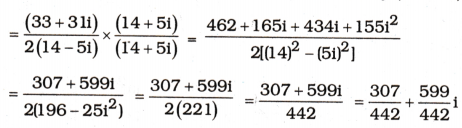
This is the required standard form.

Question 4.
Let z1 = 2 – i, z1 = -2 + i. Find (i) Re \(\left(\frac{z_1 z_2}{\bar{z}_1}\right)\)
(ii) Im\(\left(\frac{1}{z_1 \bar{z}_1}\right)\)
Solution:
i) It is given that z1 = 2 – i, z2 = -2 + i
z1z2 = (2 – i)(-2 + i)
= -4 + 2i + 2i – i2
= – 4 + 4i – (-1)
= -3 + 4i
Now, z̄1 = 2 + i
Hence, \(\frac{z_1 z_2}{\bar{z}_1}=\frac{-3+4 i}{2+i}\)
On multiplying nummerator and denominator by (2 – i), we obtain
\(\frac{z_1 z_2}{\bar{z}_1}=\frac{(-3+4 i)(2-i)}{(2+i)(2-i)}=\frac{-6+3 i+8 i-4 i^2}{2^2+1}\)
= \(\frac{-6+11 \mathrm{i}-4(-1)}{5}=\frac{-2+11 \mathrm{i}}{5}=\frac{-2}{5}+\frac{11}{5} \mathrm{i}\)
On comparing real parts, we obtain Re\(\left(\frac{z_1 z_2}{\bar{z}_1}\right)=-\frac{2}{5}\)
ii) \(\frac{1}{z_1 \bar{z}_1}=\frac{1}{(2+i)(2-i)}=\frac{1}{(2)^2+(1)}=\frac{1}{5}\)
On comparing imaginary parts, we obtain Im\(\left(\frac{1}{z_1 \bar{z}_1}\right)\) = 0
Question 5.
Find the real numbers x and y if (x – iy) (3 + 5i) is the conjugate of – 6 – 24i
Solution:
Let z = (x – iy) (3 + 5i) = 3x – i3y + i5x – i25y
= 3x + i5x – i3y + 5y
= (3x + 5y) + i(5x – 3y)
Then, z̄ = (3x + 5y) – i(5x – 3y)
It is given that, z̄ = -6 – 24i
Therefore, (3x + 5y) – i(5x – 3y) = -6 – 24i
Equating real and imaginary parts, we obtain
3x + 5y = – 6 ……..(1)
5x – 3y = 24 ……….(2)
Multiplying equation (1) with 3 and equation (2) with 5
we obtain
9x + 15y = -18; 25x – 15y = 120
On adding both the equations we get, 34x = 102
⇒ x = \(\frac{102}{34}\)
⇒ x = 3
Putting the value if x in equation (1) we obtain
3(3) + 5y = – 6
⇒ 5y = -6 – 9
⇒ y = \(\frac{-15}{5}\)
⇒ y = -3
Thus, the values of x = 3 and y = – 3
Question 6.
Find the modulus of \(\frac{1}{2}\).
Solution:
\(\frac{1+i}{1-i}-\frac{1-i}{1+i}=\frac{(1+i)^2-(1-i)^2}{(1-i)(1+i)}=\frac{1+i^2+2 i-1-i^2+2 i}{2}=\frac{4 i}{2}\)
= 2i
Therefore, \(\frac{1+\mathrm{i}}{1-\mathrm{i}}-\frac{1-\mathrm{i}}{1+\mathrm{i}}\) = |2i| = \(\sqrt{2^2}\) = 2
Question 7.
Find the number of ono-zero integral solutions of the equation |1 – i|x = 2x
Solution:
|1 – i|x = 2x
⇒ \(\left(\sqrt{1^2+(-1)^2}\right)^x\) = 2x
⇒ (√2)x = 2x
⇒ 2x/2 = 2x
⇒ \(\frac{x}{2}\) = x
⇒ x = 2x
⇒ 2x – x = 0
⇒ x = 0
Thus, 0 is the only integrak solution of the given equation.
Therefore, the number of non-zero integral solutions of the given equation is 0.
II.
Question 1.
If x – iy = \(\sqrt{\frac{a-i b}{c-i d}}\), prove that (x2 + y2)2 = \(\frac{a^2+b^2}{c^2+d^2}\)
Solution:
x – iy = \(\sqrt{\frac{a-i b}{c-i d}}=\sqrt{\frac{a-i b}{c-i d} \times \frac{c+i d}{c+i d}}=\sqrt{\frac{(a c+b d)+i(a d-b c)}{c^2+d^2}}\)
Squaring on both sides we get
∴ (x – iy)2 = \(\frac{(a c+b d)+i(a d-b c)}{c^2+d^2}\)
⇒ x2 – y2 – 2ixy = \(\frac{(a c+b d)}{c^2+d^2}+i \frac{(a d-b c)}{c^2+d^2}\)
On comparing real and imaginary parts, we obtain
x2 – y2 = \(\frac{a c+b d}{c^2+d^2}\) – 2xy = \(\frac{a d-b c}{c^2+d^2}\) …….. (1)
Since (x2 + y2)2 = (x2 – y2)2 + (-2xy)2
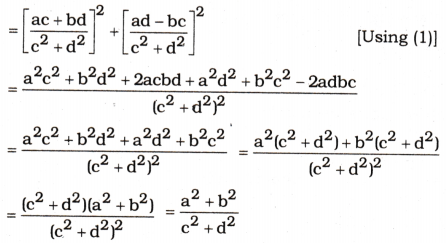
Hence Proved.
Question 2.
If z1 = 2 – i, z2 = 1 + i, find \(\left|\frac{z_1+z_2+1}{z_1-z_2+1}\right|\)
Solution:
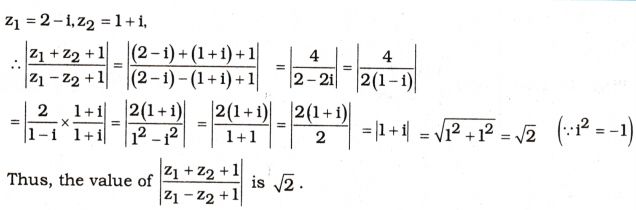
Question 3.
If a + ib = \(\frac{(x+i)^2}{2 x^2+1}\), prove that a2 + b2 = \(\frac{\left(x^2+1\right)^2}{\left(2 x^2+1\right)^2}\)
Solution:
a + ib = \(\frac{(x+i)^2}{2 x^2+1}\)
a + ib = \(\frac{(x+i)^2}{2 x^2+1}=\frac{x^2+i^2+i 2 x}{2 x^2+1}=\frac{x^2-1+i 2 x}{2 x^2+1}=\frac{x^2-1}{2 x^2+1}+i\left(\frac{2 x}{2 x^2+1}\right)\)
On comparing real and imaginary parts
a = \(\frac{x^2-1}{2 x^2+1}\) and b = \(\frac{2 x}{2 x^2+1}\)
Since, a2 + b2 = \(\left(\frac{x^2-1}{2 x^2+1}\right)^2+\left(\frac{2 x}{2 x^2+1}\right)^2\)
= \(\frac{x^4+1-2 x^2+4 x^2}{\left(2 x^2+1\right)^2}=\frac{x^4+1+2 x^2}{\left(2 x^2+1\right)^2}\)
a2 + b2 = \(\frac{\left(x^2+1\right)^2}{\left(2 x^2+1\right)^2}\)
Hence proved.
Question 4.
If (x + iy)3 = u + iv, then show that \(\frac{1}{2}\) = 4(x2 – y2).
Solution:
It is given that (x + iy)3 = u + iv
⇒ x3 + (iy)3 + 3 × x × iy (x + iy) = u + iv
⇒ x3 + i3y3 + 3x2yi + 3xy2i2 = u + iv
⇒ x3 – iy3 + 3x2yi – 3xy2 = u + iv
⇒ (x3 – 3xy2) + i(3x2y – y3) = u + iv
On equating real and imaginary parts, we obtain u = x3 – 3xy2, v = 3x2y – y3
Therefore, \(\frac{u}{x}+\frac{v}{y}=\frac{x^3-3 x y^2}{x}+\frac{3 x^2 y-y^3}{y}=\frac{x\left(x^2-3 y^2\right)}{x}+\frac{y\left(3 x^2-y^2\right)}{y}\)
= x2 – 3y2 + 3x2 = y2 = 4x2 – y2 = 4(x2 – y2)
Hence, \(\frac{u}{x}+\frac{v}{y}\) = 4(x2 – y2) proved.
Question 5.
If α and β are different complex numbers with |β| = 1, then find \(\frac{\beta-\alpha}{1-\bar{\alpha} \beta}\).
Solution:
Let α = a + ib and β = x + iy
It is given that, |β| = 1
Therefore, \(\sqrt{x^2+y^2}\) = 1
⇒ x2 + y2 = 1 …………(1)
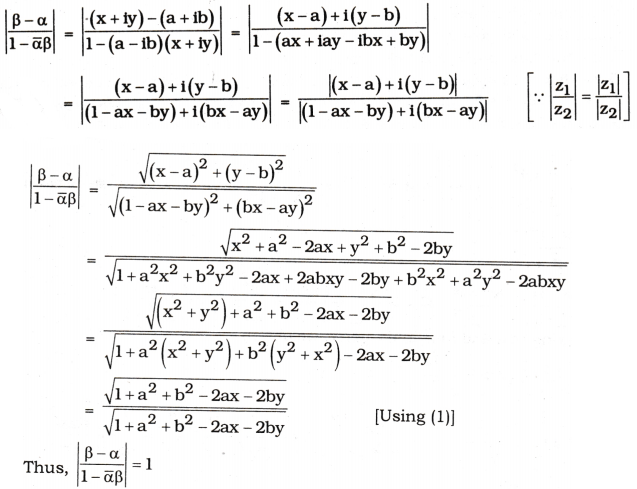
Question 6.
If (a + ib) (c + id) (e + if) (g + ih) = A + iB, then show that (a2 + b2) (c2 + d2) (e2 + f2) (g2 + h2) = A2 + B2
Solution:
It is given that, (a + ib) (c + id) (e + if) (g + ih) = A + iB
Therefore, |(a + ib) (c + id) (e + if) (g + ih)| = |A + iB|
|(a + ib)| x |(c + id)| x |(e + if )| x |(g + ih)| = |A + iB|
\(\sqrt{a^2+b^2} \times \sqrt{c^2+d^2} \times \sqrt{e^2+f^2} \times \sqrt{g^2+h^2}=\sqrt{A^2+B^2}\)
\(\sqrt{\left(\mathrm{a}^2+\mathrm{b}^2\right)\left(\mathrm{c}^2+\mathrm{d}^2\right)\left(\mathrm{e}^2+\mathrm{f}^2\right)\left(\mathrm{g}^2+\mathrm{h}^2\right)}=\sqrt{\mathrm{A}^2+\mathrm{B}^2}\)
Squaring on both sides, we obtain
(a2 + b2) (c2 + d2) (e2 + f2) (g2 + h2) = A2 + B2
Hence proved.
Question 7.
If \(\left(\frac{1+\mathrm{i}}{1-\mathrm{i}}\right)^{\mathrm{m}}\) = 1, then find the least positive integral value of m.
Solution:
It is given that \(\left(\frac{1+\mathrm{i}}{1-\mathrm{i}}\right)^{\mathrm{m}}\) = 1
⇒ \(\left(\frac{1+\mathrm{i}}{1-\mathrm{i}} \times \frac{1+\mathrm{i}}{1+\mathrm{i}}\right)^{\mathrm{m}}\) = 1
⇒ \(\left(\frac{(1+i)^2}{1^2+1}\right)^{\mathrm{m}}\) = 1
⇒ \(\left(\frac{1^2+i^2+2 i}{2}\right)^m\) = 1
⇒ \(\left(\frac{1-1+2 \mathrm{i}}{2}\right)^{\mathrm{m}}\) = 1
⇒ \(\left(\frac{2 \mathrm{i}}{2}\right)^{\mathrm{m}}\) = 1
⇒ im = 1
⇒ im = 14k
Hence, m = 4k, where k is some integer.
Since, the least positive integer is 1, m = 4 × 1 = 4
Thus, the least positive integral value of m = 4.
Question 8.
Show that the four points in the Argand plane represented by the complex numbers 2 + i, 4 + 3i, 2 + 5i, 3i are the vertices of a square.
Solution:
Given A = (2 + i) = (2, 1), B = (4 + 3i) = (4, 3), C = (2 + 5i) = (2, 5), D = (3i) = (0, 3)
Distance between two points A(x1, y1) and B(x2, y2) is AB = \(\sqrt{\left(\mathrm{x}_2-\mathrm{x}_1\right)^2+\left(\mathrm{y}_2-\mathrm{y}_1\right)^2}\)
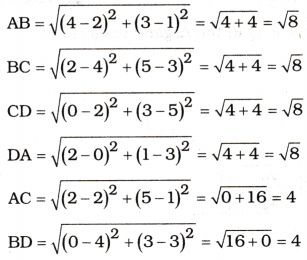
In the square all sides are equal and diagonals are also equal
∴ Given points are the vertices of a square.
Question 9.
Show that the points in the Argand plane represented by the complex numbers -2 + 7i, – 3i, \(\frac{-3}{2}+\frac{1}{2}\)i, 4 – 3i, \(\frac{7}{2}\)(1+i) are the vertices of a rhombus.
Solution:
A = (-2 + 7i) = (-2, 7)
B = \(\frac{-3}{2}+\frac{1}{2}\)i = (-\(\frac{3}{2}\), \(\frac{1}{2}\)),
C = (4 – 3i) = (4, -3)
D = \(\frac{7}{2}\)(1 + i) = (\(\frac{7}{2}\), \(\frac{7}{2}\))
Distance between two points A(x1, y1) and B(x2, y2) is AB = \(\sqrt{\left(\mathrm{x}_2-\mathrm{x}_1\right)^2+\left(\mathrm{y}_2-\mathrm{y}_1\right)^2}\)
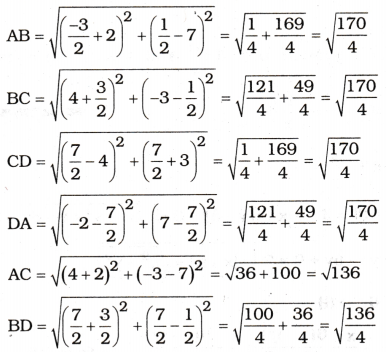
AB = BC = CD = DA and AC ≠ BD
In the rhombus all sides are equal but diagonals are not equal
∴ Given points are the vertices of a rhombus.
Question 10.
The points P, Q denote the complex numbers z1, z2 in the Argand diagram. O is the origin. If z1z̄2 + z̄1z2 = 0 then show that ∠POQ = \(\frac{\pi}{2}\).
Solution:
Let z1 = x1 + iy1, z2 = x2 + iy2 be the points P, Q in the Argand diagram.
z̄1 = x1 – iy1, z̄2 = x2 – iy2
∴ P(x1, y1),Q(x2, y2),O(0,0)
Slope of OP = \(\frac{0-y_1}{0-x_1}=\frac{y_1}{x_1}\)
∵ If A = (x1, y1),B = (x2, y2); Slope of \(\overline{A B}=\frac{y_2-y_1}{x_2-x_1}\)
Slope of OQ= \(\frac{0-y_2}{0-x_2}=\frac{y_2}{x_2}\)
Taking, z1z̄2 + z̄1z2 = 0
⇒ (x1 + iy1) (x2 – iy2) + (x1 – iy1) + (x2 + iy2) = 0
⇒ x1x2 + y1y2 + i(x2y1 – x1y2) + x1x2 + y1y2 + i(x1y2 – x2y1) = 0
⇒ 2(x1x2 + y1y2) = 0
⇒ x1x2 + y1y2 = 0
⇒ y1y2 = -x1x2
⇒ \(\frac{y_1}{x_1} \cdot \frac{y_2}{x_2}\) = -1
Slope of OP × Slope of OQ = -1
⇒ ∠POQ = 90°
Question 11.
If the complex number z has argument θ, 0 < θ < \(\frac{\pi}{2}\) and satisfy the equation |z – 3i| = 3. Then prove that (cot θ – \(\frac{6}{z}\)) = i
Solution:
Let z = x + iy ⇒ tan θ = \(\frac{y}{x}\) so cot θ = \(\frac{x}{y}\)
Given that |z – 3i| = 3
⇒ |x + iy – 3i| = 3
⇒ |x + i(y – 3)| = 3
⇒ \(\sqrt{x^2+y^2+9-6 y}\) = 3
Squaring both sides
⇒ x2 + y2 – 6y + 9 = 9
⇒ x2 + y2 – 6y = 0 [∵ |x + iy| = \(\sqrt{x^2+y^2}\)]
⇒ x2 + y2 = 6y ……… (1)
Consider (cot θ – \(\frac{6}{z}\)) = \(\frac{x}{y}-\frac{6}{x+i y}=\frac{x}{y}-\frac{6(x-i y)}{x^2+y^2}=\frac{x}{y}-\frac{6(x-i y)}{6 y}\) (∵ from (1))
= \(\frac{6 x-6(x-i y)}{6 y}=\frac{6 i y}{6 y}\) = i