
Regular practice with AP Inter 2nd Year Physics Study Material Chapter 2 Electrostatic Potential and Capacitance Questions and Answers helps students stay prepared for examinations.
AP Inter 2nd Year Physics 2nd Lesson Electrostatic Potential and Capacitance Questions and Answers
I. Multiple Choice Questions
Question 1.
Two points P and Q are maintained at the potential of 10V and -4V respectively. The work done in moving 100 electrons from P to Q is
1) -9.6 × 10⁻¹⁷J
2) 9.6 × 10⁻¹⁷J
3) -2.24 × 10⁻¹⁶J
4) 2.24 × 10⁻¹⁶J
Answer:
4) 2.24 × 10⁻¹⁶J
The potential difference between two points P & Q is ∆W = VP – VQ = 10 – (-4) = 14 V
No.of electrons n = 100, e = 1.6 × 10¹⁹ C
Total charge q = ne = 100 × (1.6 × 1019C) = -1.6 × 10⁻¹⁷C
Work done W = q(∆V) = (-1.6 ) × (14) × 10-17= 2.24 × 10⁻¹⁷
Question 2.
A hollow metal sphere of radius 10 cm is charged such that the potential on its surface becomes 80V. Then the potential at the centre of the sphere is
1) 80V
2) 800V
3) 8V
4) 0
Answer:
1) 80V
The potential must be a constant value throughout the interior of the sphere.
∴ Vsurface = Vcentre = 80 V
Question 3.
The electric potential of a short dipole varies with distance r as
1) 1/r2
2) 1/r
3) 1/r
4) 1/r4
Answer:
1) 1/r2
For a short dipole V = \(\frac{1}{4 \pi \varepsilon_0} \frac{\mathrm{p} \cos \theta}{\mathrm{r}^2}\)
∴ V ∝ \(\frac{1}{r^2}\)
Question 4.
The examples of polar molecules are
1) HCl
2) H2O
3) NH3
4) Both (1) and (2)
Answer:
4) Both (1) and (2)
Polar molecules are formed when atoms share the electrons unequally.

Question 5.
Two conducting spheres of radii 5 cm and 10 cm are given a charge of 15 μC each. After the two spheres are joined by a conducting wire, the charge on the smaller sphere is
1) 5 μC
2) 10 μC
3) 15 μC
4) 20 μC
Answer:
2) 10 μC
Total charge Q = q1 + q2 = 15 + 15 = 30 μC
At equilibrium, V1 = V2
\(\frac{K q_1}{r_1}=\frac{K q_2}{r_2}\) ⇒ \(\frac{r_2}{r_1}=\frac{q_2}{q_1}\)
⇒ \(\frac{r_2}{r_1}\) + 1 ⇒ \(\frac{q_2}{q_1}\) + 1
⇒ \(\frac{r_2+r_1}{r_1}=\frac{q_2+q_1}{q_1}\)
∴ For smaller sphere, charge q1 = \(\frac{\left[q_1+q_2\right] r_1}{r_1+r_2}=\frac{Q r_1}{r_1+r_2}=\frac{30 \times 5}{10+5}=\frac{150}{15}\) = 10 = 10 μC
Question 6.
A hollow conducting sphere of radius R has a charge +Q on its surface. What is the electric potential within the sphere at a distance r = \(\frac{\mathrm{R}}{\mathrm{3}}\) from its centre?
1) Zero
2) \(\frac{1}{4 \pi \varepsilon_0} \frac{\mathrm{Q}}{\mathrm{r}}\)
3) \(\frac{1}{4 \pi \varepsilon_0} \frac{Q}{R}\)
4) \(\frac{1}{4 \pi \varepsilon_0} \frac{\mathrm{Q}}{\mathrm{r}^2}\)
Answer:
3) \(\frac{1}{4 \pi \varepsilon_0} \frac{Q}{R}\)
Electric potential remains constant in the entire interior of the sphere.
∴ Vsurface = Vinside ⇒ V = \(\frac{1}{4 \pi \varepsilon_0} \frac{\mathrm{Q}}{\mathrm{R}}\) [∵ E = 0, \(\frac{\mathrm{dV}}{\mathrm{dx}}\) = 0]
Question 7.
An electric dipole consisting of two opposite charges of 2 μC each separated by a distance of 3 cm is placed in an electric field of 2 × 10⁵ N/C . The maximum torque on the dipole in Nm will be
1) 12 × 10-1
2) 12 × 10-3
3) 24 × 10-1
4) 24 × 10-3
Answer:
2) 12 × 10-3
Maximum Torque = PE = (q × 2a)E = (2 × 10-6 × 3 × 10-2) (2 × 10⁵) = 12 × 10-3 Nm
Question 8.
Electric potential at an equatorial point of a small dipole with dipole moment P (r, distance from the dipole) is
1) V = Zero
2) V = \(\frac{\mathrm{P}}{4 \pi \varepsilon_0 \mathrm{r}^2}\)
3) V = \(\frac{\mathrm{P}}{4 \pi \varepsilon_0 \mathrm{r}^3}\)
4) V = \(\frac{2 \mathrm{P}}{4 \pi \varepsilon_0 \mathrm{r}^3}\)
Answer:
1) V = Zero
Potential V = \(\frac{1}{4 \pi \varepsilon_0} \frac{p \cos \theta}{r^2}\), On equatorial line, θ = 90°, So cos θ = 0
∴ Potential V = 0
Question 9.
A parallel plate condenser has a capacitance 50 μF in air and 110 μF when immersed in an oil. The dielectric constant k of the oil is
1) 0.45
2) 0.55
3) 1.10
4) 2.20
Answer:
4) 2.20
When immersed in oil, new capacity of the capacitor C’ = KC [∵ C = Actual capacity]
∴ K = \(\frac{C^{\prime}}{C}=\frac{110}{50}\) = 2.2
Question 10.
The potentials of the two plates of a capacitor are +10V and -10V . The charge on one of the plates is 40C. The capacitance of the capacitor is
1) 2F
2) 4F
3) 0.5F
4) 0.25F
Answer:
1) 2F
Potential difference ∆V = V1 – V2 = 10 – (-10) = 20 V, Charge Q = 40C
∴ C = \(\frac{\mathrm{Q}}{\Delta \mathrm{~V}}=\frac{40}{20}\) = 2
Question 11.
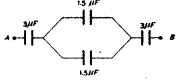
The capacitance between the points A and B in the given circuit (fig) will be
1) 1 μF
2) 2 μF
3) 3 μF
4) 4 μF
Answer:
1) 1 μF
Here 1.5 μF capacitor with 1.5 μF are connected in parallel.
∴ Ceq = C1 + C2 = 1.5 + 1.5 = 3 μF
Now 3 μF, 3 μF with 3 μF capacitors are connected in series.
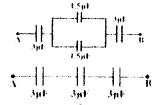
∴ \(\frac{1}{C_S}=\frac{1}{C_1}+\frac{1}{C_2}+\frac{1}{C_3}=\frac{1}{3}+\frac{1}{3}+\frac{1}{3}=\frac{3}{3}\) = 1
∴ CS = 1 μF
Question 12.
Three capacitors of capacitance 1 μF, 2 μF and 3 μF are connected in series and a potential difference of 11 V is applied across the combination. Then, the potential difference across the plates of 1 μF capacitor is
1) 2 V
2) 4 V
3) 1 V
4) 6 V
Answer:
4) 6 V
In series combination \(\frac{1}{\mathrm{C}_{\mathrm{S}}}=\frac{1}{\mathrm{C}_1}+\frac{1}{\mathrm{C}_2}+\frac{1}{\mathrm{C}_3}=\frac{1}{1}+\frac{1}{2}+\frac{1}{3}=\frac{11}{6}\) ⇒ CS = \(\frac{6}{11}\)
∴ Q = CS V = \(\frac{6}{11}\) × 11 = 6 μC
Potential difference across 1 μF capacitor is V1 = \(\frac{Q}{C_1}=\frac{6}{1}\) = 6V
∴ V1 = 6 V
Question 13.
A parallel plate air capacitor is charged and then isolated. When a dielectric material is inserted between the plates of the capacitor completely, then which of the following does not change?
1) Electric field between the plates
2) Potential difference across the plates
3) Charge on the plates
4) Energy stored in the capacitor
Answer:
3) Charge on the plates
The total charge remains constant because the capacitor is isolated, to there is no external path for charge to flow. Charge on plates is constant
Question 14.
The capacity of a capacitor is 48 μp. When it is charged from 0.1C to 0.5C the change in energy stored is
1) 2500 J
2) 2.5 × 10⁻³ J
3) 2.5 × 10⁶ J
4) 2.42 × 10⁻² J
Answer:
1) 2500 J
Energy stored in a capacitor E = \(\frac{Q^2}{2 C}\)
Change in energy ∆E = E2 – E1 = ∆\(\frac{Q_2^2}{2 C}-\frac{Q_1^2}{2 C}\)
= \(\frac{1}{2 C}\left[Q_2^2-Q_1^2\right]\) = \(\frac{1}{2 \times 48 \times 10^{-6}}\)[(0.5)2 – (0.1)2] = 2500 J
Question 15.
A capacitor is charged by a battery and the energy stored is U . The battery is now removed and the separation distance between the plates is doubled. Then the energy stored is now
1) U / 2
2) U
3) 2U
4) 4U
Answer:
3) 2U
Energy stored in a capacitor E = \(\frac{Q^2}{2 C}\) But C = \(\frac{\varepsilon_0 A}{d}\)
∴ E = \(\frac{\mathrm{Q}^2 \mathrm{~d}}{2 \varepsilon_0 \mathrm{~A}}\) ⇒ E ∝ d
∴ \(\frac{E_2}{E_1}=\frac{d_2}{d_1}=\frac{2 d_1}{d_1}\) = 2 ⇒ E2 = 2E1
II. Fill in the Blanks
Question 1.
The potential at a point P at a distance 9cm away from a point charge 1 × 10⁻⁷ C is _________
Answer:
104 V.
V = \(\frac{1}{4 \pi \varepsilon_0} \frac{\mathrm{q}}{\mathrm{r}}=\frac{9 \times 10^9 \times 10^{-7}}{9 \times 10^{-2}}\) = 104
Question 2.
Work done in moving a charge q from one point to another inside a uniformly charged conducting sphere is always ________
Answer:
zero.
Inside a charged conductor E = 0. So, potential is constant.
Thus potential difference ∆V = 0.
∴ Workdone = Q∆V = 0
Question 3.
The electric dipole moment per unit volume is called ___________.
Answer:
polarisation.
Polarisation P = \(\frac{1}{V}\) × Dipole moment
Question 4.
1 GeV is ___________Joules
Answer:
1.6 × 10⁻¹⁰ .
1 GeV = 1 × 109 × 1.6 × 10-19 = 1.6 × 10⁻¹⁰J
Question 5.
The potential energy of a system consisting of two charges 7 μC and -2 μC placed at (-9cm, 0, 0) and (9cm, 0, 0) is _______
Answer:
-0.7 J.
d = 9 – (-9) = 18 cm
P.E. = \(\frac{1}{4 \pi \varepsilon_0} \frac{\mathrm{q}_1 \mathrm{q}_2}{\mathrm{~d}}=\frac{9 \times 10^9 \times\left(7 \times 10^{-6}\right) \times\left(-2 \times 10^{-6}\right)}{18 \times 10^{-2}}\) = -0.7 J
Question 6.
The potential at infinity due to a point charge is ________
Answer:
zero.
V = \(\frac{1}{4 \pi \varepsilon_0} \frac{\mathrm{q}}{\mathrm{r}}\); when r → ∞ we get V = 0
Question 7.
A 25 μF capacitor is charged to a potentiâl of 18V . Then charge stored in the capacitor is ________
Answer:
4.5 × 10⁻⁴ C.
Charge Q = CV = (25 × 10-6)(18) = 4.5 × 10⁻⁴ C
Question 8.
The negative electrical potential gradient is called ___________
Answer:
Intensity of electric field.
The negative gradient of electric potential iscalled Electric intensity of field.
Question 9.
The dielectric field strength of air is about _______
Answer:
3 × 10⁶ V/m.
Question 10.
The product ε₀ K is called __________
Answer:
permittivity of the medium.
Dielectric constant K = \(\frac{\varepsilon}{\varepsilon_0}\) ⇒ Kε₀ = ε
ε is the permitivity of the medium.
Question 11.
The energy density of the electric field in a region with electric field (E) is ________.
Answer:
\(\frac{1}{2}\) ε₀E2
Energy U = \(\frac{1}{2}\)CV2 = \(\frac{1}{2}\left[\frac{\varepsilon_0 A}{d}\right]\) [ED]2 = \(\frac{1}{2}\left[\frac{\varepsilon_0 A}{d}\right]\) E2d2
= \(\frac{1}{2}\) ε₀E2(Ad) = 2}[/latex] ε₀E2V [∵ Ad = V]
⇒ \(\frac{U}{V}=\frac{1}{2}\) ε₀E2
Energy per unit volume is energy density.
Question 12.
The potential energy of a dipole of dipole moment p in a uniform field E is ________
Answer:
U = \(-\vec{\mathrm{P}} . \vec{\mathrm{E}}\)
Potential energy of a dipole U = -pEcosθ = – \(\vec{\mathrm{P}} . \vec{\mathrm{E}}\)
Question 13.
The total capacitance when two capacitors of capacitance C1 and C2 are connected in parallel is ________
Answer:
C = C1 + C2
In parallel combination q = q1 + q2 ⇒ CV = C1 V + C2 V
⇒ CV = V(C1 + C2) [∵ q = CV]
∴ C = C1 + C2
III. One Word Answer Questions
Question 1.
Write the expression for potential due to a point charge q at a distance r from it.
Answer:
Potential V = \(\frac{1}{4 \pi \varepsilon_0} \frac{\mathrm{q}}{\mathrm{r}}\). Here q charge, r distance and ε₀ is the permittivity of free space.
Question 2.
Define the unit of electric potential.
Answer:
One volt (V) is equal to one joule of work performed per unit coulomb of charge
Unit of electric potential is volt (V).
Question 3.
What is the electric potential of a dipole on the equatorial plane?
Answer:
The electrical potential V at any point on the equatorial plane of an electric dipole is ‘zero’.
Question 4.
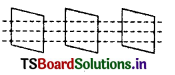
What is the shape of equipotential surface for a uniform electric field?
Answer:
In a uniform electric field, the equipotential surfaces take the shape of equidistant parallel planes perpendicular to the direction of the electric field lines.
Question 5.
What is the SI unit of electric potential?
Answer:
SI unit of electric potential is volt (V)
Question 6.
What is an equipotential surface?
Answer:
It is the surface at every point of which, the electric potential is the same.
Question 7.
Is the electric potential a scalar or vector quantity?
Answer:
Electric potential is a scalar quantity.
It possesses only magnitude and does not have a specific direction.
Question 8.
What is the potential difference between two points on an equipotentiai surface?
Answer:
The potential difference between any two points on an equipotential surface is zero.
V is constant at every point.
∴ VA – VB = 0
Question 9.
Define the capacitance of a capacitor.
Answer:
Capacitance (C) is the ratio of charge stored (Q) on a conductor to the potential difference (V) applied.
Formula: C = \(\frac{\mathrm{Q}}{\mathrm{~V}}\)
Question 10.
What is the SI unit of capacitance?
Answer:
SI unit of capacitance is farad (F).
Question 11.
How does the capacitance of a parallel plate capacitor change when the distance between the plates is halved?
Answer:
The new capacity becomes double to the initial capacity.
Capacitance C = \(\frac{\varepsilon_0 A}{d}\) ⇒ C ∝ \(\frac{1}{d}\)
∴ \(\frac{\mathrm{C}_2}{\mathrm{C}_1}=\frac{\mathrm{d}_1}{\mathrm{~d}_2}=\frac{\mathrm{d}_1}{\mathrm{~d}_1 / 2}\) = 2 ⇒ \(\frac{\mathrm{C}_2}{\mathrm{C}_1}\) = 2 ⇒ C2 = 2C1
Question 12.
Write the expression for capacitance of a parallel plate capacitor with air between plates.
Answer:
Capacitance of a parallel capacitor is C = \(\frac{\varepsilon_0 A}{d}\). Here ε₀ is permittivity of the air,
A is the area of the plates, d is the separation between the plates.
Question 13.
What is the total capacitance when two capacitors of capacitance C, and are connected in series?
Answer:
Total capacitance C = \(\frac{C_1 C_2}{C_1+C_2}\)
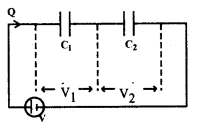
In series combination, V \(\frac{1}{\mathrm{C}}\)
V = V1 + V2 ⇒ \(\frac{Q}{C}=\frac{Q}{C_1}+\frac{Q}{C_2}\) [∵ V = \(\frac{Q}{C}\)]
∴ \(\frac{1}{C}=\frac{1}{C_1}+\frac{1}{C_2}=\frac{C_1+C_2}{C_1 C_2}\)
⇒ C = \(\frac{C_1 C_2}{C_1+C_2}\)
IV. Very Short Answer Questions
Question 1.
Can there be electric potential at a point with zero electric intensity? Give an example.
Answer:
Yes.
Ex: Inside a charged metal spherical shell, potential is non-zero but electric intensity is zero .
Question 2.
Can there be electric intensity at a point with zero electric potential ? Give an example.
Answer:
Yes.
Ex: When two charges +q and -q are separated by a distance, electric intensity at the mid point is non-zero. But the potential at the midpoint is zero [∵ + V – V = 0. ]
Question 3.
The potential difference between two points is 1 V.
What is the work done to move 1 C charge between them?
Answer:
Given potential difference V = 1 Volt and charge q = 1C
∴ Work done W = Vq = 1 × 1 = 1 Joule
Question 4.
Why is the electric field always at right angles to the equipotential surface ? Explain.
Answer:
The potential difference between any two points on an equipotential surface dV = 0.
Potential difference dV = –\(\vec{\mathrm{E}} . \mathrm{d} \vec{\mathrm{r}}\) ⇒ 0 = -Edrcosθ
⇒ cosθ =0 ⇒ θ = 90°
∴ Electric field \(\vec{\mathrm{E}}\) is always at right angles to the equipotential surface.
Question 5.
Three capacitors of capacitances 1 μF, 2 μF and 3 μF are connected in parallel.
a) What is the ratio of charges on each capacitor?
b) What is the ratio of potential differences across each capacitor?
Answer:
Given that C1 = 1 μF, C2 = 2 μF, C3 = 3 μF
In the parallel combination of capacitors we have Q ∝ C and V is same,
a) Q1 : Q2 : Q3 = C1 : C2 : C3 = 1 : 2 : 3
b) V1 = V2 = V3 = 1 : 1 : 1 [∵ V is same]
Question 6.
Three capacitors of capacitances 1 μF, 2μF and 3 μF are connected in series,
a) What is the ratio of charges?
b)What is the ratio of potential differences?
Answer:
Given that C1 = 1 μF, C2 = 2 μF, C3 = 3 μF
In the series combination of capacitors we have Q is same and V ∝ \(\frac{1}{\mathrm{C}}\)
a) Q1 : Q2 : Q3 = 1 : 1 : 1 [∵ Q is same]
b) V1 : V2 : V3 = \(\frac{1}{C_1}: \frac{1}{C_2}: \frac{1}{C_3}=\frac{1}{1}: \frac{1}{2}: \frac{1}{3}=\frac{6}{1}: \frac{6}{2}: \frac{6}{3}\) = 6 : 3 : 2
Question 7.
What happens to the capacitance of a parallel plate capacitor if the area of its plates is doubled? ‘
Answer:
Capacitance C = \(\frac{\varepsilon_0 A}{d}\) ⇒ C ∝ A Here A2 = 2A1
∴ \(\frac{C_2}{C_1}=\frac{A_2}{A_1}=\frac{2 A_1}{A_1}\) = 2 ⇒ C2 = 2C1
∴ Capacitance becomes double.
Question 8.
The dielectric strength of air is 3 × 10⁶V m-1 at certain pressure. A parallel plate capacitor with air in between the plates has a plate separated by I cm. Can you charge the capacitor to 3 × 10⁶ V. Give reason.
Answer:
No.
Since air is the dielectric, the maximum possible potential of the capacitor is V = Ed
V = 3 × 106 × 10-2 = 3 × 10⁴ V
But required potential is 3 × 10⁶ V. Required potential > Possible potential.
So it is not possible for the capacitor to charge potential 3 × 10⁶ V .
Question 9.
What is electrostatic shielding? (Jive an example.
Answer:
Electrostatic shielding is the process of isolating a specific region from external electric fields by enclosing it within a conducting material.
Ex: Metallic car body protects passengers from thunderstorm as the electric field inside is zero.
Question 10.
What happens to the capacitance of a parallel plate capacitor if the distance between plates is doubled?
Answer:
Capacitance \(\frac{\varepsilon_0 A}{d}\) ⇒ C ∝ \(\frac{1}{d}\)
Here d2 = 2d1
∴ \(\frac{C_2}{C_1}=\frac{d_1}{d_2}=\frac{d_1}{2 d_1}=\frac{1}{2}\) ⇒ \(\frac{C_2}{C_1}=\frac{1}{2}\)
⇒ C2 = \(\frac{C_1}{2}\)
∴ Capacitance becomes half.
Question 11.
In a hydrogen atom, the electron and proton are at a distance of 1Å . Find the dipole moment of the system.
Answer:
Given length of dipole is 2a = 1Å = 1 × 10⁻¹⁰ m, we know q = 1.6 × 10⁻¹⁹ C, p = ?
Formula; Dipole moment p = q(2a) = 1.6 × 10⁻¹⁹ (1 × 10⁻¹⁰) = 1.6 × 10⁻²⁹ C-m
Question 12.
What will be the shapes of equipotential surfaces in case of a uniform electric field and a point charge?
Answer:
In a uniform electric field, the equipotential surfaces take the shape of equidistant parallel planes perpendicular to direction of the electric field lines.
At a point charge, equipotential surfaces are concentric spheres centered on the point charge.
V. Short Answer Questions
Question 1.
Derive an expression for the electric potential due to a point charge.
Answer:
Potential due to a Point Charge:
Consider a positive point charge q at O.
Let P be a point at a distance r from O.
Consider a unit positive test charge (+1 C) at A on the line OP at a distance x from O.
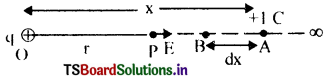
At A, electrostatic force on unit positive charge (+1 C) is F = \(\frac{q \times 1}{4 \pi \varepsilon_0 x^2}=\frac{1}{4 \pi \varepsilon_0} \frac{q}{x^2}\) ……….. (1)
If dW is the small work done in moving the unit positive charge at A against the force through a small distance (AB) = dx, then dW = – F dx [∵ the two positive charges repel as θ = 1 From (1), dW = –\(\frac{1}{4 \pi \varepsilon_0} \frac{\mathrm{q}}{\mathrm{x}^2}\) dx
Total work done(W) is obtained by integrating this between the limits from ∞ to r.
W = –\(\int_{\infty}^r \frac{1}{4 \pi \varepsilon_0} \frac{q}{x^2}=\frac{-q}{4 \pi \varepsilon_0} \int_{\infty}^r \frac{1}{x^2} d x=\frac{q}{4 \pi \varepsilon_0}\left[\frac{1}{x}\right]_{\infty}^r=\frac{q}{4 \pi \varepsilon_0}\left(\frac{1}{r}\right)\) (∵ \(\int \frac{1}{x^2} d x=\frac{-1}{x}\))
The electric potential due to a point charge is this work done.
∴ V = \(\frac{1}{4 \pi \varepsilon_0}\left(\frac{q}{r}\right)\)
Question 2.
Derive an expression for the electrostatic potential energy of a system of two point charges and find its relation with electric potential of a charge.
Answer:
Potential Energy of System of Two Charges :
Consider a positive charge q1 located at A.
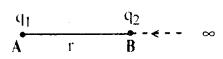
Let another charge q2 be brought from infinity to the point B.
Let r be the distance between A and B.
Potential at B due to charge q1 is V1 = \(\frac{1}{4 \pi \varepsilon_0} \frac{q_1}{r}\)
The work done to bring the charge q2 from infinity to B is W = V1(q2) = \(\frac{1}{4 \pi \varepsilon_0} \frac{q_1 q_2}{r}\)
As this is the total work done to build the system, it gives the potential energy of the system.
Potential energy U = \(\frac{1}{4 \pi \varepsilon_0} \frac{q_1 q_2}{r}\)
The same result is obtained while bringing the charge q1 first and q2 later.
Question 3.
Derive an expression for the potential energy of an electric dipole placed in a uniform electric field.
Answer:
Consider an electric dipole AB consisting of two
equal and opposite charges -q & q separated by a distance 2a placed in a uniform electric field E.
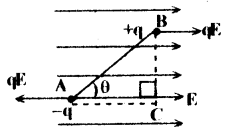
The torque on the dipole is \(\vec{\tau}=\vec{\mathrm{p}} \times \vec{\mathrm{E}}\) = pE sin θ
If an external torque 𝜏ext is applied to rotate the dipole from θ0 to θ1, the work done is given by
W = \(\int_{\theta_0}^{\theta_1} \tau_{\text {ext }} \mathrm{d} \theta=\int_{\theta_0}^{\theta_1} \mathrm{pE} \sin \theta \mathrm{~d} \theta=\mathrm{pE}[-\cos \theta]_{\theta_0}^{\theta_1}\) = pE(cosθ0 – cos θ1)
This work done is stored as the potential energy in the system.
If θ0 = π/2 and θ1 = 0, the potential energy of the dipole at an angle θ, in uniform electric field is
U = pE (cos π/2 – cos θ) = pE(0 – cos θ) = – pE cos 0 = – \(\vec{\mathrm{p}} \cdot \vec{\mathrm{E}}\)
∴ U = – \(\vec{\mathrm{p}} \cdot \vec{\mathrm{E}}\)
This is the expression for potential energy of dipole at an angle θ in a uniform electric field.
Question 4.
Derive an expression for the capacitance of a parallel plate capacitor.
Answer:
Capacitance of a parallel plate capacitor :
Consider a parallel plate capacitor consisting of two parallel plates of area’ A, separated by a small distance ‘d’.
Let V be the potential difference between two plates.
The charges of the plates are Q and -Q.
The plate 1 has uniform surface charge density and the plate 2 has uniform surface charge density -σ.
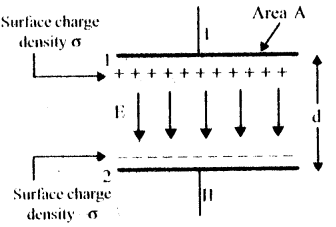
The electric field due to plate 1 is \(\frac{\sigma}{2 \varepsilon_0}\). The electric field due to plate 2 is \(\frac{\sigma}{2 \varepsilon_0}\)
Electric field between two charged plates is E = \(\frac{\sigma}{2 \varepsilon_0}+\frac{\sigma}{2 \varepsilon_0}=2\left(\frac{\sigma}{2 \varepsilon_0}\right)=\frac{\sigma}{\varepsilon_0}\)
We know a = Q/A
∴ The field inside the capacitor is E = \(\frac{\mathrm{Q}}{\mathrm{~A} \varepsilon_0}\) ……….. (1)
But, E = \(\frac{V}{d}\) and Q = CV From (1), \(\frac{V}{d}=\frac{C V}{A \varepsilon_0}\) ⇒ C = \(\frac{\varepsilon_0 A}{d}\)
∴ Capacitance of the parallel plate capacitor is given by C = \(\frac{\varepsilon_0 A}{d}\)
Question 5.
Explain the behaviour of dielectrics in an external field.
Answer:
Dielectrics are non-conducting substances.
The molecules of a dielectric may be polar or non-polar.
Polarization: When a dielectric with non-polar molecules is placed in an external electric field, the positive and negative charges of non-polar molecules are displaced in opposite directions. Thus induced dipole moments are developed in the dielectric by the external field.
Hence the dielectric is said to be polarised by the external field. All the induced dipole moments of the non-polar molecules add up to give a net dipole moment to the dielectric.
In dielectric with polar molecules, in the absence of external electric field, the different permanent dipoles are oriented randomly due to thermal agitation. Hence, the total dipole moment becomes zero. When an external electrical field is applied, the individual dipole moments tend to align with the field. As a result, a net dipole moment develops in the dielectric in the direction of external field. Hence the dielectric gets polarised.
Thus in either case, whether polar or non-polar, a dielectric develops a net dipole moment in the presence of an external field. The dipole moment per unit volume is called polarisation (P).
For linear isotropic dielectrics, P = 𝜒e E
Here 𝜒e is electric susceptibility and E is intensity of external field.
Question 6.
Derive an expression for the equivalent capacitance of a combination when three capacitors are connected in series.
Answer:
Series Combination: In series combination, the second plate of first capacitor is connected to first plate of second capacitor and so on. Also, first plate of first capacitor and second plate of last capacitor are connected to opposite terminals of a battery.
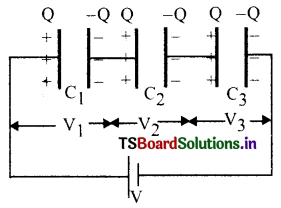
Capacitors in Series:
Let us suppose that three capacitors of capacitances C1, C2, C3 are connected in series to a potential difference V.
Let Q be charge in each capacitor which remains constant in each capacitor.
Let V1, V2, V3 be the potential differences between the plates of the capacitors C1, C2,C3 and C be the equivalent capacitance Total potential.differences is V = V1 + V2 + V3 ………… (1)
⇒ V = \(\frac{Q}{C_1}+\frac{Q}{C_2}+\frac{Q}{C_3}\) [∵ V1 = \(\frac{Q}{C_1}\), V2 = \(\frac{Q}{C_2}\), V3 = \(\frac{Q}{C_3}\)]
\(\frac{V}{Q}=\left[\frac{1}{C_1}+\frac{1}{C_2}+\frac{1}{C_3}\right]\) ⇒ \(\frac{1}{C}=\frac{1}{C_1}+\frac{1}{C_2}+\frac{1}{C_3}\) ………… (2)
For n number of capacitors in series \(\frac{1}{C}=\frac{1}{C_1}+\frac{1}{C_2}+\ldots \ldots \ldots+\frac{1}{C_n}\)
Question 7.
Derive an expression for the equivalent capacitance of a combination when three capacitors are connected in parallel.
Answer:
Capacitors in Parallel:
In parallel combination, the first plates of all the capacitors are connected to a common terminal and second plates of all the capacitors are connected to common terminal and these terminals are connected to opposite terminals of the battery.
Consider three capacitors of capacitances C1, C2, C3 connected in parallel to a potential difference V.
In parallel combination of capacitors, potential difference V remains the same on all the capacitors.
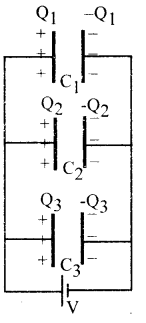
Let Q1, Q2, Q3 be the charges stored on the plates of capacitors C1,C2,C3.
In parallel combination, the total charge(Q) is equal to sum of charges stored in the capacitors.
∴ Q = Q1 + Q2 + Q3 …………… (1)
Q = C1V + C2V + C3V [∵ Q1 = C1V, Q2 = C2V, Q3 = C3V]
\(\frac{\text { Q }}{\text { V }}\) = C1 + C2 + C3 ⇒ C = C1 + C2 + C3 ………. (2)
This is the equivalent capacitance of a combination.
For n number of capacitors in parallel, C = C1 + C2 + C3 + ……… + Cn
Question 8.
Derive an expression for the energy stored in a capacitor.
Answer:
Energy Stored in a Capacitor :
When a capacitor of capacitance C is connected to a battery of potential difference V, the capacitor gets charged to Q. The work done to move the charge is stored in the capacitor in the form of potential energy called energy stored (U).
If dW is the small work done to store a charge of dQ at the potential drop V, we have
dW = V dQ ……………. (1)
The total work done to store the charge can be obtained by integrating it in the limits from 0 to Q.
W = \(\int_0^Q\) VdQ But we know C = \(\frac{\mathrm{Q}}{\mathrm{V}}\) ⇒ V = \(\frac{\mathrm{Q}}{\mathrm{C}}\)
∴ W = \(\int_0^Q \frac{Q}{C} d Q=\frac{1}{C} \int_0^Q Q d Q=\frac{1}{C}\left(\frac{Q^2}{2}\right)=\frac{Q^2}{2 C} .\) ………. (2) (∵ ∫ x dx = \(\frac{x^2}{2}\))
This work done is stored in the form of energy U.
∴ U = \(\frac{Q^2}{2 C}=\frac{(C V)^2}{2 C}=\frac{C V^2}{2}\) (∵ \(\frac{\mathrm{Q}}{\mathrm{C}}\) = V ⇒ Q = CV)
∴ Energy Stored in a Capacitor is U = \(\frac{1}{2}\)CV2
Question 9.
Define electric field intensity and electric potential and then derive the relation between them.
Answer:
Electric field intensity (E) at a point in an electric field is defined as the force experienced by unit positive test charge (q0) kept at that point. Formula: E = \(\frac{F}{q_0}\)
Electric potential (V) is defined as the work done per unit positive charge in bringing it from infinity to that point against the electric field.
Relation between E and V:
Consider two points separated by a distance ‘d’ in a uniform electric field of intensity E.
Let V be the potential difference between these points.
The amount of work done in moving a charge q is W = Vq ……. (1)
The force acting on the charge q is F = Eq.
Work done W = Fd = (Eq)d …… (2)
From (1) & (2), Vq = Eqd
∴ V = Ed ⇒ E = \(\frac{V}{d}\). This is the required relation between E and V.
VI. Long Answer Questions
Question 1.
Define electric potential. Derive an expression for the electric potential due to an electric dipole and hence the electric potential at a point (a) on the axial line of electric dipole (b) on the equatorial line of the electric dipole. P
Answer:
Electric potential (V) is the work done per unit positive charge in bringing it from infinity to that point against the electric field.
Formula: V = \(\frac{W}{q}\)
Potential due to an Electric Dipole:
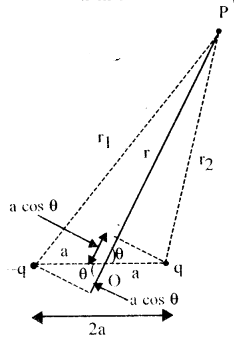
Consider a dipole of charges -q and +q separated by a distance 2a. Its dipole moment p = (2a)q .
Let P be a point at a distance r from the centre O of the dipole. Let OP make an angle θ with the dipole.
The distances of point P from -q and q are r1 and r2.
From figure, as r >> a, it can be taken as r1 ≈ r + a cos θ and r2 ≈ r – a cos θ
The potential at P due to the charge -q is V1 = –\(\frac{1}{4 \pi \varepsilon_0} \frac{\mathrm{q}}{\mathrm{r}_1}\)
⇒ V1 = –\(\frac{1}{4 \pi \varepsilon_0} \frac{\mathrm{q}}{(\mathrm{r}+\mathrm{a} \cos \theta)}\) ………. (1) [∵ r1 ≈ r + a cos θ]
The potential at P due to the charge q is V2 = \(\frac{1}{4 \pi \varepsilon_0} \frac{\mathrm{q}}{\mathrm{r}_2}\)
∴ V2 = \(\frac{1}{4 \pi \varepsilon_0} \frac{\mathrm{q}}{(\mathrm{r}-\mathrm{a} \cos \theta)}\) ……….. (2) [∵ r2 ≈ r + a cos θ]
The net potential at P due to the dipole is V = V1 + V2 From (1) & (2),
From (1) & (2), V = \(\frac{1}{4 \pi \varepsilon_0}\left[\frac{q}{r-a \cos \theta}-\frac{q}{r+a \cos \theta}\right]=\frac{q}{4 \pi \varepsilon_0}\left[\frac{(r+a \cos \theta)-(r-a \cos \theta)}{r^2-a^2 \cos ^2 \theta}\right]\)
V = \(\frac{1}{4 \pi \varepsilon_0}\left[\frac{2 \mathrm{aq} \cos \theta}{\mathrm{r}^2-\mathrm{a}^2 \cos ^2 \theta}\right]\) [∵ a2 cos2θ is very small and it can be neglected.]
∴ V = \(\frac{1}{4 \pi \varepsilon_0}\left[\frac{2 \mathrm{aq} \cos \theta}{\mathrm{r}^2}\right]\) But q(2a) = p = dipole moment
∴ V = \(\frac{1}{4 \pi \varepsilon_0} \frac{\mathrm{p} \cos \theta}{\mathrm{r}^2}\)
a) Potential on the Axial line:
When the point lies on axial line of the dipole, θ = 0 or 180°.
∴ Vax = ±\(\frac{1}{4 \pi \varepsilon_0} \frac{\mathrm{p}}{\mathrm{r}^2}\)
b) Potential on the Equatorial line:
When the point lies on equatorial line of the dipole, θ = 90°.
∴ Veq = 0
Thus the potential on equatorial line of a dipole is zero.
Question 2.
Explain series and parallel combination of capacitors. Derive the formula for equivalent capacitance in each combination.
Answer:
Series Combination: In series combination, the second plate of first capacitor is connected to first plate of second capacitor and so on. Also, first plate of first capacitor and second plate of last capacitor are connected to opposite terminals of a battery.
Capacitors in Series:
Let us suppose that three capacitors of capacitances C1, C2, C3 are connected in series to a potential difference V.
Let Q be charge in each capacitor which remains constant in each capacitor.
Let V1, V2, V3 be the potential differences between the plates of the capacitors C1, C2,C3 and C be the equivalent capacitance Total potential.differences is V = V1 + V2 + V3 ………… (1)
⇒ V = \(\frac{Q}{C_1}+\frac{Q}{C_2}+\frac{Q}{C_3}\) [∵ V1 = \(\frac{Q}{C_1}\), V2 = \(\frac{Q}{C_2}\), V3 = \(\frac{Q}{C_3}\)]
\(\frac{V}{Q}=\left[\frac{1}{C_1}+\frac{1}{C_2}+\frac{1}{C_3}\right]\) ⇒ \(\frac{1}{C}=\frac{1}{C_1}+\frac{1}{C_2}+\frac{1}{C_3}\) ………… (2)
For n number of capacitors in series \(\frac{1}{C}=\frac{1}{C_1}+\frac{1}{C_2}+\ldots \ldots \ldots+\frac{1}{C_n}\)
Capacitors in Parallel:
In parallel combination, the first plates of all the capacitors are connected to a common terminal and second plates of all the capacitors are connected to common terminal and these terminals are connected to opposite terminals of the battery.
Consider three capacitors of capacitances C1, C2, C3 connected in parallel to a potential difference V.
In parallel combination of capacitors, potential difference V remains the same on all the capacitors.
Let Q1, Q2, Q3 be the charges stored on the plates of capacitors C1,C2,C3.
In parallel combination, the total charge(Q) is equal to sum of charges stored in the capacitors.
∴ Q = Q1 + Q2 + Q3 …………… (1)
Q = C1V + C2V + C3V [∵ Q1 = C1V, Q2 = C2V, Q3 = C3V]
\(\frac{\text { Q }}{\text { V }}\) = C1 + C2 + C3 ⇒ C = C1 + C2 + C3 ………. (2)
This is the equivalent capacitance of a combination.
For n number of capacitors in parallel, C = C1 + C2 + C3 + ……… + Cn
Question 3.
Derive an expression for the energy stored in a capacitor. What is the energy stored when the space between the plates is filled with a dielectric (a) With charging battery disconnected (b) With charging battery connected to the circuit.
Answer:
Energy Stored in a Capacitor: The work done to move the charge is stored in the capacitor in the form of potential energy called energy stored (U).
Consider a capacitor of capacitance C is connected to a battery of potential difference V, so the capacitor gets charged to Q.
If dW is the work done to store a charge of dQ at the potential drop V then dW = V dQ …………… (1)
The total work done to store the charge can be obtained by integrating it in the limits from 0 to Q.
W = \(\int_0^Q\) V dQ But V = \(\frac{\text { Q }}{\mathrm{C}}\)
∴ W = \(\int_0^Q \frac{Q}{C} d Q=\frac{1}{C} \int_0^Q Q d Q=\frac{1}{2}\left(\frac{Q^2}{2}\right)\) ((∵ ∫ x dx = \(\frac{x^2}{2}\))
This work is stored in the form of energy.
So it can be written as U = \(\frac{Q^2}{2 C}=\frac{(C V)^2}{2 C}\) = \(\frac{1}{2}\)CV2 (Q = CV)
U = \(\frac{1}{2}\)CV2
Effect of Dielectric on Energy Stored in a Capacitor :
i) With Battery disconnected:
If the dielectric is filled in the capacitor after disconnecting the battery its C increases,
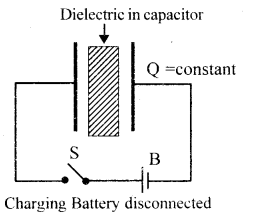
Q remains constant and V decreases.
Energy stored without dielectric U0 = \(\frac{Q^2}{2 C}\) ….(1)
Energy stored with dielectric U = \(\frac{Q^2}{2 C^{\prime}}\)
But C’ = KC ∴ U = \(\frac{Q^2}{2 K C}\) ………… (2)
Dividingeq(2)by eq(1), \(\frac{U}{U_0}=\frac{1}{K}\) ⇒ U = \(\frac{\mathrm{U}_0}{\mathrm{~K}}\)
Thus if the dielectric is filled in a capacitor energy stored in it decreases to 1/K times.
ii) With Battery connected:
If the dielectric is filled in the capacitor keeping the battery connected, its C increases,
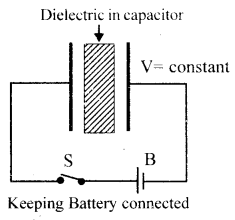
V remains constant and charge Q increases.
Energy stored without dielectric U0 = \(\frac{1}{2}\)CV2 ….(3)
Energy stored in the capacitor with dielectric U = \(\frac{1}{2}\)C’V2
But C ‘ =KC ∴ U = \(\frac{1}{2}\)(KQ)V2 ………. (4)
Dividing eq (4) by eq (3), we get \(\frac{U}{U_0}\) = K ⇒ U = KU0
Thus if dielectric is filled in a capacitor, energy stored in it increases by K times.
Textual Solved Problems
Question 1.
Calculate the potential at a point P due to a charge of 4 × 10⁻⁷ C located 9cm away.
Solution:
Given charge Q =4 × 10⁻⁷C, distance r = 9 cm = 0.09 m,
we know \(\frac{1}{4 \pi \varepsilon_0}\) = 9 × 10⁹ Nm2C-2, V = ?
V = \(\frac{1}{4 \pi \varepsilon_0} \frac{\mathrm{Q}}{\mathrm{r}}\) = 9 × 10⁹ × \(\frac{4 \times 10^{-7}}{0.09}\) = 4 × 10⁴ V
Question 2.
What is the work done in bringing a charge of 2 × 10⁻⁹ C from infinity to the point of potential 4 × 10⁴ V ? Does this work depend on the path along which the charge is brought?
Solution:
Given q = 2 × 10⁻⁹C, V= 4 × 10⁴
∴ Work W = qV = (2 × 10⁻⁹)( 4 × 10⁴) = 8 × 10⁻⁵ J
No. Work done is path independent.
Question 3.
Two charges 3 × 10⁻⁸ C and -2 × 10⁻⁸ C are located 15 cm apart. At what point on the line joining the two charges is the electric potential zero? Take the potential at infinity to be zero.
Solution:
If the point of zero potential P lies at distance x from q1 in between the charges q1 and -q2, then V1 + V2 = 0
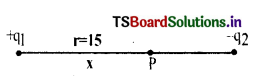
⇒ \(\frac{1}{4 \pi \varepsilon_0}\left(\frac{q_1}{x}+\frac{q_2}{r-x}\right)\) = 0 ⇒ \(\left(\frac{q_1}{x}+\frac{q_2}{r-x}\right)\) = 0
Here, q1 = 3 × 10⁻⁸ C, q2 = -2 × 10⁻⁸ C, r = 15 cm = 0.15 m, x = ?
Now \(\frac{3 \times 10^{-8}}{x}-\frac{2 \times 10^{-8}}{0.15-x}\) = 0 ⇒ 3(0.15 – x) = 2x ⇒ x = 0.09 m = 9 cm
The point of zero potential may lie outside the charges also. Then V1 – V2 = 0
If so, \(\left(\frac{q_1}{x}+\frac{q_2}{r-x}\right)\) = 0
∴ \(\frac{3 \times 10^{-8}}{x}-\frac{2 \times 10^{-8}}{x-0.15}\) = 0 ⇒ 3(x – 015) = 2x ⇒ x = 0.45 m = 45 cm
Question 4.
A slab of material of dielectric constant K has the same area as the plates of a parallel- plate capacitor but has a thickness(3/4)d, where d is the separation of the plates. How is the capacitance changed when the slab is inserted between the plates ?
Solution:
When there is no dielectric in the capacitor, let the potential difference be V0, capacitance be C0.
The electric field in it is E0 = V0/d.
The electric field with dielectric is E = E0/K.
We know potential difference field × distance
∴ V = E0 \(\left(\frac{d}{4}\right)\) + \(\frac{\mathrm{E}_0}{\mathrm{~K}}\left(\frac{3 \mathrm{~d}}{4}\right)\) = E0d\(\left(\frac{1}{4}+\frac{3}{4 \mathrm{~K}}\right)\)
V = V0\(\left(\frac{1}{4}+\frac{3}{4 \mathrm{~K}}\right)\) …………… (1) (∵ E0d = V0)
But the charge Q0 in the capacitor remains unchanged.
∴ Q0 = CV = C0V0 ⇒ V = \(\frac{\mathrm{C}_0 \mathrm{~V}_0}{\mathrm{C}}\)
Putting this in eqn (1), we get \(\frac{\mathrm{C}_0 \mathrm{~V}_0}{\mathrm{C}}\) = V0\(\left(\frac{1}{4}+\frac{3}{4 K}\right)\) ⇒ C = C0\(\left(\frac{4 \mathrm{~K}}{\mathrm{~K}+3}\right)\)
Question 5.
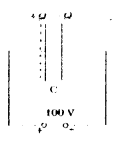
A 900 pF capacitor is charged by 100 V battery . How much electrostatic energy is stored in the capacitor?
Solution:
Given C = 900 × 10-12 F, V = 100V, U = ?
U = \(\frac{1}{2}\)CV2 = \(\frac{1}{2}\)(900 x 10-12)(100)2 = 4.5 × 10⁻⁶ J
Question 6.
(a) A comb run through one’s dry hair attracts small bits of paper. Why ?What happens if the hair is wet or if it is a rainy day? (Remember, a paper does not conduct electricity.)
(b) Ordinary rubber is an insulator. But special rubber tyres of aircraft are made slightly conducting. Why is this necessary?
(c) Schieles carrying inflammable materials usually have metallic ropes touching the ground during motion. Why?
(d) A bird perches on a bare high power line, and nothing happens to the bird.
A man standing on the ground touches the same line and gets a fatal shock. Why ?
Solution:
(a) When a comb runs through dry hair, it gets charged by friction. The molecules in the paper gets polarised by the charged comb, resulting in a net force of attraction. If the hair is wet, or if it is rainy day, friction between hair and the comb reduces. Then the comb does not get charged and thus it will not attract small bits of paper.
(b) To enable the tyres to conduct charge to the ground; because much of static electricity accumulated may result in spark and result in fire.
(c) Reason similar to (b).
(d) Current passes only when there is difference in potential.
Exercise Problems
Question 1.
The work in moving a charge of AC’ from a point A, which is at a potential of -2V’ to another point B is 18.1. Find potential at point B?
Solution:
Given charge q = 3C, Work done W = 18J Initial potential VA = -2V, Final potential VB = ?
Work done W = q ∆V = q(VB – VA)
⇒ 18 = 3[VB -(-2)] ⇒ 6 = VB + 2
⇒ VB = 4V
Question 2.
The electric potential at 0.9m from a point charge is +50V. What is the magnitude and sign of the charge?
Solution:
Given potential V = 50V, distance r = 0.9m
Potential V = K\(\frac{\mathrm{q}}{\mathrm{r}}=\) ⇒ q = \(\frac{V r}{K}=\frac{50 \times 0.9}{9 \times 10^9}\) = 5 × 10⁻⁹
Since the given potential is positive, the charge must also be positive.
Question 3.
The electric field at a point due to a point charge is 20 N/C and the electric potential at that point is 10 J/C. Calculate the distance of the point from the charge and the magnitude of the charge.
Solution:
Electric field intensity E=20 N/C, Electric potential V = 10 J/C, Couloumb’s constant K = 9 × 10⁹
(i) Distance of the point from the charge is r = \(\frac{V}{E}=\frac{10}{20}\) = 0 5 m
(ii) Magnitude of the charge, q = \(\frac{\mathrm{Vr}}{\mathrm{~K}}=\frac{10 \times 0.5}{9 \times 10^9}\) = – 0-55 × 10-9 C
Question 4.
A uniform electric field of 30 N/C’ exists along the X-axis. Calculate the potential difference VB – VA between the points A(4m, 2m) and B(10m, 5m).
Solution:
Electric field intensity \(\vec{\mathrm{E}}=30 \hat{\mathrm{i}}\) N / C
Displacement vector from A to B is \(\vec{r}=\overrightarrow{r B}-\overrightarrow{r A}=\left(x_2-x_1\right) \hat{i}+\left(y_2-y_1\right) \hat{j}\)
\(\vec{\mathrm{r}}=(10-4) \hat{\mathrm{i}}+(5-2) \hat{\mathrm{j}}=6 \hat{\mathrm{i}}+3 \hat{\mathrm{j}}\)
∴ Potential difference ∆V = VB – VA = \(\vec{\mathrm{E}} \cdot \vec{\mathrm{r}}=-(30 \hat{\mathrm{i}}) \cdot(6 \hat{\mathrm{i}}+3 \hat{\mathrm{j}})\) = -180 V
∴ ∆V = -180 V
Question 5.
Two point charges +10 μC and -10 μC are separated by a distance of 2.0 cm in air. Calculate the potential energy of the system, assuming the zero of the potential energy to be at infinity.
Solution:
Given charge q1 = +10 μC = 10 × 10-6 C , Charge q2 = -10 μC = -10 × 10-6 C
distance r = 2cm = 2 × 10⁻² m
Potential energy U = k\(\frac{q_1 q_2}{r}=\frac{9 \times 10^9\left(10 \times 10^{-6}\right)\left(-10 \times 10^{-6}\right)}{2 \times 10^{-2}}=\frac{-0.9}{0.02}\) = -45 J
Question 6.
Two charges of magnitude +q each are kept ‘2a’ distance apart. A Third charge ‘-2q’ is placed midway between them. What is the potential energy of the system?
Solution:
Given that q1 = +q, q2 = +q, q3 = -2q
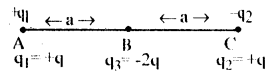
Potential energy of the system U = UAB + UBC + UAC
= \(\frac{1}{4 \pi \varepsilon_0} \frac{(\mathrm{q})(-2 \mathrm{q})}{\mathrm{a}}+\frac{1}{4 \pi \varepsilon_0} \frac{(-2 \mathrm{q}) \mathrm{q}}{\mathrm{a}}+\frac{1}{4 \pi \varepsilon_0} \frac{(\mathrm{q})(\mathrm{q})}{2 \mathrm{a}}\)
= \(\frac{1}{8 \pi \varepsilon_0}\left[\frac{-8 q^2+q^2}{a}\right]\) = \(\frac{-7 q^2}{8 \pi \varepsilon_0 a}\)
∴ Potential energy of the system U = \(\frac{-7 q^2}{8 \pi \varepsilon_0 a}\)
Question 7.
A parallel plate capacitor has plates of area 200 cm2 and separation between the plates 1.0 mm. What potential difference will be developed if a charge of 1.0 NC is given to the capacitor.
Solution:
Given Area A = 200 Cm2 = 200 × 10-4 m2 = 0.02 m2 ; Separation d = 1 mm = 10-3m
Charge q = 1 nC = 10-9 C
Capacity C = \(\frac{\varepsilon_0 A}{d}=\frac{8.854 \times 10^{-12} \times 0.02}{10^{-3}}\) = 0.177 × 10⁻⁹ F
Potential V = \(\frac{q}{C}=\frac{10^{-9}}{0.177 \times 10^{-9}}\) = 5.65 V
Question 8.
If C1 = 3 μF and C2 = 2 μF (fig.).
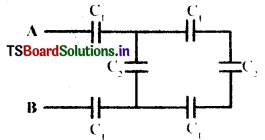
Calculate the equivalent capacitance of the given network between points A and B.
Solution:
Capacity C1 = 3 μF, Capacity C2 = 2μF
Initially C1, C2, C1 are in series
⇒ \(\frac{1}{C_s}=\frac{1}{C_1}+\frac{1}{C_2}+\frac{1}{C_1}=\frac{1}{3}+\frac{1}{2}+\frac{1}{3}=\frac{2+3+2}{6}\)
∴ CS = \(\frac{6}{7}\) pF
Now CS and C2 are in parallel.
CP = CS + C2 = \(\frac{6}{7}\) + 2 = \(\frac{6+14}{7}\) = \(\frac{20}{7}\) pF
Then C1, CP, C1 are in series.
\(\frac{1}{C}=\frac{1}{C_1}+\frac{1}{C_P}+\frac{1}{C_1}=\frac{1}{3}+\frac{7}{20}+\frac{1}{3}=\frac{20+21+20}{60}=\frac{61}{60}\)
∴ Resultant capacity C = \(\frac{60}{61}\)pF
Question 9.
In the circuit shown in fig. the charge on the capacitor of 4 μF is 16 μC. Calculate the energy stored in the capacitor of 12 μF capacitance.
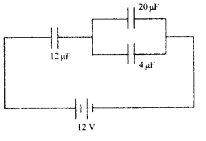
Solution:
Given that, charge on the capacitor of 4 μF is of 16 μC.
Voltage across 4 μF capacitor. V2 = \(\frac{q}{C}=\frac{16}{4}\) = 4 V
∴ Voltage across 12 μF capacitor V1 = V1 – V2 = 12 – 4 = 8V
∴ Energy stored in the capacitor 12 μF is U = \(\frac{1}{2}\)CV12 = \(\frac{1}{2}\)(12)(8)2 = 384 μJ
Question 10.
In parallel plate capcitor, the capacitance increases from 4 μF to 80 μF on introducing a dielectric medium between plates. What is the dielectric constant of the medium.
Solution:
Initial capacitance in air C0 = 4 μF, Final capacitance with dielectric medium C = 80 μF
when a dielectric is introduced new capacity C = KC0
∴ K = \(\frac{\mathrm{C}}{\mathrm{C}_0}=\frac{80}{4}\) = 20
∴ Dielectric constant K = 20
Question 11.
In a hydrogen atom the electron and proton are at a distance of 0.5 Å. The dipole moment of the system is
Solution:
Given 2a = 0.5Å = 0.5 × 10⁻¹⁰ m, Charge q = 1.6 × 10⁻¹⁹ C, p = ?
Formula; Dipole moment p = q(2a) = 1.6 × 10⁻¹⁹ 0.5 × 10-10 = 0.8 × 10-29 = 8 × 10-30 C-m
Question 12.
There is a uniform electric field in the XOY plane represented by \((40 \hat{\mathrm{i}}+40 \hat{\mathrm{j}})\) Vm-1
If the electric potential at the origin is 200V, the electric potential at the point with coordinates (2 m, 1 m) is
Solution:
Given \(\vec{\mathrm{E}}=(40 \hat{\mathrm{i}}+40 \hat{\mathrm{j}})\) Vm-1, \(\)m,V1 = 200V, V2 = ? dV = V2 – V1
Formula: dV = –\(\vec{\mathrm{E}} \cdot \mathrm{~d} \vec{\mathrm{r}}\) = V2 – V1 = –\(\vec{\mathrm{E}} \cdot \mathrm{~d} \vec{\mathrm{r}}\)
⇒ V2 – 200 = – \((40 \hat{\mathrm{i}}+40 \hat{\mathrm{j}}) \cdot(2 \hat{\mathrm{i}}+\hat{\mathrm{j}})\)
⇒ V2 – 200 = – (80 + 40) = -120
⇒ V2 = – 120 + 200 = 80 V
Question 13.
An electric dipole of moment P is placed in a uniform electric field E, with P parallel to E. It is then rotated by an angle θ. What is the work done?
Solution:
Torque on a dipole 𝜏 = pE sin θ
The work done to rotate the dipole from 0 to θ is given by W = \(\int_0^\theta\) pE sin θdθ
W = pE (cos 0 – cos θ) = pE (1 – cos θ)
Objective Questions
Question 1.
In a certain region of space with volume 0.2 m3 the electric potential is found to be 5 V throughout. The magnitude of electric field in this region is
1) zero
2) 0.5 N/C
3) 1 N/C
4) 5 N/C
Answer:
1) zero
Question 2.
A bullet of mass 2 g is having a charge of 2μC. Through what potential difference must it be accelerated, starting from rest, to acquire a speed of 10 m/s ?
1) 5 kV
2) 50 kV
3) 5 V
4) 50 V
Answer:
2) 50 kV
Question 3.
Twenty seven drops of same size are charged at 220 V each. They combine to form a bigger drop. Calculate the potential of the bigger drop.
1) 1980 V
2) 660 V
3) 1320 V
4) 1520 V
Answer:
1) 1980 V
Question 4.
Two charged spherical conductors of radius R1 and R2 are connected by a wire. Then the ratio of surface charge densities of the spheres (σ1 , σ2) is
1) \(\frac{\mathrm{R}_1^2}{\mathrm{R}_2^2}\)
2) \(\frac{R_1}{R_2}\)
3) \(\frac{R_2}{R_1}\)
4) \(\sqrt{\left(\frac{R_1}{R_2}\right)}\)
Answer:
3) \(\frac{R_2}{R_1}\)
Question 5.
A hollow metallic sphere of radius 10 cm is charged such that potential of its surface is 80 V. The potential at the centre of the sphere would be
1) 80 V
2) 800V
3) zero
4) 8 V
Answer:
1) 80 V
Question 6.
The diagrams below show regions of equipotentials.
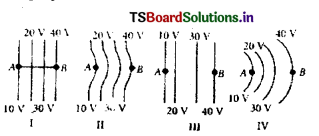
A positive charge is moved from A to B in each diagram.
1) In all the four cases the work done is the same.
2) Minimum work is required to move q in figure (I).
3) Maximum work is required to move q in figure (II).
4) Maximum work is required to move q iN figure (III).
Answer:
1) In all the four cases the work done is the same.
Question 7.
Charge q2 is at the centre of a circular path with radius r. Work done in carrying charge q1, once around this equipotential path, would be
1) \(\frac{1}{4 \pi \varepsilon_0} \times \frac{q_1 q_2}{r^2}\)
2) \(\frac{1}{4 \pi \varepsilon_0} \times \frac{q_1 q_2}{r}\)
3) zero
4) infinite
Answer:
3) zero
Question 8.
In bringing an electron towards another electron, the electrostatic potential energy of the system
1) becomes zero
2) increases
3) decreases
4) remains same
Answer:
2) increases
Question 9.
A dipole is placed in an electric field as shown. In which direction will it move?
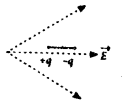
1) towards the right as its potential energy will increase.
2) towards the left as its potential energy will increase.
3) towards the right as its potential energy will decrease.
4) towards the left as its potential energy will decrease.
Answer:
3) towards the right as its potential energy will decrease.
Question 10.
An electric dipole of moment \(\vec{\mathrm{p}}\) is lying along a uniform electric field \(\vec{\mathrm{E}}\). The work done in rotating the dipole by 90° is
1) pE
2) \(\sqrt{2}\)pE
3) pE/2
4) 2pE
Answer:
1) pE
Question 11.
There is an electric field F. in x-direction. If the work done on moving a charge of 0.2 C through a distance of 2 in along a line making an angle 60° with x-axis is 4 .1, then what is the value of K?
1) 5 N/C
2) 20 N/C
3) \(\sqrt{3}\) N/C
4) 4 N/C
Answer:
2) 20 N/C
Question 12.
Two metallic spheres of radii 1 cm and 3 cm are given charges of -1 × 10⁻²C and 5 × 10⁻² respectively. If these are connected by a conducting wire, the final charge on the bigger sphere is
1) 2 × 10⁻²C
2) 3 × 10⁻²C
3) 4 × 10⁻²C
4) 1 × 10⁻²C
Answer:
2) 3 × 10⁻²C
Question 13.
A parallel plate air capacitor has capacity C. distance of separation between plates is d and potential difference V is applied between the plates. Force of attraction between the plates of the parallel plate air capacitor is
1) \(\frac{\mathrm{CV}^2}{\mathrm{~d}}\)
2) \(\frac{C^2 V^2}{2 d^2}\)
3) \(\frac{C^2 V^2}{2 d}\)
4) \(\frac{\mathrm{CV}^2}{2\mathrm{~d}}\)
Answer:
4) \(\frac{\mathrm{CV}^2}{2\mathrm{~d}}\)
Question 14.
The capacitance of a parallel plate capacitor with air as medium is 6 μF. With the introduction of a dielectric medium, the capacitance becomes 30 μF. The permitivity of the medium is
(ε₀ = 8.85 × 10⁻¹²C2N-1 m2)
1) 0.44 × 10⁻¹³C2N-1 m2
2) 1.77 × 10⁻¹²C2N-1 m2
3) 0.44 × 10⁻¹²C2N-1 m2
4) 5.00 C2N-1 m2
Answer:
3) 0.44 × 10⁻¹²C2N-1 m2
Question 15.
Two parallel metal plates having charges +Q and -Q face each other at a certain distance between them. If the plates are now dipped in kerosene oil tank, the electric field between the plates will
1) become zero
2) increase
3) decrease
4) remain same
Answer:
3) decrease
Question 16.
The equivalent capacitance of the combination shown in the figure is
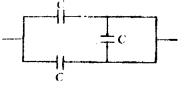
1) 3C/2
2) 3C
3) 2C
4) C/2
Answer:
3) 2C
Question 17.
Two metallic spheres of radii 1 cm and 2 cm are given charges 10-2;C and 5 × 10⁻² C respectively. If they are connected by a conducting wire, the final charge on the smaller sphere is
1) 3 × 10⁻²C
2) 4 × 10⁻²C
3) 1 × 10⁻² C
4) 2 × 10⁻²C
Answer:
4) 2 × 10⁻²C
Question 18.
Three capacitors each of capacitance C and I of breakdown voltage V are joined in series. The capacitance and breakdown voltage of the combination will be
1) 3C, V/3
2) C/3, 3V
3) 3C, 3V
4) C/3,V/3
Answer:
2) C/3, 3V
Question 19.
A network of four capacitors of capacity equal to C1 = C, C2 = 2C, C3 = 3C and lo a battery as shown in the figure. The ratio of the charges on C2 and C4 is
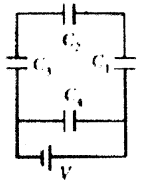
1) 4/7
2) 3/22
3) 7/4
4) 22/3
Answer:
2) 3/22
Question 20.
Three capacitors each of capacity 4 μF are to be connected in such a way that the effective capacitance is 6 μF. This can be done by
1) connecting all of them in series
2) connecting them in parallel
3) connecting two in series and one in parallel
4) connecting two in parallel and one in series.
Answer:
3) connecting two in series and one in parallel
Question 21.
A capacitor is charged by a battery. The battery is removed and another identical uncharged capacitor is connected in parallel. The total electrostatic energy of resulting system
1) decreases by a factor of 2
2) remains the same
3) increases by a factor of 2
4) increases by a factor of 4.
Answer:
1) decreases by a factor of 2
Question 22.
A parallel plate capacitor has a uniform electric field F. in the space between the plates. If the distance between the plates is d and area of each plate is A, the energy stored in the capacitor is
1) \(\frac{1}{2}\) ε₀E2
2) \(\frac{\mathrm{E}^2 \mathrm{Ad}}{\varepsilon_0}\)
3) \(\frac{1}{2}\)ε₀E2Ad
4) ε₀EAd
Answer:
3) \(\frac{1}{2}\)ε₀E2Ad
Question 23.
Energy per unit volume for a capacitor ! having area A and separation d kept at potential difference V is given by
1) \(\frac{1}{2} \varepsilon_0 \frac{\mathrm{~V}^2}{\mathrm{~d}^2}\)
2) \(\frac{1}{2 \varepsilon_0} \frac{\mathrm{~V}^2}{\mathrm{~d}^2}\)
3) \(\frac{1}{2} \mathrm{CV}^2\)
4) \(\frac{Q^2}{2 C}\)
Answer:
1) \(\frac{1}{2} \varepsilon_0 \frac{\mathrm{~V}^2}{\mathrm{~d}^2}\)
Question 24.
A capacitor is charged with a battery and energy stored is U. After disconnecting battery another capacitor of same capacity is connected in parallel to the first capacitor. Then energy stored in each capacitor is
1) U/2
2) U/4
3) 4U
4) 2U
Answer:
2) U/4
Question 25.
The energy stored in a capacitor of capacity C and potential V is given by
1) \(\frac{\text { CV }}{2}\)
2) \(\frac{\mathrm{C}^2 \mathrm{~V}^2}{2}\)
3) \(\frac{\mathrm{C}^2 \mathrm{~V}}{2}\)
4) \(\frac{\mathrm{CV}^2}{2}\)
Answer:
4) \(\frac{\mathrm{CV}^2}{2}\)
Question 26.
An infinite number of charges of equal magnitude q, but of opposite sign are placed along the x-axis at x = 1, x = 2, x = 4, x = 8… and so on. The electric potential at the point x = 0 due to these charges will be (in multiples of \(\frac{1}{4 \pi \varepsilon_0}\))
1) q/2
2) q/3
3) 2q/3
4) 3q/2
Answer:
3) 2q/3
Question 27.
A 20 F capacitor is charged to 5V and isolated. It is then connected in parallel with an uncharged 30F capacitor. The decrease in the energy of the system will be
1) 25 J
2) 100 J
3) 125 J
4) 150 J
Answer:
4) 150 J
Question 28.
A 100 μF capacitor is charged to 200 volt. It is discharged through a 2 ohm resistance. The amount of heat generated will be
1) 2 J
2) 4 J
3) 0.2 J
4) 0.4 J
Answer:
1) 2 J
Question 29.
Three condensers whose capacities are 3 μF, 9 μF and 18 μF respectively are first connected in series and then in parallel. The ratio of resultant capacities in two cases will be
1) 1 : 15
2) 15 : 1
3) 1 : 1
4) 1 : 3
Answer:
1) 1 : 15
Question 30.
A condenser of capacity 500pF is charged at the rate of 50 μC/s. The time taken for charging the condenser to 10V will be
1) 100 s
2) 50 s
3) 25 s
4) 10 s
Answer:
1) 100 s