
Referring to the AP Inter 1st Year Maths Study Material Chapter 2 Relations and Functions Exercise 2a Solutions makes it easier to understand complex problems.
AP Inter 1st Year Maths Relations and Functions Solutions Exercise 2a
I.
Question 1.
If (\(\frac{x}{3}\) + 1, y – \(\frac{2}{3}\)) = \(\left(\frac{5}{3}, \frac{1}{3}\right)\), find the values of x and y.
Solution:
Given (\(\frac{x}{3}\) + 1, y – \(\frac{2}{3}\)) = \(\left(\frac{5}{3}, \frac{1}{3}\right)\)
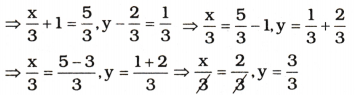
∴ x = 2, y = 1.
Question 2.
If the set A has 3 elements and the set B = {3, 4, 5}, then find the number of elements in (A × B),
Solution:
Given number of elements in A = 3 ⇒ n(A) = 3 ; Given B = {3, 4, 5} ⇒ n(B) = 3
Number of elements in A × B = (Number of elements in A) × (Number of elements in B)
n(A × B) = n(A) × n(B) = 3 × 3 = 9
Number of elements in (A × B) =9
Question 3.
If G = {7, 8} and H = {5, 4, 2}, find G × H and H × G.
Solution:
Given G = {7, 8}; H = {5, 4, 2}
G × H = {7, 8} × {5, 4, 2} = {(7, 5), (7, 4), (7, 2), (8, 5),(8, 4), (8, 2)}
H × G = {5, 4, 2} × {7,8} = {(5, 7), (5, 8), (4, 7), (4, 8), (2,7), (2, 8)}
Question 4.
State whether each of the following statements are true or false. If the statement is false, rewrite the given statement correctly.
i) If P = (m, n} and 9 = In, ni}, then P × g = j(m, n),(n, m)|.
ii) If A and B are two non-empty sets, then A × B is a non-empty set of ordered pairs (x, y) such that x ∈ A and y ∈ B.
iii) If A = {1, 2}, B = {3, 4}, then A × (B ∩ Φ) = Φ.
Solution:
i) False; P × Q = {m, n} ×{n,m} = {(m, n), (m, m), (n, n), (n, m)}
ii) True; Because A × B is a non-empty set of ordered pairs (x, y) such that x ∈ A and y ∈ B.
iii) True; Because B ∩ Φ = Φ ⇒ A × (B ∩ Φ ) = A × Φ = Φ.
Question 5.
If A = (-1, 1), find A × A × A.
Solution:
Given A = {-1, 1}
A × A = {-1, 1} × {-1, 1} = {(-1, -1), (-1, 1), (1, -1), (1, 1)}
A × A × A = {(-1,-1), (-1, 1), (1, -1), (1, 1)} × {-1,1}
= {(-1, -1, -1), (-1, -1, 1), (-1, 1, -1), (-1, 1, 1), (1, -1, -1), (1,-1,1) (1,1-1), (1, 1, 1)}
Question 6.
If A × B = {(a, x),(a , y), (b, x), (b, y)}. Find A and B.
Solution:
Given A x B = {(a, x), (a, y), (b, x), (b, y)}
A = set of first elements of A × B = {a, b};
B = set of second elements of A × B = {x, y}.
Question 7.
Let A = {1, 2) and B = {3, 4). Write A × B. How many subsets will A × B have? List them.
Solution:
Given A = {(1, 2), B = {3, 4} ; A × B = {(1, 3), (1, 4), (2, 3), (2, 4)} ⇒ n (A × B) = 4
The number of subsets of A × B = 24 = 16
Subsets of A × B = { }, {(1, 3)}, {(1,4)}, {(2, 3)}, {(2, 4)}
{(1,3), (1, 4)}, {(1, 3), (2, 3)}, {(1, 3), (2, 4)}, {(1, 4), (2, 3)}
{(1, 4), (2, 4)}, {(2, 3), (2, 4)}, {(1, 3), (1, 4), (2, 3)}
{(1, 3), (1, 4), (2, 4)}, {(1, 3), (2, 3), (2, 4)}, {(1, 4), (2,3), (2, 4)}, {(1, 3), (1, 4), (2, 3), (2, 4)}.

Question 8.
Let A and B be two sets such that n(A) = 3 and n(B) = 2. If (x, 1), (y, 2), (z, 1) are in A × B, find A and B, where x, y and z are distinct elements.
Solution:
Given A & B are 2 sets such that n(A) = 3 & n(B) = 2
Given (x, 1), (y, 2), (z, 1) lies in A × B
⇒ A = {x, y, z}, B = {1, 2}
Question 9.
The Cartesian product A × A has 9 elements among which are found (-1, 0) and (0,1). Find the set A and the remaining elements of A × A.
Solution:
Given (-1, 0) and (0, 1) are in the cartesian product of A × A having 9 elements.
∴ n(A × A) = 9 ⇒ n(A) × n(A) = 9 ⇒ n(A) = 3.
∴ A = {-1, 0, 1}
A × A = {-1, 0, 1} × {-1, 0, 1} = {(-1, -1), (-1, 0), (-1, 1), (0, -1), (0, 0), (0, 1), (1, -1), (1, 0), (1, 1)}
II.
Question 1.
Let A = (1, 2), B = (1, 2, 3, 4), C = (5, 6| and D = (5, 6, 7, 8). Verify that
(i) A × (B ∩ C) – (A × B) ∩ (A × C).
(ii) A × C is a subset of B × D.
Solution:
Given A = {1, 2}, B = {1, 2, 3, 4}, C = {5, 6} 8s D = {5, 6, 7, 8}
i) B ∩ C = {1, 2, 3, 4} ∩ {5, 6} = { }
A × (B ∩ C)= A × Φ = Φ
A × B = {(1, 1), (1, 2), (1, 3), (1, 4), (2, 1), (2, 2), (2, 3), (2, 4)}
A × C = {(1, 5), (1, 6), (2, 5) (2, 6)}
(A × B) ∩ (A × C) = Φ
∴ A × (B ∩ C) = Φ
(A × B) ∩ (A ∩ C) = Φ
∴ A × (B ∩ C) = (A × B) ∩ (A × C)
ii) A × C = {1, 2} × {5, 6} = {(1, 5), (1, 6), (2, 5) (2, 6)}
B × D = {1, 2, 3, 4} × {5, 6, 7, 8} = {(1, 5), (1, 6), (1, 7), (1, 8), (2, 5), (2, 6), (2, 7), (2, 8), (3, 5), (3, 6) (3, 7), (3, 8), (4, 5), (4, 6), (4, 7), (4, 8)}
A × C a is subset of B × D