
Practice AP Inter 2nd Year Maths Study Material Chapter 10 Vector Algebra MCQ to identify your strengths and weak areas.
AP Inter 2nd Year Maths Vector Algebra MCQ
Question 1.
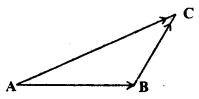
In triangle ABC (Fig), which of the following is not true:
1) \(\overrightarrow{\mathrm{AB}}+\overrightarrow{\mathrm{BC}}+\overrightarrow{\mathrm{CA}}=\overrightarrow{0}\)
2) \(\overrightarrow{\mathrm{AB}}+\overrightarrow{\mathrm{BC}}-\overrightarrow{\mathrm{AC}}=\overrightarrow{0}\)
3) \(\overrightarrow{\mathbf{A B}}+\overrightarrow{\mathbf{B C}}+\overrightarrow{\mathbf{A C}}=\overrightarrow{\mathbf{0}}\)
4) \(\overrightarrow{\mathrm{AB}}-\overrightarrow{\mathrm{CB}}+\overrightarrow{\mathrm{CA}}=\overrightarrow{0}\)
Solution:
3) \(\overrightarrow{\mathbf{A B}}+\overrightarrow{\mathbf{B C}}+\overrightarrow{\mathbf{A C}}=\overrightarrow{\mathbf{0}}\)
By Triangle Law of Addition of Vectors we have
\(\overrightarrow{\mathrm{AB}}+\overrightarrow{\mathrm{BC}}=\overrightarrow{\mathrm{AC}} \text { (or) } \overrightarrow{\mathrm{AB}}+\overrightarrow{\mathrm{BC}}=-\overrightarrow{\mathrm{CA}} \Rightarrow \overrightarrow{\mathrm{AB}}+\overrightarrow{\mathrm{BC}}+\overrightarrow{\mathrm{CA}}=\overrightarrow{0}\)
Question 2.
If \(\vec{a} \text { and } \vec{b}\) are two collinear vectors, then which of the following is correct
1) \(\overrightarrow{\mathbf{b}}=\lambda \overrightarrow{\mathbf{a}}\) for some scalar λ ≠ 0.
2) \(\vec{a}= \pm \vec{b}\)
3) the respective components of \(\vec{a} \text { and } \vec{b}\) are not proportional
4) both the vectors \(\vec{a} \text { and } \vec{b}\) have same direction, but different magnitudes.
Solution:
1) \(\overrightarrow{\mathbf{b}}=\lambda \overrightarrow{\mathbf{a}}\) for some scalar λ ≠ 0.
If \(\vec{a} \text { and } \vec{b}\) are two collinear vectors, then \(\vec{b}\) = λ\(\vec{a}\).
The other options (2) & (4) are only true for particular values of λ

Question 3.
If \(\overrightarrow{\mathbf{a}}\) is a nonzero vector of magnitude ‘a’ and λ. a nonzero scalar, then \(\lambda \overrightarrow{\mathbf{a}}\) is unit vector if
1) λ = 1
2) λ = – 1
3) a = |λ|
4) a = 1/| λ|
Solution:
4) a = 1/| λ|
\(|\lambda \bar{a}|=1 \Rightarrow|\lambda \| \vec{a}|=1 \Rightarrow|\vec{a}|=\frac{1}{|\lambda|} \Rightarrow a=\frac{1}{|\lambda|}\)
Question 4.
Let the vectors \(\vec{a} \text { and } \vec{b}\) be such that \(|\overrightarrow{\mathrm{a}}|=3,|\overrightarrow{\mathrm{~b}}|=\frac{\sqrt{2}}{3}\), then \(\overrightarrow{\mathbf{a}} \times \overrightarrow{\mathbf{b}}\) is a unit vector, if the angle between \(\vec{a} \text { and } \vec{b}\) is
1) π/6
2) π/4
3) π/3
4) π/2
Solution:
2) π/4
Given that |\(\vec{a}\)| = 3, |\(\vec{b}\)| = \(\frac{\sqrt{2}}{3}\) and \(\vec{a} \text { and } \vec{b}\) is a unit vector. ⇒ \(|\vec{a} \times \vec{b}|=1 \Rightarrow|\vec{a} \| \vec{b}| \sin \theta=1\)
⇒ \(3\left(\frac{\sqrt{2}}{3}\right) \sin \theta=1 \Rightarrow \sqrt{2} \sin \theta=1 \Rightarrow \sin \theta=\frac{1}{\sqrt{2}}=\sin \frac{\pi}{4} \Rightarrow \theta=\frac{\pi}{4}\)
Question 5.
Area of a rectangle having vertices A, B, C and D with position vectors \(-\hat{\mathbf{i}}+\frac{1}{2} \hat{\mathbf{j}}+4 \hat{\mathbf{k}}, \hat{\mathbf{i}}+\frac{1}{2} \hat{\mathbf{j}}+4 \hat{\mathbf{k}}, \hat{\mathbf{i}}-\frac{1}{2} \hat{\mathbf{j}}+4 \hat{\mathbf{k}} \text { and }-\hat{\mathbf{i}}-\frac{1}{2} \hat{\mathbf{j}}+4 \hat{\mathbf{k}}\), respectively is
1) 1/2
2) 1
3) 2
4) 4
Solution:
3) 2
Given ABCD is a rectangle
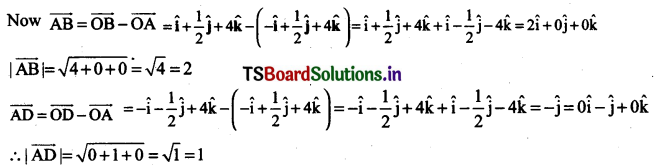
Area of rectangle ABCD = Length × Breadth = (AB) × (AD) = 2(1) = 2 sq. units
Question 6.
If θ is the angle between two vectors \(\vec{a} \text { and } \vec{b}\), then \(\vec{a} \text.\vec{b}\) > 0 only when
1) 0 < θ < \(\frac{\pi}{2}\)
2) 0 ≤ θ ≤ \(\frac{\pi}{2}\)
3) 0 < θ < π
4) 0 ≤ θ ≤ π
Solution:
2) 0 ≤ θ ≤ \(\frac{\pi}{2}\)
We have \(\vec{a} \cdot \vec{b} \geq 0 \Rightarrow|\vec{a} \| \vec{b}| \cos \theta \geq 0 \Rightarrow \cos \theta \geq 0\) [∵ \(|\overrightarrow{\mathrm{a}}| \geq 0 \text { and }|\overrightarrow{\mathrm{b}}| \geq 0\)]
⇒ 0 ≤ θ ≤ \(\frac{\pi}{2}\) Hence \(\vec{a}\).\(\vec{b}\) ≥ 0 of 0 ≤ θ ≤ \(\frac{\pi}{2}\)
Question 7.
Let \(\vec{a} \text { and } \vec{b}\) be two unit vectors and θ is the angle between them. Then \(\overrightarrow{\mathbf{a}}+\overrightarrow{\mathbf{b}}\) is a unit vector if
1) θ = \(\frac{\pi}{4}\)
2) θ = \(\frac{\pi}{3}\)
3) θ = \(\frac{\pi}{2}\)
4) θ = \(\frac{2\pi}{3}\)
Solution:
4) θ = \(\frac{2\pi}{3}\)
We have \(\vec{a} \text { and } \vec{b}\) two unit vectors and θ is the angle between them. Then, |\(\vec{a}\)|=|\(\vec{b}\)|= 1
Now \(\overrightarrow{\mathrm{a}}+\overrightarrow{\mathrm{b}}\) is a unit vector if \(|\vec{a}+\vec{b}|=1 \Rightarrow(\vec{a}+\vec{b}) \cdot(\vec{a}+\vec{b})=1 \Rightarrow \vec{a} \cdot \vec{a}+\vec{a} \cdot \vec{b}+\vec{b} \cdot \vec{a}+\vec{b} \cdot \vec{b}=1\)
⇒ \(|\vec{a}|^2+2 \vec{a} \vec{b}+|\vec{b}|^2=1 \Rightarrow 1^2+2|\vec{a}| \vec{b} \cos \theta+1^2=1\)
⇒ 1 + 2(1)(1) cosθ + 1 = 1 ⇒ cos θ = \(-\frac{1}{2} \Rightarrow \theta=\frac{2 \pi}{3}\)
Question 8.
The value of \(\hat{\mathbf{i}} \cdot(\hat{\mathbf{j}} \times \hat{\mathbf{k}})+\hat{\mathbf{j}} \cdot(\hat{\mathbf{i}} \times \hat{\mathbf{k}})+\hat{\mathbf{k}} \cdot(\hat{\mathbf{i}} \times \hat{\mathbf{j}})\) is
1) 0
2) -1
3) 1
4) 3
Solution:
3) 1
\(\hat{\mathrm{i}} \cdot \hat{\mathrm{j}} \times \hat{\mathrm{k}})+\hat{\mathrm{j}} \cdot(\hat{\mathrm{i}} \times \hat{\mathrm{k}})+\hat{\mathrm{k}} .(\hat{\mathrm{i}} \times \hat{\mathrm{j}})=\hat{\mathrm{i}} . \hat{\mathrm{i}}+\hat{\mathrm{j}} .(-\hat{\mathrm{j}})+\hat{\mathrm{k}} . \hat{\mathrm{k}}=1-1+1=1\)
Question 9.
If θ is the angle between any two vectors \(\vec{a} \text { and } \vec{b}\), then \(|\overrightarrow{\mathrm{a}} \cdot \overrightarrow{\mathrm{~b}}|=|\overrightarrow{\mathrm{a}} \times \overrightarrow{\mathrm{b}}|\) when θ is equal to 10.
1) 0
2) \(\frac{\pi}{4}\)
3) \(\frac{\pi}{2}\)
4) π
Solution:
2) \(\frac{\pi}{4}\)
\(|\overrightarrow{\mathrm{a}} \cdot \overrightarrow{\mathrm{~b}}|=|\overrightarrow{\mathrm{a}} \times \overrightarrow{\mathrm{b}}| \Rightarrow|\overrightarrow{\mathrm{a}}||\overrightarrow{\mathrm{b}}| \cos \theta=|\overrightarrow{\mathrm{a}}||\overrightarrow{\mathrm{b}}| \sin \theta \Rightarrow \cos \theta=\sin \theta \Rightarrow \tan \theta=1 \Rightarrow \theta=\frac{\pi}{4}\)
Question 10.
The value of the dot product of \(\vec{a}-\vec{b} \text { and } \vec{a}+\vec{b}/latex] is
1) a2 – b2
2) [latex](\vec{a} \times \vec{b})\)
3) \(\overrightarrow{\mathbf{a}} \times \overrightarrow{\mathbf{b}}\)
4) \(\overrightarrow{\mathbf{b}} \times \overrightarrow{\mathbf{a}}\)
Solution:
1) a2 – b2
\((\bar{a}-\bar{b}) \cdot(\bar{a}+\bar{b})=\bar{a} \cdot \bar{a}+\bar{a}-\bar{b}-\bar{b} \cdot \bar{a}-\bar{b} \cdot \bar{b}=|\bar{a}|^2-|\bar{b}|^2=a^2-b^2 \text { where }|\bar{a}|=a ;|\bar{b}|=b\)
Question 11.
The position vector of the point (1, 2, 0)is
1) \(\overrightarrow{\mathrm{i}}+\overrightarrow{\mathrm{j}}+\overrightarrow{\mathrm{k}}\)
2) \(\overrightarrow{\mathrm{i}}+\overrightarrow{\mathrm{2j}}+\overrightarrow{\mathrm{k}}\)
3) \(\vec{i}+2 \vec{j}\)
4) \(2 \vec{j}+\vec{k}\)
Solution:
3) \(\vec{i}+2 \vec{j}\)
PV of P = (1, 2, 0) is \(\overline{\mathrm{OP}}=\overline{\mathrm{i}}+2 \overline{\mathrm{j}}+0 \overline{\mathrm{k}}\)
Question 12.
If \(|(\vec{a} \times \vec{b})|=4 \text { and }|\vec{a} \cdot \vec{b}|=2\) then \(\left.\overrightarrow{\mathbf{a}}\right|^2|\overrightarrow{\mathbf{b}}|^2\) is equal to
1) 4
2) 2
3) 20
4) 2
Solution:
3) 20
Relation between \(\vec{a} \text { and } \vec{b}\) and \(\bar{a} \cdot \bar{b} \text { is }|\bar{a} \times \bar{b}|^2+(\bar{a} \cdot \bar{b})^2=(\bar{a})^2(\bar{b})^2\)
⇒ (4)2 + (2)2 = \((\bar{a})^2(\bar{b})^2 \Rightarrow(\bar{a})^2 \cdot(\bar{b})^2\) = 16 + 4 = 20
Question 13.
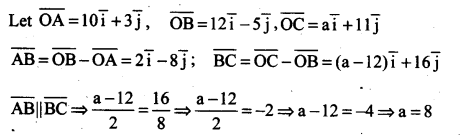
The points with position vectors \(10 \bar{i}+3 \bar{j}, 12 i-5 \vec{j} \text { and } a \dot{i}+11 j\) are collinear, if a is
1) 2
2) -8
3) 4
4) 8
Solution:
4) 8
Question 14.
The vector cos α cosβ \(\vec{i}\) + cosα sinβ \(\vec{j}\) + sinα \(\vec{k}\) is
1) null vector
2) unit vector
3) constant vector
4) vector with magnitude > 1
Solution:
2) unit vector
Consider \(|(\cos \alpha \cdot \cos \beta) \overline{\mathrm{i}}+(\cos \alpha \cdot \sin \beta) \overline{\mathrm{j}}+(\sin \alpha) \overline{\mathrm{k}}|\)
= \(\sqrt{\cos ^2 \alpha \cos ^2 \beta+\cos ^2 \alpha \sin ^2 \beta+\sin ^2 \alpha}=\sqrt{\cos ^2 \alpha\left(\cos ^2 \beta+\sin ^2 \beta\right)+\sin ^2 \alpha}\)
= \(\sqrt{\cos ^2 \alpha+\sin ^2 \alpha}=\sqrt{1}=1\). Hence a Unit vector.
Question 15.
If \(\vec{a}\), \(\vec{b}\), \(\vec{b}\) are mutually perpendicular unit vectors, then the value of |\(\vec{a}\) + \(\vec{b}\) + \(\vec{c}\)| is
1) 1
2) \(\sqrt{2}\)
3) \(\sqrt{3}\)
4) 2
Solution:
3) \(\sqrt{3}\)
Given \(|\bar{a}|=|\bar{b}|=|\bar{c}|=1 \text { and } \bar{a} \cdot \bar{b}=\bar{b}-\bar{c}=\bar{c} \cdot \bar{a}=0\)
⇒ \(|\bar{a}+\bar{b}+\bar{c}|^2=(\bar{a})^2+(\bar{b})^2+(\bar{c})^2+2(\bar{a} \cdot \bar{b}+\bar{b}-\bar{c}+\bar{c}-\bar{a})\) = 1 + 1 + 1 + 0 = 3
⇒ \(|\overline{\mathrm{a}}+\overline{\mathrm{b}}+\overline{\mathrm{c}}|=\sqrt{3}\)
Question 16.
If \(\vec{a}\) + \(\vec{b}\) + \(\vec{c}\), |\(\vec{a}\)| = 3, |\(\vec{b}\)| = 5, |\(\vec{c}\)| = 7 then the angle between \(\vec{a} \text { and } \vec{b}\) is
1) \(\frac{\pi}{6}\)
2) \(\frac{2\pi}{3}\)
3) \(\frac{5\pi}{3}\)
4) \(\frac{\pi}{3}\)
Solution:
4) \(\frac{\pi}{3}\)
\(\bar{a}+\bar{b}+\bar{c}=0 \Rightarrow \bar{a}+\bar{b}=-\bar{c} \quad \Rightarrow|\bar{a}+\bar{b}|=\bar{c}\). Squaring on both sides, we get
⇒ \((\bar{a})^2+(\bar{b})^2+2 \bar{a} \cdot \bar{b}=(\bar{c})^2 \Rightarrow 9+25+2 \bar{a} \cdot \bar{b}=49 \Rightarrow 2 \bar{a} \cdot \bar{b}=15 \Rightarrow 2(\bar{a})(\bar{b}) \cos (\bar{a} \bar{b})=15\)
⇒ 2(3)(5) cos θ = 15 ⇒ 2 cos θ = 1 ⇒ cos θ = \(\frac{\pi}{2}\) = cos 60°
∴ θ = 60° = π/3
Question 17.
If \(\vec{a} \text { and } \vec{b}\) are two unit vectors inclined atan angle θ then the Value of |\(\vec{a}\) – \(\vec{b}\)| is
1) 2sin\(\frac{\theta}{2}\)
2) 2sinθ
3) 2cos\(\frac{\theta}{2}\)
4) 2cosθ
Solution:
1) 2sin\(\frac{\theta}{2}\)
Given \(\bar{a}=|\bar{b}|=1\langle\bar{a}, \bar{b}\rangle\) = θ
consider \(|\bar{a}-\bar{b}|^2=(\bar{a})^2+(\bar{b})^2-2 \bar{a}-\bar{b}=1+1-2(\bar{a})(\bar{b}) \cos \theta\) = 2 – 2 cosθ
= 2(1 – cosθ) = \(2 \sin ^2 \theta / 2 \Rightarrow|\bar{a}-\bar{b}|=\sqrt{4 \sin ^2(\theta / 2)}=2 \sin (\theta / 2)\)
Question 18.
If |\(\vec{a}\)|= 3 and -1 ≤ k ≤ 2 then | k\(\vec{a}\) |lies in the internal
1) [0, 6]
2) [-3, 6]
3) [3, 6]
4) [1, 2]
Solution:
1) [0, 6]
|k\(\vec{a}\)| ⇒ |k||\(\vec{a}\)| ⇒ 3|k|
-1 ≤ k ≤ 2
0 ≤ |k| ≤ 2
0 × 3 ≤ 3 |k| ≤ 2 × 3
0 ≤ 3|k| ≤ 6 ⇒ |k\(\vec{a}\)| ∈ [0, 6]