Referring to the AP Inter 2nd Year Maths Study Material Chapter 10 Vector Algebra Exercise 10d Solutions makes it easier to understand complex problems.
AP Inter 2nd Year Maths Vector Algebra Solutions Exercise 10d
I.
Question 1.
Find \(|\mathbf{a} \times \mathbf{b}| \text {, if } \overrightarrow{\mathbf{a}}=\hat{\mathbf{i}}-7 \hat{\mathbf{j}}+7 \hat{\mathbf{k}} \text { and } \mathbf{b}=3 \hat{\mathbf{i}}-2 \hat{\mathbf{j}}+2 \hat{\mathbf{k}}\)
Solution:
Given that \(\vec{a}=\hat{i}-7 \hat{j}+7 \hat{k} \text { and } \vec{b}=3 \hat{i}-2 \hat{j}+2 \hat{k}\)
\(\vec{a} \times \vec{b}=\left|\begin{array}{ccc}
\hat{i} & \hat{j} & \hat{k} \\
1 & -7 & 7 \\
3 & -2 & 2
\end{array}\right|=\hat{i}(-14+14)-\hat{j}(2-21)+\hat{k}(-2+21)=19 \hat{j}+19 \hat{k}\)
∴ \(|\vec{a} \times \vec{b}|=\sqrt{19^2+19^2}=\sqrt{2 \times(19)^2}=19 \sqrt{2}\)
Question 2.
If a unit vector \(\vec{a}\) makes angles \(\frac{\pi}{3}\) with \(\hat{\mathbf{i}}, \frac{\pi}{4} \text { with } \hat{\mathbf{j}}\) and an acute angle θ with \(\hat{\mathbf{k}}\), then find 6 and hence, the components of \(\vec{a}\).
Solution:
Let us take the unit vector as \(\vec{a}=a_1 \hat{i}+a_2 \hat{j}+a_3 \hat{k} \text {. Then, }|\bar{a}|=1\)
Now, cos\(\frac{\pi}{3}=\frac{a_1}{|\vec{a}|} \Rightarrow a_1=\frac{1}{2} ; \cos \frac{\pi}{4}=\frac{a_2}{|\vec{a}|} \Rightarrow a_2=\frac{1}{\sqrt{2}}\)
\(\cos \theta=\frac{a_3}{|\vec{a}|} \Rightarrow a_3=\cos \theta\)
Since \(\vec{a}\) is a unit vector, we have \(\sqrt{a_1^2+a_2^2+a_3^2}=1 \Rightarrow\left(\frac{1}{2}\right)^2+\left(\frac{1}{\sqrt{2}}\right)^2+\cos ^2 \theta=1\)
⇒ \(\frac{1}{4}+\frac{1}{2}+\cos ^2 \theta=1 \Rightarrow \frac{3}{4}+\cos ^2 \theta=1 \Rightarrow \cos ^2 \theta=1-\frac{3}{4}=\frac{1}{4} \Rightarrow \cos \theta=\frac{1}{2} \Rightarrow \theta=\frac{\pi}{3}\)
Hence, \(a_3=\cos \frac{\pi}{3}=\frac{1}{2}\) (∵ θ = \(\frac{\pi}{3}\)) Components of \(\hat{\mathbf{a}}\) are \(\left(\frac{1}{2}, \frac{1}{\sqrt{2}}, \frac{1}{2}\right)\)

Question 3.
Show that \((\vec{a}-\vec{b}) \times(\vec{a}+\vec{b})=2(\vec{a} \times \vec{b})\)
Solution:
L.H.S = \((\vec{a}-\vec{b}) \times(\vec{a}+\vec{b})=(\vec{a}-\vec{b}) \times \vec{a}+(\vec{a}-\vec{b}) \times \vec{b}\)
= \(\vec{a} \times \vec{a}-\vec{b} \times \vec{a}+\vec{a} \times \vec{b}-\vec{b} \times \vec{b}=0+\vec{a} \times \vec{b}+\vec{a} \times \vec{b}-0=2(\vec{a} \times \vec{b})\) = R.H.S
Question 4.
Find λ and µ if \((2 \hat{i}+6 \hat{j}+27 \hat{k}) \times(\hat{i}+\lambda \hat{j}+\mu \hat{k})=0\) = 0
Solution:
Given that \((2 \hat{i}+6 \hat{j}+27 \hat{k}) \times(\hat{i}+\lambda \hat{j}+\mu \hat{k})=\overrightarrow{0} \Rightarrow(2 \hat{i}+6 \hat{j}+27 \hat{k}) \times(\hat{i}+\lambda \hat{j}+\mu \hat{k})=\overrightarrow{0}\)
⇒ \(\left|\begin{array}{ccc}
\hat{i} & \hat{j} & \hat{k} \\
2 & 6 & 27 \\
1 & \lambda & \mu
\end{array}\right|=0 \hat{i}+0 \hat{j}+0 \hat{k} \Rightarrow \hat{i}(6 \mu-27 \lambda)-\hat{j}(2 \mu-27)+\hat{k}(2 \lambda-6)=0 \hat{i}+0 \hat{j}+0 \hat{k}\)
On Comparing the corresponding components, we have
6µ – 27λ = 0, 2λ – 6 = 0
2λ – 6 = 0 ⇒ λ = 3 2µ – 27 = 0 ⇒ 2µ – 27 = 0 ⇒ µ = \(\frac{27}{2}\)
Question 5.
Given that \(\vec{a} . \vec{b}=0 \text { and } \vec{a} \times \vec{b}=0\). What can you conclude about the vectors \(\vec{a} \text { and } \vec{b}\)?
Solution:
When \(\vec{a} \cdot \vec{b}=0\) then either \(|\overrightarrow{\mathrm{a}}|=0 \text { or }|\overrightarrow{\mathrm{b}}|=0\) or a JL b (if \(\overrightarrow{\mathrm{a}} \mid \neq 0 \text { and }|\overrightarrow{\mathrm{b}}| \neq 0\))
When \(\vec{a} \times \vec{b}=\overrightarrow{0}\) then either \(|\overrightarrow{\mathrm{a}}|=0 \text { or }|\overrightarrow{\mathrm{b}}|=0\) or \(\overrightarrow{\mathrm{a}} \| \overrightarrow{\mathrm{b}}\) (if \(\vec{a} \mid \neq 0 \text { and }|\vec{b}| \neq 0\))
But \(\vec{a} \text { and } \vec{b}\) cannot be perpendicular and parallel simultaneously.
We conclude that \(\overrightarrow{\mathrm{a}}=0 \text { or } \overrightarrow{\mathrm{b}}=0\)
Question 6.
If either \(\vec{a}=0 \text { or } \vec{b}=0 \text {, then } \vec{a} \times \vec{b}=\overrightarrow{0}\). Is the converse true? Justify your answer with an example.
Solution:
Let \(\vec{a}=2 \vec{i}+3 \vec{j}+4 \vec{k} \text { and } \vec{b}=4 \vec{i}+6 \vec{j}+8 \vec{k}\)
∴ \(\vec{a} \times \vec{b}=\left|\begin{array}{lll}
\hat{i} & \hat{j} & \hat{k} \\
2 & 3 & 4 \\
4 & 6 & 8
\end{array}\right|=\hat{i}(24-24)-\hat{j}(16-16)+\hat{k}(12-12)=\overrightarrow{0}\)
Here \(\vec{a}, \vec{b}\) are two non-zero collinear vectors
So, the converse of the statement is not true.
Question 7.
Find the area of the parallelogram whose adjacent sides are determined by the vectors \(\overrightarrow{\mathbf{a}}=\hat{\mathbf{i}}-\hat{\mathbf{j}}+3 \hat{\mathbf{k}} \text { and } \overrightarrow{\mathbf{b}}=2 \hat{\mathbf{i}}-7 \hat{\mathbf{j}}+\hat{\mathbf{k}}\)
Solution:
Given that \(\vec{a}=\hat{i}-\hat{j}+3 \hat{k} \text { and } \vec{b}=2 \hat{i}-7 \hat{j}+\hat{k}\)
∴ \(\vec{a} \times \vec{b}=\left|\begin{array}{ccc}
\hat{i} & \hat{j} & \hat{k} \\
1 & -1 & 3 \\
2 & -7 & 1
\end{array}\right|=\hat{i}(-1+21)-\hat{j}(1-6)+\hat{k}(-7+2)=20 \hat{i}+5 \hat{j}-5 \hat{k}\)
We know that area of parallelogram = \(|\overrightarrow{\mathbf{a}} \times \overrightarrow{\mathbf{b}} \mid\)
= \(\sqrt{400+25+25}=\sqrt{450}=\sqrt{25 \times 9 \times 2}=5(3) \sqrt{2}=15 \sqrt{2} \text { Sq.units. }\)
II.
Question 1.
Find a unit vector perpendicular to each of the vector \(\overrightarrow{\mathbf{a}}+\overrightarrow{\mathbf{b}} \text { and } \overrightarrow{\mathbf{a}}-\overrightarrow{\mathbf{b}}\), where \(\vec{a}=3 \hat{i}+2 \hat{j}+2 \hat{k} \text { and } \vec{b}=\hat{i}+2 \hat{j}-2 \hat{k}\)
Solution:
Given \(\vec{a}=3 \hat{i}+2 \hat{j}+2 \hat{k} \text { and } \vec{b}=\hat{i}+2 \hat{j}-2 \hat{k}\)
Adding we have \(\vec{a}+\vec{b}=4 \hat{i}+4 \hat{j}+0 \hat{k}\)
Substracting \(\vec{a}-\vec{b}=2 \hat{i}+0 \hat{j}+4 \hat{k}\)
∴ \((\vec{a}+\vec{b}) \times(\vec{a}-\vec{b})=\left|\begin{array}{ccc}
\hat{i} & \hat{j} & \hat{k} \\
4 & 4 & 0 \\
2 & 0 & 4
\end{array}\right|=\hat{i}(16-0)-\hat{j}(16-0)+\hat{k}(0-8)=16 \hat{i}-16 \hat{j}-8 \hat{k}=\vec{c}(\text { say })\)
∴ \(|\vec{c} \mid=\sqrt{16^2+(-16)^2+(-8)^2}=\sqrt{256+256+64}=\sqrt{576}=24 .\)
∴ a unit vector perpendicular to both \(\vec{a} \text { and } \vec{b} \text { is } \hat{c}= \pm \frac{\vec{c}}{|\vec{c}|}\)
= \(\pm \frac{(16 \hat{\mathrm{i}}-16 \hat{\mathrm{j}}-8 \hat{\mathrm{k}})}{24}= \pm\left(\frac{16}{24} \hat{\mathrm{i}}-\frac{16}{24} \hat{\mathrm{j}}-\frac{8}{24} \hat{\mathrm{k}}\right)= \pm\left(\frac{2}{3} \hat{\mathrm{i}}-\frac{2}{3} \hat{\mathrm{j}}-\frac{1}{3} \hat{\mathrm{k}}\right) .\)
Question 2.
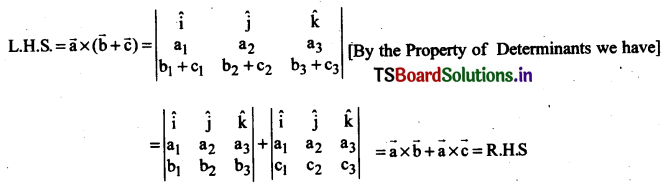
Let the vectors \(\vec{a}, \vec{b}, \vec{c} \text { be given as } a_1 \hat{i}+a_2 \hat{j}+a_3 \hat{k}, b_1 \hat{i}+b_2 \hat{j}+b_3 \hat{k}, c_1 \hat{i}+c_2 \hat{j}+c_3 \hat{k}\) given as \(a_1 \hat{i}+a_2 \hat{j}+a_3 \hat{k}, b_1 \hat{i}+b_2 \hat{j}+b_3 \hat{k}, c_1 \hat{i}+c_2 \hat{j}+c_3 \hat{k}\). Then show that \(\overrightarrow{\mathbf{a}} \times(\overrightarrow{\mathbf{b}}+\overrightarrow{\mathbf{c}})=\overrightarrow{\mathbf{a}} \times \overrightarrow{\mathbf{b}}+\overrightarrow{\mathbf{a}} \times \overrightarrow{\mathbf{c}}\).
Solution:
Given vectors \(\vec{a}=a_1 \hat{i}+a_2 \hat{j}+a_3 \hat{k}, \vec{b}=b_1 \hat{i}+b_2 \hat{j}+b_3 \hat{k}, \vec{c}=c_1 \hat{i}+c_2 \hat{j}+c_3 \hat{k}\)
∴ \(\vec{b}+\vec{c}=\left(b_1+c_1\right) \hat{i}+\left(b_2+c_2\right) \hat{j}+\left(b_3+c_3\right) \hat{k}\)
Question 3.
Find the area of the triangle with vertices A(1, 1, 2), B(2, 3, 5) and C(1, 5, 5)
Solution:
Vertices of ∆ABC are A(1, 1, 2), B(2, 3, 5) and C(1, 5, 5)
Position Vector (P.V) of point A(1, 1, 2) is \(\overrightarrow{O A}=\hat{i}+\hat{j}+2 \hat{k}\)
Position Vector (P.V) of point B(2, 3, 5) is \(\overrightarrow{\mathrm{OB}}=2 \hat{\mathrm{i}}+3 \hat{\mathrm{j}}+5 \hat{\mathrm{k}}\)
Position Vector (P.V) of point C(1, 5, 5) is \(\overrightarrow{\mathrm{OC}}=\hat{\mathrm{i}}+5 \hat{\mathrm{j}}+5 \hat{\mathrm{k}}\)
\(\overrightarrow{A B}=\overrightarrow{O B}-\overrightarrow{O A}=(2 \hat{i}+3 \hat{j}+5 \hat{k})-(\hat{i}+\hat{j}+2 \hat{k})=2 \hat{i}+3 \hat{j}+5 \hat{k}-\hat{i}-\hat{j}-2 \hat{k}=\hat{i}+2 \hat{j}+3 \hat{k}\)
\(\overrightarrow{A C}=\overrightarrow{O C}-\overrightarrow{O A}=(\hat{i}+5 \hat{j}+5 \hat{k})-(\hat{i}+\hat{j}+2 \hat{k})=\hat{i}+5 \hat{j}+5 \hat{k}-\hat{i}-\hat{j}-2 \hat{k}=0 \hat{i}+4 \hat{j}+3 \hat{k}\)
∴ \(\overrightarrow{\mathrm{AB}} \times \overrightarrow{\mathrm{AC}}=\left|\begin{array}{lll}
\hat{i} & \hat{j} & \hat{k} \\
1 & 2 & 3 \\
0 & 4 & 3
\end{array}\right|=\hat{i}(6-12)-\hat{j}(3-0)+\hat{k}(4-0)=-6 \hat{i}-3 \hat{j}+4 \hat{k}\)
Area of triangle ABC = \(\frac{1}{2}|\overrightarrow{\mathrm{AB}} \times \overrightarrow{\mathrm{AC}}|=\frac{1}{2} \sqrt{36+9+16}=\frac{\sqrt{61}}{2} \text { sq. units. }\)
III.
Question 1.
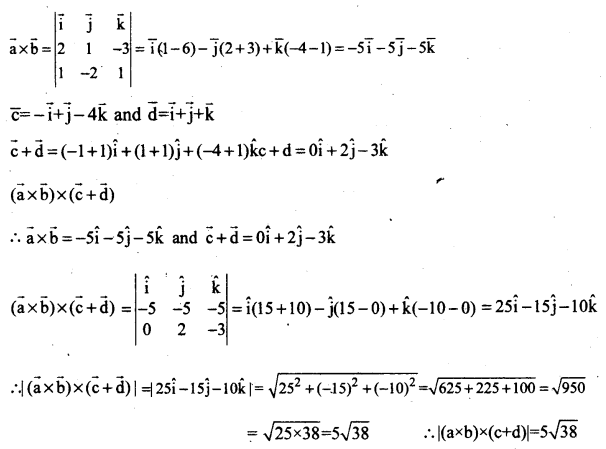
If \(\vec{a}=2 \vec{i}+\vec{j}-3 \vec{k}, \vec{b}=\vec{i}-2 \vec{j}+\vec{k}, \vec{c}=-\vec{i}+\vec{j}-4 \vec{k} \text { and } \vec{d}=\vec{i}+\vec{j}+\vec{k}\) then compute \(|(\overline{\mathbf{a}} \times \overline{\mathbf{b}}) \times(\overline{\mathbf{c}}+\overline{\mathbf{d}})|\)
Solution:
Given vectors \(\vec{a}=2 \vec{i}+\vec{j}-3 \vec{k}, \vec{b}=\vec{i}-2 \vec{j}+\vec{k}, \vec{c}=-\vec{i}+\vec{j}-4 \vec{k} \text { and } \vec{d}=\vec{i}+\vec{j}+\vec{k}\)
Question 2.
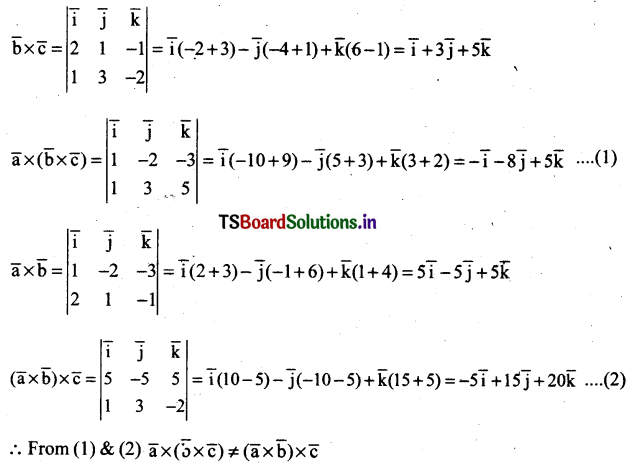
If \(\bar{a}=\bar{i}-2 \bar{j}-3 \bar{k}, \bar{b}=2 \bar{i}+\bar{j}-\bar{k}, \bar{c}=\bar{i}+3 \bar{j}-2 \bar{k}\) then, verify \(\overline{\mathbf{a}} \times(\overline{\mathbf{b}} \times \overline{\mathbf{c}}) \neq(\overline{\mathbf{a}} \times \overline{\mathbf{b}}) \times \overline{\mathbf{c}}\)
Solution:
Question 3.
If \(\overline{\mathrm{a}}=7 \overline{\mathrm{i}}-\overline{2 \mathrm{j}}+\overline{\mathrm{k}}, \overline{\mathrm{~b}}=2 \overline{\mathrm{i}}+8 \overline{\mathrm{k}} \text { and } \overline{\mathrm{c}}=\overline{\mathrm{i}}+\overline{\mathrm{j}}+\overline{\mathrm{k}}\), then compute \(\mathbf{a} \times \mathbf{b}, \overline{\mathbf{a}} \times \overline{\mathbf{c}} \text { and } \overline{\mathbf{a}} \times(\overline{\mathbf{b}}+\mathbf{c})\). Verify whether cross product is distributive over vector addiion.
Solution:
Given that \(\overline{\mathrm{a}}=7 \overline{\mathrm{i}}-\overline{2 \mathrm{j}}+\overline{\mathrm{k}}, \overline{\mathrm{~b}}=2 \overline{\mathrm{i}}+8 \overline{\mathrm{k}} \text { and } \overline{\mathrm{c}}=\overline{\mathrm{i}}+\overline{\mathrm{j}}+\overline{\mathrm{k}}\)
Now \(\bar{a} \times \bar{b}=\left|\begin{array}{ccc}
\bar{i} & \bar{j} & \bar{k} \\
7 & -2 & 3 \\
2 & 0 & 8
\end{array}\right|=\bar{i}(-16-0)-\bar{j}(56-6)+\bar{k}(0+4)=-16 \bar{i}-50 \bar{j}+4 \bar{k}\)
Also, \(\bar{a} \times \bar{c}=\left|\begin{array}{ccc}
\bar{i} & \bar{j} & \bar{k} \\
7 & -2 & 3 \\
1 & 1 & 1
\end{array}\right|=\bar{i}(-2-3)-\bar{j}(7-3)+\bar{k}(7+2)=-5 \bar{i}-4 \bar{j}+9 \bar{k}\)
Now \(\bar{b}+\bar{c}=(2 \bar{i}+8 \bar{k})+(\bar{i}+\bar{j}+\bar{k})=3 \bar{i}+\bar{j}+9 \bar{k}\)
\(\bar{a} \times(\bar{b}+\bar{c})=\left|\begin{array}{ccc}
\bar{i} & \bar{j} & \bar{k} \\
7 & -2 & 3 \\
3 & 1 & 9
\end{array}\right|==\bar{i}(-18-3)-\bar{j}(63-9)+\bar{k}(7+6)=-21 \bar{i}-54 \bar{j}+13 \bar{k}\) …….(1)
Now \((\overline{\mathrm{a}} \times \overline{\mathrm{b}})+(\overline{\mathrm{a}} \times \overline{\mathrm{c}})=(-16 \overline{\mathrm{i}}-50 \overline{\mathrm{j}}+4 \overline{\mathrm{k}})+(-5 \overline{\mathrm{i}}-4 \overline{\mathrm{j}}+9 \overline{\mathrm{k}})=-21 \overline{\mathrm{i}}-54 \overline{\mathrm{j}}+13 \overline{\mathrm{k}}\) ……(2)
From (1) and (2) we have \(\bar{a} \times(\bar{b}+\bar{c})=(\bar{a} \times \bar{b})+(\bar{a} \times \bar{c})\)
∴ Vector product is distributive over vector addition.
Question 4.
If \(\bar{a}=2 \bar{i}+3 \bar{j}+4 \bar{k}, \bar{b}=\bar{i}+\bar{j}-\bar{k}, \bar{c}=\bar{i}-\bar{j}+\bar{k}\), compute \(\overline{\mathbf{a}} \times(\overline{\mathbf{b}} \times \overline{\mathbf{c}})\) and verify that it is perpendicular to \(\overline{\mathbf{a}}\)
Solution:
Given \(\bar{a}=2 \bar{i}+3 \bar{j}+4 \bar{k}, \bar{b}=\bar{i}+\bar{j}-\bar{k}, \bar{c}=\bar{i}-\bar{j}+\bar{k}\)
\(\bar{b} \times \bar{c}=\left|\begin{array}{ccc}
\bar{i} & \bar{j} & \bar{k} \\
1 & 1 & -1 \\
1 & -1 & 1
\end{array}\right|=\bar{i}(1-1)-\bar{j}(1+1)+\bar{k}(-1-1)=-2 \bar{j}-2 \bar{k}\)
∴ \(\overline{\mathrm{a}} \times(\overline{\mathrm{b}} \times \overline{\mathrm{c}})=\left|\begin{array}{ccc}
\overline{\mathrm{i}} & \overline{\mathrm{j}} & \overline{\mathrm{k}} \\
2 & 3 & 4 \\
0 & -2 & -2
\end{array}\right|=\overline{\mathrm{i}}(\cdot 6+8)-\overline{\mathrm{j}}(-4-0)+\overline{\mathrm{k}}(-4-0)=2 \overline{\mathrm{i}}+4 \overline{\mathrm{j}}-4 \overline{\mathrm{k}}\)
Now \([(\overline{\mathrm{a}} \times \overline{\mathrm{b}}) \times \overline{\mathrm{c}})] \cdot \overrightarrow{\mathrm{a}}=(2 \overline{\mathrm{i}}+4 \cdot \overline{\mathrm{j}}-4 \overline{\mathrm{k}}) \cdot(2 \overline{\mathrm{i}}+3 \overline{\mathrm{j}}+4 \overline{\mathrm{k}})\) = 4 + 12 – 16 = 0
∴ \((\overline{\mathrm{a}} \times \overline{\mathrm{b}}) \times \overline{\mathrm{c}})\) is perpendicular to \(\overline{\mathbf{a}}\)
Question 5.
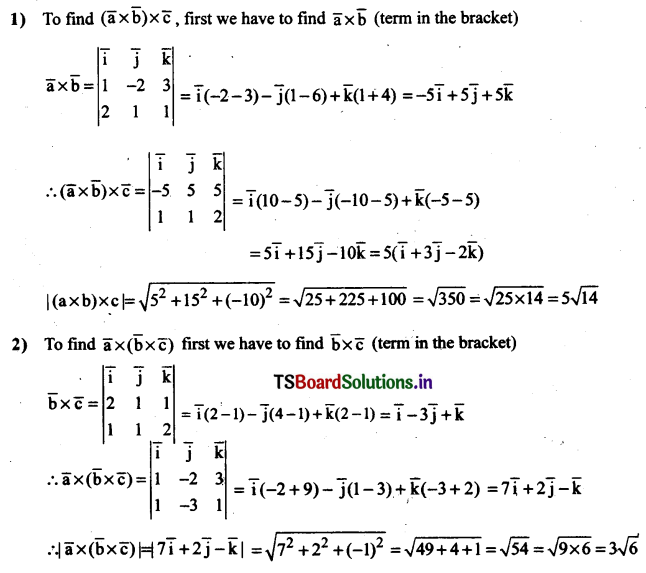
If \(\overline{\mathbf{a}}=\overline{\mathbf{i}}-2 \overline{\mathbf{j}}+3 \overline{\mathbf{k}}, \overline{\mathbf{b}}=2 \overline{\mathbf{i}}+\overline{\mathbf{j}}+\overline{\mathbf{k}}, \overline{\mathbf{c}}=\overline{\mathbf{i}}+\overline{\mathbf{j}}+2 \overline{\mathbf{k}}\) then find \(|(\overline{\mathbf{a}} \times \overline{\mathbf{b}}) \times \overline{\mathbf{c}}| \text { and }|\overline{\mathbf{a}} \times(\overline{\mathbf{b}} \times \overline{\mathbf{c}})|\)
Solution:
Given \(\bar{a}=\bar{i}-2 \bar{j}+3 \bar{k}, \bar{b}=2 \bar{i}+\bar{j}+\bar{k}, \bar{c}=\bar{i}+\bar{j}+2 \bar{k}\)