Referring to the AP Inter 2nd Year Maths Study Material Chapter 9 Differential Equations Exercise 9f Solutions makes it easier to understand complex problems.
AP Inter 2nd Year Maths Differential Equations Solutions Exercise 9f
I.
Question 1.
Find the order and degree of \(\frac{d^2 y}{d x^2}+5 x\left(\frac{d y}{d x}\right)^2-6 y\) = log x
Solution:
\(\frac{d^2 y}{d x^2}+5 x\left(\frac{d y}{d x}\right)^2-6 y=\log x \Rightarrow \frac{d^2 y}{d x^2}+5 x\left(\frac{d y}{d x}\right)^2-6 y-\log x=0\)
Highest order derivative present in differential equation is \(\frac{d^2 y}{d x^2}\). Its order is two.
Highest power raised to \(\frac{d^2 y}{d x^2}\) is one. Its degree is one.
Question 2.
Find the order and degree of \(\left(\frac{d y}{d x}\right)^3-4\left(\frac{d y}{d x}\right)^2+7 y\) = sin x
Solution:
\(\left(\frac{d y}{d x}\right)^3-4\left(\frac{d y}{d x}\right)^2+7 y=\sin x \Rightarrow\left(\frac{d y}{d x}\right)^3-4\left(\frac{d y}{d x}\right)^2+7 y-\sin x=0\)
Highest order derivative in differential equation is \(\frac{d y}{d x}\). Its order is one.
Highest power raised to \(\frac{d y}{d x}\) is three. Its degree is three.

Question 3.
Find the order and degree of \(\frac{d^4 y}{d x^4}-\sin \left(\frac{d^3 y}{d x^3}\right)=0\)
Solution:
Highest order derivative in differential equation is \(\frac{d^4 y}{d x^4}\). Its order is four.
The given differential equation is not a polynomial equation. Degree is not defined.
Question 4.
Verify that xy = aex + be-x + x2 is implicit or explicit is a solution of the corresponding differential equation \(x \frac{d^2 y}{d x^2}+2 \frac{d y}{d x}-x y+x^2-2\) = 0
Solution:
Given Equation is xy = aex + be-x + x2 ⇒ y = \(a \frac{e^x}{x}+b \frac{e^{-x}}{x}+x\).
This in the form of y = f(x)
∴ It is explicit:
Given D.E is \(\frac{d^2 y}{d x^2}+2 \frac{d y}{d x}-x y+x^2-2=0\) = 0
Also xy = aex + be-x + x2 ……….(1)
Differentiating both sides with respect to x, we get
\(x \frac{d y}{d x}+y \cdot 1=a \frac{d}{d x}\left(e^x\right)+b \frac{d}{d x} \cdot\left(e^{-x}\right)+\frac{d}{d x}\left(x^2\right)\)
⇒ \(x \frac{d y}{d x}+y=a e^x-b e^{-x}+2 x\)
Also Differentiating both sides with respect to x, we get
\(x \frac{d^2 y}{d x^2}+\frac{d y}{d x}+\frac{d y}{d x}=a e^x+b e^{-x}+2\)
⇒ \(x \frac{d^2 y}{d x^2}+2 \frac{d y}{d x}=a e^x+b e^{-x}+2\) ……(2)
Now, we have to prove \(x \frac{d^2 y}{d x^2}+2 \frac{d y}{d x}-x y+x^2-2=0\) = 0
L.H.S = \(x \frac{d^2 y}{d x^2}+2 \frac{d y}{d x}-x y+x^2-2\)
= aex + be-x + 2 – (aex + be-x + x2) + x2 – 2 [using (1) and (2)]
= aex + be-x + 2 – aex – be-x – x2 + x2 – 2 = 0 = R.H.S.
Hence verified.
Question 5.
Verify that y = ex (acosx + bsinx) is implicit or explicit is a solution of the corresponding differential equation \(\frac{d^2 y}{d x^2}-2 \frac{d y}{d x}+2 y=0\)
Solution:
The given solution y = ex (acosx + bsinx) is in the form y = f(x) and hence it is explicit.
Given D.E is \(\frac{d^2 y}{d x^2}-2 \frac{d y}{d x}+2 y=0\). Also, y = ex(a cos x + b sin x) ……(1)
Differentiating both sides with respect to x, we get
y = ex(a cosx + b sin x) = aex cos x + bex sin x
⇒ \(\frac{d y}{d x}=a \frac{d}{d x}\left(e^x \cos x\right)+b \frac{d}{d x}\left(e^x \sin x\right)\)
⇒ \(\frac{d y}{d x}=a\left(e^x \cos x-e^x \sin x\right)+b\left(e^x \sin x+e^x \cos x\right)\)
⇒ \(\frac{d y}{d x}=(a+b) e^x \cos x+(b-a) e^x \sin x\) ……..(2)
Again, Differentiating both sides with respect to x, we get
\(\frac{d^2 y}{d x^2}=(a+b) \frac{d}{d x}\left(e^x \cos x\right)+(b-a) \frac{d}{d x}\left(e^x \sin x\right)\)
⇒ \(\frac{d^2 y}{d x^2}=(a+b) \cdot\left(e^x \cos x-e^x \sin x\right)+(b-a)\left(e^x \sin x+e^x \cos x\right)\)
⇒ \(\frac{d^2 y}{d x^2}=e^x[(a+b)(\cos x-\sin x)+(b-a)(\sin x+\cos x)]\)
⇒ \(\frac{d^2 y}{d x^2}=e^x[a \cos x-a \sin x+b \cos x-b \sin x+b \sin x+b \cos x-a \sin x-a \cos x]\)
⇒ \(\frac{d^2 y}{d x^2}=2 e^x(b \cos x-a \sin x)\) …………(3)
Now, we have to prove \(\frac{d^2 y}{d x^2}-2 \frac{d y}{d x}+2 y=0\) L.H.S = \(\frac{d^2 y}{d x^2}-2 \frac{d y}{d x}+2 y\)
= 2ex(b cos x – a sin x) – 2[(a + b)ex cos x + (b – a)ex sinx] + 2ex(a cos x + b sin x) [using (1), (2) and (2)]
= ex[(2b cos x – 2a sin x) – (2a cos x – 2b cos x) – (2b sin x – 2a sin x) + (2a cos x + 2b sin x)]
= ex[2b cos x – 2a sin x – 2a cos x – 2b cos x – 2b sin x + 2a sin x + 2a cos x + 2b sin x]
= ex[0] = 0 = R.H.S
Thus, the given function is a solution of the corresponding differential equation.
Question 6.
Verify that y = xsin 3x is implicit or explicit is a solution of the corresponding differential equation \(\frac{d^2 y}{d x^2}+9 y-6 \cos 3 x\) = 0
Solution:
The given solution y = x sin3x is in the form y = f(x) and hence it is explicit.
Given D.E is \(\frac{d^2 y}{d x^2}+9 y-6 \cos 3 x\)
Also, y = x sin 3x ………………….(1)
Differentiating both sides with respect to x, we get
⇒ \(\frac{d y}{d x}=\frac{d}{d x}(x \sin 3 x)=\sin 3 x+x \cos 3 x(3)\)
⇒ \(\frac{d y}{d x}=\sin 3 x+3 x \cos 3 x\)
Again, Differentiating both sides with respect to x, we get
\(\frac{d^2 y}{d x^2}=\frac{d}{d x}(\sin 3 x)+3 \frac{d}{d x}(x \cos 3 x)\)
⇒ \(\frac{d^2 y}{d x^2}=3 \cos 3 x+3[\cos 3 x+x(-\sin 3 x) \cdot 3]\)
⇒ \(\frac{d^2 y}{d x^2}=6 \cos 3 x-9 x \sin 3 x\) ……………..(2)
Now, we have \(\frac{d^2 y}{d x^2}+9 y-6 \cos 3 x=0\)
L.H.S. = \(\frac{d^2 y}{d x^2}+9 y-6 \cos 3 x\)
= (6 cos 3x – 9x sin 3x) + 9x sin 3x – 6 cos 3x = 0 = RHS [using (1) and (2)]
Hence verified.
Question 7.
Verify that x2 = 2y2log y is implicit or explicit is a solution of the corresponding differential equation \(\left(x^2+y^2\right) \frac{d y}{d x}-x y=0\).
Solution:
The given solution is in the form x = f(y) and hence it is explicit.
Given D.E is \(\left(x^2+y^2\right) \frac{d y}{d x}-x y=0\) Also, x2 = 2y2 log y ………..(1)
⇒ \(x=\frac{d y}{d x}(2 y \log y+y) \Rightarrow \frac{d y}{d x}=\frac{x}{y(1+2 \log y)}\) ……….(2)
Now, we have to prove \(\left(x^2+y^2\right) \frac{d y}{d x}-x y=0\)
L.H.S = \(\left(x^2+y^2\right) \frac{d y}{d x}-x y=0\) = (2y2log y + y2).\(\frac{x}{y(1+2 \log y)}\) – xy [using (1) and (2)]
= y2(1 + 2 log y).\(\frac{x}{y(1+2 \log y)}\) – xy = xy – xy = 0 = RHS
Question 8.
Find the general solution of the differential equation \(\frac{d y}{d x}+\sqrt{\frac{1-y^2}{1-x^2}}=0\)
Solution:
Given D.E is \(\frac{d y}{d x}+\sqrt{\frac{1-y^2}{1-x^2}}=0 \Rightarrow \frac{d y}{d x}=-\frac{\sqrt{1-y^2}}{\sqrt{1-x^2}} \Rightarrow \frac{d y}{\sqrt{1-y^2}}=-\frac{d x}{\sqrt{1-x^2}}\)
Integrating both sides, we get sin-1y = -sin-1x + C ⇒ sin-1x + sin-1y = C
II.
Question 1.
Find the equation of the curve passing through the point (0, \(\frac{\pi}{4}\)) whose differential equation is sin x cos y dx + cos x sin y dy = 0.
Solution:
Given D.E is sin x cos ydx + cos xsin ysy = 0 ⇒ \(\frac{\sin x \cos y d x+\cos x \sin y d y}{\cos x \cos y}=0\)
⇒ tan xdx + tan ydy = 0 ⇒ log(sec x)+log(sec y) = logC
⇒ log(secx sec y)=log C ⇒ secx. secy = C
The curve passes through the point (0, \(\frac{\pi}{4}\))
⇒ 1 x \(\sqrt{2}\) = C ⇒ C = \(\sqrt{2}\) ⇒ sec x sec y = \(\sqrt{2}\) ⇒ sec x.\(\frac{1}{\cos y}=\sqrt{2}\) ⇒ cos y = \(\frac{\sec x}{\sqrt{2}}\)
The equation of the curve is sec x. sec y = \(\sqrt{2}\)
Question 2.
Find the particular solution of the differential equation
(1 + e2x)dy + (1 + y2)exdx = 0, given that y = 1 when x = 0.
Solution:
Given D.E is (1 + e2x)dy + (1 + y2)exdx = 0 ⇒ \(\frac{d y}{1+y^2}+\frac{e^x}{1+e^{2 x}} d x=0\)
Integrating both sides, we get \(\tan ^{-1} y+\int \frac{e^x d x}{1+e^{2 x}}=C\) ….(1)
Let ex = t ⇒ e2x = t2
\(\frac{d}{d x}\left(e^x\right)=\frac{d t}{d x} \Rightarrow e^x=\frac{d t}{d x} \Rightarrow e^x=\frac{d t}{d x} \Rightarrow e^x d x=d t\)
Substituting this value in equation (1), we get
\(\tan ^{-1} y+\int \frac{d t}{1+t^2}=C \Rightarrow \tan ^{-1} y+\tan ^{-1} t=C \Rightarrow \tan ^{-1} y+\tan ^{-1}\left(e^x\right)=C\)
We have x = 0 at y = 1
Hence, tan-1 1 + tan-11 = C ⇒ \frac{\pi}{4}+\frac{\pi}{4}=C \Rightarrow C=\frac{\pi}{2}\(\)
Thus, tan-1y + tan-1(ex) = \(\frac{\pi}{2}\)
Question 3.
Solve the differential equation \(y e^{\frac{x}{y}} d x=\left(x e^{\frac{x}{y}}+y^2\right) d y\) (y ≠ 0)
Solution:
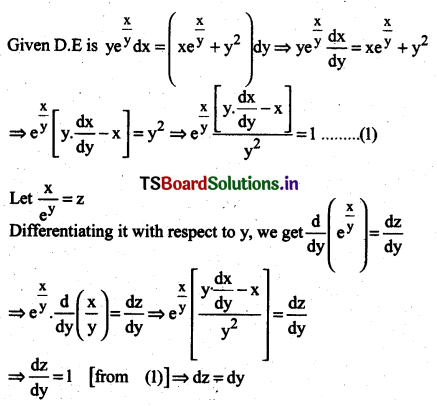
Integrating both sides, we get x = y + C ⇒ \(e^{\frac{x}{y}}\) = y + C
Question 4.
Solve the differential equation \(\left[\frac{e^{-2 \sqrt{x}}}{\sqrt{x}}-\frac{y}{\sqrt{x}}\right] \frac{d x}{d y}=1\) (x ≠ 0)
Solution:
Given D.E is \(\left[\frac{e^{-2 \sqrt{x}}}{\sqrt{x}}-\frac{y}{\sqrt{x}}\right] \frac{d x}{d y}=1 \Rightarrow \frac{d y}{d x}=\frac{e^{-2 \sqrt{x}}}{\sqrt{x}}-\frac{y}{\sqrt{x}} \Rightarrow \frac{d y}{d x}+\frac{y}{\sqrt{x}}=\frac{e^{-2 \sqrt{x}}}{\sqrt{x}}\)
This equation is a linear differential equation of the form
\(\frac{d y}{d x}\) + Py = Q where P = \(\frac{1}{\sqrt{x}}\) and Q = \(\frac{e^{-2 \sqrt{x}}}{\sqrt{x}}\)
Now, IF = \(e^{\int P d x}=e^{\int \frac{1}{\sqrt{x}} d x}=e^{2 \sqrt{x}}\)
The general solution of the given D.E is given by, y(IF) = ∫(Q × IF) + C
⇒ \(y e^{2 \sqrt{x}}=\int\left(\frac{e^{-2 \sqrt{x}}}{\sqrt{x}} x e^{2 \sqrt{x}}\right) d x+C \Rightarrow y e^{2 \sqrt{x}}=\int \frac{1}{\sqrt{x}} d x+C \Rightarrow y e^{2 \sqrt{x}}=2 \sqrt{x}+C\)
Question 5.
Find a particular solution of the differential equation \(\frac{d y}{d x}\) + y cot x = 4xcosecx (x ≠ 0), given that y = 0 when x = \(\frac{\pi}{2}\)
Solution:
Given D.E is \(\frac{d y}{d x}\) + y cot x = 4x cosecx
This equation is a linear differential equation of the form \(\frac{d y}{d x}\) + Py = Q
where P = cot x and Q = 4xcosecx
Now, IF = \(\mathrm{e}^{\int \mathrm{Pdx}}=\mathrm{e}^{\int \cot \mathrm{xdx}}=\mathrm{e}^{\log |\sin \mathrm{x}|}=\sin \mathrm{x}\)
The general solution of the given D.E is given by,
y(IF) = \(\int(Q \times I F) d x+C \Rightarrow y \sin x=\int(4 x {cosec} x \cdot \sin x) d x+C\)
\(y \sin x=4 \int x d x+C \Rightarrow y \sin x=4 \cdot \frac{x^2}{2}+C \Rightarrow y \sin x=2 x^2+C\)
We have x = \(\frac{\pi}{2}\) at y = 0
∴ \(2 \times \frac{\pi^2}{4}+C \Rightarrow C=-\frac{\pi^2}{2}\). Thus, y sinx = \(2x^2-\frac{\pi^2}{2}\), sin x ≠ 0
III.
Question 1.
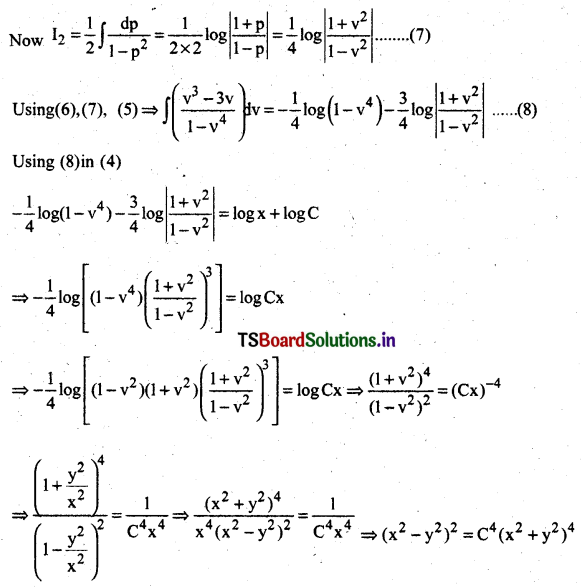
Prove that x2 – y2 = c (x2 + y2)2 is the general solution of differential equation (x3 – 3xy2) dx = (y3 – 3x2y) dy, where c is a parameter.
Solution:
(x3 – 3xy2) dx = (y3 – 3x2y) dy ⇒ \(\frac{d y}{d x}=\frac{x^3-3 x y^2}{y^3-3 x^2 y}\) …(1)
This is a homogenous equation, to simplify it,
Let y = vx …………(2)
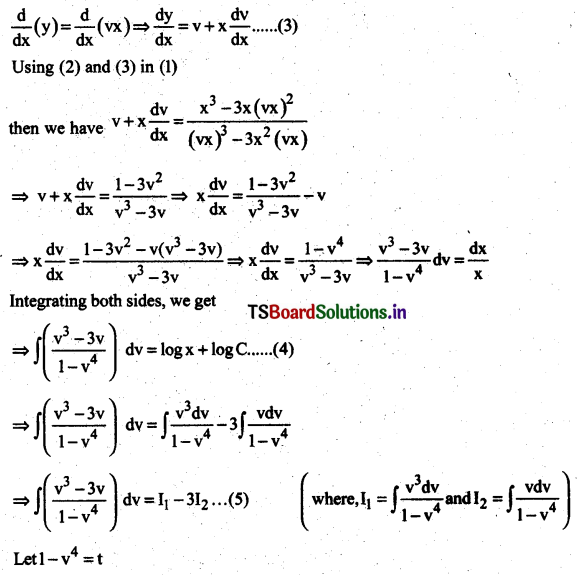
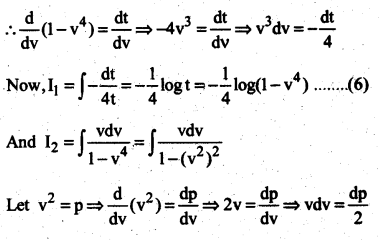
Taking square root on both sides
⇒ (x2 – y2) = C2(x2 + y2)2 ⇒ (x2 – y2) = k(x2 + y2)2 where, k = C2
Question 2.
Show that the general solution of the differential equation \(\frac{d y}{d x}+\frac{y^2+y+1}{x^2+x+1}=0\) is given by (x + y + 1) = A (1 – x – y – 2xy), where A is parameter.
Solution:
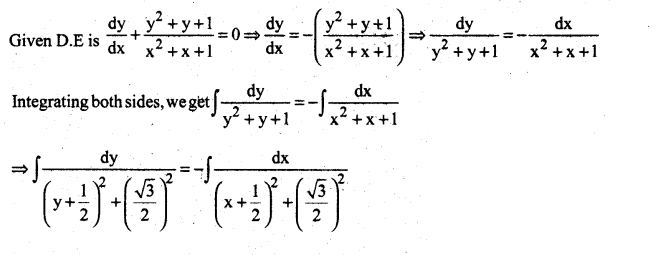
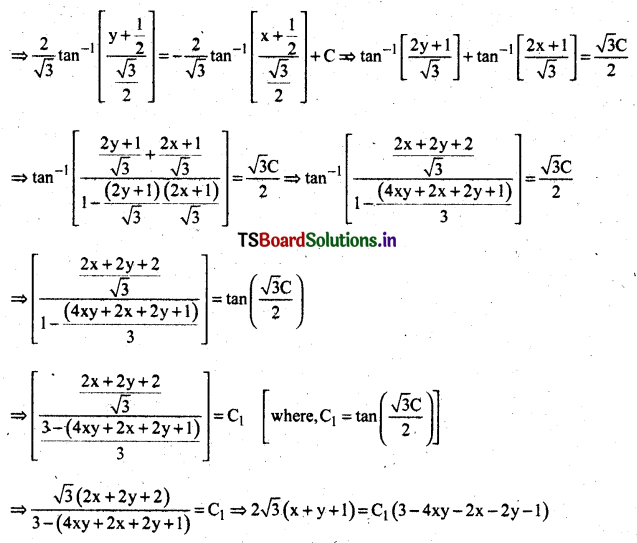
⇒ \(2 \sqrt{3}(x+y+1)=C_1(2-4 x y-2 x-2 y) \Rightarrow 2 \sqrt{3}(x+y+1)=C_1 \times 2(1-2 x y-x-y)\)
⇒ \(\sqrt{3}(x+y+1)=C_1(1-x-y-2 x y)\)
⇒ \((x+y+1)=\frac{C_1}{\sqrt{3}}(1-x-y-2 x y) \Rightarrow(x+y+1)=A(1-x-y-2 x y)\) [Where A = \(\frac{C_1}{\sqrt{3}}\)]
Question 3.
Find a particular solution of the differential equation (x – y) (dx + dy) = dx – dy, given that y = -1, when x = 0. (Hint: put x – y = t)
Solution:
GivenD.E is (x – y)(dx + dy) = (dx – dy) ⇒ (x – y + 1)dy = (1 – x + y)dx
⇒ \(\frac{d y}{d x}=\frac{1-x+y}{x-y+1} \Rightarrow \frac{d y}{d x}=\frac{1-(x-y)}{1+(x-y)}\) ……………(1)
Let x – y = t ……..(2)
⇒ \(\frac{d}{d x}(x-y)=\frac{d t}{d x} \Rightarrow 1-\frac{d y}{d x}=\frac{d t}{d x} \Rightarrow 1-\frac{d t}{d x}=\frac{d y}{d x}\) ……..(3)
Using (1), (2) and (3)
⇒ \(1-\frac{\mathrm{dt}}{\mathrm{dx}}=\frac{1-\mathrm{t}}{1+\mathrm{t}} \Rightarrow \frac{\mathrm{dt}}{\mathrm{dx}}=1-\left(\frac{1-\mathrm{t}}{1+\mathrm{t}}\right)\)
⇒ \(\frac{d t}{d x}=\frac{(1+t)-(1-t)}{1+t} \Rightarrow \frac{d t}{d x}=\frac{2 t}{1+t}\)
⇒ \(\left(\frac{1+t}{t}\right) d t=2 d x \Rightarrow\left(1+\frac{1}{t}\right) d t=2 d x\)
Integrating both sides, we get ⇒ t + log|t| = 2x + C
⇒ (x – y) + log |x – y| = 2x + C ⇒ log|x – y| = x + y + C
We have x = 0 at y = -1
⇒ log 1 = 0 – 1 + C ⇒ C = 1 ⇒ log|x – y| = x + y + 1
Question 4.
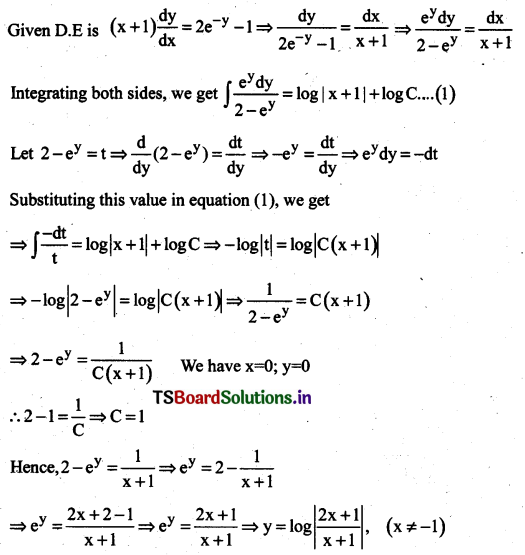
Find a particular solution of the differential equation (x + 1)\(\frac{d y}{d x}\) = 2e-y – 1 given that y = 0 when x = 0.
Solution: