
Referring to the AP Inter 2nd Year Maths Study Material Chapter 12 Linear Programming Exercise 12a Solutions makes it easier to understand complex problems.
AP Inter 2nd Year Maths Linear Programming Solutions Exercise 12a
I. Solve the following Linear Programming Problems graphically:
Question 1.
Maximise Z = 3x + 4y subject to the constraints : x + y ≤ 4, x ≥ 0, y ≥ 0
Solution:
The feasible region determined by the constraints,
x + y ≤ 4, x ≥ 0, y ≥ 0 and is given by the shaded region.
The comer points of the feasible region are
O(0, 0), A(4, 0) and B(0, 4) .
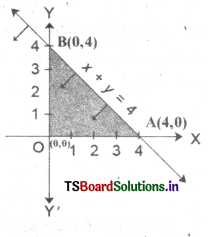
The value of Z at these points are as follows:
| Corner Point | Z = 3x+4y | |
| O(0, 0) | 0 | |
| A(4, 0) | 12 | |
| B(0, 4) | 16 | → Maximum |
Thus, the maximum value of Z is 16 at the point B(0, 4)

Question 2.
Maximise Z = x + y, subject to x – y ≤ -1, -x + y ≤ 0, x, y ≥ 0.
Solution:
The feasible region determined by the system of constraints,
x – y ≤ -1, -x + y ≤ 0, and x, y ≥ 0, is given by the shaded region.
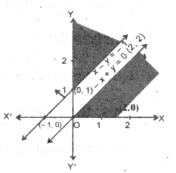
There is no feasible region and thus, Z has no maximum value.
Question 3.
Define Objective function
Solution:
Objective function : The Linear function Z = ax + by, where a, b are constants, which has to be maximized or minimized in the LPP is called a linear objective function.
Question 4.
Define Constraints
Solution:
Constraints: The linear inequalities or equations or restrictions on the variables of a linear programming problem are called constraints.
Question 5.
Define Optimal Solution
Solution:
Optimal (feasible) solution : The point in the feasible region that gives the optimal value (maximum or minimum) of the objective function is called an optimal solution.
Question 6.
Any point outside the feasible region is called _________.
Solution:
an infeasible point
II.
Question 1.
Solve the Linear Programming Problem graphically:
Minimise Z = – 3x + 4 y subject to x + 2y ≤ 8, 3x + 2v ≤ 12, x ≥ 0, y ≥ 0.
Solution:
The feasible region determined by the system of constraints,
x + 2y ≤ 8, 3x + 2y ≤ 12, x ≥ 0, and y ≥ 0 is given by the shaded region.
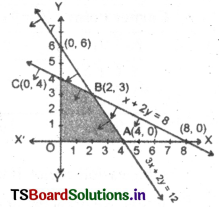
The corner points of the feasible region are
O(0, 0), A(4, 0), B(2, 3), C(0, 4).
The value of Z at these comer points are as follows:
| Corner Point | Z = -3x + 4y | |
| O(0, 0) | 0 | |
| A(4, 0) | -12 | → Minimum |
| B(2, 3) | 6 | |
| C(0, 4) | 16 |
Thus, the minimum value of Z is -12 at the point A(4, 0)
Question 2.
Solve the Linear Programming Problem graphically:
Maximise Z = 5x + 3y subject to 3x + 5y ≤ 15, 5x + 2y ≤ 10, x ≥ 0, y ≥ 0.
Solution:
The feasible region determined by the system of constraints,
3x + 5y ≤ 15, 5x + 2y ≤ 10, x ≥ 0, and y ≥ 0 is given by the shaded region.
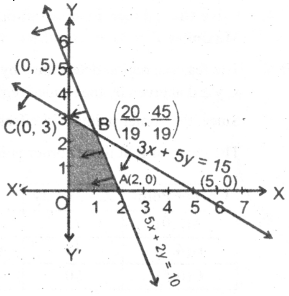
The corner points of the feasible region are
O(0, 0), A(2, 0), B\(\left(\frac{20}{19}, \frac{45}{19}\right)\) , C(0, 3).
The value of Z at these comer points are as follows:
| Corner Point | Z = 5x + 3y | |
| O(0, 0) | 0 | |
| A(2, 0) | 10 | |
| B\(\left(\frac{20}{19}, \frac{45}{19}\right)\) | \(\frac{235}{19}\) = 12.3 | → Maximum |
| C(0, 3) | 9 |
Thus, the minimum value of Z is \(\frac{235}{19}\) at the point B.
Question 3.
Solve the Linear Programming Problem graphically:
Minimise Z = 3x + 5y such that x + 3y ≥ 3, x + y ≥ 2, x, y ≥ 0.
Solution:
The feasible region determined by the system of constraints,
x + 3y ≥ 3, x + y ≥ 2, and x, y ≥ 0 is given by the shaded region.
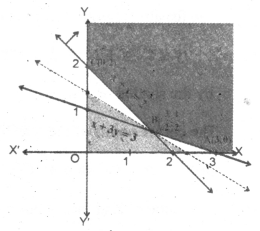
The feasible region is unbounded, the comer points of the feasible region are A(3, 0), B\(\left(\frac{3}{2}, \frac{1}{2}\right)\) and C(0, 2)
The values of Z at these comer points are as follows:
| Corner Point | Z = 3x + 5y | |
| A(3, 0) | 9 | |
| B\(\left(\frac{3}{2}, \frac{1}{2}\right)\) | 7 | → Minimum |
| C(0, 2) | 10 |
As the feasible region is unbounded, therefore, 7 may or may not be the minimum value of Z. For this, we draw the graph of the inequality, 3x + 5y < 7, and check whether the resulting half plane has points in common with the feasible region or not.
Since, feasible region has no common point with 3x + 5y < 7
Thus, the minimum value of Z is 7 at \(\left(\frac{3}{2}, \frac{1}{2}\right)\)
Question 4.
Solve the Linear Programming Problem graphically:
Maximise Z = 3x + 2y subject to x + 2y ≤ 10, 3x + y ≤ 15, x, y ≥ 0.
Solution:
The feasible region determined by the system of constraints, x + 2y ≤ 10, 3x + y ≤ 15, and x, y ≥ 0 is given by the shaded region.
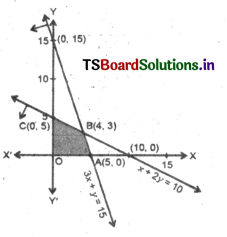
Since, the comer points of the feasible region are A(5, 0), B(4, 3), C(0, 5).
The value of Z at these comer points are as follows:
| Corner Point | Z = 3x + 2y | |
| A(5, 0) | 15 | |
| B(4, 3) | 18 | → Maximum |
| C(0, 5) | 10 |
Thus, the minimum value of Z is 18 at the point B(4, 3)
Question 5.
Solve the Linear Programming Problem graphically:
Minimise Z = x + 2y subject to 2x + y ≥ 3, x + 2y ≥ 6, x, y ≥ 0.
Solution:
The feasible region determined by the system of constraints,
2x + y ≥ 3, x + 2y ≥ 6, and x, y ≥ 0 is given by the shaded region.
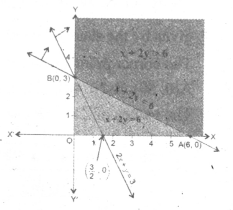
The comer points of the feasible region are A(6, 0), B(0, 3)
The value of Z at these comer points are as follows:
| Corner point | Z = x + 2y |
| A(6, 0) | 6 |
| B(0, 3) | 6 |
Here the values of Z at points A and B is same.
If we take any other point such as (2, 2) on line x + 2y = 6, then Z = 6.
Thus, the minimum value of Z occurs at more than 2 points.
Thus, the value of Z is minimum at every point on the line, x + 2y = 6.
Question 6.
Show that the minimum of Z occurs at more than two points.
Minimise and Maximise Z = 5x + 10 y subject to x + 2y ≤ 120, x + y ≥ 60, x – 2y ≥ 0, x, y ≥ 0.
Solution:
The feasible region determined by the system of constraints,
x + 2y ≤ 120, x + y ≥60, x – 2y ≥ 0, and x, y ≥ 0 is given by the shaded region.
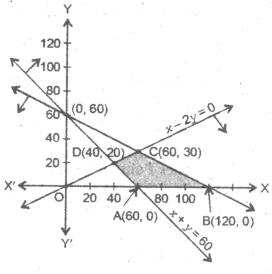
The comer points of the feasible region are A(60, 0), B(120, 0), C(60, 30) and D(40, 20)
The values of Z at these comer points are as follows:
| Corner Point | Z = 5x + 10y | |
| A(60, 0) | 300 | → Minimum |
| B(120, 0) | 600 | → Maximum |
| C(60, 30) | 600 | → Maximum |
| D(40, 20) | 400 |
The minimum value of Z is 300 at A (60, 0) and the
maximum value of Z is 600 at all the points on the line segment joining B( 120, 0) and C(60, 30).
Question 7.
Show that the minimum of Z occurs at more than two points.
Minimise and Maximise Z = x + 2y subject to x + 2y ≥ 100, 2x – y ≤ 0, 2x + y ≤ 200; x, y ≥ 0.
Solution:
The feasible region determined by the system of constraints,
x + 2y ≥ 100, 2x – y ≤ 0, 2x + y ≤ 200 and x, y ≥ 0 is given by the shaded region.
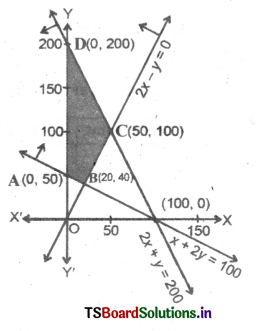
The corner points of the feasible region are
A(0, 50), B(20, 40), C(50, 100) and D(0, 200)
The values of Z at these comer points are as follows:
| Corner Point | Z = x + 2y | |
| A(0, 50) | 100 | → Minimum |
| B(20, 40) | 100 | → Minimum |
| C(50, 100) | 250 | |
| D(0, 200) | 400 | → Maximum |
The minimum value of Z is 400 at A (0, 50), B(20, 40) and the maximum value of Z is 400 at D(0, 200)
Question 8.
Show that the minimum of Z occurs at more than two points.
Maximise Z = – x + 2y, subject to the constraints: x ≥ 3, x + y ≥ 5, x + 2y ≥ 6, x, y ≥ 0.
Solution:
The feasible region determined by the given system of constraints is shown by the shaded region in the graph.
The feasible region is unbounded.
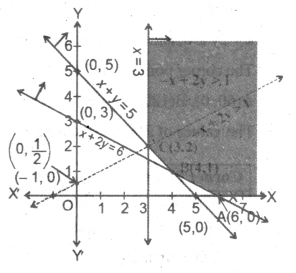
The values of Z at corner points A(6, 0), B(4, 1), C(3, 2) are as follows:
| Corner Point | Z = -x + 2y |
| A(6, 0) | z = -6 |
| B(4, 1) | z = -2 |
| C(3, 2) | z = 1 |
As the feasible region is unbounded, hence Z = 1 may or may not be the maximum value.
For this, we graph the inequality, -x + 2y > 1, and check whether the resulting half plane has points in common with the feasible region or not.
The resulting feasible region has points in common with the feasible region.
Thus, Z = 1 is not the maximum value. Hence Z has no maximum value.