
Referring to the AP Inter 2nd Year Maths Study Material Chapter 9 Differential Equations Exercise 9e Solutions makes it easier to understand complex problems.
AP Inter 2nd Year Maths Differential Equations Solutions Exercise 9e
II.
Question 1.
Find the general solution of \(\frac{d y}{d x}\) + 2y = sinx
Solution:
Given D.E. is \(\frac{d y}{d x}\) + 2y = sin x
This is in the form \(\frac{d y}{d x}\) + Py = Q where p = 2 and Q = sin x
IF = \(e^{\int P d x}=e^{\int 2 d x}=e^{2 x}\)
G.S: y(I.F) = \(\int(Q \times I . F) \cdot d x+C \Rightarrow y e^{2 x}=\int \sin x e^{2 x} d x+C\) …..(1)
Let I = \(\int \sin x \cdot e^{2 x} d x \Rightarrow I=\sin x \int e^{2 x} d x-\int\left(\frac{d}{d x}(\sin x) \int e^{2 x} d x\right) d x\)
⇒ I = \(\sin x \cdot \frac{e^{2 x}}{2}-\int\left(\cos x \cdot \frac{e^{2 x}}{2}\right) d x\)
⇒ I = \(\frac{e^{2 x} \sin x}{2}-\frac{1}{2}\left[\cos x \cdot \int e^{2 x}-\int\left(\frac{d}{d x}(\cos x) \cdot \int e^{2 x} d x\right) d x\right]\)
⇒ I = \(\frac{e^{2 x} \sin x}{2}-\frac{1}{2}\left[\cos x \cdot \frac{e^{2 x}}{2}-\int\left[(-\sin x) \cdot \frac{e^{2 x}}{2}\right] d x\right]\)
⇒ I = \(\frac{e^{2 x} \sin x}{2}-\frac{e^{2 x} \cos x}{4}-\frac{1}{4} \int\left(\sin x \cdot e^{2 x}\right) d x\)
⇒ I = \(\frac{e^{2 x}}{4}(2 \sin x-\cos x)-\frac{1}{4} I \Rightarrow \frac{5}{4} I=\frac{e^{2 x}}{4}(2 \sin x-\cos x)\)
⇒ I = \(\frac{e^{2 x}}{5}\)(2sin x – cos x)
(1) ⇒ ye2x = \(\frac{e^{2 x}}{5}\)(2sin x – cos x) + C ⇒ y = \(\frac{1}{5}\)(2sin x – cos x) + Ce-2x
Question 2.
Find the general solution of \(\frac{d y}{d x}\) + 3y = e-2x
Solution:
Given D.E. is in the form \(\frac{d y}{d x}\) + Py = Q where, p = 3 and Q = e-2x
IF = \(e^{\int P d x}=e^{\int 3 d x}=e^{3 x}\)
GS: y(I.F) = ∫(Q × F)dx + C
⇒ ye3x = ∫(e-2x x e3x) + C ⇒ ye3x = ∫exdx + C ⇒ ye3x = ex + C ⇒ y = e-2x + Ce-3x

Question 3.
Find the general solution of \(\frac{d y}{d x}+\frac{y}{x}\) = x2
Solution:
Given D.E. is in the form \(\frac{d y}{d x}\) + Py = Q where, p = \(\frac{1}{x}\) and Q = x2
IF = \(e^{\int P d x}=e^{\int \frac{1}{x} d x}=e^{\log x}\) = x
GS: y(I.F) = \(\int(\mathrm{Q} \times \mathrm{IF}) \mathrm{dx}+\mathrm{C}\)
∴ yx = ∫(x2.x)dx + C ⇒ yx = ∫ x3dx + C ⇒ xy = \(\frac{x^4}{4}\) + C
Question 4.
Find the general solution of \(\frac{d y}{d x}\) + (sec x)y = tan x,(0 ≤ x < \(\frac{\pi}{2}\))
Solution:
Given D.E. is in the form \(\frac{d y}{d x}\) + Py = Q where, P = sec x and Q = tan x
IF = \(\) = sec x + tan x
GS: y(I.F) = ∫(Q × IF)dx + C ⇒ y(sec x + tan x) = ∫tan x(sec x + tan x)dx + C
⇒ y(sec x + tan x) = ∫secx tan x dx + ∫tan2 dx + C
⇒ y(sec x+ tan x) = sec x + ∫(sec2x – 1)dx + C ⇒ y(sec x + tan x) = sec x + tan x – x + C
Question 5.
Find the general solution of cos2 x\(\frac{d y}{d x}\) + y = tan x(0 ≤ x < \(\frac{\pi}{2}\))
Solution:
Given D.E. is cos2 x\(\frac{d y}{d x}\) + y = tan x(0 ≤ x < \(\frac{\pi}{2}\)) ⇒ \(\frac{d y}{d x}+\frac{y}{\cos ^2 x}=\frac{\tan x}{\cos ^2 x}\)
⇒ \(\frac{d y}{d x}\) + (sec2 x)y = sec2 x.tan x which is in the form of \(\frac{d y}{d x}\) + Py = Q
where, P = sec2 x and Q = sec2 x. tan x IF = \(\)
G.S: y(IF) = ∫(Q × IF)dx + C ⇒ yetan x = ∫(sec2 x tan x etan x)dx + C
⇒ yetan x = etan x(tan x – 1) + C ⇒ y = (tan x -1) + Ce-tan x
Question 6.
Find the general solution of \(x \frac{d y}{d x}\) + 2y = x2 log x
Solution:
Given D.E. is \(x \frac{d y}{d x}\) + 2y = x2 log x ⇒ \(\frac{d y}{d x}+\frac{2}{x} y\) = x log x
\(\frac{d y}{d x}\) + PY = Q(where, P = \(\frac{2}{x}\) and Q = x log x)
I.F = \(e^{\int P d x}=e^{\int \frac{2}{x} d x}=e^{2 \log x}=e^{\log x^2}=x^2\)
G.S: y(IF) = ∫(Q × I.F)dx + C
∴ y.x2 = ∫(x logx.x2)dx + C ⇒ x2 y = ∫(x3logx)dx + C
⇒ x2y = log x ∫x3dx – ∫[\(\frac{d}{d x}\)(log x)∫x3 dx]dx + C
⇒ x2y = \(\log x \cdot \frac{x^4}{4}-\int\left(\frac{1}{x} \cdot \frac{x^4}{4}\right) d x+C \Rightarrow x^2 y=\frac{x^4 \log x}{4}-\frac{1}{4} \int x^3 d x+C\)
⇒ x2y = \(\frac{x^4 \log x}{4}-\frac{1}{4} \frac{x^4}{4}+C\)
⇒ x2y = \(\frac{1}{16} x^4(4 \log x-1)+C \Rightarrow y=\frac{1}{16} x^2(4 \log x-1)+C x^{-2}\)
Question 7.
Find the general solution of x log x \(\frac{d y}{d x}\) + y = \(\frac{2}{x}\)log x
Solution:
Given D.E. is x log x\(\frac{d y}{d x}\) + y = \(\frac{2}{x}\)log x ⇒ \(\frac{d y}{d x}+\frac{y}{x \log x}=\frac{2}{x^2}\), which is in the form of
\(\frac{d y}{d x}\) + Py = Q (where, P = \(\frac{1}{x \log x}\) and Q = \(\frac{2}{x^2}\))
IF = \(\) = elog(log x) = log x
G.S: y(IF) = ∫(Q × I.F)dx + C ⇒ y log x = \(\int\left(\frac{2}{x^2} \log x\right) d x+C\)
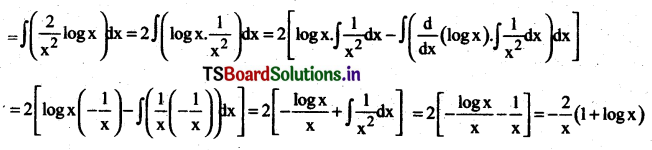
∴ y log x = \(\frac{-2}{x}\)(1 + log x) + C is the required general solution of the given D.E.
Question 8.
Find the general solution of (1 + x2)dy + 2xydx = cot xdx, (x ≠ 0)
Solution:
Given D.E. is (1 + x2)dy + 2xydx = cot xdx ⇒ \(\frac{d y}{d x}+\frac{2 x y}{\left(1+x^2\right)}=\frac{\cot x}{\left(1+x^2\right)}\), which is in the form of \(\frac{d y}{d x}\) + Py = Q(where, P = \(\frac{2 x}{\left(1+x^2\right)}\) and Q = \(\frac{\cot x}{\left(1+x^2\right)}\))
IF = \(\mathrm{e}^{\int \mathrm{Pdx}}=\mathrm{e}^{\int \frac{2 \mathrm{x}}{1+\mathrm{x}^2} \mathrm{dx}}=\mathrm{e}^{\log \left(1+\mathrm{x}^2\right)}\) = 1 + x2
G.S: y(IF) = ∫(Q × IF)dx + C
∴ y(1 + x2) = \(\int\left(\frac{\cot x}{1+x^2} \times\left(1+x^2\right)\right) d x+C=\int \cot x d x+C\)
⇒ y(1 + x2) = log|sin x| + C
Question 9.
Find the general solution of x\(\frac{d y}{d x}\) + y – x + xy cotx = 0, (x ≠ 0)
Solution:
Given D.E. is x\(\frac{d y}{d x}\) + y – x + xy cotx = 0, (x ≠ 0)
⇒ \(\frac{d y}{d x}+\frac{y}{x}-1+y \cot x=0 \Rightarrow \frac{d y}{d x}+y\left(\frac{1}{x}+\cot x\right)-1=0\)
⇒ \(\frac{d y}{d x}+\left(\frac{1}{x}+\cot x\right) y=1\) which is in the form of
\(\frac{d y}{d x}\) + Py = Q(where, P = (\(\frac{1}{x}\) + cot x) and Q = 1)
IF = \(\mathrm{e}^{\int \mathrm{Pdx}}=\mathrm{e}^{\int\left(\frac{1}{\mathrm{x}}+\cot \mathrm{x}\right) \mathrm{dx}}=\mathrm{e}^{\log \mathrm{x}+\log (\sin \mathrm{x})}=\mathrm{e}^{\log (\mathrm{x} \sin \mathrm{x})}\) = x sin x
G.S: y(IF) = ∫(Q × IF)dx + C
⇒ y(x sin x) = (1 × x sin x)dx + C
⇒ y(x sin x) = (x sin x)dx + C
⇒ y(x sin x) = \(x \int \sin x d x-\int\left[\frac{d}{d x}(x) \cdot \int \sin x d x\right]+C\)
⇒ y(x sin x) = x(-cos x) – \(\int 1 \cdot(-\cos x) d x+C\)
⇒ y(x sin x) = -x cos x + sin x + C
⇒ y = \(\frac{-x \cos x}{x \sin x}+\frac{\sin x}{x \sin x}+\frac{C}{x \sin x}\)
⇒ y = \(-\cot x+\frac{1}{x}+\frac{C}{x \sin x} \Rightarrow y=\frac{1}{x}-\cot x+\frac{C}{x \sin x}\)
Question 10.
Find the general solution of (x + y)\(\frac{d y}{d x}\) = 1
Solution:
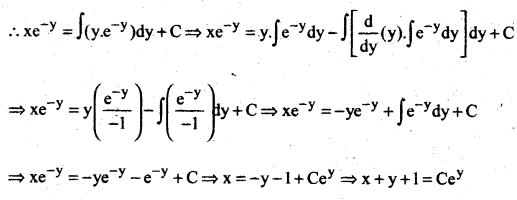
Given D.E is (x + y)\(\frac{d y}{d x}\) = 1 ⇒ \(\frac{d y}{d x}=\frac{1}{x+y} \Rightarrow \frac{d x}{d y}=x+y \Rightarrow \frac{d x}{d y}-x=y\) which is in the form of \(\frac{d x}{d y}\) + P1x = Q1(where, P1 = -1 and Q1 = y)
IF = \(\mathrm{e}^{\int P_1 d y}=\int \mathrm{e}^{-1 \mathrm{dy}}\) = e-y
G.S: x(I.F) = ∫(Q × IF)dx + C
Question 11.
Find the general solution of ydx + (x – y2)dy = 0
Solution:
Given D.E is ydx + (x – y2)dy = 0 ⇒ ydx – (y2 -x)dy = 0
⇒ \(\frac{d x}{d y}=\frac{y^2-x}{y}=y-\frac{x}{y} \Rightarrow \frac{d x}{d y}+\frac{x}{y}=y\), which is in the form of
\(\frac{d x}{d y}\) + P1x = Q1(where, P1 = \(\frac{1}{y}\) and Q1 = y)
IF = \(e^{\int P_1 d y}=\int e^{\frac{1}{y} d y}=e^{\log y}\) = y
G.S: x(I.F) = ∫(Q1 × I.F)dy + C ⇒ xy = ∫(y.y)dy + C
⇒ xy = ∫y2dy + C
⇒ xy = \(\frac{y^3}{3}\) + C ⇒ x = \(\frac{y^2}{3}+\frac{C}{y}\)
Question 12.
Find the general solution of (x + 3y2)\(\frac{d y}{d x}\) = y (y > 0)
Solution:
Given D.E is (x + 3y2)\(\frac{d y}{d x}\) = y ⇒ \(\frac{d y}{d x}=\frac{y}{x+3 y^2}\)
⇒ \(\frac{d x}{d y}=\frac{x+3 y^2}{y}=\frac{x}{y}+3 y \Rightarrow \frac{d x}{d y}-\frac{x}{y}=3 y\), which is in the form of
\(\frac{d x}{d y}\) + P1x = Q1(where, P1 = \(-\frac{1}{y}\) and Q1 = 3y)
IF = \(e^{\int P_i d y}=e^{-\int \frac{d y}{y}}=e^{-\log y}=e^{\log y^{-1}}=\frac{1}{y}\)
G.S: x(I.F) = ∫(Q1 × I.F)dy + C
∴ \(x \times \frac{1}{y}=\int\left(3 y \times \frac{1}{y}\right) d y+C \Rightarrow \frac{x}{y}=3 y+C \Rightarrow x=3 y^2+C y\)
III.
Question 1.
Find the particular solution of the differential equation
\(\frac{d y}{d x}\) + 2y tan x = sin x; y = 0 when x = \(\frac{\pi}{3}\)
Solution:
Given D.E. is \(\frac{d y}{d x}\) + 2y tan x = sin x, which is in the form of
\(\frac{d y}{d x}\) + Py = Q(where, P = 2 tan x and Q = sin x)
IF = \(e^{\int P d x}=e^{\int 2 \tan x d x}=e^{2 \log |\sec x|}=e^{\log \left(\sec ^2 x\right)}=\sec ^2 x\)
G.S: y(IF) = \(\int(Q \times I . F) d x+C \Rightarrow y\left(\sec ^2 x\right)=\int\left(\sin x \cdot \sec ^2 x\right) d x+C\)
∴ y sec2 x = ∫(sec x. tan x)dx + C ⇒ y sec2 x = sec x + C
we have y = 0 at x = \(\frac{\pi}{3}\)
⇒ 0 × sec2\(\frac{\pi}{3}\) = sec\(\frac{\pi}{3}\) + C ⇒ 0 = 2 + C ⇒ C = -2
∴ ysec2 x = sec x – 2 ⇒ y = cos x – 2cos2 x, which is the required particular solution.
Question 2.
Find the particular solution of the differential equation.
(1 + x2)\(\frac{d y}{d x}\) + 2xy = \(\frac{1}{1+x^2}\); y = 0 when x = 1
Solution:
Given D.E is (1 + x2)\(\frac{d y}{d x}\) + 2xy = \(\frac{1}{1+x^2}\) ⇒ \(\frac{d y}{d x}+\frac{2 x y}{1+x^2}=\frac{1}{\left(\left(1+x^2\right)\right)^2}\) which is in the form of
\(\frac{d y}{d x}\) + Py = Q(where, P = \(\frac{2 x}{1+x^2}\) and Q = \(\frac{1}{\left(1+x^2\right)^2}\))
IF = \(e^{\int P d x}=e^{\int \frac{2 x}{1+x^2} d x}=e^{\log \left(1+x^2\right)}\) = 1 + x2
G.S: y(IF) = ∫(Q × I.F)dx + C
∴ \(y\left(1+x^2\right)=\int\left[\frac{1}{\left(1+x^2\right)^2} \cdot\left(1+x^2\right)\right] d x+C \Rightarrow y\left(1+x^2\right)=\int \frac{1}{1+x^2} d x+C\)
⇒ y(1 + x2) = tan-1 x + C …………(1)
we have y = 0 at x = 1 ⇒ C = \(-\frac{\pi}{4}\); y(1 + x2) = tan-1 x – \(\frac{\pi}{4}\) is the required solution.
Question 3.
Find the particular solution of the differential equation.
\(\frac{d y}{d x}\) – 3y cot x = sin 2x; y = 2 when x = \(\frac{\pi}{2}\)
Solution:
\(\frac{d y}{d x}\) – 3y cot x = sin 2x which is in the form of \(\frac{d y}{d x}\) + Py = Q(where, P = -3cot x and Q = sin 2x)
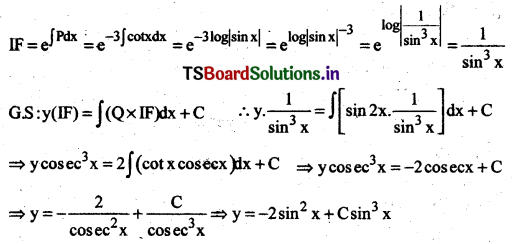
we have y = 2 at x = \(\frac{\pi}{2}\) ⇒ 2 = -2 + C ⇒ C = 4
∴ y = -2sin2 x + 4sin3 x ⇒ y = 4sin3x – 2sin2x is the required particular solution.
Question 4.
Find the equation of a curve passing through the origin given that the slope of the tangent to the curve at any point (x, y) is equal lo the sum of the coordinates of the point.
Solution:
Let F(x, y)be the curve passing through origin.
At (x, y), slope of curve will be \(\frac{d y}{d x}\)
∴ \(\frac{d y}{d x}\) = x + y ⇒ \(\frac{d y}{d x}\) – y = x, which is in the form of \(\frac{d y}{d x}\) + Py = Q (where, P = -1 and Q = x)
IF = \(e^{\int P d x}=e^{\int(-1) d x}=e^{-x}\)
∴ ye-x = \(\int x e^{-x} d x+C \Rightarrow y e^{-x}=x \int e^{-x} d x-\int\left[\frac{d}{d x}(x) \cdot \int e^{-x} d x\right] d x+C\)
⇒ \(y e^{-x}=-x e^{-x}+\int e^{-x} d x+C \Rightarrow y e^{-x}=-x e^{-x}+\left(-e^{-x}\right)+C \Rightarrow y e^{-x}=-e^{-x}(x+1)+C\)
⇒ x + y + 1 = ce-x ………..(1)
As the curve passes through origin, O(0, 0) from (1) we have 0 + 0 + 1 = C.e ⇒ C = 1
(1) ⇒ x + y + 1 = ex which is the required equation of the curve.
Question 5.
Find the equation of a curve passing through the point (0, 2) given that the sum of the coordinates of any point on the curve exceeds the magnitude of the slope of the tangent to the curve at that point by 5.
Solution:
F(x, y) be the curve and let (x, y) be a point on the curve.
Slope of the tangent to curve at (x, y)\(\frac{d y}{d x}\)
Given that \(\frac{d y}{d x}\) + 5 = x + y ⇒ \(\frac{d y}{d x}\) – y = x – 5 which is in the form of \(\frac{d y}{d x}\) + Py = Q(where, P = -1 and Q = x – 5)
IF = \(\mathrm{e}^{\int \mathrm{Pdx}}=\mathrm{e}^{\int(-1) \mathrm{dx}}=\mathrm{e}^{-\mathrm{x}}\)
G.S: \(y(I . F)=\int(Q \times I F) d x+C \Rightarrow y e^{-x}=\int(x-5) e^{-x} d x+C\)
= \(\int(x-5) e^{-x} d x=(x-5) \int e^{-x} d x-\int\left[\frac{d}{d x}(x-5) \int e^{-x} d x\right] d x\)
= \((x-5)\left(-e^{-x}\right)-\int\left(-e^{-x}\right) d x=(5-x) e^{-x}-\left(e^{-x}\right)=(4-x) e^{-x}\)
⇒ ye-x = (4 – x)e-x + C ⇒ y = (4 – x) + Ce-x ………….(1)
Given that the curve passes through (0, 2)
⇒ 2 = 4 + c ⇒ c = -2
(1) ⇒ y = 4 – x – 2ex