Referring to the AP Inter 2nd Year Maths Study Material Chapter 9 Differential Equations Exercise 9d Solutions makes it easier to understand complex problems.
AP Inter 2nd Year Maths Differential Equations Solutions Exercise 9d
I.
Question 1.
Show that the differential equatin y’ = \(\frac{x+y}{x}\) is homogenous and solve it.
Solution:
Given D.E. is y’ = \(\frac{x+y}{x} \Rightarrow \frac{d y}{d x}=\frac{x+y}{x}\) …………(1)
Let F(x, y) = \(\frac{x+y}{x}\)
Then F(λx, λy) = \(\frac{\lambda \mathrm{x}+\lambda \mathrm{y}}{\lambda \mathrm{x}}=\frac{\lambda(\mathrm{x}+\mathrm{y})}{\lambda(\mathrm{x})}=\lambda^0 \mathrm{~F}(\mathrm{x}, \mathrm{y})\)
Given Differential Equation is a homogenous equation.
Let y = vx ⇒ \(\frac{d y}{d x}\) = v + x\(\frac{d v}{d x}\) (1) v + x\(\frac{d v}{d x}\) = \(\frac{x+v x}{x}\)
⇒ \(v+x \frac{d v}{d x}=1+v \Rightarrow x \frac{d v}{d x}=1 \Rightarrow d v=\frac{d x}{x} \Rightarrow \int d v=\int \frac{d x}{x} \Rightarrow v=\log |x|+C\)
⇒ \(\frac{y}{x}=\log |x|+C \Rightarrow y=x \log |x|+C x\)
This is the required general solution to the given D.E.
Question 2.
Show that the differential equation \(x \frac{d y}{d x}-y+x \sin \left(\frac{y}{x}\right)=0\) is homogenous and solve it.
Solution:
Given D.E. is \(x \frac{d y}{d x}-y+x \sin \left(\frac{y}{x}\right)=0 \Rightarrow x \frac{d y}{d x}=y-x \sin \left(\frac{y}{x}\right) \Rightarrow \frac{d y}{d x}=\frac{y-x \sin \left(\frac{y}{x}\right)}{x}\) ………..(1)
Let F(x, y) = \(\frac{y-x \sin \left(\frac{y}{x}\right)}{x}\)
Then F(λx, λy) = \(\frac{\lambda \mathrm{y}-\lambda \mathrm{x} \sin \left(\frac{\lambda \mathrm{y}}{\lambda \mathrm{x}}\right)}{\lambda \mathrm{x}}=\frac{\lambda\left(\mathrm{y}-\mathrm{x} \sin \left(\frac{\mathrm{y}}{\mathrm{x}}\right)\right)}{\lambda(\mathrm{x})}=\lambda^0 \mathrm{~F}(\mathrm{x}, \mathrm{y})\)
∴ Given differential equation is a homogenous equation.
Let y = vx ⇒ \(\frac{d y}{d x}=\frac{d}{d x}(v x) \Rightarrow \frac{d y}{d x}=v+x \frac{d v}{d x}\)
Substituting this in eqn (1), we have v + x\(x \frac{d v}{d x}=\frac{v x-x \sin v}{x}\)
⇒ \(v+x \frac{d v}{d x}=v-\sin v \Rightarrow \frac{d v}{\sin v}=-\frac{d x}{x} \Rightarrow {cosec} v d v=-\frac{d x}{x}\)
log|cosec v – cot v| = -log x + log C = \(\log \frac{C}{x}\)
⇒ \({cosec}\left(\frac{y}{x}\right)-\cot \left(\frac{y}{x}\right)=\frac{C}{x} \Rightarrow \frac{1}{\sin \left(\frac{y}{x}\right)}-\frac{\cos \left(\frac{y}{x}\right)}{\sin \left(\frac{y}{x}\right)}=\frac{C}{x}\)
⇒ \(x\left[1-\cos \left(\frac{y}{x}\right)\right]=C \sin \left(\frac{y}{x}\right)\)
This is the required general solution to the given D.E.

III.
Question 1.
Show that the differential equation (x2 + xy)dy = (x2 + y2) dx is homogenous and solve it.
Solution:
Given D.E. is (x2 + xy)dy = (x2 + y2)dx and it can be written as \(\frac{d y}{d x}=\frac{x^2+y^2}{x^2+x y}\) ……..(1)
Let F(x, y) = \(\frac{x^2+y^2}{x^2+x y}\)
Then F(λx, λy) = \(\frac{(\lambda x)^2+(\lambda y)^2}{(\lambda x)^2+(\lambda x)(\lambda y)}=\frac{\lambda^2\left(x^2+y^2\right)}{\lambda^2\left(x^2+x y\right)}=\lambda^0 \mathrm{~F}(\mathrm{x}, \mathrm{y})\)
∴ Given differential equation is a homogenous equation.
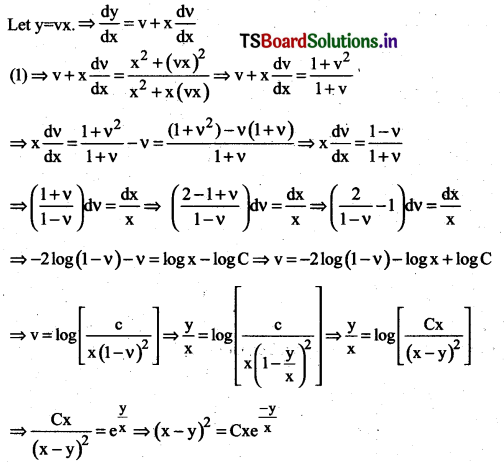
This is the required general solution to the given D.E.
Question 2.
Show that the differential equation (x – y)dy – (x + y) dx = 0 is homogenous and solve it.
Solution:
Given D.E. (x – y)dy – (x + y)dx = 0 ⇒ \(\frac{d y}{d x}=\frac{x+y}{x-y}\) ………..(1)
Let F(x, y) = \(\frac{x+y}{x-y}\)
Then F(λx, λy) = \(\frac{\lambda x+\lambda y}{\lambda x-\lambda y}=\frac{\lambda(x+y)}{\lambda(x-y)}=\lambda^0 \mathrm{~F}(x, y)\)
∴ Given differential equation is a homogenous equation.
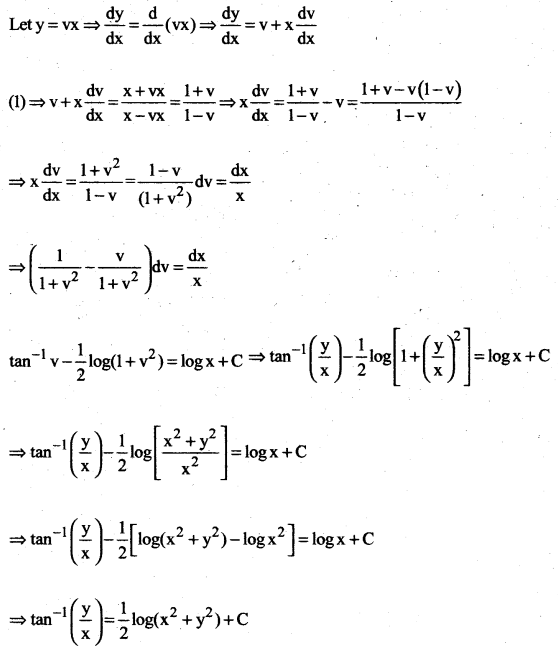
This is the required general solution to the given D.E.
Question 3.
Show that the differential equation (x2 – y2)dy + 2xy dy = 0 is homogenous and solve it.
Solution:
Given D.E. is (x2 – y2)dx + 2xydy = 0 ⇒ \(\frac{d y}{d x}=-\frac{\left(x^2-y^2\right)}{2 x y}\) ……………….(1)
Let F(x, y) = \(-\frac{\left(x^2-y^2\right)}{2 x y}\)
Then F(λx, λy) = \(\left[\frac{(\lambda x)^2-(\lambda y)^2}{2(\lambda x)(\lambda y)}\right]=\frac{-\lambda^2\left(x^2-y^2\right)}{\lambda^2(2 x y)}=\lambda^0 F(x, y)\)
∴ Given differential equation is a homogenous equation.
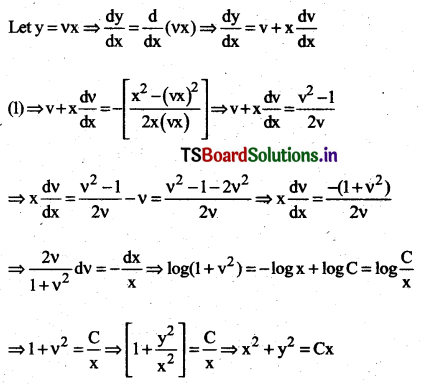
This is the required general solution to the given D.E.
Question 4.
Show that the differential equation x2\(\frac{d y}{d x}\) = x2 – 2y2 + xy is homogenous and solve it.
Solution:
Given D.E. is x2\(\frac{d y}{d x}\) = x2 – 2y2 + xy ⇒ \(\frac{d y}{d x}=\frac{x^2-2 y^2+x y}{x^2}\) ……..(1)
Let F(x, y) = \(\frac{x^2-2 y^2+x y}{x^2}\)
Then F(λx, λy) = \(\frac{(\lambda x)^2-2(\lambda y)^2+(\lambda x)(\lambda y)}{(\lambda x)^2}=\frac{\lambda^2\left(x^2-2 y^2+x y\right)}{\lambda^2\left(x^2\right)}=\lambda^0 F(x, y)\)
∴ Given differential equation is a homogenous equation.
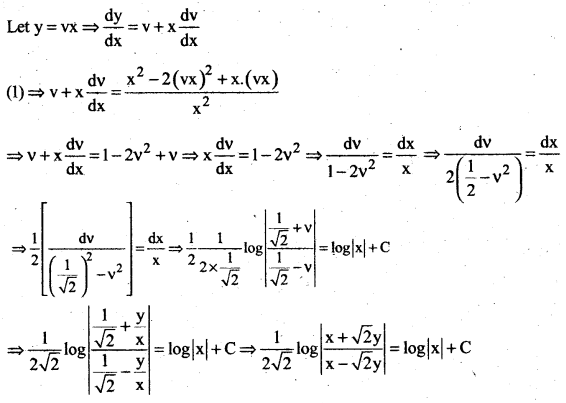
This is the required general solution to the given D.E.
Question 5.
Show that the differential equation xdy – ydx = \(\sqrt{x^2+y^2} d x\) is homogenous and solve it.
Solution:
Given D.E. is xdy – ydx = \(\sqrt{x^2+y^2} d x\) ⇒ xdy = ydx + \(\sqrt{x^2+y^2} d x\)dx
⇒ xdy = \(\left(y+\sqrt{x^2+y^2}\right) d x \Rightarrow \frac{d y}{d x}=\frac{y+\sqrt{x^2+y^2}}{x}\) = F(x, y) …….(1). This is a homogenous D.E
Then F(λx, λy) = \(\frac{\lambda y+\sqrt{(\lambda x)^2+(\lambda y)^2}}{\lambda x}=\lambda\left(\frac{y+\sqrt{x^2+y^2}}{\lambda x}\right)=\lambda^0 F(x, y)\)
Let y = vx ⇒ \(\frac{d y}{d x}=v+x \frac{d v}{d x}\)
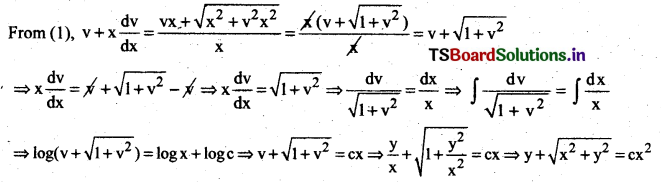
This is the required general solution to the given D.E.
Question 6.
Show that the differential equation \(\left\{x \cos \left(\frac{y}{x}\right)+y \sin \left(\frac{y}{x}\right)\right\} y d x=\left\{y \sin \left(\frac{y}{x}\right)-x \cos \left(\frac{y}{x}\right)\right\} x d y\) is homogenous and solve it.
Solution:
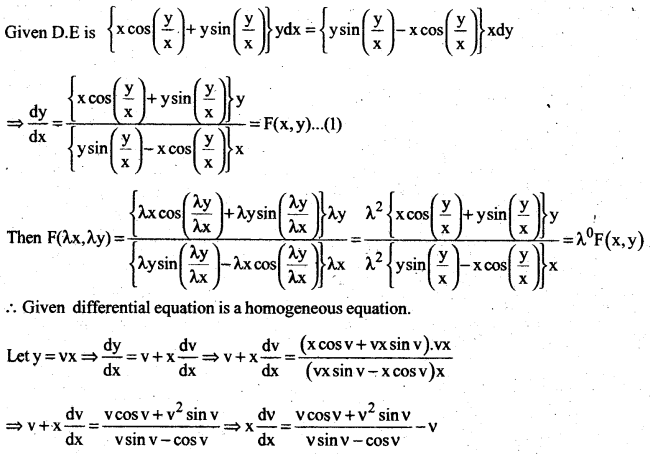
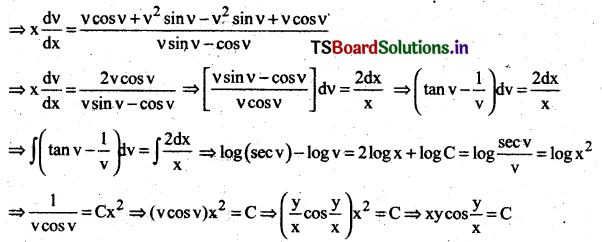
This is the required general solution to the given D.E.
Question 7.
Show that the differential equation ydx + x log\(\left(\frac{y}{x}\right)\)dy – 2xdy = 0 is homogenous and solve it.
Solution:
Given D.E. is ydx + x log\(\left(\frac{y}{x}\right)\)dy – 2xdy = 0
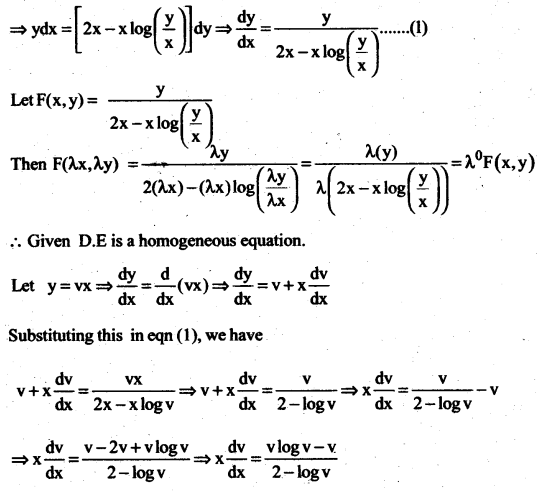
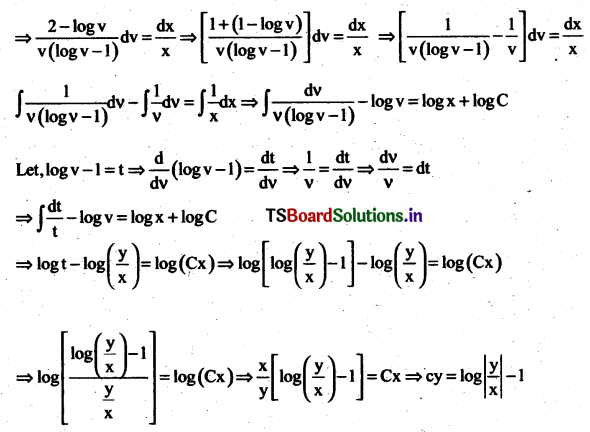
This is the required general solution to the given D.E.
Question 8.
Show that the differential equation \(\left(1+e^{\frac{x}{y}}\right) d x+e^{\frac{x}{y}}\left(1-\frac{x}{y}\right) d y=0\) is homogenous and solve it.
Solution:
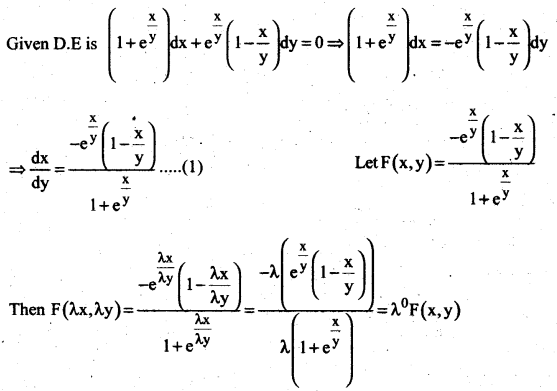
∴ Given D.E. is a homogenous equation.
Here, the derivative in the H.D.E. is \(\frac{d x}{d y}\). So take x = vy ………..(2) Diff w.r.t, we get
\(\frac{d x}{d y}=v+y \frac{d v}{d y}\)
Let x = vy ⇒ \(\frac{d}{d y}(x)=\frac{d}{d y}(v y) \Rightarrow \frac{d x}{d y}=v+y \frac{d v}{d y}\)
Substituting this in eqn (1), we have
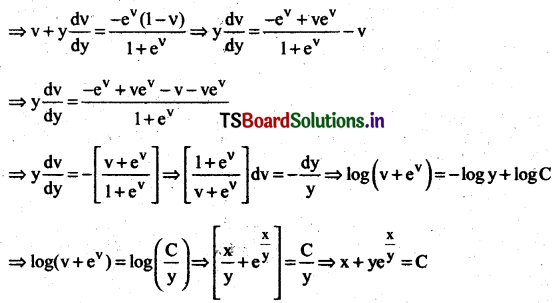
This is the required general solution to the given D.E.
Question 9.
Find the particular solution of (x + y)dy + (x – y)dx = 0; y = 1 rhen x = 1
Solution:
Given D.E. is (x + y)dy + (x – y)dx = 0 ⇒ (x + y)dy = -(x – y)dx ⇒ \(\frac{d y}{d x}=-\frac{(x-y)}{x+y}\) ……….(1)
Let F(x, y) = \(\frac{-(x-y)}{x+y}\)
Then F(λx, λy) = \(\frac{-(\lambda x-\lambda y)}{\lambda x+\lambda y}=\frac{-\lambda(x-y)}{\lambda(x+y)}=\lambda^0 \mathrm{~F}(x, y)\)
∴ Given D.E. is a homogenous equation.
Let y = vx ⇒ \(\frac{d}{d x}(y)=\frac{d}{d x}(v x) \Rightarrow \frac{d y}{d x}=v+x \frac{d v}{d x}\)
Substituting this in eqn (1), we have
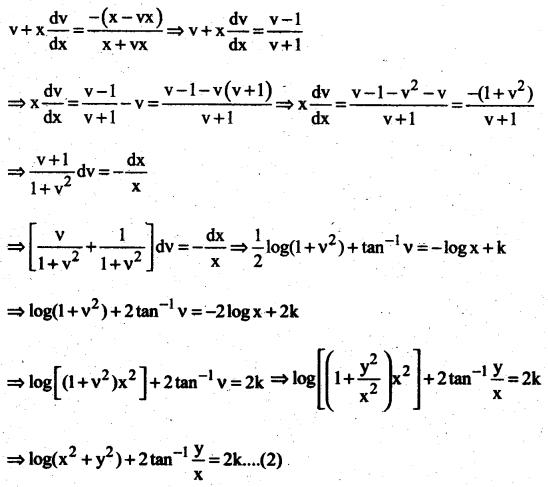
Also from the given data in the problem, we have y = 1 at x = 1
Substitute this value in (2), we have
⇒ log 2 + 2 tan-1 1 = 2k ⇒ log 2 + 2 × \(\frac{\pi}{4}\) = 2k ⇒ \(\frac{\pi}{2}\) + log 2 = 2k
log(x2 + y2) + 2tan-1 \(\frac{y}{x}=\frac{\pi}{2}\) + log 2
Question 10.
Find the particular solution of x2dy + (xy + y2)dx = 0; y = 1 when x = 1
Solution:
Given D.E. is x2dy + (xy + y2)dx = 0 ⇒ x2dy = -(xy + y2) dx ⇒ \(\frac{d y}{d x}=\frac{-\left(x y+y^2\right)}{x^2}\) ………..(1)
F(x, y) = \(\frac{-\left(x y+y^2\right)}{x^2}\)
Then F(λx, λy) = \(\frac{\left[\lambda x \cdot \lambda y+(\lambda y)^2\right]}{(\lambda x)^2}=\frac{-\lambda^2\left(x y+y^2\right)}{\lambda^2\left(x^2\right)}=\lambda^0 F(x, y)\)
∴ Given D.E. is a homogenous equation.
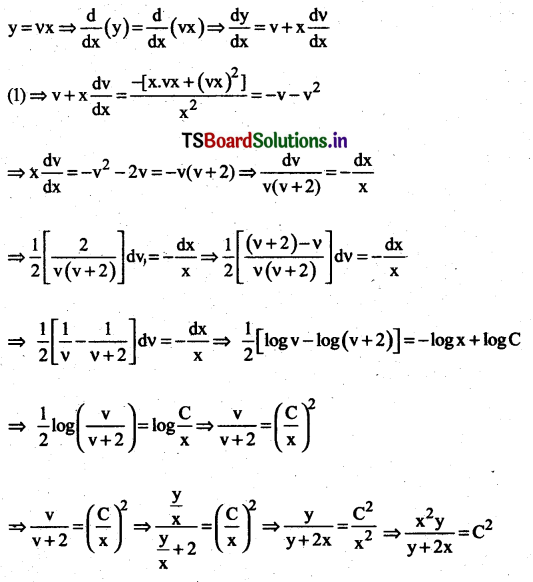
Also from the given data in the problem, we have
⇒ \(\frac{1}{1+2}\) = C2 ⇒ C2 = \(\frac{1}{3}\)
\(\frac{x^2 y}{y+2 x}=\frac{1}{3}\) ⇒ y + 2x = 3x2y
Question 11.
Find the particular solution of \(\left[x \sin ^2\left(\frac{y}{x}\right)-y\right]\)dx + xdy = 0; y = \(\frac{\pi}{4}\) when x = 1
Solution:
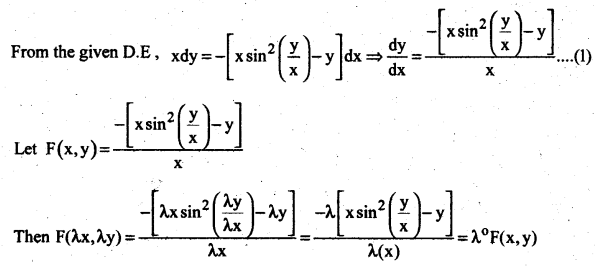
∴ Given D.E. is a homogenous equation.
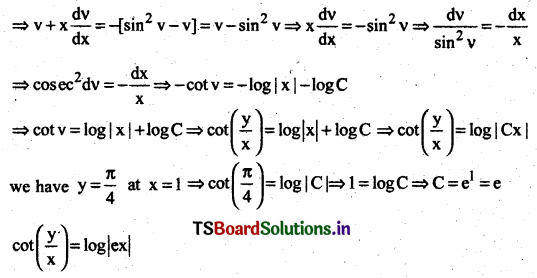
Let y = vx ⇒ \(\frac{d y}{d x}\) = v + x\(\frac{d v}{d x}\)
(1) ⇒ v + x\(\frac{d v}{d x}=\frac{-\left[x \sin ^2 v-v x\right]}{x}\)
Question 12.
Find the particular solution of \(\frac{d y}{d x}-\frac{y}{x}+{cosec}\left(\frac{y}{x}\right)=0\); y = 0 when x = 1
Solution:
Given D.E. is \(\frac{d y}{d x}-\frac{y}{x}+\csc \left(\frac{y}{x}\right)=0 \Rightarrow \frac{d y}{d x}=\frac{y}{x}-{cosec}\left(\frac{y}{x}\right)\)
Let F(x, y) = \(\frac{y}{x}-{cosec}\left(\frac{y}{x}\right)\)
Then F(λx, λy) = \(\frac{\lambda y}{\lambda x}-{cosec}\left(\frac{\lambda y}{\lambda x}\right)=\frac{y}{x}-{cosec}\left(\frac{y}{x}\right)=\lambda^0 F(x, y)\)
Let y = vx ⇒ \(\frac{d y}{d x}=v+x \frac{d v}{d x}\)
(1) ⇒ v + x \(\frac{d v}{d x}=v-{cosecv} \Rightarrow-\frac{d v}{{cosec} v}=\frac{d x}{x} \Rightarrow-\sin v d v=\frac{d x}{x}\)
⇒ cos v = log x + log C = log|Cx| ⇒ cos\(\left(\frac{y}{x}\right)\) = log |Cx|
We have y = 0 at x = 1
⇒ cos(0) = log C ⇒ C = e1 = e
∴ cos\(\left(\frac{\mathrm{y}}{\mathrm{x}}\right)\) = log|(ex)|
Question 13.
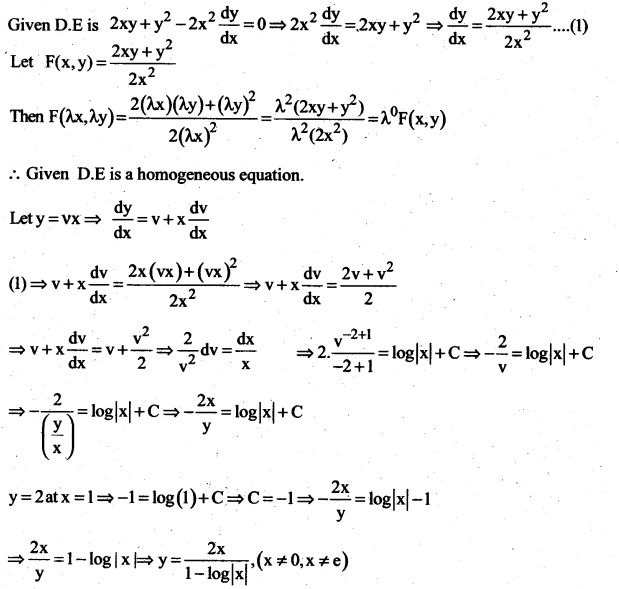
Find the particular solution of 2xy + y2 – 2x2\(\frac{d y}{d x}\) = 0; y = 2 when x = 1
Solution: