
Referring to the AP Inter 2nd Year Maths Study Material Chapter 6 Application of Derivatives Exercise 6d Solutions makes it easier to understand complex problems.
AP Inter 2nd Year Maths Application of Derivatives Solutions Exercise 6d
II.
Question 1.
Show that the function given by f(x) = \(\frac{\log x}{x}\), has maximum at x = e.
Solution:
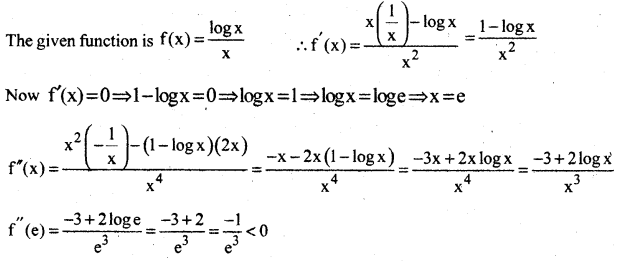
∴ by second derivative test, f is the maximum at x = e.
Question 2.
The to equal sides of an isosceles triangle with fixed base h are decreasing at the rate of 3 cm per second. how fast is the area decreasing when the two equal sides are equal to the base ?
Solution:
Let ∆ABC be isosceles where BC is the base of fixed length.
Also, let the length of the two equal sides of ∆ABC be a. Draw AD ⊥ BC.
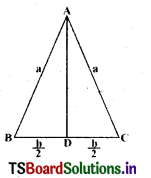
Now in ∆ADC by applying the Pythagoras theorem, we have: AD = \(\sqrt{a^2-\frac{b^2}{4}}\)
Area of triangle, A = \(\frac{1}{2} b \sqrt{a^2-\frac{b^2}{4}}\)
The rate of change of the area with respect to time (t) is given by,
\(\frac{\mathrm{dA}}{\mathrm{dt}}=\frac{1}{2} b \cdot \frac{2 a}{2 \sqrt{a^2-\frac{b^2}{4}}} \frac{d a}{d t}=\frac{a b}{\sqrt{4 a^2-b^2}} \frac{d a}{d t}\)
It is given that the two equal sides of the triangle are decreasing at the rate of 3 cm per second.
∴ \(\frac{\mathrm{da}}{\mathrm{dt}}\) = -3cm/s
Hence, \(\frac{\mathrm{dA}}{\mathrm{dt}}=\frac{-3 \mathrm{ab}}{\sqrt{4 \mathrm{a}^2-\mathrm{b}^2}}\)
When a = b, we have \(\frac{\mathrm{dA}}{\mathrm{dt}}=\frac{-3 b^2}{\sqrt{4 a^2-b^2}}=\frac{-3 b^2}{\sqrt{3 b^2}}=-\sqrt{3} b\)
Hence, if the two equal sides are equal to the base, then the area of the triangle is decreasing at the rate of \(\sqrt{3} \mathrm{~b}\) cm2 / s.

Question 3.
Find the intervals in which the function f given by f(x) = \(\frac{4 \sin x-2 x-x \cos x}{2+\cos x}\) is (i) increasing (ii) decreasing
Solution:
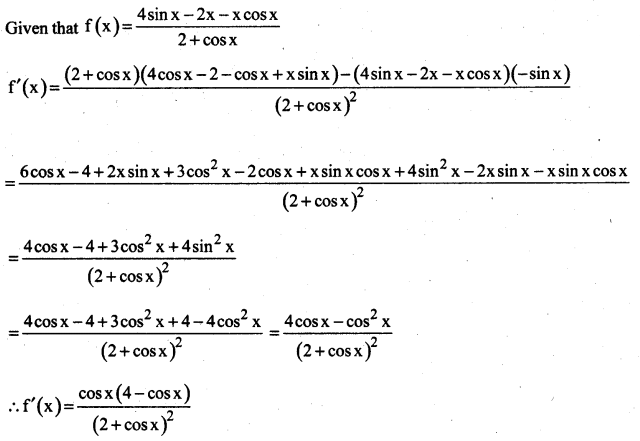
Now, f'(x) = 0 ⇒ cos x = 0 or cos x = 4
But cos x ≠ 4
Hence,cos x = 0 ⇒ x = \(\frac{\pi}{2}\), \(\frac{3 \pi}{2}\)
Now x = \(\frac{\pi}{2}\)and x = \(\frac{3\pi}{2}\) divide(0, 2π) into three disjoint intervals i.e.,,
(0, \(\frac{\pi}{2}\)), (\(\frac{\pi}{2}\), \(\frac{3\pi}{2}\)) and (\(\frac{3\pi}{2}\), 2π)
In intervals, (0, \(\frac{\pi}{2}\)) and (\(\frac{3\pi}{2}\), 2π), f'(x) > 0
Thus, f(x) is increasing for 0 < x < \(\frac{\pi}{2}\) and \(\frac{3\pi}{2}\) < x < 2π
In the interval (\(\frac{\pi}{2}\), \(\frac{3\pi}{2}\)) , f'(x) < 0
Thus, f(x) isdecreasing for \(\frac{\pi}{2}\) < x < \(\frac{3\pi}{2}\)
Question 4.
Find the intervals in which function f given by f(x) = x3 + \(\frac{1}{x^3}\), x ≠ 0
(i) increasing
(ii) decreasing
Solution:
Given that f(x) = x3 + \(\frac{1}{x^3}\) ⇒ f'(x) = 3x2 – \(\frac{3}{x^4}\) = \(\frac{3 x^6-3}{x^4}\)
Now, f'(x) = 0 ⇒ 3x6 – 3 = 0
⇒ x6 = 1
⇒ x = ±1
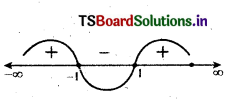
Now, the points x = 1 and x = -1 divide the real line into three disjoint intervals
i.e., ,(-∞, -1), (-1, 1) and (1, ∞)
In intervals (-∞, -1) and (1, ∞) i.e., when x < -1 and x > 1, f'(x) > 0
Thus, when x < -1 and x > 1, f is increasing.
In interval (-1, 1) i.e., -1 < x < 1, f'(x) < 0.
Thus, when -1 < x < 1, f is decreasing.
Question 5.
Find the points at which the function f given by f (x) = (x – 2)4 (x + 1)3 has
(i) local maxima
(ii) local minima
(iii) point of inflexion
Solution:
The given function is f (x) = (x – 2)4 (x + 1)3
f'(x) = 4(x – 2)3 (x + 1)3 + 3(x + 1)2 (x – 2)4
= (x – 2)3 (x + 1)2 [4(x + 1) + 3(x – 2)] = (x – 2)3 (x + 1)2 (7x – 2)
Now, f'(x) = 0 ⇒ x = -1, x = \(\frac{2}{7}\), x = 2
For values of close to \(\frac{2}{7}\) and to the left of \(\frac{2}{7}\), f'(x) > 0
Also, for values of x close to \(\frac{2}{7}\) and to the right of \(\frac{2}{7}\), f'(x) < 0.
Thus, x = \(\frac{2}{7}\) is the point of local maxima.
Now, for values of x close to 2 and to the left of 2, f'(x) < 0 Also, for values of close to 2 and to the right of 2, f'(x) > 0.
Thus, x = 2 is the point of local minima.
Now, as the value of varies through -1, f'(x) does not change its sign.
Thus, x = -1 is the point of inflexion.
Question 6.
Find the absolute maximum and minimum values of the function f given by f (x) = cos2 x + sin x, x ∈ [0, π]
Solution:
Given that f (x) = cos2 x + sin x, x ∈ [0, π]
f'(x) = 0 ⇒ -2sin x cos x + cos x = 0
⇒ cos x = 2 sin x cos x ⇒ cos x (2 sin x – 1) = 0
⇒ sin x = \(\frac{1}{2}\) or cos x = 0 ⇒ x = \(\frac{\pi}{6}\) or \(\frac{\pi}{2}\) ∵ x ∈ [0, π]
Now we evaluate the value of f at critical points x = \(\frac{\pi}{6}\), \(\frac{\pi}{2}\) and at the, end points of the interval [0, π] i.e., at x = 0 and x = π, we have.
(i) f\(\left(\frac{\pi}{6}\right)\) = c0s2\(\left(\frac{\pi}{6}\right)\) + sin \(\left(\frac{\pi}{6}\right)\) = \(\left(\frac{\sqrt{3}}{2}\right)^2+\frac{1}{2}=\frac{5}{4}\)
(ii) f(0) = cos2(0) + sin(0) = 1 + 0 = 1
(iii) f(π) = cos2(π) + sin(π) = (-1)2 + 0 = 1
(iv) f\(\left(\frac{\pi}{2}\right)\) = cos2\(\left(\frac{\pi}{2}\right)\) + sin\(\left(\frac{\pi}{2}\right)\) + sin\(\left(\frac{\pi}{2}\right)\) = 0 + 1 = 1
Hence, the absolute maximum value of f is 5/4 occurring at x = π/6 and the absolute minimum value of f is 1 occurring at x = 0, π/2, π.
Question 7.
Let f be a function defined on [a, b] such that f'(x) > 0. for all x ∈ (a, b). Then prove that f is an increasing function on (a, b).
Solution:
Let x1, x2 ∈ (a, b) such that
Consider the sub-interval [x1, x2]
Since f(x) is differentiable on (a, b) and [x1, x2] ⊂ (a, b).
∴ f(x) is continuous on [x1, x2] and differentiable on (x1, x2).
By the Lagrange’s mean value theorem, there exists x ∈ (x1, x2) such that
f'(c) = \(\frac{f\left(x_2\right)-f\left(x_1\right)}{x_1-x_2}\) ……………. (1)
Since, f(x) > 0 for all x ∈ (a, b), so in particular, f'(c) > 0 ⇒ \(\frac{f\left(x_2\right)-f\left(x_1\right)}{x_1-x_2}\) > 0 [Using (1)]
⇒ f(x2) – f(x1) > 0
⇒ f(x2) > f(x1)
⇒ f(x1) < f(x2)
Since , x1, x2 are arbitrary points in (a, b).
∴ x1 < x2 ⇒ f(x1) < f(x2) for all x1, x2 ∈ (a, b).
Hence, f(x) is increasing on (a, b).
III.
Question 1.
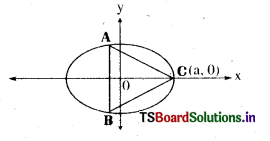
Find the maximum area of an isosceles triangle inscribed in the ellipse \(\frac{x^2}{a^2}+\frac{y^2}{b^2}\) = 1 with its vertex at one end of the major axis.
Solution:
The given ellipse is \(\frac{x^2}{a^2}+\frac{y^2}{b^2}\) = 1
Let the major axis be along the x-axis.
Let ABC be the triangle inscribed in the ellipse where vertex C is at (a, 0)
Since the ellipse is symmetrical with respect to the x- axis and y-axis, we can assume the
coordinates of A to be (-x1, y1) and the coordinates of B to be(-x1, -y1)
Now, we have y1 = ±\(\frac{b}{a} \sqrt{a^2-x_1^2}\)
Coordinates of A are (-x1, \(\frac{b}{a} \sqrt{a^2-x_1^2}\)) and the coordinates of B are (-x1, \(\frac{b}{a} \sqrt{a^2-x_1^2}\))
As the point (x1, y1) lies on the ellipse, the area of triangle ABC (A) is given by,
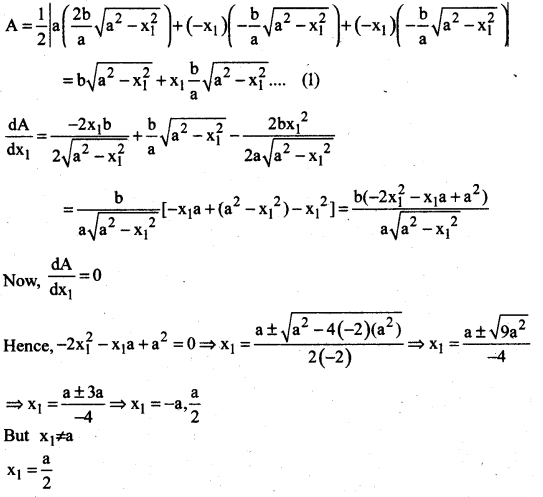
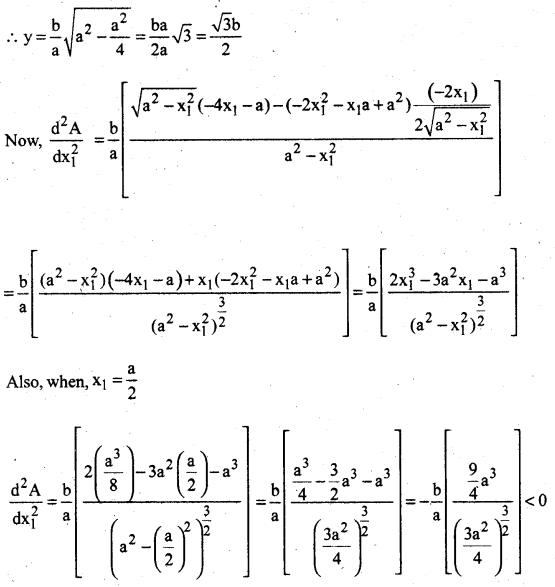
Thus, the area is the maximum when x1 = \(\frac{\mathrm{a}}{2}\).
Hence, Maximum area of the triangle is given by,
A = \(b \sqrt{a^2-\frac{a^2}{4}}+\left(\frac{a}{2}\right) \frac{b}{a} \sqrt{a^2-\frac{a^2}{4}}=a b \frac{\sqrt{3}}{2}+\left(\frac{a}{2}\right) \frac{b}{a} \times \frac{a \sqrt{3}}{2}\)
= \(\frac{a b \sqrt{3}}{2}+\frac{a b \sqrt{3}}{4}=\frac{3 \sqrt{3}}{4} a b\)
Question 2.
A tank with rectangular base and rectangular sides, open at the top is to be constructed so that its depth is 2 m and volume is 8 m3. If building of tank costs Rs 70 per sq metres for the base and Rs 45 per square metre for sides. What is the cost of least expensive tank?
Solution:
Let l, b, and h represent the length, breadth, and height of the tank respectively.
Then, we have height , h = 2m and volume of the tank, V = 8m3
Volume of the tank V = lbh
⇒ 8 = l × b × 2
⇒ lb = 4
⇒ b = \(\frac{4}{l}\)
Now, area of the base, lb = 4
Area of the 4 walls, A = 2h(l + b) = 4(l + \(\frac{4}{l}\)) = 4(l + 4l-1)
⇒ \(\frac{\mathrm{dA}}{\mathrm{dl}}=4\left(1-\frac{4}{l^2}\right)\)
Now, \(\frac{\mathrm{dA}}{\mathrm{dl}}\) = 0 ⇒ (1 – \(\frac{4}{l^2}\)) = 0
⇒ l2 = 4
⇒ l = ± 2
However, the length cannot be negative,
∴ we have l = 2
Hence, b = \(\frac{4}{l}\) = \(\frac{4}{2}\) = 2
Now, \(\frac{\mathrm{d}^2 \mathrm{~A}}{\mathrm{dl}^2}=\frac{32}{l^3}\)
When, l = 2
Then, \(\frac{\mathrm{d}^2 \mathrm{~A}}{\mathrm{~dl}^2}=\frac{32}{8}\) = 4 > 0
Thus, by second derivative test, the area is the minimum when l = 2
We have l = b = h = 2
∴ Cost of building the base in ₹ is 70(lb) = 70(4) = Rs 280
Cost of building the walls in ₹ is 2h(l + b) × 45 = 2 × 2(2 + 2) × 45 = Rs 720
Required total cost is ₹ is 280 + 720 = Rs 1000
Thus, the total cost of the tank will be ₹ 1000.
Question 3.
The sum of the perimeter of a circle and square is k, where k is some constant. Prove that the sum of their areas is least when the side of square is double the radius of the circle.
Solution:
Let V be the radius of the circle and ‘a’ be the side of the square .
Then, we have 2πr + 4a = k ⇒ a = \(\frac{\mathrm{k}-2 \pi \mathrm{r}}{4}\)
The sum of the areas of the circle and the square (A) is given by,
A = πr2 + a2 = πr2 + \(\frac{(\mathrm{k}-2 \pi \mathrm{r})^2}{16}\)
Now, \(\frac{\mathrm{dA}}{\mathrm{dr}}\) = 0
⇒ 2πr – \(\frac{\pi(\mathrm{k}-2 \pi \mathrm{r})}{4}\) = 0 ⇒ 2πr = \(\frac{\pi(\mathrm{k}-2 \pi \mathrm{r})}{4}\)
⇒ 8r = k – 2πr
⇒ (8 + 2π)r = k
⇒ r = \(\frac{\mathrm{k}}{(8+2 \pi)}\)
⇒ r = \(\frac{\mathrm{k}}{2(4+\pi)}\) ………… (1)
When, r = \(\frac{\mathrm{k}}{2(4+\pi)}\) ⇒ \(\frac{\mathrm{d}^2 \mathrm{~A}}{\mathrm{dr}^2}\) > 0
The sum of the areas is least when, r = \(\frac{\mathrm{k}}{2(4+\pi)}\)
When r = \(\frac{\mathrm{k}}{2(4+\pi)}\)
We have a = \(\frac{\mathrm{k}-2 \pi\left[\frac{\mathrm{k}}{2(4+\pi)}\right]}{4}=\frac{\mathrm{k}(4+\pi)-\pi \mathrm{k}}{4(4+\pi)}\)
= \(\frac{4 \mathrm{k}}{4(4+\pi)}=\frac{\mathrm{k}}{4+\pi}\)
= 2r [From (1)]
Hence, it has been proved that the sum of their areas is least when the side of the square is double the radius of the circle.
Question 4.
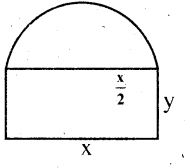
A window is in the form of a rectangle surmounted by a semicircular opening. The total perimeter of the window is 10 m. Find the dimensions of the window to admit maximum light through the whole opening.
Solution:
Let x and y be the length and breadth of the rectangular window.
Radius of the semicircular opening be x/2.
It is given that the perimeter of the window is 10m.
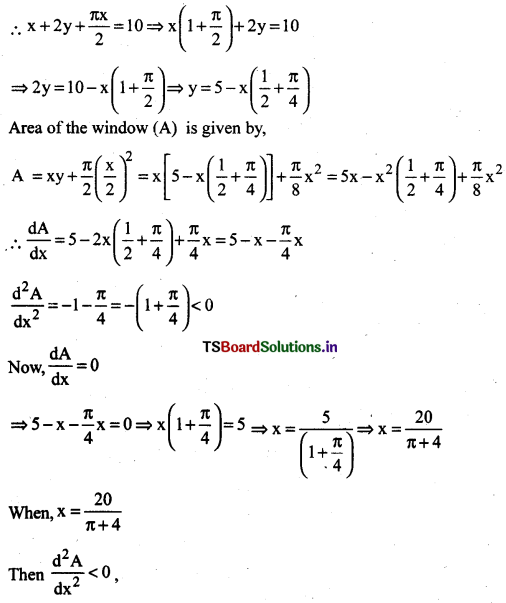
∴ by second derivative test, the area is the maximum when length is \(\frac{20}{\pi+4}\) m
Now, y =5 – \(\frac{20}{\pi+}\left(\frac{2+\pi}{4}\right)=5-\frac{5(2+\pi)}{\pi+4}=\frac{10}{\pi+4}\)
Hence, the required dimensions of the window to admit maximum light is given by length \(\frac{20}{\pi+4}\) m and breadth \(\frac{10}{\pi+4}\) m.
Question 5.
A point on the hypotenuse of a triangle is at distance a and b from the sides of the triangle. Show that the minimum length of the hypotenuse is \(\left(a^{\frac{2}{3}}+b^{\frac{2}{3}}\right)^{\frac{3}{2}}\)
Solution:
Let ∆ABC be right-angled at B, AB = x, BC = y and ZC = 0
Also, let P be a point on the hypotenuse of the triangle such that P is at a distance of a and b from the sides AB and BC respectively.
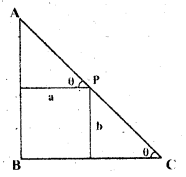
We have, AC = \(\sqrt{x^2+y^2}\) Now, PC = b cosecθ; AP = asecθ
Hence, AC = AP + PC ⇒ AC = bcosec0 + asec0 (1)
Therefore, \(\frac{\mathrm{d}(\mathrm{AC})}{\mathrm{d} \theta}\) = -b cosec θ cot θ + a sec θ tan θ
Now, \(\frac{\mathrm{d}(\mathrm{AC})}{\mathrm{d} \theta}\) = 0 ⇒ -b cosec θ cot θ + a sec θ tan θ = 0
⇒ a sec θ tan θ = b cosec θ cot θ dθ
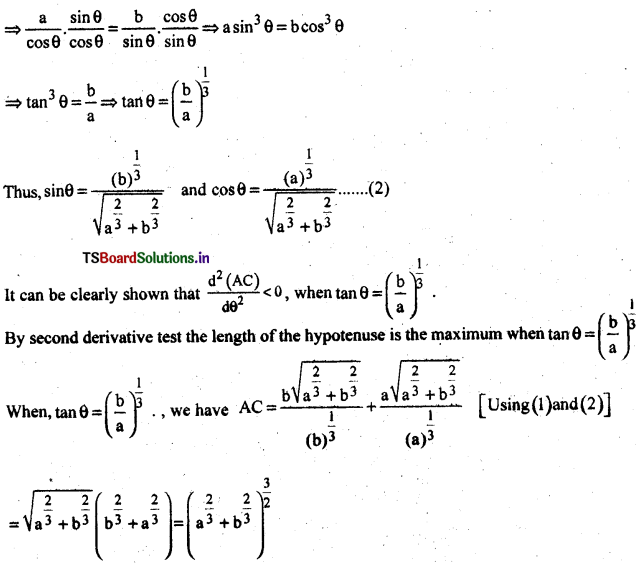
Thus, the maximum length of the hypotenuse is \(\left(a^{\frac{2}{3}}+b^{\frac{2}{3}}\right)^{\frac{3}{2}}\) proved.
Question 6.
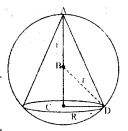
Show that the altitude of the right circular cone of maximum volume that can be inscribed in a sphere of radius r is \(\frac{4 r}{3}\).
Solution:
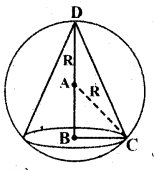
A sphere of fixed radius (r) is given.
Let R and h be the radius and the height of the cone respectively.
The volume V of the cone is given by V = \(\frac{1}{3}\) πR2 h
Now, from the right ABCD , we have: BC = \(\sqrt{\mathrm{r}^2-\mathrm{R}^2}\) ⇒ h = r + \(\sqrt{\mathrm{r}^2-\mathrm{R}^2}\)
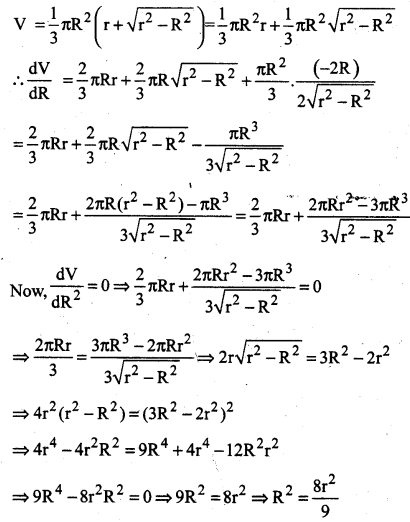
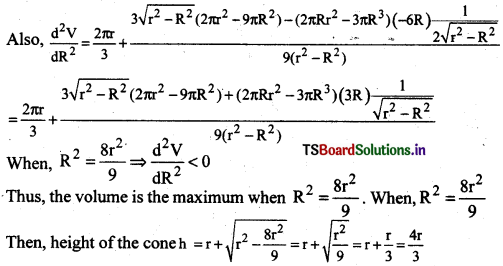
Hence, it can be seen that the altitude of the right circular cone of maximum volume that can be inscribed in a sphere of radius 4π/3
Question 7.
Show that the height of the cylinder of maximum volume that can be inscribed in a sphere of radius R is \(\frac{2 R}{\sqrt{3}}\). Also find the maximum volume.
Solution:
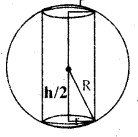
A sphere of fixed radius (R) is given.
Let r and h be the radius and the height of the cylinder respectively.
From the given figure, we have h = 2\(\sqrt{R^2-r^2}\)
The volume (V) of the cyclinder is given by, V = πr2h = 2πr2\(\sqrt{R^2-r^2}\)
∴ V = 2πr2\(\sqrt{R^2-r^2}\)
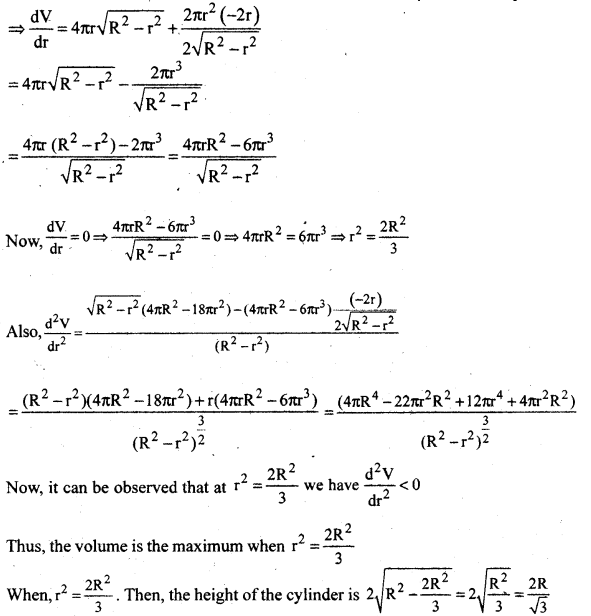
Hence, the volume of the cylinder is the maximum when the height of the cylinder is \(\frac{2 R}{\sqrt{3}}\).
∴ Maximum volume of cylinder = πr2h
= 2πr2\(\sqrt{R^2-r^2}\) = 2π\(\left(\frac{2 \mathrm{R}^2}{3}\right) \sqrt{\mathrm{R}^2-\left(\frac{2 \mathrm{R}^2}{3}\right)}\) = \(\frac{4 \pi}{3 \sqrt{3}} R^3\)
Question 8.
Show that height of the cylinder of greatest volume which can be inscribed in a right circular cone of height h and semi vertical angle a is one-third that of the cone and the greatest volume of cylinder is \(\frac{4}{27}\) πh3 tan2 α.
Solution:
The given right circular cone of fixed height h and semi-vertical angle a can be drawn as:
Here, a cylinder of radius R and height H is inscribed in the cone.
Then ∠GAO = α, OG = r, OA = h; OE = r and CE = H
We have, r = h tanα
Now, since ∆AOG is similar to ∆ CEQ we have:
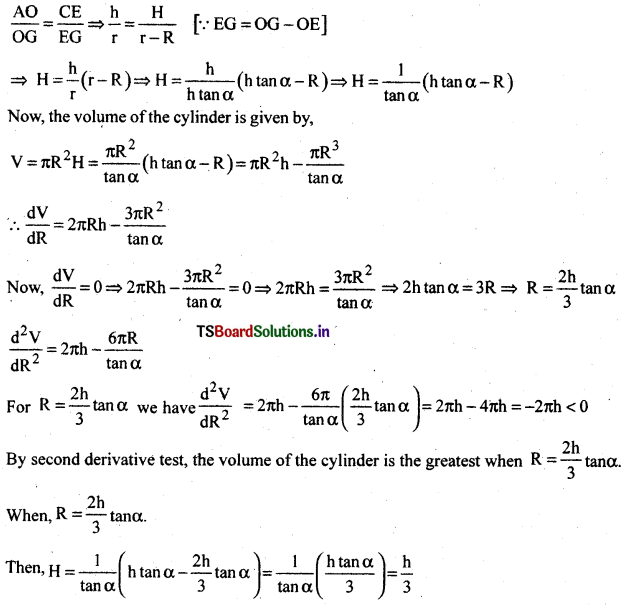
Thus, the height of the cylinder is one-third the height of the cone when the volume of the cylinder is the greatest.
Thus, the maximum volume of the cylinder can be obtained as
\(\pi\left(\frac{2 \mathrm{~h}}{3} \tan \alpha\right)^2\left(\frac{\mathrm{~h}}{3}\right)=\pi\left(\frac{4 \mathrm{~h}^2}{9} \tan ^2 \alpha\right)\left(\frac{\mathrm{h}}{3}\right)=\frac{4}{27} \pi \mathrm{~h}^3 \tan ^2 \alpha\)
Hence, the given result is proved.