
Referring to the AP Inter 2nd Year Maths Study Material Chapter 5 Continuity and Differentiability Exercise 5a Solutions makes it easier to understand complex problems.
AP Inter 2nd Year Maths Continuity and Differentiability Solutions Exercise 5a
Question 1.
Prove that the function f(x) = 5x – 3 is continuous at x = 0.
Solution:
Given function is f(x) = 5x – 3; At x = 0
(i) f(x) = 5x – 3 = f(0) = 5(0) – 3 – 3 ………..(1)
(ii) \(\underset{\mathrm{x} \rightarrow 0}{\mathrm{Lt}}\) f(x) = \(\underset{\mathrm{x} \rightarrow 0}{\mathrm{Lt}}\) (5x – 3) = 5(0) – 3 = -3 …………….. (2)
(iii) From (1) & (2), \(\underset{\mathrm{x} \rightarrow 0}{\mathrm{Lt}}\) f(x) = f(0)
So, f(x) is continuous at x = 0

Question 2.
Prove that the function f(x) = 5x – 3 is continuous at x = -3
Solution:
Given function is f(x) = 5x – 3; At x = -3
(i) f(x) = 5x – 3 ⇒ f(-3) = 5(-3) – 3 = -18 …………….. (1)
(ii) \(\underset{x \rightarrow-3}{\mathrm{Lt}}\) f(x) = \(\underset{x \rightarrow-3}{\mathrm{Lt}}\) (5x – 3) = 5(-3) – 3 = -18 …………. (2)
(iii) From (1) & (2), \(\underset{x \rightarrow-3}{\mathrm{Lt}}\) f(x) = f(3).
So, f(x) is continuous at x = -3
Question 3.
Prove that the function f(x) = 5x – 3 is continuous at x = 5.
Solution:
Given function is f(x) = 5x – 3; At x = 5
(i) f(x) = 5x – 3 ⇒ f(5) = 5(5) – 3 = 22 ………….. (1)
(ii) \(\underset{\mathrm{x} \rightarrow 5}{\mathrm{Lt}}\) f(x) = \(\underset{\mathrm{x} \rightarrow 5}{\mathrm{Lt}}\) (5x – 3) = 5(5) – 3 = 22 …………….. (2)
(iii) From (1) & (2), \(\underset{\mathrm{x} \rightarrow 5}{\mathrm{Lt}}\) f(x) = f(5)
So, f(x) is continuous at x = 5
Question 4.
Prove that the function f(x) = 2x2 – 1 is continuous at x = 3
Solution:
Given function is f(x) = 2x2 – 1; At x = 3
(i) f(x) = 2x2 – 1 ⇒ f(3) = 2(3)2 – 1 = 17 …………….. (1)
(ii) \(\underset{x \rightarrow3}{\mathrm{Lt}}\) f(x) = \(\underset{x \rightarrow3}{\mathrm{Lt}}\) (2x2 – 1) = 2(3)2 – 1 = 17 …………. (2)
(iii) From (1) & (2), \(\underset{x \rightarrow3}{\mathrm{Lt}}\) f(x) = f(3).
So, f(x) is continuous at x = 3
Question 5.
Examine f(x) = x – 5 for continuity.
Solution:
The given function is f(x) = x – 5
For a real k, f(k) = k – 5.
\(\underset{\mathrm{x} \rightarrow k}{\mathrm{Lt}}\) f(x) = \(\underset{\mathrm{x} \rightarrow k}{\mathrm{Lt}}\) (x – 5) = k – 5 = f(k)
∴ \(\underset{\mathrm{x} \rightarrow k}{\mathrm{Lt}}\) f(x) = f(k)
Thus f is continuous at every real number and hence it is a continuous function.
Question 6.
Examine f(x) = \(\frac{1}{x-5}\), x ≠ 5 for continuity.
Solution:
The given function is f(x) = \(\frac{1}{x-5}\), x ≠ 5
For any real number k ≠ 5 ,we have f(k) = \(\frac{1}{k-5}\)
\(\underset{\mathrm{x} \rightarrow k}{\mathrm{Lt}}\) f(x)= \(\underset{\mathrm{x} \rightarrow k}{\mathrm{Lt}}\) \(\frac{1}{x-5}\) = \(\frac{1}{k-5}\)
∴ \(\underset{\mathrm{x} \rightarrow k}{\mathrm{Lt}}\) f(x) = f(k)
Thus f is continuous at every point in the domain of f and hence it is a continuous function.
Question 7.
Examine f(x) = \(\frac{x^2-25}{x+5}\), x ≠ -5 for continuity.
Solution:
The given function is f(x) = \(\frac{x^2-25}{x+5}\), x ≠ -5
For any real number c≠5, we have f(c) = \(\frac{c^2-25}{c+5}\) = \(\frac{(c+5)(c-5)}{c+5}\) = (c – 5)
\(\underset{x \rightarrow c} {\mathrm{Lt}} f(x)=\underset{x \rightarrow c}{\mathrm{Lt}} \frac{x^2-25}{x+5}\)
\(\underset{x \rightarrow c} {\mathrm{Lt}}\frac{(x+5)(x-5)}{x+5}\)
\(\underset{\mathrm{x} \rightarrow \mathrm{c}}{\mathrm{Lt}}\) (x – 5) = (c – 5)
∴ \(\underset{\mathrm{x} \rightarrow c}{\mathrm{Lt}}\) f(x) = f(c)
Thus f is continuous at every point in the domain of f and hence it is a continuous function.
Question 8.
Examine f(x) = |x – 5| for continuity.
Solution:
The given function is
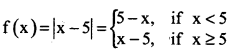
This function f is defined at all points on the real line.
Let c be a point on a real line. Then, c < 5, c – 5 or c > 5.
Case i:
c < 5
Here, f(c) = 5 – c \(\underset{\mathrm{x} \rightarrow \mathrm{c}}{\mathrm{Lt}}\) f(x)= \(\underset{\mathrm{x} \rightarrow \mathrm{c}}{\mathrm{Lt}}\) (5 – x) = 5 – c
∴ \(\underset{\mathrm{x} \rightarrow \mathrm{c}}{\mathrm{Lt}}\) f(x) = f(c)
∴ f is continuous at all real numbers less than 5.
Case ii:
c = 5
Here, f(c) = f(5) = (5 – 5) = 0
\(\underset{\mathrm{x} \rightarrow 5}{\mathrm{Lt}}\) f(x) = \(\underset{\mathrm{x} \rightarrow 5}{\mathrm{Lt}}\)(5 – x) = (5 – 5) = 0
\(\underset{\mathrm{x} \rightarrow 5}{\mathrm{Lt}}\) f(x) = \(\underset{\mathrm{x} \rightarrow 5}{\mathrm{Lt}}\) (x – 5) = 0
\(\underset{\mathrm{x} \rightarrow 5}{\mathrm{Lt}}\) f(x) = \(\underset{\mathrm{x} \rightarrow 5}{\mathrm{Lt}}\) f(x) = f(c) ∴ f is continuous at x = 5
Case iii:
c > 5
Here f(c) = f(5) = c – 5
\(\underset{\mathrm{x} \rightarrow \mathrm{c}}{\mathrm{Lt}}\) f(x)= \(\underset{\mathrm{x} \rightarrow \mathrm{c}}{\mathrm{Lt}}\) (x – 5) = c – 5
∴ \(\underset{\mathrm{x} \rightarrow \mathrm{c}}{\mathrm{Lt}}\) f(x) = f(c)
∴ f is continuous at all real numbers greater than 5.
Thus f is continuous at every real number and hence it is a continuous function.
Question 9.
Prove that the function f(x) = xn Is continuous at x = n, where n is a positive Integer.
Solution:
Given function is f(x) = xn
for all positive integers n, we have f(n) = nn
\(\underset{\mathrm{x} \rightarrow \mathrm{n}}{\mathrm{Lt}}\) f(x) = \(\underset{\mathrm{x} \rightarrow \mathrm{n}}{\mathrm{Lt}}\) (xn) = nn
∴ \(\underset{\mathrm{x} \rightarrow \mathrm{n}}{\mathrm{Lt}}\) f(x) = f(n)
Thus f(x) is continuous at n, where n is a positive integer.
Question 10.
Discuss the continuity of the function f(x) sin x + cos x
Solution:
We know that if g and h are two continuous functions, then g+h is continuous.
Let g(x) = sinx and h(x) = cosx. These two are continuous functions.
g(x) = sinx is defined for every real number.
Let c be a real number.
Put x = c+h. If x → c, then h → 0
Now g(c) = sinc .
\(\underset{\mathrm{x} \rightarrow \mathrm{c}}{\mathrm{Lt}}\) g(x) = \(\underset{\mathrm{x} \rightarrow \mathrm{c}}{\mathrm{Lt}}\) sin x = \(\underset{\mathrm{h} \rightarrow \mathrm{0}}{\mathrm{Lt}}\) sin(c + h) = sin(c + 0) = sin c = g (c)
\(\underset{\mathrm{x} \rightarrow \mathrm{c}}{\mathrm{Lt}}\) g (x ) = g (c)
∴ g(x) = sin x is a continuous function.
II.
Question 1.
Is the function f defined by \(f(x)= \begin{cases}x, & \text { if } x \leq 1 \\ 5, & \text { if } x>1\end{cases}\) continuous at x = 0? At x = 1? At x = 2?
Solution:
Given function is \(f(x)= \begin{cases}x, & \text { if } x \leq 1 \\ 5, & \text { if } x>1\end{cases}\)
(a) At x = 0,
It is clear that f is defined at 0 and its value at 0 is f(0) = 0.
Then, \(\underset{\mathrm{x} \rightarrow \mathrm{0}}{\mathrm{Lt}}\) f(x) = \(\underset{\mathrm{x} \rightarrow \mathrm{0}}{\mathrm{Lt}}\) (x) = 0
∴ \(\underset{\mathrm{x} \rightarrow \mathrm{0}}{\mathrm{Lt}}\) f(x) = f(0)
∴ f is continuous at x = 0
(b) At x = 1,
It is clear that f is defined at 1 and its value at 1 is f(1) = 1.
L.H.L = \(\underset{\mathrm{x} \rightarrow \mathrm{1-}}{\mathrm{Lt}}\) f(x) = \(\underset{\mathrm{x} \rightarrow \mathrm{1-}}{\mathrm{Lt}}\) (x) = 1 = 1.
R.H.L = \(\underset{\mathrm{x} \rightarrow \mathrm{1+}}{\mathrm{Lt}}\) f(x) = \(\underset{\mathrm{x} \rightarrow \mathrm{1+}}{\mathrm{Lt}}\) (5) = 5
Here L.H.L ≠ R.H.L
∴ \(\underset{\mathrm{x} \rightarrow \mathrm{1}}{\mathrm{Lt}}\) f(x) ≠ f(1)
∴ f(x) is not continuous at x = 1
(c) At x = 2
It is clear that f is defined at 2 and its value at 2 is f(2) = 5.
\(\underset{\mathrm{x} \rightarrow \mathrm{2}}{\mathrm{Lt}}\) f(x) = \(\underset{\mathrm{x} \rightarrow \mathrm{2}}{\mathrm{Lt}}\) 5 = 5
∴ \(\underset{\mathrm{x} \rightarrow \mathrm{1}}{\mathrm{Lt}}\) f(x) = f(2)
∴ f(x) is continuous at x = 2
Question 2.
Find all points of discontinuity of f, where f is defined by f(x) = \(\left\{\begin{array}{l}
2 x+3, \text { if } x \leq 2 \\
2 x-3, \text { if } x>2
\end{array}\right.\)
Solution:
Given function is f(x) = \(\left\{\begin{array}{l}
2 x+3, \text { if } x \leq 2 \\
2 x-3, \text { if } x>2
\end{array}\right.\)
It is clear that the given function is defined at all the points of the real line.
Let c be a point on the real line. Then, three cases arise. c < 2, c > 2, c = 2
Case i: c < 2
Here f(c) = 2c + 3.
Then, \(\underset{\mathrm{x} \rightarrow \mathrm{c}}{\mathrm{Lt}}\) f(x) = \(\underset{\mathrm{x} \rightarrow \mathrm{c}}{\mathrm{Lt}}\) (2x + 3) = 2c + 3
∴ \(\underset{\mathrm{x} \rightarrow \mathrm{c}}{\mathrm{Lt}}\) f(x) = f(c)
∴ f is continuous at all points x, such that x < 2. Case ii: c > 2
Here f(c) = 2c – 3.
Then, \(\underset{\mathrm{x} \rightarrow \mathrm{c}}{\mathrm{Lt}}\) f(x) = \(\underset{\mathrm{x} \rightarrow \mathrm{c}}{\mathrm{Lt}}\) (2x – 3) = 2c – 3
∴ \(\underset{\mathrm{x} \rightarrow \mathrm{c}}{\mathrm{Lt}}\) f(x) = f(c)
∴ f is continuous at all points x, such that x > 2.
Case iii: c = 2
L.H.L = \(\underset{\mathrm{x} \rightarrow \mathrm{2-}}{\mathrm{Lt}}\) f(x) = \(\underset{\mathrm{x} \rightarrow \mathrm{2-}}{\mathrm{Lt}}\) (2x + 3) = 2(2) + 3 = 7
R.H.L = \(\underset{\mathrm{x} \rightarrow 2+}{\mathrm{Lt}}\) f(x) = \(\underset{\mathrm{x} \rightarrow 2+}{\mathrm{Lt}}\) (2x – 3) = 2(2) – 3 = 1.
Here L.H.L. ≠ R.H.L
∴ f is not continuous at x = 2
Thus, x = 2 is the only point of discontinuity of f.
Question 3.
Find all points of discontinuity of f, where f is defined by f(x) = \(\begin{cases}|x|+3, & \text { if } x \leq-3 \\ -2 x, & \text { if }-3<x<3 \\ 6 x+2, & \text { if } x \geq 3\end{cases}\)
Solution:
The given function is f(x)= \(\begin{cases}|x|+3, & \text { if } x \leq-3 \\ -2 x, & \text { if }-3<x<3 \\ 6 x+2, & \text { if } x \geq 3\end{cases}\)
The given function f is defined at all the points of the real line.
Let c be a point on the real line.
Case i:
If c < -3, then f(c) = -c+3,
\(\underset{\mathrm{x} \rightarrow \mathrm{c}}{\mathrm{Lt}}\) f(x)= \(\underset{\mathrm{x} \rightarrow \mathrm{c}}{\mathrm{Lt}}\) (-x + 3) = -c + 3
∴ \(\underset{\mathrm{x} \rightarrow \mathrm{c}}{\mathrm{Lt}}\) f(x) = f(c)
∴ f is continuous at all points x, such that x < -3.
Case ii:
If c = -3, then f(-3) = -(-3) + 3 = 6
L.H.L = \(\underset{\mathrm{x} \rightarrow 3-}{\mathrm{Lt}}\) f(x) = \(\underset{\mathrm{x} \rightarrow 3-}{\mathrm{Lt}}\) (-x + 3) = -(3) + 3 = 6;
R.H.L = \(\underset{\mathrm{x} \rightarrow 3+}{\mathrm{Lt}}\) f(x) = \(\underset{\mathrm{x} \rightarrow 3+}{\mathrm{Lt}}\) (-2x)= -2(-3) = 6
Here L.H.L = R.H.L
∴ \(\underset{\mathrm{x} \rightarrow -3}{\mathrm{Lt}}\) f(x) = 6 = f(-3)
∴ f is continuous at x = -3
Case iii:
If -3 < c < 3, then f(c) = -2c \(\underset{\mathrm{x} \rightarrow \mathrm{c}}{\mathrm{Lt}}\) f(x) = \(\underset{\mathrm{x} \rightarrow \mathrm{c}}{\mathrm{Lt}}\) (-2x) = -2c
∴ \(\underset{\mathrm{x} \rightarrow \mathrm{c}}{\mathrm{Lt}}\) f(x) = f(c)
∴ f is continuous in (-3, 3)
Case iv:
If c = 3, then
L.H.L = \(\underset{\mathrm{x} \rightarrow 3-}{\mathrm{Lt}}\) f(x) = \(\underset{\mathrm{x} \rightarrow 3-}{\mathrm{Lt}}\) (-2x) = -2(3) = -6
R.H.L = \(\underset{\mathrm{x} \rightarrow 3+}{\mathrm{Lt}}\) f(x) = \(\underset{\mathrm{x} \rightarrow 3+}{\mathrm{Lt}}\) (6x + 2) = 6(3) + 2 = 20
Here L.H.L ≠ R.H.L
∴ f is continuous at x = 3
Case v.
If c > 3, then f(c) = 6c + 2
\(\underset{\mathrm{x} \rightarrow \mathrm{c}}{\mathrm{Lt}}\) f(x) = \(\underset{\mathrm{x} \rightarrow \mathrm{c}}{\mathrm{Lt}}\) (6x + 2) = 6c + 2
∴ \(\underset{\mathrm{x} \rightarrow \mathrm{c}}{\mathrm{Lt}}\) f(x) = f(c)
∴ f is continuous at all points x , such that x > 3.
Hence, x = 3 is the only point of discontinuity of f.
Question 4.
Find all points of discontinuity of f, where f is defined by f(x) = \(\begin{cases}\frac{|x|}{x}, & \text { if } x \neq 0 \\ x & \text { if } x=0\end{cases}\)
Solution:
The given function is f(x) = \(\begin{cases}\frac{|x|}{x}, & \text { if } x \neq 0 \\ x & \text { if } x=0\end{cases}\)
We know that, |x| = -x when x < 0 and |x| = x when x > 0
∴ the given function can be rewritten f (x) = \(\begin{cases}\frac{|x|}{x}=\frac{-x}{x}=-1, & \text { if } x<0 \\ 0, & \text { if } x=0 \\ \frac{|x|}{x}=\frac{x}{x}=1, & \text { if } x>0\end{cases}\)
The given function f is defined at all the points of the real line.
Let c be a point on the real line.
Case i:
if c < 0, then f(c) = -1
\(\underset{\mathrm{x} \rightarrow \mathrm{c}}{\mathrm{Lt}}\) f(x) = \(\underset{\mathrm{x} \rightarrow \mathrm{c}}{\mathrm{Lt}}\) (-1) = -1
∴ \(\underset{\mathrm{x} \rightarrow \mathrm{c}}{\mathrm{Lt}}\) f(x) = f(c)
∴ f is continuous at all points x < 0
Case ii:
If c = 0, then L.H.L = \(\underset{\mathrm{x} \rightarrow 0-}{\mathrm{Lt}}\) f(x) = \(\underset{\mathrm{x} \rightarrow 0-}{\mathrm{Lt}}\) (-1) = -1
R.H.L = \(\underset{\mathrm{x} \rightarrow 0+}{\mathrm{Lt}}\) f(x) = \(\underset{\mathrm{x} \rightarrow 0+}{\mathrm{Lt}}\) (1) = 1
Here L.H.L ≠ R.H.L
∴ f is not continuous at x = 0.
Case iii.
If c > 0, then f(c) = 1
\(\underset{\mathrm{x} \rightarrow \mathrm{c}}{\mathrm{Lt}}\) f(x) = \(\underset{\mathrm{x} \rightarrow \mathrm{c}}{\mathrm{Lt}}\) (1) = 1
∴ \(\underset{\mathrm{x} \rightarrow \mathrm{c}}{\mathrm{Lt}}\) f(x) = f(c)
∴ f is continuous at all points x, such that x > 0.
Hence, x = 0 is the only point of discontinuity of f.
Question 5.
Find all points of discontinuity of f, where f is defined by f(x) = \(\begin{cases}\frac{x}{|x|}, & \text { if } x<0 \\ -1, & \text { if } x \geq 0\end{cases}\)
Solution:
Given function is f(x) = \(\begin{cases}\frac{x}{|x|}, & \text { if } x<0 \\ -1, & \text { if } x \geq 0\end{cases}\)
We know that |x| = -x when x < 0
∴ the given function can be rewritten as f(x) = \(\begin{cases}\frac{x}{|x|}=\frac{x}{-x}=-1, & \text { if } x<0 \\ -1, & \text { if } x \geq 0\end{cases}\)
Let c be any real number.
\(\underset{\mathrm{x} \rightarrow \mathrm{c}}{\mathrm{Lt}}\) f(x) = \(\underset{\mathrm{x} \rightarrow \mathrm{c}}{\mathrm{Lt}}\) (-1) = -1
Also, f(c) = -1 = \(\underset{\mathrm{x} \rightarrow \mathrm{c}}{\mathrm{Lt}}\) f(x)
∴ the given function is a continuous function.
Hence, the given function f(x) has no point of discontinuity.
Question 6.
Find all points of discontinuity of f, where f is defined by f(x) = \(\begin{cases}x+1, & \text { if } x \geq 1 \\ x^2+1, & \text { if } x<1\end{cases}\)
Solution:
Given function is f (x) = \(\begin{cases}x+1, & \text { if } x \geq 1 \\ x^2+1, & \text { if } x<1\end{cases}\)
The given function f is defined at all the points of the real line.
Let c be a point on the real line.
Case i:
If c < 1, then f(c) = c2 + 1
\(\underset{\mathrm{x} \rightarrow \mathrm{c}}{\mathrm{Lt}}\) f(x) = \(\underset{\mathrm{x} \rightarrow \mathrm{c}}{\mathrm{Lt}}\) (x2 + 1) = c2 + 1
∴ \(\underset{\mathrm{x} \rightarrow \mathrm{c}}{\mathrm{Lt}}\) f(x) = f(c)
∴ f is continuous at all points x, such that x < 1.
Case ii.
If c = 1, then f(c) = f(1) = 1 + 1 = 2
L.H.L = \(\underset{\mathrm{x} \rightarrow 1-}{\mathrm{Lt}}\) f(x) = \(\underset{\mathrm{x} \rightarrow 1-}{\mathrm{Lt}}\) (x2 + 1) = 12 + 1 = 2
R.H.L = \(\underset{\mathrm{x} \rightarrow 1+}{\mathrm{Lt}}\) f(x) = \(\underset{\mathrm{x} \rightarrow 1+}{\mathrm{Lt}}\) (x + 1) = 1 + = 2
Here L.H.L = R.H.L
∴ \(\underset{\mathrm{x} \rightarrow 1}{\mathrm{Lt}}\) f(x) = 2 = f(1)
∴ f is continuous at x = 1.
Case iii.
If c > 1, then f(c) = c + 1
\(\underset{\mathrm{x} \rightarrow \mathrm{c}}{\mathrm{Lt}}\) f(x) = \(\underset{\mathrm{x} \rightarrow \mathrm{c}}{\mathrm{Lt}}\) (x + 1) = c + 1
∴ \(\underset{\mathrm{x} \rightarrow \mathrm{c}}{\mathrm{Lt}}\) f(x) = f(c)
∴ f is continuous at all points x, such that x > 1.
Hence, the given function f(x) has no point of discontinuity.
Question 7.
Find all points of discontinuity of f, where f is defined by f(x) = \(\begin{cases}x^3-3, & \text { if } x \leq 2 \\ x^2+1, & \text { if } x>2\end{cases}\)
Solution:
The given function is f(x) = \(\begin{cases}x^3-3, & \text { if } x \leq 2 \\ x^2+1, & \text { if } x>2\end{cases}\)
The given function f is defined at all the points of the real line.
Let c be a point on the real line.
Case i:
If c < 2, then f(c) = c3 – 3
\(\underset{\mathrm{x} \rightarrow \mathrm{c}}{\mathrm{Lt}}\) f(x) = \(\underset{\mathrm{x} \rightarrow \mathrm{c}}{\mathrm{Lt}}\) (x3 – 3) = c3 – 3
∴ \(\underset{\mathrm{x} \rightarrow \mathrm{c}}{\mathrm{Lt}}\) f(x) = f(c)
∴ f is continuous at all points x, such that x< 2.
Case ii:
If c = 2, then f(c) = f(2) = 23 – 3 = 5
L.H.L = \(\underset{\mathrm{x} \rightarrow 2-}{\mathrm{Lt}}\) f(x) = \(\underset{\mathrm{x} \rightarrow 2-}{\mathrm{Lt}}\) (x3 – 3) = 2 – 3 = 5
R.H.L = \(\underset{\mathrm{x} \rightarrow 2+}{\mathrm{Lt}}\) f(x) = \(\underset{\mathrm{x} \rightarrow 2+}{\mathrm{Lt}}\) (x2 + 1) = 22 + 1 = 5
Here L.H.L = R.H.L
∴ \(\underset{\mathrm{x} \rightarrow 2}{\mathrm{Lt}}\) f(x)= 5 = f(2)
∴ f is continuous at x = 2.
Case iii:
If c > 2, then f(c) = c2 + 1
\(\underset{\mathrm{x} \rightarrow \mathrm{c}}{\mathrm{Lt}}\) f(x) = \(\underset{\mathrm{x} \rightarrow \mathrm{c}}{\mathrm{Lt}}\) (x2 + 1) = c2 + 1
∴ \(\underset{\mathrm{x} \rightarrow \mathrm{c}}{\mathrm{Lt}}\) f(x) = f(c)
∴ f is continuous at all points x, such that x > 2.
Thus, the given function f is continuous at every point on the real line.
Hence, the given function f(x) has no point of discontinuity.
Question 8.
Find all points of discontinuity off, where f is defined by f(x) = \(\begin{cases}x^{10}-1, & \text { if } x \leq 1 \\ x^2, & \text { if } x>1\end{cases}\)
Solution:
The given function is f(x) = \(\begin{cases}x^{10}-1, & \text { if } x \leq 1 \\ x^2, & \text { if } x>1\end{cases}\)
The given function fis defmed at all the points of the real line.
Let c be a point on the real line.
Case i:
If c < 1,then f(c) = c10 – 1
\(\underset{\mathrm{x} \rightarrow \mathrm{c}}{\mathrm{Lt}}\) f(x) = \(\underset{\mathrm{x} \rightarrow \mathrm{c}}{\mathrm{Lt}}\) (x10 – 1) = c10 – 1
∴ \(\underset{\mathrm{x} \rightarrow \mathrm{c}}{\mathrm{Lt}}\) f(x) = f(c)
∴ f is continuous at all points x, such that x < 1.
Case ii:
L.H.L = \(\underset{\mathrm{x} \rightarrow 1-}{\mathrm{Lt}}\) f(x) = \(\underset{\mathrm{x} \rightarrow 2-}{\mathrm{Lt}}\) (x10 – 1) = 110 – 1 = 1 – 1 = 0
R.H.L = \(\underset{\mathrm{x} \rightarrow 1+}{\mathrm{Lt}}\) f(x)= \(\underset{\mathrm{x} \rightarrow 1+}{\mathrm{Lt}}\) (x2) = 12 = 1
Here L.H.L ≠ R.H.L
∴ f is not continuous at x = 1.
Case iii
If c > 1 then f(c) = c2
\(\underset{\mathrm{x} \rightarrow \mathrm{c}}{\mathrm{Lt}}\) f(x) = f(c) = \(\underset{\mathrm{x} \rightarrow \mathrm{c}}{\mathrm{Lt}}\) (x2) = c2
∴ \(\underset{\mathrm{x} \rightarrow \mathrm{c}}{\mathrm{Lt}}\) f(x) = f(c)
∴ f is continuous at all points x, such that x > 1.
We observe that x = 1 is the only point of discontinuity of f.
Question 9.
Is the function defined by f(x) = \(\begin{cases}x+5, & \text { if } x \leq 1 \\ x-5, & \text { if } x>1\end{cases}\) a continuous function?
Solution:
Given function is f(x) = \(\begin{cases}x+5, & \text { if } x \leq 1 \\ x-5, & \text { if } x>1\end{cases}\)
The given function f is defined at all the points of the real line.
Let c be a point on the real line.
Case i:
If c < 1, then f(c) = c + 5 \(\underset{\mathrm{x} \rightarrow \mathrm{c}}{\mathrm{Lt}}\) f(x) = \(\underset{\mathrm{x} \rightarrow \mathrm{c}}{\mathrm{Lt}}\) (x + 5) = c + 5
∴ \(\underset{\mathrm{x} \rightarrow \mathrm{c}}{\mathrm{Lt}}\) f(x) = f(c)
Case ii:
If c = 1, then f(1) = 1 + 5 = 6
L.H.L = \(\underset{\mathrm{x} \rightarrow 1-}{\mathrm{Lt}}\) f(x) = \(\underset{\mathrm{x} \rightarrow 1-}{\mathrm{Lt}}\) (x + 5) = 1 + 5 = 6
R.H.L = \(\underset{\mathrm{x} \rightarrow 1+}{\mathrm{Lt}}\) f(x) = \(\underset{\mathrm{x} \rightarrow 1+}{\mathrm{Lt}}\) (x – 5) = 1 – 5 = -4
Here L.H.L ≠ R.H.L
∴ f is not continuous at x = 1.
Case iii:
If c >1, then f(c) = c – 5
\(\underset{\mathrm{x} \rightarrow \mathrm{c}}{\mathrm{Lt}}\) f(x) = \(\underset{\mathrm{x} \rightarrow \mathrm{c}}{\mathrm{Lt}}\) (x – 5) = c – 5
∴ \(\underset{\mathrm{x} \rightarrow \mathrm{c}}{\mathrm{Lt}}\) f(x) = f(c)
∴ f is continuous at all points x, such that x > 1.
We observe that, x = 1 is the only point of discontinuity of f.
Question 10.
Discuss the continuity of the function f, where f is defined by f(x) = \(\left\{\begin{array}{l}
3, \text { if } 0 \leq x \leq 1 \\
4, \text { if } 1<x<3 \\
5, \text { if } 3 \leq x \leq 10
\end{array}\right.\)
Solution:
The given function is f(x) = \(\left\{\begin{array}{l}
3, \text { if } 0 \leq x \leq 1 \\
4, \text { if } 1<x<3 \\
5, \text { if } 3 \leq x \leq 10
\end{array}\right.\)
The given function is defined at all the points of the interval [0, 10].
Let c be a point in the interval [0, 10].
Case i:
If 0 ≤ c < 1, then f(c) = 3
\(\underset{\mathrm{x} \rightarrow \mathrm{c}}{\mathrm{Lt}}\) f(x) = \(\underset{\mathrm{x} \rightarrow \mathrm{c}}{\mathrm{Lt}}\) (3) = 3
∴ \(\underset{\mathrm{x} \rightarrow \mathrm{c}}{\mathrm{Lt}}\) f(x) = f(c)
∴ f is continuous in the interval [0, 1)
Case ii:
If c = 1, then f(3) = 3
L.H.L = \(\underset{\mathrm{x} \rightarrow 1-}{\mathrm{Lt}}\) f(x) = \(\underset{\mathrm{x} \rightarrow 1-}{\mathrm{Lt}}\) (3) = 3
R.H.L = \(\underset{\mathrm{x} \rightarrow 1+}{\mathrm{Lt}}\) f(x) = \(\underset{\mathrm{x} \rightarrow 1+}{\mathrm{Lt}}\) (4) = 4
Here L.H.L≠ R.H.L
∴ f is not continuous at x = 1.
Case iii:
If 1 < c < 3, then f(c) = 4
\(\underset{\mathrm{x} \rightarrow \mathrm{c}}{\mathrm{Lt}}\) f(x) = \(\underset{\mathrm{x} \rightarrow \mathrm{c}}{\mathrm{Lt}}\) (4) = 4
∴ \(\underset{\mathrm{x} \rightarrow \mathrm{c}}{\mathrm{Lt}}\) f(x) = f(c)
∴ f is continuous in the interval (1, 3).
Case iv:
If c = 3, then f(c) = 5
L.H.L = \(\underset{\mathrm{x} \rightarrow 3-}{\mathrm{Lt}}\) f(x) = \(\underset{\mathrm{x} \rightarrow 3-}{\mathrm{Lt}}\) (4) = 4
R.H.L = \(\underset{\mathrm{x} \rightarrow 3+}{\mathrm{Lt}}\) f(x) = \(\underset{\mathrm{x} \rightarrow 3+}{\mathrm{Lt}}\) (5) = 5
Here L.H.L≠ R.H.L
∴ f is not continuous at x = 3.
Case v:
If 3 < c ≤ 10, then f(c) = 5
\(\underset{\mathrm{x} \rightarrow \mathrm{c}}{\mathrm{Lt}}\) f(x) = \(\underset{\mathrm{x} \rightarrow \mathrm{c}}{\mathrm{Lt}}\) (5) = 5
∴ \(\underset{\mathrm{x} \rightarrow \mathrm{c}}{\mathrm{Lt}}\) f(x) = f(c)
∴ f is continuous at all points of the interval (3, 10]
Also f is discontinuous at x = 1 and x = 3.
Question 11.
Discuss the continuity of the function f, where f is defined by f(x) = \(\begin{cases}2 x, & \text { if } x<0 \\ 0, & \text { if } 0 \leq x \leq 1 \\ 4 x, & \text { if } x>1\end{cases}\)
Solution:
Given function is f(x) = \(\begin{cases}2 x, & \text { if } x<0 \\ 0, & \text { if } 0 \leq x \leq 1 \\ 4 x, & \text { if } x>1\end{cases}\)
The given function f is defined at all the points of the real line.
Let c be a point in the interval (-∞, 0).
Case i:
If c < 0, then f(c) = 2c
\(\underset{\mathrm{x} \rightarrow \mathrm{c}}{\mathrm{Lt}}\) f(x) = \(\underset{\mathrm{x} \rightarrow \mathrm{c}}{\mathrm{Lt}}\)(2x) = 2c
∴ \(\underset{\mathrm{x} \rightarrow \mathrm{c}}{\mathrm{Lt}}\) f(x) = f(c)
∴ f is continuous at all points x, such that x < 0.
Case ii:
If c = 0, then f(c) = f(0) = 0
L.H.L = \(\underset{\mathrm{x} \rightarrow 0-}{\mathrm{Lt}}\) f(x) = \(\underset{\mathrm{x} \rightarrow 0-}{\mathrm{Lt}}\) (2x) = 2(0) = 0
R.H.L = \(\underset{\mathrm{x} \rightarrow 0+}{\mathrm{Lt}}\) f(x) = \(\underset{\mathrm{x} \rightarrow 0+}{\mathrm{Lt}}\) (0) = 0
∴ \(\underset{\mathrm{x} \rightarrow \mathrm{c}}{\mathrm{Lt}}\) f(x) = f(0)
∴ f is continuous at x = 0.
Case iii:
If 0 < c < 1, then f(x) = 0
\(\underset{\mathrm{x} \rightarrow \mathrm{c}}{\mathrm{Lt}}\) f(x) = \(\underset{\mathrm{x} \rightarrow \mathrm{c}}{\mathrm{Lt}}\) (0) = 0
∴ \(\underset{\mathrm{x} \rightarrow \mathrm{c}}{\mathrm{Lt}}\) f(x) = f(c)
∴ f is continuous in the interval (0, 1)
Case iv:
If c = 1, then f(c) = f(1) = 0
L.H.L = \(\underset{\mathrm{x} \rightarrow 1-}{\mathrm{Lt}}\) f(x)= \(\underset{\mathrm{x} \rightarrow 1-}{\mathrm{Lt}}\) (0) = 0
R.H.L = \(\underset{\mathrm{x} \rightarrow 1+}{\mathrm{Lt}}\) f(x)= \(\underset{\mathrm{x} \rightarrow 1+}{\mathrm{Lt}}\) (4x) = 4(1) = 4
Here L.H.L ≠ R.H.L
∴ f is not continuous at x = 1.
Case v:
If c > 1, then f(c) = 4c
\(\underset{\mathrm{x} \rightarrow \mathrm{c}}{\mathrm{Lt}}\) f(x) = \(\underset{\mathrm{x} \rightarrow \mathrm{c}}{\mathrm{Lt}}\) (4x) = 4c
∴ \(\underset{\mathrm{x} \rightarrow \mathrm{c}}{\mathrm{Lt}}\) f(x) = f(c)
∴ f is continuous at all points x, such that x > 1.
Question 12.
Discuss the continuity of the function f. where f is defined by f(x) = \(\begin{cases}-2, & \text { if } x \leq-1 \\ 2 x, & \text { if }-11\end{cases}\)
Solution:
Given function is f(x) = \(\begin{cases}-2, & \text { if } x \leq-1 \\ 2 x, & \text { if }-11\end{cases}\)
The given function f is defined at all the points.
Let c be a point on the real line.
Case i:
If c < -1, then f(c) = -2
\(\underset{\mathrm{x} \rightarrow \mathrm{c}}{\mathrm{Lt}}\) f(x) = \(\underset{\mathrm{x} \rightarrow \mathrm{c}}{\mathrm{Lt}}\) (-2) = -2
∴ \(\underset{\mathrm{x} \rightarrow \mathrm{c}}{\mathrm{Lt}}\) f(x) = f(c) .
∴ f is continuous at all points x. such that x < -1.
Case ii:
If c = -1, then f(c) = f (-1) = -2 .
L.H.L = \(\underset{x \rightarrow 1-}{\mathrm{Lt}}\) f(x) = \(\underset{x \rightarrow 1-}{\mathrm{Lt}}\) (-2) = -2
R.H.L = \(\underset{x \rightarrow 1+}{\mathrm{Lt}}\) f(x) = \(\underset{x \rightarrow 1+}{\mathrm{Lt}}\) (2x) = 2(-1) = -2
Here L.H.L = R.H.L
∴ \(\underset{\mathrm{x} \rightarrow \mathrm{c}}{\mathrm{Lt}}\) f(x) = -2 = f(-1)
∴ f is continuous at x = -1.
Case iii:
If -1 < ç < 1, then f(ç) = 2c \(\underset{\mathrm{x} \rightarrow \mathrm{c}}{\mathrm{Lt}}\)
f(x) = \(\underset{\mathrm{x} \rightarrow \mathrm{c}}{\mathrm{Lt}}\) (2x) = 2c
∴ \(\underset{\mathrm{x} \rightarrow \mathrm{c}}{\mathrm{Lt}}\) f(x) = f(c)
∴ f is continuous in the interval (-1, 1).
Case iv:
If c = 1, then f(ç) = f(1) = 2(1) = 2
L.H.L = \(\underset{x \rightarrow 1-}{\mathrm{Lt}}\) f(x) = \(\underset{x \rightarrow 1-}{\mathrm{Lt}}\) (2x) = 2(1) = 2
R.H.L = \(\underset{x \rightarrow 1+}{\mathrm{Lt}}\) f(x) = \(\underset{x \rightarrow 1+}{\mathrm{Lt}}\) (2) = 2
Here L.H.L = R.H.L
∴ \(\underset{\mathrm{x} \rightarrow \mathrm{c}}{\mathrm{Lt}}\) f(x) = f(c)
∴ f is continuous at x = 2.
Case v:
If c > 1, then f(c) = 2
\(\underset{\mathrm{x} \rightarrow \mathrm{c}}{\mathrm{Lt}}\) f(x) = \(\underset{\mathrm{x} \rightarrow \mathrm{c}}{\mathrm{Lt}}\)(2) = 2
∴ \(\underset{\mathrm{x} \rightarrow \mathrm{c}}{\mathrm{Lt}}\) f(x) = f(c)
∴ f is continuous at all points x, such that x > 1.
Thus f is continuous at all points of all real line.
Question 13.
Find the relationship between a and b so that the function f defined by f(x) = \(\left\{\begin{array}{l}
a x+1, \text { if } x \leq 3 \\
b x+3, \text { if } x>3
\end{array}\right.\) is continuous at x = 3.
Solution:
Given function is f(x) = \(\left\{\begin{array}{l}
a x+1, \text { if } x \leq 3 \\
b x+3, \text { if } x>3
\end{array}\right.\)
For f to be continuous at x = 3, then \(\underset{x \rightarrow 3-}{\mathrm{Lt}}\) f(x) = \(\underset{x \rightarrow 3+}{\mathrm{Lt}}\) f(x)= f(3)
L.H.L = \(\underset{x \rightarrow 3-}{\mathrm{Lt}}\) f(x) = \(\underset{x \rightarrow 3-}{\mathrm{Lt}}\) (ax + 1) = 3a + 1
R.H.L = \(\underset{x \rightarrow 3+}{\mathrm{Lt}}\) f(x) = \(\underset{x \rightarrow 3+}{\mathrm{Lt}}\) (bx + 3) = 3b + 3
Also f(3) = 3a + 1
When L.H.L = R.H.L then 3a + 1 = 3b + 3 = 3a = 3b + 2 = a = b + \(\frac{2}{3}\)
This is the required relation.
Question 14.
For what value of λ is the function defined by f(x) = \(\begin{cases}\lambda\left(x^2-2 x\right), & \text { if } x \leq 0 \\ 4 x+1, & \text { if } x>0\end{cases}\) continuous at x = 0? What about continuity at x = 1?
Solution:
Given function is f(x) = \(\begin{cases}\lambda\left(x^2-2 x\right), & \text { if } x \leq 0 \\ 4 x+1, & \text { if } x>0\end{cases}\)
If f is continuous at x = 0,then \(\underset{x \rightarrow 0-}{\mathrm{Lt}}\) f(x) = \(\underset{x \rightarrow 0+}{\mathrm{Lt}}\) f(x) = f(0)
∴ \(\underset{x \rightarrow 0-}{\mathrm{Lt}}\) λ(x2 – 2x) = \(\underset{x \rightarrow 0+}{\mathrm{Lt}}\) (4x + 1) = X(02 – 2 × 0)
⇒ λ(2 – 2 × 0) = 4(0) + 1 = 0
⇒ 0 = 1 = 0 [which is not possible]
∴ f is continuous at x = 0 for no value of λ.
At x = 1, f(1) = 4x + 1 = 4(1) + 1 = 5
\(\underset{x \rightarrow 1}{\mathrm{Lt}}\) (4x + 1) = 4(1) + 1 = 5
\(\underset{x \rightarrow 1}{\mathrm{Lt}}\) f(x)=f(l)
∴ f, is continuous at x = 1 for any value of λ.
Question 15.
Show that the function defined by g(x) = x – |x| is discontinuous at all integral points. Here |x| denotes (he greatest integer less than or equal to x.
Solution:
The given function ¡s g(x) = x – [x] .
It is clear that g is defined at all integral points.
Let n be an integer
Then, g(n) n – [n] = n – n = 0
LHL = \(\underset{\mathrm{x} \rightarrow \mathrm{n}-}{\mathrm{Lt}}\) g(x) = \(\underset{\mathrm{x} \rightarrow \mathrm{n}-}{\mathrm{Lt}}\) (x – [x]) = \(\underset{\mathrm{x} \rightarrow \mathrm{n}-}{\mathrm{Lt}}\) (x) – \(\underset{\mathrm{x} \rightarrow \mathrm{n}-}{\mathrm{Lt}}\) [x] = n – (n – 1) = 1
R.H.L = \(\underset{\mathrm{x} \rightarrow \mathrm{n}+}{\mathrm{Lt}}\) g(x) = \(\underset{\mathrm{x} \rightarrow \mathrm{n}+}{\mathrm{Lt}}\) (x – [x]) = \(\underset{\mathrm{x} \rightarrow \mathrm{n}+}{\mathrm{Lt}}\) (x) – \(\underset{\mathrm{x} \rightarrow \mathrm{n}+}{\mathrm{Lt}}\) [x] = n – n = 0
Here L.H.L ≠ R.H.L
∴ g is not continuous at x = n.
Hence, g is discontinuous at all integral points.
Question 16.
Is the function defined by f(x) = x2 – sin x + 5 continuous at x = π?
Solution:
The given function is f(x) = x2 – sin x + 5
It is clear that f is defined at x = π.
At x = π, f(x) = f(π) = π2 – sin π + 5 = π2 – 0 + 5 = π2 + 5
Now \(\underset{\mathrm{x} \rightarrow \pi}{\mathrm{Lt}}\) f(x) = \(\underset{\mathrm{x} \rightarrow \pi}{\mathrm{Lt}}\) (x2 – sin x + 5)
∴ \(\underset{\mathrm{x} \rightarrow \pi}{\mathrm{Lt}}\) f(x) = \(\underset{\mathrm{x} \rightarrow \pi}{\mathrm{Lt}}\) (x2 – sin x) + 5
= (π + 0)2 – sin(π + 0) + 5 = π2 – sin π + 5
= π2 – 0(1) – (-1)0 + 5 = π2 + 5 = f(π)
∴ the given function f is continuous at x = π.
Question 17.
Find all points of discontinuity of f, where f(x) = \(\begin{cases}\frac{\sin x}{x}, & \text { if } x<0 \\ x+1, & \text { if } x \geq 0\end{cases}\)
Solution:
The given function is f(x) = \(\begin{cases}\frac{\sin x}{x}, & \text { if } x<0 \\ x+1, & \text { if } x \geq 0\end{cases}\)
The given function f is defined at all the points of the real line.
Let c be a point on the real line.
Case i:
If c < 0, then f(c) = \(\frac{\sin c}{c}\)
\(\underset{\mathrm{x} \rightarrow \mathrm{c}}{\mathrm{Lt}}\) f(x) = \(\underset{\mathrm{x} \rightarrow \mathrm{c}}{\mathrm{Lt}}\) \(\left(\frac{\sin x}{x}\right)=\frac{\sin c}{c}\)
∴ \(\underset{\mathrm{x} \rightarrow \mathrm{c}}{\mathrm{Lt}}\) f(x) = f(c)
∴ f is continuous at all points x, such that, x < 0.
Case ii:
If c > 0, then f(c) = c + 1
\(\underset{\mathrm{x} \rightarrow \mathrm{c}}{\mathrm{Lt}}\) f(x) = \(\underset{\mathrm{x} \rightarrow \mathrm{c}}{\mathrm{Lt}}\) (x + 1) = c + 1
∴ \(\underset{\mathrm{x} \rightarrow \mathrm{c}}{\mathrm{Lt}}\) f(x) = f(c)
∴ f is continuous at all points x . such that x > 0.
Case iii:
If c = 0, then f(c) = f(0) = 0 + 1 = 1
L.H.L = \(\underset{\mathrm{x} \rightarrow 0-}{\mathrm{Lt}}\) f(x) = \(\underset{\mathrm{x} \rightarrow 0-}{\mathrm{Lt}}\) \(\left(\frac{\sin x}{x}\right)\) = 1
R.H.L = \(\underset{\mathrm{x} \rightarrow 0+}{\mathrm{Lt}}\) f(x) = \(\underset{\mathrm{x} \rightarrow 0+}{\mathrm{Lt}}\) (x + 1) = 1
\(\underset{\mathrm{x} \rightarrow 0+}{\mathrm{Lt}}\) f(x) = \(\underset{\mathrm{x} \rightarrow 0-}{\mathrm{Lt}}\) f(x) = f(0)
∴ f is continuous at x = 0
Thus, f is continuous at all points of the real line.
Thus, f has no point of discontinuity.
Question 18.
Determine if f defined by f(x) = \(\begin{cases}x^2 \sin \frac{1}{x}, & \text { if } x \neq 0 \\ 0, & \text { if } x=0\end{cases}\) is a continuous function?
Solution:
The given function is f(x) = \(\begin{cases}x^2 \sin \frac{1}{x}, & \text { if } x \neq 0 \\ 0, & \text { if } x=0\end{cases}\)
The given function is defined at all the points of the real line.
Let c be a point on the real line.
Case i:
If c ≠ 0, then f(c) = c2sin\(\frac{1}{c}\)
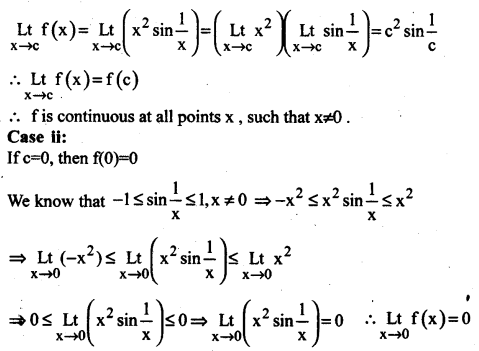
∴ f is continuous at x = 0
Hence f is continuous at every point of the real line.
Thus, f is a continuous function on R.
Question 19.
Examine the continuity of f, where f ¡s defined by f(x) = \(\begin{cases}\sin x-\cos x, & \text { if } x \neq 0 \\ -1, & \text { if } x=0\end{cases}\)
Solution:
The given function is f(x) = \(\begin{cases}\sin x-\cos x, & \text { if } x \neq 0 \\ -1, & \text { if } x=0\end{cases}\)
The given function f is defined at all the points of the real line.
Let c be a point on the real line.
Case i:
If c ≠ 0, then f(c) = sin c – cos c
\(\underset{\mathrm{x} \rightarrow \mathrm{c}}{\mathrm{Lt}}\) f(x) = \(\underset{\mathrm{x} \rightarrow \mathrm{c}}{\mathrm{Lt}}\) (sinx – cosx) = sinc – cosc
∴ \(\underset{\mathrm{x} \rightarrow \mathrm{c}}{\mathrm{Lt}}\) f(x) = f(c)
∴ f is continuous at all points x , such that x ≠ 0.
Case ii:
If c = 0, then f(0) = -1.
L H L = \(\underset{\mathrm{x} \rightarrow 0-}{\mathrm{Lt}}\) f(x) = \(\underset{\mathrm{x} \rightarrow 0-}{\mathrm{Lt}}\) (sin x – cos x) = sin 0 – cos 0 = 0 – 1 = -1
R.H.L= \(\underset{\mathrm{x} \rightarrow 0+}{\mathrm{Lt}}\) f(x) = \(\underset{\mathrm{x} \rightarrow 0+}{\mathrm{Lt}}\) (sin x – cos x) = sin 0 – cos 0 = 0 – 1 = -1
Here L.H.L = R.H.L
\(\underset{\mathrm{x} \rightarrow 0-}{\mathrm{Lt}}\) f(x)= \(\underset{\mathrm{x} \rightarrow 0+}{\mathrm{Lt}}\) f(x) = f(0)
∴ f is continuous at x = 0
Hence f is continuous at every point of the real line. Thus, f is a continuous function on R.
Question 20.
Find the values of k. so that the function f is continuous at the indicated point f(x) = \(\begin{cases}\frac{k \cos x}{\pi-2 x}, & \text { if } x \neq \frac{\pi}{2} \\ 3, & \text { if } x=\frac{\pi}{2}\end{cases}\) at x = \(\frac{\pi}{2}\)
Solution:
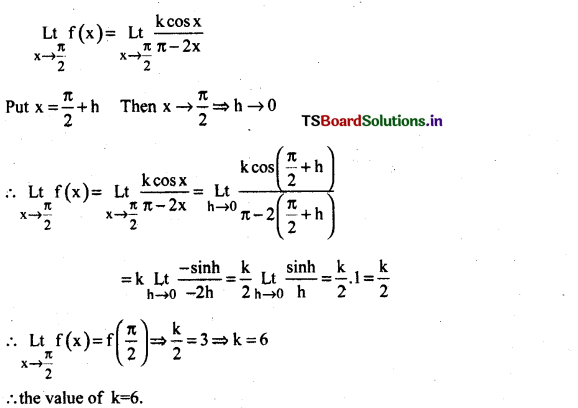
The given function is f(x) = \(\begin{cases}\frac{k \cos x}{\pi-2 x}, & \text { if } x \neq \frac{\pi}{2} \\ 3, & \text { if } x=\frac{\pi}{2}\end{cases}\)
It is clear that f is defined at x = \(\frac{\pi}{2}\) and f(\(\frac{\pi}{2}\)) = 3
From the given f(x) to be continuous at x = \(\frac{\pi}{2}\), we have
Question 21.
Find the values of k so that the function f is continuous at the indicated point f(x) = \(\begin{cases}k x^2, & \text { if } x \leq 2 \\ 3, & \text { if } x>2\end{cases}\) at x = 2
Solution:
The given function is f(x) = \(\begin{cases}k x^2, & \text { if } x \leq 2 \\ 3, & \text { if } x>2\end{cases}\)
f is defined at x = and f(2) = k(2)2 = 4k
For the given function f(x) to be continuous at x = 2 we have
\(\underset{\mathrm{x} \rightarrow 2-}{\mathrm{Lt}}\) f(x) = \(\underset{\mathrm{x} \rightarrow 2-}{\mathrm{Lt}}\) f(x) = f(2)
⇒ \(\underset{\mathrm{x} \rightarrow 2-}{\mathrm{Lt}}\) (kx2) = \(\underset{\mathrm{x} \rightarrow 2+}{\mathrm{Lt}}\) (3) = 4k ⇒ 4k = 3 ⇒ k = \(\frac{3}{4}\)
∴ the value of k = \(\frac{3}{4}\)
Question 22.
Find the values of k so that the function f is continuous at the indicated point f(x) = \(\begin{cases}k x+1, & \text { if } x \leq \pi \\ \cos x, & \text { if } x>\pi\end{cases}\) at x = π
Solution:
The given function is f(x) = \(\begin{cases}k x+1, & \text { if } x \leq \pi \\ \cos x, & \text { if } x>\pi\end{cases}\)
It is clear that f is defined at x = π and f(π) = kπ + 1
For the given function f(x) to be continuous at x = π we have
\(\underset{\mathrm{x} \rightarrow \pi-}{\mathrm{Lt}}\) f(x) = \(\underset{\mathrm{x} \rightarrow \pi+}{\mathrm{Lt}}\) f(x) = f(π)
⇒ \(\underset{\mathrm{x} \rightarrow \pi-}{\mathrm{Lt}}\) (kx + 1) = \(\underset{\mathrm{x} \rightarrow \pi+}{\mathrm{Lt}}\) (cosx)kπ + 1
⇒ kπ + 1 = cos π = kπ + 1
⇒ kπ + 1 = -1 = kπ + 1
⇒ k = –\(\frac{2}{\pi}\)
∴ the value of k = –\(\frac{2}{\pi}\)
Question 23.
Find the values of k so that the function f is continuous at the indicated point f(x) = \(\begin{cases}k x+1, & \text { if } x \leq 5 \\ 3 x-5, & \text { if } x>5\end{cases}\) at x =
Solution:
The given function is f(x) = \(\begin{cases}k x+1, & \text { if } x \leq 5 \\ 3 x-5, & \text { if } x>5\end{cases}\)
It is clear that f is defined at x = 5 and f(5) = kx + 1 = 5k + 1
For the given function f(x) to be continuous at x = 5, we have
\(\underset{\mathrm{x} \rightarrow 5-}{\mathrm{Lt}}\) f(x) = \(\underset{\mathrm{x} \rightarrow 5+}{\mathrm{Lt}}\) f(x) = f(5)
⇒ \(\underset{\mathrm{x} \rightarrow 5-}{\mathrm{Lt}}\) (kx + 1) = \(\underset{\mathrm{x} \rightarrow 5-}{\mathrm{Lt}}\) (3x – 5) = 5k + 1
⇒ 5k + 1 = 3(5) – 5 = 5k + 1
⇒ 5k + 1 = 15 – 5 = 5k + 1
⇒ 5k + 1 = 10 = 5k + 1
⇒ 5k + 1 = 10 = 5k + 1
⇒ 5k + 1 = 10 ⇒ 5k = 9 ⇒ k = \(\frac{9}{5}\)
∴ the value of k = \(\frac{9}{5}\)
Question 24.
Find the values of a and b such that the function defined by f(x) = \(\begin{cases}5, & \text { if } x \leq 2 \\ a x+b, & \text { if } 2<x<10 \\ 21, & \text { if } x \geq 10\end{cases}\) is a continuous function.
Solution:
The given function is f(x) = \(\begin{cases}5, & \text { if } x \leq 2 \\ a x+b, & \text { if } 2<x<10 \\ 21, & \text { if } x \geq 10\end{cases}\)
It is clear that f is defined at all points of the real line.
If f is a continuous function, then f is continuous at all real numbers.
In particular, f is continuous at x = 2 and x = 10
(i) When f is continuous at x = 2 , we obtain
\(\underset{\mathrm{x} \rightarrow 2-}{\mathrm{Lt}}\) f(x) = \(\underset{\mathrm{x} \rightarrow 2+}{\mathrm{Lt}}\) f(x) = f(2)
⇒ \(\underset{\mathrm{x} \rightarrow 2-}{\mathrm{Lt}}\) (5) = \(\underset{\mathrm{x} \rightarrow 2+}{\mathrm{Lt}}\) (ax + b) = 5
⇒ 5 = 2a + b = 5
⇒ 2a + b = 5 …………. (1)
(ii) When f is continuous at x = 10, we obtain
\(\underset{\mathrm{x} \rightarrow 10-}{\mathrm{Lt}}\) f(x) = \(\underset{\mathrm{x} \rightarrow 10+}{\mathrm{Lt}}\) f(x) = f(10)
⇒ \(\underset{\mathrm{x} \rightarrow 10-}{\mathrm{Lt}}\) (ax + b) = \(\underset{\mathrm{x} \rightarrow 10+}{\mathrm{Lt}}\) (21) = 21
⇒ 10a + b = 21 ………… (2)
On subtracting equation (1) from equation (2), we obtain 8a = 16 ⇒ a = 2
By putting a = 2 in equation (1), we get 2(2) + b = 5 ⇒ 4 + b = 5 ⇒ b = 1
∴ the values of a and b for which is a continuous function are 2 and 1 respectively.
Question 25.
Show that the function defined by f(x) = cos (x2) is a continuous function.
Solution:
The given function is f(x) = cos (x2).
This function f is defined for every real number and f can be written as the composition of two functions as,f = goh,where g(x) = cos x and h(x) = x2
[∵ (goh)(x) = g(h(x)) = g(x2) = cos(x2) = f(x)]
It has to be proved first that g(x) = cosx and h(x) = x2 are continuous functions.
It is clear that g is defined for every real number.
Let c be a real number.
(i) Let g(c) = cosc. Put x = c + h
If x → c, then, h → 0
\(\underset{\mathrm{x} \rightarrow \mathrm{c}}{\mathrm{Lt}}\) g(x) = \(\underset{\mathrm{x} \rightarrow \mathrm{c}}{\mathrm{Lt}}\) cos x
= \(\underset{\mathrm{x} \rightarrow \mathrm{h}}{\mathrm{Lt}}\) cos(c + h) = cos(c + 0) = cos c = g(c)
∴ \(\underset{\mathrm{x} \rightarrow \mathrm{c}}{\mathrm{Lt}}\) g(x) = g(c)
∴ g(x) = cosx is a continuous function.
(ii) Let h(x) = x2
It is evident that h is defined for every real number.
Let k be a real number, then h(k) = k2
\(\underset{\mathrm{x} \rightarrow \mathrm{k}}{\mathrm{Lt}}\) h(x) = \(\underset{\mathrm{x} \rightarrow \mathrm{k}}{\mathrm{Lt}}\) x2 = k2
∴ h is a continuous function.
∴ f(x) = (goh)(x) = cos(x2) is a continuous function.
Question 26.
Show that the function defined by f(x) = |cos x| is a continuous function.
Solution:
We may rewrite f as f(x) = \(\begin{cases}-x, & \text { if } x<0 \\ x, & \text { if } x \geq 0\end{cases}\)
By Example 3, we know that f is continuous at x = 0.
LH.L = \(\lim _{x \rightarrow c-}\) f(x) = \(\lim _{x \rightarrow c-}\) (x) = c
R.H.L = \(\lim _{x \rightarrow c+}\) f(x) = \(\lim _{x \rightarrow c+}\) x = c
Here L.H.L = R.H.L = f(c) for all real values of c.
Hence, f is continuous at all points.
In Ex 21 Part 2 we proved that cosx is a continuous function.
Thus, their composite functions |cosx| is also a continuous function.
Question 27.
Examine that sin is a continuous function.
Solution:
Let f(x) = sin x and g(x) = x
We know that sin x and |x| are continuous functions. .. f and g are continuous.
Now (fog) (x) = f(g(x)) = f(|x|) = sin |x|
We know that composite function of two continuous functions ¡s continuous.
∴ fog is continuous.
Hence, sin |x| is continuous.
Question 28.
Find all the points of discontinuity of f defined by f(x) = |x| – |x + 1|
Solution:
We may rewrite f as f(x) = \(\begin{cases}-x, & \text { if } x<0 \\ x, & \text { if } x \geq 0\end{cases}\)
By Example 3, we know that f is continuous at x = 0.
LH.L = \(\lim _{x \rightarrow c-}\) f(x) = \(\lim _{x \rightarrow c-}\) (x) = c
R.H.L = \(\lim _{x \rightarrow c+}\) f(x) = \(\lim _{x \rightarrow c+}\) x = c
Here L.H.L = R.H.L = f(c) for all real values of c.
Hence, f is continuous at all points.
Let h(x) = |x + 1|can be written as h(x) = \(\left\{\begin{array}{l}
-(x+1), \text { if } x<-1 \\
x+1, \text { if } x \geq-1
\end{array}\right.\)
It is clear that h is defined for every real number.
Let c be a real number.
Case I:
If c < -1, then h(c) = -(c + 1)
\(\underset{\mathrm{x} \rightarrow \mathrm{c}}{\mathrm{Lt}}\) h(x) = \(\underset{\mathrm{x} \rightarrow \mathrm{c}}{\mathrm{Lt}}\) [-(x + 1)] = -(c + 1)
∴ \(\underset{\mathrm{x} \rightarrow \mathrm{c}}{\mathrm{Lt}}\) h(x) = h(c)
∴ h is continuous at all points x, such that x < -1.
Case II:
If c > -1, then h(c) = c + 1
\(\underset{\mathrm{x} \rightarrow \mathrm{c}}{\mathrm{Lt}}\) h(x) = \(\underset{\mathrm{x} \rightarrow \mathrm{c}}{\mathrm{Lt}}\) (x + 1) = c + 1
∴ \(\underset{\mathrm{x} \rightarrow \mathrm{c}}{\mathrm{Lt}}\) h(x) = h(c)
∴ h is continuous at all points x, such that x > -1.
Case III:
If c = -1, then h(c) = h(-1) = -1 + 1 = 0
L.H.L = \(\underset{\mathrm{x} \rightarrow 1-}{\mathrm{Lt}}\) h(x) = \(\underset{\mathrm{x} \rightarrow 1-}{\mathrm{Lt}}\) [-(x + 1)] = -(-1 + 1) = 0
R.H.L = \(\underset{\mathrm{x} \rightarrow 1+}{\mathrm{Lt}}\) h(x) = \(\underset{\mathrm{x} \rightarrow 1+}{\mathrm{Lt}}\) (x + 1) = (-1 + 1) = 0
Here L.H.L = R.H.L
∴ \(\underset{\mathrm{x} \rightarrow 1-}{\mathrm{Lt}}\) h(x)= \(\underset{\mathrm{x} \rightarrow 1+}{\mathrm{Lt}}\) h(x) = h(-1)
∴ h is continuous at x = -1
Thus h is continuous at all points. It concludes that g and h are continuous functions.
∴ f = g – h is also a continuous function.
Question 29.
Discuss the continuity of the following functions:
(a) f(x) = sin x – cos x
(b) f(x) = sin x . cos x
Solution:
We know that if g and h are two continuous functions, then g – h, gh are also continuous.
Let g(x) = sinx and h(x) = cosx.
(a) Let h(x) = cosx
It is clear that h(x) = cosx is defined for every real number.
Let c be a real number.
Put x = c + h. If x → c, then h → 0
h(c) = cosc
\(\underset{\mathrm{x} \rightarrow \mathrm{c}}{\mathrm{Lt}}\) h(x) = \(\underset{\mathrm{x} \rightarrow \mathrm{c}}{\mathrm{Lt}}\) cos x = \(\underset{\mathrm{x} \rightarrow 0}{\mathrm{Lt}}\) cos(c + h) = cos(c + 0) = cos c = h(c)
∴ \(\underset{\mathrm{x} \rightarrow \mathrm{c}}{\mathrm{Lt}}\) h(x) = h(c)
∴ h(x) = cos x is a continuous function.
Here, we conclude that,
f(x) = g(x) – h(x) = sinx – cosx is a continuous function.
f(x) = g(x) × h(x) = sinx × cosx is a continuous function.
III.
Question 1.
Discuss the continuity of the cosine function and cosecant function.
Solution:
We know that if h(x), g(x) and are two continuous functions, then we have
(i) \(\frac{\mathrm{h}(\mathrm{x})}{\mathrm{g}(\mathrm{x})}\), g(x) ≠ 0
(ii) \(\frac{1}{\mathrm{~g}(\mathrm{x})}\), g(x) ≠ 0
(iii) \(\frac{1}{\mathrm{~h}(\mathrm{x})}\), h(x) ≠ 0 is continuous.
In the previous problem we proved that sinx and cosx are continous functions.
\(\frac{1}{\sin x}\) = csc x is continuous except at x = nπ (n ∈ Z)
Question 2.
Discuss the continuity of the secant function and cotangent function.
Solution:
We know that if h(x), g(x) and are two continous functions, then we have
(i) \(\frac{\mathrm{h}(\mathrm{x})}{\mathrm{g}(\mathrm{x})}\), g(x) ≠ 0
(ii) \(\frac{1}{\mathrm{~g}(\mathrm{x})}\), g(x) ≠ 0
(iii) \(\frac{1}{\mathrm{~h}(\mathrm{x})}\), h(x) ≠ 0 is continuous.
In the previous problem we proved that sinx and cosx are continous functions.
\(\frac{1}{\sin x}\) = csc x is continuous except at x = nπ (n ∈ Z)
secx = \(\frac{1}{\cos x}\) is continuous when cos x ≠ 0
⇒ sec x is continuous when x ≠ (2n + 1)\(\frac{\pi}{2}\) (n ∈ Z)
secant is continuous except at x = (2n + 1)\(\frac{\pi}{2}\) (n ∈ Z)
cot x = \(\frac{\cos x}{\sin x}\). when sin x ≠ 0 cot x is continuous When x ≠ nπ (n ∈ Z)
cotangent is continuous except at x = nπ (n ∈ Z)