
Referring to the AP Inter 2nd Year Maths Study Material Chapter 4 Determinants Exercise 4e Solutions makes it easier to understand complex problems.
AP Inter 2nd Year Maths Determinants Solutions Exercise 4e
I.
Question 1.
Examine the consistency of the system of equations x + 2y – 2, 2x + 3y = 3
Solution:
The given system of equations is: x + 2y – 2, 2x + 3y = 3
The given system of equations can be written in the form of AX = B where
A = \(\left[\begin{array}{ll}
1 & 2 \\
2 & 3
\end{array}\right]\), x = \(\left[\begin{array}{l}
x \\
y
\end{array}\right]\) and B = \(\left[\begin{array}{l}
2 \\
3
\end{array}\right]\)
Hence, |A| = 1(3) – 2(2) = 3 – 4 = -1 ≠ 0
So, A is non-singular. Hence, A-1 exists.
Thus, the given system of equations is consistent.

Question 2.
Examine the consistency of the system of equations 2x – y = 5, x + y = 4
Solution:
The given system of equations is 2x – y = 5, x + y = 4
The given system of equations can be written in the form of AX = B where
A = \(\left[\begin{array}{ll}
2 & -1 \\
1 & 1
\end{array}\right]\), X = \(\left[\begin{array}{l}
x \\
y
\end{array}\right]\) and B = \(\left[\begin{array}{l}
5 \\
4
\end{array}\right]\)
Hence, |A| = 2(1) – 1(-1) = 2 + 1 = 3 ≠ 0 .
So, A is non-singular. Hence, A-1 exists.
Thus, the given system of equations is consistent.
Question 3.
Examine the consistency of the system of equations x + 3y = 5, 2x + 6y = 8
Solution:
The given system of equations is x + 3y = 5, 2x + 6y = 8
The given system of equations can be written in the form of AX = B where
A = \(\left[\begin{array}{ll}
1 & 3 \\
2 & 6
\end{array}\right]\), X = \(\left[\begin{array}{l}
x \\
y
\end{array}\right]\) and B = \(\left[\begin{array}{l}
5 \\
8
\end{array}\right]\)
Hence, |A| = 1(6) – 2(3) = 6 – 6 = 0 .
So, A is a singular matrix.
Now, (adjA) = \(\left[\begin{array}{cc}
6 & -3 \\
-2 & 1
\end{array}\right]\)
(adj A)B = \(\left[\begin{array}{cc}
6 & -3 \\
-2 & 1
\end{array}\right]\left[\begin{array}{l}
5 \\
8
\end{array}\right]=\left[\begin{array}{c}
30-24 \\
-10+8
\end{array}\right]=\left[\begin{array}{c}
6 \\
-2
\end{array}\right]\) ≠ 0
Hence, A-1 exists.
Thus, the solution of the given system of equations does not exist.
Thus, the given system of equations is inconsistent.
II.
Question 1.
Examine the consistency of the system of equations x + y + z = 1, 2x + 3y + 2z = 2, ax + ay + 2az = 4
Solution:
The given system of equations is x + y + z = 1, 2x + 3y + 2z = 2,ax + ay + 2az =4
The given system of equations can be written in the form of AX = B where
A = \(\left[\begin{array}{ccc}
1 & 1 & 1 \\
2 & 3 & 2 \\
\mathrm{a} & \mathrm{a} & 2 \mathrm{a}
\end{array}\right]\), X = \(\left[\begin{array}{l}
x \\
y \\
z
\end{array}\right]\), B = \(\left[\begin{array}{l}
1 \\
2 \\
4
\end{array}\right]\)
Hence, |A| = 1(6a – 2a) – 1(4a – 2a) + 1(2a – 3a) = 4a – 2a – a
= 4a – 3a = a ≠ 0
So, A is non-singular. Hence, A–1 exists.
Thus, the given system of equations is consistent.
Question 2.
Examine the consistency of the system of equations 3x – y – 2z = 2, 2y – 2z = -1, 3x – 5y = 3
Solution:
The given system of equations is 3x – y – 2z = 2, 2y – 2z = -1, 3x – 5y = 3
The given system of equations can be written in the form of AX = B where
A = \(\left[\begin{array}{ccc}
3 & -1 & -2 \\
0 & 2 & -1 \\
3 & -5 & 0
\end{array}\right],\), X = \(\left[\begin{array}{l}
x \\
y \\
z
\end{array}\right]\), B = \(\left[\begin{array}{l}
2 \\
-1 \\
3
\end{array}\right]\)
Hence, |A| = 3(0 – 5) – 0 + 3(1 + 4) = -15 + 15 = 0
So, A is a singular matrix.
Now, (adjA) = \(\left[\begin{array}{rcr}
-5 & 10 & 5 \\
-3 & 6 & 3 \\
-6 & 12 & 6
\end{array}\right]\)
∴ (adjA)B = \(\left[\begin{array}{ccc}
-5 & 10 & 5 \\
-3 & 6 & 3 \\
-6 & 12 & 6
\end{array}\right]\left[\begin{array}{c}
2 \\
-1 \\
3
\end{array}\right]=\left[\begin{array}{c}
-10-10+15 \\
-6-6+9 \\
-12-12+18
\end{array}\right]=\left[\begin{array}{l}
-5 \\
-3 \\
-6
\end{array}\right]\) ≠ 0
Thus, the given system of equations does not exist.
Hence, the system of equations is inconsistent.
Question 3.
Examine the consistency of the system of equations 5x – y + 4z = 5, 2x + 3y + 5z = 2, 5x – 2y + 6z = -1
Solution:
The given system of equations is 5x – y + 4z = 5, 2x + 3y + 5z = 2, 5x – 2y + 6z = -1
The given system of equations can be written in the form of AX = B where
A = \(\left[\begin{array}{ccc}
5 & -1 & 4 \\
2 & 3 & 5 \\
5 & -2 & 6
\end{array}\right]\), X = \(\left[\begin{array}{l}
x \\
y \\
z
\end{array}\right]\), B = \(\left[\begin{array}{l}
5 \\
2 \\
-1
\end{array}\right]\)
Hence, |A| = 5(18 + 10) + 1(12 – 25) + 4(-4 – 15)
= 5(28) + 1(-13) + 4(-19)
= 140 – 13 – 76 = 51 ≠ 0
So, A is non-singular. Hence, A-1 exists.
Thus, the given system of equations is consistent.
Question 4.
Examine the consistency of the system of equations 5x + 2y = 4, 7x + 3y = 5
Solution:
The given system of equations is 5x + 2y = 4, 7x + 3y = 5
The given system of equations can be written in the form of AX = B where
A = \(\left[\begin{array}{ll}
5 & 2 \\
7 & 3
\end{array}\right]\), X = \(\left[\begin{array}{l}
x \\
y
\end{array}\right]\), B = \(\left[\begin{array}{l}
4 \\
5
\end{array}\right]\)
Hence, |A| = 15 – 14 = 1 ≠ 0
So, A is non-singular. Hence, A-1 exists.
Now, A-1 = \(\frac{1}{|\mathrm{~A}|}\)(adjA) = \(\left[\begin{array}{cc}
3 & -2 \\
-7 & 5
\end{array}\right]\)
⇒ X = A-1B \(\left[\begin{array}{l}
x \\
y
\end{array}\right]=\left[\begin{array}{cc}
3 & -2 \\
-7 & 5
\end{array}\right]\left[\begin{array}{l}
4 \\
5
\end{array}\right]=\left[\begin{array}{c}
12-10 \\
-28+25
\end{array}\right]=\left[\begin{array}{c}
2 \\
-3
\end{array}\right]\)
∴ x = 2 and y = -3
Question 5.
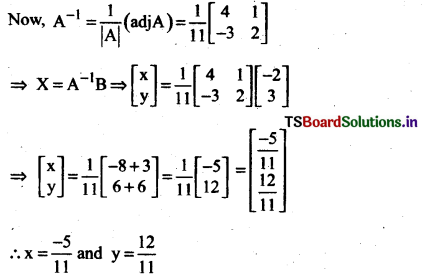
Solve system of linear equations, using matrix method 2x – y = -2, 3x + 4y = 3.
Solution:
The given system of equations is 2x – y = -23x + 4y = 3
The given system of equations can be wrEtten in the form of AX = B where
A = \(\left[\begin{array}{ll}
2 & -1 \\
3 & 4
\end{array}\right]\), X = \(\left[\begin{array}{l}
x \\
y
\end{array}\right]\), B = \(\left[\begin{array}{l}
-2 \\
3
\end{array}\right]\)
Hence, |A| = 8 + 3 = 11 ≠ 0
So, A is non-singular. Hence, A-1 exists.
Question 6.
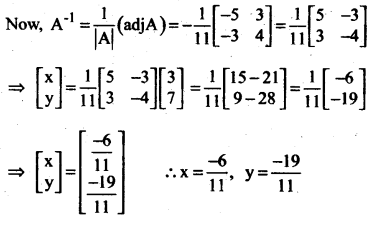
Solve system of linear equations, using matrix method 4x – 3y = 3, 3x – 5y = 7.
Solution:
The given system of equations is 4x – 3y = 3, 3x – 5y = 7
The given system of equations can be wrEtten in the form of AX = B where
A = \(\left[\begin{array}{ll}
4 & -3 \\
3 & -5
\end{array}\right]\), X = \(\left[\begin{array}{l}
x \\
y
\end{array}\right]\), B = \(\left[\begin{array}{l}
3 \\
7
\end{array}\right]\)
Hence, |A| = -20 + 9 = -11 ≠ 0
So, A is non-singular. Hence, A-1 exists.
Question 7.
Solve system of linear equations, using matrix method 5x + 2y = 3, 3x + 2y = 5.
Solution:
The given system of equations is 5x + 2y = 3, 3x + 2y = 5.
The given system of equations can be wrEtten in the form of AX = B where
A = \(\left[\begin{array}{ll}
5 & 2 \\
3 & 2
\end{array}\right]\), X = \(\left[\begin{array}{l}
x \\
y
\end{array}\right]\), B = \(\left[\begin{array}{l}
3 \\
5
\end{array}\right]\)
Hence, |A| = 10 – 6 = 4 ≠ 0
So, A is non-singular. Hence, A-1 exists.
Now, A-1 = \(\frac{1}{|\mathrm{~A}|}(\) (adjA) = \(\frac{1}{4}\left[\begin{array}{cc}
2 & -2 \\
-3 & 5
\end{array}\right]\)
⇒ X = A-1B ⇒ \(\left[\begin{array}{l}
x \\
y
\end{array}\right]\) = \(\frac{1}{4}\left[\begin{array}{cc}
2 & -2 \\
-3 & 5
\end{array}\right]\)
= \(\frac{1}{4}\left[\begin{array}{c}
6-10 \\
-9+25
\end{array}\right]\)
= \(\frac{1}{4}\left[\begin{array}{c}
-4 \\
16
\end{array}\right]\) = \(\left[\begin{array}{c}
-1 \\
4
\end{array}\right]\)
III.
Question 1.
Solve the system of equations using matrix method 2x + y + z = 1, x – 2y – z = \(\frac{3}{2}\), 3y – 5z = 9
Solution:
The given system of equations is 2x + y + z = 1, x – 2y – z = \(\frac{3}{2}\), 3y – 5z = 9
The given system of equations can be written in the form of AX = B where
A = \(\left[\begin{array}{ccc}
2 & 1 & 1 \\
1 & -2 & -1 \\
0 & 3 & -5
\end{array}\right]\), X = \(\left[\begin{array}{l}
x \\
y \\
z
\end{array}\right]\) and B = \(\left[\begin{array}{l}
1 \\
\frac{3}{2} \\
9
\end{array}\right]\)
|A| = 2(10 + 3) -1(-5 – 3) + 0 = 2(13) – 1(-x) = 26 + 8 = 34 ≠ 0
So, A is non-singular. Hence. A-1 exists.
Now, A11 = 13; A12 = 5; A13 = 3
A21 = 8; A22 = -10; A23 = -6
A31 = 1; A32 = 3; A33 = -5
Thus, A-1 = \(\frac{1}{|\mathrm{~A}|}(\) (adjA) = \(\frac{1}{34}\left[\begin{array}{ccc}
13 & 8 & 1 \\
5 & -10 & 3 \\
3 & -6 & -5
\end{array}\right]\)
Also AX = B ⇒ X = A-1B
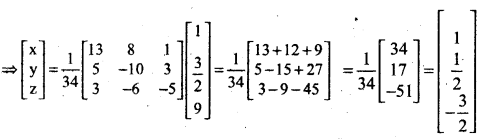
∴ x = 1, y = \(\frac{1}{2}\) and z = \(\frac{-3}{2}\)
Question 2.
Solve the system of equations using matrix method x – y + z = 4, 2x + y – 3z = 0, x + y + z = 2
Solution:
The given system of equations is x – y + z = 4, 2x + y – 3z = 0, x + y + z = 2
The given system of equations can be written in the form of AX = B where
A = \(\left[\begin{array}{ccc}
1 & -1 & 1 \\
2 & 1 & -3 \\
1 & 1 & 1
\end{array}\right]\), X = \(\left[\begin{array}{l}
x \\
y \\
z
\end{array}\right]\), B = \(\left[\begin{array}{l}
4 \\
0 \\
2
\end{array}\right]\)
⇒ |A| = 1(1 + 3) + 1(2 + 3) + 1(2 – 1) = 4 + 5 + 1 = 10 ≠ 0
So, A is non-singular. Hence A-1 exists.
Now, A11 = 4; A12 = -5; A13 = 1
A21 = 2; A22 = 0; A23 = -2
A31 = 2; A32 = 5; A33 = 3
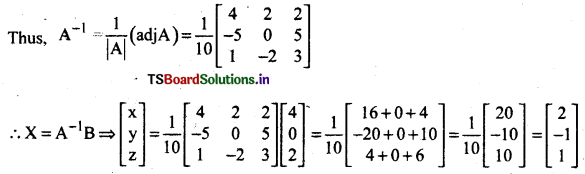
∴ x = 2, y = -1 and z = 1
Question 3.
Solve the system of equations using matrix method 2x + 3y + 3z = 5, x – 2y + z = -4, 3x – y – 2z = 3
Solution:
The given system of equations is 2x + 3y + 3z = 5, x – 2y + z = -4, 3x – y – 2z = 3
The given system of equations can be written in the form of AX = B where
A = \(\left[\begin{array}{ccc}
2 & 3 & 3 \\
1 & -2 & 1 \\
3 & -1 & -2
\end{array}\right]\), X = \(\left[\begin{array}{l}
x \\
y \\
z
\end{array}\right]\) and B = \(\left[\begin{array}{l}
5 \\
-4 \\
3
\end{array}\right]\)
|A| = 2(4 + 1) – 3(-2 – 3) + 3(-1 + 6) = 10 + 15 + 15 = 40 ≠ 0
So, A is non-singular. Hence. A-1 exists.
Now, A11 = 5; A12 = 5; A13 = 5
A21 = 3; A22 = -13; A23 = 11
A31 = 9; A32 = 1; A33 = -7
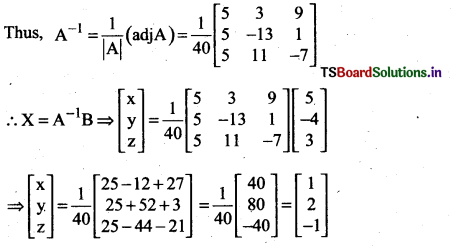
Hence, x = 1, y = 2 and z = 1
Question 4.
Solve the system of equations using matrix method x – y + 2z = 7, 3x + 4y – 5z = -5, 2x – y + 3z = 12
Solution:
The given system of equations is x – y + 2z = 7, 3x + 4y – 5z = -5, 2x – y + 3z = 12
The given system of equations can be written in the form of AX = B where
A = \(\left[\begin{array}{ccc}
1 & -1 & 2 \\
3 & 4 & -5 \\
2 & -1 & 3
\end{array}\right]\), X = \(\left[\begin{array}{l}
x \\
y \\
z
\end{array}\right]\) and B = \(\left[\begin{array}{l}
7 \\
-5 \\
12
\end{array}\right]\)
|A| = 1(12 – 5) + 1(9 + 10) + 2(-3 – 8) = 7 + 19 = 4 ≠ 0
So, A is non-singular. Hence. A-1 exists.
Now, A11 = 7; A12 = -19; A13 = -11
A21 = 1; A22 = -1; A23 = -1
A31 = -3; A32 = 11; A33 = 7
Thus, A-1 = \(\frac{1}{|\mathrm{~A}|}(\) (adjA) = \(\frac{1}{4}\left[\begin{array}{ccc}
7 & 1 & -3 \\
-19 & -1 & 11 \\
-11 & -1 & 7
\end{array}\right]\)
∴ X = A-1B
⇒ \(\left[\begin{array}{l}
x \\
y \\
z
\end{array}\right]\)=\(\frac{1}{4}\left[\begin{array}{ccc}
7 & 1 & -3 \\
-19 & -1 & 11 \\
-11 & -1 & 7
\end{array}\right]\left[\begin{array}{c}
7 \\
-5 \\
12
\end{array}\right]\)=\(\frac{1}{4}\left[\begin{array}{c}
49-5-36 \\
-133+5+132 \\
-77+5+84
\end{array}\right]\)=\(\frac{1}{4}\left[\begin{array}{c}
8 \\
4 \\
12
\end{array}\right]\)=\(\left[\begin{array}{l}
2 \\
1 \\
3
\end{array}\right]\)
Hence, x = 2, y = 1 and z = 3
Question 5.
If A = \(\left[\begin{array}{ccc}
2 & -3 & 5 \\
3 & 2 & -4 \\
1 & 1 & -2
\end{array}\right]\), find A-1. Using A-1 solve the system of equations
2x – 3y + 5z = 11, 3x + 2y – 4z = -5, x + y – 2z = -3
Solution:
Given that A = \(\left[\begin{array}{ccc}
2 & -3 & 5 \\
3 & 2 & -4 \\
1 & 1 & -2
\end{array}\right]\)
⇒ |A| = 2(-4 + 4) + 3(-6 + 4) + 5(3 – 2) = 0 – 6 + 5 = -1 ≠ 0
Now, A11 = 0; A12 = 2; A13 = 1
A21 = -1; A22 = -9; A23 = -5
A31 = 2; A32 = 23; A33 = 13
Thus, A-1 = \(\frac{1}{|\mathrm{~A}|}(\) (adjA) = –\(\left[\begin{array}{ccc}
0 & -1 & 2 \\
2 & -9 & 23 \\
1 & -5 & 13
\end{array}\right]=\left[\begin{array}{ccc}
0 & 1 & -2 \\
-2 & 9 & -23 \\
-1 & 5 & -13
\end{array}\right]\)
The given system of equations can be written in the form of AX = B where
A = \(\left[\begin{array}{ccc}
2 & -3 & 5 \\
3 & 2 & -4 \\
1 & 1 & -2
\end{array}\right]\), X = \(\left[\begin{array}{l}
\mathrm{x} \\
\mathrm{y} \\
\mathrm{z}
\end{array}\right]\) and B = \(\left[\begin{array}{l}
11 \\
-5 \\
-3
\end{array}\right]\)
The solution of the system of equations is given by X = A-1B
⇒ X = A-1B
⇒ \(\left[\begin{array}{l}
x \\
y \\
z
\end{array}\right]=\left[\begin{array}{ccc}
0 & 1 & -2 \\
-2 & 9 & -23 \\
-1 & 5 & -13
\end{array}\right]\left[\begin{array}{c}
11 \\
-5 \\
-3
\end{array}\right]=\left[\begin{array}{c}
0-5+6 \\
-22-45+69 \\
-11-25+39
\end{array}\right]=\left[\begin{array}{l}
1 \\
2 \\
3
\end{array}\right]\)
Hence, x = 1, y = 2 and z = 3
Question 6.
The cost of 4 kg onion, 3 kg wheat and 2 kg rice is ₹ 60. The cost of 2 kg onion, 4 kg wheat and 6 kg rice is ₹ 90. The cost of 6 kg onion 2 kg wheat and 3 kg rice is ₹ 70. Find cost of each item per kg b matrix method.
Solution:
Let the cost of onions, wheat, and rice per kg in ₹ be x, y and z respectively.
Then, the given situation can be represented by a system of equations as
4x + 3y + 2z = 60
2x + 4y + 6z = 90
6x + 2y + 3z = 70
The given system of equations can be written in the form of AX = B where
A = \(\left[\begin{array}{lll}
4 & 3 & 2 \\
2 & 4 & 6 \\
6 & 2 & 3
\end{array}\right]\), X = \(\left[\begin{array}{l}
x \\
y \\
z
\end{array}\right]\) and B = \(\left[\begin{array}{l}
60 \\
90 \\
70
\end{array}\right]\)
∴ |A| = 4(12 – 12) – 3(6 – 36) + 2(4 – 24) = 0 + 90 – 40 = 50 ≠ 0
Now, A11 = 0; A12 = 30; A13 = -20
A21 = -5; A22 = 0; A23 = 10
A31 = 10; A32 = -20; A33 = 10
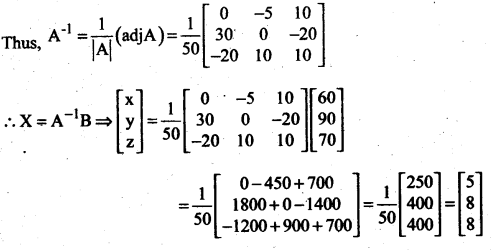
Thus, x = 5, y = 8 and z = 8
Hence, the cost of onions is ₹ 5 per kg, the cost of wheat is 8 per kg, and the cost of rice is ₹ 8 per kg