
Referring to the AP Inter 2nd Year Maths Study Material Chapter 1 Relations and Functions Exercise 1a Solutions makes it easier to understand complex problems.
AP Inter 2nd Year Maths Relations and Functions Solutions Exercise 1a
I. Give an example of a relation. Which is
Question 1.
Symmetric but neither reflexive nor transitive:
Solution:
Let A = {1, 2}. On A × A consider a relation R = {(1, 2),(2, 1)}
(i) (1, 1),(2, 2) ∈ R . So, R is not reflexive.
(ii) (1, 2) ∈ R and (2, 1) ∈ R. So, R is symmetric
(iii) (1, 2), (2, 1) ∈ R,but (1, 1) ∉ R. So, R is not transitive.
∴ This relation R is symmetric but not reflexive or transitive.
Question 2.
Transitive but neither reflexive nor symmetric:
Solution:
Let A = {1, 2, 3}. On A × A consider a relation R = {(a, b): a < b}
(i) (1, 1) ∉ R. So, R is not reflexive, [v 1 cannot be less than itself ]
(ii) (1, 2) ∈ R. But (2, 1) ∉ R.So, R is not symmetric. [∵ 2 is not less than 1]
(iii) (1, 2),(2, 3) ∈ R ⇒ (1, 3) ∈ R. So, R is transitive. [∵ 1 < 2 and 2 < 3 ⇒ 1 < 3]
∴ This relation R is transitive but not reflexive and symmetric.

Question 3.
Reflexive and symmetric but not transitive:
Solution:
LetA = {1, 2, 3} and R = {(1, 1), (2, 2), (3, 3), (1, 2), (2, 1), (2, 3), (3, 2)}
(i) (a, a) ∈ R ∀ a ∈ A, . So, R is reflexive.
(ii) (1, 2) ∈ R ⇒ (2, 1) ∈ R for a, b ∈ R. So, R is symmetric.
(iii) (1, 2), (2, 3) ∈ R ⇒ (1, 3) ∉ R. So, R is not transitive.
∴ This relation R is reflexive and symmetric but not transitive.
Question 4.
Reflexive and transitive hut not symmetric.
Solution:
Let A = {1, 2, 3} and R = {(1, 1), (2, 2), (3, 3), (1, 2), (2, 3), (1, 3)}
(i) (a, a) ∈ R ∀ a ∈ A, . So, R is reflexive.
(ii) (1, 2) ∈ R ⇒ (2, 1) ∉ R . So, R is not symmetric.
(iii) (1, 2) ∈ R, (2, 3) ∈ R ⇒ (1, 3) ∈ R . So, R is transitive.
∴ This relation R is reflexive and transitive but not symmetric.
Question 5.
Symmetric and transitive but not reflexive.
Solution:
Let A = {1, 2} and R = {(1, 2), (2, 1), (1, 1)}
(i) (2, 2) ∉ R . So, R is not reflexive.
(ii) (1, 2), (2, 1) ∈ R .So, R is symmetric.
(iii) (1, 2), (2, 1) ∈ R ⇒ (1, 1) ∈ R . So, R is transitive.
∴ This relation R is not reflexive but symmetric and transitive.
Question 6.
Define reflexive relation
Solution:
Reflexive Relation: A relat ion R on a set A is reflexive if (a, a) ∈ R for all a ∈ A.
Ex : The relation equality (=) on reals.
Question 7.
Define symmetric relation
Solution:
Symmetric Relation: A relation R on a set A is symmetric if (a, b) ∈ R ⇒ (b, a) ∈ R
Ex: The relation ‘parallel of lines (||) in a plane.
Question 8.
Define transitive relation
Solution:
Transitive Relation: A relation R on a set A is transitive if(a, b) ∈ R and (b, c) ∈ R ⇒ (a, c) ∈ R
Ex: The relation greater than ( > ) on reals.
Question 9.
Define an equivalence relation
Solution:
Equivalence Relation:
A relation R on a set A is called an equivalence relation if R is reflexive, symmetric and transitive.
Ex: The relation equality (=) on reals.
II.
Question 1.
Determine whether the Relation R in the set A = {I, 2, 3, 13, 14} defined as R = {(x, y): 3x – y = 0} is reflexive, symmetric and transitive.
Solution:
Given that A = {1, 2, 3, …, 13, 14} andR= {(x, y): 3x – y = 0}.
∴ R = {(1, 3), (2, 6), (3, 9), (4, 12), (14, 52)}
(i) (1, 1), (2, 2), …. ∉ R. So, R is not reflexive.
(ii) (1, 3) ∈ R, but (3, 1) ∉ R. So, R is not symmetric.
(iii) (1, 3), (3, 9) ∈ R, but(1, 9) ∉ R. So, R is not transitive.
Question 2.
Determine whether the Relation R in the set N of natural numbers defined as,
R = {(x, y): y = x + 5 and x < 4} is reflexive, symmetric and transitive.
Solution:
Given N = {1, 2, 3, …} and R = {(x, y): y = x + 5 and x < 4}
∴ R = {(1, 6), (2, 7), (3, 8)}
(i) (1, 1) ∉ R. So, R is not reflexive.
(ii) (1, 6) ∈ R but(6, 1) ∉ R So, R is not symmetric.
(iii) We find no 3 ordered pairs such that (x, y), (y, z) ∈ R ⇒ (x, z) ∈ R .
Among the three ordered pairs in R, no chaining is possible vacously true. So, R is transitive.
Question 3.
Determine whether the Relation R in the set A = {1, 2, 3, 4, 5, 6} as R = {(x, y): y is divisible by x} is reflexive, symmetric and transitive.
Solution:
Given that A = {1, 2, 3, 4, 5, 6} as R = {(x, y): y is divisible by x}
(i) (x, x) ∈ R ∀ x ∈ A. So, R is reflexive.
[∵ Any number other than 0 is divisible by itself. ]
(ii) (x, y) ∈ R then (y, x)need not belong to R. So, R is not symmetric.
Let (2, 4) ∈ R [because 4 is divisible by 2]
But (4, 2)∉ R[since 2 is not divisible by 4]
(iii) (x, y) and (y, z) ∈ R ⇒(x, z) ∈ R. So, R is transitive.
Let (1, 3) ∈ R [because 3 is divisible by 1]
and (3, 6) ∈ R[since 6 is divisible by 3 ]
Then (1, 6) ∈ R[since 6 is divisible by 1]
Question 4.
Determine whether, the Relation R in the set Z of all integers defined as R = {(x, y): x – y is an integer} is reflexive, symmetric and transitive.
Solution:
Given that x, y ∈ Z and R = {(x, y): x – y is an integer)}
(i) (x, x) ∈R x ∈ Z. So, R is reflexive.
[∵ x – x = 0 and 0 is an integer.]
(ii) (x, y) ∈ R, =(y, x) ∈ R. So, R is symmetric.
[∵ if (x – y) is an integer then (y – x) is also an integer.]
(iii) (x, y), (y, z) ∈ R =(x, z) ∈ R where x, y, z ∈ Z. So, R is transitive.
[∵ if (x – y) and (y – z) are integers then (x – z) = (x – y) + (y – z) is also an integer]
Question 5.
Show that the relation R in the set R of real numbers, defined as
R = {(a, b): a ≤ b2) is neither reflexive nor symmetric nor transitive.
Solution:
Given that a, b ∈ R and R =(a, b): a ≤ b2}
(i) (\(\frac{1}{2}\), \(\frac{1}{2}\)) ∉ R. So, R is not reflexive. [∵ \(\frac{1}{2}\) > (\(\frac{1}{2}\))2]
(ii) (1, 2) ∈ R ⇒ (2, 1) ∉ R. So, R is not symmetric.
[∵ (1, 2) ∈ R ⇒ 1< 22 = 4, (2, 1) ∈ R ⇒ 2 < 12 = 1, which is absurd.]
(iii) (3, 2), (2, 1.5) ∈ R ⇒ (3, 1.5) ∉ R So, R is not transitive.
[(3, 2) ∈ R⇒ 3 < 22 = 4 and also 2 < (1.5)2 = 2.25 .But 3 < (1.5)2 = 2.25, which is absurd.]
∴ R is not reflexive, not symmetric, not transitive.
Question 6.
Check whether the relation R defined in the set {1, 2, 3, 4, 5, 6} as
R = {(a, b): b = a + 1} is reflexive, symmetric or transitive.
Solution:
Given that A = {1, 2, 3, 4, 5, 6} and R = {(a, b):b = a + 1}
∴ R = {(1, 2), (2, 3), (3, 4), (4, 5), (5, 6)}
(i) (1, 1), (2, 2) ∉ R . So, R is not reflexive.
(ii) (1, 2) ∈ R, but (2, 1) ∉ R. So, R is not symmetric.
(iii) (1, 2), (2, 3) ∈ R but (1, 3) ∉ R. So, R is not transitive.
∴ R is not reflexive, not symmetric, not transitive.
Question 7.
Show that the relation R in R defined as R = {(a, b): a ≤ b} is reflexive and transitive but not symmetric.
Solution:
Let a, b ∈ R and R = {(a, b): a ≤ b}
(i) (a, a)∈ R. So, R is reflexive [∵ a ≤ a]
(ii) (a, b) ∈ R . But (b, a) ∉ R. So, R is not symmetric.
[∵ (2, 4) ∈ R(as 2 < 4) and(4, 2) ∉ R(as 4 > 2)]
(iii) (a, b), (b, c) ∈ R ⇒ (a, c) ∈ R . So, R is transitive, [∵ a ≤ b and b ≤ c ⇒ a ≤ c]
∴ R is reflexive and transitive but not symmetric.
Question 8.
Check whether the relation R in R defined by R = {(a, b): a ≤ b3} is reflexive, symmetric or transitive.
Solution:
Given that a, b ∈ R and R = {(a, b):a ≤ b3}
(i) (\(\frac{1}{2}\), \(\frac{1}{2}\)) ∉ R. So, R is not reflexive. [∵ \(\frac{1}{2}\) > (\(\frac{1}{2}\))3]
(ii) (1, 2) ∈ R ⇒ (2, 1) ∉ R. So, R is not symmetric.
[∵ (1, 2) ∈ R ⇒ 1 < 23 = 8.(2, 1) ∈ R ⇒ 2 < 13 = 1, which is absurd.]
(iii) Consider (3, 1.5), (1.5, 1.2), (3, 1.2) . Here R is not transitive [ (1.2)3 = 1.728, (1.5)3 = 3.75]
[∵ 3 ≤ (1.5)3 ⇒ (3, 1.5) ∈ R; 1.5 ≤ (1.2)3 ⇒ (1.5, 1.2) ∈ R. But(1.5)3 >3 ⇒ (3, 1.5) ∉ R]
∴ R is not reflexive, not symmetric and not transitive.
Question 9.
Show that the relation R in the set {1, 2, 3} given by R = {(1, 2), (2, 1)} is symmetric but neither reflexive nor transitive.
Solution:
Given that A = {1, 2, 3}; R = {(1, 2), (2, 1)}
(i) (1, 1), (2, 2), (3, 3) ∉ R. So, R is not reflexive
(ii) (1, 2) ∈ R and (2, 1) ∈ R. So, R is symmetric.
(iii) (1, 2) ∈ R and (2, 1) ∈ R, (1, 1) ∉ R. So, R is not transitive.
∴ R is not reflexive, not transitive but R is symmetric.
Question 10.
Show that the relation R in the set A of all the books in a library of a college, given by R = {(x, y): x and y have same number of pages} is an equivalence relation. .
Solution:
Set A contain various library books and x, y related to the number of pages in any two books.
Given that R = {(x, y): x and y have same number of pages}.
(i) (x, x) ∈ R. So, R is reflexive
∵ x and x have same number of pages.]
(ii) (x, y) ∈ R ⇒ (y, x) ∈ R. So, R is symmetric.
[ ∵ If x and y have same number of pages then y and x also have same number of pages.]
(iii) (x, y) ∈ R, (y, z) ∈ R ⇒ (z, x) ∈ R. So, R is transitive.
[∵ If x and y have same number of pages, and y and z have same number of pages, then x and z have same number of pages. ]
Thus, R is reflexive, symmetric, transitive. Hence, R is an equivalence relation.
Question 11.
Show that the relation R in the set A = {1, 2, 3, 4, 5} given by R = {(a, b): |a – b| is even} is an equivalence relation. Show that all the elements of {1, 3, 5} are related to each other and all the elements of {2, 4} are related to each other. But no element of {1, 3, 5} is related to ally element of {2, 4}.
Solution:
GiyenthatA={1, 2, 3, 4, 5}givenbyR={(a, b):|a-b| is even},
(i) (a, a) ∈ R ∀ a ∈ A. So, R is reflexive. [∵ |a-a| = 0 (which is even)]
(ii) (a, b) ∈ R ⇒ (b, a) ∈ R. So, R is symmetric. [∵ if |a-b| is even then |-(a-b)| =|b-a| is also even]
(iii) (a, b) ∈ R and (b, c) ∈ R ⇒ (a, c) ∈ R. So, R is transitive.
[∵ if |a—b| , |b—c| are even then (a-b), (b-c) are also even .
Now (a-c) = (a+b) +(b-c) is even ⇒ |a-c| is even ]
Thus, R is reflexive, symmetric, transitive. Hence, R is an equivalence relation.
Further, all elements of {1, 3, 5} are related to each other because they are all odd.
So, the modulus of the difference between any two elements is even.
Similarly, all elements {2, 4} are related to each other because they are all even.
No element of {1, 3, 5}is related to any elements of {2, 4} as all elements of {1, 3, 5}are odd and all elements of {2, 4} are even. So, the modulus of the difference between the two elements will not be even.
Question 12.
Show that each of the relation R in the set A = {x ∈ Z : 0 ≤, x ≤ 12}, given by R = {(a, b): |a – b| is a multiple of 4} is an equivalence relation. Find the set of all elements related to 1 .
Solution:
Given that A = {x ∈ Z: 0 ≤ x ≤ 12} ⇒ A = {0, 1, 2, 3, 4, 5, 6, 7, 8, 9, 10, 11, 12}
R = {(a, b):|a – b|is a mutiple of 4}
(i) (a, a) ∈ R ∀ a ∈ A. So, R is reflexive, [∵ |a – a| = 0 and 0 is a multiple of 4]
(ii) (a, b) ∈ R ⇒ (b, a) ∈ R . So, Ris symmetric.
[∵ |a – b| is a multiple of 4 ⇒ |-(a -b)| = |b – a| is also a multiple of 4]
(iii) (a, b) ∈ R and (b, c) ∈ R ⇒ (a, c) ∈ R So, Ris transitive.
[∵If |a-b|, |b-c| are multiples of 4 ⇒ (a-b), (b-c) are multiples of 4.
Now (a-c) = (a-b) + (b-c) is a multiple of 4 ⇒ |a – c| is a multiple of 4 ]
Thus, R is reflexive, symmetric, transitive. Hence, R is an equivalence relation. Further, the set of elements related to 1 is {1, 5, 9}
∵ |1 – 1| = 0 is a multiple of 4; |5 – 1| = 4 is a multiple of 4., |9 -1| = 8 is a multiple of 4
Question 13.
Show that each of the relation R in the set A = {x ∈ Z : 0≤ x ≤ 12}, given by R = {(a, b): a = b} is an equivalence relation. Find the set of all elements related to 1.
Solution:
Given that R = {(a, b):a = b}
(i) (a, a) ∈ R ∀ a ∈ A . So, R is reflexive, [∵ a = a ∀a]
(ii) (a, b) ∈ R ⇒ a = b => b = a ⇒ (b, a)e R . So, R is symmetric.
(iii) (a, b) ∈ R and (b, c) ∈ R ⇒ (a, c) ∈ R. So, R is transitive. [∵ a = b and b = c ⇒ a = c]
Thus, R is reflexive, symmetric, transitive. Hence, R is an equivalence relation.
Further, the set of elements related to 1 are those elements of A which are equal to 1.
∴ the required set is {1}.
III.
Question 1.
Show that the relation R in the set A of points in a plane given by R = {(P, Q): distance of the point P from the origin is same as the distance of the point Q from the origin}, is an equivalence relation. Further, show that the set of all points related to a point P ≠ (0, 0) is the circle passing through P with origin as center.
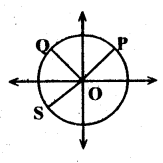
Solution:
Given that A is the set of points in a plane and
R = {(P, Q): Distance of the point P from the origin = the distance of the point Q from the origin}
(i) Clearly (P, P) ∈ R. So, R is reflexive. [∵ OP = OP]
(ii) (P, Q) ∈ R ⇒ (Q, P) ∈ R . So, R is symmetric. [∵ PQ = QP]
(iii) (P, Q), (Q, S) ∈ R ⇒ (P, S) ∈ R . So, R is transitive
[∵ (P, Q), (Q, S) ∈ R ⇒ OP = OQ and OQ = OS then OP = OS ⇒ (P, S) ∈ R]
Thus, R is reflexive, symmetric, transitive. Hence, R is an equivalence relation.
Further, the set of points related to P ≠ (0, 0) will be those points whose distance from origin is same as distance of P from the origin.
Set of points forms a circle with the centre as brigin and this circle passes through P.
Question 2.
Show that the relation R defined in the set A of all triangles as
R = {(T1, T2): T1 is similar to T2}, is an equivalence relation. Consider three right angle triangles T1 with sides 3, 4, 5, T2 with sides 5, 12, 13 and T3 with sides 6, 8, 10. Which triangles among T1, T2 and T3 are related?
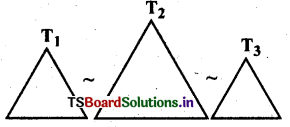
Solution:
Given that R = {(T1, T2):T1 is similar to T2}
(i) (T1, T1) ∈ R ∀ T1 ∈ A . So, R is reflexive.
[∵ Every triangle is similar to itself. ]
(ii) If (T1, T2) ∈ R ⇒ (T2, T1) ∈ R. So, R is symmetric.
[∵ If T1 is similar to T2 then T2 is similar to T1]
(iii) (T1, T2), (T2, T3) ∈ R ⇒ (T1, T3) ∈ R. So, R is transitive.
[∵ If T1 is similar to T2 and T2 is similar to T3 then T1 is similar to T3]
The given 3 triangles with sides (3, 4, 5), (5, 12, 13) and (6, 8, 10) are right angled triangles.
But among T1, T2, T3 the Corresponding sides of T1 and T3 are in the same ratio.
∵ \(\frac{3}{6}=\frac{4}{8}=\frac{5}{10}=\left(\frac{1}{2}\right)\)
So, triangle T1 is similar to triangle T3. Hence, T1 is related to T3.
Question 3.
Show that the relation R defined in the set A of all polygons as R = {(P1, P2): P1 and P2 have same number of sides}, is an equivalence relation. What is the set of all elements in A related to the right-angle triangle T with sides 3, 4 and 5?
Solution:
Given that A is the set of all polygons and R = {(P1, P2):P1 and P2 have same number of sides}
(i) (P1, P1) ∈ R. So, R is reflexive.
[∵ Same polygon has same number of sides.]
(ii) (P1, P2) ∈ R ⇒ (P2, P1) ∈ R. So, R is symmetric.
[∵ if P1 and P2 have same number of sides then P2 and P1) have same number of sides.]
(iii) (P1, P2), (P2, P3) ∈ R ⇒ (P1, P3) ∈ R. So, R is transitive.
[∵ (P1, P2), (P2, P3) ∈ R ⇒ P1, P2 and P2 P3 have same number of sides.
Then P1, P3 have same number of sides ⇒ (P1, P3) ∈ R. ]
Thus, R is reflexive, symmetric, transitive. Hence, R is an equivalence relation.
Further, the elements in A related to right-angled triangle (T) with sides 3, 4, 5 are those polygons which have three sides.
Set of all elements in a related to triangle T is the set of all triangles.
Question 4.
Let L be the set of all lines in XY plane and R be the relation in L defined as R = {(L1, L2): L1 is parallel to L2}. Show that R is an equivalence relation. Find the set of all lines related to the line y = 2x + 4.
Solution:
Given that L is the set of all lines and R = {(L1, L2): L1 is parallel to L2}.
(i) (L1, L1) ∈ R. So, R is reflexive ‘
[∵ Any line L1 is parallel to itself. ]
(ii) If (L1, L2) ∈ R ⇒ (L2, L1) ∈ R. So, R is symmetric.
[∵ If L1 is parallel to L2 then L2 is parallel to L1]
(iii) (L1, L2), (L2, L3) ∈ R ⇒ (L1, L3) ∈ R. So, R is transitive.
[∵ If L1 is parallel to L2 and L2 is parallel to L3 then L1 is parallel to L3.]
Thus, R is reflexive, symmetric, transitive. Hence, R is an equivalence relation.
Also, set of all lines related to the line y = 2x + 4 is the set of all lines parallel to y = 2x + 4
Slope of the line y = 2x + 4 is m = 2.
Line parallel to the given line is in the form y = 2x + c, where c ∈ R .
Set of all lines related to the given line is given by y = 2x + c, where c ∈ R
Question 5.
Determine whether each of the following relations are reflexive, symmetric and transitive. Relation R in the set A of human beings in a town at a particular time given by a) R = {(x, y): x and y work at the same place)
b) R {(x, y): x and y live in the same locality)
Solution:
Given that A is the set of all human beings in a town
a) Given that R = {(x,y): x and y work at the same place)
(i) (x, x) ∈ R ∀ x ∈ A. So, R is reflexive.
[∵ Every person x, he himself works at the same place]
(ii) (x, y) ∈ R ⇒ (y, x) ∈ R. So, R is symmetric.
[∵ If x and y work at the same place then y and x also work at the same place.]
(iii) If (x, y) ∈ R and (y, z) ∈ R then (x, z) ∈ R. So, R is transitive.
[∵ If x and y work at the same place, and y and z also work at the same place, then x and z also work at the same place] .
b) Given that R={(x, y): x and y live in the same locality)
(i) (x, x) ∈ R. So, R is reflexive.[∵ Every person x, he himself lives at the same locality]
(ii) (x,y) ∈ R ⇒ (y, x) ∈ R. So, R is symmetric.
[∵ If x and y live in the same locality then y and x also live in the same locality.]
(iii) If(x, y) ∈ R and (y, z) ∈ R then (x, z) ∈ R. So, R is transitive
∵ If x and y live in the same locality, and y and z also live in the same locality, then x and z also live in the same locality.]
Question 6.
Determine whether each of the following relations are reflexive, symmetric and transitive. Relation R in the set A of human beings in a town at a particular time given by
a) R = {(x, y): x is exactly 7 cm taller than y}
b) R = {(x, y): x is wife of y} .
c) R = {(x, y): x is father of y}
Solution:
a) Given that R = {(x, y): x is exactly 7 cm taller than y}
(i) (x, x) ∉ R. So, R is not reflexive
[∵ A person cannot be 7 cm taller than himself.]
(ii) (x, y) ∈ R ⇒ (y, x) ∉ R. So, R is not symmetric .
[∵ If x is exactly 7cm taller than y then y is clearly not taller than x.]
(iii) If(x, y), (y, z) ∈ R then (x, z) ∉ R. So, R is not transitive
[∵ If x is exactly 7 cm taller than y and y is.exactly 7cm taller than z, then x is not exactly 7 cm taller than z.]
b) Given that R = {(x, y): x is wife of y}
(i) (x, x) ∉ R. So, R is not reflexive
[∵ A women can never be a wife to herself]
(ii) (x, y) ∈ R ⇒ (y, x) ∉ R. So, R is not symmetric.
[∵ If x is the wife of y then y can never be the wife of x.]
(iii) If (x, y) ∈ R and (y, z)e R then (x, z) ∉ R. So, R is not transitive
[∵ If x is wife of y and y is wife of z (this itself is a contradiction, so we need not go for the next step)]
c) Given that R = {(x, y): x is father of y}
(i) (x, x) ∉ R So, R is not reflexive
[∵ A man can never be a father to himself.]
(ii) (x, y) ∈ R ⇒ (y, x) ∉ R. So, R is not symmetric .
[∵ if x is the father of y then y can never be a father of x]
(iii) If (x, y) ∈ R and (y, z) ∈ R then (x, z) ∉ R. So, R is not transitive
[∵ if x is father of y and y is father of z (this itself is a contradiction, so we need not go for the next step)]
Question 7.
If R1 and R2 are equivalence relations in a set A, show that R1 ∩ R2 is also an equivalence relation.
Solution:
Given that R1 and R2 are equivalence relations .
(i) ∀ a ∈ A, (a, a) ∈ R1, and (a, a) ∈ R2 ⇒ (a, a) ∈ R1 ∩ R2. So R1 ∩ R2 is reflexive.
(ii) (a, b) ∈ R1 ∩ R2 ⇒ (a, b) ∈ R1 and (a, b) ∈ R 2 ⇒ (b, a) ∈ R1 and (b, a) ∈ R2
⇒ (b, a) ∈ R1 ∩ R2. So; R1 ∩ R2 is symmetric.
(iii) (a, b) ∈ R1 ∩ R2 and (b, c) ∈ R1 ∩ R2 ⇒ (a, c) ∈ R1 and (a, c) ∈ R2 ⇒ (a, c) ∈ R1 ∩ R2.
So, R1 ∩ R2 is transitive.
Thus, R1 ∩ R2 is reflexive, symmetric, transitive. Hence it is an equivalence relation.
Question 8.
Let R be a relation on the set A of ordered pairs of positive integers defined by (x, y)R(u, v) if and only if xv = yu. Show that R is an equivalence relation.
Solution:
(i) (x, y) R(x, y), [∵ xy = yx, ∀ (x, y) ∈ A]. So, R is reflexive.
(ii) (x, y) R (u, v) ⇒ xv = yu ⇒ uy = vx ⇒ (u, v) R (x, y). So, R is symmetric.
(iii) (x, y) R (u, v) and (u, v) R (a, b) ⇒ xv = yu and ub = va; Now we show that xb = ya
xv = yu ⇒ y = \(\frac{x v}{u}\) and ub = va ⇒ a = \(\frac{u b}{v}\)
Now ya = \(\left(\frac{\mathrm{xv}}{\mathrm{u}}\right)\left(\frac{\mathrm{ub}}{\mathrm{v}}\right)\). Hence, we have xb = ya
⇒ (x, y) R (a, b). So, R is transitive.
Thus, R is reflexive, symmetric, transitive. Hence R is an equivalence relation.
Question 9.
Let X = {1, 2, 3, 4, 5, 6, 7, 8, 9}. Let R1 be a relation in X given by
R1 = {(x, y): x – y is divisible by 3} and R2 be another relation on X given by R2 = {(x, y): {x, y} ⊂ {1, 4, 7}} or {x, y} ⊂ {2, 5, 8} or {x, y} ⊂ {3, 6, 9}}. Show that R1 = R2.
Solution:
R1 Contains (x, y) such that x – y should be divisible by 3
So, elements of X are grouped according to their remainders when divided by 3:
Remainder 1: {1, 4, 7}; Remainder2: {2, 5, 8}; Remainder 0: {3, 6, 9}
Thus, R1 relates all ordered pairs where both elements come from the same group.
Step 1: Ordered pairs in R1
Frpm {1, 4, 7}: (1, 1), (1, 4), (1, 7), .(4, 1), (4, 4), (4, 7), (7, 1), (7, 4), (7, 7)
From {2, 5, 8}: (2, 2), (2, 5), (2, 8), (5, 2), (5, 5), (5, 8), (8, 2), (8, 5), (8, 8)
From {3, 6, 9}: (3, 3), (3, 6), (3, 9), (6, 3), (6, 6), (6, 9), (9, 3), (9, 6), (9, 9)
Step 2: Ordered pairs in R2
By definition, R2 consists of all ordered pairs (x, y) such that: both x, y ∈ {1, 4, 7} or both x, y ∈ {2, 5, 8} or both x, y ∈ (3, 6, 9}
This gives exactly the same ordered pairs listed above for R1. Hence R1 = R2
Question 10.
Let f : X → Y be a function. Define a relation R in X given by
R = {(a, b): f(a) = f(b)}. Examine whether R is an equivalence relation or not.
Solution:
(i) ∀a ∈ X, (a, a) ∈ R, since f(a) = f(a). So, R is reflexive.
(ii) (a, b) ∈ R ⇒ f(a) = f(b) ⇒ f(b) = f(a) ⇒ (b, a) ∈ R. So, R is symmetric.
(iii) (a, b) ∈ R and (b, c) ∈ R ⇒ f(a) = f(b) and f(b) = f(c)
⇒ f(a) = f(c) ⇒ (a, c) ∈ R, So, R is transitive.
Thus, R is reflexive, symmetric, transitive. Hence R is an equivalence relation.
Question 11.
Find the number of all one-one functions from set A = {1, 2, 3} to itself.
Solution:
Total number of one-one function from {1, 2, 3} to itself is
= Total number of permutations on{1, 2, 3} = 3P3 = 3! = 3 × 2 × 1 = 6.
Question 12.
Let A = {1, 2, 3}. Then show that the number of relations containing (1, 2) and (2, 3) which are reflexive and transitive but not symmetric is three.
Solution:
The smallest relation R1 containing (1, 2) and (2, 3) which is reflexive and transitive but not
symmetric is R1 = {(1, 1), (2, 2), (3, 3), (1, 2), (2, 3), (1, 3)}.
Now, if we add the pair (2, 1) to R1 we get R2, which is reflexive, transitive but not symmetric. Similarly, if we add the pair (3, 2) we get R3 by adding (3, 2) to R1 to get the desired relation. Thus, the total number of desired relations is three.(R1, R2, R3)
[Note: We can not add two pairs (2, 1), (3, 2) or single pair (3, 1) to R1 at a time, as by doing so, we need to add the remaining pair in order to maintain transitivity. Then the relation will become symmetric which is not required.]
Question 13.
Show that the number of equivalence relation in the set {1, 2, 3} containing (1, 2) and (2, 1) is two.
Solution:
The smallest equivalence relation R1 containing (1, 2) and (2, 1) is
R1 = {(1, 1), (2, 2), (1, 2), (2, 1)}.
Now we are left with only 4 pairs namely (2, 3), (3, 2), (1, 3) and (3, 1).
If we add any one pair (2, 3) to R1, then for symmetry we must add (3, 2) and for transitivity we need to add (1, 3) and (3, 1). So R2 = {(1, 1), (2, 2), (1, 2), (2, 1), (2, 3), (3, 2), (1, 3) , (3, 1), (3, 3)}.
Thus, the only equivalence relation bigger than R1 is this universal relation.
This shows that the total number of equivalence relations containing (1, 2) and (2, 1) is two.
Question 14.
Given a non empty set X, consider P(X) which is the set of all subsets of X. Define the relation R in P(X) as follows: For subsets A, B in P(X), ARB if and only if A ⊂ B, Is R an equivalence relation on P(X)? Justify your answer.
Solution:
(i) ARA for all A e P(X) [ every set is a subset of itself]. So, R is reflexive.
(ii) Let ARB ⇒ A ⊂ B . This does not imply that B ⊂ A. So, R is not symmetric.
(iii) If ARB and BRC, then A ⊂ B and B ⊂ C ⇒ A ⊂ C ⇒ ARC . So, R is transitive.
R is not an equivalence relation as it is not symmetric.