
Reviewing AP Inter 2nd Year Commerce Study Material Chapter 4 Stock Exchanges & Securities and Exchange Board of India (SEBI) Questions and Answers can help students prepare confidently for exams.
AP Inter 2nd Year Commerce 4th Lesson Stock Exchanges & Securities and Exchange Board of India (SEBI) Questions and Answers
Very Short Answer Questions
Question 1.
What is meant by a Stock Exchange?
Answer:
A stock exchange is an institution which provides a platform for buying and selling of existing securities. It provides a connecting link between people who wants to dispose of their investment because they need cash and people who wish to invest because they have surplus cash available.
Question 2.
Write a short note on the Bombay Stock Exchange (BSE)
Answer:
BSE (Bombay Stock Exchange) was established in 1875 with the formation of the “Native Share and Stock Brokers’ Association.” It is one of the oldest organized stock exchanges in the world and is located on Dalal Street, Mumbai. It has permanent recognition from SEBI and plays an important role in the Indian capital market.
Question 3.
What is Dematerialisation?
Answer:
Dematerialisation is a process where securities held by the investor in the physical form are cancelled, and the investor is given an electronic entry or number so that he can hold it as an electronic balance in an account. This process of holding securities in an electronic form is called dematerialization.
Question 4.
State any two objectives of SEBI.
Answer:
Two objectives of SEBI:
- To regulate stock exchanges and the securities industry to promote their orderly functioning.
- To protect the rights and interests of investors, particularly individual investors and to guide and educate them.

Question 5.
What is SENSEX?
Answer:
SENSEX is the benchmark index of the BSE. The BSE – SENSEX is also called the ‘BSE-30’. Since the BSE has been the leading exchange of the Indian Secondary Market, the SENSEX has been an important indicator of the Indian Stock Market. The SENSEX, launched in 1986 is made up of 30 of the most actively traded stocks in the market.
Short Answer Questions
Question 1.
Describe the evolution and growth of the Bombay Stock Exchange (BSE) and the National Stock Exchange (NSE).
Answer:
i) Bombay Stock Exchange (BSE): “Native Share and Stock Brokers’ Association”, formed in 1875 at Bombay, later transformed itself into the present Bombay Stock Exchange. The BSE is located in Dalai Street of Mumbai. The BSE has been granted a permanent recognition. This Stock Exchange is one of the oldest organized exchanges in the world. Today, BSE is the world’s number one exchange in terms of the number of listed companies and the worlds 5th in transaction numbers.
The BSE is the first stock exchange in Asia and second stock exchange in the world to get ISO 9001-2000 certification. It is first to launch Free Float Market Capitalization (Sensex) Index in India. According Asian Development Bank’s 2010 Report BSE is the second most profitable stock exchange of the world.
ii) National Stock Exchange (NSE): The National Stock Exchange of India Ltd was promoted by IDBI, ICICI, IFCI, GIC, LIC, SBI. The Government of India has granted recognition with effect from April 26th 1993. The main objective of NSE, is to ensure comprehensive nationwide securities trading facilities to investors through automated screen – based trading and automatic post trade clearing and settlement facilities. It commenced its operation in 1994. NSE is the world’s fourth largest stock exchange in terms of number of trades in equity shares.
Question 2.
Discuss the advantages of holding securities in Demat form and the role of depositories in
India.
Answer:
a) Advantages of Holding Securities in Demat Form:
- Safety and Security: The foremost advantage of the Demat system is safety. Unlike physical certificates, which can be lost, stolen, or forged, electronic securities are stored securely in an investor’s account. This eliminates risks of theft, damage, and duplication, ensuring the complete protection of investor holdings.
- Speed and Convenience: Transactions in a Demat account are completed quickly and without paperwork. Buying, selling, or transferring shares can be done electronically.
- Liquidity and Loans: Demat holdings provide liquidity, allowing investors to sell or transfer shares easily. Moreover, investors can pledge or hypothecate their securities to obtain loans from banks or other financial institutions.
- Reduced Costs: The Demat system also reduces transaction costs. Since transfers are electronic, there is no need for stamp duty or courier charges, and administrative errors are minimized.
b) Role of Depositories in India:
- National Securities Depository Limited (NSDL): Established in 1996, NSDL was the first depository in India. It was promoted by the Industrial Development Bank of India (IDBI), the Unit Trust of India (UTI), and the National Stock Exchange (NSE).
- Central Depository Services Limited (CDSL): The second depository, CDSL, was established by the Bombay Stock Exchange (BSE) and the Bank of India. It offers similar services to NSDL.
Both NSDL and CDSL are regulated by SEBI and have contributed significantly to making Indian financial markets safer and more transparent.
Question 3.
Write about SENSEX and NIFTY.
Answer:
i) SENSEX (Sensitive Index): SENSEX is the benchmark index of the BSE. The BSE – SENSEX is also called the ‘BSE – 30’. Since the BSE has been the leading exchange of the Indian Secondary Market, the SENSEX has been an important indicator of the Indian Stock Market. It is the most frequently used indicator while reporting on the state of the market. The SENSEX, launched in 1986 is made up of 30 of the most actively traded stocks in the market. They represent 13 sectors of the economy and are leaders in their respective industries. The index with a base year of 1978-79, the value of base year was 100.
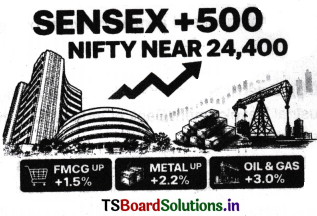
ii) NIFTY: NIFTY is an index of NSE, which computed from performance of top stocks from different sectors listed on NSE. Nifty stands for National Stock Exchange’s fifty. NIFTY consists of 50 companies from 24 different sectors. The companies which form index of NIFTY may vary from time to time based on many factors considered by NSE. The base year for the index is 1995-96, with the base value as 1000.

Long Answer Questions
Question 1.
Explain the functions of Stock Exchange
Answer:
Meaning of Stock Exchange: A stock exchange is an institution which provides a platform for buying and selling of existing securities. It provides a connecting link between people who wants to dispose of their investment because they need cash and people who wish to invest because they have surplus cash available.
Definition of Stock Exchange: According to Securities Contracts (Regulation) Act 1956, Stock Exchange means a body of individuals, whether incorporated or not, constituted for the purpose of assisting, regulating or controlling the business of buying and selling or dealing in securities.
Functions of Stock Exchange:
1. Providing liquidity and marketability to existing securities: The basis function of a stock exchange is the creation of a continuous market where securities are bought and sold. It gives investors the chance to disinvest and reinvest. This provides both liquidity and easy marketability to already existing securities in the market.
2. Pricing of Securities: Share prices on a stock exchange are determined by the forces of demand and supply. A stock exchange is a mechanism of constant valuation through which the prices of securities are determined. Such a valuation provides important instant information to both buyers and sellers in the market.
3. Safety of Transaction: The membership of a stock exchange is well regulated, and its dealings are well defined according to the existing legal framework. This ensures that the investing public gets a safe and fair deal on the market.
4. Contributes to Economic Growth: A stock exchange is a market in which existing securities are resold or traded. Through this process of disinvestment and reinvestment savings get channelized into their most productive investment avenues. This leads to capital formation and economic growth.
5. Spreading of Equity Culture: The stock exchange can play a vital role in ensuring wider share ownership by regulating new issues, better trading practices and taking effective steps in educating the public about investments.
6. Providing scope for speculation: The stock exchange provides sufficient scope within the provisions of law for speculative activity in a restricted and controlled manner, it is generally accepted that a certain degree of healthy speculation is necessary to ensure liquidity and price continuity in the stock market.
Question 2.
Explain the objectives and functions of SEBI.
Answer:
Objectives of SEBI: The overall objective of SEBI is to protect the interests of investors and to promote the development and regulate the securities market. This is discussed as follows:
- To regulate stock exchanges and the securities industry to promote their orderly functioning.
- To protect the rights and interests of investors, particularly individual investors, and to guide and educate them.
- To prevent trading malpractices and achieve a balance between self-regulation by the securities industry and its statutory regulation.
- To regulate and develop a code of conduct and fair practices by intermediaries like brokers, merchant bankers etc., with a view to making them competitive and professional.
Functions of SEBI: SEBI was entrusted with the twin task of both regulation and development of the securities market. It also has certain protective functions:
A. Regulatory Functions:
- Registration of brokers, sub-brokers and other players in the market.
- Registration of collective investment schemes and Mutual Funds.
- Regulation of stock brokers, portfolio exchanges, underwriters and merchant bankers and the business in stock exchanges and any other securities market.
- Regulation of takeover bids by companies.
- Calling for information by undertaking inspection, conducting enquiries and audits of stock exchanges and intermediaries.
- Charging fees for its regulatory activities.
- Exercising power under the Securities Contracts (Regulation) Act, 1956.
B. Development Functions:
- Training for intermediaries of the securities market.
- Conducting research and publishing information useful to all market participants.
- Undertaking measures to develop the capital markets by adapting a flexible approach.
C. Protective Functions:
- Prohibition of fraudulent and unfair trade practices i.e. making misleading statements, manipulations, price rigging etc.
- Controlling insider trading and imposing penalties for such practices.
Fill in the Blanks
Question 1.
The first stock exchange in India was established in __________
Answer:
1875
Question 2.
The benchmark index of the National Stock Exchange is known as __________
Answer:
NIFTY
Question 3.
The process of converting physical share certificates into electronic form is called __________
Answer:
DEMAT
Question 4.
The regulatory authority for the Indian securities market is __________
Answer:
SEBI
Question 5.
SEBI was given statutory powers through the __________ Act, 1992.
Answer:
SEBI