
Reviewing AP Inter 2nd Year Commerce Study Material Chapter 5 Consumer Protection Act & GST Questions and Answers can help students prepare confidently for exams.
AP Inter 2nd Year Commerce 5th Lesson Consumer Protection Act & GST Questions and Answers
Very Short Answer Questions
Question 1.
Who is Consumer ?
Answer:
Consumer: A consumer is a person who purchases goods or hires services for personal use, whether offline or online.
- Consumer as per goods point of view
- Consumer as per services.
Question 2.
Consumerism Meaning.
Answer:
Consumerism: It is a movement that helps consumers protect their rights and interests from unfair practices by sellers and producers. It aims to create a fair and safe market. It encourages awareness, transparency, and trust between buyers and sellers.
Question 3.
Right to safety.
Answer:
Right to Safety: According to this right the consumers have right to be protected against the marketing of goods and services which are hazardous to life and property. This right is important for safe and secure life.
Question 4.
Right to be informed.
Answer:
Right to information: According to this right the consumer has right to get information about the quality, quantity, purity standard and piece of goods or Services. The producer must supply all the relevant information at a suitable place.
Question 5.
Right to heard
Answer:
Right to heard/Right to Representation: According to this right the consumer has the right to represents himself or to be heard or right to advocate his interest. In case a consumer has been exploited or has any complaint against the product or service then he has the right to be heard.
Question 6.
Right to choice
Answer:
Right to Choice: According to this right every consumer has right to choose the goods or services of his or her likings. The suppliers should not force the customer to buy a particular brand only. Consumer should be free to choose the most suitable product from his point of view.
Question 7.
Any two objectives of GST
Answer:
Two objectives of GST:
- One Nation, One Tax
- Simplify India’s indirect tax system
Question 8.
What are benefits of GST to Nation?
Answer:
Benefits of GST to Nation:
- Unified National Market: GST removes interstate trade barriers, creating a single, common market across India.
- Boost to Economic Growth: Simplified taxation encourages businesses to expand, increasing production, investment, and employment.

Question 9.
What are benefits of GST to Customers?
Answer:
- Lower Prices: Reduction in cascading taxes decreases the final cost of goods and services.
- Uniform Pricing: Standardized tax rates across states ensure similar prices nationwide.
Question 10.
What are benefits of GST to Business Organisations.
Answer:
Benefits for Business Organisations:
- Elimination of Cascading Taxes: Businesses can claim ITC, paying tax only on value addition, reducing costs.
- Simplified Compliance: Unified tax structure, online filing, and pre-filled returns reduce administrative burdens.
Short Answer Questions
Question 1.
Give the meaning of Consumer and Consumerism.
Answer:
Consumer: A consumer is a person who purchases goods or hires services for personal use, whether offline or online.
Goods may be consumables like wheat flour, salt, sugar, fruit etc. or durable items like television, refrigerator, toaster, mixer, bicycle etc.
Services refer to items like electricity, cooking gas, telephone, transportation, film show etc. Normally, it is the consumption or use of goods and services that makes the person to be called as ‘consumer’.
Consumerism is a movement that helps consumers protect their rights and interests from unfair practices by sellers and producers. It aims to create a fair and safe market where buyers can make informed choices and businesses act honestly and responsibly. Consumerism encourages awareness, transparency, and trust between buyers and sellers, ensuring that consumers get the right value for their money and are not misled or exploited.
Question 2.
What do you know about District Commission?
Answer:
District Commission: This is established by the state governments in each of its districts.
- Composition: The district forums consist of a President and two other members one of whom shall be woman. The district forums are headed by the person of the rank of a District Judge.
- Jurisdiction: A written complaint can be filed before the District Consumer Forum where the value of the goods or services and the compensation claimed does not exceed Rs. 1 Crore
- Appeal: If a consumer is not satisfied by the decision of the district forum, he can challenge the same before the State commission, within 45 days of the order.
Question 3.
How State Commission help in consumer protection?
Answer:
State Commission: This is established by the state governments in their respective states.
a. Composition: The State Commission consists of a President and not less than four members, one of whom shall be a woman. The Commission is headed by a person of the level of High Court judge.
b. Jurisdiction: A written complaint can be filed before the State Commission where the value of goods or services and the compensation claimed exceeds Rs. 1 Crore but does not exceed Rs. 10 crores.
c. Appeal: In case the aggrieved party is not satisfied with the order of the State Commission he can appeal to the National Commission within 30 days of passing of the order.
Question 4.
What is the composition and jurisdiction of the National Commission?
Answer:
National Commission: The National commission was constituted in 1988 by the central government. It is the apex body in the tier judicial machinery set up by the government for redressal of consumer grievances. Its office is situated at Janpath Bhawan (Old Indian Oil Bhawan), A Wing, 5th Floor, Janpath, New Delhi.
- Composition: It consists of a president and not less than four and not more than such members as may be prescribed, one of whom shall be woman. The National Commission is headed by a sitting or retired judge of the Supreme Court.
- Jurisdiction: All complaints pertaining to those goods or services and compensation whose value is more than Rs. 10 Crore can be filed directly before the National Commission.
- Appeal: An appeal against the order of the National commission can be filed before the Supreme Court within 30 days from the date of the order.
Question 5.
Describe any four rights of a consumer as per CPA 2019.
Answer:
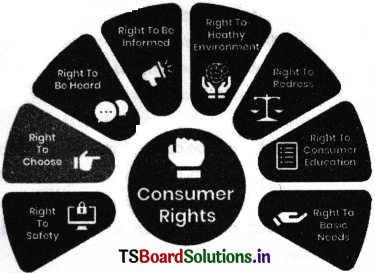
1. Right to Safety: Consumers have the right to be protected against the marketing of goods and services which are hazardous to life and property. This right is important for safe and secure life.
2. Right to be Informed: Consumers have the right to get information about the quality, quantity, purity standard and piece of goods or Services. This helps to protect them from unfair trade practices.
3. Right to Choose: Consumers has right to be assured, wherever possible, access to a variety of goods, products or services at competitive prices. Consumer should be free to choose the most suitable product from his point of view
4. Right to Consumer Education: Consumers have the right to consumer awareness that is the right of consumer to acquire knowledge and skill to be informed to customer. It is easier for literate consumers to know their rights and take actions.
Question 6.
Explain the four important responsibilities of a consumer.
Answer:
CONSUMER RESPONSIBILITIES:
1. Quality must be checked: The quality of products should be checked before purchase. Standard certification marks like ISI, Agmark, Hallmark, FPO, Woolmark, etc., should be looked for to ensure safety and reliability.
2. Ads should not be Trusted Blindly: Advertisements can be misleading, so they should not be fully trusted. Products should be personally checked, or feedback from other users should be taken, before making a purchase.
3. Products must be compared: Various brands or models should be compared before choosing a product. Aspects like price, quality, durability, and after-sales service should be considered.
4. Bill/Invoice should be kept: A bill or invoice must be collected at the time of purchase and preserved safely. For durable goods, warranty or guarantee cards duly filled and signed by the seller.
Question 7.
What are the objectives of GST ?
Answer:
Objectives of GST:
- One Nation, One Tax is the main objective of GST.
- GST simplifies India’s indirect tax system.
- GST removes multiple and cascading taxes.
- GST ensures transparency and fairness.
- GST promotes ease of doing business.
- GST boosts economic growth and national integration.
- GST encourages voluntary tax compliance.
Question 8.
What are benefits of GST?
Answer:
I. Benefits for the Nation:
- Reduction in Tax Evasion: Online GST filing, invoices, and Input Tax Credit (ITC) create transparency, reducing leakages in revenue collection.
- Promotes ‘Make in India’ and Exports: Exported goods are zero-rated, improving competitiveness in international markets.
II. Benefits for Businesses:
- Ease of Interstate Trade: IGST enables smooth movement of goods across states without multiple taxes.
- Encourages MSMEs (Micro, Small, Medium Enterprises) and Startups: Lower compliance costs and automated refunds make it easier for small businesses to operate.
III. Benefits for Consumers:
- Transparency: Consumers can see tax charges on bills, creating awareness and trust.
- Better Quality and Availability of Goods: Businesses benefit from lower costs and streamlined supply chains, indirectly improving product availability.
Question 9.
What are key initiatives of GST 2.0?
Answer:
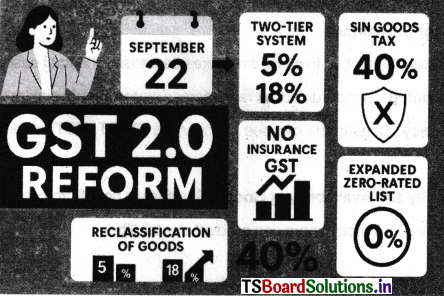
Launched on 22nd September 2025, GST 2.0 simplifies the tax system with three main goals:
- Structural Reforms-Fix inverted duties and simplify classification
- Rate Rationalisation-Fewer slabs and lower taxes on essentials
- Ease of Business-Faster refunds, pre-filled returns, and digital compliance
Key Changes:
- Two main slabs: 5% and 18%, 40% for luxury/sin goods
- Removed 12% and 28% slabs; most items moved to lower rates
- Essentials now cheaper with 5% or zero tax
- Health and life insurance tax-free
- Electronics, white goods, and small cars reduced from 28% to 18%
- Pre-filled returns and automated refunds for MSMEs and exporters
Impact and Focus:
For Youth & Startups
- Cheaper essentials and business tools
- Easier compliance and registration
- Encourages entrepreneurship and job creation in sectors like textiles, handicrafts, footwear, and logistics.
Economic Impact:
- Simplified tax structure boosts consumption and competitiveness
- Improved cash flow for MSMEs
- Supports Atmanirbhar Bharat and inclusive growth.
Long Answer Questions
Question 1.
Describe the rights of a consumer as per CPA 2019.
Answer:
Business men are generally aware of their social responsibilities, but we come across many cases of consumer exploitation. Hence, Government of India provided following six rights to all consumers under the Consumer Protection Act:
The Consumer Protection Act 2019, Section 2(9) provides for six rights of consumers.
1. Right to Safety: Consumers have the right to be protected against the marketing of goods, products, or services that are hazardous to life and property.
2. Right to be Informed: Consumers have the right to be informed about the quality, quantity, potency, purity, standard, and price of goods, products, or services. This helps to protect them from unfair trade practices.
3. Right to Choose: Consumers have the right to be assured, wherever possible, access to a variety of goods, products, or services at competitive prices.
4. Right to be Heard: Consumers have the right to be heard and to be assured that their interests will receive due consideration at appropriate forums or platforms.
5. Right to Seek Redressal: Consumers have the right to seek redress against unfair trade practices, restrictive trade practices, or unscrupulous exploitation.
6. Right to Consumer Education: Consumers have the right to consumer awareness that is, the right to acquire the knowledge and skills needed to make informed and confident choices about goods and services.
Question 2.
Explain the responsibilities of a consumer.
Answer:
Responsibilities of a consumer:
1. Quality must be checked: The quality of products should be checked before purchase. Standard certification marks like ISI, Agmark, Hallmark, FPO, Woolmark, etc., should be looked for to ensure safety and reliability.
2. Ads should not be Trusted Blindly: Advertisements can be misleading, so they should not be fully trusted. Products should be personally checked, or feedback from other users should be taken, before making a purchase.
3. Products must be compared: Various brands or models should be compared before choosing a product. Aspects like price, quality, durability, and after-sales service should be considered.
4. Bill/Invoice should be kept: A bill or invoice must be collected at the time of purchase and preserved safely. For durable goods, warranty or guarantee cards duly filled and signed by the seller.
5. Consumer Rights must be known: Consumers should be aware of their rights and must use them wisely. Complete information about products and services should be asked for, and purchases should be free from any kind of defect.
6. Genuine Complaints must be filed: If the product or service is unsatisfactory, a proper complaint should first be submitted to the seller or company. If unresolved, a consumer forum can be approached. However, only real and reasonable claims should be made.
7. Products must be used properly: ‘Goods and services should be used carefully. Misuse during the guarantee period should be avoided, as proper usage is expected from consumers even when replacements are offered.
Question 3.
Explain the redressal mechanism available to consumers under the Consumer Protection Act, 2019.
Answer:
The Judicial machinery set up under the Consumer Protection Act (CPA), 1986 consists of three tier system at various levels i.e., District Commission, State Commission and National Commission separately.
I. District Commission: This is established by the state governments in each of its districts.
- Composition: The district forums consist of a President and two other members one of whom shall be woman. The district forums are headed by the person of the rank of a District Judge.
- Jurisdiction: A written complaint can be filed before the District Consumer Forum where the value of the goods or services and the compensation claimed does not exceed Rs. 1 Crore
- Appeal: If a consumer is not satisfied by the decision of the district forum, he can challenge the same before the State commission, within 45 days of the order.
II. State Commission: This is established by the state governments in their respective states.
- Composition: The State Commission consists of a President and not less than four members, one of whom shall be a woman. The Commission is headed by a person of the level of High Court judge.
- Jurisdiction: A written complaint can be filed before the State Commission where the value of goods or services and the compensation claimed exceeds Rs. 1 Crore but does not exceed Rs. 10 crores.
- Appeal: In case the aggrieved party is not satisfied with the order of the State Commission he can appeal to the National Commission within 30 days of passing of the order
III. National Commission: The National commission was constituted in 1988 by the Central Government. It is the apex body in the tier judicial machinery set up by the government for redressal of consumer grievances. Its office is situated at Janpath Bhawan (Old Indian Oil Bhawan)
- Composition: It consists of a president and not less than four and not more than such members as may be prescribed, one of whom shall be woman. The National Commission is headed by a sitting or retired judge of the Supreme Court.
- Jurisdiction: All complaints pertaining to those goods or services and compensation whose value is more than Rs. 10 Crores can be filed directly before the National Commission.
- Appeal: An appeal against the order of the National commission can be filed before the Supreme Court within 30 days from the date of the order.
Question 4.
What are benefits of GST?
Answer:
GST is widely regarded as a revolutionary tax reform because it streamlines indirect taxation and reduces complexity. Its benefits can be categorized into three levels: for the nation, businesses, and consumers.
I. Benefits for the Nation:
- Unified National Market: GST removes interstate trade barriers, creating a single, common market across India.
- Boost to Economic Growth: Simplified taxation encourages businesses to expand, increasing production, investment, and employment.
- Reduction in Tax Evasion: Online GST filing, invoices, and Input Tax Credit (ITC) create transparency, reducing leakages in revenue collection.
- Promotes ‘Make in India’ and Exports: Exported goods are zero-rated, improving competitiveness in international markets.
II. Benefits for Businesses:
- Elimination of Cascading Taxes: Businesses can claim ITC, paying tax only on value addition, reducing costs.
- Simplified Compliance: Unified tax structure, online filing, and pre-filled returns reduce administrative burdens.
- Ease of Interstate Trade: IGST enables smooth movement of goods across states without multiple taxes.
- Encourages MSMEs and Startups: Lower compliance costs and automated refunds make it easier for small businesses to operate.
III. Benefits for Consumers:
- Lower Prices: Reduction in cascading taxes decreases the final cost of goods and services.
- Uniform Pricing: Standardized tax rates across states ensure similar prices nationwide.
- Transparency: Consumers can see tax charges [CGST, GST] on bills, creating awareness and trust.
- Better Quality and Availability of Goods: Businesses benefit from lower costs and streamlined supply chains, indirectly improving product availability.
Fill in the Blanks
Question 1.
The Consumer Protection Act, 2019 came into force on ___________
Answer:
20 July 2020
Question 2.
The shift in principle is from caveat emptor to ___________
Answer:
Caveat Venditor
Question 3.
The CCPA stands for ___________
Answer:
Central Consumer Protection Authority
Question 4.
The District Commission handles cases up to ___________ rupees.
Answer:
Rs. 1 crore
Question 5.
E-commerce is included under the Consumer Protection Act of ___________
Answer:
2019
Question 6.
GST stands for ___________.
Answer:
Goods and Service Tax
Question 7.
The main objective of GST is “___________”
Answer:
One Nation, One Tax
Question 8.
The tax collected on goods sold between states is called ___________.
Answer:
IGST (Integrated Goods and Services Tax)
Question 9.
Health and life insurance are made ___________ from tax under GST 2.0.
Answer:
Extempt/Tax-free