
Reviewing AP Inter 2nd Year Accounts Study Material Chapter 5 Dissolution of Partnership Questions and Answers can help students prepare confidently for exams.
AP Inter 2nd Year Accountancy 5th Lesson Dissolution of Partnership Questions and Answers
I. Fill in the blanks
Question 1.
When the business relationship among partners comes to an end, it is known as _____________.
Answer:
Dissolution of Partnership
Question 2.
According to the Indian Partnership Act 1932, Section 39, “The dissolution of the partnership between all the partners of a firm is called the _____________”.
Answer:
Dissolution of a Partnership firm
Question 3.
Partnership at will can be dissolved by giving a notice of _____________ days.
Answer:
14 (Fourteen)
Question 4.
The business continues in a dissolution of a partnership but in a _____________, the business discontinues completely.
Answer:
Dissolution of firm
Question 5.
A court order cannot dissolve a partnership, but a court order can dissolve a _____________.
Answer:
Partnership firm
Question 6.
As per the Indian Partnership Act 1932, Section 48, the first priority for paying liabilities on dissolution is to cover _____________ expenses.
Answer:
Realisation
Question 7.
The final remaining surplus cash is distributed among the partners according to their agreed-upon _____________.
Answer:
Profit Sharing Ratio
Question 8.
The three stages of a simple dissolution process are the Transfer Stage, Realisation/Disposal Stage, and _____________.
Answer:
Distribution stage
Question 9.
The Realisation Account is a _____________ account created to calculate the profit or loss from dissolving a firm.
Answer:
Nominal
II. Very Short Answer Questions
Question 1.
Define Dissolution of firm according to the Indian Partnership Act 1932.
Answer:
- According to Section 39 of the Indian Partnership Act, 1932, the dissolution of the partnership among all the partners of a firm is known as the dissolution of a firm.
- It signifies the complete termination of the partnership relationship among all the partners.
Question 2.
Give any two reasons for dissolution of a partnership.
Answer:
- By the mutual consent of all the partners.
- On the expiry of the agreed period (duration) of the partnership firm.
Question 3.
List the first two payments that must be made from the realised assets when settling accounts on the dissolution of a firm.
Answer:
According to Section 48 of the Indian Partnership Act, 1932, the realised assets are applied towards payments in the following order:
- Realisation expenses
- External (Outside) liabilities

Question 4.
Who is an insolvent partner?
Answer:
- An insolvent partner is a partner whose liabilities exceed the value of his assets.
- A person is considered insolvent when he is unable to pay off his liabilities using his available assets.
Question 5.
What is the main purpose of creating the Realisation Account?
Answer:
The Realisation Account is a nominal account prepared to determine the profit or loss arising from the process of dissolving a partnership firm.
Question 6.
What is Capital Deficiency?
Answer:
Capital deficiency refers to a situation where one or more partners have a debit balance in their capital accounts at the time of making, the final distribution of cash.
III. Short Answer Questions
Question 1.
What is the main difference between the dissolution of a partnership and the dissolution of a partnership firm?
Answer:
| Basis of Comparison | Dissolution of Partnership | Dissolution of Firm |
| Meaning | It may or may not result in the dissolution of the firm. | It always results in the dissollution of the partnership firm. |
| Nature | It is generally voluntary in nature. | It may be either voluntary or compulsory |
| Continuation of Business | The business continues, but the Partnership is reconstituted. | The business comes to an end completely. |
Question 2.
List any four reasons why a partnership firm might be dissolved.
Answer:
- By the mutual agreement of all the partners.
- On the expiry of the fixed period (duration) of the partnership.
- After the completion of the particular venture for which the partnership was established.
- When the business becomes illegal or unlawful.
Question 3.
Explain the specific order in which liabilities are paid upon the dissolution of a firm?
Answer:
According to Section 48 of the Indian Partnership Act, 1932, the liabilities are settled in the following sequence:
- Realisation expenses
- Outside liabilities
- Loans advanced by partners
- Partners’capital
Question 4.
Define a Solvent Partner.
Answer:
- A solvent partner is a partner whose assets are greater than his liabilities.
- A person is regarded as solvent when he is capable of paying all his liabilities from his assets.
- Therefore, a solvent partner is one who can fulfil all his financial obligations.
Question 5.
What is the key purpose of the Realisation Account in the dissolution process?
Answer:
- The Realisation Account is a nominal account prepared to determine the profit or loss arising from the dissolution of a partnership firm.
- Its primary objective is to ascertain the overall financial result of the dissolution.
- A credit balance in the account indicates a profit, whereas a debit balance indicates a loss.
- The resulting profit or loss is then transferred to the partners’ capital accounts according to their agreed profit-sharing ratio.
Question 6.
How is the deficiency of an insolvent partner’s capital account handled under the Fluctuating Capital Method?
Answer:
- Under the Fluctuating Capital Method, separate current accounts are not maintained. All necessary adjustments are recorded directly in the partners’ capital accounts.
- The deficiency in the capital account of an insolvent partner is transferred to the capital accounts of the solvent partners in their profit-sharing ratio.
Question 7.
Name the three main stages of closing the books of accounts during a simple dissolution process.
Answer:
On the dissolution of a partnership firm, the books of accounts are closed permanently and a balance sheet is prepared. The process of simple dissolution is generally carried out in the following three stages:
- Transfer Stage
- Realisation (or Disposal) Stage
- Distribution Stage
IV. Long Answer Questions
Question 1.
Define “Dissolution of Partnership” and explain various reasons for the dissolution of a partnership firm.
Answer:
In legal terminology, the word dissolution has several meanings. It is derived from the Latin word “Dissolution” which means the act of bringing something to an end or breaking it up. Dissolution represents the final stage in the closure of a business.
Definition: According to Section 39 of the Indian Partnership Act, 1932, “The dissolution of partnership between all the partners of a firm is called the dissolution of a firm.” It refers to the complete termination of the partnership relationship among all the partners.
Reasons for the dissolution of a partnership firm:
- By the mutual consent of all the partners.
- On the expiry of the agreed period (duration) of the partnership.
- After the completion of the specific venture for which the partnership was established.
- Insolvency of all the partners, or of all except one partner.
- When the business becomes illegal or unlawful.
- A partnership at will may be dissolved by giving a 1 4-day notice.
Question 2.
Explain the meaning of “Dissolution of Partnership” and “Dissolution of Firm” and discuss the key differences between the two.
Answer:
| Basis of Comparison | Dissolution of Partnership | Dissolution of Firm |
| Meaning | It may or may not result in the dissolution of the firm. | It always results in the dissolution of the partnership firm. |
| Nature | It is generally voluntary in nature. | It may be either voluntary or compulsory |
| Continuation of Business | The business continues, but the Partnership is reconstituted. | The business comes to an end completely. |
| Requirements | Revaluation of assets and liabilities is required for the reconstitution of the firm. | Realisation of assets and settlement of liabilities are required for winding up the firm. |
| Final Closure of Books | The books of accounts are not finally closed. | The books of accounts are permanently closed. |
| Court Order | A partnership is not dissolved by a court order. | A court has the authority to dissolve a firm. |
Question 3.
Elaborate the stages of closing the books of accounts on dissolution.
Answer:
When a partnership firm is dissolved, its books of accounts are closed permanently and a final balance sheet is prepared. The process of simple dissolution is generally divided into the following three stages:
a) Transfer Stage: The dissolution process starts with the transfer stage, where all the firm’s assets (except cash and bank balances) and external liabilities are transferred to a temporary account called the Realisation Account.
b) Realisation / Disposal Stage:
- During this stage, the firm’s assets are converted into cash.
- This may be done either by selling the assets to outsiders or by allowing one or more partners to take over the assets.
c) Distribution Stage:
- After all assets are realised and liabilities are settled, the Realisation Account is closed.
- The resulting profit or loss is transferred to the partners’ capital accounts according to their profit-sharing ratio.
- Finally, the balances in the partners’ capital accounts are settled by distributing the remaining cash. This marks the completion of the dissolution process.
Question 4.
Explain the purpose of a Realisation Account in the dissolution of a partnership firm.
Answer:
- The Realisation Account is a nominal account prepared to determine the profit or loss arising from the dissolution of a partnership firm.
- All assets, except cash and bank balances, along with all external liabilities, are transferred to this account.
- The amount received from the sale of assets is credited to the Realisation Account, while the payments made towards liabilities are debited.
- The main objective of preparing this account is to ascertain the overall financial result of the dissolution.
- A credit balance in the account indicates a profit, whereas a debit balance indicates a loss.
- The resulting profit or loss is then transferred to the partners’ capital accounts according to their agreed profit-sharing ratio.
Question 5.
What are the main accounts prepared during dissolution of partnership firm?
Answer:
The following accounts are prepared during the dissolution of a partnership firm:
1) Realisation Account:
- The Realisation Account is a nominal account opened to calculate the profit or loss arising from dissolution.
- All assets, except cash and bank balances, and all external liabilities are transferred to this account.
- The proceeds from the sale of assets are credited, while payments made towards liabilities are debited.
2) Partners’Capital Account:
- This account begins with the capital balances shown in the firm’s balance sheet.
- During dissolution, it is adjusted for each partner’s share of accumulated profits or losses, reserves, and the profit or loss transferred from the Realisation Account.
3) Partners’ Current Account (When the Fixed Capital Method is followed): Under the fixed capital method, a separate Partners’ Current Account is maintained to record routine transactions such as interest on capital, salaries, drawings, and similar adjustments.
4) Partners’Loan Account (If Applicable):
- A loan given by a partner to the firm is treated separately from the partner’s capital.
- Therefore, the Partners’ Loan Account is not transferred to the Realisation Account.
- It is settled separately after all external liabilities have been paid.
5) Cash or Bank Account:
- This account starts with the cash and bank balances shown in the final balance sheet.
- Cash received from the sale of assets is recorded on one side, while payments towards liabilities, dissolution expenses, and settlement of partners’ capital are recorded on the other side.
- After all transactions are completed, the account should have a zero balance, indicating that all available cash has been fully utilised in settling the firm’s obligations and distributing the remaining amount among the partners.
Exercises
Question 1.
Anya and Bharat are partners sharing profits and losses in the ratio of 3 : 2. On March 31st, 2024, their firm was dissolved. Their Balance Sheet was as follows:
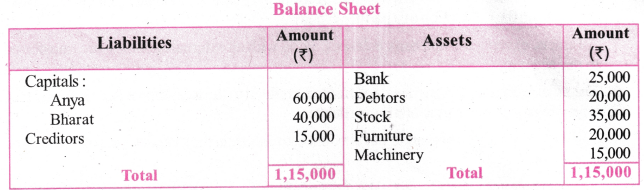
Additional Information:
- Anya agreed to take over the Machinery at an agreed value of ₹ 12,000.
- Debtors realized 80% of their book value.
- The remaining assets (Stock and Furniture) were sold for a lump sum of ₹ 50,000.
- Creditors were paid off in full.
Prepare the Realization Account and Partners’ Capital Accounts to close the books of the firm.
Solution:
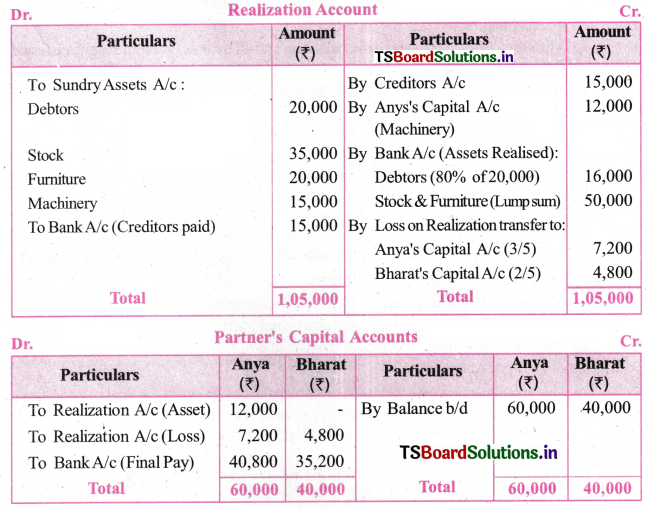
Working Notes:
1. Realization of Assets:
- Debtors: 80% of 20,000 = ₹ 16,000
- Stock & Furniture: ₹ 50,000
- Total Bank Realization : ₹ 66,000
2. Distribution of Loss (3:2):
- Anya: 12,000 × 3/5 = ₹ 7,200
- Bharat: 12,000 × 2/5 = ₹ 4,800
3. Bank Account (Verification) :
- Opening Balance (25,000) + Asset Realization (66000) = ₹ 91,000
- Payment to Creditors (15,000) + Anya (40,800) + Bharat (35,200) = ₹ 91,000
Question 2.
Deepak, Esha, and Farhan are partners sharing profits and losses equally. Their firm was dissolved on April 1st, 2024. The Balance Sheet on that date was:
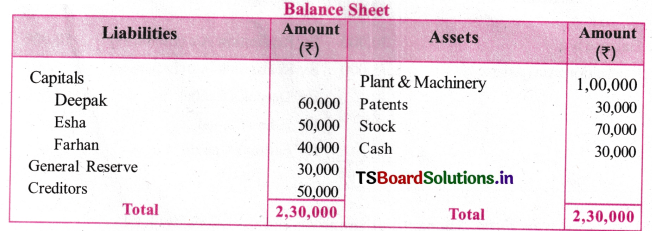
Additional Information:
- Plant & Machinery and Stock were sold for ₹ 95,000 and ₹ 75,000, respectively.
- An unrecorded asset (an old computer) was sold for ₹ 5,000.
- Dissolution expenses paid ₹ 3,000
- Farhan took over the Patents at a valuation of ₹ 25,000.
Prepare the Realization Account, Partners1 Capital Accounts, and the Cash Account to close the firm’s books.
Solution:
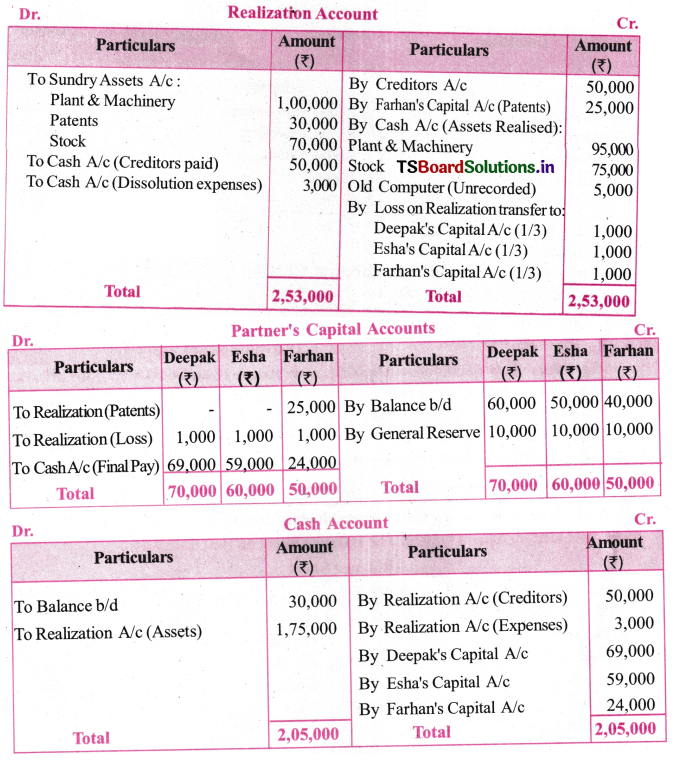
Working Notes:
Working Notes:
- Profit Sharing Ratio : The partners share profits and losses equality(1 : 1 : 1).
- General Reserve : The reserve of ₹ 30,000 is distributed equally (₹ 10,000 each) among the partners in their Capital Accounts.
- Realization of Assets :
- Plant & Machinery: ₹ 95,000
- Stock : ₹ 75,000
- Old Computer : ₹ 5,000
- Total Cash Realized : ₹ 1,75,000
Question 3.
Lokesh and Monika are partners sharing profits and losses in the ratio of 2 : 1. They decide to dissolve their partnership. The Balance Sheet on the date of dissolution was:
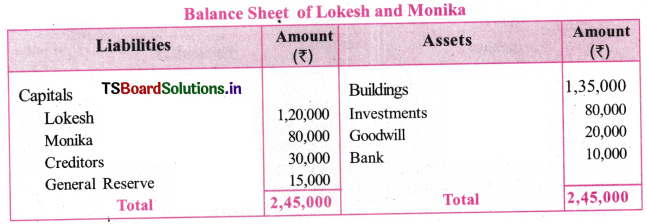
Additional Information:
- Buildings realized ₹ 1,40,000.
- Investment was taken over by Lokesh at ₹ 77,000.
- Goodwill was treated as valueless.
Prepare the Realization Account and Partners’ Capital Accounts to show the final settlement.
Solution:
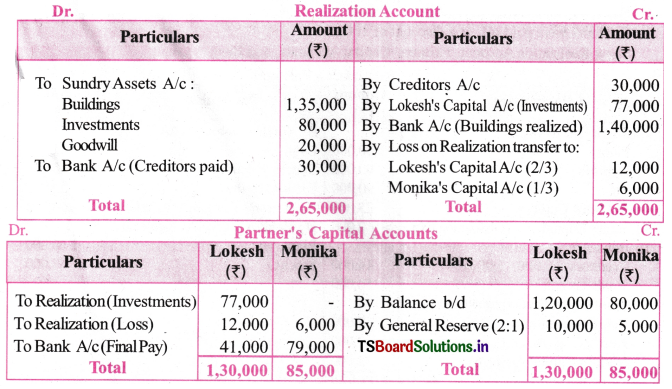
Working Notes:
1. General Reserve (₹ 15,000) : Divided between Lokesh and Monika in their profit – sharing ratio of 2: 1.
- Lokesh : 15,000 × 2/3 = 10,000
- Monika: 15,000 × 1/3 = 5,000
2. Realization Loss Calculation:
- Total Debit: 1,35,000 + 80,000 + 20,000 + 30,000 = ₹ 2,65,000
- Total Credit : 30,000 + 77,000 + 1,40,000 = ₹ 2,47,000
- Loss : ₹ 18,000 (Shared as 12,000 and 6,000)
3. Creditors : Even if not specifically mentioned, liabilities are paid off at their book value (₹ 30,000) during dissolution.
Question 4.
Rajesh, Amit, and Nikhil were in partnership sharing Profits and Losses in the ratio 3 : 2 : 1. They decided to dissolve their partnership firm on 30th June 2023 and their Balance Sheet on that date stood as:
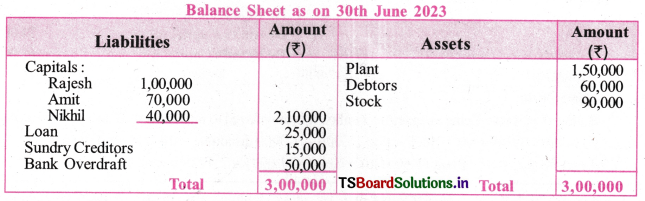
It was agreed that:
- Rajesh would discharge the Loan and take Debtors at book value.
- Dissolution charges of ₹ 2000 paid by Amit A Plant was realised for 1,60,000.
- Stock was realised for 87,000.
- Creditors were paid off at a discount of 1000.
Show Realisation Account, Partners’ Capital Accounts, and Bank Account.
Solution:
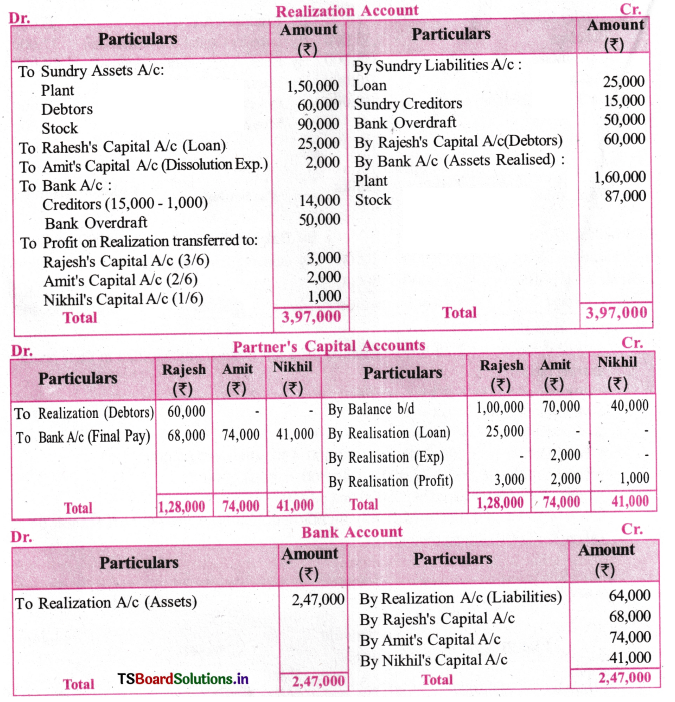
Working Notes :
- Bank Overdraft : Being an external liability, it is transferred to the Realisation account and paid off.
- Creditors Settlement: Book value 15,000 – 1,000 (discount) = 14,000 paid in cash.
- Asset Realisation : Plant (1,60,000) + Stock (87,000) = 2,47,000 total cash inflow.
Question 5.
Sunita, and Preeti are partners in a business dealing in authentic Indian spices. They share profits and losses in the ratio of 3 : 2, respectively. They have decided to dissolve their partnership.
The business Balance Sheet as on March 31st, 2023 is as follows:
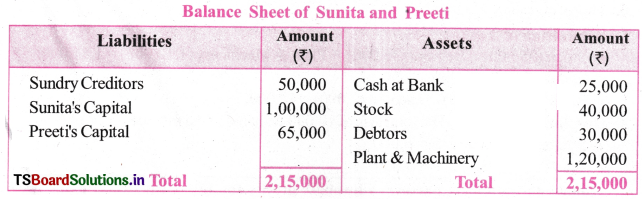
It was agreed that:
1. Stock was sold for ₹ 35,000.
2. Debtors realized ₹ 36,000.
3. Plant & Machinery was sold for ₹ 1,10,000.
4. Sundry Creditors were paid with a discount of ₹ 2,000.
5. Expenses of dissolution amounted to ₹ 3,000 paid.
You are required to prepare the Realization Account, Partners’ Capital Accounts and Bank Account.
Solution:
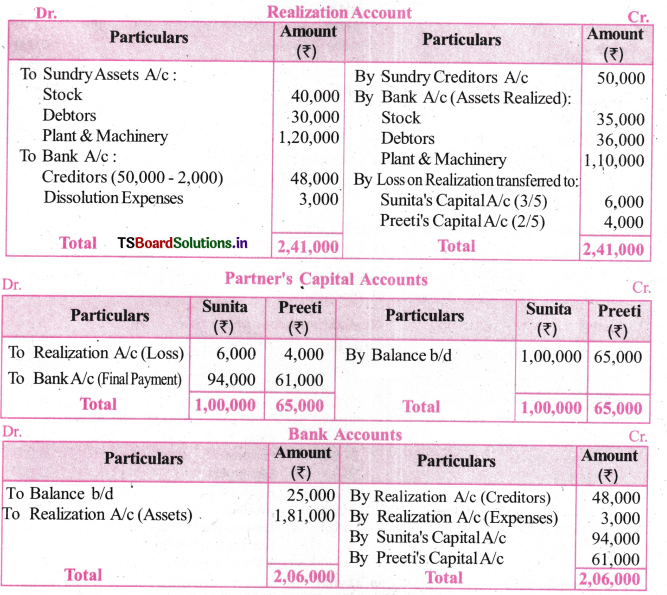
Working Notes:
1. Realization of Assets :
- Stock (35,000) + Debtors (36,000) + Plant & Machinery(1,10,000) = 1,81,000.
2. Settlement of Creditors:
- Book Value (50,000) – Discount (2,000) = 48,000.
3. Distribution of Loss : The total loss of 10,000 is shared in the ratio of 3 : 2.
- Sunita: 10,000 × 3/5 = 6000
- Preeti: 10,000 × 2/5 4,000
Question 6.
Kunal and Latika are partners who share profits and losses equally. The following is their Balance Sheet as of March 31st, 2023.
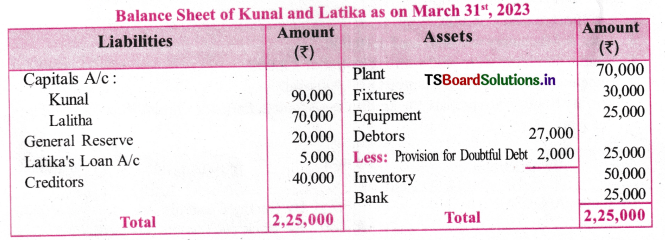
The firm was dissolved on March 31st, 2023.
Assets Realized:
- Plant: ₹ 30,000
- Fixtures: ₹ 28,000
- Equipment: ₹ 22,000
- Debtors: ₹ 23,000
- Inventory: ₹ 45,000
1. Creditors were paid with a discount of ₹ 1,000.
2. Dissolution expenses amounted to ₹ 5,000.
Prepare the Realization account, Partners’ Capital Accounts Latika’s Loan Account and the bank Account to close the books of the firm.
Solution:
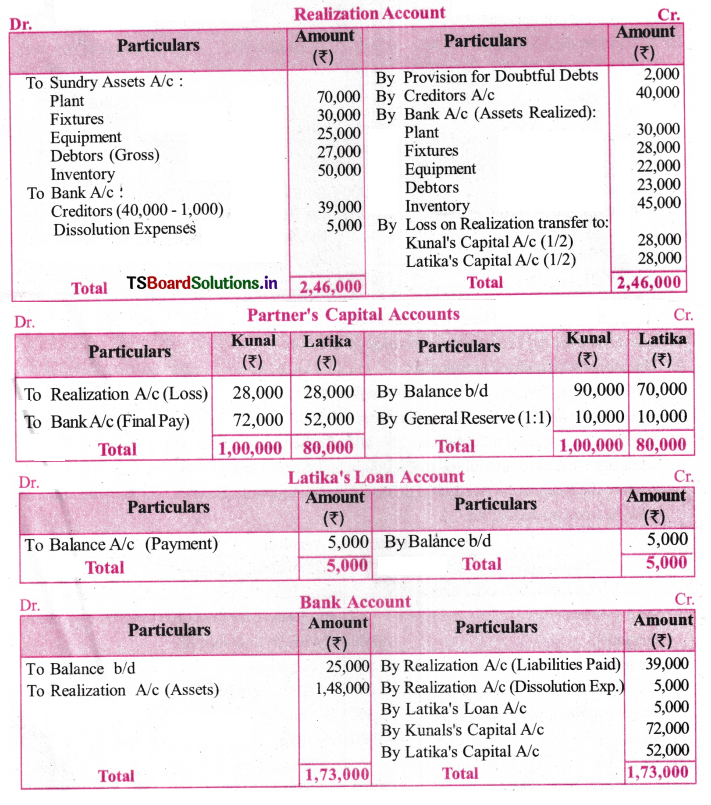
Working Notes:
- General Reserve (20,000): Since the partners share profits equally, 10,000 is credited to each partner’s capital account.
- Provision for Doubtful Debts (2,000): This is transferred to the credit side of the Realiazation Account. Assets (Debtors) are transferred at their gross value (27,000) to the debit side.
- Realization of Assets:
- Plant (30,000) + Fixture (28,000) + Equipment (22,000) + Debtors (23,000) + Inventory (45,000) = 1,48,000
- Partner’s Loan: Latika’s Loan is a liability of the firm to the partner. It is paid separately through the Bank Account after external liabilities are settled, but before final capital payments.
Question 7.
Ravi and Seema are partners who share profits and losses equally. The following is their Balance Sheet as of March 31st, 2022.
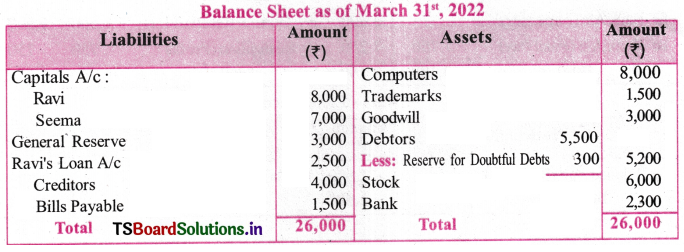
On April 1st, 2022, the firm was dissolved.
- Ravi took over the Trademarks at a value of ₹ 2,500.
- The assets were realized as follows:
- Computers: ₹ 9,000
- Goodwill: ₹ 4,000
- Stock: ₹ 5,000
- Debtors: ₹ 4,500
- Creditors were paid at a discount of 5%, and all other liabilities were paid in full.
- Realization expenses amounted to ₹ 2,000, which Seema agreed to bear.
Prepare the Realization Account, Partners’ Capital Accounts, Ravi’s Loan Account, and the Bank Account on dissolution.
Solution:
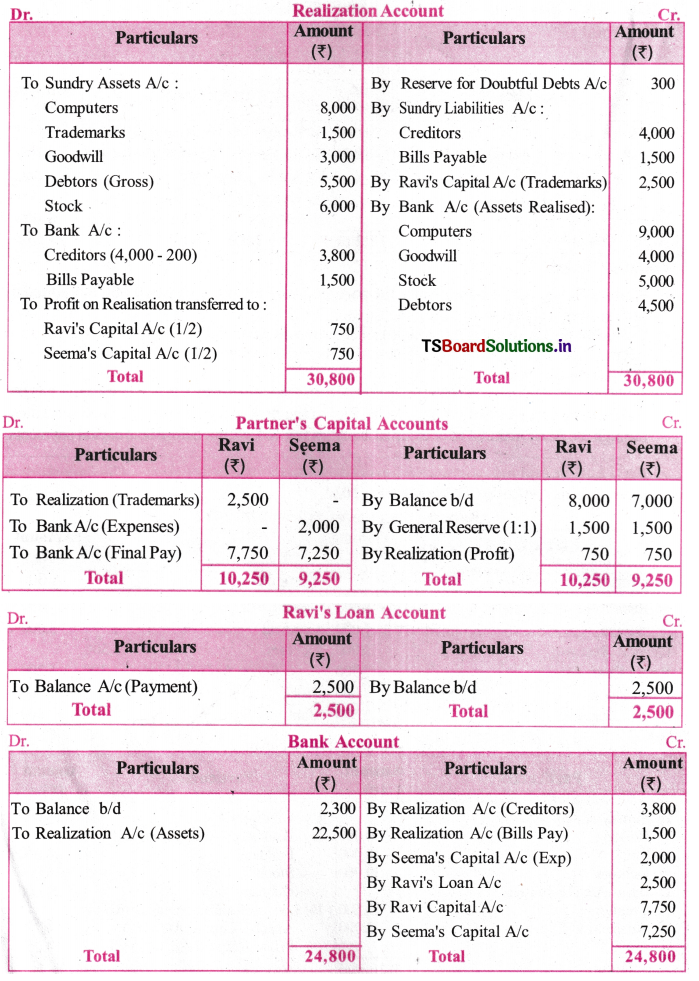
Working Notes:
- Realization Expenses: Since Seema agreed to bear the expenses, they are charged to her Capital Account.
- Creditors Discount : 5% of 4,000 = 200. Final Payment = 3,800.
- General Reserve (3,000) : Divided equally (₹ 1,500 each) as per the 1 : 1 profit-sharing ratio.
- Ravi’s Loan : Paid directly through the Bank account as he has a surplus capital balance.
- Seema’s Final Payment : Her adjusted capital was 11,250. After deducting the 2,000 expenses she bore (paid by bank), her final cash receipt is 9,250.
Question 8.
Akash and Priya are partners sharing profits and losses equally. On September 15th, 2024, they decide to dissolve their partnership.
Their Balance Sheet on that date was:
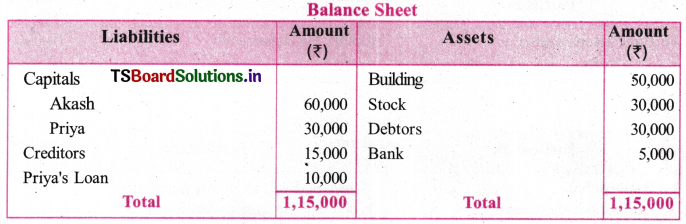
Additional Information:
- The Building was sold for ₹ 40,000.
- Stock was sold for ₹ 35,000, and Debtors realized ₹ 28,000.
- Creditors were paid off at a 10% discount.
- Realization expenses amounted to ₹ 3,000.
- Priya’s loan was paid in full.
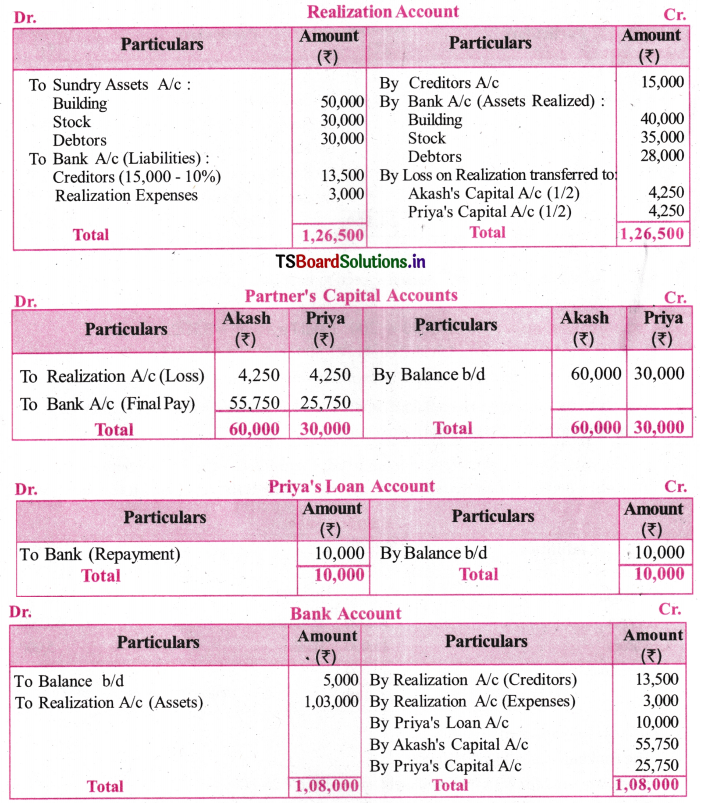
Prepare the Realization Account, Partners’ Capital Accounts, Priya’s Loan Account, and the Bank Account to show the final settlement.
Solution:
Question 9.
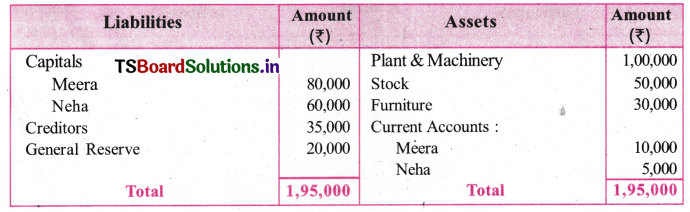
Meera and Neha are partners who share profits and losses in the ratio of 3:2. They maintain their capital accounts under the fixed capital method. Their firm was dissolved on October 31st, 2024.
Their Balance Sheet was as follows:
Additional Information:
Plant & Machinery and Furniture were sold for a total of 1,20,000.
Stock was sold for 40,000.
Creditors were paid 27,000 in full settlement.
Realization expenses amounted to 3,000.
Prepare the Realization Account, Partners’ Current Accounts & Partners’ Capital Accounts using fixed capital method and the Bank Account to show the final settlement on dissolution.
Solution:
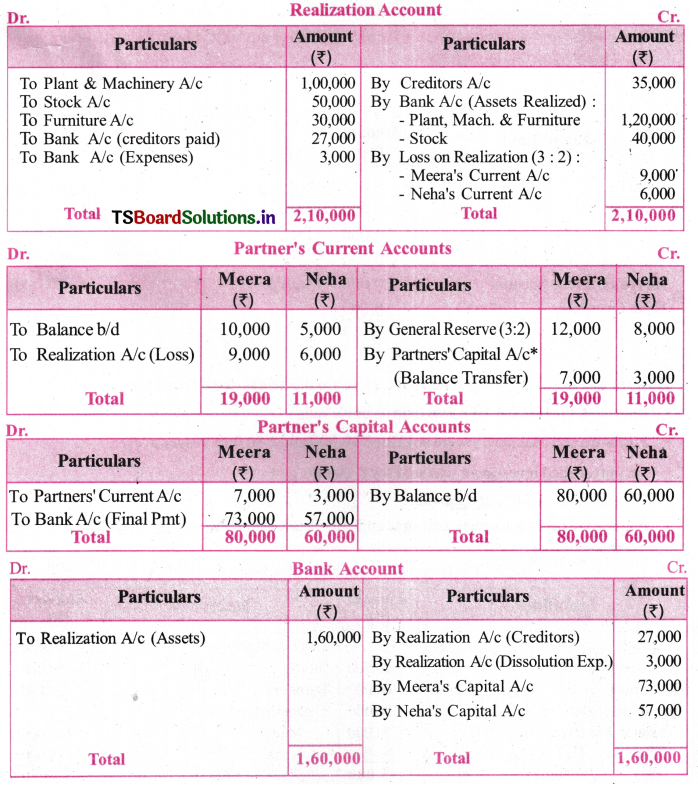
WorkingNotes:
- General Reserve (20,000): Distributed in 3 : 2 ratio as follows:
Meera = 12,000; Neha = 8,000. - Current Account Balances: Since they appeared on the Assets side in given balance sheet, they are treated as debit balances in their capital accounts (To Balance b/d)
- Realization of Loss (15,000): Total Debits (2,10,000) – Realized Values (1,95,000) = 15,000. Distributed in 3 : 2 ratio i/e., 9,000 and 6,000.
Question 10.
Rani and Kavya are partners who share profits equally. Their balance sheet as of March 31st, 2023, is shown below:
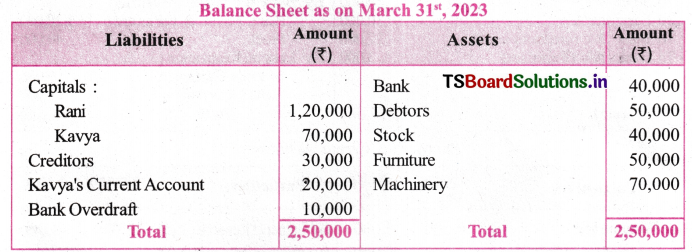
The firm was dissolved on the date above. Here are the details of the dissolution:
- Rani took the stock at 10% less than its book value.
- Furniture and Machinery were sold for ₹ 40,000 and ₹ 80,000, respectively.
- An unrecorded investment was sold for ₹ 20,000.
- Debtors realized 80% of their value.
Prepare the necessary ledger accounts under the fixed capital method, to close the firm’s books on dissolution.
Solution:
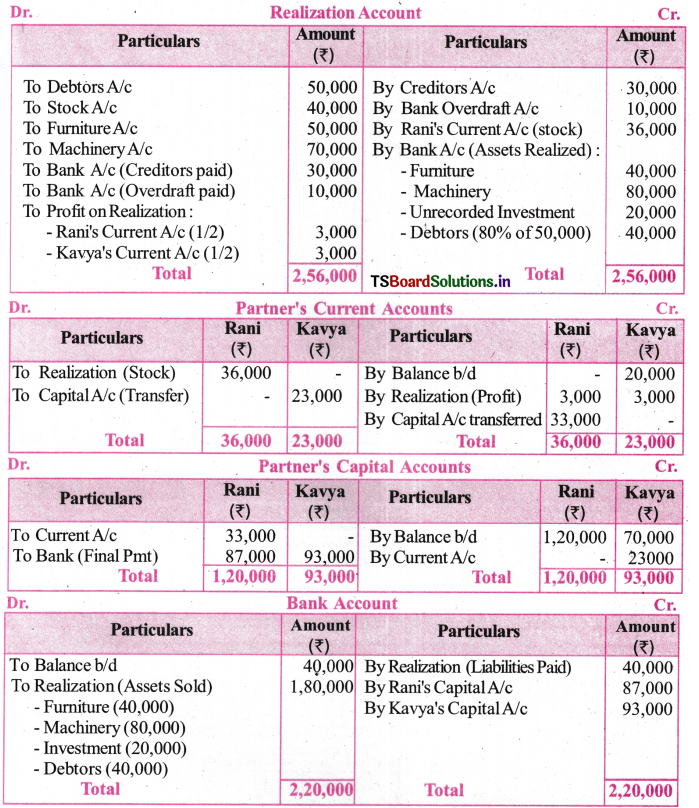
Working Notes:
1. Calculation of Stock taken over by Rani:
Book Value of stock : ₹ 40,000
Less: 10% reduction (10% of ₹40000) : ₹ 4,000
Value at which Rani took Stock : ₹ 36,000
2. Calculation of Realization Profit/ Loss :
Total Credits (Realization A/c) : = ₹ 2,56,000
Total Debits (Realization A/c): = ₹ 2,50,000
Net Profit on Realization:
₹ 2,56,000 – ₹ 2,50,000 = ₹ 6,000
Profit is shared equally (1:1) between Rani (₹ 3,000) and Kavya (₹ 3,000).