
Reviewing AP Inter 2nd Year Botany Study Material Chapter 6 Ecosystem Questions and Answers can help students prepare confidently for exams.
AP Inter 2nd Year Botany 6th Lesson Ecosystem Questions and Answers
IV. Very Short Answer Questions
Question 1.
Define an ecosystem.
Answer:
- An ecosystem is the basic functional unit of the biosphere where organisms interact with one another as well as with their surrounding physical environment.
- These interactions involve the transfer of energy and cycling of nutrients within the system. Examples: Pond, Lake.
Question 2.
Name any two decomposers found in a pond ecosystem.
Answer:
Common decomposers present in a pond ecosystem include :
- Fungi
- Bacteria
- Flagellates
Question 3.
What is humus?
Answer:
Humus is a dark-coloured, amorphous organic substance formed during the decomposition of organic matter through the process of humification.

Question 4.
Mention any two climatic factors that affect the rate of decomposition.
Answer:
Two important climatic factors influencing decomposition are :
- Temperature
- Soil moisture.
Question 5.
What is meant by a trophic level?
Answer:
A trophic level refers to the feeding position occupied by an organism in a food chain based on the source from which it obtains food and energy.
Question 6.
What is an ecological pyramid?
Answer:
An ecological pyramid is a diagrammatic representation that illustrates the relationship among organisms at different trophic levels in terms of number, biomass, or energy.
V. Short Answer Questions
Question 1.
Describe the types and importance ecological pyramids.
Answer:
An ecological pyramid is a diagrammatic representation that illustrates the feeding and energy relationships among organisms at different trophic levels in an ecosystem. It generally has a broad base consisting of producers and a narrow top occupied by top consumers.
Types of Ecological Pyramids :
1. Pyramid of Numbers:
- Represents the number of individuals present at each trophic level.
- Generally remains upright. Example: Grassland ecosystem.
- May become inverted in certain ecosystems. Example: A single tree supporting numerous insects.
2. Pyramid of Biomass:
- Shows the total biomass (living matter) present at each trophic level.
- Usually upright in terrestrial ecosystems.
- Can be inverted in aquatic ecosystems where the biomass of fishes exceeds that of phytoplankton.
3. Pyramid of Energy:
- Depicts the amount of energy available at successive trophic levels.
- It is always upright and never inverted.
- Since energy is lost as heat at every trophic level (10% law), higher trophic levels possess progressively less energy.
Importance of Ecological Pyramids :
- Illustrates energy transfer Helps in understanding how energy moves through different trophic levels and flows the 10% law.
- Explains trophic relationships: Shows the relationship between producers and consumers in terms of number, biomass, and energy.
- Facilitates ecosystem comparison: Upright and inverted pyramids help compare different ecosystems such as grasslands and aquatic systems.
- Indicates ecosystem stability: Helps in understanding the balance, structure, and functioning of ecosystems.
Question 2.
Distinguish between gross primary productivity and net primary productivity.
Answer:
| Gross Primary Productivity (GPP) | Net Primary Productivity (NPP) |
| 1) Total amount of organic matter or energy produced by producers through photosynthesis. | 1) Organic matter or energy remaining after respiratory losses are deducted. |
| 2) Includes energy utilized in respiration. | 2) Excludes respiratory losses. |
| 3) Represents the total productivity of producers. | 3) Represents the actual productivity available to consumers. |
| 4) Higher value than NPP. | 4) Lower value than GPP. |
| 5) Formula: GPP = NPP + R | 5) Formula : NPP = GPP – R |
Question 3.
Explain the different steps involved in the process of decomposition.
Answer:
- Decomposition is the breakdown of dead organic matter (detritus) into simpler inorganic substances such as carbon dioxide, water, and nutrients by decomposers.
- It is predominantly an oxygen-dependent process and occurs through several stages.
- The first stage is fragmentation, where detritivores like earthworms break detritus into smaller pieces, increasing the surface area available for microbial activity.
- This is followed by leaching, in which water dissolves soluble nutrients and carries them into deeper soil layers.
- The next stage is catabolism, where bacteria and fungi release enzymes that convert complex organic compounds into simpler substances.
- Subsequently, humification occurs, resulting in the formation of humus, a dark-coloured amorphous substance.
- Humus is resistant to further decomposition and serves as a nutrient reservoir.
- Finally, mineralisation takes place, where microbes break down humus and release inorganic nutrients into the soil, making them available to plants.
- Fragmentation, leaching and catabolism often occur simultaneously.
- The rate of decomposition is influenced by factors such as temperature, moisture and the chemical composition of detritus.
Question 4.
Differentiate between grazing food chain and detritus food chain.
Answer:
| Aspect | Grazing Food Chain (GFC) | Detritus Food Chain (DFC) |
| Starting point | Begins with living green plants (producers) | Begins with dead organic matter (detritus) |
| Source of energy | Derived from solar energy captured by plants | Derived from energy stored in dead organic matter |
| Primary organisms | Herbivores followed by carnivores | Decomposers (bacteria, fungi) and detritivores |
| Flow of energy | Plants → Herbivores → Carnivores | Detritus → Decomposers → Detritivores → Predators |
| Major in ecosystem | More common in aquatic ecosystems | More common in terrestrial ecosystems |
| Example | Grass → Goat → Human | Dead leaves → Earthworm → Bird |
VI. Long Answer Questions
Question 1.
Describe the components of an ecosystem.
Answer:
- An ecosystem is a functional unit of nature where living organisms interact with one another and with their surrounding environment.
- It consists of abiotic (non-living) and biotic (living) components, along with structural and – Wabr functional features.
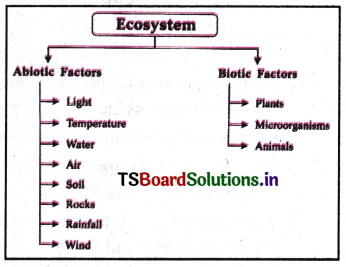
Abiotic Components (Non-living): Abiotic factors include all physical and chemical elements that influence living organisms.
i) Physical and inorganic materials :
- Air supplies oxygen for respiration and carbon dioxide for photosynthesis.
- Water is essential for life processes.
- Soil provides minerals and support for plant growth.
ii) Dissolved substances:
- Nutrients such as nitrogen, phosphorus, and minerals occur in soil and water.
- These nutrients are absorbed by plants and transferred through food chains.
iii) Climatic factors:
- Sunlight, temperature, rainfall, humidity, and wind regulate photosynthesis, growth, and reproduction.
- Sunlight serves as the primary source of energy in most ecosystems.
2. Biotic Components (Living): Biotic components include all living organisms classified according to their role in energy transfer.
i) Producers (Autotrophs):
- Green plants, algae, and phytoplankton convert solar energy into chemical energy through photosynthesis.
- They form the foundation of food chains.
ii) Consumers (Heterotrophs):
- Depend on producers or other organisms for food.
- Primary consumers feed on plants.
- Secondary and tertiary consumers feed on other animals.
iii) Decomposers (Saprotrophs):
- Bacteria and fungi decompose dead plants, animals, and organic matter.
- They convert complex substances into simple nutrients and recycle them back to the environment.
3. Structural Features of an Ecosystem :
- Species composition: Refers to the variety and abundance of species present in an ecosystem. Greater diversity generally indicates higher stability.
- Stratification: Organisms are arranged in different vertical layers. For example, forests show canopy, shrub, and ground layers.
4. Functional Aspects of an Ecosystem :
- Productivity: Rate at which producers synthesize organic matter through photosynthesis.
- Decomposition: Breakdown of dead organic matter into simpler substances.
- Energy flow: Energy moves from the sun to producers and then to consumers in a unidirectional manner.
- Nutrient cycling: Continuous circulation of nutrients such as carbon, nitrogen, and phosphorus between living and non-living components.
Question 2.
Give an account of energy flow in an ecosystem.
Answer:
Flow of Energy in an Ecosystem :
- The Sun is the ultimate source of energy for all ecosystems.
- Solar energy is captured by plants and transferred through various trophic levels.
- Less than 50% of the incoming solar radiation is photosynthetically active radiation (PAR).
- Plants utilize only about 2-10% of PAR, which supports the entire living world.
- All organisms depend directly or indirectly on producers for energy.
- According to the First Law of Thermodynamics, energy can neither be created nor destroyed; it only changes from one form to another.
- The Second Law of Thermodynamics states that some energy is lost as heat at every trophic level, reducing the amount available to the next level.
- Energy transfer through trophic levels is known as energy flow.
- Available energy decreases progressively at higher trophic levels.
- When organisms die, their stored energy becomes available to decomposers.
- Each trophic level possesses a certain amount of living material called the standing crop.
- Standing crop represents biomass and may be expressed as fresh weight or dry weight, with dry weight being more accurate.
I. Multiple Choice Questions
Question 1.
An ecosystem can best be defined as :
1. A collection of similar species living in a habitat.
2. A group of plants and animals living together without interaction.
3. A functional unit where living organisms interact with each other and the environment.
4. The population of a single species in a given area.
Answer:
3. A functional unit where living organisms interact with each other and the environment.
Question 2.
Which of the following is not a natural ecosystem?
1. Desert
2. Forest
3. Aquarium
4. Lake
Answer:
3. Aquarium
Question 3.
Vertical distribution of different species occupying various levels ¡n an ecosystem is called:
1. Stratification
2. Speciation
3. Decomposition
4. Succession
Answer:
1. Stratification
Question 4.
The rate of biomass production per unit area and time is known as:
1. Decomposition
2. Productivity
3. Energy flow
4. Respiration
Answer:
2. Productivity
Question 5.
Net Primary Productivity (NPP) is calculated as:
1. GPP+R
2. GPP-R
3. R-GPP
4. GPP × R
Answer:
2. GPP-R
Question 6.
The process of breaking down complex organic matter into simple inorganic substances is known as :
1. Mineralization
2. Decomposition
3. Stratification
4. Catabolism
Answer:
2. Decomposition
Question 7.
The energy transfer from one trophic level to another follows the
1. 50% law
2. 25% law
3. 10% law
4. 90% law
Answer:
3. 10% law
Question 8.
In a terrestrial ecosystem, the major conduit for energy flow is the
1. Detritus food chain
2. Grazing food chain
3. Inverted pyramid
4. Microbial chain
Answer:
1. Detritus food chain
Question 9.
Which ecological pyramid is always upright?
1. Pyramid of numbers
2. Pyramid of biomass
3. Pyramid of energy
4. Pyramid of productivity
Answer:
3. Pyramid of energy
Question 10.
The pyramid of biomass in the sea is generally inverted because:
1. Phytoplankton have a higher biomass than that of fishes.
2. Fishes have more biomass than that of phytoplankton.
3. Energy flow in the sea is bidirectional.
4. Decomposers dominate the marine ecosystem.
Answer:
2. Fishes have more biomass than that of phytoplankton.
II. Fill in the Blanks
1. The natural interconnection of food chains make ………………………… .
Answer:
Food web
2. Each trophic level has a certain mass of living material at a particular time called …………………………. .
Answer:
Standing crop
3. …………………………… is the process through which water-soluble inorganic nutrients go down into the soil horizon and get precipitated as unavailable salts.
Answer:
Leaching
Question 4.
Common decomposers in pond ecosystems are ……………………………….. .
Answer:
Bacteria, fungi, and flagellates
5. Measurement of biomass in terms of ……………………….. weight is more accurate
Answer:
Dry
6. In aquatic ecosystems, the limiting factor for the productivity is ………………………….. .
Answer:
Light
7. The rate of decomposition is slower if detritus is rich in lignin and ……………………….. .
Answer:
Chitin
8. Only about ………………………….. percent of the incident solar radiation is photosynthetically active radiation (PAR).
Answer:
Less than 50
9. ………………………… play a vital role in the ecosystem but not given any place in ecological pyramids.
Answer:
Saprophytes
10. Plants are called …………………………. because they fix carbon dioxide.
Answer:
Producers
III. One Word Answer Questions
Question 1.
What is the natural structural and functional unit where living organisms interact with their environment?
Answer:
Ecosystem
Question 2.
What do we call organisms that prepare their own food using sunlight?
Answer:
Producers
Question 3.
Which term describes the rate of production of biomass or organic matter per unit area over time?
Answer:
Productivity
Question 4.
Which organisms break down dead organic matter into inorganic nutrients?
Answer:
Decomposers
Question 5.
What is the dark, amorphous substance formed during the process of humification?
Answer:
Humus
Question 6.
What is the primary source of energy for all ecosystems on Earth?
Answer:
Sun
Question 7.
What is the sequence of organisms through which energy is transferred in an ecosystem called?
Answer:
Food chain
Question 8.
Which trophic level is occupied by herbivores in a food chain?
Answer:
Second trophic level
Question 9.
Which ecological pyramid is always upright and never inverted?
Answer:
Pyramid of Energy
Question 10.
Which process releases inorganic nutrients from humus through microbial activity?
Answer:
Mineralisation
Objective Questions
Question 1.
The interaction between organisms and their physical surroundings leads primarily to:
1. Species extinction
2. Formation of functional units
3. Random associations
4. Only energy loss
Answer:
2. Formation of functional units
Question 2.
A pond is regarded as a self-sustaining ecosystem because it exhibits components such as productivity, energy flow, and:
1. Mutation
2. Decomposition
3. Evolution
4. Stratification
Answer:
2. Decomposition
Question 3.
The layered arrangement of trees, shrubs, and grasses in a forest ecosystem is known as:
1. Biomagnification
2. Food chain
3. Stratification
4. Trophic collapse
Answer:
3. Stratification
Question 4.
In pond ecosystems, the chief autotrophic organisms are:
1. Earthworms
2. Phytoplankton and algae
3. Fishes
4. Zooplankton
Answer:
2. Phytoplankton and algae
Question 5.
Consumers in a pond ecosystem are organisms that:
1. Decompose matter
2. Feed on producers or other consumers
3. Produce their own food
4. Fix nitrogen
Answer:
2. Feed on producers or other consumers
Question 6.
Decomposers primarily convert organic matter into:
1. Proteins
2. Lipids
3. Inorganic substances
4. Complex polymers
Answer:
3. Inorganic substances
Question 7.
Energy flow in an ecosystem is considered unidirectional because it:
1. Remains constant
2. Moves only upward
3. Flows and is lost as heat
4. Cycles continuously
Answer:
3. Flows and is lost as heat
Question 8.
Productivity is generally expressed in units such as:
1. kg/hour
2. mol/L
3. g/m2/year
4. m/s
Answer:
3. g/m2/year
Question 9.
Gross Primary Productivity (GPP) includes the total organic matter produced along with:
1. Decomposition
2. Respiration losses
3. Secondary production
4. Only stored biomass
Answer:
2. Respiration losses
Question 10.
Net Primary Productivity (NPP) represents the biomass available to:
1. Only decomposers
2. Only bacteria
3. Heterotrophs
4. Only producers
Answer:
3. Heterotrophs
Question 11.
Although oceans occupy nearly 70% of Earth’s surface, their productivity is comparatively low mainly due to:
1. High salinity
2. Excess sunlight
3. Lack of nutrients
4. High oxygen
Answer:
3. Lack of nutrients
Question 12.
Biomass production by heterotrophic organisms is referred to as:
1. Parasites
2. Producers
3. Consumers
4. Decomposers
Answer:
3. Consumers
Question 13.
In the decomposition process, fragmentation is mainly performed by:
1. Carnivores
2. Parasites
3. Detritivores
4. Plants
Answer:
3. Detritivores
Question 14.
The downward transport of nutrients into the soil due to water is called:
1. Water action
2. Photosynthesis
3. Chemical reactions
4. Evaporation
Answer:
1. Water action
Question 15.
During decomposition, catabolism is associated with:
1. Energy storage
2. Reproduction
3. Breaking down substances
4. Building complex molecules
Answer:
3. Breaking down substances
Question 16.
Which substance is produced as a result of humification?
1. Proteins
2. Humus
3. Lipids
4. Glucose
Answer:
2. Humus
Question 17.
Humus is characterized by being:
1. Rich in microbes
2. Inorganic
3. Resistant to decomposition
4. Highly degradable
Answer:
3. Resistant to decomposition
Question 18.
Decomposition proceeds more rapidly when detritus is rich in:
1. Chitin
2. Wax
3. Nitrogen
4. Lignin
Answer:
3. Nitrogen
Question 19.
Warm and moist environmental conditions accelerate decomposition by:
1. Preventing leaching
2. Enhancing microbial activity
3. Slowing microbial activity
4. Stopping reactions
Answer:
2. Enhancing microbial activity
Question 20.
The rate of decomposition generally declines under :
1. Increase respiration
2. Increase decomposition
3. Decrease decomposition
4. Have no effect
Answer:
3. Decrease decomposition
Question 21.
Plants can utilize only a small fraction of solar radiation because :
1. It is reflected by soil
2. Only PAR is useful
3. It is converted to heat
4. It is absorbed by animals
Answer:
2. Only PAR is useful
Question 22.
Approximately what percentage of PAR is captured by plants?
1. 80 – 90%
2. 50 – 70%
3. 2 – 10%
4. 20 – 30%
Answer:
3. 2 – 10%
Question 23.
Producers are important in ecosystems because they :
1. Consume energy
2. Reduce oxygen
3. Fix solar energy
4. Decompose matter
Answer:
3. Fix solar energy
Question 24.
Primary consumers are mainly
1. Decomposers
2. Carnivores
3. Omnivores
4. Herbivores
Answer:
4. Herbivores
Question 25.
The grazing food chain originates from:
1. Carnivores
2. Producers
3. Detritus
4. Decomposers
Answer:
2. Producers
Question 26.
The detritus food chain originates from:
1. Omnivores
2. Dead organic matter
3. Live plants
4. Herbivores
Answer:
2. Dead organic matter
Question 27.
Decomposers are commonly known as saprotrophs because they:
1. Fix nitrogen
2. Store nutrients
3. Decompose organic matter
4. Produce sap
Answer:
3. Decompose organic matter
Question 28.
Food webs are formed due to:
1. Absence of consumers
2. Interconnection of food chains
3. Single feeding relationships
4. Lack of producers
Answer:
2. Interconnection of food chains
Question 29.
Producers occupy which trophic level in a food chain?
1. Third trophic level
2. First trophic level
3. Fourth trophic level
4. Second trophic level
Answer:
2. First trophic level
Question 30.
Herbivores are placed in which trophic level?
1. Fourth level
2. First level
3. Second level
4. Third level
Answer:
3. Second level
Question 31.
Energy availability decreases at higher trophic levels mainly because of:
1. Increased consumption
2. Storage
3. Heat loss
4. Transfer efficiency
Answer:
3. Heat loss
Question 32.
The term “standing crop” refers to:
1. Decomposition rate
2. Number of crops harvested
3. Biomass at a given time
4. Productivity rate
Answer:
3. Biomass at a given time
Question 33.
Biomass estimation is more accurate when measured as dry weight because:
1. It simplifies counting
2. It removes water variability
3. It increases value
4. It is lighter
Answer:
2. It removes water variability
Question 34.
According to the 10% law:
1. Energy is constant
2. 90% energy is transferred
3. Only 10% energy is transferred
4. Energy increases upward
Answer:
3. Only 10% energy is transferred
Question 35.
The number of trophic levels in an ecosystem is mainly restricted by:
1. Oxygen
2. Water
3. Energy loss
4. Space
Answer:
3. Energy loss
Question 36.
Ecological pyramids depict relationships based on:
1. Only biomass
2. Energy, biomass, number
3. Only energy
4. Only number
Answer:
2. Energy, biomass, number
Question 37.
The base of an ecological pyramid is occupied by:
1. Carnivores
2. Producers
3. Consumers
4. Decomposers
Answer:
2. Producers
Question 38.
Which ecological pyramid is never inverted?
1. Variable
2. Upright
3. Inverted
4. Irregular
Answer:
2. Upright
Question 39.
In marine ecosystems, the biomass pyramid often appears inverted because:
1. Decomposers dominate
2. Fish biomass is higher
3. Producers dominate
4. Energy flow is cyclic
Answer:
2. Fish biomass is higher
Question 40.
Ecological pyramids in most ecosystems are upright mainly because:
1. Consumers dominate
2. Energy increases upward
3. Producers are more abundant
4. Producers are fewer
Answer:
3. Producers are more abundant
Question 41.
Humans are generally categorized as:
1. Producers
2. Only herbivores
3. Omnivores
4. Only carnivores
Answer:
3. Omnivores
Question 42.
Which of the following is not represented in ecological pyramids?
1. Consumers
2. Herbivores
3. Decomposers
4. Producers
Answer:
3. Decomposers
Question 43.
In forest ecosystems, stratification minimizes competition among plants by:
1. Eliminating weaker species
2. Allowing species to occupy different vertical levels
3. Preventing decomposition
4. Increasing energy loss
Answer:
2. Allowing species to occupy different vertical levels
Question 44.
Autotrophs in pond ecosystems synthesize organic matter using :
1. Thermal energy
2. Solar energy
3. Mechanical energy
4. Chemical energy
Answer:
2. Solar energy
Question 45.
Net Primary Productivity (NPP) mainly denotes :
1. Energy lost in decomposition
2. Energy used in respiration
3. Total biomass
4. Growth rate of plants
Answer:
2. Energy used in respiration
Question 46.
Earthworms are called farmers’ friends because they improve soil fertility through:
1. Increasing temperature
2. Breaking down organic matter
3. Producing oxygen
4. Fixing nitrogen
Answer:
2. Breaking down organic matter
Question 47.
Humus serves as a nutrient reservoir because it is:
1. Rich in oxygen
2. Colloidal in nature and resistant to decomposition
3. Easily degradable
4. Water-soluble
Answer:
2. Colloidal in nature and resistant to decomposition
Question 48.
The decomposition rate in an ecosystem is strongly influenced by:
1. Population density
2. Chemical composition of detritus
3. Light intensity
4. Wind speed
Answer:
2. Chemical composition of detritus
Question 49.
Lignin-rich detritus decomposes slowly because:
1. It absorbs oxygen
2. It resists microbial degradation
3. It contains excess nitrogen
4. It is water-soluble
Answer:
2. It resists microbial degradation
Question 50.
In terrestrial ecosystems, energy primarily moves through the:
1. Food web
2. Detritus food chain
3. Grazing food chain
4. Pyramid of energy
Answer:
2. Detritus food chain
Question 51.
Grazing food chains dominate aquatic ecosystems because:
1. Consumers are few
2. Producers are directly consumed by herbivores
3. Decomposers are absent
4. Detritus is abundant
Answer:
2. Producers are directly consumed by herbivores
Question 52.
The number of trophic levels remains limited because:
1. Consumers are few
2. Energy is lost at each transfer
3. Biomass increases upward
4. Producers are limited
Answer:
2. Energy is lost at each transfer
Question 53.
A pyramid of numbers may become inverted when:
1. Energy flow increases
2. A single large producer supports many consumers
3. Small producers support fewer consumers
4. Decomposers dominate
Answer:
2. A single large producer supports many consumers
Question 54.
The biomass pyramid in aquatic ecosystems is inverted because:
1. Producers have high biomass
2. Consumers reproduce slowly
3. Producers have low standing biomass but high turnover
4. Energy flow is reversed
Answer:
3. Producers have low standing biomass but high turnover
Question 55.
The pyramid of energy always remains upright due to:
1. Increased biomass
2. Energy recycling
3. Loss of energy as heat at each trophic level
4. Constant energy supply
Answer:
3. Loss of energy as heat at each trophic level
Question 56.
Saprotrophs play a major role in ecosystems because they:
1. Consume producers
2. Recycle nutrients by decomposition
3. Produce organic matter
4. Fix nitrogen
Answer:
2. Recycle nutrients by decomposition
Question 57.
Ecological pyramids have limitations because they:
1. Show decomposition
2. Do not account for food webs
3. Include all organisms
4. Show exact biomass
Answer:
2. Do not account for food webs
Question 58.
Why are decomposers generally excluded from ecological pyramids?
1. They do not consume energy
2. They are absent in ecosystems
3. They operate across multiple trophic levels
4. They are autotrophs
Answer:
3. They operate across multiple trophic levels
Question 59.
Biomass is usually expressed as dry weight instead of fresh weight because:
1. Dry weight is easier to measure
2. Water content varies greatly among organisms
3. Water is insignificant
4. Dry weight is higher
Answer:
2. Water content varies greatly among organisms
Question 60.
Energy flow in ecosystems is said to be irreversible mainly because:
1. Producers dominate
2. Nutrients are reused
3. Energy dissipates as heat
4. Energy cycles continuously
Answer:
3. Energy dissipates as heat
Question 61.
If energy transfer efficiency between trophic levels increased greatly, what would happen to the number of trophic levels?
1. Remain unchanged
2. Increase as more energy becomes available
3. Become zero
4. Decrease due to instability
Answer:
2. Increase as more energy becomes available
Question 62.
Excessive accumulation of detritus in an ecosystem suggests that:
1. Mineralisation is rapid
2. Catabolism is enhanced
3. Decomposition rate is reduced
4. Fragmentation is high
Answer:
3. Decomposition rate is reduced
Question 63.
An increase in lignin content of plant litter would cause nutrient cycling to:
1. Remain unaffected
2. Become irregular
3. Decrease due to slow decomposition
4. Increase rapidly
Answer:
3. Decrease due to slow decomposition
Question 64.
The greatest energy loss in an ecosystem occurs through:
1. Food web formation
2. Nutrient cycling
3. Respiration at each trophic level
4. Photosynthesis
Answer:
3. Respiration at each trophic level
Question 65.
What is the Immediate effect of completely removing herbivores from a grazing food chain?
1. Collapse of decomposers
2. Increase in carnivores
3. Increase in plant biomass
4. Decrease in producers
Answer:
3. Increase in plant biomass
Question 66.
Secondary consumers obtain energy indirectly from producers through:
1. Parasites
2. Herbivores
3. Decomposers
4. Detritus
Answer:
2. Herbivores
Question 67.
Long food chains are uncommon in nature primarily because :
1. Producers are limited
2. Decomposers are absent
3. Energy loss increases with each transfer
4. Consumers dominate
Answer:
3. Energy loss increases with each transfer
Question 68.
A highly productive ecosystem is typically characterized by:
1. Reduced nutrient cycling
2. Low biodiversity
3. High rate of biomass production
4. Low energy flow
Answer:
3. High rate of biomass production
Question 69.
A noticeable decrease in temperature within an ecosystem is most likely to result in:
1. Increased productivity
2. Faster decomposition
3. Increased mineralisation
4. Slower decomposition
Answer:
4. Slower decomposition
Question 70.
A detritus-based ecosystem becomes dominant when:
1. Consumers dominate
2. Dead organic matter accumulation is high
3. Producers are absent
4. Live plant consumption is high
Answer:
2. Dead organic matter accumulation is high
Question 71.
Ecological pyramids do not accurately represent omnivores because they:
1. Are producers
2. Occupy multiple trophic levels simultaneously
3. Consume plants
4. Decompose matter
Answer:
2. Occupy multiple trophic levels simultaneously
Question 72.
If trophic-level energy transfer were 100%, ecosystems would theoretically:
1. Support infinite trophic levels
2. Stop functioning
3. Collapse
4. Lose energy rapidly
Answer:
1. Support infinite trophic levels
Question 73.
Multiple feeding links within a food web help in:
1. Reduced biomass
2. Energy loss
3. Greater ecosystem resilience
4. Reduced productivity
Answer:
3. Greater ecosystem resilience
Question 74.
Elimination of top carnivores from an ecosystem is most likely to cause:
1. No change
2. Increase in herbivore population
3. Stable system
4. Decrease in producers
Answer:
2. Increase in herbivore population
Question 75.
The primary reason for the inverted biomass pyramid in aquatic ecosystems is:
1. Absence of decomposers
2. Rapid turnover of phytoplankton
3. High producer biomass
4. Low consumer population
Answer:
2. Rapid turnover of phytoplankton