
Referring to the AP Inter 1st Year Maths Study Material Chapter 9 Straight Lines Exercise 9d Solutions makes it easier to understand complex problems.
AP Inter 1st Year Maths Straight Lines Solutions Exercise 9d
I.
Question 1.
Find the values of k for which the line (k – 3)x – (4 – k2)y + k2 – 7k + 6 = 0 is
a) Parallel to X-axis,
b) Parallel to Y-axis.
c) Passing through the origin.
Solution:
The given equation of the line is (k – 3) x – (4 – k2) y + k2 – 7k + 6 = 0 …………. (1)
a) If the given line is parallel to the X – axis then,
Slope of the given line = Slope of the X – axis
Then given line can be written as (k – 3) x + k2 – 7k + 6 (4 – k2)y
y = \(\frac{(k-3)}{\left(4-k^2\right)} x+\frac{k^2-7 k+6}{\left(4-k^2\right)}\) Which is of the form y = mx + c
Slope of the given line = \(\frac{1}{2}\), Slope of the X-axis = 0
⇒ \(\frac{(k-3)}{\left(4-k^2\right)}\) = 0
⇒ k – 3 = 0
⇒ k = 3
Thus, the given line is parallel to X-axis, then the value of k = 3.
b) If the given line is parallel to the Y-axis, it is vertical. Hence, its slope will be undefined.
The slope of the given line is = \(\frac{(k-3)}{\left(4-k^2\right)}\)
Now, \(\frac{(k-3)}{\left(4-k^2\right)}\) is undefined at k = 4 ⇒ k = ±2
Thus, if the given line is parallel to the Y-axis, then the value of k = ± 2.
c) If the given line is passing through the origin, then point (0, 0) satisfies the given equation of the line.
(k – 3) (0) – (4 – k2) (0) + k2 – 7k = 6 = 0
⇒ k2 – 7k + 6 = 0
⇒ k2 – 6k – k + 6 = 0
⇒ (k – 6)(k – 1) = 0
⇒ k = 6 or k = 1
Thus, if the given line is passing through the origin, then the value of k is either 1 or 6.
Question 2.
Find the equations of the line, which cut – off intercepts on the axes whose sum and product are 1 and -6 respectively.
Solution:
Let the intercepts cut by the given lines on the axes be a and b. It is given that
a + b = 1 …….. (1); ab = -6 ….(2)
On solving equation (1) and (2), we obtain a = 3 and b = -2 or a = -2 and b = 3 It is known that the equation of the line whose intercepts on the axes are a and b is x y
\(\frac{x}{a}+\frac{y}{b}\) = 1 ⇒ bx + ay – ab = 0
Case I : a = 3 and b = -2
In this case, the equation of the line is -2x + 3y + 6 = 0 ⇒ 2x – 3y = 6
Case II : a = -2 and b = 3
In this case, the equation of the line is 3x – 2y + 6 = 0 ⇒ -3x + 2y = 6
Thus, the required equations of the lines are 2x – 3y = 6 and -3x + 2y = 6.
Question 3.
What are the points on the Y-axis whose distance from the line \(\frac{1}{2}\) = 1 is 4 units.
Solution:
Let (0, b) be the point on Y-axis whose distance from line \(\frac{1}{2}\) = 1 is 4 units.
The given line can be written as 4x + 3y – 12 = 0 ……… (1)
On comparing equation (1) to the general equation of line Ax + By + C = 0, we obtain A = 4, B = 3 and C = -12.
It is known that the perpendicular distance (d) of a line Ax + By + C = 0 from a point (x1, y1) is given by d = \(\frac{1}{2}\)
Therefore, if (0, b) is the point on the Y-axis whose distance from line \(\frac{1}{2}\) = 1 is 4 units. Then,
⇒ 4 = \(\frac{1}{2}\)
⇒ 4 = \(\frac{1}{2}\)
⇒ 20 = |3b – 12|
⇒ 20 = (3b – 12)
⇒ (3b – 12) = 20 or (3b – 12) = -20
⇒ 3b = 32 ⇒ b = \(\frac{32}{3}\) or 3b = -8 ⇒ b = \(\frac{-8}{3}\)
Thus, the required points are (0, \(\frac{32}{3}\)) and (0, \(\frac{-8}{3}\))

Question 4.
Find the perpendicular distance from the origin to the line joining the points (cos θ, sin θ) and (cos Φ, sin Φ).
Solution:
The equation of the line joining the points (cos0, sin0) and (cos Φ, sin Φ) is given by
y – sin θ = \(\frac{\sin \phi-\sin \theta}{\cos \phi-\cos \theta}\) (x – cos θ)
⇒ y(cos Φ – cos θ) – sin0(cos Φ – cos θ) = x (sin Φ – sin θ) – cos θ(sin Φ – sin θ)
⇒ x (sin Φ -sin θ) + y (cos Φ – cos θ) + cos θ sin Φ – cos θ sin θ – sin θ cos Φ + sin θ cos θ = 0
⇒ x(sin Φ – sin0) + y (cos Φ cos θ) + sin Φ – θ) = 0
⇒ Ax + By + C = 0, where A = sin θ – sin Φ, B = cos Φ – cos θ and C = sin (Φ – θ)
It is known that the perpendicular distance (d) of a line Ax + By + C = 0 from a point (x1, y1) is given by d = \(\frac{\left|\mathrm{Ax}_1+\mathrm{By}_1+\mathrm{C}\right|}{\sqrt{\mathrm{A}^2+\mathrm{B}^2}}\)
Therefore, the perpendicular distance (d) of the given line from point (x1, y1) = (0, 0) is
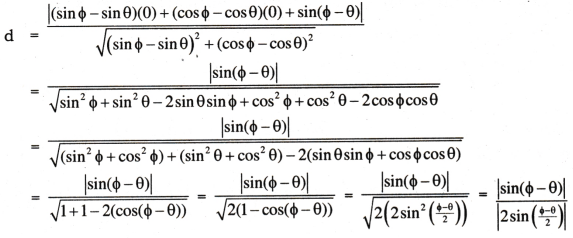
But we know that sin θ = 2(cos\(\frac{\theta}{2}\).sin\(\frac{\theta}{2}\))
Then, \(\frac{\left|2 \cos \left(\frac{\phi-\theta}{2}\right) \sin \left(\frac{\phi-\theta}{2}\right)\right|}{\left|2 \sin \left(\frac{\phi-\theta}{2}\right)\right|}=\left|\cos \left(\frac{\phi-\theta}{2}\right)\right|\)
Question 5.
Find the equation of the line parallel to Y-axis and draw through the point of intersection of the lines x – 7y + 5 = 0 and 3x + y = 0.
Solution:
The equation of any line parallel to the Y-axis is of the form x = a ………. (1)
The two given lines are x – 7y + 5 = 0 ……………(2)
3x + y = 0 ………. (3)
On solving equation (2) and (3), we obtain x = –\(\frac{5}{22}\) and y = \(\frac{15}{22}\)
Therefore, \(\left(-\frac{5}{22}, \frac{15}{22}\right)\) is the point of intersection of lines (2) and (3)
Since, line x = a passes through the point \(\left(-\frac{5}{22}, \frac{15}{22}\right)\) ⇒ a = \(-\frac{5}{22}\)
Thus, the required equation of the line is x = \(-\frac{5}{22}\)
Question 6.
Find the equation of a line drawn perpendicular to the line \(\frac{1}{2}\) = 1 through the point, where it meets the Y-axis.
Solution:
The equation of the given line is \(\frac{1}{2}\) = 1.
This equation can also be written as 3x + 2y – 12 = 0.
y = –\(\frac{3}{2}\)x + 6 which is of the form y = mx + c.
Hence, the slope of the given line is
On substituting x = 0 in the equation of the given line, we obtain \(\frac{y}{26}\) = 1 ⇒ y = 6
The given line intersects the Y-axis at (0, 6).
The equation of the line that has a slope of \(\frac{2}{3}\) and passes through the point (0, 6) is
⇒ (y – 6) = \(\frac{2}{3}\)(x – 0)
⇒ 3y – 18 = 2x
⇒ 2x – 3y + 18 = 0
Thus, the required equation of the line is 2x – 3y + 18 = 0
Question 7.
Find the length of the perpendicular drawn from the point (3, 4) to the straight line 3x – 4y + 10 = 0.
Solution:
Length of the perpendicular = \(\frac{\left|a x_1+b y_1+c\right|}{\sqrt{a^2+b^2}}=\frac{|3(3)-4(4)+10|}{\sqrt{9+16}}=\frac{3}{5}\)
Question 8.
Find the distance between the following parallel lines,
i) 3x – 4y = 12, 3x – 4y = 7
Solution:
Equations of the given lines are 3x – 4y – 12 = 0, 3x – 4y – 7 = 0
Distance between parallel lines = \(\frac{\left|c_1-c_2\right|}{\sqrt{a^2+b^2}}=\frac{|-12+7|}{\sqrt{9+16}}=\frac{5}{5}\) = 1
ii) 5x – 3y – 4 = 0, 10x – 6y – 9 = 0
Solution:
Equations of the given lines can be taken as 10x – 6y – 8 = 0, 10x – 6y – 9 = 0
Distance between parallel lines = \(\frac{\left|c_1-c_2\right|}{\sqrt{a^2+b^2}}=\frac{|-8+9|}{\sqrt{100+36}}=\frac{1}{2 \sqrt{34}}\)
Question 9.
Find the value of k, if the straight lines y – 3kx + 4 = 0 and (2k – 1) x – (8k – 1)y -6 = 0 are perpendicular.
Solution:
Equations of the given lines are -3kx + y + 4 = 0, (2k – 1) x – (8k – 1) y – 6 = 0
The lines are perpendicular.
Here ax = -3k, b1 =1, a2 = 2k – 1, b2 = -(8k – 1)
a1a2 + b1b2 = 0
⇒ -3k(2k – 1) -1 (8k -1) = 0
⇒ -6k2 + 3k – 8k + 1 = 0
⇒ 6k2 + 5k – 1 = 0
⇒ (k + 1) (6k – 1) = 0
⇒ k = -1 or k = \(\frac{1}{6}\)
Question 10.
(- 4, 5) is a vertex of a square and one of its diagonals is 7x – y + 8 = 0. Find the equation of the other diagonal.
Solution:
ABCD is a square.
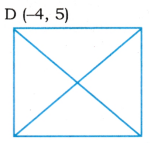
Equation of the diagonal AC is 7x – y + 8 = 0
The diagonal BD can be taken as x + 7y + k = 0
BD passes through D (- 4, 5)
-4 + 35 + k = 0 ⇒ k = -31
Equation of BD is x + 7y – 31 = 0.
II.
Question 1.
Find the area of the triangle formed by the lines y-x = 0, x + y = 0 and x – k = 0.
Solution:
The equations of the given lines are, y – x = 0 …………(1)
x + y = 0 ……….(2)
x – k = 0 ………..(3)
The point of intersecction of lines (1) and (2) is given by x = 0 and y = 0
The point of intersection of lines (2) and (3) is given by x = k and y = – k
The point of intersecction of lines (3) and (1) is given by x = k and y = k
Thus, the vertices of the triangle formed by the three given lines are (0, 0), (k, -k) and (k, k).
We know that the area of a triangle whose vertices are (x1, y1), (x2, y2) and (x3, y3) is
½|x1(y2 – y3)+ x2 (y3 – y1) + x3(y1 – y2) |
Therefore, area of the triangle formed by three given lines
= ½|0(-k – k) + k (k – 0) + k (0 + k)|
= ½|k2 + k2| = ½(2k)2 = k2
Hence, the area of the triangle is k2 square units.
Question 2.
Find the value of p so that the three lines 3x + y – 2 = 0, px + 2y – 3 = 0 and 2x – y – 3 = 0 may intersect at one point.
Solution:
The equations of the given lines are 3x + y – 2 = 0 ………(1)
px + 2y – 3 = 0 ………. (2)
2x – y – 3 = 0 ……… (3)
On solving equations (1) and (3), we obtain x = 1 and y = -1
Since these three lines may intersect at one point, the point of intersection of lines (1) and (3) will also satisfy line (2)
⇒ p (1) + 2 (-1) – 3 = 0
⇒ p – 2 – 3 = 0
⇒ p = 5
Thus, the required value of p = 5.
Question 3.
If three lines whose equations are y = m1x + c1, y = m2x + c2 and y = m3x + c3 are concurrent, then show that m1 (c2 – c3) + m2 (c3 – c1) + m3 (c1 – c2) = 0.
Solution:
The equations of the given lines are y = m1x + c1 …….. (1)
y = m2x + c2 ………. (2)
y = m3x + c3 ………. (3)
On subtracting equation (1) from (2) we obtain
(m2 – m1)x + (c2 – c1) = 0
⇒ (m1 – m2)x = (c2 – c1)
⇒ x = \(\frac{\mathrm{c}_2-\mathrm{c}_1}{\mathrm{~m}_1-\mathrm{m}_2}\)
On substituting this value of x in (1), we obtain y = m1\(\left(\frac{\mathrm{c}_2-\mathrm{c}_1}{\mathrm{~m}_1-\mathrm{m}_2}\right)\) + c1
= \(\frac{m_1 c_2-m_1 c_1}{m_1-m_2}\) + c1
= \(\frac{m_1 c_2-m_1 c_1+c_1\left(m_1-m_2\right)}{m_1-m_2}\)
= \(\frac{m_1 c_2-m_1 c_1+m_1 c_1-m_2 c_1}{m_1-m_2}\)
y = \(\frac{\mathrm{m}_1 \mathrm{c}_2-\mathrm{m}_2 \mathrm{c}_1}{\mathrm{~m}_1-\mathrm{m}_2}\)
Therefore, \(\left(\frac{\mathrm{c}_2-\mathrm{c}_1}{\mathrm{~m}_1-\mathrm{m}_2}, \frac{\mathrm{~m}_1 \mathrm{c}_2-\mathrm{m}_2 \mathrm{c}_1}{\mathrm{~m}_1-\mathrm{m}_2}\right)\) is the point of intersection of the lines (1) and (2).
It is given that lines (1), (2) and (3) are concurrent.
Hence the point of intersection of lines (1) and (2) will also satisfy equation (3).
On substituting the values of x and y in (3), we obtain
⇒ \(\frac{m_1 c_2-m_2 c_1}{m_1-m_2}\) = m3\(\left(\frac{\mathrm{c}_2-\mathrm{c}_1}{\mathrm{~m}_1-\mathrm{m}_2}\right)\) + c3
⇒ \(\frac{m_1 c_2-m_2 c_1}{m_1-m_2}=\frac{m_3 c_2-m_3 c_1+c_3 m_1-c_3 m_2}{m_1-m_2}\)
⇒ m1c2 – m2c1 – m3c1 + m3c1 – m1c3 + m2c3 = 0
⇒ m1c2 – m2c1 – m3c2 + m3c1 – m1c3 + m2c3 = 0
⇒ m1(c2 – c3) + m2 (c3 – c1) + m3 (c1 – c2) = 0
Hence, m1(c2 – c3) + m2 (c3 – c1) + m3 (c1 – c2) = 0 proved.
Question 4.
Find the equation of the lines through the points (3, 2) which make an angle of 45° with the line x – 2y = 3.
Solution:
Let the slope of the required line be m1.
The given line can be represented as y = \(\frac{1}{2}\)x – \(\frac{3}{2}\), which is of the form y = mx + c
Slope of the given line = m2 = ½
It is given that the angle between the required line and line x – 2y = 3 is 45°.
We know that if θ is the acute angle between lines l1 and l2 with the slopes m1 and m2 respectively.
Then, tan θ = \(=\left|\frac{\mathrm{m}_2-\mathrm{m}_1}{1+\mathrm{m}_1 \mathrm{~m}_2}\right|\)
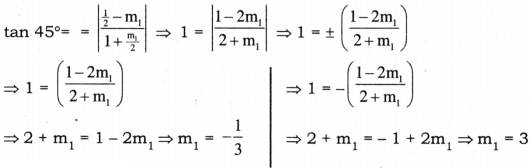
Case I: m1 = 3
The equation of the line passing through (3, 2) and having a slope of 3 is :
y – 2 = 3(x – 3)
⇒ y – 2 = 3x – 9
⇒ 3x – y = 7
Case II: m1 = –\(\frac{1}{3}\)
The equation of the line passing through (3, 2) and having a slope of –\(\frac{1}{3}\) is :
y – 2 = –\(\frac{1}{3}\)(x – 3)
⇒ 3y – 6 = -x + 3
⇒ x + 3y = 9
Question 5.
Find the equation of the line passing through the point of intersection of the lines 4x + 7y – 3 = 0 and 2x – 3y + 1 = 0 that has equal intercepts on the axes.
Solution:
Let the equation of the line having equal intercepts on the axes be
\(\frac{1}{2}\) = 1
⇒ x + y = a ……….(1)
On solving equations 4x + 7y – 3 = 0 and 2x – 3y + 1 = 0
we obtain x = \(\frac{1}{13}\) and y = \(\frac{5}{13}\)
Therefore, \(\left(\frac{1}{13}, \frac{5}{13}\right)\) is the point of intersection of the two given lines.
Since equation (1) passes through the point \(\left(\frac{1}{13}, \frac{5}{13}\right)\)
\(\frac{1}{13}+\frac{5}{13}\) = a
a = \(\frac{6}{13}\)
Equation (1) becomes x + y = \(\frac{6}{13}\)
13x + 13y = 6
Thus, the required equation of the line id 13x + 13y = 6
Question 6.
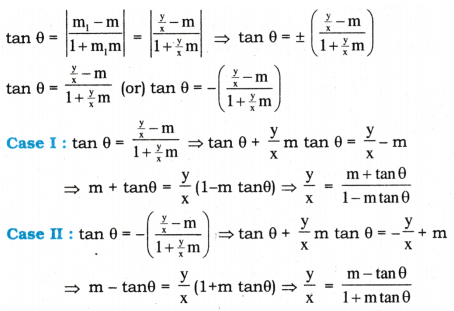
Show that the equation of the line passing through the origin and making an angle θ with the line y = mx + c, is \(\frac{y}{x}=\frac{m \pm \tan \theta}{1 \mp m \tan \theta}\)
Solution:
Let the equation of the line passing through the origin be y = m1x
If this line makes an angle of 9 with line y = mx + c, then angle is given by
Question 7.
In what ratio, the line segment joining (-1, 1) and (5, 7) is divided by the line x + y = 4 ?
Solution:
The equation of the line joining the points (-1, 1) and (5, 7) is
y – 1 = \(\frac{7-1}{5+1}\)(x + 1)
⇒ y – 1 = \(\frac{6}{6}\)(x + 1)
⇒ x – y + 2 = 0 …………….(1)
The equation of the given lines is x + y = 4 ………….(2)
The point of intersection of line (1) and (2) is x = 1 and y = 3
Let point (1, 3) divides the line segment joining (-1, 1) (5, 7) in the ratio 1 : k
Accordingly, by section formula (1, 3) = \(\left(\frac{k(-1)+1(5)}{1+k}, \frac{k(1)+1(7)}{1+k}\right)\)
⇒ (1, 3) = \(\left(\frac{-k+5}{1+k}, \frac{k+7}{1+k}\right)\)
⇒ \(\frac{-k+5}{1+k}\) = 1, \(\frac{k+7}{1+k}\) = 3
\(\frac{-k+5}{1+k}\) = 1 ⇒ -k + 5 = 1 + k
⇒ 2k = 4 ⇒ k = 2
Thus, the line joining the points (-1, 1) and (5, 7) is divided by line x + y = 4 in the ratio 1:2.
Question 8.
Find the equations of the straight lines passing through (1, 3) and (i) parallel to (ii) perpendicular to the line passing through the points (3, -5) and (-6, 1).
Solution:
A (3, -5), B(-6, 1) are the given points. mmn
Slope of the AB = \(\frac{y_1-y_2}{x_1-x_2}=\frac{-5-1}{3+6}=\frac{-6}{9}=\frac{-2}{3}\)
i) The required line is parallel to AB and passes through (1, 3).
Equation of the required line is
y – 3 = \(\frac{-2}{3}\)(x – 1)
⇒ 3y – 9 = -2x + 2
⇒ 2x + 3y – 11 = 0
ii) The required line is perpendicular to AB. Equation of required line can be taken as 3x – 2y + k = 0
This line passes through A(1, 3) ⇒ 3 – 6 + k = 0 ⇒ k = 6 – 3 = 3
∴ The required line is 3x – 2y + 3 = 0
Question 9.
Find the equation of the line perpendicular to the line 3x + 4y + 6 = 0 and making an intercept -4 on X -axis.
Solution:
Equation of the given line is 3x + 4y + 6 = 0
Equation of the line perpendicular to the given line is
4x – 3y = k ⇒ \(\frac{4 x}{k}-\frac{3 y}{k}\) = 1 ⇒ \(\frac{1}{2}\) + y = 1; x- intercept = \(\frac{k}{4}\) = -4 ⇒ k = -16
Equation of the required line is 4x – 3y = -16 ⇒ 4x – 3y + 16 = 0
Question 10.
A (-1, 1), B (5, 3) are opposite vertices of a square in the XY-plane. Find the equation of the other diagonal (not passing through A, B) of the square.
Solution:
Let ABCD be a square. A (-1, 1), B (5, 3) are opposite vertices of the square.
Slope of AB = \(\frac{1-3}{-1-5}=\frac{-2}{-6}=\frac{1}{3}\)
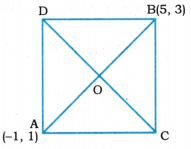
The diagonal CD is perpendicular to AB
Slope of CD = –\(\frac{1}{m}\) = -3
‘O’ is the mid point of the diagonals.
Coordinates of O are \(\left(\frac{-1+5}{2}, \frac{1+3}{2}\right)\) = (2, 2)
CD passes through O(2, 2)
Equation of CD is y – 2 = -3(x – 2)
⇒ y – 2 = -3x + 6
⇒ 3x + y – 8 = 0
Question 11.
Find the foot of the perpendicular drawn from (3, 0) upon the straight line 5x + 12y – 41 = 0.
Solution:
Equation of the line is 5x + 12y – 41 = 0, (x1, y1) = (3, 0)
If(x2, y2) is the foot of the perpendicular from (x1, y1) on the line ax + by + c = O, then
\(\frac{x_2-x_1}{a}=\frac{y_2-y_1}{b}=\frac{-\left(a x_1+b y_1+c\right)}{a^2+b^2}\)
⇒ \(\frac{x_2-3}{5}=\frac{y_2-0}{12}=-\frac{(15+0-41)}{25+144}\)
⇒ \(\frac{x_2-3}{5}=\frac{y_2}{12}=\frac{26}{169}=\frac{2}{13}\)
⇒ x2 – 3 = \(\frac{10}{13}\)
x2 = 3 + \(\frac{10}{13}=\frac{39+10}{13}=\frac{49}{13}\) and y2 = \(\frac{1}{2}\)
∴ Foot of the perpendicular = (x2, y2) = \(\left(\frac{49}{13}, \frac{24}{13}\right)\)
Question 12.
Show that the distance of the point (6, -2) from the line 4x + 3y – 12 is half the distance of the poInt (3, 4) from the line 4x – 3y = 12.
Solution:
Equation of AB is 4x + 3y – 12 = 0.
PQ Length of the perpendicular from P = \(\frac{|24-6-12|}{\sqrt{16+9}}=\frac{6}{5}\)
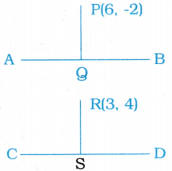
Equation of CD is 4x – 3y – 12 = 0.
RS Length of the perpendicular from R = \(\frac{|12-12-12|}{\sqrt{16+9}}=\frac{12}{5}\)
∴ PQ = \(\frac{1}{2}\)RS
III.
Question 1.
Find the distance of the line 4x + 7y + 5 = 0 from the point (1, 2) along the line 2x – y = 0.
Solution:
The given lines are 2x – y = 0 ……….. (1); 4x + 7y + 5 = 0 ……….. (2)
Let A (1, 2) is a point on the line (1) and B be the point of intersection of lines (1) and (2).
On solving equations (1) and (2), we obtain x = \(-\frac{5}{18}\) and y = \(-\frac{5}{9}\)
Coordinates of point B are \(\left(-\frac{5}{18},-\frac{5}{9}\right)\)
By using distance formula, the distance between points A and B can be obtained as
AB = \(\sqrt{\left(1+\frac{5}{18}\right)^2+\left(2+\frac{5}{9}\right)^2}=\sqrt{\left(\frac{23}{18}\right)^2+\left(\frac{23}{9}\right)^2}=\sqrt{\left(\frac{23}{9 \times 2}\right)^2+\left(\frac{23}{9}\right)^2}\)
= \(\sqrt{\left(\frac{23}{9}\right)^2\left(\frac{1}{2}\right)^2+\left(\frac{23}{9}\right)^2}=\sqrt{\left(\frac{23}{9}\right)^2\left(\frac{1}{4}+1\right)}=\frac{23}{9} \sqrt{\left(\frac{5}{4}\right)}\)
= \(\frac{23}{9} \times \frac{\sqrt{5}}{2}=\frac{23 \sqrt{5}}{18}\)
Thus, the required distance is \(\frac{23 \sqrt{5}}{18}\) units.
Question 2.
Find the direction in which a straight line must be drawn through the point (-1, 2) so that its point of intersection with the line x + y = 4 may be at a distance of 3 units from this point.
Solution:
Let y = mx + c be the line through the point (-1, 2).
Accordingly, 2 = m (-1) + c
⇒ 2 = -m + c
⇒ c = m + 2
⇒ y = mx + m + 2 …….. (1)
The given line is x + y = 4 ……… (2)
On solving equations (1) and (2), we obtain x = \(\frac{2-\mathrm{m}}{\mathrm{~m}+1}\) and y = \(\frac{5 m+2}{m+1}\)
Therefore, \(\left(\frac{2-\mathrm{m}}{\mathrm{~m}+1}, \frac{5 \mathrm{~m}+2}{\mathrm{~m}+1}\right)\) is the point of intersection of lines (1) and (2)
Since this point is at a distance of 3.units from point (-1, 2), accordingly to distance formula,
⇒ \(\sqrt{\left(\frac{2-m}{m+1}+1\right)^2+\left(\frac{5 m+2}{m+1}-2\right)^2}\) = 3
⇒ \(\left(\frac{2-m+m+1}{m+1}\right)^2+\left(\frac{5 m+2-2 m-2}{m+1}\right)^2\) = 3
⇒ \(\frac{9}{(\mathrm{~m}+1)^2}+\frac{9 \mathrm{~m}^2}{(\mathrm{~m}+1)^2}\) = 9
⇒ \(\frac{1+m^2}{(m+1)^2}\) = 1
⇒ 1 + m2 = m2 + 1 + 2m
⇒ 2m = 0
⇒ m = 0
Thus, the slope of the required line must be zero i.e., it must be parallel to the X-axis.
Question 3.
The hypotenuse of a right – angled triangle has its ends at the points (1,3) and (-4, 1). Find the equation of the legs (perpendicular sides ) of the triangle, which are parallel to the axes.
Solution:
Let ABC be the right – angled triangle, where C = 90°. Let the slope of AC = m
Hence, the slope of BC = –\(\frac{1}{m}\)
Equation of AC : y – 3 = m (x – 1) ⇒ (x – 1) = \(\frac{\mathrm{y}-3}{\mathrm{~m}}\)
Equation of BC : x + 4 = -m(y – 1)
For a given value of m, we can get these equations
For, m = 0, y – 3 = 0; x + 4 = 0,
For m = ∞, x – 1 = 0; y – 1 = 0
Question 4.
Find the image of the given points with respect to the line
(i) point (3, 8) w.r.t line x + 3y = 7
(ii) Point (1,2) w.r.t line 3x + 4y – 1 = 0
Solution:
(i) The equation of the given line is x + 3y = 7 …………(1)
Let point B (a, b) be the image of point A (3, 8).
Accordingly, line (1) is the perpendicular bisector of AB.
Slope of AB = \(\frac{b-8}{a-3}\), while the slope of the line (1) is –\(\frac{1}{3}\)
Since line (1) is perpendicular to AB
⇒ \(\left(\frac{b-8}{a-3}\right)\left(-\frac{1}{3}\right)\) = -1
⇒ \(\frac{b-8}{3 a-9}\) = 1
⇒ b – 8 = 3a – 9
⇒ 3a – b – 1 = 0
⇒ 3a – b = 1 ………….. (2)
Mid point of AB will also satisfy line (1).
Hence, from equation (1), we have
⇒ \(\frac{1}{2}\) + 3\(\frac{1}{2}\) = 7
⇒ a + 3 + 3b + 24 = 14
⇒ a + 3b = -13 ………… (3)
On solving equations (2) and (3), we obtain a = -1 and b = -4
Thus, the image of the given point with respect to the given line is (-1, -4).
ii) Let (x1, y1) = (1, 2) and line in 3x + 4y – 1 = 0
Image (h, k) of the point (x2, y2) w.r.t line ax + by + c = 0
\(\frac{h-x_1}{a}=\frac{k-y_1}{b}=\frac{-2\left(a x_1+b y_1+c\right)}{a^2+b^2}\)
⇒ \(\frac{h-1}{3}=\frac{k-2}{4}=\frac{-2(3+8-1)}{9+16}=\frac{-20}{25}=\frac{-4}{5}\)
⇒ \(\frac{h-1}{3}=\frac{-4}{5}\)
⇒ h = \(\frac{-7}{5} ; \frac{k-2}{4}=\frac{-4}{5}\)
⇒ k = \(=\frac{-6}{5}\)
∴ Image = \(\left(-\frac{7}{5}, \frac{-6}{5}\right)\)
Question 5.
If the lines y = 3x + 1 and 2y = x + 3 are equally indicated to the line y = mx + 4, find the value of m.
Solution:
The equations of the given lines are,
y = 3x + 1 ……….. (1), 2y = x + 3 …………. (2), y = mx + 4 ……….. (3)
Slope of line (1), m1 = 3;
Slope of line (2), m2 = ½;
Slope of line (3), m3 = m
It is given that lines (1) and (2) are equally inclined to line (3). This means that the given angle between lines (1) and (3) equals the angle between lines (2) and (3).
∴ \(\left|\frac{m_1-m_3}{1+m_1 m_3}\right|=\left|\frac{m_2-m_3}{1+m_2 m_3}\right|\)
⇒ \(\left|\frac{3-\mathrm{m}}{1+3 \mathrm{~m}}\right|=\left|\frac{\frac{1}{2}-\mathrm{m}}{1+\frac{1}{2} \mathrm{~m}}\right|\)
⇒ \(\left|\frac{3-\mathrm{m}}{1+3 \mathrm{~m}}\right|=\left|\frac{1-2 \mathrm{~m}}{\mathrm{~m}+2}\right|\)
⇒ \(\frac{3-m}{1+3 m}= \pm\left(\frac{1-2 m}{m+2}\right)\)
Case I :
If \(\frac{3-\mathrm{m}}{1+3 \mathrm{~m}}=\frac{1-2 \mathrm{~m}}{\mathrm{~m}+2}\)
⇒ (3 – m) (m + 2) = (1 – 2m) (1 + 3m)
⇒ -m2 + m + 6 = 1 + m – 6m2
⇒ 5m2 + 5 = 0
⇒ m2 + 1 = 0
⇒ m2 = -1
Here, m = √-1, which is not real. Hence, this case is not possible.
Case II :
If \(\frac{3-\mathrm{m}}{1+3 \mathrm{~m}}=-\left(\frac{1-2 \mathrm{~m}}{\mathrm{~m}+2}\right)\)
⇒ (3 – m)(m + 2) = -(1 – 2m)(1 + 3m)
⇒ -m2 + m + 6 = – (1 + m – 6m2)
⇒ 7m2 – 2m – 7 = 0
⇒ m = \(\frac{-2 \pm \sqrt{4-4(7)(-7)}}{2(7)}\)
⇒ m = \(\frac{-2 \pm 2 \sqrt{1+49}}{14}\)
⇒ m = \(\frac{1 \pm 5 \sqrt{2}}{7}\)
Thus, the required value of m = \(\frac{1 \pm 5 \sqrt{2}}{7}\)
Question 6.
If sum of the perpendicular distances of a variable point P (z, y) from the lines x + y – 5 = 0 and 3x – 2y + 7 = 0 is always 10. Show that P must move on a line.
Solution:
The equations of the lines are x + y – 5 = 0…………… (1)
3x – 2y + 7 = 0 …………. (2)
The perpendicular distance of P (x, y) from lines (1) and (2) are respectively given by
d1 = \(\frac{|x+y-5|}{\sqrt{(1)^2+(1)^2}}\) and d2 = \(\frac{|3 x-2 y+7|}{\sqrt{(3)^2+(-2)^2}}\)
⇒ d1 = \(\frac{|x+y-5|}{\sqrt{2}}\) and d2 = \(\frac{|3 x-2 y+7|}{\sqrt{13}}\)
It is given that d1 + d2 = 10
Therefore, \(\frac{|x+y-5|}{\sqrt{2}}+\frac{|3 x-2 y+7|}{\sqrt{13}}\) = 10
⇒ √13|x + y – 5| + √2|3x – 2y + 7| – 10\(\sqrt{26}\) = 0
Assuming x + y – 5 and 3x – 2y + 7 are positive.
⇒ √13(x + y – 5) + √2(3x – 2y + 7) – 10\(\sqrt{26}\) = 0
⇒ √13x + √13y – 5√13 + 3√2x – 2√2y + 7√2 – 10√26= 0
⇒ (√15 + 3√2)x + (√13 – 2√2)y + (7√2 -5√13 – 10√26) = 0
Since, (√13 + 3√2)x + (√13 – 2√2)y + (7√2 – 5√13 – 10√26) = 0 is the equation of line.
Similarly, we can obtain the equation of line for any signs of x + y- 5 = 0 and 3x – 2y + 7 = 0.
Thus, point P must move on a line.
Question 7.
Find equation of the line which is equidistant from parallel lines 9x + 6y – 7 = 0 and 3x + 2y + 6 = 0.
Solution:
The equations of the given lines are 9x + 6y – 7 = 0 …….. (1)
3x + 2y + 6 = 0 ………. (2)
Let P(h, k) be the arbitrary point, which is equidistant from lines (1) and (2). Then the perpendicular distance of P(h, k) from the line (1) is given by
d1 = \(\frac{|9 \mathrm{~h}+6 \mathrm{k}-7|}{\sqrt{(9)^2+(6)^2}}=\frac{|9 \mathrm{~h}+6 \mathrm{k}-7|}{\sqrt{117}}=\frac{|9 \mathrm{~h}+6 \mathrm{k}-7|}{3 \sqrt{13}}\)
And the perpendicular distance of P(h, k) from line (2) is given by
d2 = \(\frac{|3 \mathrm{~h}+2 \mathrm{k}+6|}{\sqrt{(3)^2+(2)^2}}=\frac{|3 \mathrm{~h}+2 \mathrm{k}+6|}{\sqrt{13}}\)
Since P(h, k) is equidistant from lines (1) and (2)
⇒ d1 = d2
\(\frac{1}{2}\) ⇒ |9h + 6k – 7| = 3|3h + 2k + 6|
⇒ 9h + 6k – 7 = ± 3(3h + 2k + 6)
Case I : 9h + 6k – 7 = 3(3h + 2k + 6)
⇒ 9h + 6k – 7 = 9h + 6k + 18
⇒ 25 = 0
Which is an absurd, hence this case is not possible.
Case II : 9h + 6k – 7 = -3 (3h + 2k + 6)
⇒ 9h + 6k – 7 = -9h – 6k – 18
⇒ 18h + 12k + 11 = 0
Thus, the required equation of the line is 18x + 12y + 11 = 0
Question 8.
A ray of light passing through the point (1, 2) reflects on the X-axis at point A and the reflected ray passes through the point (5, 3). FInd the coordinates of A.
Solution:
Let the coordinates of point A be (a, 0).
Draw a line, AL perpendicular to the X-axis.
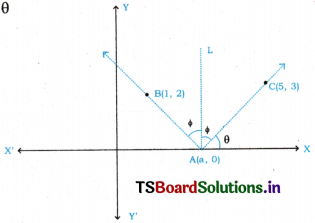
We know that angle of incidence is equal to angle of reflection.
Hence, let ∠BAL = ∠CAL = Φ and ∠CAX = θ
Now, ∠OAB = 180° – (θ + 2Φ)
= 180° [θ + 2(90° – θ)]
= 180° – (θ + 180° – 2θ)
= 180° – 180° + θ = θ.
Therefore, ∠BAX = 180° – θ
Now, Slope of line AC = \(\frac{3-0}{5-a}\)
⇒ tan θ = \(\frac{3}{5-a}\) ………. (1)
Slope of line AB = \(\frac{2-0}{1-a}\)
tan(180° – θ) = \(\frac{2}{1-a}\)
-tan θ = \(\frac{2}{1-a}\)
tan θ = \(\frac{-2}{1-a}\) ….. (2)
From equations (1) and (2), we obtain
⇒ \(\frac{1}{2}\)
⇒ 3a = -3 = -10 + 2a
⇒ a = \(\frac{13}{5}\)
Thus, the coordinates of point A are (\(\frac{13}{5}\), 0)
Question 9.
Prove that the product of the lengths of the perpendiculars drawn from the points (\(\sqrt{a^2-b^2}\), 0) and (\(-\sqrt{a^2-b^2}\), 0) to the line \(\frac{x}{a}\) cos θ + \(\frac{y}{b}\) sin θ = 1 is b2.
Solution:
The equation of the given line is \(\frac{x}{a}\) cos θ + \(\frac{y}{b}\) sin θ = 1
bx cos θ + ay sin θ – ab = 0 …………… (1)
Length of the perpendicular from point (\(\sqrt{a^2-b^2}\), 0) to the line (1) is
p1 = \(\frac{\left|b \cos \theta\left(\sqrt{a^2-b^2}\right)+a \sin \theta(0)-a b\right|}{\sqrt{b^2 \cos ^2 \theta+a^2 \sin ^2 \theta}}=\frac{\left|b \cos \theta\left(\sqrt{a^2-b^2}\right)-a b\right|}{\sqrt{b^2 \cos ^2 \theta+a^2 \sin ^2 \theta}}\) ……………… (2)
Length of the perpendicular from point (\(-\sqrt{a^2-b^2}\), 0) to the line (2) is
p2 = \(\frac{\left|b \cos \theta\left(-\sqrt{a^2-b^2}\right)+a \sin \theta(0)-a b\right|}{\sqrt{b^2 \cos ^2 \theta+a^2 \sin ^2 \theta}}=\frac{\left|b \cos \theta\left(-\sqrt{a^2-b^2}\right)-a b\right|}{\sqrt{b^2 \cos ^2 \theta+a^2 \sin ^2 \theta}}\)
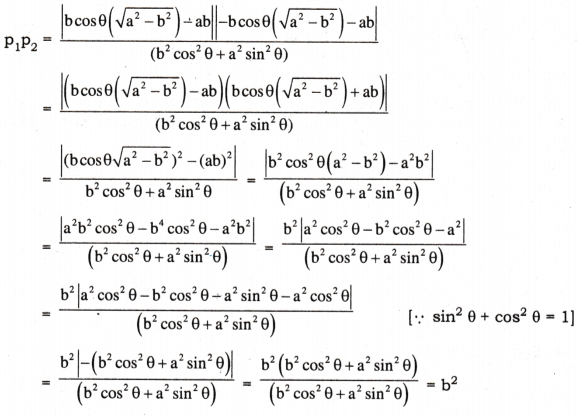
On multiplying equation (2) and (3), we obtain
Question 10.
A person standing at the junction (crossing) of two straight paths represented by the equations 2x – 3y + 4 = 0 and 3x + 4y – 5 = 0 wants to reach the path whose equation is 6x – 7y + 8 = 0 in the least time. Find equation of the path that he should follow.
Solution:
The equations of the given lines are 2x – 3y + 4 = 0 ………… (1)
3x + 4y – 5 = 0 …………….. (2)
6x – 7y + 8 = 0 …………. (3)
The person is standing at the junction of the paths represented by lines (1) and (2).
On solving equations (1) and (2), we obtain x = –\(\frac{1}{17}\) and y = \(\frac{22}{17}\).
Thus, the person is standing at point \(\left(-\frac{1}{17}, \frac{22}{17}\right)\).
The person can reach path (3) in the least time if he walks along the perpendicular line to (3) from point \(\left(-\frac{1}{17}, \frac{22}{17}\right)\)
Now, slope of the line (3) = \(\frac{6}{7}\)
Slope of the line perpendicular to line (3) = \(-\left(\frac{1}{\frac{6}{7}}\right)=-\frac{7}{6}\) and having a slope of \(\frac{-7}{6}\) is given by
(y – \(\frac{22}{17}\)) = –\(\frac{7}{6}\) (x + \(\frac{1}{17}\))
⇒ 6(17y – 22) = -7(17x + 1)
⇒ 102y – 132 = -119x – 7
⇒ 119x + 102y = 125
Hence, the path that the person should follow us 119x + 102y = 125.
Question 11.
Show that the lines x – 7y – 22 = 0, 3x + 4y + 9 = 0 and 7x + y – 54 = 0 form a right angled isosceles triangle.
Solution:
The equations of the straight lines are
x – 7y – 22 = 0 ………… (1)
3x + 4y + 9 = 0 ……….. (2)
7x + y – 54 = 0 ………. (3)
Let A be the angle between (1) & (2)
cos A = \(\frac{\left|a_1 a_2+b_1 b_2\right|}{\sqrt{a_1^2+b_1^2} \sqrt{a_2^2+b_2^2}}=\frac{|3-28|}{\sqrt{1+49} \sqrt{9+16}}\)
= \(\frac{25}{5 \sqrt{2} .5}=\frac{25}{25 \sqrt{2}}=\frac{1}{\sqrt{2}}\)
⇒ A = 45°
Let B be the angle between (2) & (3)
cos B = \(\frac{21+4}{\sqrt{9+16} \sqrt{49+1}}=\frac{25}{25 \sqrt{2}}=\frac{1}{\sqrt{2}}\)
⇒ B = 45°
Let C be the angle between (3) & (1)
cos C = \(\frac{7-7}{\sqrt{1+49} \sqrt{49+1}}\) = 0
⇒ C = 90°
Since ∠A = ∠B = 45° and ∠C = 90°
Therefore, given lines form a right angled isosceles triangle.
Question 12.
Find the equation of the straight line passing through the point (-3, 2) and making an angle of 45° with the straight line 3x – y + 4 = 0.
Solution:
Let the slope of the required line be m1.
Given line is 3x – y + 4 = 0, slope m2 = 3.
If 0 is the angle between them ⇒ tan θ = \(\left|\frac{\mathrm{m}_1-\mathrm{m}_2}{1+\mathrm{m}_1 \mathrm{~m}_2}\right|\)
⇒ tan 45 = \(\left|\frac{m_1-3}{1+3 m_1}\right|\)
⇒ 1 = \(\frac{m_1-3}{1+3 m_1}\)
⇒ ± 1 = \(\frac{m_1-3}{1+3 m_1}\)
⇒ 1 + 3m1 = m1 – 3
⇒ 2m1 = -4
m1 = -2 (or)
⇒ -(1 + 3m1) = m1 – 3
⇒ -1 – 3m1 = m1 – 3
⇒ 2 = 4m1
⇒ m1 = ½
The equation of line passing through (-3, 2) with slope m1 = -2 is
y – y1 = m(x – x1)
⇒ y – 2 = -2(x + 3)
⇒ y – 2 = -2x – 6
⇒ 2x + y + 4 = 0
The equation of line passing through (-3, 2) with slope m = -½ is
y – 2 = \(\frac{1}{2}\) (x + 3)
⇒ 2y – 4 = x+ 3
⇒ x – 2y + 7 = 0