
Referring to the AP Inter 1st Year Maths Study Material Chapter 7 Binomial Theorem Exercise 7a Solutions makes it easier to understand complex problems.
AP Inter 1st Year Maths Binomial Theorem Solutions Exercise 7a
I. Expand each of the expressions in Exercises 1 to 8.
Question 1.
(1 – 2x)5
Solution:
By using Binomial theorem, the expression (1 – 2x)5 can be expanded as
5C0(1)5(-2x)0 + 5C1(1)4(-2x)1 + 5C2 (1)3 (-2x)2 + 5C3(1)2(-2x)3 + 5C4(1)1 (-2x)4 + 5C5(1)° (-2x)5
= 1 – 5(2x) + 10(4x2) – 10(8x3) + 5(16x4) – (32x5)
= 1 – 10x + 40x2 – 80x3 + 80x4 – 32x5.
Question 2.
\(\left(\frac{2}{x}-\frac{x}{2}\right)^5\)
Solution:
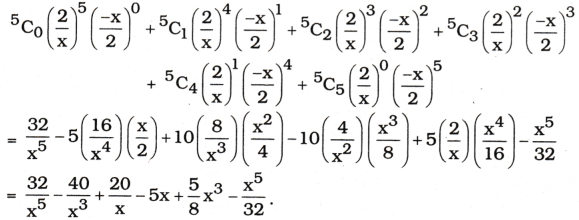
By using Binomial theorem, the expression \(\left(\frac{2}{x}-\frac{x}{2}\right)^5\) can be expanded as
Question 3.
(2x – 3)6
Solution:
By using Binomial theorem, the expression (2x – 3)6 can be expanded as 6C0 (2x)6 (-3)° + 6C1 (2x)5 (-3)1 + 6C2 (2x)4 (-3)2 + 6C3 (2x)3 (-3)3 + 6C4 (2x)2 (-3)4 + 6C5 (2x)1 (-3)5 + 6C6 (2x)0 (-3)6
= 64x6 – 6(32x5) (3) + 15(16x4)(9) – 20(8x3)(27) + 15(4x2)(81) – 6(2x)(243) + 729
= 64x6 – 576x5 + 2160x4 – 4320x3 + 4860x2 – 2916x + 729
Question 4.
\(\left(\frac{x}{3}+\frac{1}{x}\right)^5\)
Solution:
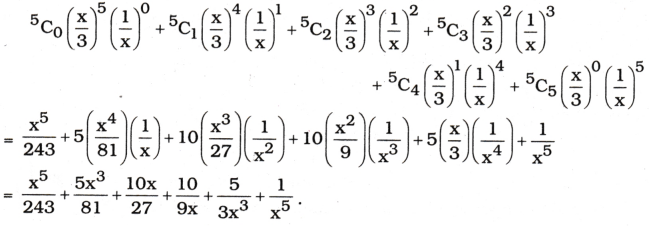
By using Binomial theorem, the expression \(\left(\frac{x}{3}+\frac{1}{x}\right)^5\) can be expanded as
Question 5.
\(\left(x+\frac{1}{x}\right)^6\)
Solution:
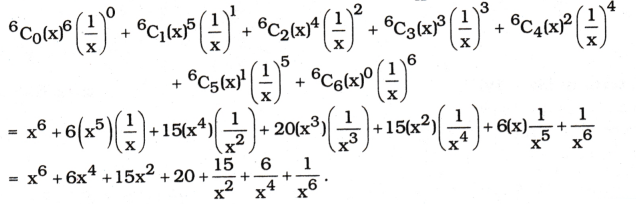
By using Binomial theorem, the expression \(\left(x+\frac{1}{x}\right)^6\) can be expanded as

Question 6.
(4x + 5y)7
Solution:
By using Binomial theorem,
(4x + 5y)7 = 7C0 (4x)7 (5y)0 + 7C1 (4x)6 (5y)1 + 7C2 (4x)5 (5y)2 + 7C3 (4x)4 (5y)3 + 7C4 (4x)3 (5y)4 + 7C5 (4x)2 (5y)5 + 7C6 (4x)1 (5y)6 + 7C7 (4x)° (5y)7
= \(\sum_{r=0}^7\) 7Cr (4x)7-r (5y)r
Question 7.
\(\left(\frac{2}{3} x+\frac{7}{4} y\right)^5\)
Solution:
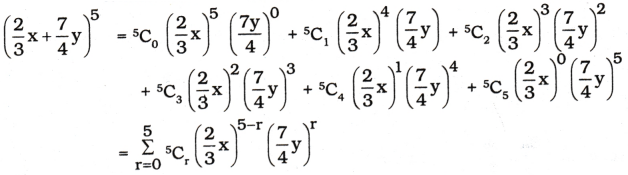
By using Binomial theorem, we have
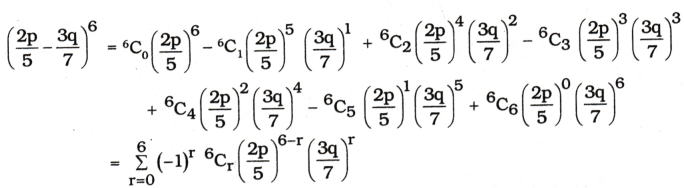
Question 8.
\(\left(\frac{2 p}{5}-\frac{3 q}{7}\right)^6\)
Solution:
Question 9.
Write down and simplify.
i) 6th term in \(\left(\frac{2 x}{3}+\frac{3 y}{2}\right)^9\)
Solution:
Given that \(\left(\frac{2 x}{3}+\frac{3 y}{2}\right)^9\)
The general term in \(\left(\frac{2 x}{3}+\frac{3 y}{2}\right)^9\) is
Tr+1 = 9Cr \(\left(\frac{2 x}{3}\right)^{9-r}\left(\frac{3 y}{2}\right)^r\)
If r = 5
T6 = 9C5\(\frac{1}{2}\)
= 9C5\(\frac{1}{2}\)
= 9C4\(\frac{1}{2}\) x4y5
= \(\frac{1}{2}\). x4y5
= 189 x4y5
ii) 7th term in (3x – 4y)10.
Solution:
Given that (3x – 4y)10
The general term in (3x – 4y)10 is Tr+1 = (-1)r 10Cr (3x)10-r (4y)r
If r = 6 ⇒ T7 = (-1)6 10C6 (3x)4 (4y)6
= 2C43446x4y6
= \(\frac{10 \times 9 \times 8 \times 7}{1 \times 2 \times 3 \times 4}\). 34.46. x4. y6
= 280 (12)5x4y6 (∵ nCr = nCn-r)
iii) 10th term in \(\left(\frac{3 p}{4}-5 q\right)^{14}\)
Solution:
Given that \(\left(\frac{3 p}{4}-5 q\right)^{14}\)
The general term in \(\left(\frac{3 p}{4}-5 q\right)^{14}\) is Tr+1 = (-1)r 14Cr \(\left(\frac{3 \mathrm{p}}{4}\right)^{14-\mathrm{r}}\) (5q)r
If r = 9
T10 = (-1)9 14C9\(\left(\frac{3 p}{4}\right)^5\) (5q)9
= – 14C5\(\left(\frac{3}{4}\right)^5\) 59.p5.q9 (∵ nCr = nCn-r)
= \(-\frac{14 \times 13 \times 12 \times 11 \times 10}{1 \times 2 \times 3 \times 4 \times 5} \cdot \frac{3^5}{4^5}\).59.p5.q9
= \(\frac{-(2002) 3^5 \cdot 5^9}{4^5}\)p5.q9
iv) rth term in \(\left(\frac{3 a}{5}+\frac{5 b}{7}\right)^8\) (1 ≤ r ≤ 8)
Solution:
Given that \(\left(\frac{3 a}{5}+\frac{5 b}{7}\right)^8\)
The general term in \(\left(\frac{3 a}{5}+\frac{5 b}{7}\right)^8\) is Tr+1 = 8Cr \(\left(\frac{3 a}{5}\right)^{8-r}\left(\frac{5 b}{7}\right)^r\)
Replace r by r – 1, then
Tr = 8C(r-1)\(\left(\frac{3 a}{5}\right)^{8-r+1}\left(\frac{5 b}{7}\right)^{r-1}\)
= 8C(r-1)\(\left(\frac{3 a}{5}\right)^{9-r}\left(\frac{5 b}{7}\right)^{r-1}\) (1 ≤ r ≤ 8)
v) Middle term in \(\left(3-\frac{x^3}{6}\right)^7\)
Solution:
Given that \(\left(3-\frac{x^3}{6}\right)^7\)
The expression contains 8 terms. Thus T4 and T5 are middle terms.
T4 = T3+1 = 7C3 (3)7-3\(\left(-\frac{x^3}{6}\right)^3=\frac{35 \times 3^4(-x)^9}{6^3}=-\frac{105}{8}\)x9.
T5 = T4+1 = 7C4 (3)7-4\(\left(-\frac{x^3}{6}\right)^4=\frac{35 \times 3^3 x^{12}}{6^4}=\frac{35}{48}\)x12
Thus, the middle terms in the expansion of \(\left(3-\frac{x^3}{6}\right)^7\) are \(-\frac{105}{8}\) x9 and \(\frac{35}{48}\)x12
vi) Middle term in \(\left(\frac{x}{3}+9 y\right)^{10}\)
Solution:
Given that \(\left(\frac{x}{3}+9 y\right)^{10}\)
The number of terms in the given expansion is 11. Thus T6 is the middle term.
T6 = T5+1 = 10C5 \(\frac{1}{2}\) (9y)5
= \(\frac{1}{2}\) 310.x5y5
= 252 × 35 x5.y5
= 61236 x5y5
vii) 4th term in (x – 2y)12
Solution:
Given that (x – 2y)12
General term in the expansion of (x + y)n is Tr+ x = nCr Xn_r (Y)r
Here, X = x, Y = -2y, and n = 12; Tr+1 = 12Cr (x)12-r (-2y)r
Putting r = 3, ,
T3+1 = 12C3x12-3 (-2y)3
T4 = \(\frac{12 \times 11 \times 10}{6}\) x9(-2)3y3
= 2 × 11 × 10x9(-8)y3
= 220 × (-8)x9y3
= -1760 x9y3
viii) 13th term in \(\left(9 x-\frac{1}{3 \sqrt{x}}\right)^{18}\), x ≠ 0
Solution:
The general term in the expansion of (X + Y)n is Tr+1 = nCr Xn-rYr
Here X = 9x, Y = –\(\frac{1}{3 \sqrt{x}}\), and n = 18
The General term in the expansion of \(\frac{1}{2}\) is Tr = 18Cr (9x)18-r\(\left(\frac{-1}{3 \sqrt{x}}\right)^r\)
Putting r = 12
T12+1 = 18C12 (9x)6 \(\left(\frac{-1}{3 \sqrt{x}}\right)^{12}\)
= 18C12 96 × x6\(\frac{1}{3^{12}(\sqrt{x})^{12}}\) (∵ nCr = nCn-r)
= \(\frac{18 \times 17 \times 16 \times 15 \times 14 \times 13}{6 \times 5 \times 4 \times 3 \times 2 \times 1} \times \frac{3^{12} \times x^6}{3^{12} \times x^6}\)
= 18564
Question 10.
Find the number of terms in the expansion of
i) \(\left(\frac{3 a}{4}+\frac{b}{2}\right)^9\)
Solution:
The number of terms in (x + a)n is (n + 1), where n is a positive integer.
Hence number of terms in \(\left(\frac{3 a}{4}+\frac{b}{2}\right)^9\) are 9 + 1 = 10
ii) (3p + 4q)14
Solution:
The number of terms in (x + a)n is (n + 1), where n is a positive integer.
Hence number of terms in (3p + 4q)14 are 14 + 1 = 15
II. Using binomial theorem, evaluate each of the following.
Question 1.
(96)3
Solution:
96 can be expressed as the sum or difference of two numbers whose powers are easier to calculate and then, Binomial theorem can be applied, it can be written that, 96 = 100 – 4
Therefore, (96)3 = (100 – 4)3
= 3C0 (100)3 (-4)0 + 3C1 (100)2 (-4)1 + 3C2 (100)1 (-4)2 + 3C3 (100)° (-4)3
= (100)3 – 3(100)2(4) + 3(100)(4)2 – (4)3
= 1000000 – 120000 + 4800 – 64
= 884736
Question 2.
(102)5
Solution:
102 can be expressed as the sum or difference of two numbers whose powers are
easier to calculate and then, Binomial theorem can be applied.
It can be written that, 102 = 100 + 2.
Therefore, (102)5 = (100 + 2)5
= 5C0 (100)5 (2)° + 5C1 (100)4 (2)1 + 5C2 (100)3 (2)2 + 5C3 (100)2 (2)3 + 5C4 (100)1 (2)4 + 5C5 (100)° (2)5
= (100)5 + 5(100)4 (2) + 10(100)3(2)2 + 10(100)2(2)3 + 5(100) × (2)4 + (2)5
= 10000000000 + 1000000000 + 40000000 + 800000 + 8000 + 32
= 11040808032
Question 3.
(101)4
Solution:
101 can be expressed as the sum or difference of two numbers whose powers are easier to calculate and then, Binomial theorem can be applied.
It can be written that, 101 = 100+ 1.
(101)4 = (100 + 1)4 = 4C0 (100)4(1)°+ 4C1 (100)3 (1)1 + 4C2 (100)2 (1)2 + 4C3 (100)1 (1)3 + 4C4 (100)° (1)4
= (100)4 + 4(100)3 + 6(100)2 + 4(100)1 + 1
= 100000000 + 4000000 + 60000 + 400 + 1
= 104060401
Question 4.
(99)5
Solution:
99 can be written as the sum or difference of two numbers whose powers are easier to calculate and then, Binomial theorem can be applied.
It can be written that 99 = 100 – 1
=> (99)5 = (100 – 1)5
= 5C0(100)5(-1)° + 5C1(100)4(-1)1 + 5C2(100)3(-1)2 + 5C3(100)2(-1)3 + 5C4(100)1(-1)4 + 5C5(100)°(-1)5
= (100)5 – 5(100)4 + 10(100)3 – 10(100)2 + 5(100) – 1
= 10000000000 – 500000000 + 10000000 – 100000 + 500 – 1
= 10010000500 – 500100001
= 9509900499
Question 5.
Using Binomial theorem, indicate which number is larger (1.1)10000 0r 1000.
Solution:
By splitting 1.1 and then applying Binomial theorem, the first few terms of (1.1)10000 can be obtained as (1.1)10000
= (1 + 0.1)10000
= 10000C0 + 10000C1(0.1)1 + other positive terms
= 1 + 10000 × 0.1 + other positive terms
= 1001 + other positive terms > 1000
Hence, (1.1)10000 > 1000
Question 6.
Find (a + b)4 – (a – b)4, hence evaluate (√3 + √2)4 – (√3 – √2)4
Solution:
Using Binomial theorem, the expression, (a + b)4 – (a – b)4, can be expanded as (a + b)4 – (a – b)4
= 4C0a4b° + 4C1b1 + 4C2a2b2 + 4C3b3 + 4C4a°b4 – [4C0a4b° – 4C1a3b1 + 4C2a2b2 – 4C3a1b3 + 4C4a°b4]
= 2[4C1a3b1 + 4C3a1b3]
= 2[4a3b + 4ab3]
= 8ab(a2 + b2)
Now putting a = √3 and b = √2 , we have
(√3 + √2)4 – (√3 – √2)4 = 8(√3)(√2) [(√3)2 +(√2)2]
= 8√6(3 + 2)
= 40√6
Question 7.
Find (x + 1)6 + (x – 1)6. Hence or otherwise evaluate (√2 + 1) + (√2 – 1)
Solution:
Using Binomial theorem, the expression, (x + 1)6 + (x – 1)6, can be expanded as (x + 1)6 + (x – 1)6
= 6C0x610 + 6C1511 + 6C2x412 + 6C3x313 + 6C4x214 + 6C5x115 + 6C6x°16 + 6C0x61°- 6C1x511 + 6C2x412 – 6C3x313 + 6C4x214 – 6C5x115 + 6C6x°16
= 2[6C0x6 + 6C2x4 + 6C4x2 + 6C6x0]
= 2(x6 + 15x4 + 15x2 + 1)
Now putting x = √2 , we have (√2)6 + (√2)6
= 2[(√2)6 + 15(√2)4 + 15(√2)2 + 1]
= 2(8 + 60 + 30 + 1)
= 198
Question 8.
Show that 9n +1 – 8n – 9 is divisible by 64, whenever n is a positive integer.
Solution:
Using Binomial theorem,
(1 + x)n+1 = n+1C0 x° + n+1C1 x1 + n+1C2 x2 + …………. + n+1Cn+1 xn+1
Now putting x = 8, we have
(1+8)n+1 = n+1C0 8° + n+1C1 81 + n+1C2 82 + n+1Cn+1 8n+1
⇒ 9n+1 = 1 + (n + 1)(8) + 82[n+1C2 + …….. + n+1Cn+1 8n-1]
⇒ 9n+1 – 1 – 8(n+1) = 64[n+1C2 + + n+1Cn+1 8n-1]
⇒ 9n+1 – 8n – 9 = 64 [n+1C2 + …. + n+1Cn+1 8n-1]
Now, RHS is divisible by 64 for all positive integers n. So, LHS is also divisible by 64. Hence, 9n+1 – 8n – 9 is divisible by 64, whenever n is a positive interger.
Question 9.
Prove that \(\sum_{r=0}^n\)3rnCr = 4n.
Solution:
LHS = \(\sum_{r=0}^n\)3rnCr = 30nC0 + 31nC1 + 32nC2 + …………… 3n-1 nCn-1 + nCn+1. 3n
= nC0 3° + nC1 31 + nC2 32 + …. + 3n-1 + nCn.3n
= (1 + 3)n = 4n = RHS
Question 10.
Using the binomial theorem, prove that 50” – 49n – 1 is divisible by 492 for all positive integers n.
Solution:
Given 50n – 49n – 1 = (49 + 1)n – 49n – 1
= nC0(49)n + nC1(49)n-1 + nC2(49)n-2 + … + nCn 2(49)2 + nCn-1(49) + nCn(49)° – 49n – 1
= (49)n + nC1(49)n-1 + nC2(49)n-2 + … + nCn-2(49)2 + (n) (49) + 1 – 49n – 1
= (49)2 [(49)n-2 + nC2 (49)n-3 + nC2(49)n-4 + … + nCn-2]
= (49)2 [a positive integer]
∴ 50n – 49n – 1 is divisible by 492 for all positive integers of n.