Regular practice with AP Inter 1st Year Accounts Study Material Chapter 8 Cash Book Questions and Answers helps students stay prepared for examinations.
AP Inter 1st Year Accountancy 8th Lesson Cash Book Questions and Answers
I. Fill in the blanks
Question 1.
…….. is the ‘Book of Prime entry’ (or) ‘Book of original Entry’.
Answer:
Cash Book
Question 2.
…….. book plays a dual role as a Journal as well as a Ledger.
Answer:
Cash
Question 3.
In the Cash Book, cash receipts are recorded on the …… side
Answer:
Debit
Question 4.
In Cash Book, cash payments are recorded on the ……. side.
Answer:
Credit
Question 5.
A single- column Cash Book is also known as a …….
Answer:
simple Cash Book
Question 6.
A double-column Cash Book is also known as a ……. Cash Book.
Answer:
Two column
Question 7.
…… is an incentive given by the creditor to the Debtor for prompt payment.
Answer:
Discount
Question 8.
The discount given by the seller to the buyer is known as the ……. discount.
Answer:
Trade

Question 9.
……….. should not be recorded in the books of accounts.
Answer:
Trade discounts
Question 10.
Discount given for prompt and early payment is called a ……. discount.
Answer:
cash
Question 11.
The discount allowed is shown on the …….. side of the Cash Book.
Answer:
debit
Question 12.
The discount received is shown on the ….. side of the Cash Book.
Answer:
credit
Question 13.
Opening Bank balance (overdraft) should be recorded on the ……. of Bank column in the triple column Cash Book. Answer:
credit side
Question 14.
An entry that appears on both sides of the Three Column Cash Book is called ……..
Answer:
contra entry
Question 15.
Sales through credit cards or Debit cards are equivalent to ……..
Answer:
cash sales
Question 16.
The Cash Book which is maintained to record all petty (small) expenses is called a ……..
Answer:
petty cash book
Question 17.
The petty Cash Book is maintained by a ………
Answer:
petty cashier
Question 18.
The system in which an estimated amount for petty expenses is determined and handed over in advance to the petty cashier is called the ………..
Answer:
imprest system
II. Very Short Answer Type Questions
Question 1.
Cash Discount
Answer:
It is given for prompt and early payment. If a debtor pays the amount to the creditor on or before the due date, he may receive discount in the form of cash. It is known as cash discount. It is discount received for the debtor and discount allowed for the creditor. The discount column is maintained on both sides of the cash book.
Question 2.
Discount Allowed.
Answer:
Discount given or allowed by the creditor is known as discount allowed. It is a loss for the creditor. This was allowed to the debtor for prompt payment.
Question 3.
Discount Received.
Answer:
If a debtor pays the amount on or before the due date, he may receive discount in the form of cash. It is gain for the debtor. It is called discount received.
Question 4.
Contra entry
Answer:
The transaction which is recorded on both sides of Triple column cash book i.e. Cash and Bank on the opposite sides is called contra entry. Contra means opposite side. It should be denoted by “C” in the L.F column on both sides of Triple Column Cash Book.
Question 5.
Imprest System
Answer:
In this system petty cash payments for a period is estimated and that amount is given to the petty cashier as advance. The cashier makes payments from this amount and records them in petty cash book. At the end of a particular period the petty cashier submits petty cash book to the Head Cashier. The Head Cashier scrutinizes the petty payments and issues a fresh cheque equal to the amount of petty expenses paid. This system of book keeping is called Imprest System.
Question 6.
Overdraft
Answer:
When withdrawals exceed deposits, cash book bank column shows credit balance and the pass book shows debit balance. It is called unfavourable or overdraft balance. lt should be posted on the credit side of the bank column by writing “By Balance b/d”.
III. Short Answer Type Questions
Question 1.
Explain the advantages of cash book.
Answer:
Advantages of Cash Book :
- It helps to know the amount of cash received and the amount of cash paid by the Business Unit.
- It gives the Cash and Bank balances of a business unit at any given period.
- Mistakes or Fraud can be detected by verifying the closing balance of cash book with the actual amount of cash in hand.
- As cash book acts as Cash A/c, preparation of a separate Cash A/c (ledger) is not required.
Question 2.
Give the characteristics of cash book.
Answer:
Characteristics of Cash Book :
- Cash book is a Subsidiary Book.
- It records only Cash Transactions.
- Cash book serves as Cash Account.
- It records cash receipts on the debit side and cash payments on the credit side.
- Cash book will show Debit Balance only.
IV. Essay Type Questions
Question 1.
Describe the meaning and importance of cash book.
Answer:
Among the entire subsidiary books cash book is one of the important books. In this book we record cash receipts and cash payments. The main objective of cash book is to know the balance of cash at any given time. The person who maintains cash book is known as cashier. Business transactions are mainly two kinds.
- Cash Transactions
- Credit Transactions
All cash transactions are two types :
- Cash receipts
- Cash payments
Cash receipts should be recorded on debit side and cash payments are on the credit side. Generally cash book shows debit balance, because a business unit cannot pay more than its receipts.
Question 2.
Briefly explain the different types of cash books.
Answer:
The form of the cash book depends on the need, nature and scope of activities of a business firm. They are as follows :
1) Simple cash book
2) Double column cash book
i) With cash and discount columns
ii) With bank and discount columns
3) Triple column cash book
4) Analytical petty cash book
1) Simple Cash Book : The simple cash book is maintained by small business concern. Only cash transactions are recorded in this book. Cash receipts are to be recorded on the debit side and cash payments are on credit side. After entering all the transactions, the balance is ascertained like other accounts.
2) Double Column Cash Book :
a) Cash Book with Cash and Discount Columns : The transactions pertaining to cash and cash discounts are also recorded. To record the discount involved in any transactions one additional column on both sides of the cash book is provided. Discount column on the debit side should be named as discount allowed, and on the credit side discount received. They should not be balanced.
b) Cash Book with Bank and Discount Columns : Modern business organisations carry their transactions in the form of cheques through banks. The receipts and payments of the business are made through cheques. They maintain bank column in the cash book. The traders deposit money and cheques into bank account and make payments by cheques. The traders’ deposit through bank is having advantages of safety and convenience.
3) Triple Column Cash Book : This book also known as cash book with cash discount and bank columns; It contains three columns on both the sides. Three column cash book is used by big trading organisations, to record large number of cash and bank transactions of different nature.
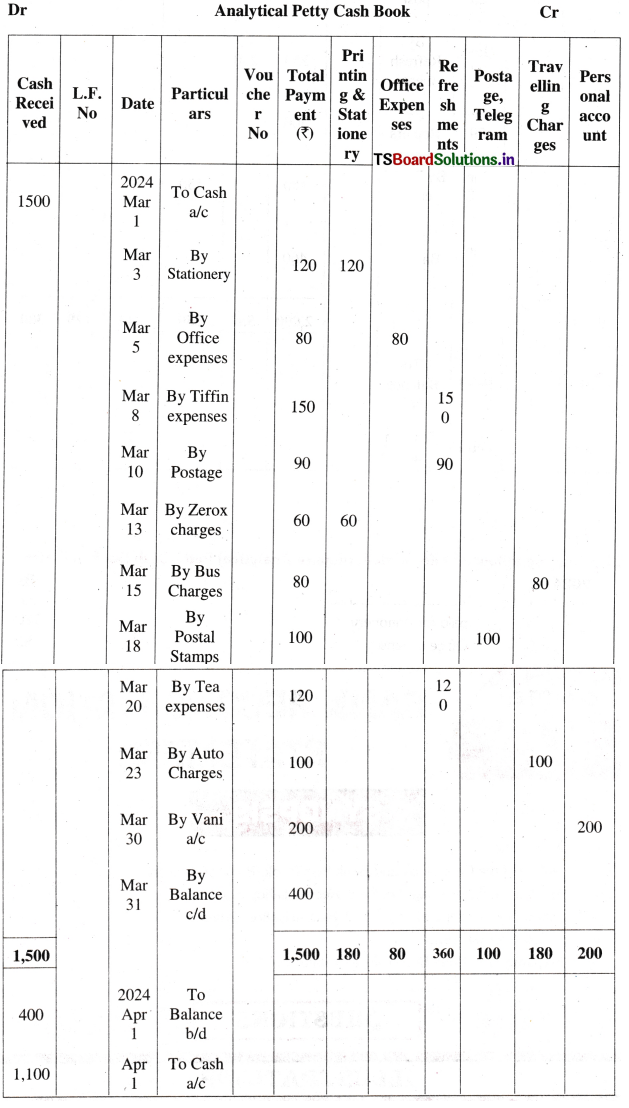
4) Analytical Petty Cash Book : In large scale business organisation cash is paid and received through banks, but every day the organisation has to pay various small payments. It is not possible to pay small payments through cheques and enter in the cash book. Hence all petty payments of the business are recorded in a separate cash book which is called a Petty Cash Book.
Question 3.
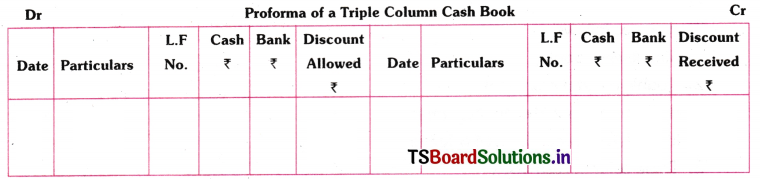
Write the importance of Triple column cash book and draw its proforma.
Answer:
Triple column cash book contains three columns on both sides (debit and credit) in addition to date, particulars and L.F columns. Three column cash book is very useful to the big trading organisations for the following reasons.
- It helps to record cash Receipts and also Receipts through cheques.
- It is useful to record Cash Payments and also Payments by Cheques.
- It helps to record large number of cash and bank transactions of different nature.
- It is useful to record Contra Entries.
Question 4.
Explain the important points to be followed in the preparation of three column cash book.
Answer:
The following points are to be noted carefully while preparing three column cash book.
- Opening cash and bank balances are recorded on the debit side of the cash and bank column as “To Balance b/d” in the particulars column.
- If the overdraft is given as opening bank balance, it should be recorded on the credit side of Bank column.
- All cash receipts should be recorded on the debit side cash column and cash payments are recorded in the cash column on thq credit side.
- If any cheque is received from customers and if it was not deposited in the bank on the same day, it should be debited to cash column.
- If cheque is received and sent to bank on the same day, it should be debited to bank column.
- Any payment made through cheque, should be credited to bank column on the credit side.
- If discount amounts are involved either in cash or in bank transactions, discount allowed should be recorded on the debit side and discount received should be recorded on the credit side in the discount column.
- If the cheques sent to bank for collection are dishonoured, it should be recorded in the bank column on debit side.
- The transaction which is passed on both sides of the cash book is called ‘Contra Entry’. While opening bank a/c, cash deposited in bank, cash withdrawn from bank for personal use and cheque received on one day but deposited on another day. Contra entries will appear on both sides. It is denoted by “C”.
Problems
Question 1.
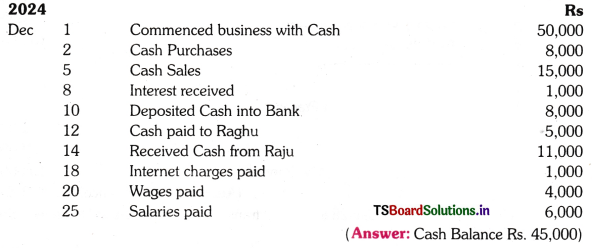
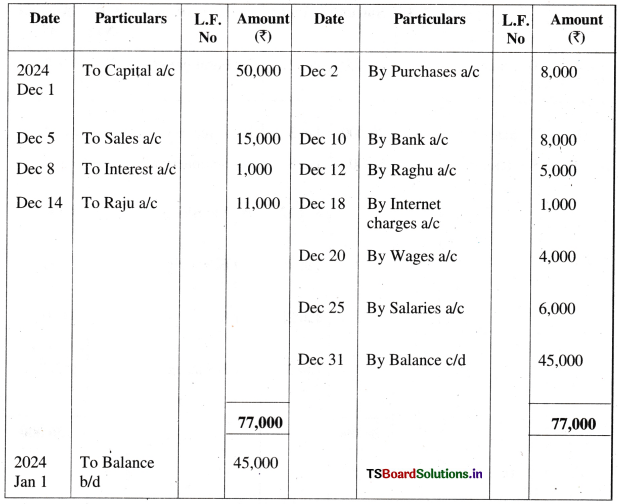
Prepare simple Cash Book of Nanda as on 31-12-2024
Solution:
Question 2.
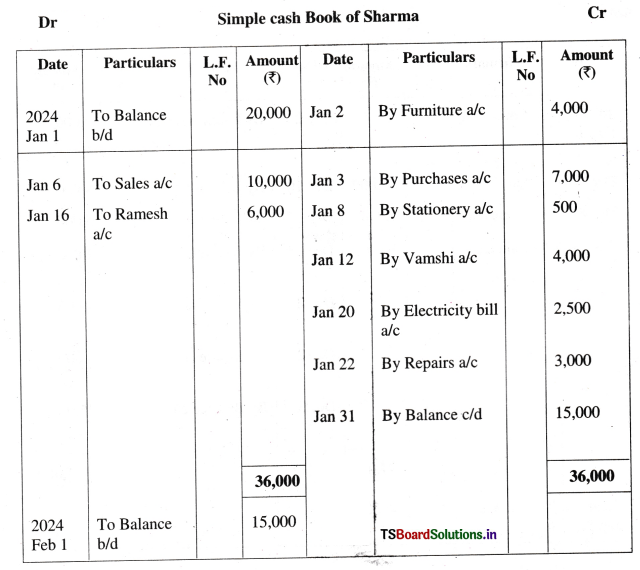
Record the following transactions in the Books of Sharma
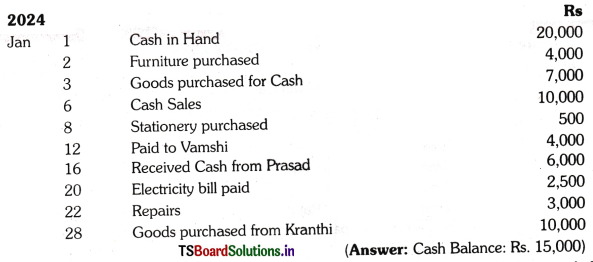
(Hint: Transaction on Jan 28 is a Credit transaction. Hence it is not to be recorded in the Cash Book)
Solution:
Question 3.
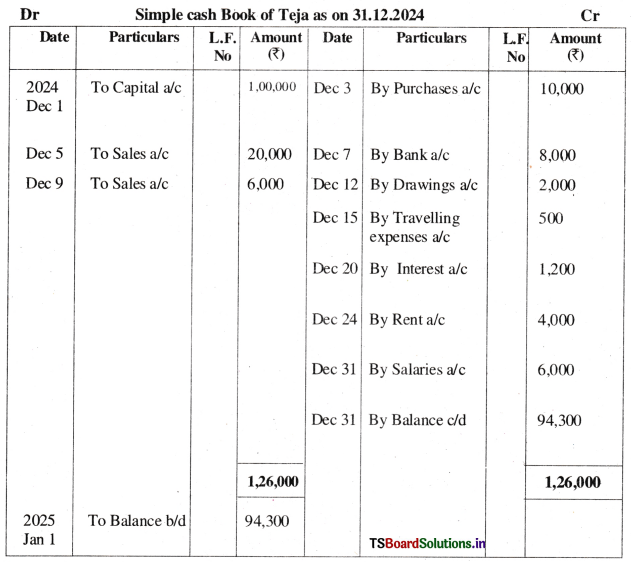
Enter the following transactions in the books of Teja as on 31.12.2024
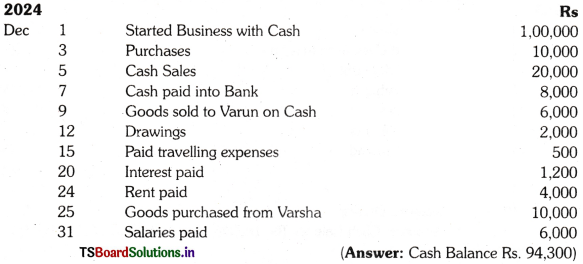
(Hint: December 25: Goods purchased from Varsha Rs. 10.000 is a Credit transaction. Hence it is not to be recorded in the Cash Book)
Solution:
Question 4.
Prepare double Column Cash Book from the following transactions.
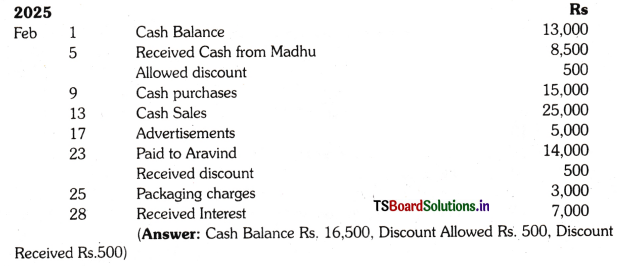
Solution:
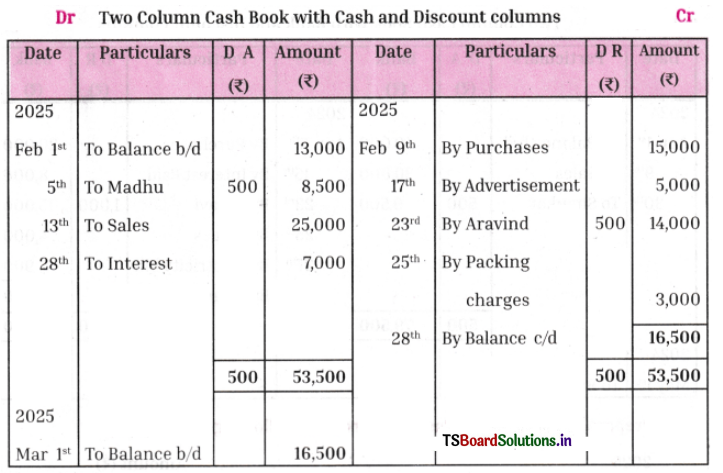
(Hint December 25 : Goods purchased from Varsha Rs. 10,000 is a Credit trans-action. Hence it is not to be recorded in the Cash Book)
Question 5.
Prepare double column Cash Book with Bank and Discount column from the following particulars
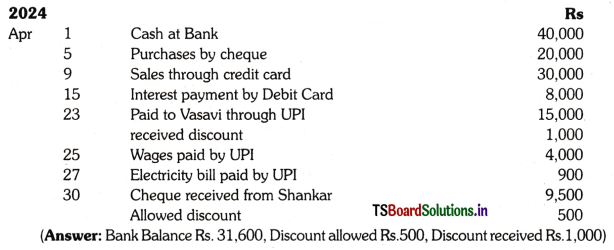
Solution:
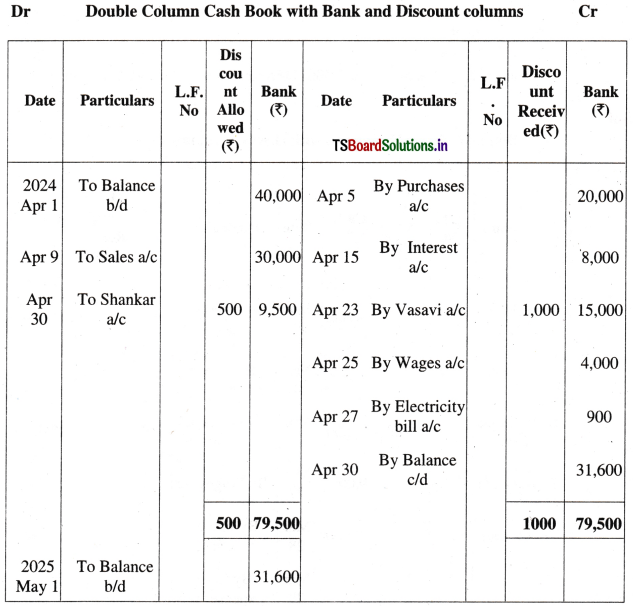
Question 6.
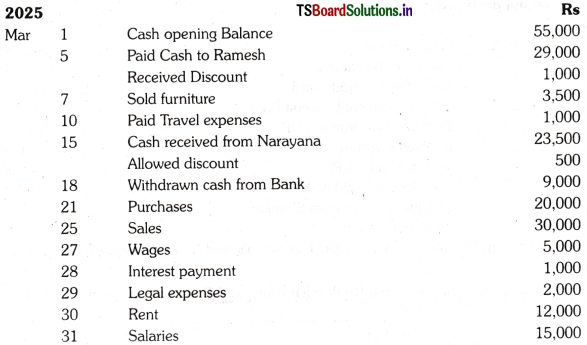
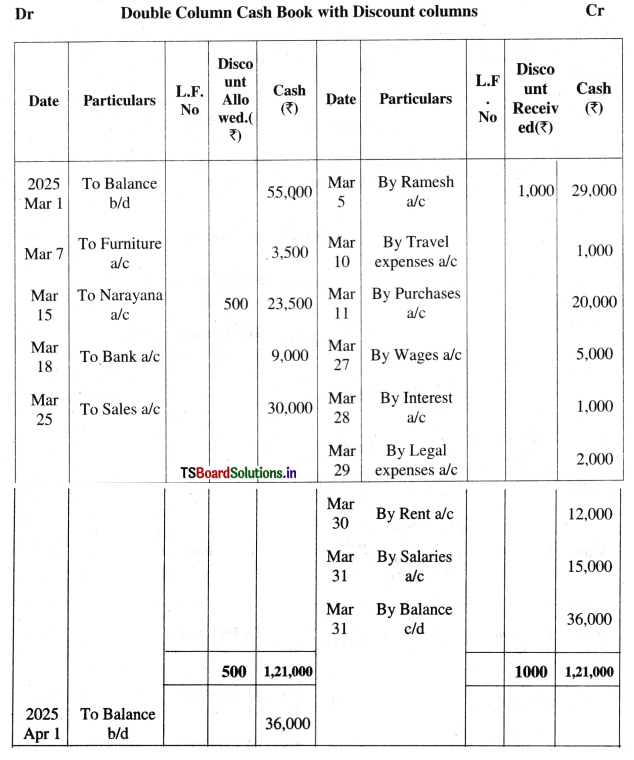
Prepare Double Column Cash Book from the following transactions
Solution:
Question 7.
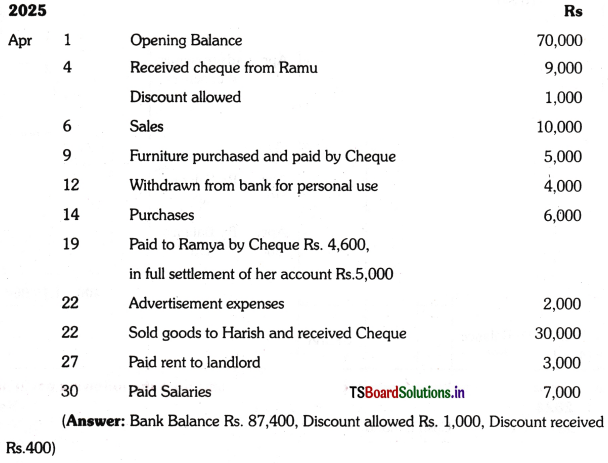
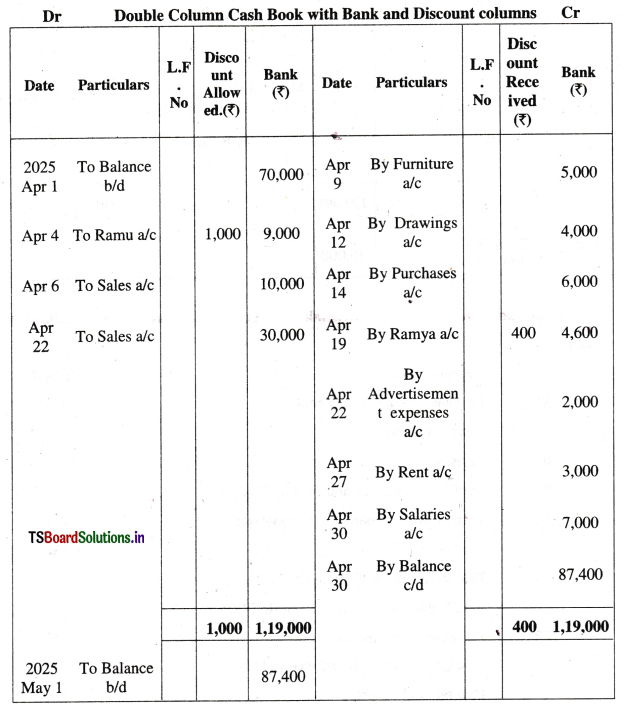
Prepare two column Cash Book with Bank and Discount columns from the following
Solution:
Question 8.
Prepare three column Cash Book of Maha Lakshmi from the following particulars
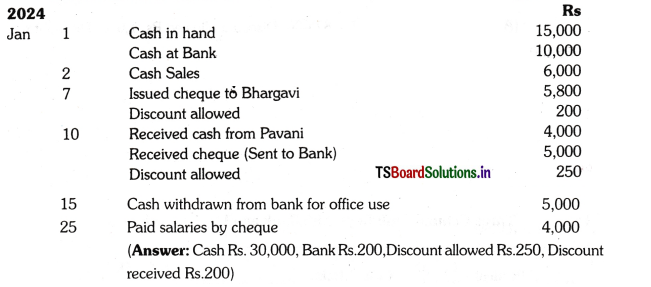
Solution:
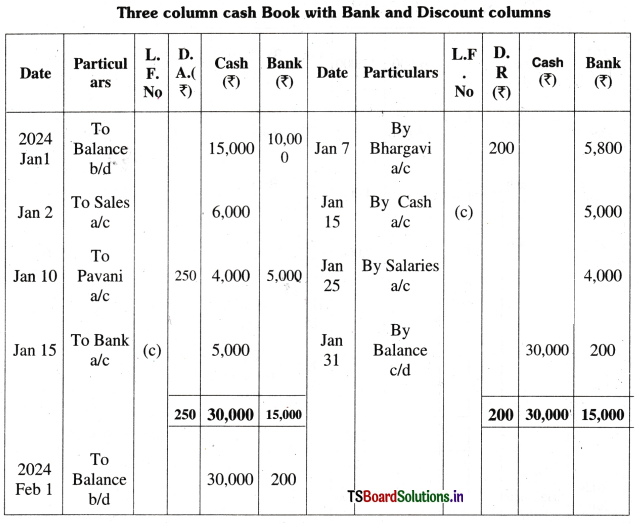
Question 9.
Prepare three column Cash Book of Pavani from the following transactions
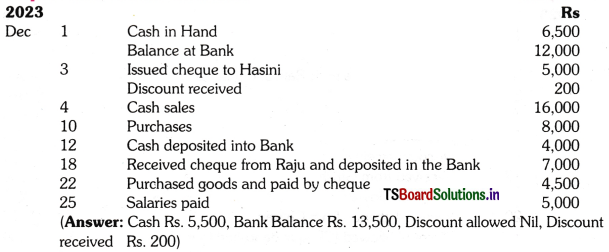
Solution:
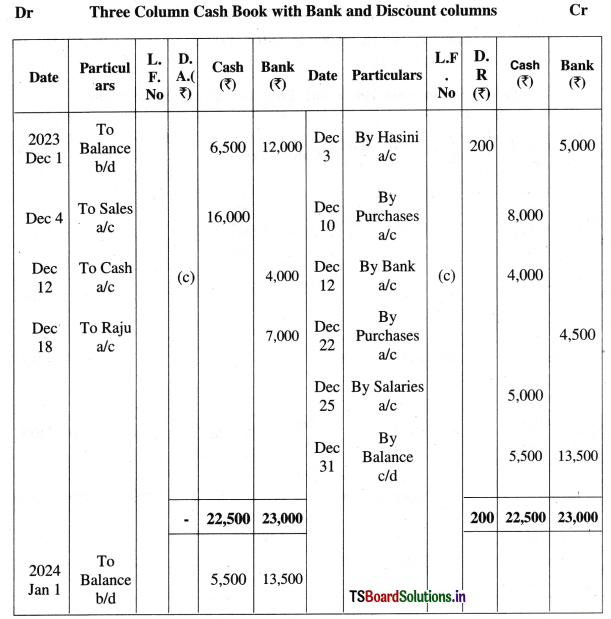
Question 10.
Prepare three Column Cash Book of Adarsh from the following particulars
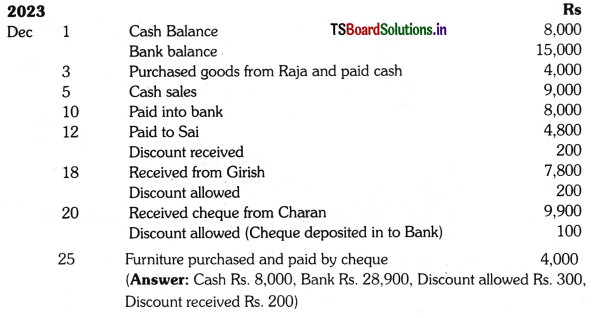
Solution:
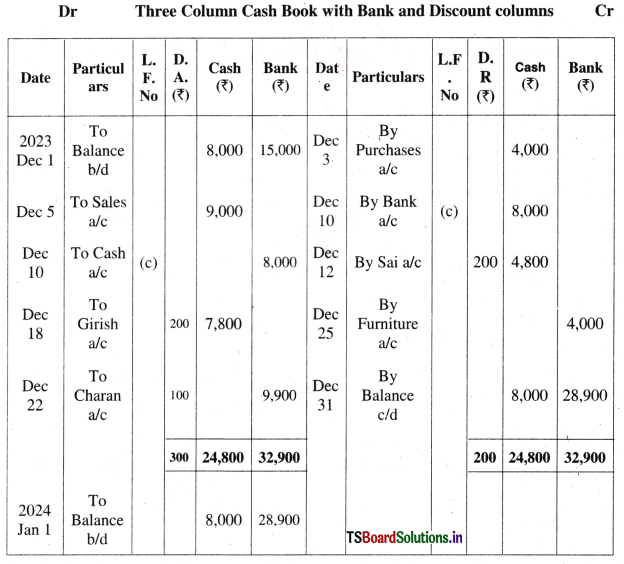
Question 11.
Prepare three column cash book of Krishna Dev from the following transactions.
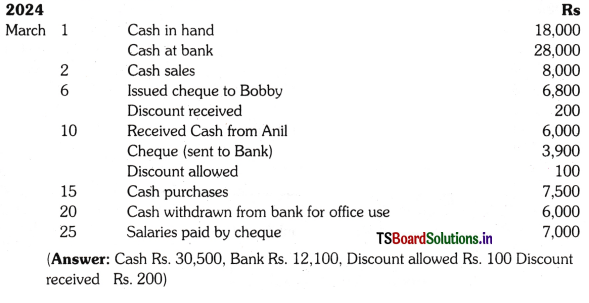
Solution:
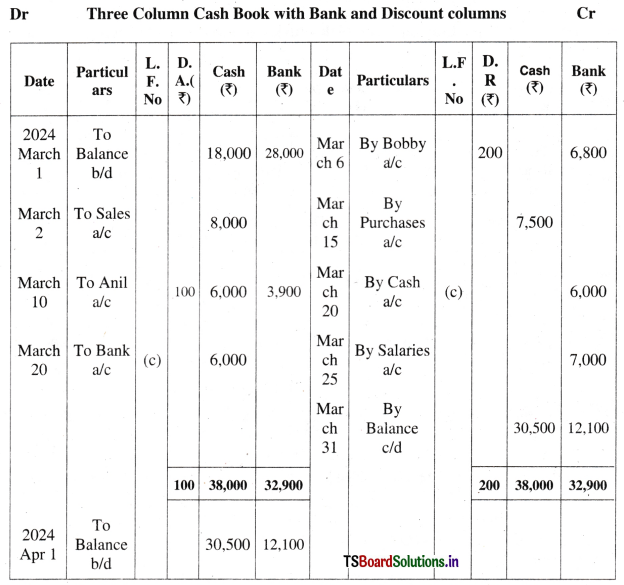
Question 12.
From the following particulars, prepare three column Cash Book of Harsha
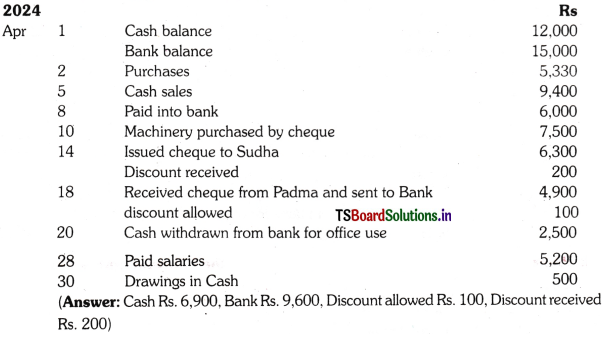
Solution:
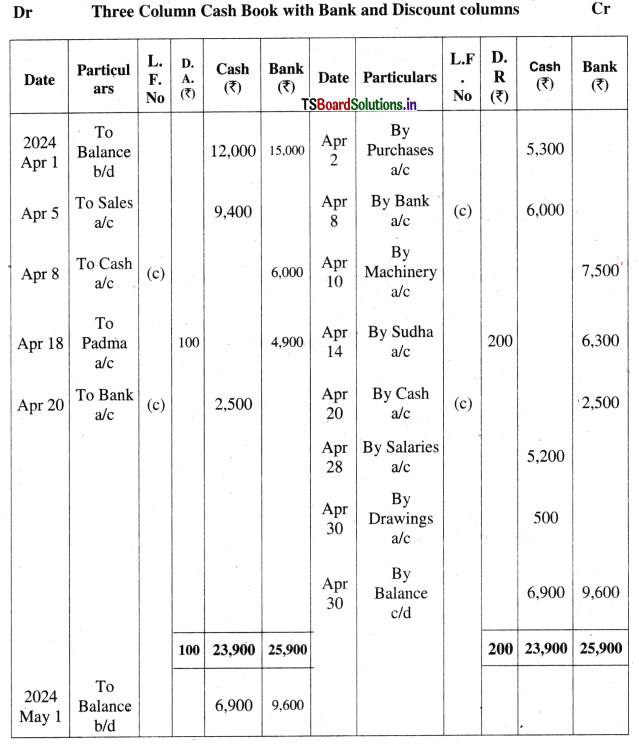
Question 13.
Prepare three column Cash Book of Nani from the following transactions
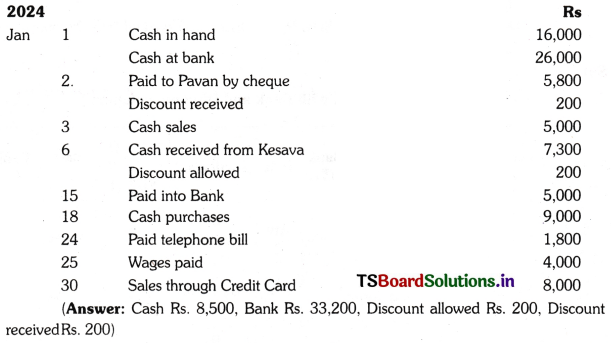
Solution:
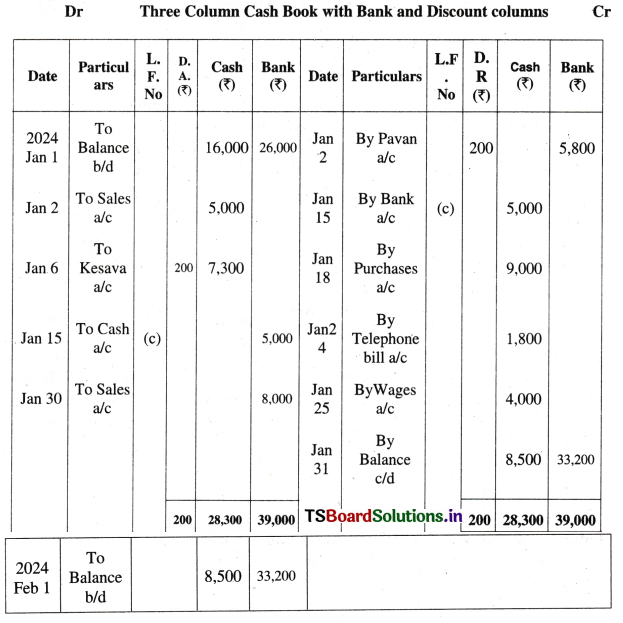
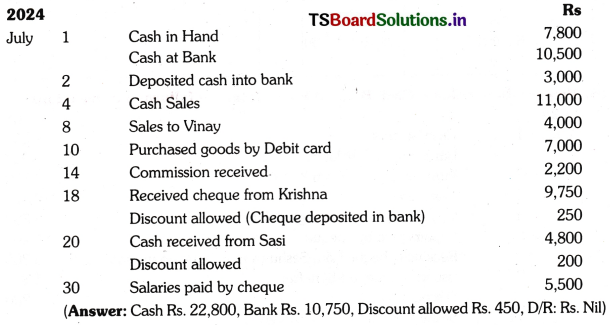
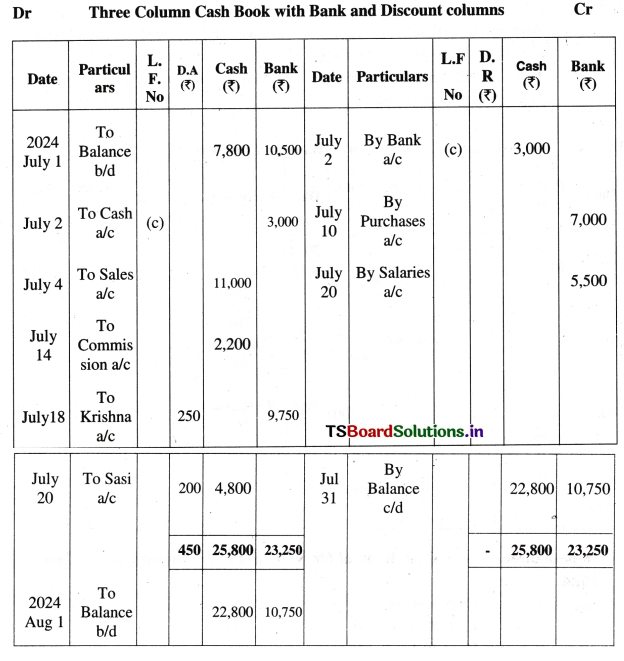
Question 14.
Prepare three column Cash Book of Mr. Vijay from the following particulars
Solution:
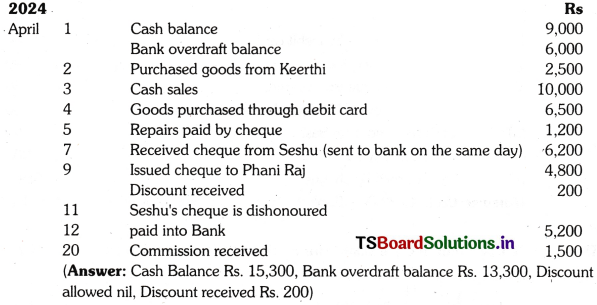
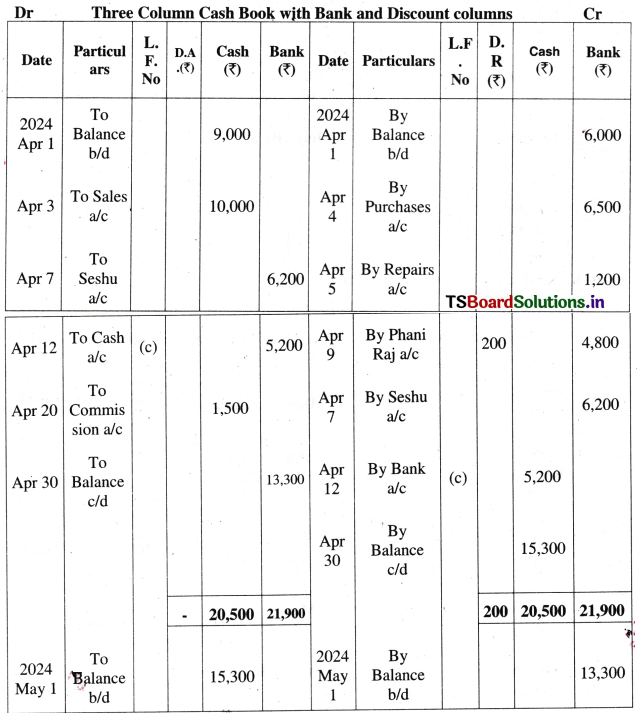
Question 15.
Prepare three column Cash Book of Indira from the following transactions.
Solution:
Question 16.
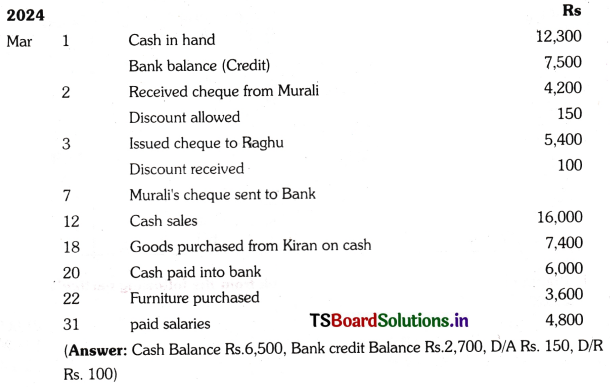
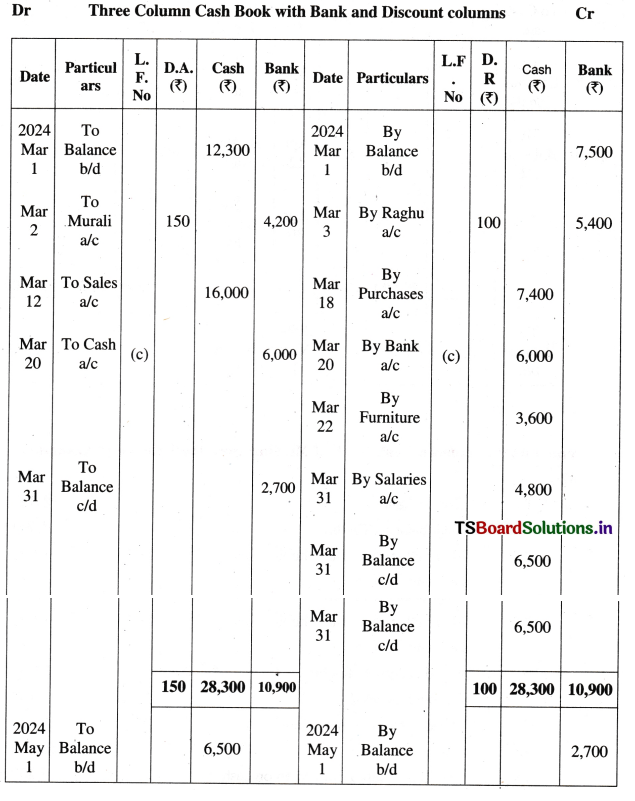
Prepare a three column Cash Book of Mr. Hail from the following transactions.
Solution:
Question 17.
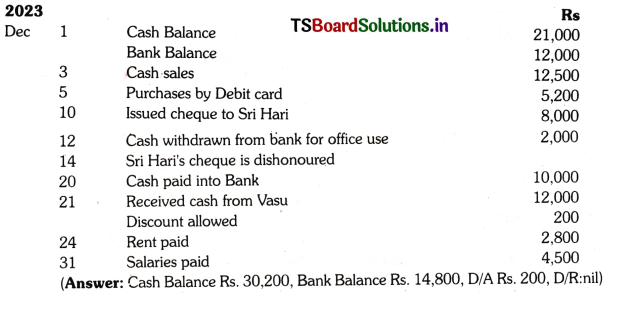
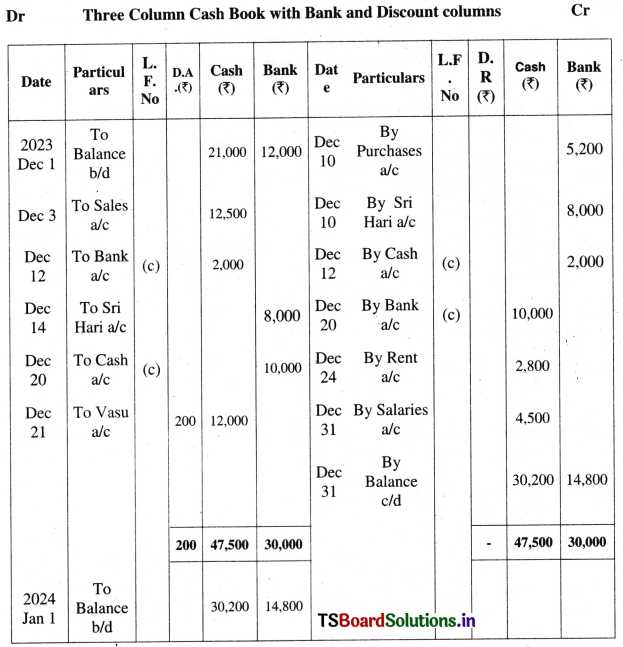
Prepare Venkats three column Cash Book from the following particulars.
Solution:
Question 18.
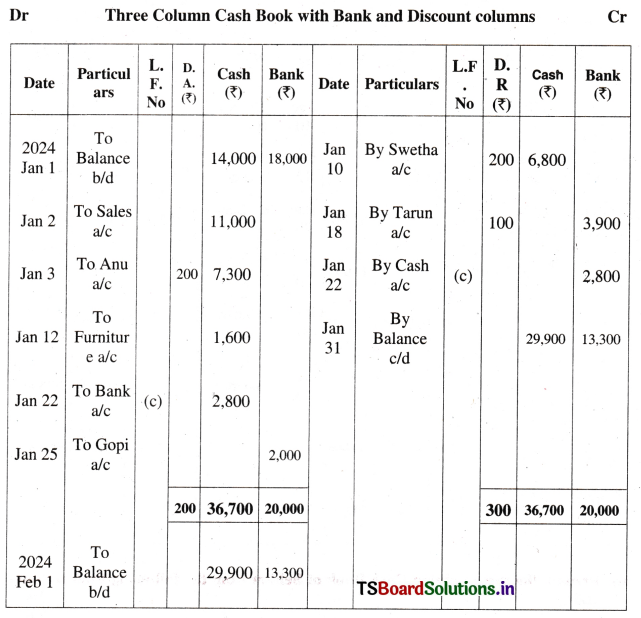
Prepare the three column Cash Book of Sekhar from the following transactions.
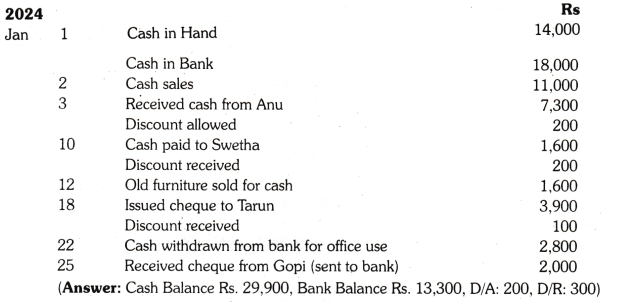
Solution:
Question 19.
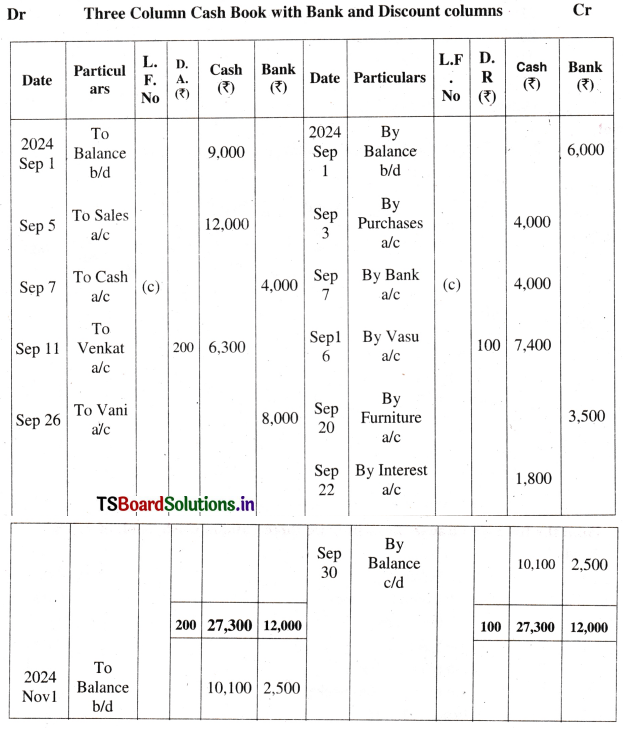
From the following transactions prepare three column Cash Book of Arjun.
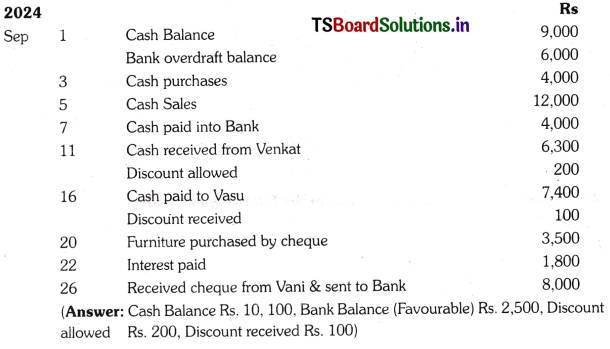
Solution:
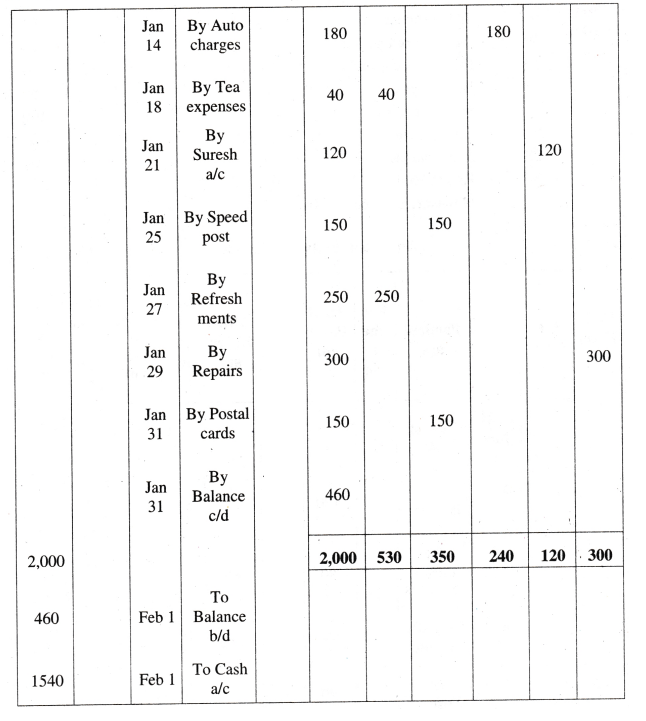
Question 20.
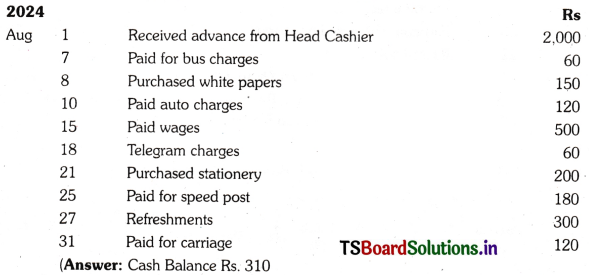
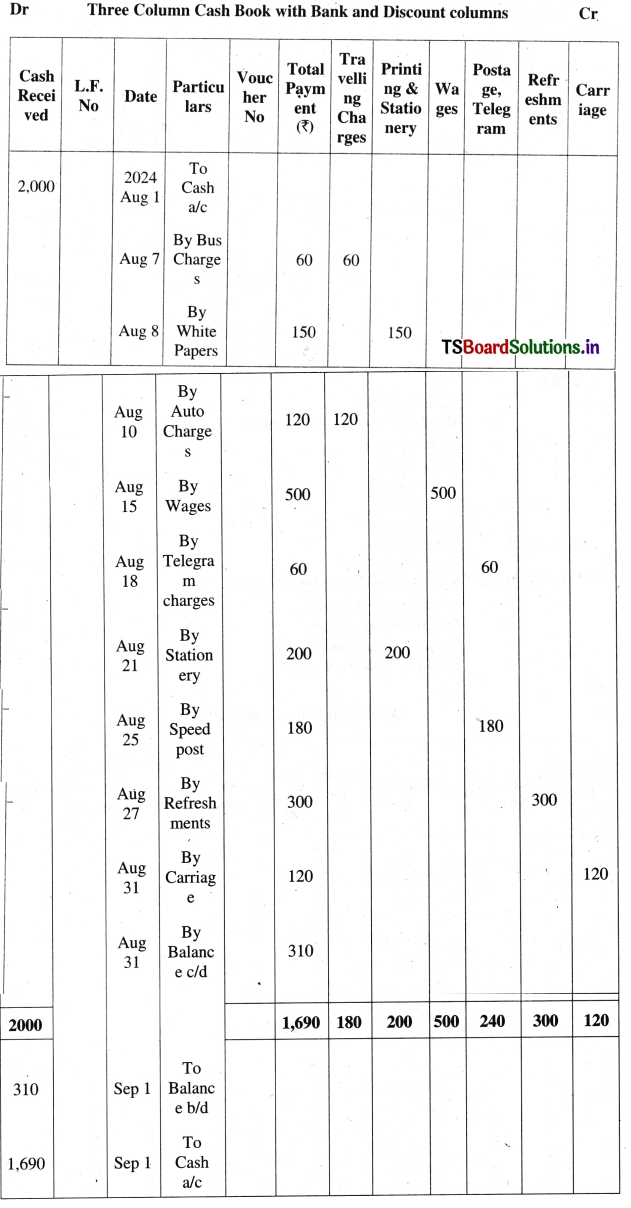
Prepare Analytical petty Cash from the following particulars.
Solution:
Question 21.
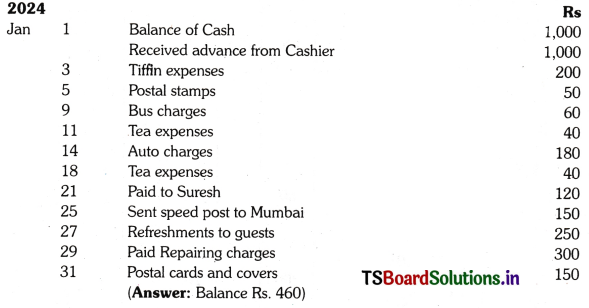
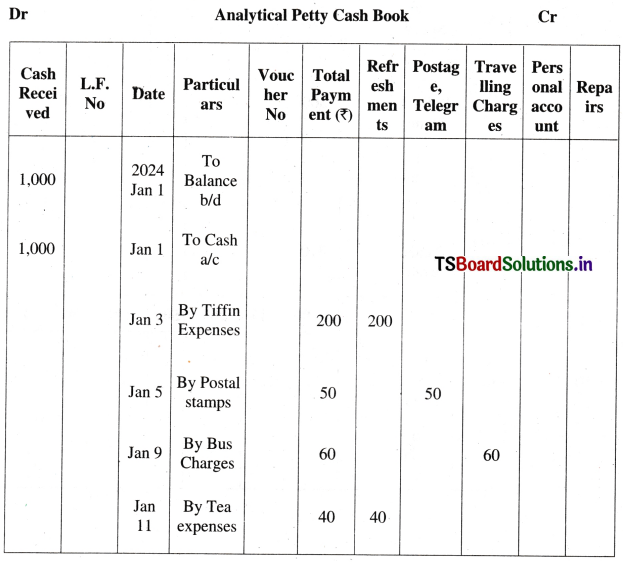
Prepare Analytical petty Cash Book
Solution:
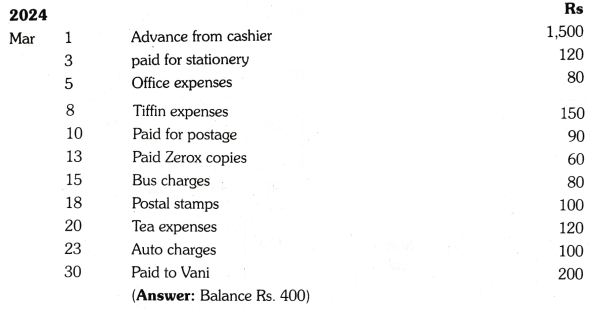
Question 22.
From the following information, prepare Analytical Petty Cash Book and also
Solution: