
Practice AP Inter 1st Year Maths Study Material Chapter 12 Limits and Derivatives MCQ to identify your strengths and weak areas.
AP Inter 1st Year Maths Limits and Derivatives MCQ
Question 1.
\(\frac{1}{2}\)
1) 0
2) -2
3) 2
4) Does not exist
Answer:
4) Does not exist
Explanation:
LHL: \(\lim _{x \rightarrow 1^{-}} \frac{x^2-1}{|x-1|}=\lim _{x \rightarrow 1^{-}} \frac{(x-1)(x+1)}{-(x-1)}=\lim _{x \rightarrow 1}\)-(x + 1) = -2
RHL : \(\lim _{x \rightarrow 1^{+}} \frac{x^2-1}{|x-1|}=\lim _{x \rightarrow 1^{+}} \frac{(x-1)(x+1)}{x-1}=\lim _{x \rightarrow 1}\)(x + 1) = 2
LHL ≠ RHL
Question 2.
\(\lim _{x \rightarrow 0} \frac{1}{x}\)cos<sup-1\(\frac{\left(1-x^2\right)}{1+x^2}\)
1) 0
2) 1
3) 2
4) Does not exist
Answer:
4) Does not exist
Question 3.
\(\lim _{x \rightarrow 0}\)(1 + tan2x)\(\frac{1}{2 x^2}\)
1) e\(\frac{1}{2}\)
2) e
3) e\(-\frac{1}{2}\)
4) 1
Answer:
1) e\(\frac{1}{2}\)
Explanation:
\(\lim _{x \rightarrow 0}\)(1 + tan2x)\(\frac{1}{2 x^2}\) = e\(\lim _{x \rightarrow 0} \frac{1}{2 x^2}\left(1+\tan ^2 x-1\right)\)
= e\(\lim _{x \rightarrow 0} \frac{\tan ^2 x}{2 x^2}\)
= e\(\lim _{x \rightarrow 0} \frac{\tan ^2 x}{2 x^2}\)
= e\(\frac{1}{2}\)(1)
= e\(\frac{1}{2}\) (∵ \(\lim _{x \rightarrow 0}\)f(x)g(x) = e\(\lim _{x \rightarrow 0}(f(x)-1) g(x)\))

Question 4.
If \(\frac{-\pi}{2}\) < α < \(\frac{\pi}{2}\) then \(\lim _{x \rightarrow 2} \frac{(\cos \alpha)^x+(\sin \alpha)^x-1}{x-2}\)
1) cos2α log cos α
2) sin2α log sin α
3) cos2α log cos α + sin2α log sin α
4) 0
Answer:
3) cos2α log cos α + sin2α log sin α
Explanation:
\(\lim _{x \rightarrow 2} \frac{(\cos \alpha)^x+(\sin \alpha)^x-1}{x-2}\left(\frac{0}{0} \text { form }\right)\)
= \(\lim _{x \rightarrow 2} \frac{(\cos \alpha)^x \log \cos \alpha+(\sin \alpha)^x \log \sin \alpha}{1}\)
= (cos2α)log cos α + sin2α log sin α
Question 5.
If ∆(x) = \(\left|\begin{array}{cc}
e^x & -1 \\
\sin x-1 & 1
\end{array}\right|\) then \(\lim _{x \rightarrow 0} \frac{\Delta(x)}{x}\)
1) 0
2) 1
3) 2
4) -1
Answer:
3) 2
Explanation:
∆(x) = \(\left|\begin{array}{cc}
e^x & -1 \\
\sin x-1 & 1
\end{array}\right|\) = ex + sin x – 1
\(\lim _{x \rightarrow 0} \frac{\Delta x}{x}=\lim _{x \rightarrow 0} \frac{e^x+\sin x-1}{x}=\lim _{x \rightarrow 0} \frac{e^x-1}{x}+\lim _{x \rightarrow 0} \frac{\sin x}{x}\)
= 1 + 1 = 2
Question 6.
\(\lim _{x \rightarrow 0}\left(\frac{a^x+b^x}{2}\right)^{\frac{1}{x}}\) =
1) \(\frac{1}{\sqrt{a b}}\)
2) \(\sqrt{a b}\)
3) \(\frac{1}{a b}\)
4) ab
Answer:
2) \(\sqrt{a b}\)
Explanation:
\(\lim _{x \rightarrow 0}\left(\frac{a^x+b^x}{2}\right)^{\frac{1}{x}}\) (1∞ form)
= \(e^{\lim _{x \rightarrow 0}\left(\frac{a^x+b^x}{2}-1\right) \frac{1}{x}}=e^{\lim _{x \rightarrow 0}\left(\frac{a^x+b^x-2}{2 x}\right)}\)
= \(e^{\frac{1}{2}} \lim _{x \rightarrow 0} \frac{a^x-1}{x}+\frac{b^x-1}{x}\)
= e\(\frac{1}{2}\)(log a + log b)
= e\(\frac{1}{2}\)log ab
= elog\(\sqrt{a b}\)
= \(\sqrt{a b}\)
Question 7.
\(\lim _{x \rightarrow 0} \frac{\tan x-\sin x}{x^3}\) =
1) –\(\frac{1}{2}\)
2) 0
3) 2
4) \(\frac{1}{2}\)
Answer:
4) \(\frac{1}{2}\)
Explanation:
\(\lim _{x \rightarrow 0} \frac{\tan x-\sin x}{x^3}=\lim _{x \rightarrow 0} \frac{\tan x}{x} \frac{(1-\cos x)}{x^2}=\lim _{x \rightarrow 0} \frac{\tan x}{x} \cdot \lim _{x \rightarrow 0} \frac{1-\cos x}{x^2}\)
= 1 × \(\frac{1}{2}\) = \(\frac{1}{2}\)
Question 8.
If a, b,d > 0 and ≠ 1 then \(\lim _{x \rightarrow 0} \frac{a^x-b^x}{d^x-1}\)
1) \(\log _d\left(\frac{a}{b}\right)\)
2) \(\log _d\left(\frac{b}{a}\right)\)
3) \(\log _{\left(\frac{\mathrm{a}}{\mathrm{~b}}\right)} \mathrm{d}\)
4) \(\log _{\frac{a}{b}} d\)
Answer:
1) \(\log _d\left(\frac{a}{b}\right)\)
Explanation:
\(\lim _{x \rightarrow 0} \frac{a^x-b^x}{d^x-1}=\lim _{x \rightarrow 0} \frac{\frac{a^x-1}{x}-\frac{b^x-1}{x}}{\frac{d^x-1}{x}}\)
= \(\frac{\log a-\log b}{\log d}=\frac{\log \frac{a}{b}}{\log d}\)
= \(\log _d\left(\frac{a}{b}\right)\)
Question 9.
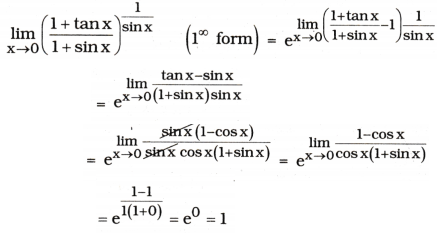
\(\lim _{x \rightarrow 0}\left(\frac{1+\tan x}{1+\sin x}\right)^{\frac{1}{\sin x}}\)
1) 1
2) e-1
3) e-2
4) e
Answer:
1) 1
Explanation:
Question 10.
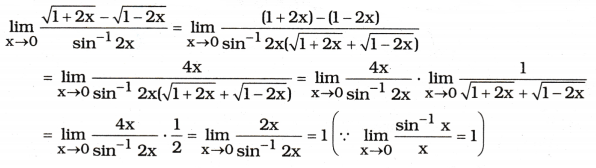
\(\frac{1}{2}\)
1) -1
2) 0
3) 1
4) \(\frac{1}{2}\)
Answer:
3) 1
Explanation:
Question 11.
Assertion (A): \(\lim _{x \rightarrow 0} \frac{\sin x}{x}\) = 1
Reason (R) : If \(\lim _{x \rightarrow a}\) f(x) = l, \(\lim _{x \rightarrow a}\)g(x) = m then \(\lim _{x \rightarrow a}\) f(x)g(x) = lm
1) Both A and R are true and R is correct explanation of A.
2) Both A and R are true and R is not correct explanation of A.
3) A is true but R is false.
4) A is false but R is true.
Answer:
2) Both A and R are true and R is not correct explanation of A.
Question 12.
Assertion (A): \(\lim _{x \rightarrow 0} \frac{|x|}{x}\) = 1
Reason (R) : f: R – {0} → R defined by f(x) = \(\frac{|x|}{x}\) has range {-1, 1}
1) Both A and R are true and R is correct explanation of A.
2) Both A and R are true and R is not correct explanation of A.
3) A is true but R is false.
4) A is false but R is true.
Answer:
4) A is false but R is true.
Explanation:
\(\lim _{x \rightarrow 0} \frac{|x|}{x}\) does not exist.
Question 13.
Let f(x) = x + [x], x ∈ R then f’\(\left(\frac{3}{2}\right)\) is equal to
1) 3/2
2) 1
3) 0
4) 5/2
Answer:
2) 1
Explanation:
f(x) – x + 1
⇒ f(x) = 1
⇒ f’\(\left(\frac{3}{2}\right)\) = 1
Question 14.
If f(x) = z cos x then f’\(\left(\frac{\pi}{2}\right)\) is equal to
1) \(\frac{-\pi}{2}\)
2) \(\frac{\pi}{2}\)
3) \(\frac{\pi}{4}\)
4) π
Answer:
1) \(\frac{-\pi}{2}\)
Explanation:
f(x) = x ⇒ cos x = f'(x) = – x sinx + cosx
⇒ f’\(\frac{-\pi}{2}\) = \(-\frac{\pi}{2}\)sin\(\frac{\pi}{2}\) + cos \(\frac{\pi}{2}=\frac{-\pi}{2}\)
Question 15.
If f(x) = 1 + x + x2 + x3 + x4 +…. + xn then f’(1) =
(1) n
(2) n + 1
(3) n(n + 1)
(4) \(\frac{\mathrm{n}+\mathrm{n}^2}{2}\)
Answer:
f(x) = 1 + x + x2 + x3 + x4 + …….. +xn
⇒ f(x) = 1 + 2x + 3x2 + 4x3 + ………. + nxn-1
⇒ f(1) = 1 + 2 + 3 + 4 + ………. + n = \(\frac{\mathrm{n}(\mathrm{n}+1)}{2}=\frac{\mathrm{n}^2+\mathrm{n}}{2}\)