
Referring to the AP Inter 1st Year Maths Study Material Chapter 9 Straight Lines Exercise 9b Solutions makes it easier to understand complex problems.
AP Inter 1st Year Maths Straight Lines Solutions Exercise 9b
I. In Exercises 1 to 7, find the equation of the line which satisfy the given conditions.
Question 1.
Write the equations for the X and Y – axes.
Solution:
The y-coordinate of every point on the X-axis is 0. Therefore, the equation of the X-axis is y = 0. The ‘x’ coordinate of every point on the Y-axis is zero.
Therefore, the equation of Y-axis is x = 0.
Question 2.
Find the equation of line passing through the point (-4, 3) with slope ½.
Solution:
We know that the equation of the line passing through the point (x0, y0) whose slope is m is (y – y0) = m(x – x0).
Thus, the equation of the line passing through the point (- 4, 3), whose slope is ½
(y – 3) = ½(x + 4)
⇒ 2(y -3) = x + 4
⇒ 2y – 6 = x + 4
⇒ x – 2y + 10 = 0
Question 3.
Find the equation of the line passing through (0, 0) with slope m.
Solution:
We know that the equation of the line passing through the point (x0, y0) whose slope’m’ is (y – y0) = m(x – x0).
Thus, the equation of the line passing through the point (0, 0) whose slope’m’ is
(y – 0) = m(x – 0)
⇒ y = mx.
Question 4.
Find the equation of the line passing through (2, 2√3) and inclined with X-axis at an angle of 75°.
Solution:
The slope of the line that inclines with the X-axis at an angle of 75° is m = tan 75°
⇒ m = tan(45° + 30°) = \(\frac{\tan 45^{\circ}+\tan 30^{\circ}}{1-\tan 45^{\circ} \tan 30^{\circ}}\)
= \(\frac{1+\frac{1}{\sqrt{3}}}{1-1 \cdot \frac{1}{\sqrt{3}}}=\frac{\frac{\sqrt{3}+1}{\sqrt{3}}}{\frac{\sqrt{3}-1}{\sqrt{3}}}=\frac{\sqrt{3}+1}{\sqrt{3}-1}\)
We know that the equation of the line passing through the point (x0, y0) whose slope m is (y – y0) = m(x – x0)
Thus, if a line passes through (2, 2√3) and inclined with the X-axis at an angle of
75°, then the equation of the line is (y – 2√3) = \(=\frac{\sqrt{3}+1}{\sqrt{3}-1}\)(x – 2)
⇒ (y – 2√3)(√3 -1) = (√3 + 1)(x – 2)
⇒ y(√3 – 1) – 2√3(√5 – 1) = x (√3 +1) – 2 (√3 + 1)
⇒ (√3 + 1) x – (√3 -1) y = 2√3 + 2 – 6 + 2√3
⇒ (√3 +1) x – (√3 – 1) y = 4√3 – 4
⇒ (√3 +1) x – (√3 -1) y = 4(√3 – 1)

Question 5.
Find the equation of line intersecting the X-axis at a distance of 3 units to the left of origin with slope -2.
Solution:
It is known that, if a line with slope m makes x-intercept a. Then the equation of the line is y = m(x – a).
For the line intersecting the X-axis at a distance of 3 units to the origin, a = – 3
The slope of the line is given as m = – 2
Thus, the required equation of the line is y = – 2[x – (- 3)]
⇒ y = -2x – 6
⇒ 2x + y + 6 = 0
Question 6.
Find the equation of line intersecting the Y-axis at a distance of 2 units above the origin and making an angle of 30° with positive direction of the X-axis.
Solution:
It is known that, if a line with slope m makes y-intercept c, then, the equation of the line is y = mx + c.
Here, c = 2 and m = tan 30° = \(\frac{1}{2}\)
Thus, the required equation of the line is y = \(\frac{1}{\sqrt{3}}\)x + 2
⇒ y = \(\frac{x+2 \sqrt{3}}{\sqrt{3}}\)
⇒ √3y = x + 2√3
∴ x – √3y + 2√3 = 0
Question 7.
Find the equation of the line passing through the points (-1, 1) and (2, -4).
Solution:
It is known that, if the equation of the line passing through the points (x1; y1) and (x2, y2) is y – y1 = \(\frac{1}{2}\) (x – x1)
Therefore, the equation of the line passing through the points (-1, 1) and (2, – 4) is
(y – 1) = \(\frac{-4-1}{2+1}\) (x + 1)
⇒ (y – 1) = \(\frac{-5}{3}\)(x + 1)
⇒ 3(y – 1) = – 5(x + 1)
⇒ 3y – 3 = -5x – 5
∴ 5x + 3y + 2 = 0
Question 8.
The vertices of ΔPQR are P(2, 1), Q(-2, 3) and R(4, 5). Find the equation of the median through the vertex R.
Solution:
Given that the vertices of ΔPQR are P(2, 1), Q(-2, 3) and R(4, 5).
Let RL be the median through vertex R.
Accordingly, L is the mid point of PQ.
By mid point formula, the coordinates of point L is given by \(\left(\frac{2-2}{2}, \frac{1+3}{2}\right)\) = (0, 2)
It is known that, the equation of the line passing through the points (x1, y1) and (x2, y2) is y – y1 = \(\frac{y_2-y_1}{x_2-x_1}\)(x – x1)
Therefore, the equation of RL can be determined by substituting (x1, y1) = (4, 5) and (x2, y2) = (0, 2)
Hence, y – 5 = \(\frac{2-5}{0-4}\)(x – 4)
⇒ y – 5 = \(\frac{-3}{-4}\) (x – 4)
⇒ 4(y – 5) = 3(x – 4)
⇒ 4y – 20 = 3x -12
⇒ 3x – 4y + 8 = 0
Thus, the required equation of the median through vertex R is 3x – 4y + 8 = 0.
Question 9.
Find the equation of the line passing through (-3, 5) and perpendicular to the line through the points (2, 5) and (-3, 6).
Solution:
The slope of the line joining the points (2, 5) and (-3, 6) is m = \(\frac{6-5}{-3-2}=\frac{1}{-5}\)
We know that, two non-vertical lines are perpendicular to each other if and only if their slopes are negative reciprocals of each other.
Therefore, slope of the line perpendicular to the line through the points (2, 5) 1 1
and (- 3, 6) is = \(-\frac{1}{m}=-\frac{1}{\left(-\frac{1}{5}\right)}\) = 5
Now, the equation of the line passing through the point (- 3, 5) whose slope is 5, is
(y – 5) = 5(x + 3)
⇒ (y – 5) = 5x + 15
⇒ 5x – y + 20 = 0
Question 10.
A line perpendicular to the line segment joining the points (1, 0) and (2. 3) divides it in the ratio l:n. Find the equation of the line.
Solution:
According to the section formula, the coordinates of the point that divides the line segment joining the points (1,0) and (2, 3) in the ratio 1 : n is
\(\left(\frac{n(1)+1(2)}{1+
The slope of the line joining the points (1, 0) and (2, 3) is m = [latex]\frac{3-0}{2-1}\) = 3
We know that two non-vertical lines are perpendicular to each other if and only if their slopes are negative reciprocals of each other. Therefore, slope of the line that is perpendicular to the line joining the points (1, 0) and (2, 3) is \(-\frac{1}{m}=-\frac{1}{3}\).
Now the equation of the line passing through \(\left(\frac{\mathrm{n}+2}{\mathrm{n}+1}, \frac{3}{\mathrm{n}+1}\right)\) and whose slope is \(-\frac{1}{3}\) is (y – \(\frac{3}{(\mathrm{n}+1)}\)) = \(\frac{-1}{3}\)(x – \(\frac{n+2}{n+1}\))
⇒ 3[(n + 1)y – 3] = -[x(n + 1) – (n + 2)]
⇒ 3(n + 1)y – 9 = – (n + 1)x + n + 2
⇒ (1 + n)x + 3(1 + n)y = n + 11
Question 11.
Find the equation of a line that cuts off equal Intercepts on the coordinate axes and passes through the point (2, 3).
Solution:
The equation of a line in the intercept form is \(\frac{x}{a}+\frac{y}{b}\) = 1 …….(1)
Here, a and b are the intercepts on X and Y axes respectively. It is given that the line cuts off equal intercepts on both the axes. This means that a = b. Therefore, equation (!) reduces to \(\frac{x}{a}+\frac{y}{b}\) = 1
⇒ x + y = a ……….(2)
Since the line passes’through point (2, 3), equation (2) reduces to 2 + 3 = a
a = 5
On substituting the value of ‘a’ in the equation (2), we have x + y = 5
This is the required equation of the line.
Question 12.
If the portion of a straight line intercepted between the axes of coordinates is bisected at (2p, 2q), write the equation of the straight line.
Solution:
Let a,b be the intercepts of the line.
∴ The line cut X – axis at A(a, 0), Y – axis at B (0, b)
Mid point if \(\overline{\mathrm{AB}}\) is \(\left(\frac{\mathrm{a}}{2}, \frac{\mathrm{~b}}{2}\right) \Rightarrow\left(\frac{\mathrm{a}}{2}, \frac{\mathrm{~b}}{2}\right)\) = (2p, 2q)
⇒ \(\frac{a}{2}\) = 2P, \(\frac{b}{2}\) = 2q
⇒ a = 4p, b = 4q
Equation of the line is \(\frac{x}{4 p}+\frac{y}{4 q}\) = 1
⇒ \(\frac{x}{p}+\frac{y}{q}\) = 4
Question 13.
Find the angle made by the straight line y = -√3x + 3 with the positive direction of the X – axis measured in the counter clockwise direction.
Solution:
Let ‘θ’ be the inclination.
Slope = -√3
⇒ tan θ = -√3
⇒ θ = \(\frac{2 \pi}{3}\)
Question 14.
The intercepts of a straight line on the axes of coordinates are a and b. If p is the length of the perpendicular drawn from the origin to this line, write the value of p in terms of a and b.
Solution:
Equation of the line having intercepts a, b is \(\frac{x}{a}+\frac{y}{b}\) = 1 ⇒ bx + ay – ab = 0 …(1)
p = Length of the perpendicular from (0, 0) to line (1).
= \(\frac{|-a b|}{\sqrt{b^2+a^2}}=\frac{|a b|}{\sqrt{a^2+b^2}}\)
II.
Question 1.
Find the equation of the line passing through the point (2, 2) and cutting off intercepts on the axes whose sum is 9.
Solution:
The equation of a line in the intercept form is \(\frac{x}{a}+\frac{y}{b}\) = 1 ……. (1)
Here, a and b are the intercepts on X and Y axes respectively, it is given that a + b = 9
⇒ b = 9 – a ……….(2)
From eqns. (1) and (2) we have \(\frac{x}{a}+\frac{y}{9-a}\)
It is given that the line passes through the point (2, 2). Therefore, equation (3) reduces to
\(\frac{2}{a}+\frac{2}{9-a}\) = 1
⇒ 2\(\left(\frac{1}{a}+\frac{1}{9-a}\right)\) = 1
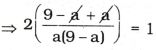
⇒ \(\frac{2}{a}+\frac{2}{9-a}\) = 1
⇒ 18 = 9a – a2
⇒ a2 – 9a + 18 = 0
⇒ a2 – 6a – 3a + 18 = 0
⇒ a(a – 6) – 3(a – 6) = 0
⇒ (a – 6)(a -3) = 0
⇒ a = 6 or a = 3
If a = 6 then b = 9 – 6 = 3,
Therefore, the equation of the line is \(\frac{x}{6}+\frac{y}{3}\) = 1
⇒ x + 2y – 6 = 0
If a = 3 then b = 9 – 3 = 6, therefore, the equation of the line is
\(\frac{x}{3}+\frac{y}{6}\) = 1
⇒ 2x + y – 6 = 0
Question 2.
Find the equation of the Une through the point (0, 2) making an angle \(\frac{2 \pi}{3}\) with the positive X-axis. Also, find the equation of the line parallel to it and crossing the Y-axis at a distance of 2 units below the origin.
Solution:
The slope of the line making an angle \(\frac{2 \pi}{3}\) with the positive X-axi is m = tan(\(\left(\frac{2 \pi}{3}\right)\)) – √3
Equation of a line passing through (0, 2) and slope √3 is
(y – 2) = -√3(x – 0)
⇒ y – 2 = -√3x
⇒ √3x + y – 2 = 0
The slope of the line parallel to the line √3x + y – 2 = 0 is .4.
It is given that the line parallel to line √3x + y – 2 = 0 crosses the Y – axis 2 units below the origin i.e., it passes through (0, -2).
Hence, the equation of the line passing through the point (0, -2) and having a slope √3 is y – (-2) = -√3(x – 0)
⇒ y + 2 = √3x
⇒ √3x + y + 2 = 0
Question 3.
The perpendicular from the origin to a line meets it at the point (-2, 9). Find the equation of the line.
Solution:
The slope of the line joining the origin (0, 0) and point (-2, 9) is m1 = \(\frac{9-0}{-2-0}=\frac{-9}{2}\)
Accordingly, the slope of the line perpendicular to the line joining the origin and point (- 2, 9) is m2 = \(\frac{-1}{m_1}=-\frac{1}{\left(\frac{-9}{2}\right)}=\frac{2}{9}\)
Now, the equation of the line passing through the point (-2, 9) and having a slope ‘2/9’ is
9y – 81 = 2x + 4
⇒ 2x – 9y + 85 = 0
Question 4.
The length L (in centimetres) of a copper rod is a linear function of its Celsius temperature C. In an experiment, if L = 124.942 when C = 20 and L = 125.134 when C = 110, express L in terms of C.
Solution:
It is given that when C = 20, the value of L is 124.942
whereas when C = 110, the value of L is 125.134
Accordingly, points (20, 124.942) and (110, 125.134) satisfy the linear relation between L and C.
Now, assuming C along the X-axis and L along the Y-axis, we have two points, (20, 124.942) and (110, 125.134) in the xy plane.
Therefore, the linear relation between L and C is the equation of the line passing through the points (20, 124.942) and (110, 125.134)
(L – 124.942) = \(\frac{125.134-124.942}{110-20}\)(C – 20)
L – 124.942 = \(\frac{0.192}{90}\)(C – 20)
L = \(\frac{0.192}{90}\)(C – 20) + 124.942.
This is the required linear relations.
Question 5.
The owner of a milk, store finds that, he can sell 980 litres of milk each week at Rs. 14/ litre and 1220 litres of milk each week at Rs. 16/ litre. Assuming a linear relationship between selling price and demand, how many litres could he sell weekly at Rs. 17/litre?
Solution:
The relationship between selling price and demand is linear. Assuming selling price per litre along the X-axis and demand along the Y-axis, we have two points i.e. (14,980) and (16,1220) in the xy-plane that satisfy the linear relationship between selling price and demand.
Therefore, the linear relationship between selling price per litre and demand is the equation of the line passing through the points (14, 980) and (16, 1220).
y – 980 = \(\frac{1220-980}{16-14}\) (x – 14)
⇒ y – 980 = \(\frac{240}{2}\)(x – 14)
⇒ y – 980 = 120(x – 14)
⇒ y = 120(x – 14) + 980
when x = ₹ 17/litre, y = 120(17 – 14) + 980
⇒ y = 120 × 3 + 980 = 360 + 980 = 1340
∴ The owner of the milk store could sell 1340 litres of milk weekly at Rs. 17/ litre.
Question 6.
P(a, b) is the mid-point of a line segment between axes. Show that equation of the line is \(\frac{x}{a}+\frac{y}{b}\) = 2.
Solution:
Let AB be the line segment between the axes and let P(a, b) be its mid-point.
Let the coordinates of A and B are (0, y) and (x, 0) respectively. Since P(a, b) is the mid-point of AB.
\(\left(\frac{0+x}{2}, \frac{y+0}{2}\right)\) = (a, b)
⇒ \(\left(\frac{\mathrm{x}}{2}, \frac{\mathrm{y}}{2}\right)\) = (a, b)
⇒ \(\frac{x}{2}\) = a and \(\frac{y}{2}\) = b
∴ x = 2a and y = 2b
Thus, the respective coordinates of A and B are (0, 2b) and (2a, 0). The equation of the line passing through points (0, 2b) and (2a, 0) is
(y – 2b) = \(\frac{(0-2 b)}{(2 a-0)}\)(x – 0)
⇒ y – 2b = \(\frac{1}{2}\)(x)
⇒ a(y – 2b) = -bx
⇒ ay – 2ab = – bx
⇒ bx + ay = 2ab
On dividing both sides by ab, we have \(\frac{b x}{a b}+\frac{a y}{a b}=\frac{2 a b}{a b}\) ⇒ \(\frac{x}{a}+\frac{y}{b}\) = 2
Thus, the equation of the line is \(\frac{x}{a}+\frac{y}{b}\) = 2
Question 7.
Point R(h, k) divides a line segment between the axes in the ratio 1 : 2. Find the equation of the line.
Solution:
Let AB be the line segment between the axes such that point R(h, k) divides AB in the ratio 1 : 2.
Let the respective coordinates of A and B are (x, 0) and (0, y). Since R(h, k) divides AB in the ratio 1 : 2, according to the section formula
(h, k) = \(\left(\frac{1 \times 0+2 \times x}{1+2}, \frac{1 \times y+2 \times 0}{1+2}\right)\)
⇒ (h, k) = \(\left(\frac{2 \mathrm{x}}{3}, \frac{\mathrm{y}}{3}\right)\)
⇒ h = \(\frac{2 x}{3}\) and k = \(\frac{y}{3}\)
⇒ x = \(\frac{3 h}{2}\) and y = 3k
Therefore, the respective coordinates of A and B are (\(\frac{3 h}{2}\), o) and (0, 3k).
Now, the equation of line AB is
(y – 0) = \(\frac{3 k-0}{0-\frac{3 h}{2}}\) (x – \(\frac{1}{2}\))
⇒ y = \(-\frac{2 \mathrm{k}}{\mathrm{~h}}\)(x – \(\frac{3 \mathrm{h}}{2}\))
⇒ hy = -2kx + 3hk
⇒ 2kx + hy = 3hk
Thus, the required equation of the line is 2kx + hy = 3hk.
Question 8.
By using the concept of equation of a line, prove that the three points are collinear. C
i) (3, 0), (-2, -2) and (8, 2)
Solution:
Let A(3, 0), B(-2, -2), C(8, 2) be the given points.
Equation of the line \(\frac{1}{2}\) is y – y1 = \(\frac{y_2-y_1}{x_2-x_1}\) (x – x1)
⇒ y – 0 = \(\frac{-2-0}{-2-3}\)(x – 3)
y = \(\frac{2}{5}\)(x – 3)
⇒ 5y = 2x – 6
⇒ 2x – 5y – 6 = 0 …(1)
Put C(8, 2) in (1) ⇒ 2(8) – 5(2) – 6 = 0
Hence given points A, B and C are collinear.
ii) (-5, 1), (5, 5), (10, 7)
Solution:
Let A(-5, 1), B(5, 5), C(10, 7)
Slope of \(\frac{1}{2}\), Slope of \(\frac{1}{2}\)
Slope of \(\frac{1}{2}\) = Slope of \(\frac{1}{2}\)
A, B, C are collinear.
Equation of the line is y – 1 = \(\frac{1}{2}\)(x + 5)
⇒ 5y – 5 = 2x + 10
⇒ 2x – 5y + 15 = 0
iii) (a, b + c), (b, c + a), (c, a + b)
Solution:
Let A(a, b + c), B(b, c + a), C(c, a + b)
Slope of \(\overrightarrow{\mathrm{AB}}=\frac{\mathrm{c}+\mathrm{a}-\mathrm{b}-\mathrm{c}}{\mathrm{~b}-\mathrm{a}}=\frac{\mathrm{a}-\mathrm{b}}{-(\mathrm{a}-\mathrm{b})}\) = -1, Slope of \(\stackrel{\rightharpoonup}{\mathrm{AC}}=\frac{\mathrm{a}+\mathrm{b}-\mathrm{b}-\mathrm{c}}{\mathrm{c}-\mathrm{a}}=\frac{-(\mathrm{c}-\mathrm{a})}{\mathrm{c}-\mathrm{a}}\) = -1
Since slope of \(\overrightarrow{\mathrm{AB}}\) = slope of \(\overrightarrow{\mathrm{AC}}\), the point A, B, C are collinear.
Equation of the line is y – (b + c) = -1(x – a)
⇒ x + y = a + b + c