
For systematic learning, students can include AP Inter 1st Year English Study Material and Transformation of Sentences in English Inter 1st Year in their daily study routine.
Inter 1st Year English Transformation of Sentences with Answers
The term ‘voice’ in grammar refers to one aspect of the verb. If the verb group in a sentence has ‘be+pp of the verb’, then that sentence is said to be in the passive voice. If any of or both the elements (be+V3) are missing in the structure of the verb then the sentence is said to be in the active voice.
(వాక్యంలోనిverb group లో ‘be + V3 ఉంటే, passive voice, be + V3 లలో ఏ ఒక్కటి లేకున్నా active voice అంటారు.)
If the verb is in the passive form, the subject of that sentence is just the ‘sufferer’ of the action indicated by the verb.
(Verb passive లో ఉంటే ఆ వాక్యంలోని subject, verb సూచించిన పని ఫలితాన్ని అనుభవిస్తుంది. అందుకనే ఈ రూపానికి ‘passive’, ‘సోమరిగా పనిచేయకుండా అని పేరు.)
If the verb group is in the active voice, the subject of that sentence is the doer of the action shown by the verb.
(Verb Active voice ఉన్నపుడు, ఆ వాక్యం యొక్క subject, verb సూచించిన పనిని చేస్తుంది. అందుకే ఈ రూపానికి ‘Active-చురుకుగా పనిచేస్తున్న’ అని పేరు.)
If the doer of an action is either unimportant or unknown, the passive structure is natural.
(పనిచేసిన వారు ప్రదానం కాకున్నా, తెలియకున్నా, passive నిర్మాణాలు సహజంగా ఉంటాయి.)
Transformation of sentences from one voice to the other involves five steps.
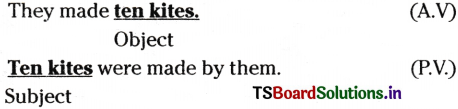
1. The object in the Active Voice sentence becomes the subject in the Passive Voice sentence.
Ex :
If there are two objects in the A.V. sentence, either of them can be made the subject in the P.V. sentence.
Ex :
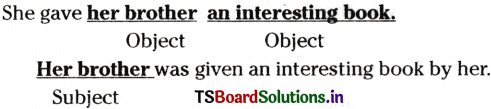
An interesting book was given to her brother by her.
2. A suitable ‘be’ form is to be introduced. This is the most important step. Selection of the right be’ form is based on two factors : (a) the number and person of the subject in the passive voice and (b) the tense of the verb in the Active Voice.
The following table helps one select the right ‘be’ form.
| Subject in the Passive Voice | Tense of the verb in Active Voice | ‘Be’ form to be used in the Passive Voice |
| 1. I | Simple Present | am |
| 2. he, she, it, singular nouns | Simple Present | is |
| 3. We, you, they, plural nouns | Simple Present | are |
| 4. I, he, she, it, singular nouns | Simple Past | was |
| 5. We, you, they plural nouns | Simple Past | were |
| 6. I | Present Continuous | am being |
| 7. he, she, it, singular nouns | Present Continuous | is being |
| 8. We, you, they plural subjects | Present Continuous | are being |
| 9. I, he, she, it singular nouns | Past Continuous | was being |
| 10. We, you, they plural subjects | Past Continuous | were being |
| 11. he, she, it singular nouns | Present Perfect | has been |
| 12. I, we, you, they plural nouns | Present Perfect | have been |
| 13. Any subject | Past Perfect | had been |
| 14. Any subject | will/shall/can/ may/ would/ should/ could/ might/ must, etc. | will, etc. + be |
| 15. Any subject | will, etc. + have | will, etc. + have been |
Ex :
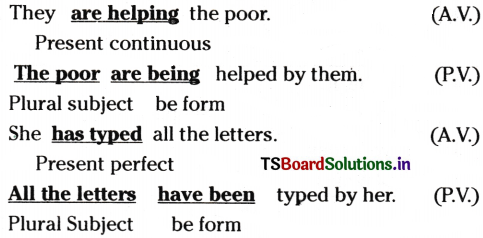
3. The main verb in the Active Voice sentence is to be changed into its past participle form. One must know the correct past participle forms of irregular verbs.
Ex:
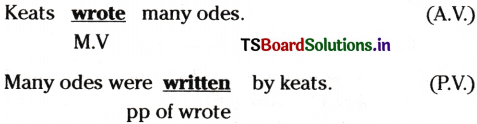
4. The preposition ‘by’ is used.
5. The subject in the Active voice sentence is made the object of the preposition by’ in the passive voice sentence.
Ex : He broke the glass. (A.V.)

If the subject in the A.V. sentence is either unimportant or a general one, by + object’ may be dropped.
Ex: Someone removed the dead snake. (A.V.)
The dead snake was removed. (PV.)
(by someone’ is dropped)
People call him ‘Babuji.’ (A.V.)
He is called Babuji’. (‘by people’ not necessary) (P V.)

→ Changing Imperative Sentences into Passive
We follow a slightly different method to change imperative sentences from the A.V. to the P.V. (Sentences with dropped subject and with V + object structure, conveying a request or an order are called imperative sentences.)
1. The passive voice sentence begins with Let’.
Ex: Close the door. (A.V.) imperative
Let the door be closed. (P.V.)
2. The object in the A.V. sentence becomes the subject in the P.V. sentence.
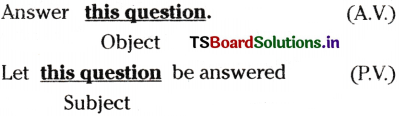
3. The ‘be’ form ‘be’ is introduced.
(Whatever be the subject or the tense form, it is always ‘be’ in imperative sentences.)
Ex. Clean the room. (A.V.)
Let the room be cleaned. (P.V.)
4. The M.V. is changed into its Past Participle form.
Ex:
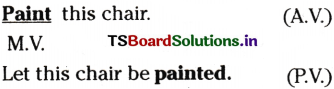
As the subject is not explicit in the imperative sentences, the need to use by’ and its object doesn’t arise, while changing imperative sentences into the passive voice.
Changing Questions into Passive
Carefully study the transformation of the interrogative sentences into the passive voice.
Ex: Who brought this book ? (A.V.)
By whom was this book brought ? (P.V.)
All the steps followed here are exactly like those we follow in changing the declarative sentences. But the word order is different,
By whom + be + Subject + M.V. in PP + etc ?
Now, notice the transformation of Questions with other ‘wh’ words.
Ex : Where did you put my pen? (A.V.)
Where was my pen put ?
‘Wh’ word + be + subject + MV in PP ?
Observe how ‘yes / no’ Questions are rewritten in the passive voice.
Have you solved the problem ? (A.V.)
Has the problem been solved? (P.V.)
Helping Verb + Subject + be + MV in pp + etc ?
More Examples
1. Lalitha does homework. (AV)
Homework is done by Lalitha. (PV)
2. They are eating bananas. (AV)
Bananas are being eaten by them. (PV)
3. Teja has painted the door. (AV)
The door has been painted by Teja. (PV)
4. We saw many animals in the zoo. (AV)
Many animals were seen by us in the zoo. (PV)
5. Suresh was playing cricket. (AV)
Cricket was being played by Suresh. (PV)
6. 1 had bought three books. (AV)
Three books had been bought by me. (PV)
7. I shall watch a movie. (AV)
A movie will be watched by me. (PV)
8. You will have built a house by the end of next year. (AV)
A house will have been built by the end of next year by you. (PV)
9. He is going to post this letter. (AV)
This letter is going to be posted by him. (PV)
10. Close the door. (AV)
Let the door be closed. (PV)
11. Why have you eaten it ? (AV)
Why has it been eaten by you ? (PV)
12. Did you paint the door ? (AV)
Was the door painted by you ? (PV)
13. We can lock the gate. (AV)
The gate can be locked. (PV)
Exercise
Change the voice of the following sentences.
1. Everyone will laugh at us.
Answer:
We will be laughed at by everyone.
2. How did you solve this sum ?
Answer:
How was this sum solved by you?
3. He has lost his wallet and bag.
Answer:
His wallet and bag have been lost by him.
4. Farmers grow crops.
Answer:
Crops are grown by farmers.
5. Tell him to go.
Answer:
Let him be told to go.
6. The jury found the prisoner guilty of murder.
Answer:
The prisoner was found guilty of murder by the jury.
7. I hate people looking at me.
Answer:
I hate being looked at by people.
8. Who taught you English ?
Answer:
By whom were you taught English?
9. I bought her a present.
Answer:
A present was bought for her by me.
10. Who did this?
Answer:
By whom was this done?
11. Consult a good doctor.
Answer:
Let a good doctor be consulted.
12. I will never forget this experience.
Answer:
This experience will never be forgotten by me.
13. The tiger was chasing the deer.
Answer:
The deer was being chased by the tiger.
14. Have you finished the report ?
Answer:
Has the report been finished by you?
15. Somebody stole my pen yesterday.
Answer:
My pen was stolen yesterday by somebody.
16. Nurses look after patients.
Answer:
Patients are looked after by nurses.
17. I saw him opening the parcel.
Answer:
He was seen opening the parcel by me.
18. They are repairing chairs in the hall.
Answer:
Chairs are being repaired in the hall (by them).
19. Do not insult the weak and the oppressed.
Answer:
Let the weak and the oppressed not be insulted.
20. Prashant is solving problems.
Answer:
Problems are being solved by Prashant.
21. She has opened the door.
Answer:
The door has been opened by her.
22. She wrote a poem.
Answer:
A poem was written by her.
(B) Reported Speech or Direct / Indirect Speech
Sometimes it becomes necessary to report a person’s words. It can be done in two different ways. One way is to reproduce the actual words of the speaker. The speaker’s actual words are shown in quotation marks in writing. This kind of reporting is called the ‘Direct Speech’.
The other kind is to express the idea of the speaker in the reporter’s words. This type is referred to as the ‘Indirect Speech’.
(ఒక వ్యక్తి అన్న మాటలు అన్నట్లుగా తిరిగి చెబితే Direct Speech. కేవలం భావం మాత్రమే తిరిగి చెబితే Indirect Speech.)
The sentence in the Direct Speech has two parts. They are (a) the part out side the quotation marks (called the reporting part and (b) the part within the quotation marks (called the reported part).
Ex :

The verb in the reporting part is called “the reporting verb.”

To change a sentence from the direct speech to the indirect speech, the following steps are to be followed.
1. The reporting part is to be written first. This is applicable only when the reporting part is either in the middle or at the end of the sentence.
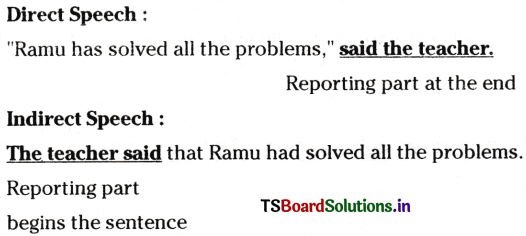
2. The order of the words in the reporting part is arranged as “Subject + Verb.”
This is applicable only when this order is not followed in the direct speech sentence.
Ex :
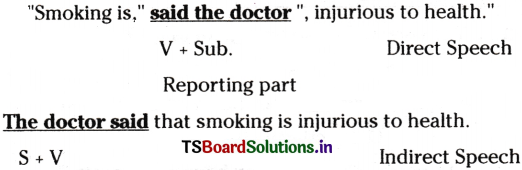
3. The reporting verb is changed to words like ordered, requested, enquired, told, asked, advised exclaimed, depending on the meaning of the reported part.
Ex :
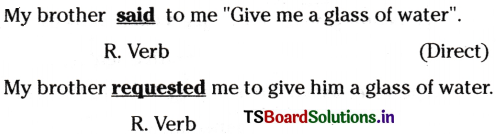
4. The quotation marks and the comma between the reporting and reported parts are removed in the indirect speech.
Ex : The boy said,” This plant has grown very tall.” (D.S.)
The boy said that that plant had grown very tall. (I.S.)
5. A suitable connecting word is used to connect the reporting and reported parts. The selection of the right connecting word needs careful observation.
| Sentence in quotation marks | Connecting word |
| 1. Assertive or Exclamatory | that |
| 2. Imperative | to |
| 3. Yes/No type Question | if or whether |
| 4. Wh’ type Question | No connecting word |
Ex:
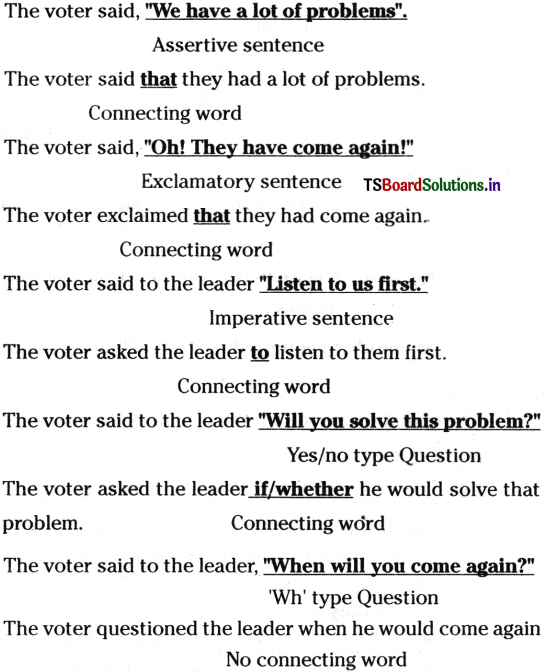
6. The pronouns in the reported part are to be changed suitably. This depends on the first speaker, the speaker’s listener, the reporter and the reporter s listener. One has to ensure that the original speaker’s intention is correctly reported.
(Indirect speech లోకి మార్చేటప్పుడు, ఎవరు ఎవరితో అన్న మాటలను తిరిగి ఎవరు ఎవరికీ చెబుతున్నారు అనేదానిని బట్టి pronouns మారతాయి. మొదట మాట్లాడిన వ్యక్తి ఉద్దేశ్యం మారకుండా సరిగ్గా చెప్పడం అవసరం.)
Now notice the following examples carefully :
a) The teacher said to you, “You are late again.” (D.S.)
The teacher told you that you were late again. (I.S.) ‘you’ not changed.
b) The teacher said to me “You have improved your performance.” (D.S.)
The teacher told me that I had improved my performance.
You → I & Your → my
c) The teacher said to Geetha, “You have to submit your assignments tomorrow.” (D.S.)
The teacher told Geetha that she had to submit her assignments the following day. (I.S.)
You → she and your → her
d) The teacher said to Prudhvi, “When will you finish your computer course” ? (D.S.)
The teacher asked Prudhvi when he would finish his computer course. (I.S.)
You → he and your → his
e) The teacher said to the students, “You must consult your parents.” (D.S.)
The teacher told the students that they should consult their parents. (l.S.)
You → they and Your → their
As the examples a, b, c, d and e show you, pronouns change in accordance with the speaker’s reference to a person / persons.
7. In changing sentences into the indirect speech, the tense form of the verbs in the reported part is to be changed. This is the most important part of the transformation. This is done in accordance with the concept popularly known as “the sequence of tenses.”
(Reported part లోని verbs tenses మార్చడం అతి ప్రధాన భాగం. దేనిని ’Sequence of tenses’ అనే నియమానుసారంగా చేయాలి.)
The following table clearly shows when and how to change the tense.
| Tense of the Reporting verb | Type of the reported sentence | Change from Tense in direct speech to tense in indirect speech (with examples) | |
| 1. Present or Future | Any type | No change He says, I can … | He says that he can |
| 2. Any tense | Universal truths | No change She said “Water saves……………… | She said that water saves |
| 3. Any tense | Imperative | No change …said close the | …… asked to close the… |
| 4. Past tense | Any type other than imperative & universal truths | Simple Present … said … is a…” | Simple Past ……said…was a… |
| 5. || | || | Present Continuous said…’is/am/are/ playing | Past Continuous … said… was/ were playing… |
| 6. || | || | Present Perfect Cont. said …”has/have answered” | Past Perfect …said… had answered |
| 7. || | || | Any type other than imperative & universal truths | Present perfect cont. said…”has/have been waiting Past perfect cont. said… had been waiting |
| 8. || | || | Simple Past said… “came…” | Past Perfect said…had come |
| 9. || | || | Past Continuous said …”were making | Past Perfect Cont. said… had been making |
| 10. || | || | Past Perfect said…”had attended | No change said had attended. |
| 11. || | || | Past Perfect Cont. said ‘had been watching…” | No change had been watching |
| 12. || | || | All future tense with modal helping verbs “will, can, may” | their past tense forms would, could, might |
| 13. || | || | Future with ‘shall’ said … “shall…” | to would said… “would” |
| 14. || | || | must | had to / should |
| 15. || | || | ought | ought |
8. The next step in the transformation from the direct to the indirect is to change the adjectives or adverbs showing ‘nearness” to those showing ‘distance’ as explained in the following table :
| Adjective / adverb in ‘direct speech’ | Adjective or adverb in ‘indirect speech’ |
| 1. this | that |
| 2. these | those |
| 3. here | there |
| 4. now | then |
| 5. today/tonight | that day / that night |
| 6. yesterday | the previous day/ the day before |
| 7. tomorrow | the next day / the following day |
| 8. ago | before |
9. The transformation from the direct to the indirect involves a change in the word order. This principle is applicable to interrogative and exclamatory sentences only. This is exemplified in the table given below.
| Word order in Direct Speech with examples | Word order in Indirect Speech with examples |
| 1. … Helping verb+subject+Main verb … said … “are you coming”… | subject + Helping verb + Main verb asked …..you were coming |
| 2. Helping verb + subject + Main verb said … do you like … | subject + …………… + Main verb asked … he …………. liked |
| 3. ‘wh’ word + adj / adv + subject + verb said “How beautiful + the toy is ….. | subject + verb + intensifier adj/adv exclaimed the toy was very beautiful. |
Note that the wh’ word in exclamatory sentences doesn’t have the meaning of a question. It just emphasises the adjective or adverb. Hence this ‘wh’ word in the direct speech becomes the intensifier ‘very’ in the indirect speech.
10. The last step in this kind of transformation is to change the Question mark’ or the ‘exclamatory mark’ into a full stop in the indirect speech.
You must note that all the Ten steps detailed above are not necessary to follow in the case of all kinds of sentences. You carefully check which steps are necessary and which steps are not necessary to follow in changing a given sentence.
Examples :
A) Statements:
1. Direct : He said to me, “I am happy to be here this evening”.
Indirect : He told me that he was happy to be there that evening.
2. Direct : He said to her, ‘I bought a house’.
Indirect : He told her that he had bought a house.
3. Direct : He said to me, ‘I shall pay your fees tomorrow.
Indirect : He told me that he would pay my fees the next day.
4. Direct : He said, The sun rises in the east’.
Indirect : He said that the sun rises in the east.
B) Questions:
1. Direct : He said, How many brothers have you ?’
Indirect : He asked me how many brothers I had.
2. Direct : “Have you no sense ?’ shouted the man.
Indirect : The man shouted if he had any sense.
3. Direct : The student asked ‘Where can I get an application form ?’
Indirect : The student enquired where he could get an application form.
4. Direct : John said ‘Will you play chess with me ?’
Indirect : John asked me whether I would play chess with him.
5. Direct : The doctor asked the patient, What did you eat today ?’
Indirect : The doctor enquired the patient what he had eaten that day.
6. Direct : Are you the manager ?’ I said.
Indirect : I asked (or enquired) whether he was the manager.
Imperative Sentences:
1. Direct : The teacher said to the boy, Get out of the room’.
Indirect : The teacher asked (or ordered) the boy to get out of the room.
2. Direct : The doctor said to the patient, Do not smoke’.
Indirect : The doctor advised the patient not to smoke.
3. Direct : Please take me to the officer’ said the visitor.
Indirect : The visitor requested them to take him to the officer.
4. Direct : Polonius said to Laertes, ‘Neither a borrower nor a lender be’.
Indirect: Polonius advised Laertes to be neither a borrower nor a lender.
5. Direct : He said, Let us wait for an hour’.
Indirect: He proposed that they should wait for an hour.
6. Direct : He said to her, ‘Don’t go out now’.
Indirect: He asked her not to go out then.
D) Exclamatory Sentences:
1. Direct : He said ‘What a fool I am !’
Indirect : He exclaimed that he was a fool.
2. Direct : ‘How selfish I have been!‘ he said.
Indirect : He exclaimed that he had been very selfish.
3. Direct : He said, ‘Alas, I am ruined!’
Indirect: He exclaimed that he was ruined.
4. Direct : He said, ‘God save the king!’
Indirect : He prayed that God might save the King.
5. Direct : ‘What a lazy girl you are!’ he said to Judy.
Indirect : He exclaimed to Judy that she was a very lazy girl.
6. Direct : ‘May our country be peaceful!’ said they.
Indirect : They expressed their wish that their country might be peaceful.
7. Direct : ‘Hurrah! I have won again’, he said.
Indirect : He exclaimed with joy that he had won again.
8. Direct : He said, ‘Alas! How foolishly have I acted!’
Indirect : He exclaimed with regret that he had acted very foolishly.
9. Direct : The captain said to the goalee, ‘Bravo ! Well done’.
Indirect: The captain applauded the goalee.
10. Direct : The frog said, ‘What a feast it was!’
Indirect: The frog exclaimed that it was a great feast.
More Examples
1. Kiran said, “I am angry.” (Direct)
Kiran said that he was angry. (Indirect)
2. Vijay said, “I’m searching for my wallet.” (Direct)
Vijay said that he was searching for his wallet. (Indirect)
3. He said, “I watched this movie last week.” (Direct)
He said that the had watched that movie the previous week. (Indirect)
4. Latha said, “I have lived here since 1970.” (Direct)
Latha said that she had lived there since 1970. (Indirect)
5. He said, “They had finished the project when I arrived.” (Direct)
He said that they had finished the project when he had arrived.” (Indirect)
6. Shreya said, “I was playing tennis when the accident occurred.” (Direct)
Shreya said that she had been playing tennis when the accident had occurred. (Indirect)
7. She said, “I have been playing the piano for two hours.” (Direct)
She said that she had been playing the piano for two hours. (Indirect)
8. Ajay said, “I had been writing a novel when the light went off.” (Direct)
Ajay said that he had been writing a novel when the light had gone off. (Indirect)
9. Vimal said, “I will shut the window.” (Direct)
Vimal said that he would shut the window. (Indirect)
10. Anji said, “I would buy Rolls Royce if I were rich.” (Direct)
Anji said that he would buy Rolls Royce if he had been rich.” (Indirect)
Exercise
Convert the following sentences into indirect speech.
Question 1.
Parnika will say, “I am not invited.”
Answer:
Parnika will say that she is not invited.
Question 2.
Our science teacher said, “Oil floats on water.”
Answer:
Our science teacher said that oil floats on water.
Question 3.
Eleanor Roosevelt said, “The future belongs to those who believe in the beauty of their dreams.”
Answer:
Eleanor Roosevelt said that the future belongs to those who believe in the beauty of their dreams.
Question 4.
Aarav said to Meghana, “You should not reveal my plan to them.”
Answer:
Aarav told Meghana that she should not reveal his plan to them.
Question 5.
Darshil said to Mayukhi, “I will meet you here tomorrow.”
Answer:
Darshil told Mayukhi that he would meet her there the next day.
Question 6.
Aarushi said, “I was watching TV at 10 pm yesterday.”
Answer:
Aarushi said that she had been watching TV at 10 pm the previous day.
Question 7.
Mahima said, “I have been studying for three hours.”
Answer:
Mahima said that she had been studying for three hours.
Question 8.
We asked the guide, “How far is the museum from here ?”
Answer:
We asked the guide how far the museum was from there.
Question 9.
Angelina said to Jennifer, “When did you submit your project ?”
Answer:
Angelina asked Jennifer when she had submitted her project.
Question 10.
Vedant asked his mother, “Can you make me a sandwich ?”
Answer:
Vedant asked his mother if she could make him a sandwich.
Question 11.
Anokhi said to Sahasra, “Do you like painting ?”
Answer:
Anokhi asked Sahasra if she liked painting.
Question 12.
Aaradhya said to her brother, “Please pass me the book.”
Answer:
Aaradhya requested her brother to pass her the book.
Question 13.
My father said to me, “Don’t waste your time.”
Answer:
My father told me not to waste my time.
Question 14.
My brother said, “Let’s go to a movie”.
Answer:
My brother suggested that we go to a movie. / My brother said that we should go to a movie.
Question 15.
The doctor said to the patient, “Wish you a speedy recovery.”
Answer:
The doctor wished the patient a speedy recovery.
Question 16.
“May God bless our country,” said the priest.
Answer:
The priest prayed that God might bless our country.
Question 17.
Jatin said, “I can solve this problem.”
Answer:
Jatin said that he could solve that problem.
Question 18.
Arunima said, “I may attend the meeting.”
Answer:
Arunima said that she might attend the meeting.
Question 19.
Yashwin said, “I must finish the report today.”
Answer:
Yashwin said that he must finish the report that day.
Question 20.
Yamini said, “I would join the team if I had time.”
Answer:
Yamini said that she would join the team if she had time.
Question 21.
The boy said, ‘‘Mom, please give me some milk.”
Answer:
The boy requested her mother to give him some milk.
Question 22.
Kishore said, “I will go to Delhi tomorrow.”
Answer:
Kishore said that he would go to Delhi the next day.
(C) Degrees of Comparison
Man craves for variety. He knows that variety is the spice of life. Hence he tries to express the same idea in various different ways. The result is the tradition of describing the quality, quantity size etc., of some thing or person in three different ways. Most adjectives and some adverbs have three different forms. They are positive, comparative and superlative. They are known as the three degrees of comparison.
(ఒక వ్యక్తి యొక్క, వస్తువు యొక్క గుణ, పరిమాణాలను మూడు భిన్న రూపాలలో వ్యక్తీకరించడం ఆనవాయితీ. ఈ రూపాలనే Degrees of comparison అని పిలుస్తారు.)
When the comparison is among a minimum of three persons/things, that can be expressed in all the three degrees. If the compared persons are two only, the superlative degree is not possible. When we talk of the quality, quantity of a single item, only positive degree is possible.
Interchange of Degrees of comparison :
Transforming one sentence from the Superlative Degree to Comparative Degree involves the following steps.
1. First, remove ‘the’ that is used before the superlative adjective, while changing it into the comparative.
2. Write the comparative form of the adjective.
3. Then, add than any other’ after the adjective.
Ex : Praveen is the youngest boy in the class. (S.D.)
Praveen is younger than any other boy in the class.(C.D.)
To change that sentence into the positive :
1. Begin the sentence with No other’.
2. Secondly, place the phrase after the superlative adjective after No other’.
3. Use ‘so + adj in positive Degree + as’ after the verb.
4. Place the subject in the S.D after ‘as’ in P.D.
Ex : He is the richest man in our town. (S.D.)

Transforming one sentence from the superlative Degree to comparative or positive Degree involves the following steps.
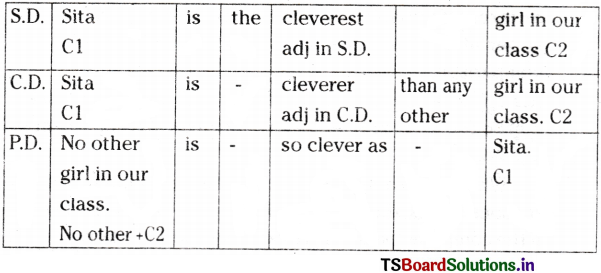
Sentences with one of phrase in the Superlative degree follow a slightly different wording. This is as explained here under.
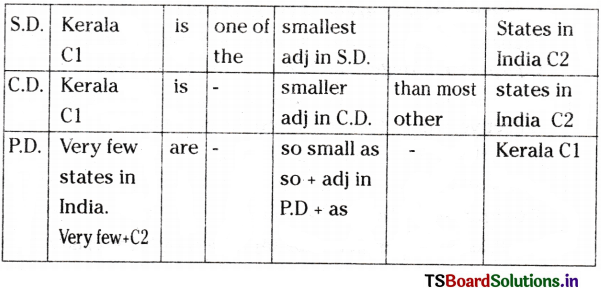
Some sentences show the comparison between only two things / persons. In such cases, the superlative is not possible. The interchange is made as shown here.
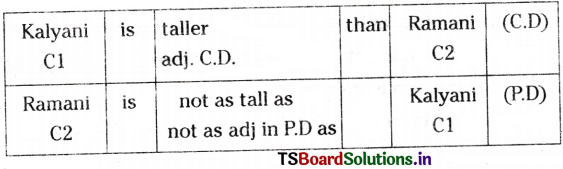
Examples:
I.
Question 1.
Bengaluru is as cool as Ooty. (Into Comparative)
Answer:
Ooty is not cooler than Bengaluru.
Question 2.
Australia is the biggest island in the world. (Into other degrees)
Answer:
i) Australia is bigger than any other island in the world. (Comparative)
ii) No other island in the world is so big as Australia. (Positive)
Question 3.
The moon is brighter than the stars. (Into Positive)
Answer:
The stars are not so bright as the moon.
Question 4.
There is no vice so bad as drink. (Into Comparative)
Answer:
Drink is worse than any other vice.
Question 5.
Kashmir is the most beautiful place in India. (Into other degrees)
Answer:
i) No other place in India is so beautiful as Kashmir. (Positive)
ii) Kashmir is more beautiful than any other place in India. (Comparative)
Question 6.
Silver is not so precious as gold. (Into Comparative)
Answer:
Gold is more precious than silver.
Question 7.
}Rumble is one of the ablest bowlers. (Into other degrees)
Answer:
i) Very few bowlers are so able as Kumble. (Positive)
ii) Kumble is abler than most other bowlers.(Comparative)
Question 8.
The lion is more ferocious than any other animal. (Into other degrees)
Answer:
i) The lion is the most ferocious of all the animals. (S.D)
ii) No other animal is so ferocious as the lion. (P.D)
Question 9.
The sword is not so mighty as the pen.(Into Comparative)
Answer:
The pen is mightier than the sword. (C.D)
Question 10.
Copper is more useful than most other metals. (Into other degrees)
Answer:
i) Copper is one of the most useful metals. (S.D)
ii) Very few metals are so useful as copper. (P.D)
Question 11.
Mount Everest is higher than any other peak in the world. (Into other degrees)
Answer:
i) Mount Everest is the highest of all the peaks in the world. (S.D)
ii) No other peak in the world is so high as Mount Everest. (P.D)
Question 12.
I like you better than him. (Into Positive)
Answer:
I don’t like him as well as I like you. (P.D)
Question 13.
A deer runs faster than a horse. (Into Positive)
Answer:
A horse does not run so fast as a deer. (P.D)
Question 14.
Sangeetha is the tallest girl in the class. (Into Positive)
Answer:
No other girl in the class is so tall as Sangeetha. (P.D)
Question 15.
This is one of the most powerful earthquakes that occurred. (Into other degrees)
Answer:
i) This is more powerful than most other earthquakes that occurred. (C.D)
ii) Very few earthquakes that occurred are as powerful as the earthquake. (PD)
More Examples
Question 1.
Yashwant is not so tail as Praneeth. (Positive)
Answer:
Praneeth is taller than Yashwanth. (Comparative)
Not possibile. (Superlative)
Question 2.
Few other/very few boys are at least as tall as Praneeth. (Positive)
Answer:
Praneeth is taller than most other boys.
Praneeth is one of the tallest boys.
Question 3.
No other boy is so tall as Praneeth. (Positive)
Answer:
Praneeth is taller than any other boy. (Comparative)
Praneeth is the tallest boy. (Superlative)
Question 4.
Mumbai is bigger than Hyderabad. (Comparative)
Hyderabad is not so/as big as Mumbai. (Positive)
Question 5.
Mumbai is one of the biggest cities in the world. (Superlative)
Mumbai is bigger than most other cities in the world. (Comparative)
Few other cities in the world are as big as Mumbai. (Positive)
Question 6.
Mumbai is the biggest city in India. (Superlative)
Mumbai is bigger than any other city in India.(Comparative) No other city in India is so/as big as Mumbai. (Positive)
Exercise for Practice
Fill in the blanks with the correct form of the adjective in parentheses.
Question 1.
Chinnodu is the ___________ (small) of the three friends.
Answer:
smallest
Question 2.
Peddodu says he is ___________ (brave) than Chinnodu.
Answer:
braver
Question 3.
Bheemudu is the ___________ (tall) and the ___________ (strong) of all.
Answer:
tallest, strongest
Question 4.
Chinnodu finds a rock and says it is ___________ (big) any other rocks he’s ever seen.
Answer:
bigger
Question 5.
The water in the stream feels ___________ (cold) than they expected.
Answer:
colder
Question 6.
Bheemudu says he is the ___________ (brave) because he’s not even cold!
Answer:
bravest
Question 7.
In the meadow, Chinnodu thinks the flowers are the ___________ (pretty) he’s ever seen.
Answer:
prettiest
Question 8.
Peddodu finds a yellow flower and says it is ___________ (pretty) than the others.
Answer:
prettier
Question 9.
Bheemudu spots a purple flower and claims it’s the ___________ (pretty) flower of all.
Answer:
prettiest
Question 10.
At the end of the day, Chinnodu says he is the ___________ (tired) of the three.
Answer:
most tired
Question 11.
Peddodu yawns and says he’s even ___________ (tired) than Chinnodu.
Answer:
more tired
Question 12.
Bheemudu believes he is the ___________ (tired) because he walked the farthest.
Answer:
most tired
Exercise
Rewrite the sentences according the clues given in the brackets.
Question 1.
Rahul is one of the cleverest boys in the class.
(Convert into Comparative and Positive)
Answer:
Comparative: Rahul is cleverer than most other boys in the class.
Positive : Very few boys in the class are as clever as Rahul.
Question 2.
No other English poet is so great as Milton.
(Rewrite using ‘greater’ and ‘greatest’)
Answer:
Comparative: Milton is greater than any other English poet.
Superlative : Milton is the greatest of all English poets.
Question 3.
Keerthana is more intelligent than any other girl in the class.
(Convert into Superlative and Positive)
Answer:
Superlative: Keerthana is the most intelligent girl in the class.
Positive : No other girl in the class is as intelligent as Keerthana.
Question 4.
Very few towns are as much popular as Varanasi.
(Convert into Comparative and Superlative)
Answer:
Comparative : Varanasi is more popular than most other towns.
Superlative : Varanasi is one of the most popular towns.
Question 5.
Chennai is hotter than Mumbai. (Convert into Positive)
Answer:
Positive : Mumbai is not as hot as Chennai.
Question 6.
Hercules was stronger than any other man.
(Rewrite using ‘strongest’ and ‘strong’)
Answer:
Superlative : Hercules was the strongest man.
Positive : No other man was as strong as Hercules.
Question 7.
He is more like his father than his mother. (Convert into Positive)
Answer:
Positive : He is not as like his mother as he is like his father.
Question 8.
No other animal is so faithful as the dog.
(Convert into Comparative and Superlative)
Answer:
Comparative: The dog is more faithful than any other animal.
Superlative : The dog is the most faithful of all animals.
Question 9.
Mount Everest is higher than any other peak in the world.
(Rewrite using ‘highest’ or ‘high’ instead of ‘higher’)
Answer:
Superlative : Mount Everest is the highest peak in the world.
Positive : No other peak in the world is as high as Mount Everest.
Question 10.
Apples are not so cheap as oranges. (Convert into Comparative)
Answer:
Comparative : Oranges are cheaper than apples.
Question 11.
Manasa sings the best.
(Convert into Comparative and Positive)
Answer:
Comparative : Manasa sings better than all others.
Positive : No one sings as well as Manasa.
Question 12.
Vivekananda was more popular than most other Indian saints.
(Convert into Positive and Superlative)
Answer:
Positive : Very few Indian saints were as popular as Vivekananda.
Superlative: Vivekananda was one of the most popular Indian saints.
Question 13.
No one sings so much beautifully as Chitra.
(Rewrite using ‘better’ and ‘best’)
Answer:
Comparative : Chitra sings better than anyone else.
Superlative : Chitra sings the best of all.
Question 14.
Julie is not as pretty as her sister. (Rewrite using ‘prettier’)
Answer:
Comparative : Her sister is prettier than Julie.
Question 15.
Judith painted better than all other participants.
(Convert into Positive and Superlative)
Answer:
Positive : No other participant painted as well as Judith.
Superlative : Judith was the best painter among all the participants.
Question 16.
Sudha sings the best of all. (Write the Positive Degree)
Answer:
No other girl (person) sings as well as she does.
Question 17.
Very few plays are as much as popular as ‘Julius Caesar’.
(Write the Superlative Degree)
Answer:
‘Julius Caesar’ is one of the most popular plays.
(D) Clause Analysis and Synthesis of Sentences
Words are grouped into bigger units in various ways. Depending on their parts and function, the word groups are classified into phrases, clauses and sentences.
(పదసమూహాలలోని భాగాలను, వాటి విధులను అనుసరించి పదసముదాయాలను phrases, clauses and sentences అని వర్గీకరిస్తారు.)
A word group that has no subject, predicate distinction is called the phrase.
Ex: a clever boy (word group – no subject predicate division)
an old house – will have been completed.
A word group that has one subject and one predicate (and only one) with complete or incomplete sense is known as the clause.
Note -1: A predicate is finite verb + something. Therefore, if there is a finite verb in a group of words, that group of words can be identified as a clause.
Note – 2 : To infinites and present participles or past participles without a helping verb before them are not finite verbs. Therefore, they cannot make a group of words a clause.
Ex : I want to go. (To go – not finite – not a clause)
Seeing the police, the crowd dispersed. (Seeing-present participle-No H.V.)
Dejected, she started crying. (Dejected-p.p. No H.V.)
A group of words with one or more subjects and with complete sense is termed as the sentence.
Clauses are of two types. Clauses that have complete sense are main clauses. Clauses that have incomplete sense are subordinate clauses.
Depending on the number of clauses in a sentence and their type, sentences are divided into three kinds.
1. The Simple Sentence: A sentence which contains one main clause and no subordinate clause is called a Simple sentence. It has only one subject and one predicate.
Eg : – The sun rises in east.
1 saw a lion in the zoo.
She completed her work.
2. The Complex Sentence : A sentence which contains one main clause and one or more subordinate clauses is called a Complex sentence.
Eg : – A man, who is dead, tells no lies.
Although she is poor, she is honest.
Where there is a will, there is a way.
3. The Compound Sentence : A sentence which has two or more main clauses is a Compound sentence.
Eg:- Do it or leave it.
She took her dinner and went to bed.
They painted the wall but the paint was washed off.
Conversion from one type of sentence into another requires changing a phrase into a clause or vice versa.
- Simple to compound – a phrase into a main clause.
- Simple to complex – a phrase into a subordinate clause. Compound to simple – a main clause into a phrase.
- Complex to simple – a subordinate clause into a phrase Compound to complex – a main clause into a subordinate clause.
- Complex to compound – a subordinate clause into a main clause.
Conversion of phrases into clauses or vice versa cannot be reduced into a set of simple rules. Hence one has to practise with keen observation the transformation of simple, complex and compound sentences. However, the following lists of words will be of some help to the learners.
The correct use of the following words will help the learner construct a compound sentence.
and, but, then, or, so, yet, still, either or neither… nor; not only … but also; otherwise, else, therefore.
The words listed below are useful in writing complex sentences.
as, though, although, that, so…that, as soon as; as…as, who, what, when, where, which
(Note : ‘So’ is used both in compound and complex sentences. In complex sentences, ‘So’ is followed by “that”.)
The following phrases are helpful in writing simple sentences.
in spite of; besides, owing to; on account of; in the event of, present participles, past participles’ without helping verbs.
Examples:
I. Conversion of Simple Sentences to Compound
1. By using ‘and’:
e.g.: i) Putting off his clothes, he plunged into the river. (Simple)
He put off his clothes and plunged into the river. (Compound)
ii) The farmer went home at sun set. (Simple)
The sun set and the farmer went home.(Compound)
2. By using ‘not only …………… but also’:
e.g.: i) Besides being handsome, she is intelligent. (Simple)
She is not only handsome, but also intelligent. (Compound)
ii) In addition to useful advice, he gave me financial help. (Simple)
He gave me not only useful advice but also financial help. (Compound)
3. By using but, still, yet, etc :
e.g.: i) In spite of hard work, he could not succeed. (Simple)
He worked hard but he could not succeed. (Compound)
ii) In spite of very bad weather, they marched on. (Simple)
The weather was very bad, still they marched on. (Compound)
iii) Not withstanding her poverty, I love her. (Simple)
She is poor, yet I love her. (Compound)
4. By using conjunctions like or, otherwise, else, so, therefore, etc.
e.g.: i) You must pay the fine to get your scooter back. (Simple)
You must pay the fine or you won’t get your scooter back. (Compound)
ii) I would have been robbed but for the timely help of the policeman. (Simple)
The policeman gave me timely help, otherwise I would have been robbed. (Compound)
iii) She failed on account of her laziness. (Simple)
She was lazy, so she failed. (Compound)
iv) I was pleased with him for his honesty. (Simple)
He was honest, therefore 1 was pleased with him. (Compound)
II. Conversion of Compound Sentences into Simple
1, By using a participle :
e.g.: i) His wife died and this added to his misery. (Compound)
His wife died adding to his misery. (Simple)
ii) The players were tired and they decided to stop the play. (Compound)
Having been tired, the players decided to stop the play. (Simple)
2. By using a prepositional phrase :
e.g.: i) He is rich, yet he is not happy. (Compound)
In spite of his being rich, he is not happy.(Simple)
ii) The film is not only interesting but also it conveys a moral. (Compound)
Besides being interesting, the film conveys a moral. (Simple)
III. Conversion of Simple Sentences into Complex Sentences
By expanding a word or a phrase into a clause :
e.g.: i) He pleaded ignorance of the law. (Simple)
He pleaded that he was ignorant of the law. (Complex)
ii) A dead man tells no lies. (Simple)
A man, who is dead, tells no lies. (Complex)
iii) Immediately on reading the telegram, she wept. (Simple)
As soon as she read the telegram, she wept. (Complex)
iv) Being rich, he can buy two cars. (Simple)
As he is rich, he can buy two cars. (Complex)
v) He is working hard to get rank. (Simple)
He is working hard so that he may get rank. (Complex)
vi) The typist worked to the best of his ability. (Simple)
The typist worked as best as he could. (Complex)
vii) In spite of all his riches, he is not happy. (Simple)
Although he is rich, he is not happy. (Complex)
IV. Conversion of Complex Sentences to Simple Sentences
By Converting a clause into a word or a phrase :
e.g.: i) lam responsible for what I do. (Complex)
I am responsible for my actions. (Simple)
ii) The boy proved that he was brilliant. (Complex)
The boy proved his brilliance! (Simple)
iii) As he was ill, he stayed at home. (Complex)
He stayed at home on account of his illness .(Simple)
iv) When the teacher went out, the pupils made a lot of noise. (Complex)
The pupils made a lot of noise in the absence of the teacher. (Simple)
V. Conversion of Compound Sentences to Complex
1. Sentences containing the cumulative conjunction.
e.g.: i) He wanted to win the prize and worked hard .(Compound)
He worked hard so that he might win the prize.(CompIex)
ii) Go to the dentist and he will pull out your painful tooth. (Compound)
If you go to the dentist, he will pull out your painful tooth. (Complex)
2. Sentences containing alternative conjunctions like but, still, nevertheless, however, or otherwise, else, either ………… or, etc.
e.g.: i) Do it or you will suffer. (Compound)
Unless you do it, you will suffer. (Complex)
ii) I have known her for many years but I have never seen her. (Compound)
Although I have known her for many years, I have never seen her. (Complex)
iii) His parents were poor, still they gave him the best education. (Compound)
Though his parents were poor, they gave him the best education. (Complex)
iv) Hurry up, otherwise you will be lat^.(Compound)
Unless you hurry up, you-will be late. (Complex)
VI. Conversion of Complex Sentences to Compound
1. By using cumulative conjunction ‘and’:
e.g.: i) Everybody knows that death is inevitable.(Complex)
Death is inevitable and everybody knows it. (Compound)
ii) I am happy that you have come. (Complex)
You have come and I am happy for it. (Compound)
2. By using alternative conjunction ‘but’:
e.g.: i) Although we lost the match, we fought bravely.(Complex)
We lost the match but we fought bravely/Compound)
ii) I have found my pen that I had lost. (Complex)
I had lost my pen but I have found it. (Compound)
3. By using alternative conjunction ‘or’:
e.g.: i) Unless you control your anger, you won’t prosper. (Complex)
Control your anger or you won’t prosper. (Compound)
4. By using illusive conjunctions like so, therefore etc.,
e.g.: i) As he wants to be a doctor, he has taken Bi.P.C. (Complex)
He wants to be a doctor, therefore, he has taken Bi.P.C. (Compound)
ii) They took rest because they were tired. (Complex)
They were tired, so they took rest. (Compound)
A single sentence can be changed from one form into two other forms as seen above. Similarly, two simple sentences can be synthesised to form one simple, complexor compound sentence.
I. The following examples will illustrate the synthesis.
i) By using a participle
A participle is commonly used when the subjects of the two sentences are the same.
For example,
He was tired, He lay down on the sofa.
Being tired, he lay down on the sofa.
ii) By using a prepositional phrase (The preposition is followed by a noun.)
For example,
The magician made a flower. He used colour papers.
The magician made a flower with colour papers.
iii) By using an adverb or adverb phrase
For example,
He signed the agreement. That was foolish.
He foolishly signed the agreement.
iv) By using an infinitive
For example,
You must hurry. You will catch the train.
You must hurry to catch the train.
II. Two or more simple sentences can be combined into a compound sentence by making use of coordinating or correlative conjunctions.
For example,
His parents could not persuade him to give up smoking. Neither could I.
Neither his parents nor I could persuade him to give up smoking.
He was unwell. He attended office.
He was unwell, however, he attended office.
III. Two or more simple sentences can be combined into a complex sentence making use of subordinating conjunctions or relative pronouns and relative adverbs which act as subordinating conjunctions.
For example,
I said something, Ashwin did not listen to it.
Ashwin did not listen to what I said.
She was rich. She was not popular.
Although she was rich, she was not popular.
Examples
1. Advaith Reddy was late but he worked hard. (Compound Sentence)
Though Advaith Reddy was ill he worked hard. (Complex Sentence)
In spite of being ill, Advaith Reddy worked hard. (Simple Sentence)
2. Ram had high fever, so he was at home. (Compound)
As Ram had high fever he stayed at home. (Complex)
Because of high fever Ram stayed at home. OR (Simple)
Having high fever Ram stayed at home. (Simple)
3. Get up early or you can’t catch the train. (Compound)
If you get up early, you can catch the train. OR (Complex)
Unless you get up early, you can’t catch the train. (Complex)
Get up early to catch the train. OR (Simple)
Without getting up early, you can’t catch the train .(Simple)
4. The tree not only gives fruit, but also gives good shade. (Compound)
The tree gives good shade although it mainly gives fruit. (Complex)
Besides giving fruit, the tree gives good shade. (Simple)
More Examples
Rewrite the sentences combining them with the words given in the brackets.
Question 1.
It was cloudy. I went with an umbrella. (as)
Answer:
I went with an umbrella as it was cloudy.
Question 2.
Jhansi is a queen. She is an archer, (not only… but also)
Answer:
Jhansi is not only a queen, but also an archer.
Question 3.
She was tired. She continued to stitch the dress for me. (although)
Answer:
Although she was tired, she continued to stitch the dress for me.
Question 4.
He came to the hotel. He did not eat anything. (however)
Answer:
He came to the hotel; however, he did not eat anything.
Question 5.
That lady is very old. She cannot walk quickly, (too.. to)
Answer:
That lady is too old to walk quickly.
Question 6.
He saw the principal. He started studying. (Seeing)
Answer:
Seeing the principal, he started studying.
Question 7.
I have appointed an attendant. He will look after my grandfather, (to infinitive)
Answer:
I have appointed an attendant to look after my grandfather.
Question 8.
She is very short. She cannot pluck the fruit, (so… that)
Answer:
She is so short that she cannot pluck the fruit.
Question 9.
We must make it fast. The class will begin. (else)
Answer:
We must make it fast, else the class will begin.
Question 10.
My task is over. I want to go to a movie, (so)
Answer:
My task is over, so I want to go to a movie.
Exercise for Practice
Rewrite the sentences as directed in the parentheses.
Question 1.
In spite of facing many setbacks, he didn’t lose hope. (Change into compound and complex)
Answer:
Compound: He faced many setbacks, but he didn’t lose hope.
Complex : Although he faced many setbacks, he didn’t lose hope.
Question 2.
Although she is an illiterate, she speaks English well. (Change into simple and compound)
Answer:
Simple : Despite being an illiterate, she speaks English well.
OR
In spite of being an illiterate, she speaks English well.
Compound: She is an illiterate, but she speaks English well!
Question 3.
Speak the truth, or I will kill you. (Change into simple and complex)
Answer:
Simple : You must speake the truth to avoid being killed.
Complex : If you do not speak the truth, I will kill you.
Question 4.
If you work hard, you will get first class. (Change into compound and simple)
Answer:
Compound : Work hard, and you will get first class.
Simple : By working hard, you will get first class.
Question 5.
He is strong so he can lift heavy weights. (Change into simple and complex)
Answer:
Simple : Being strong, he can lift heavy weights.
Complex : Because he is strong, he can lift heavy weights.
Question 6.
Owing to his intelligence, he became an IAS officer. (Change into compound and complex)
Answer:
Compound : He was intelligent, and so he became an IAS officer.
Complex : Because he was intelligent, he became an IAS officer.
Question 7.
He finished his meal and went to work. (Change into complex and simple)
Answer:
Complex : After he finished his meal, he went to work.
Simple : Having finished his meal, he went to work.
Question 8.
The chief guest having taken his seat on the dais, the meeting began. (Change into complex and compound)
Answer:
Complex : After the chief guest had taken his seat on the dais, the meeting began.
Compound : The chief guest took his seat on the dais, and the meeting began.
Question 9.
Shrestha is too shy to face strangers. (Change into complex and compound)
Answer:
Complex: Shrestha is so shy that she cannot face strangers.
Compound : Shrestha is very shy, and she cannot face strangers.
Question 10.
Your writing is so illegible that I cannot understand it. (Change into compound and simple)
Answer:
Compound: Your writing is illegible, and I cannot understand it.
Simple : Your writing is too illegible to understand.
Question 11.
Lucy saw a wounded rabbit. (Change into complex)
Answer:
Complex: Lucy saw a rabbit that was wounded
Question 12.
The police recovered the child that was lost. (Change into simple)
Answer:
Simple : The police recovered the lost child.
Question 13.
Take care when crossing the road. (Change into complex)
Answer:
Complex : Take care when you are crossing the road.
Question 14.
We eat that we may live. (Change into simple)
Answer:
Simple : We eat to live.
Question 15.
No sooner did he see us than we disappeared into the night.
(Use ‘Hardly / Scarcely – when ’ or ‘As soon as ’)
Answer:
Hardly had he seen us when we disappeared into the night.
Scarcely had he seen us when we disappeared into the night.
As soon as he saw us, we disappeared into the night.
Question 16.
Scarcely had he entered the room when the clock struck twelve. (Use ‘No sooner – than/As soon as/Hardly – when ’)
Answer:
No sooner had he entered the room than the clock struck twelve.
As soon as he entered the room, the clock struck twelve.
Hardly had he entered the room when the clock struck twelve.
Question 17.
As soon as the thief saw the policeman coming, he took to his heels. (Use No sooner-than, Scarcely/Hardly – when ’)
Answer:
No sooner did the thief see the policeman coming than he took to his heels.
Scarcely had the thief seen the policeman coming when he took to his heels.
Hardly had the thief seen the policeman coming when he took to his heels.
Exercise
Two or more simple sentences can be combined with the help of coordinating conjunctions like, and, therefore, otherwise, as well as, either – or, neither – nor, not only – but also.
Question 1.
They went to the showroom. They bought a car. (Combine with ‘and’)
Answer:
They went to the showroom and bought a car.
Question 2.
The bag was heavy. I couldn’t carry it. (Combine with ‘therefore ’)
Answer:
The bag was heavy; therefore, I couldn’t carry it.
Question 3.
Run fast. You will miss the train. (Combine with ‘otherwise’)
Answer:
Run fast; otherwise, you will miss the train.
Question 4.
Siraj plays hockey. He plays cricket. (combine with ‘as well as ’)
Answer:
Siraj plays hockey as well as cricket.
Question 5.
Ramani is lazy. She is dull. (Combine with ‘either-or’)
Answer:
Ramani is either lazy or dull.
Question 6.
My father doesn’t smoke. He doesn’t drink. (Combine with ‘neither – nor)
Answer:
My father neither smokes nor drinks.
Question 7.
He was a boxer. He lectured at a university. (Combine with ‘not only – but also’)
Answer:
He was not only a boxer but also a university lecturer.
Question 8.
Besides being a singer, she is a dancer. (Combine with ‘not only – but also’)
Answer:
She is not only a singer but also a dancer.
Question 9.
She danced beautifully. I played the piano. (Combine with ‘while’)
Answer:
While she danced beautifully, I played the piano.
Question 10.
She had the required qualifications but she did not get the job. (Change into simple and complex)
Answer:
Simple : In spite of having the required qualifications, she did not get the job.
Complex : Though she had the required qualifications, she did not get the job.
Question 11.
Though she was poor, she would never ask for help. (Change into simple and compound)
Answer:
Simple : In spite of being poor, she would never ask for help.
Compound : She was poor, but she would never ask for help.
Question 12.
Unless he makes the payment in time, his house will be confiscated. (Change into compound and simple)
Answer:
Compound: He must make the payment in time, or his house will be confiscated.
Simple: Failing to make the payment in time, he will have his house confiscated.
Question 13.
Hire a taxi and you will not miss the bus. (Change into complex and simple)
Answer:
Complex : If you hire a taxi, you will not miss the bus.
Simple : By hiring a taxi, you will not miss the bus.
Question 14.
The visitors arrived so we all stood up. (Change into simple and complex)
Answer:
Simple : On the arrival of the visitors, we all stood up.
Complex : When the visitors arrived, we all stood up.
Question 15.
As it was very cold, we stayed indoors. (Change into simple and compound)
Answer:
Simple : Owing to the extreme cold, we stayed indoors.
Compound : It was very cold, so we stayed indoors.
Question 16.
I did not know what to do and called the doctor. (Change into complex and simple)
Answer:
Complex : As I did not know what to do, I called the doctor.
Simple : Not knowing what to do, I called the doctor.
Question 17.
When he heard a cry, he rushed into the room. (Change into compound and simple)
Answer:
Compound : He heard a cry and rushed into the room.
Simple : Hearing a cry, he rushed into the room.
Question 18.
The problem was very difficult and so no one could solve it. (Change into complex and simple)
Answer:
Complex : As the problem was very difficult, no one could solve it.
Simple : Due to the difficulty of the problem, no one could solve it.
Question 19.
The box was so heavy that I couldn’t lift it. (Change into compound and simple)
Answer:
Compound : The box was very heavy, so I couldn’t lift it.
Simple : The box was too heavy for me to lift.
Question 20.
A blind man needs help. (Change into complex)
Answer:
Complex : A man who is blind needs help.
Question 21.
The injured were taken to the nearest hospital. (Change into complex)
Answer:
Complex: Those who were injured were taken to the nearest hospital.
Question 22.
The students hope to pass the exams. (Change into complex)
Answer:
Complex: The students hope that they will pass the exams.
Question 23.
Please wait until told to proceed. (Change into complex)
Answer:
Complex : Please wait until you are told to proceed.
Question 24.
The box is too heavy for me to carry.(Change into complex)
Answer:
Complex : The box is so heavy that I cannot carry it.
(E) Question Tag
Question tags are short questions added to statements.
They seek confirmation or agreement. (ఏకీభావాన్ని లేదా ధృవీకరణను ఆశిస్తూ, ఒక వాక్యాన్ని అనుబంధంగా చేర్చిబడే చిన్న ప్రశ్నలే Question tags.)
Question tags have a fixed structure. It can be represented as:
Helping verb + (n’t) + pronoun?
((n’t) in brackets means it is optional.)
e.g. 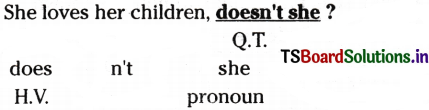
1. While constructing a tag, selecting the suitable helping verb is the first and the most important step. If the given sentence has a helping verb, then that helping verb is used in the tag too.
Eg: She has answered all the questions, hasn’t she ?
has → Helping Verb in the sentence used in the tag too.
The sentence doesn’t have a helping verb, if the verb is either in the simple present or in the simple past and in the affirmative, in case of the simple present, the suitable helping verb is “do/does”. If the verb in the sentence is in the simple past, then we must use did’ in the tag.
Eg: a) She hates smokers, doesn’t she ?
hates → Simple present, hence does’ in tag.
b) They grow vegetables, don’t they ?
Simple present
c) He sold his car, did n’t he ?
Sold – Simple past; hence ‘did’ in tag.
2. The second step is to decide whether to use ‘n’t’ or not. The guiding principle is quite simple. If the given sentence doesn’t have ‘no/not, use n’t is the tag. If the given sentence has ‘no/not’, then the tag doesn’t have n’t’.
Eg : a) He was sleeping in the class, was n’t he ?
‘not’ is not used n’t’ in the tag.
b) They don’t grow rice, do they ?
‘n’t’ in sentence ‘n’t’ not used in tag
Remember to use the short form n’t’ in the tag.
3. The last part of the tag is a pronoun. This corresponds to the subject of the given sentence. If the subject of the sentence is a pronoun, the same pronoun is used in the tag. If the sub¬ject is a noun, select a suitable pronoun as shown below.
| Subject in the sentence | Pronoun used in the tag |
| 1. Name of a man | he |
| 2. Name of a woman | she |
| 3. Name of a single thing | it |
| 4. Name referring to a group of persons, places, things | they |
Eg : a) Gourav is a good cricketer, isn’t he ?
b) Sanya Mirza played well, didn’t she ?
c) Ooty is a beautiful hill station, isn’t it ?
d) Mangoes aren’t good this season, are they ?
4. Note that ‘amn’t is not used. Instead, aren’t is used.
Eg : I am rather slow, aren’t I ?
5. Imperative sentences take will’ as the helping verb in the tags.
Eg : a) Close the door, won’t you? (will + n’t = won’t)
b) Don’t leave the place, will you ?
6. Sentences expressing proposals with the help of “Let us ” have for their tags “Shall we ?”
Eg : Let us walk fast, shall we ?
Examples
1. The boys are playing in the hot sun, aren’t they?
2. The girls have sung well, haven’t they?
3. Hari has not learnt well, has he?
4. Hari is one of the cleverest students, isn’t he?
5. Gouri was not good at Mathematics in her S.S.C, was she?
6. Children were playing at that time, weren’t they?
7. Charan did not meet the principal, did he ?
8. Students do not use their mind power properly, do they?
9. Your mother does not become angry easily, does she?
10. Communication skills will help you a lot, won’t they?
11. He should complete the syllabus in time, shouldn’t he?
12. Reshma cannot solve this problem, can she?
13. He shall see me tomorrow, shan’t he?
14. We have never seen him before, have we?
15. There is no time to spend with them, is there?
16. I am your lecturer, aren’t I?
17. Indu and Bhargavi work hard, don’t they?
18. Ramesh treats reading a physical activity, doesn’t he?
19. Prasad spoke to Murali well, didn’t he?
20. Ravi and Ramesh seldom agree with each other, do they ?
21. He hardly helps others, does he?
22. She scarcely responded to my call, did she?
23. I am not invited, am I?
24. Let’s have a cup of tea, shall we?
25. Let me see your photograph, will you?
Exercise
Add suitable question tags to each of the following sentences given below.
Question 1.
You can’t speak Tamil, _________ ?
Answer:
can you?
Question 2.
Children often play video games on smartphones, _________ ?
Answer:
don’t they?
Question 3.
There aren’t any spiders in the bedroom, _________ ?
Answer:
are there?
Question 4.
He could always borrow the money, _________ ?
Answer:
couldn’t he?
Question 5.
They won’t tell anyone, _________ ?
Answer:
will they?
Question 6.
That was amazing, _________ ?
Answer:
wasn’t it?
Question 7.
I’m quite busy with my schedule today, _________ ?
Answer:
aren’t I?
Question 8.
They hadn’t been to the States before, _________ ?
Answer:
had they?
Question 9.
My father works at the art theatre, _________ ?
Answer:
doesn’t he?
Question 10.
Open the door, _________ ? (polite)
Answer:
will you?
Question 11.
Let’s go to the beach, _________ ?
Answer:
shall we?
Question 12.
Be quiet, _________ ? (irritation)
Answer:
will you?
Question 13.
John and Mary admire each other, _________ ?
Answer:
don’t they?
Question 14.
One shouldn’t say things like that, _________ ?
Answer:
should one?
Question 15.
Owing to the menace of mosquitoes, none of us slept well last night, _________ ?
Answer:
did we?
Question 16.
Don’t spend too much on trifles, _________ ?
Answer:
will you?
Question 17.
Nobody cares how I feel. _________ ?
Answer:
do they?
Question 18.
I think she’s from Chennai, _________ ?
Answer:
isn’t she?
Question 19.
Have another dosa. _________ ?
Answer:
won’t you?
Question 20.
A little progress has been made, _________ ?
Answer:
hasn’t it?
Question 21.
Sivamani plays the drum well. _________ ?
Answer:
doesn’t he?
Question 22.
I can lift this box, _________ ?
Answer:
can’t I ?