
Reviewing AP Inter 2nd Year Botany Study Material Chapter 1 Sexual Reproduction in Flowering Plants Questions and Answers can help students prepare confidently for exams.
AP Inter 2nd Year Botany 1st Lesson Sexual Reproduction in Flowering Plants Questions and Answers
IV. Very Short Answer Questions
Question 1.
Name the parts of an angiosperm flower where the development of male and female gametophytes takes place?
Answer:
- The male gametophyte develops from microspores inside the anther.
- The female gametophyte develops from the megaspore inside the ovule of the ovary.
Question 2.
What is the role of tapetum in the development of pollen grains?
Answer:
- The tapetum supports pollen development by supplying nutrients and enzymes to the developing microspores.
- It also helps in the growth and maturation of pollen grains.
Question 3.
Which cells are present in a pollen grain when it is shed at the three-celled stage?
Answer:
A pollen grain released at the three-celled stage contains one vegetative (tube) cell, Two male gametes (sperm cells).

Question 4.
Name the component cells of the egg apparatus in an embryo sac.
Answer:
The egg apparatus consists of three cells:
- One egg cell,
- Two synergids.
Question 5.
What is meant by monosporic development of the female gametophyte?
Answer:
Formation of the embryo sac from one functional megaspore is called monosporic development.
Question 6.
Differentiate between cleistogamy and chasmogamy?
Answer:
| Cleistogamy | Chasmogamy |
| 1) Flowers remain closed. | 1) Flowers open normally. |
| 2) Usually results in self-pollination. Examples: Viola, Oxalis | 2) Usually results in cross-pollination. Examples: Hibiscus, Jasmine |
Question 7.
Differentiate between geitonogamy and xenogamy?
Answer:
| Geitonogamy | Xenogamy |
| 1) Transfer of pollen between different flowers of the same plant. | 1) Transfer of pollen between flowers of different plants. |
| 2) Produces little or no genetic variation. Examples: Maize, Cucurbits | 2) Produces genetic variation. Examples: Papaya, Date Palm |
Question 8.
How does pollination occur in water plants?
Answer:
Pollination in aquatic plants occurs in two ways:
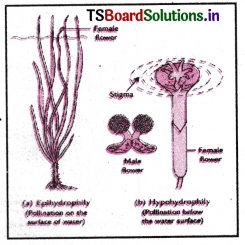
- Epihydrophily: Pollination takes place on the water surface. Ex: Vallisneria
- Hypohydrophily: Pollination takes place below the water surface. Ex: Zostera
Question 9.
What is self-incompatibility?
Answer:
- Self-incompatibility is the inability of pollen grains to germinate or grow on the stigma of the same flower or a genetically similar flower.
- Ex: Brassica
Question 10.
Name the parts of the pistil that develop into fruit and seeds.
Answer:
- After fertilization, the ovary enlarges and develops into the fruit.
- The ovules develop into seeds.
Question 11.
What is meant by polyembryony?
Answer:
- Polyembryony is the formation of more than one embryo inside a single seed.
- These embryos may arise from the zygote or from other tissues such as the nucellus or integuments. Ex: Citrus, Mango.
Question 12.
What is scutellum? In which type of seeds is it found?
Answer:
- Scutellum is a large, shield-shaped cotyledon present in the embryo.
- It is found in monocot seeds, especially in grasses.
V. Short Answer Questions
Question 1.
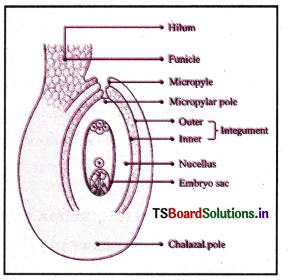
With the help of a neat labelled diagram, describe the structure of megasporangium?
Answer:
The megasporangium (ovule) is a small reproductive structure present inside the ovary of a flower. An atypical angiosperm ovule consists of the following parts:
- Funicle: The funicle is the stalk that connects the ovule to the placenta.
- Hilum: The hilum is the point where the body of the ovule joins the funicle.
- Integuments: These are one or two protective coverings surrounding the nucellus, leaving a small opening at one end. Later, they develop into the seed coat.
- Micropyle: The micropyle is a tiny opening at the tip of the ovule through which the pollen tube enters during fertilization.
- Chalaza: The chalaza is the basal region of the ovule situated opposite to the micropyle.
- Nucellus: The nucellus is a nutritive tissue enclosed by the integuments. It provides nourishment to the developing embryo sac.
- Embryo Sac: The embryo sac is the female gametophyte present inside the nucellus. It is usually 7-celled and 8-nucleate and develops from a megaspore.
Question 2.
Write a brief note on different kinds of pollination?
Answer:
Pollination is the transfer of pollen grains from the anther to the stigma of a flower, which is essential for fertilization.
Based on the source of pollen, pollination is classified into three types:
1. Autogamy: Autogamy is the transfer of pollen from the anther to the stigma of the same flower. Occurs mainly in bisexual flowers. Does not require any external pollinating agent. Ensures self-pollination and guaranteed seed formation. Ex: Pea, Wheat
2. Geitonogamy: Geitonogamy is the transfer of pollen from one flower to another flower on the same plant. Requires pollinating agents such as insects or wind. Functionally resembles cross-pollination. Genetically similar to self-pollination. Ex: Maize, Cucurbits
3. Xenogamy: Xenogamy is the transfer of pollen from a flower of one plant to the stigma of a flower on a different plant of the same species. Always requires external pollinating agents. Produces genetic variation in offspring. Ex: Papaya, Date Palm.
Question 3.
Explain different types of outbreeding devices to encourage cross-pollination.
Answer:
Outbreeding devices are special adaptations in flowering plants that prevent self-pollination and promote cross-pollination.
1. Non-Synchronization: In some plants, pollen release and stigma receptivity do not occur at the same time. Pollen may be released before the stigma becomes receptive. Or the stigma may become receptive before pollen release. This prevents self-pollination. Ex: Ivy
2. Spatial Separation: The anthers and stigma are located at different positions in the flower. This arrangement reduces the chance of self-pollination. Ex: Oxalis
3. Self-Incompatibility: It is a genetic mechanism that prevents self-pollen from fertilizing the ovule.It may stop pollen germination. It may inhibit pollen tube growth. Ex: Petunia
4. Production of Unisexual Flowers:
- Monoecious Plants: Male and female flowers are present on the same plant. Prevents autogamy but not geitonogamy. Ex: Maize, Castor
- Dioecious Plants: Male and female flowers occur on different plants. Prevents both autogamy and geitonogamy. Ex: Papaya
Question 4.
Discuss pollen-pistil interactions.
Answer:
Pollen-pistil interaction refers to the series of events that occur after pollen lands on the stigma and continues until the pollen tube enters the ovule. Important Steps in Pollen-Pistil Interaction.
- Recognition and Interaction: The pistil identifies whether the pollen grain is compatible or incompatible. This recognition occurs through chemical signals between pollen and stigma.
- Acceptance or Rejection: If the pollen is compatible, the pistil accepts it and supports its growth.
If incompatible, the pollen is rejected by preventing germination or pollen tube growth. - Pollen Germination and Pollen Tube Growth: Accepted pollen grains germinate on the stigma. A pollen tube develops through a germ pore. In 2-celled pollen: The generative cell divides to form two male gametes during pollen tube growth. In 3-celled pollen, two male gametes are already present.
- Entry into the Ovule: The pollen tube enters the ovule through the micropyle. It penetrates one of the synergids. The filiform apparatus guides the pollen tube toward the egg apparatus.
Question 5.
Explain the process of artificial hybridization.
Answer:
Artificial hybridization is a technique used in plant breeding to combine desirable traits from different parent plants. It ensures that only selected pollen grains participate in pollination. Steps Involved in Artificial Hybridization
- Emasculation: In bisexual flowers, anthers are removed before they release pollen. This prevents self-pollination.
- Bagging: The emasculated flower is covered with a bag, usually made of butter paper. This prevents unwanted pollen from reaching the stigma.
- Pollination: When the stigma becomes receptive, pollen grains from the selected male parent are collected and dusted onto it.
- Rebagging: After pollination, the flower is covered again. This prevents contamination by unwanted pollen. The cover is kept until fruit development begins.
Question 6.
How is endosperm formed in flowering plants?
Answer:
Endosperm formation occurs as a result of double fertilization in flowering plants.
Formation of endosperm: Two male gametes are released into the embryo sac. One male gamete fuses with the egg cell to form the zygote (syngamy). The second male gamete fuses with the two polar nuclei in the central cell. This fusion is called triple fusion and forms the Primary Endosperm Nucleus (PEN), which is triploid.
Development and Functions
- Nutritional Role: Endosperm supplies food to the developing embryo. It generally develops before the embryo.
- Modes of Development: In many plants, PEN undergoes repeated nuclear divisions without cell wall formation. This stage is known as free-nuclear endosperm. Later, cell walls are formed, producing cellular endosperm. Ex: In coconut, coconut water represents free-nuclear endosperm, while the white kernel represents cellular endosperm.
- Persistence in Seeds: In non-albuminous seeds such as Pea and Groundnut, the endosperm is consumed during seed development. In albuminous seeds such as Wheat, Maize, and Castor, the endo sperm remains in the mature seed.
Question 7.
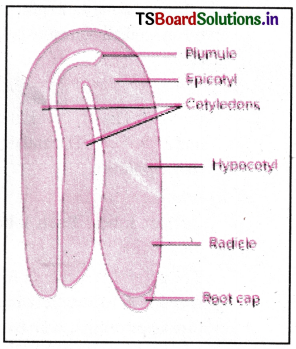
Describe the structure of dicot embryo with the help of a neat labelled diagram?
Answer:
A typical dicot embryo is made up of an embryonal axis and two cotyledons.
- Cotyledons: A dicot embryo contains two cotyledons. They store and supply food to the developing embryo.
- Embryonal Axis: The embryonal axis is the central part of the embryo situated between the two cotyledons.
- Epicotyl: The portion of the embryonal axis above the cotyledons is called the epicotyl. It ends in the plumule, which develops into the shoot system
- Hypocotyl: The portion of the embryonal axis below the cotyledons is called the hypocotyl. It terminates in the radicle, which later develops into the primary root.
- Plumule: The plumule is the growing shoot tip of the embryo. It gives rise to the future stem and leaves.
- Radicle: The radicle is the embryonic root. It develops into the primary root of the plant.
- Root Cap: The tip of the radicle is covered by a root cap. It protects the delicate root tip during growth.
Question 8.
What is apomixis and what is its importance?
Answer:
Apomixis is the formation of seeds without fertilization. It is a type of asexual reproduction in plants.
Apomixis occurs when a diploid egg cell develops into an embryo without undergoing meiosis and fertilization. Seed formation can occur even when pollinators are absent or environmental conditions are unfavorable.
Importance of Apomixis:
- No Segregation of Characters: Since meiosis and fertilization do not occur, desirable traits remain unchanged.
- Maintenance of Superior Traits: Valuable characteristics can be preserved for many generations.
- Useful in Agriculture: Helps maintain hybrid vigour (heterosis). Beneficial for large-scale commercial seed production.
VI. Long Answer Questions
Question 1.
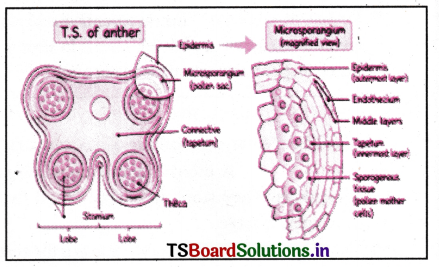
Describe the structure of anther with the help of a neat diagram?
Answer:
- A typical angiosperm anther is a bilobed structure, and each lobe contains two thecae, making it dithecous.
- As the anther matures, the microsporangia develop into pollen sacs, which extend along the length of the anther and contain numerous pollen grains.
1. External Structure :
- Stamen The stamen is the male reproductive organ of a flower. It consists of an anther and a filament. The anther is the fertile terminal part, while the filament is the slender stalk that supports it.
- Bilobed and Dithecous: An atypical angiosperm anther is bilobed, meaning it has two distinct lobes. Each lobe contains two chambers (thecae), making the anther dithecous.
- Tetragonal Structure: In transverse section (T.S.), the anther appears tetragonal (four-sided). A microsporangium is present at each corner, giving a total of four microsporangia, with two in each lobe.
2. Internal Structure of Microsporangium: Each microsporangium is nearly circular and is surrounded by four wall layers.
Wall Layers :
- Epidermis: The epidermis is the outermost protective layer of the microsporangium.
- Endothecium: Located just below the epidermis, the endothecium helps in the dehiscence (opening) of the anther for pollen release.
- Middle Layers: These layers lie between the endothecium and tapetum and provide additional protection. They usually degenerate as the anther matures.
- Tapetum: The tapetum is the innermost layer and supplies nourishment to the developing pollen grains. Its cells are dense and often multinucleate.
Sporogenous Tissue: In a young anther, the central region of each microsporangium contains compact, homogeneous cells called sporogenous tissue. These cells undergo meiosis to form microspores, which later develop into pollen grains.
Function of Outer Layers: The epidermis, endothecium, and middle layers protect the microsporangium and assist in anther dehiscence for pollen release.
3. Maturation and Dehiscence
- Pollen Sac Formation: As development proceeds, the microsporangia transform into pollen sacs extending throughout the anther.
- Pollen Development: Microspores separate from the tetrads and mature into individual pollen grains.
- Dehiscence (Release): When the anther becomes fully mature, it splits open and releases pollen grains into the environment.
Question 2.
Describe briefly the process of microsporogenesis and development of male gametophyte in angiosperms?
Answer:
Microsporogenesis and male gametophyte development are important reproductive processes occurring inside the microsporangia of the anther.
1. Microsporogenesis: Microsporogenesis is the formation of microspores from a pollen mother cell (PMC) through meiosis.
- Initial Stage: In a young anther, each microsporangium contains sporogenous tissue made up of compact cells.
- Meiotic Division: Each sporogenous cell functions as a PMC and undergoes meiosis to produce haploid cells.
- Formation of Tetrads: Meiosis results in the formation of four haploid microspores, which remain attached as a tetrad.
- Maturation: As the anther matures, microspores separate from the tetrad and become individual pollen grains.
2. Development of Male Gametophyte: The pollen grain represents the male gametophyte. Its development involves structural and cellular changes before fertilization.
- Structure of Pollen Grain: Pollen grains are generally spherical, measuring about 25-50 micrometers in diameter.
- Exine: The outer hard wall is called exine and is made of sporopollenin, one of the most resistant organic substances. Germ pores are present where sporopollenin is absent.
- Intine: The intine is the inner thin wall made of cellulose and pectin.
- Cytoplasm: The cytoplasm contains all the essential cell components required for growth and development.
3. Cellular Development: As the pollen grain matures, it divides internally to form two cells.
- Vegetative Cell: The larger cell of the pollen grain containing abundant food reserves. It helps in pollen tube formation.
- Generative Cell: A smaller spindle-shaped cell present within the vegetative cell. It later divides to form two male gametes.
4. Shedding Stages:
- 2-Cell Stage: In most angiosperms, pollen grains are shed with two cells—a vegetative cell and a generative cell. The generative cell divides later.
- 3-Celled Stage: In some species, the generative cell divides before shedding, so the pollen grain contains one vegetative cell and two male gametes.
Question 3.
Describe the process of megasporogenesis and development of embryo sac?
Answer:
1. Megasporogenesis: Megasporogenesis is the process by which megaspores are formed from a Megaspore Mother Cell (MMC) inside the ovule.
- Location: Within the nucellus, near the micropylar region, a cell differentiates into the MMC.
- Characteristics of MMC: The MMC is a large cell with dense cytoplasm and a prominent nucleus, specialized for division.
- Meiotic Division: The MMC undergoes meiosis, reducing the chromosome number from diploid to haploid. As a result, four haploid megaspores are formed, usually arranged in a linear row.
2. Development of Embryo Sac: After megasporogenesis, the megaspores develop into the female gametophyte or embryo sac.
- Functional Megaspore: Out of the four megaspores, only one remains functional, while the other three degenerate. This is called monosporic development.
- Nuclear Divisions: The nucleus of the functional megaspore undergoes three successive mitotic divisions:
First division → 2-nucleate stage
Second division → -nucleate stage
Third division → 8-nucleate stage
These are free nuclear divisions because cell walls are not formed immediately.
Cellular Organization: After the 8-nucleate stage, cell walls develop, resulting in a properly organized embryo sac.
3. Structure of Mature Embryo Sac: A Mature embryo sac is 8-nucleate and 7-celled.
- Egg Apparatus (Micropylar End): Consists of one egg cell and two synergids. The synergids possess a filiform apparatus that guides the pollen tube.
- Antipodal Cells (Chalazal End): Three antipodal cells are present at the opposite end of the embryo sac.
- Central Cell: The large central cell contains two polar nuclei, which participate in triple fusion.
Question 4.
Define pollination and give an account of agents of pollination.
Answer:
Pollination is the transfer of pollen grains from the anther to the stigma of a flower, leading to fertilization
Pollination occurs through different agents, broadly classified as abiotic agents (wind and water) and biotic agents (animals).
Agents of Pollination:
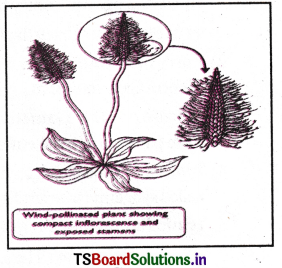
1. Wind Pollination (Anemophily): Pollination by wind is called anemophily.
Characteristics:
- Pollen grains are light, dry, and non-sticky.
- Flowers produce large quantities of pollen.
- Stamens remain exposed for easy pollen release.
- Stigmas are large and feathery to trap pollen.
- Flowers are often arranged in inflorescences. Examples: Maize, Grasses
2. Water Pollination (Hydrophily): Pollination through water is called hydrophily.
a) Epihydrophily: Pollination occurs on the water surface.
- Female flowers reach the surface through long stalks.
- Male flowers float and are carried by water currents. Example: Vallisneria
b) Hypohydrophily: Pollination occurs below the water surface.
- Flowers remain submerged.
- Pollen grains are long and ribbon-like. Example: Zostera
3. Animal Pollination (Zoophily): Pollination by animals is called zoophily.
Characteristics:
- Flowers are brightly coloured and fragrant.
- Nectar is produced to attract animals.
- Pollen grains are sticky.
Types of Zoophily:
- Entomophily – Pollination by insects
- Ornithophily – Pollination by birds
- Chiropterophily- pollination by bats
- Therophily – Pollination by small mammals
- Ophiophily-Pollination by reptiles (rare). Ex: Squirrels.
Question 5.
Describe the fertilization process in angiosperms.
Answer:
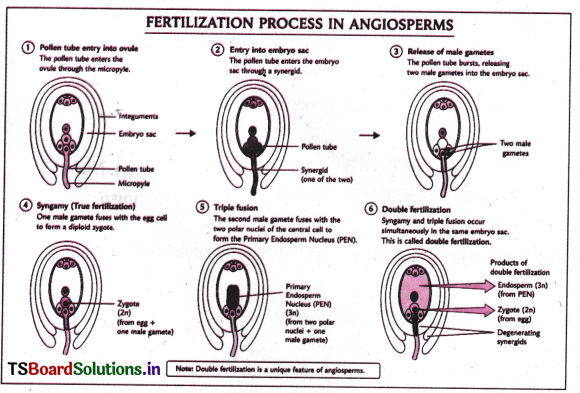
Fertilization is the fusion of male and female gametes. In angiosperms, fertilization is unique because it involves double fertilization.
Steps of Fertilization:
1. Entry of Pollen Tube into Ovule: The pollen tube may enter the ovule through different routes:
- Porogamy: Entry through the micropyle. Ex: Hibiscus
- Chalazogamy: Entry through the chalaza. Ex: Casuarina
- Mesogamy: Entry through the integuments. Ex Cucurbita
2. Entry into Embryo Sac: The pollen tube enters the embryo sac through the micropyle. The filiform apparatus of the synergids guides the pollen tube to its destination.
3. Release of Male Gametes: The pollen tube enters one synergid and bursts, releasing two male gametes into the embryo sac.
4. Syngamy: One male gamete fuses with the egg cell to form a diploid zygote. This process is called syngamy (true fertilization).
5. Triple Fusion and Double Fertilization:
- Triple Fusion: The second male gamete fuses with the two polar nuclei present in the central cell, forming a triploid Primary Endosperm Nucleus (PEN).
- Double Fertilization: Since syngamy and triple fusion occur together, the process is called double fertilization.
I. Multiple Choice Questions
Question 1.
Identify the correct sequence of anther wall layers from inside to the outside of an anther lobe.
1. the epidermis – endothecium – middle layers – tapetum
2. the epidermis – middle layers – endothecium – tapetum
3. the tapetum – middle layers – endothecium – epidermis
4. the tapetum – endothecium – middle layers – epidermis
Answer:
3. the tapetum – middle layers – endothecium – epidermis
Question 2.
The male gametophyte in flowering plants is represented by?
1. anther
2. microspore mother cell
3. stamen
4. pollen grain
Answer:
4. pollen grain
Question 3.
Which of the following organic materials make up the inner wall of pollen grains?
1. sporopollenin only
2. cellulose and sporopollenin
3. sporopollenin and pectin
4. cellulose and pectin
Answer:
4. cellulose and pectin
Question 4.
The protective envelope of an ovule is called
1. funicle
2. integument
3. chalaza
4. micropyle
Answer:
2. integument
Question 5.
In flowering plants, the female gametophyte is?
1. embryo sac
2. embryo
3. nucellus
4. egg apparatus only
Answer:
Question 6.
The filiform apparatus is present in
1. egg cell
2. synergids
3. antipodals
4. the large central cell
Answer:
2. synergids
Question 7.
What kind of pollination occurs in the flowers that do not open at all?
1. xenogamy
2. chasmogamy
3. geitonogamy
4. cleistogamy
Answer:
4. cleistogamy
Question 8.
Consider the following statements regarding wind pollination :
I. Amongst abiotic pollinations, pollination by wind is more common.
II. Wind pollination is quite common in grasses.
III. Wind-pollinated flowers often have many ovules in each ovary.
Which of the above statements are correct?
1. I and II only
2.1 and III only
3. II and III only
4. I, II and III
Answer:
1. I and II only
Question 9.
Waterlily is pollinated by
1. wind
2. water
3. insects
4. birds
Answer:
3. insects
Question 10.
Among the insects, which are particularly the dominant biotic pollinating agents?
1. butterflies
2. wasps
3. flies
4. bees
Answer:
4. bees
Question 11.
The portion of embryonal axis above the level of cotyledons is
1. hypocotyl
2. epicotyl
3. scutellum
4. coleoptile
Answer:
2. epicotyl
Question 12.
In some seeds, the residual persistent nucellus is called
1. endosperm
2. pericarp
3. perisperm
4. proembryo
Answer:
3. perisperm
II. Fill in the Blanks
1. The number of pollen sacs developed from each microsporangium of a dithecous anther is …………………….. .
Answer:
1 (one)
2. The outer hard layer of pollen wall is made up of ………………………. .
Answer:
sporopollenin
3. In pollen banks, pollen grains are stored in …………………………… .
Answer:
liquid nitrogen.
4. Only functional megaspore develops into the ……………………….. .
Answer:
female gametophyte.
5. Transfer of pollen grains from anther to the stigma of a different plant is known as …………………. .
Answer:
xenogamy/allogamy/cross pollination.
6. In artificial hybridization programme, the removal of anthers from the flowers in female parent is known as ………………………….. .
Answer:
emasculation.
7. In an embryo sac, triple fusion occurs in ………………………. .
Answer:
central cell.
8. In the grass family, the large, single cotyledon is called ………………………. .
Answer:
scutellum.
9. The final product of sexual reproduction in flowering plants is the ………………………. .
Answer:
seed.
10. In banana, fruit develops without fertilization. Such a fruit is called ………………… .
Answer:
parthenocarpic fruit
III. One Word Answer Questions
Question 1.
What is the number of microsporangia present in each lobe of a dithecous anther?
Answer:
2 (two)
Question 2.
In which layer of a pollen grain are the prominent apertures formed?
Answer:
Exine
Question 3.
At what stage are pollen grains released in most flowering plants?
Answer:
2-celled stage
Question 4.
At what temperature are pollen grains preserved in pollen banks for many years in liquid nitrogen?
Answer:
196°C
Question 5.
Which part of the pistil acts as the landing surface for pollen grains?
Answer:
Stigma
Question 6.
Which structure forms the connection between the ovule and the funicle?
Answer:
Hilum.
Question 7.
In which region of the nucellus does a single Megaspore Mother Cell (MMC) usually develop?
Answer:
Micropylar region
Question 8.
What is the main role of the filiform apparatus present in synergids?
Answer:
Guides the pollen tube
Question 9.
Which type of pollination is genetically similar to autogamy?
Answer:
Geitonogamy
Question 10.
What type of pollen grains are commonly produced in marine seagrass species such as Zostera?
Answer:
Long, ribbon-like pollen grains
Question 11.
Which structure covers the embryonal axis at its lower end, including the radicle and root cap?
Answer:
Coleorhiza
Question 12.
By which special process are seeds formed without fertilization?
Answer:
Apomixis
Objective Questions
Question 1.
The shoot apex in an embryo is known as :
1. Radicle
2. Plumule
3. Coleorhiza
4. Coleoptile
Answer:
2. Plumule
Question 2.
Pollination occurring within the same flower is called:
1. Xenogamy
2. Cross-pollination
3. Autogamy
4. Allogamy
Answer:
3. Autogamy
Question 3.
Triple fusion involves the fusion of:
1. One male gamete and two polar nuclei
2. One egg cell and two polar nuclei
3. One egg cell and two male gametes
4. Two egg cells and one male gamete
Answer:
1. One male gamete and two polar nuclei
Question 4.
The pollen tube wall is mainly composed of:
1. Pecto-cellulose
2. Sporopollenin
3. Lignosuberin
4. Pectolignin
Answer:
1. Pecto-cellulose
Question 5.
The growth of the pollen tube into the embryo sac is guided by:
1. Antipodals
2. Filiform apparatus of synergids
3. Polar nuclei
4. Filiform apparatus of egg cell
Answer:
2. Filiform apparatus of synergids
Question 6.
Fusion of a male gamete with the egg cell inside the embryo sac is called :
1. Double fertilization
2. Syngamy
3. Triple fusion
4. Zoidogamy
Answer:
2. Syngamy
Question 7.
In maize and castor plants :
1. Geitonogamy is prevented
2. Autogamy is not prevented
3. Geitonogamy is not prevented
4. Both autogamy and allogamy are prevented
Answer:
3. Geitonogamy is not prevented
Question 8.
A bisexual flower that never opens and undergoes self-pollination is termed:
1. Homogamy
2. Cleistogamy
3. Autogamy
4. Allogamy
Answer:
2. Cleistogamy
Question 9.
Wind-pollinated flowers generally possess :
1. Small smooth stigma
2. Sessile stigma
3. Large feathery stigma
4. Colourful flowers
Answer:
3. Large feathery stigma
Question 10.
How many nuclei participate in double fertilization?
1. 2
2. 3
3. 4
4. 5
Answer:
4. 5
Question 11.
The diploid nutritive tissue found in the anther is:
1. Endosperm
2. Tapetum
3. Perisperm
4. Nucellus
Answer:
2. Tapetum
Question 12.
The final products formed after sexual reproduction in flowering plants are:
1. Fruits and seeds
2. Inflorescence and flower
3. Calyx and corolla
4. Androecium and gynoecium
Answer:
1. Fruits and seeds
Question 13.
The outer exine layer of pollen grains is composed of:
1. Pectin
2. Sporopollenin
3. Cellulose
4. Chitin
Answer:
2. Sporopollenin
Question 14.
In most angiosperms, pollen grains are released at:
1. 4-celled stage
2. 3-celled stage
3. 2-celled stage
4. 1-celled stage
Answer:
3. 2-celled stage
Question 15.
The central region of a young microsporangium is occupied by:
1. Sporogenous tissue
2. Tapetum
3. Stomium
4. Endothecium
Answer:
1. Sporogenous tissue
Question 16.
The male gametophyte in flowering plants is represented by:
1. Embryo sac
2. PMC
3. Microspore
4. Pollen grain
Answer:
4. Pollen grain
Question 17.
Parthenium entered India accidentally along with imported :
1. Rice
2. Maize
3. Wheat
4. Bajra
Answer:
3. Wheat
Question 18.
“Carrot grass” is the common name of:
1. Tridax
2. Triticum
3. Oryza
4. Parthenium
Answer:
4. Parthenium
Question 19.
Pollen grains are stored for long periods at:
1. 120°C
2. -120°C
3. -196°C
4. 196°C
Answer:
3. -196°C
Question 20.
The male and female reproductive whorls of a flower are:
1. Androecium and gynoecium
2. Pistil and stamen
3. Petals and stamens
4. Calyx and corolla
Answer:
1. Androecium and gynoecium
Question 21.
The terminal fertile part of a stamen is :
1. Embryo sac
2. Anther
3. Stigma
4. Style
Answer:
2. Anther
Question 22.
The primary function of a germ pore in a mature pollen grain is:
1. Formation of exine
2. Production of male gametes
3. Facilitation of pollen tube emergence
4. Formation of generative cell
Answer:
3. Facilitation of pollen tube emergence
Question 23.
The swollen basal portion of the pistil is known as :
1. Style
2. Ovary
3. Filament
4. Stigma
Answer:
2. Ovary
Question 24.
Ovules are attached to the ovary wall through :
1. Placenta
2. Filament
3. Style
4. Stigma
Answer:
1. Placenta
Question 25.
The protective coverings surrounding the megasporangium are called :
1. Synergids
2. Funiculi
3. Integuments
4. Antipodals
Answer:
3. Integuments
Question 26.
In Loranthus, the ovule is :
1. Bitegmic
2. Unitegmic
3. Without integuments
4. Tritegmic
Answer:
3. Without integuments
Question 27.
The ovule commonly found in members of Fabaceae is:
1. Orthotropous ovule
2. Campylotropous ovule
3. Anatropous ovule
4. Naked ovule
Answer:
2. Campylotropous ovule
Question 28.
The egg apparatus in an embryo sac is situated near the :
1. Integument
2. Chalaza
3. Micropyle
4. Funicle 0
Answer:
3. Micropyle
Question 29.
Antipodal cells are located towards the :
1. Micropylar end
2. Central cell
3. Chalazal end
4. Integuments
Answer:
3. Chalazal end
Question 30.
In an embryo sac, the egg cell is located :
1. Towards the chalaza
2. In the centre of the central cell
3. Between the synergids
4. Between the antipodals
Answer:
3. Between the synergids
Question 31.
The chamber present inside the ovary where ovules are located is called :
1. Placenta
2. Locule
3. Stigma
4. Style
Answer:
2. Locule
Question 32.
Transfer of pollen grains from the anther to the stigma of the same flower is known as:
1. Geitonogamy
2. Allogamy
3. Autogamy
4. Xenogamy
Answer:
3. Autogamy
Question 33.
The scientific genus name of the common pansy plant is :
1. Tridax
2. Viola
3. Commelina
4. Oxalis
Answer:
2. Viola
Question 34.
Which of the following represents the most common abiotic mode of pollination?
1. Entomophily
2. Hydrophily
3. Omophily
4. Anemophily
Answer:
4. Anemophily
Question 35.
Which of the following is a marine seagrass?
1. Vallisneria
2. Trapa
3. Zostera
4. Hydrilla
Answer:
3. Zostera
Question 36.
In seagrasses, pollination generally takes place :
1. By insects
2. By wind
3. On the water surface
4. Inside the water
Answer:
4. Inside the water
Question 37.
The most important biotic pollinating agents among animals are :
1. Ants
2. Wasps
3. Bees
4. Birds
Answer:
3. Bees
Question 38.
Pollination carried out by bats is termed :
1. Entomophily
2. Ophiophily
3. Therophily
4. Chiropterophily
Answer:
4. Chiropterophily
Question 39.
Sunflower flowers commonly exhibit:
1. Heterostyly
2. Protandry
3. Herkogamy
4. Protogyny
Answer:
2. Protandry
Question 40.
Formation of separate male and female flowers in plants is known as :
1. Dichogamy
2. Herkogamy
3. Heterostyly
4. Dicliny
Answer:
4. Dicliny
Question 41.
Both autogamy and geitonogamy are prevented in :
1. Castor
2. Viola
3. Papaya
4. Maize
Answer:
3. Papaya
Question 42.
The liquid present inside a tender coconut is :
1. Cellular endosperm
2. Free nuclear endosperm
3. Unicellular kernel
4. Anucleate cellular form
Answer:
2. Free nuclear endosperm
Question 43.
The embryonic leaves that store food for the developing plant are called :
1. Epicotyls
2. Radicles
3. Cotyledons
4. Plumules
Answer:
3. Cotyledons
Question 44.
The persistent nucellus found in certain seeds is known as :
1. Embryo
2. Endosperm
3. Integument
4. Perisperm
Answer:
4. Perisperm
Question 45.
Seeds of guava and fig are mainly dispersed by:
1. Birds
2. Water
3. Insects
4. Wind
Answer:
1. Birds
Question 46.
Fruits of Martynia (Tiger Claw Plant) are dispersed through :
1. Wind
2. Birds
3. Animals
4. Water
Answer:
3. Animals
Question 47.
Seed formation without fertilization is referred to as:
1. Dormancy
2. Parthenocarpy
3. Quiescence
4. Apomixis
Answer:
4. Apomixis
Question 48.
The scientific name of lupin belongs to :
1. Curcuma
2. Phoenix dactylifera
3. Amorphophallus
4. Lupinus arcticus
Answer:
4. Lupinus arcticus
Question 49.
The largest seed among plants is produced by:
1. Orchid
2. Striga
3. Lodoicea
4. Loranthus
Answer:
3. Lodoicea
Question 50.
Extremely tiny (microscopic) seeds are characteristic of:
1. Lodoicea
2. Orchids
3. Striga
4. Loranthus
Answer:
2. Orchids
Question 51.
The precursor cell that gives rise to the archegonial structure is :
1. Perisperm
2. Endosperm
3. Nucellus
4. Embryo
Answer:
3. Nucellus
Question 52.
The suspensor cells of an embryo are generally :
1. Haploid
2. Triploid
3. Polyploid
4. Diploid
Answer:
4. Diploid
Question 53.
Which layer of the anther wall degenerates during development?
1. Connective
2. Epidermis
3. Tapetum
4. Endothecium
Answer:
3. Tapetum
Question 54.
The pollen tube emerges from the pollen grain through the :
1. Micropyle
2. Germ pore
3. Carpophore
4. Stomium
Answer:
2. Germ pore
Question 55.
Self-pollination is prevented due to differences in maturity time in bisexual flowers of:
1. Vallisneria
2. Gloriosa
3. Abutilon
4. Solanum
Answer:
4. Solanum
Question 56.
Autogamy may occur, but self-fertilization does not take place in :
1. Datura
2. Papaya
3. Dolichos
4. Abutilon
Answer:
3. Dolichos
Question 57.
The most common pollinating agent in gymnosperms is:
1. Water
2. Insects
3. Bats
4. Wind
Answer:
4. Wind
Question 58.
Cross-pollination occurring between flowers on the same plant is called :
1. Self-sterility
2. Heterostyly
3. Geitonogamy
4. Herkogamy
Answer:
3. Geitonogamy
Question 59.
Self-pollination is compulsory in :
1. Monoecious plants
2. Chasmogamous flowers
3. Cleistogamous flowers
4. Bisexual flowers
Answer:
3. Cleistogamous flowers
Question 60.
The ploidy level of the aleurone layer is :
1. n
2. 4n
3. 2n
4. 3n
Answer:
4. 3n
Question 61.
The persistent remains of nucellus present in some seeds are called :
1. Zygote
2. Endosperm
3. Perisperm
4. PEN
Answer:
3. Perisperm
Question 62.
The relationship between a pollen grain and an embryo sac is similar to :
1. Male gametophyte and female gametophyte
2. Sperm and female gametophyte
3. Male gametophyte and egg
4. Sperm and egg
Answer:
1. Male gametophyte and female gametophyte
Question 63.
Which of the following statements regarding sporopollenin is incorrect?
1. Sporopollenin can resist high temperatures and strong acids
2. Exine is made of sporopollenin
3. Germ pores occur where sporopollenin is present
4. Sporopollenin is one of the most resistant organic substances
Answer:
3. Germ pores occur where sporopollenin is present
Question 64.
The stomium is situated between :
1. Adjacent microsporangia of the same theca
2. Adjacent sacs of neighboring lobes
3. Theca and connective tissue
4. Pollen sacs of adjacent lobes
Answer:
1. Adjacent microsporangia of the same theca
Question 65.
The chromosome number of petal cells is :
1. Polyploid
2. 3n
3. n
4. 2n
Answer:
4. 2n
Question 66.
Arrange the anther wall layers from outermost to innermost:
a. Endothecium
b. Epidermis
c. Tapetum
d. Middle layers
1. c, d, a, b
2. c, d, b, a
3. a, b, c,.d
4. b, d, a, c
Answer:
1. c, d, a, b
Question 67.
Different stages of reduction division in plants can best be observed in :
1. Mature anthers
2. Endosperm cells
3. Young ovules
4. Young anthers
Answer:
3. Young ovules
Question 68.
The diploid nutritive tissue found in black pepper and beet seeds is :
1. Endosperm
2. Embryo
3. Perisperm
4. Male gametophytic tissue
Answer:
3. Perisperm
Question 69.
An anther is generally :
1. Monosporangiate
2. Bisporangiate
3. Tetrasporangiate
4. Trisporangiate
Answer:
3. Tetrasporangiate
Question 70.
The ratio between the number of male gametes produced by a male gametophyte and female gametes produced by a female gametophyte is :
1. 2:1
2. 1:1
3. 3:7
4. 1:2
Answer:
1. 2:1
Question 71.
The total number of genomes present in all cells of a typical angiosperm embryo sac is:
1. 3
2. 5
3. 7
4. 8
Answer:
4. 8
Question 72.
Which feature is NOT characteristic of wind-pollinated flowers?
1. Feathery stigma
2. Non-sticky pollen grains
3. Ovary with a single ovule
4. Unexposed stamens
Answer:
4. Unexposed stamens
Question 73.
Pollen grains of many plant species can be preserved for years in :
1. Liquid hydrogen
2. Liquid oxygen
3. Liquid nitrogen (-196°C)
4. Liquid nitrogen (+196°C)
Answer:
3. Liquid nitrogen (-196°C)
Question 74.
The first cell of the female gametophyte develops from the last sporophytic cell through :
1. Equational division
2. Mitosis
3. Reduction division
4. Amitosis
Answer:
3. Reduction division
Question 75.
Which sequence correctly represents the arrangement of nuclei during embryo sac development?
1. 1, 1+1, 2+2, 4+4, 3+2+3
2. 1, 1+1, 2+2, 3+1+3, 3+2+3
3. 1, 1+1, 2+2, 4+3, 3+1+3
4. 1, 1+2, 2+3, 4+3, 3+2+3
Answer:
1. 1, 1+1, 2+2, 4+4, 3+2+3
Question 76.
Plants producing both cleistogamous and chasmogamous flowers include:
1. Commelina, Cocos, Oryza
2. Oxalis, Brassica, Viola
3. Viola, Oxalis, Commelina
4. Streptocarpus, Vallisneria, Ranunculus
Answer:
3. Viola, Oxalis, Commelina
Question 77.
Arrange the stages of embryo development correctly :
a) Globular
b) Proembryo
c) Heart-shaped
d) Mature embryo
1. d, b, a, c
2. a, b, c, d
3. b, a, c, d
4. b, c, d, a
Answer:
3. b, a, c, d
Question 78.
The structures enclosing the radicle and plumule of a grass embryo, respectively, are:
1. Coleoptile and Coleorhiza
2. Coleorhiza and Scutellum
3. Scutellum and Coleoptile
4. Coleorhiza and Coleoptile
Answer:
4. Coleorhiza and Coleoptile
Question 79.
Seeds of lupin are known to germinate even after a dormancy period of approximately:
1. 1000 years
2. 1000 Months
3. 2000 years
4. 10000 Years
Answer:
4. 10000 Years
Question 80.
Identify the incorrect statement:
1. Endosperm persists in the mature seed of coconut
2. Endo sperm is completely consumed during embryo development in castor
3. White kernel of coconut represents cellular endosperm
4. Mature groundnut seeds lack endosperm
Answer:
2. Endo sperm is completely consumed during embryo development in castor
Question 81.
Select the incorrectly matched pair related to seed dispersal:
1. Coconut – floating on water
2. Guava – birds
3. Martynia – attachment to animal fur
4. Fig – wind
Answer:
4. Fig – wind
Question 82.
In a fertilized ovule, n, 2n and 3n conditions occur respectively in:
1. Egg, nucellus and endosperm
2. Antipodals, zygote and endosperm
3. Endosperm, nucellus and egg
4. Antipodals, synergids and integuments
Answer:
2. Antipodals, zygote and endosperm
Question 83.
Pollen grains are generally released at:
1. Single-celled stage
2. 3-celled stage
3. 2-celled stage
4. 2-celled stage, but sometimes 3-celled stage
Answer:
4. 2-celled stage, but sometimes 3-celled stage
Question 84.
In Citrus, apomictic embryos arise from
1. Diploid egg
2. Synergids
3. Maternal sporophytic tissue of ovule
4. Antipodal Cells
Answer:
3. Maternal sporophytic tissue of ovule
Question 85.
Development of a new individual from an unfertilized female gamete is known as:
1. Triple fusion
2. Syngamy
3. Parthenocarpy
4. Parthenogenesis
Answer:
4. Parthenogenesis
Question 86.
Exalbuminous (non-endospermic) seeds are found in :
1. Datura, Ricinus and Pea
2. Dolichos, Groundnut and Pea
3. Dolichos, Pea and Coconut
4. Coconut, Ricinus and Bean
Answer:
2. Dolichos, Groundnut and Pea
Question 87.
Coconut water and the edible white kernel are respectively equivalent to :
1. Mesocarp and embryo
2. Endosperm and endocarp
3. Endosperm and endosperm
4. Endocarp and mesocarp
Answer:
3. Endosperm and endosperm
Question 88.
Ategmic ovules lack which of the following?
a. Integuments
b. Nucellus
c. Micropyle
d. Embryo sac
1. a and d
2. b and c
3. c and d
4. a and c
Answer:
4. a and c
Question 89.
If an anther contains four microsporangia, the total number of pollen tetrads formed from one PMC in each microsporangium would result in:
1. 4
2. 8
3. 12
4. 16
Answer:
4. 16
Question 90.
Double fertilization is a characteristic feature of:
1. Algae
2. Gymnosperms
3. Fungi
4. Angiosperms
Answer:
4. Angiosperms