
Regular practice with AP Inter 2nd Year Physics Study Material Chapter 10 Wave Optics Questions and Answers helps students stay prepared for examinations.
AP Inter 2nd Year Physics 10th Lesson Wave Optics Questions and Answers
I. Multiple Choice Questions
Question 1.
If a plane wave passes through a convex lens, the geometrical shape of the wave front that emerges is
1) plane
2) diverging spherical
3) converging spherical
4) cylindrical
Answer:
3) converging spherical
A convex lens converts a plane wavefront into a converging spherical wavefront by focusing the light rays to a point.
Question 2.
What is the ratio of intensities of light sources, when the amplitudes of light waves from them has the ratio of 1 : \(\sqrt{2}\).
1) 1 : \(\sqrt{2}\)
2) \(\sqrt{2}\) : 1
3) 1 : 2
4) 2 : 1
Answer:
3) 1 : 2
Intensity I ∝ Amplitude A2. Here A1 : A2 = 1 : \(\sqrt{2}\)
So, \(\frac{I_1}{I_2}=\left[\frac{A_1}{A_2}\right]^2=\left[\frac{1}{\sqrt{2}}\right]^2=\frac{1}{2}\)
Question 3.
When three lights of red, violet and green coloured are used successively in young double slit experiment, the fringe width will be maximum for
1) Red
2) Violet
3) Green
4) Same for all
Answer:
1) Red
Fringe width β = \(\frac{\lambda D}{d}\); So, β ∝ λ
Among the given colours Red has longest wavelength. It produces the widest fringes.
Question 4.
In a wave, the path difference corresponding to a phase difference of Φ is
1) \(\frac{2 \pi}{\lambda}\)Φ
2) \(\frac{\pi}{\lambda}\)Φ
3) \(\frac{\lambda}{2 \pi}\)Φ
4) \(\frac{\lambda}{\pi}\)Φ
Answer:
3) \(\frac{\lambda}{2 \pi}\)Φ
Phase difference Φ = \(\frac{2 \pi}{\lambda}\)(∆x) ⇒ Path difference ∆x = \(\frac{\lambda}{2 \pi}\)Φ
Question 5.
The phase difference between two points ‘A’ and ‘B’ on a wave front separated by distance λ is
1) π/4
2) 2π
3) π
4) π/2
Answer:
2) 2π
In wave motion, a distance of one wave length AB corresponds to a phase difference of 2π.

Question 6.
Two waves having intensity in the ratio 25 : 4 produces interference, then the ratio of maximum to minimum intensity is
1) 5 : 2
2) 7 : 3
3) 49 : 9
4) 9 : 49
Answer:
3) 49 : 9
I11 : I2 = 25 : 4, a1 : a2 = \(\sqrt{25}: \sqrt{4}\) = 5 : 2;
\(\frac{I_{\max }}{I_{\min }}=\left[\frac{a_1+a_2}{a_1-a_2}\right]^2=\left[\frac{5+2}{5-2}\right]^2=\left[\frac{7}{3}\right]^2=\frac{49}{9}\)
Question 7.
The penetration of light into the region of geometrical shadow is called
1) polarization
2) interference
3) diffraction
4) Refraction
Answer:
3) diffraction
Diffraction is defined as the bending of waves around the comers of an obstacle or through an aperture into the region of geometrical shado
Question 8.
Which one of the following phenomenon confirms that transverse nature of light?
1) Interference
2) Diffraction
3) Dispersion
4) Polarization
Answer:
4) Polarization
Polarization can only occur with transverse waves because it involves restricting the vibrations to a single plane perpendicular to the direction of propagation.
Question 9.
Which of the’ following waves cannot be polarized?
1) X- rays
2) Radio waves
3) Sound waves
4) Light waves
Answer:
3) Sound waves
Sound waves are longitudinal waves, and longitudinal waves cannot be polarized. X-rays, radio, light waves are electromagnetic (transverse) waves, so they can be polarized.
Question 10.
The angle between the axis of polarizer and analyser is 45°, the percentage of polarized light passing through analyser is
1) 100%
2) 50%
3) 25%
4) 75%
Answer:
2) 50%
Malus law: I = I0 cos2θ, if θ = 45°
I – I0\(\left(\frac{1}{\sqrt{2}}\right)^2\) = \(\frac{I_0}{2}\) = 50% I0
II. Fill in the Blanks
Question 1.
A wave front is the continuous locus of all particles vibrating with ________.
Answer:
same Phase.
A wave front is the continuous locus of all particles vibrating with same phase.
Question 2.
The secondary wave fronts emanating from a primary wave front are also called as _________.
Answer:
wavelets.
The secondary wave fronts emanating from a primary wave front are also called as wavelets.
Question 3.
According to the principle of super position, the resultant displacement is _________ of displacements produced by each of the waves.
Answer:
vector sum
According to the principle of super position, the resultant displacement is vector sum of displacements produced by each of the waves.
Question 4.
_________ light sources should emit waves of same frequency and having constant phase difference.
Answer:
Coherent
Coherent light sources should emit waves of same frequency and having constant phase difference.
Question 5.
In interference pattern, all bright and dark fringes are of _________ width.
Answer:
same
In interference pattern, all bright and dark fringes are of same width.
Question 6.
For constructive interference, the path difference between two waves is equal to _________.
Answer:
nλ
For constructive interference, the path difference between two waves is equal to nλ.
Question 7.
The phenomenon of bending of light around the comers of obstacles is called ________.
Answer:
diffraction.
The phenomenon of bending of light around the comers of obstacles is called diffraction.
Question 8.
Angular width of central maximum in diffraction of single slit is ________.
Answer:
\(\frac{2 \lambda}{a}\) (or) 2θ
Angular width of central maximum in diffraction of single slit is 2λ/a (or) 2θ
Question 9.
Due to ________ phenomenon of light, colours on CD are formed.
Answer:
diffraction
Due to diffraction phenomenon of light, colours on CD are formed.
Question 10.
When unpolarised light is passed through a polarizing sheet, the intensity of the transmitted light is _________ that of original intensity of light.
Answer:
50 %
When unpolarised light is passed through a polarizing sheet, the intensity of the transmitted light is 50 % that of original intensity of light.
III. One Word Answer Questions
Question 1.
State Huygen’s principle.
Answer:
Every point on a wave front acts as a source of secondary spherical wavelets.
Question 2.
Which principle is used to find the position of a wave front after some time?
Answer:
Huygen’s principle is used to find the position of a wave front
Question 3.
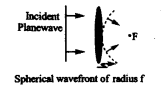
Sketch the wavefront corresponding to converging rays.
Answer:
A spherical wave front
Concave in the direction of propagation.
Question 4.
What is interference of light?
Answer:
Interference is the phenomenon where two or more light waves overlap to form a resultant wave of greater, lower or the same amplitude.
Question 5.
What is the main condition to produce interference of light?
Answer:
The primary condition is that the light sources must be coherent.
Question 6.
Why are coherent sources required to create interference of light?
Answer:
To maintain a stationary and permanent interference pattern.
Question 7.
What sheets are used in sunglasses and window panels to control the intensity of light?
Answer:
Polaroid sheets are used is sunglasses and window panels to control the intensity of light.
Question 8.
What should be the approximate slit size to observe the diffraction?
Answer:
The slit size should be comparable to the wave length of the light used.
Question 9.
What do you mean by the polarisation of light?
Answer:
Polarization is the process of restricting the vibrations of light to a single plane perpendicular to the direction of propagation.
Question 10.
A polariser and an analyser Ore so oriented that no light is transmitted. What is the angle between the axes of polariser and an analyser?
Answer:
Angle θ = 90°
From Malus law I = I0 cos2 θ. When no light is trantimitted, I = 0 ⇒ cosθ = 0 ⇒ θ = 90°
IV. Very Short Answer Questions
Question 1.
What is the wave front. Draw the geometrical shape of the wavefront produced by light diverging from a point source.
Answer:
A wave front is the locus of all points in a medium that vibrate in the same phase.

For light diverging from a point source, the wave front is spherical.
Question 2.
If a wave undergoes reflection and refraction, what will be the phase change in each – case?
Answer:
In reflection if light reflects from a denser medium there is a phase change of π radians.
In refraction, there is a no phase change.
Question 3.
Explain the statement ‘light added to light can produce darkness’
Answer:
This statement describes the phenomenon of destructive interference.
When two coherent light waves travel in the same direction and meet at a point out of phase, the crest of one wave falls on the trough of the other.
Then their amplitudes cancel out, resulting in a region of zero intensity (darkness).
Question 4.
Two independent light sources cannot act as coherent sources. Then how Young performed the interference pattern on the screen?
Answer:
Young achieved a coherent interference pattern by using a single light source to illuminate two narrow slits. This ensured that the two secondary sources were perfectly synchronized in phase.
Question 5.
If light bend around obstacles, then why can’t we see around a building?
Answer:
Light bends around obstacles due to diffraction, but diffraction is appreciable only when obstacle size is comparable to wavelength.
Since wavelength of light is very small, bending is negligible around buildings.
Question 6.
Diffraction is common in sound, but not common in light waves. Why?
Answer:
Sound waves have large wavelehgths, so they diffract easily around obstacles. Light waves have very small wavelengths, so diffraction is very small.
Question 7.
Compare Maxwell’s Electromagnetic theory with Huygen’s theory of light?
Answer:
| Maxwell Electromagnetic Theory | Huygen’s theory of light |
| 1) Light is an electromagnetic wave. | 1) Light is an transverse mechanical wave. |
| 2) Explains electric and magnetic nature | 2) Explains reflection and refraction |
| 3) Explains polarization | 3) Does not explain polarization properly |
| 4) Does not require a medium to propagate. | 4) Requires a hypothetical ether medium. |
Question 8.
State Malus’ law. Write the expression of Malus’ law.
Answer:
Statement: The intensity of plane polarized light transmitted through an analyzer varies as the square of cosine of angle between transmission axes.
Expression : I = I0cos2θ
Here I0 = initial intensity, I = transmitted intensity, θ = angle between axes
Question 9.
What is polarization of light? Which field vector, electric or magnetic, is used to represent the polarization of an electromagnetic waves?
Answer:
Polarization of light is the phenomenon of restricting vibrations of light to one direction perpendicular to propagation.
The electric field vector \(\vec{\mathrm{E}}\) is used to represents the polarization of an electromagnetic wave.
Question 10.
Two identical coherent waves, each of intensity I0, are producing an interference pattern. Write the value of resultant intensity at a point of
(1) constructive Interference (2) destructive Interference.
Answer:
1) For constructive interference, (when I1 = I2 = I0), Imax = (\(\sqrt{I_0}+\sqrt{I_0}\))2 = 4I0
2) For destructive interferences, Imax = (\(\sqrt{I_0}-\sqrt{I_0}\))2 = 0
V. Short Answer Questions
Question 1.
State Huy gen’s principle. Deduce the law of reflection on the basis of Huygen’s wave theory.
Answer:
Huygens’ Principle: Each point of the wavefront is the source of a secondary disturbance and the wavelets emanating from these points spread out in all directions with the speed of the wave. These wavelets are called secondary wavelets and a common tangent drawn to these wavelets gives the position of wavefront at a later time.
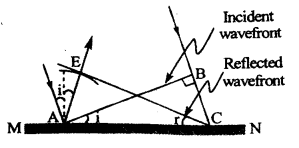
Deduction of law of reflection: We consider a plane wave AB incident at an angle on a reflecting surface MN. If ‘u’ represents the speed of the wave in the medium and if’t’ represents the time taken by the wave front to advance from the point B to C. Then the distance BC = υt.
In order to construct the reflected wave front we draw a sphere of radius ot from the point A. Let CE represent the tangent plane drawn from point C to this sphere. Then, AE = BC = υt. The triangle EAC and BAC are congruent, the angle i and r would be equal. This is the law of reflection.
Question 2.
Explain any two types of wave fronts. Draw the ray diagram to show the behavior of plane wave fronts as they pass through a) a thin prism b) a thin convex lens.
Answer:
A wave front is defined as the locus of all points is a medium that are overlapping in the same phase. There are two types o£ wave fronts.
i) Spherical wave front: It is produced by a point source of light. As the light travels outward in all directions, the surface of constant phase is a sphere.
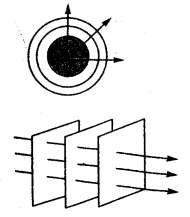
ii) Plane wave front: It is produced by a source at an infinite distance or a point source placed at the focus of a convex lens. The rays are travallel and the wave front is a plane.
Behaviour of plane wave front:
a) Through a thin prism: When a plane wave front passes through a prism, the lower part of the wave front travels through more glass than the upper part. Since light travels slower in glass, the lower part is delayed, causting the emerging wave front to be tilted.
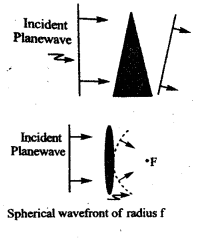
b) Through a thin convex lens: A plane wave front incident on a convex lens is refracted such that the central part of the wave front travels through the thickest part of the Jens and is delayed the most. This causes the emerging wave front to become spherical and converge towards the focal point.
Question 3.
Derive an expression for the intensity at a point where interference of light occurs. Arrive the conditions for maximum and zero intensity.
Answer:
Expression for Intensity at a point due Interference of Light :
Consider two interfering light rays coming from two sources.
The displacements of the two rays are given by y1 = A cos ωt, y2 = A cos (ωt + Φ)
where a is amplitude, ω is angular frequency and Φ is the phase difference between the waves.
From the principle of superposition of the rays the resultant displacement is y = y1+ y2
⇒ y = A [cos ωt + cos (ωt + Φ)]
⇒ y = (2A cos\(\left(\frac{\phi}{2}\right)\)) cos(ωt + \(\frac{\phi}{2}\)) (∵ cos A + cos B = 2 cos\(\left(\frac{\mathrm{A}-\mathrm{B}}{2}\right)\) cos \(\left(\frac{\mathrm{A}+\mathrm{B}}{2}\right)\))
Here, 2A cos\(\left(\frac{\phi}{2}\right)\) represents the amplitude of the resultant wave at the point.
The intensity of resultant wave is I = 4I0 cos2\(\left(\frac{\phi}{2}\right)\)
where I0 is the intensity of each wave.
Conditions for Maximum Intensities:
The maximum value of resultant intensity I is Imax = 4I0 when cos2(Φ/2) = 1.
Thus, the condition for maximum intensity at the point is Φ = 0, ± 2π, ± 4π ………….
Conditions for Zero Intensities:
The minimum value of resultant intensity I is Imin = 0 when cos2(Φ/2) = 0.
Thus, the condition for minimum intensity at the point is Φ = ± π, ± 3π, ± 5π ….
Question 4.
Compare and contrast the double slit interference pattern with single slit diffraction pattern.
Answer:
| Feature | Double slit Interference | Single slit Diffraction |
| Source | Produced by the superposition of two separate wave fronts from two coherent sources. | Produced by the superposition of secondary wavelets originating from different parts of the same wave front. |
| Fringe width | All fringes are generally of equal width. | The central bright fringe is twice as wide as the secondary maxima. |
| Intensity | All bright fringes have the same intensity. | The intensity decreased rapidly as we move away from the central maximum. |
| Constant | There is usually a good constant between bright and dark fringes. | There is poor constant dark fringes are not perfectly dark. |
Question 5.
Discuss the intensity of light when a polaroid sheet is rotated between two crossed polaroids.
Answer:
Intensity of Transmitted Polarised Light through a Polaroid :
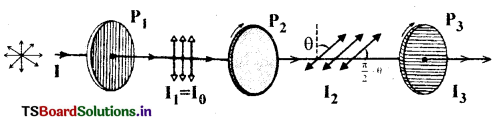
Let I0 be the intensity of polarised light after passing through the first polariser P1.
Then the intensity of light after passing through second polariser P2 will be I2 = I0 cos2 θ
Here θ is the angle between pass axes of P1 and P2
Since P1 and P3 are crossed the angle between the pass axes of P2 and P3 will be (\(\frac{\pi}{2}\) – θ)
Hence the intensity of light emerging from P3 will be I3 = I2cos2(90°- θ)
I3 = (I0cos2θ)sin2θ = \(\frac{I_0}{4}\)(4 sin2 θcos2 θ) = \(\frac{I_0}{4}\)sin2 2θ [∵ sin2θ = 2sinθcosθ]
Intensiy of transmitted light will be maximum when sin2θ = 1 ⇒ 2 θ = 90° ⇒ θ = 45°
∴ the transmitted intensity will be maximum when θ = π/4
Question 6.
Does principle of conservation of energy hold for interference and diffraction phenomenon? Explain briefly.
Answer:
Yes.
The principle of conservation of energy holds good for both interference and diffraction.
In interference and diffraction, patterns of bright and dark fringes are formed. Here the principle of conservation of energy holds good for patterns of bright and dark fringes of interference and diffraction.
In interference and diffraction, light energy is redistributed. If it reduces in one region, producing a dark fringe, it increases in another region, producing bright fringe. Thus there is no gain or loss of energy. Hence, total energy remains constant.
Question 7.
Explain single slit diffraction pattern with neat diagram. State conditions for maximum intensity and minimum intensity.
Answer:
Diffraction: The phenomenon of bending of light round the sharp comers of an obstacle placed in the path of light is called diffraction of light.
Diffraction can be explained by using Huygens principle. When a wavefront is partially obstructed, only the wavelets from the exposed parts superpose and produce diffraction pattern of bright and dark fringes.
Diffraction at Single Slit: Suppose a parallel beam of light is incident normally on a single slit LN of width a. The diffracted light goes on to meet a screen at large distance.
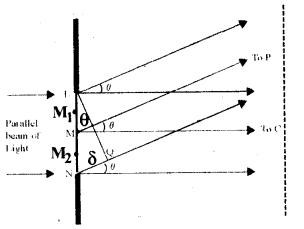
Let us consider a point P on the screen which collects the waves originating from different points of the slit at an angle θ.
From the digaram, sin θ = \(\frac{\delta}{a}\) ⇒ δ = a sin 0 ⇒ δ = aθ (when θ is very small we have sinθ = θ)
Condition for maximum intensity:
F or maximum intensity δ = (2n + 1)\(\frac{\lambda}{2}\)
(2n + 1)\(\frac{\lambda}{2}\) = aθ ⇒ θ = (2n + 1)\(\frac{\lambda}{2 \mathrm{a}}\) , n = 1, 2, 3,…
Conditions for minimum intensity:
For minimum intensity δ = 2n\(\left(\frac{\lambda}{2}\right)\)
2n\(\left(\frac{\lambda}{2}\right)\) = aθ ⇒ θ = \(\frac{\mathrm{n} \lambda}{\mathrm{a}}\), n = 1, 2, 3„…
VI. Long Answer Questions
Question 1.
Explain (he optical phenomenon of reflection, refraction and total internal reflection using lluygen’s principle, with a neat diagram.
Answer:
Huygens’ Principle: Each point of the wavefront is the source of a secondary disturbance and the wavelets emanating from these points spread out in all directions with the speed of the wave. These wavelets are called secondary wavelets and a common tangent drawn to these wavelets gives the position of wavefront at a later time.
1) Reflectionby Huygens Principle :
We consider a plane wave AB incident at an angle on a reflecting surface MN.
If ‘υ’ represents the speed of the wave in the medium and if’f represents the time taken by the wave front to advance from the point B to C.
Then the distance BC = υt.
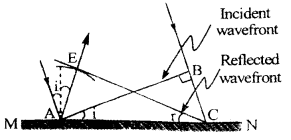
In order to construct the reflected wave front we draw a sphere of radius Dt from the point A. Let CE represent the tangent plane drawn from point C to this sphere. Then, AE = BC = υt. The triangle EAC and BAC are congruent, the angle i and r would be equal.
This is the law of reflection
2) Refraction by Huygens Principle :
AB is a plane wavefront incident at the interface of medium 1 (rarer) and medium 2 (denser). The angle of incidence is i.
The wave velocity in medium 1 is v1 and in medium 2 is v2. If t is the time taken by the wave to travel from B to C, the distance travelled by the refracted wave in the denser medium (AE = v2t) will be less than the distance travelled in rarer medium (BC = v1t) because v2 < v1.
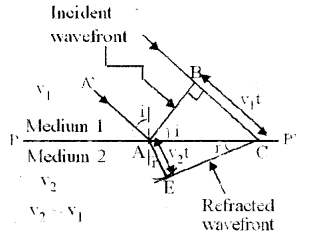
The arc drawn with a radius of v2t represents the secondary wave let at the instant. The tangent drawn to it is EC which represents the refracted wavefront.
The angle of refraction is r.
From figure, sin i = \(\frac{B C}{A C}=\frac{v_1 t}{A C}\) and sin r = \(\frac{A E}{A C}=\frac{v_2 t}{A C}\) ⇒ \(\frac{\sin i}{\sin r}=\frac{v_1}{v_2}\) ………… (1)
From (1), r < i, (∵ v2 < v1)
If c is velocity of light in vacuum, the refractive indices of medium 1 and medium 2 are given by
n1 = \(\frac{c}{v_1}\) and n2 = \(\frac{c}{v_2}\)
Putting these in equ (1), we get n1 sin i = n2 sin r . This is Snell’s law of refraction.
3) Total Internal Reflection (TTR): Total internal reflection is the complete reflection of light ray back into a denser medium, when it hits the boundary of a rare medium.
Critical Angle(iC): The specific angle of incidence in the denser medium for which the angle of refraction is 90°.
TIR Conditions: If i > iC all light rays reflect back.
The light must travel from a more dense medium to less dense medium.
The critical angle is determined by, \(\frac{\sin i}{\sin r}\)
If r = 90°, i = iC; (sin iC = \(\frac{\mathrm{n}_2}{\mathrm{n}_1}\))
If i > iC, the wave will under go total internal reflection.
Question 2.
Distinguish between coherent and incoherent addition of waves. Develop the theory for constructive and destructive interference and arrive the condition for bright and dark fringe in Young double slit experiment
Answer:
Difference Between Coherent and Incoherent Addition of Waves
| Coherent Addition | Incoherent Addition |
| 1) Waves maintain constant phase difference | 1) Phase difference changes randomly. |
| 2) Same frequency | 2) Different frequencies may exist. |
| 3) Produces sustained interference pattern | 3) No sustained interference pattern. |
| 4) Intensity depends on phase difference | 4) Intensities simply ad |
| 5) Ex: Young’s double slit experiment. | 5) Ex: Light from ordinary bulbs. |
Theory of Constructive and Destructive Interferences: Consider two interfering light rays coming from two sources.
The displacements of the two rays are given by y1 = A cos ωt, y2 = A cos (ωt + Φ)
where a is amplitude, ω is angular frequency and Φ is the phase difference between the waves.
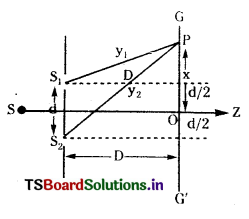
From the principle of superposition of the rays the resultant displacement is y = y1 + y2
⇒ y = A [cos ωt + cos (ωt + Φ)]
⇒ y = (2A cos\(\left(\frac{\phi}{2}\right)\)) cos(ωt + \(\frac{\phi}{2}\)) (∵ cos A + cos B = 2 cos\(\left(\frac{\mathrm{A}-\mathrm{B}}{2}\right)\) cos \(\left(\frac{\mathrm{A}+\mathrm{B}}{2}\right)\))
Here, 2A cos\(\left(\frac{\phi}{2}\right)\) represents the amplitude of the resultant wave at the point.
The intensity of resultant wave is I = 4I0 cos2\(\left(\frac{\phi}{2}\right)\) here I0 is the intensity of each wave.
Conditions for Maximum Intensities:
The maximum value of resultant intensity I is Imax when cos2(Φ/2) = 1.
Thus, the condition for maximum intensity at the point is Φ = 0, ± 2π, ± 4π ……………
The intensity will be maximum at a point P. So constructive interference takes place and bright fringes are formed.
Conditions for Zero Intensities:
The minimum value of resultant intensity I is Imin = 0 when cos2(Φ/2) = 0.
Thus, the condition for minimum intensity at the point is Φ = ± π, ± 3π, ± 5π….
The intensity will be minimum at a point P. So destructive interference takes place and dark fringes are formed.
Exercise Problems
Question 1.
In Young’s double slit experiment, the intensity of light at a point on the screen where the path difference is X is K units. Find the intensity at a point where the path difference is a) \(\frac{\lambda}{4}\) b) \(\frac{\lambda}{2}\)
Answer:
Given Phase difference Φ = \(\frac{2 \pi}{\lambda}\) ∆x and if ∆x = λ, then, Φ = \(\frac{2 \pi}{\lambda}\) × λ, = 2π ⇒ Φ = 2π
Intensity I = Imax cos2\(\left(\frac{\phi}{2}\right)\) ⇒ I = Imax cos2\(\left(\frac{2 \pi}{2}\right)\)
= Imaxcos2π = Imax(-1)2 = Imax = K
(a) :Path difference is λ/4, New phase difference Φ = \(\frac{2 \pi}{\lambda}\left(\frac{\lambda}{4}\right)=\frac{\pi}{2}\)
New intensity K cos2\(\frac{\pi / 2}{2}\) = K cos2\(\frac{\pi}{4}\) = K\(\left(\frac{1}{\sqrt{2}}\right)^2\) = \(\frac{K}{2} \)
(b) : Path difference is λ/2, New phase difference Φ = \(\frac{2 \pi}{\lambda} \times \frac{\lambda}{2}\) = π
New intensity = K cos2 \(\left(\frac{\pi}{2}\right)\) = 0
Question 2.
Find the ratio of intensities at two points ‘P’ and ‘Q’ on a screen in a Young’s double slit experiment, when waves from sources S1 and S2 have a phase difference of
a) \(\frac{\pi}{3}\) b) \(\frac{\pi}{2}\) respectively.
Answer:
Intensity I = I0 cos2\(\frac{\phi}{2}\)
At point P : IP = I0 cos2\(\left(\frac{\pi / 3}{2}\right)\) = I0 cos2\(\frac{\phi}{6}\)
= I0\(\left(\frac{\sqrt{3}}{2}\right)^2\) = \(\frac{3}{4}\)I0
At point Q : IQ = I0 cos2\(\left(\frac{\pi / 2}{2}\right)\) = I0 cos2\(\frac{\phi}{4}\)
= I0\(\left(\frac{1}{\sqrt{2}}\right)^2\) = \(\frac{1}{2}\)I0
∴ \(\frac{I_P}{I_Q}=\frac{3 / 4 I_0}{1 / 2 I_0}=\frac{3}{2}\)
Question 3.
In Young’s double slit experiment, the slits are 0.2 mm apart and the screen is 1.5 in away, it is observed that the distance between the central bright fringe and fourth dark fringe is 1.8 cm. Find the wavelength of light used.
Answer:
Given slit distance d = 0.2mm = 0.2 × 10⁻³ m, Screen distance D = 1.5m
4th dark fringe distance y4 = 1.8cm = 1.8 × 10⁻² m
Formula: yn = (2n – 1) \(\frac{\lambda D}{2 d}\) ⇒ 1.8 × 10-2 = \(\frac{(2 \times 4-1) \lambda(1.5)}{\left(0.2 \times 10^{-3}\right)}\)
⇒ λ = \(\frac{1.8 \times 10^{-2} \times 2 \times 0.2 \times 10^{-3}}{10.5}\) = 6.86 × 10⁻⁷ m
Question 4.
Light of wave length 550nm is incident as parallel beam on a slit of width 0.1 tnm. Find the angular width of central maxima of diffraction pattern.
Answer:
Given wave length λ = 550nm = 550 × 10-9, Slit width a = 0.1 mm = 0.1 × 10⁻³ m
Angular width = \(\frac{2 \lambda}{a}=\frac{2 \times 550 \times 10^{-9}}{0.1 \times 10^{-3}}\) = 1.1 × 10⁻² rad.
Question 5.
A polarizer and an analyzer are oriented, so that the maximum light is transmitted. What is the percentage Of maximum light transmitted when analyzer is rotated through
a) 300 b) 60″?
Answer:
From Malu’s law Intensity I = Imax cos2 θ
Case (a) θ = 30°, I = Imax cos2 30° – Imax\(\left(\frac{\sqrt{3}}{2}\right)^2\) = \(\frac{3}{4}\)Imax
⇒ \(\frac{I}{I_{\max }}=\frac{3}{4}\) = 75%
Case (b) θ = 60°, I = Imax cos2 60° – Imax\(\left(\frac{1}{2}\right)^2\) = \(\frac{1}{4}\)Imax
⇒ \(\frac{I}{I_{\max }}=\frac{1}{4}\) = 25%
Objective Questions
Question 1.
The refractive index of water is 1.33. What will be the speed of light in water?
1) 4 × 10⁸m/s
2) 1.33 × 10⁸ m/s
3) 3 × 10⁸m/s
4) 2.25 × 10⁸ m/s
Answer:
4) 2.25 × 10⁸ m/s
Question 2.
Light travels through a glass plate of thickness t and having a refractive index p. If c is the velocity of light in vacuum, the time taken by light to travel this thickness of glass is
1) t/μc
2) μt/c
3) tμc
4) tc/μ
Answer:
2) μt/c
Question 3.
Time taken by sunlight to pass through a window of thickness 4 mm whose refractive index is 3/2 is
1) 2 × 10⁻⁴ s
2) 2 × 10⁸ s
3) 2 × 10-11s
4) 2 × 10¹¹s
Answer:
3) 2 × 10-11s
Question 4.
Ratio of intensities of two waves are given by 4:1. then ratio of the amplitudes of the two waves is
1) 2 : 1
2) 1 : 2
3) 4 : 1
4) 1 : 4
Answer:
1) 2 : 1
Question 5.
Interference is possible in
1) light waves only
2) sound waves only
3) both light and sound waves
4) neither light nor sound waves
Answer:
3) both light and sound waves
Question 6.
Two slits in Young’s experiment have widths in the ratio 1:25. The ratio of intensity at the maxima and minima in the interference pattern, \(\frac{I_{\max }}{I_{\min }}\) is
1) 49/121
2) 4/9
3) 9/4
4) 121/49
Answer:
3) 9/4
Question 7.
In Young’s double slit experiment, an interference pattern is obtained on a screen by a light of wavelength 6000Å. coming from the coherent sources S1 and S2. At certain point P on the screen third dark fringe is formed. Then the path difference S1P – S2P in microns is
1) 0.75
2) 1.5
3) 3.0
4) 4.5
Answer:
2) 1.5
Question 8.
The fringe width in Young’s double slit experiment increases when
1) wavelength increases
2) distance between the slits increases
3) distance between the source and screen decreases
4) the width of the slits increases
Answer:
1) wavelength increases
Question 9.
In Young’s experiment, the distance between slits is 0.28 mm and distance between slits and screen is 1.4m. Distance between central bright fringe and third bright fringe is 0.9cm. What the wavelength of light used
1) 5000A°
2) 6000A°
3) 5880A°
4) 5800A°
Answer:
2) 6000A°
Question 10.
Two slits, 4mm apart are illuminated by light of wavelength 6000A”. What will be the fringe width on a screen placed 2m from the slits?
1) 0.12 mm
2) 0.3 mm
3) 3.0 mm
4) 4.0 mm
Answer:
2) 0.3 mm
Question 11.
A slit width 0.15cm is illuminated by light of wavelength 5 × 10⁻⁵cm and the diffraction pattern is obtained at a distance 2.1m. The width of central is
1) 0.14 cm
2) 0.28 cm
3) 0.42 cm
4) 0.56 cm
Answer:
1) 0.14 cm
Question 12.
The condition for obtaining maxima in the diffraction pattern due to a single slit is
1) asinθ = (2n + 1)\(\frac{\lambda}{2}\)
2) asinθ = nλ
3) asinθ = \(\frac{\mathrm{n} \lambda}{2}\)
4) asinθ = (2n + 1)λ.
Answer:
1) asinθ = (2n + 1)\(\frac{\lambda}{2}\)
Question 13.
The approximate rectilinear propagation of light can be explained by
1) interference
2) dispersion
3) refraction
4) diffraction
Answer:
4) diffraction
Question 14.
The fringes produced in diffraction pattern are of
1) equal width
2) unequal width
3) all dark fringes of zero intensity
4) all bright fringes of equal intensity
Answer:
2) unequal width
Question 15.
Angular width of diffraction maximum does not depend on
1) distance of source from slit
2) wavelength of light
3) width of slit
4) wavelength and width of slit
Answer:
1) distance of source from slit
Question 16.
Colours appear on a thin soap film and on soap bubbles due to the phenomenon of
1) interference
2) dispersion
3) refraction
4) diffraction
Answer:
1) interference
Question 17.
The ratio of resolving powers of an optical microscope for two wavelengths λ1 = 4000A° and λ2 = 6000 A° is
1) 9 : 4
2) 3 : 2
3) 16 : 81
4) 8 : 27
Answer:
2) 3 : 2
Question 18.
The angular resolution of a 10 cm diameter telescope at a wavelength of 5000 A° is of the order of
1) 106rad
2) 10-2 rad
3) 10-4 rad
4) 10-6 rad
Answer:
3) 10-4 rad
Question 19.
Two polaroids P1, and P2 are placed with their axis perpendicular to each other. Unpolarised light I0 is incident on P1. A third polaroid P3 is kept in between P1 and P2 such that its axis makes an angle 45° with that of P1. The intensity of transmitted light through P2 is
1) I0/4
2) I0/8
3) I0/16
4) I0/2
Answer:
2) I0/8
Question 20.
Which of the phenomenon is not common to sound and light waves?
1) Interference
2) Diffraction
3) Coherence
4) Polarisation
Answer:
4) Polarisation