
Regular practice with AP Inter 2nd Year Chemistry Study Material Chapter 7 Alcohols, Phenols and Ethers Questions and Answers helps students stay prepared for examinations.
AP Inter 2nd Year Chemistry 7th Lesson Alcohols, Phenols and Ethers Questions and Answers
I. Multiple Choice Questions
Question 1.
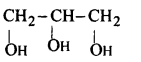
Glycerol is a:
1) dihydric alcohol
2) monohydric alcohol
3) hexahydric alcohol
4) trihydric alcohol
Answer:
4) trihydric alcohol
Count number of-OH groups in glycerol. It has three —OH groups attached to different carbons.Alcohol classification depends on number of —OH groups. Trihydric alcohol

Question 2.
Primary and secondary alcohols on action of red-hot copper give
1) aldehydes and ketones respectively
2) ketones and aldehydes respectively
3) only aldehydes
4) only ketones
Answer:
1) aldehydes and ketones respectively
Red-hot Cu causes dehydrogenation (removal of H2).
Primary alcohol → aldehyde. Secondary alcohol → ketone. Because of different carbon environments. Aldehydes and ketones respectively

Question 3.
Which of the following can work as a dehydrating agent for alcohols?
1) Conc. H2SO4
2) Anhydrous Al2O3
3) H3PO4
4) All of these
Answer:
4) All of these
Dehydrating agents remove water. Cone. H2SO4, Al2O3, and H3PO4 all promote elimination of water. So all act as dehydrating agents.
Question 4.
Which of the following shows strong hydrogen bonding?
1) Ethyl amine
2) Ammonia
3) Ethyl alcohol
4) Diethyl ether
Answer:
3) Ethyl alcohol
Strong hydrogen bonding requires -OH group (more polar than -NH).
Alcohols form stronger H-bonds than amines/ethers.
Question 5.
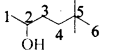
What is the IUPAC name of the compound given below?

1) 5, 5-dimethyl-hexan-2-ol
2) 5,5,5-trimethyl-pentan-2-ol
3) 2,2-dimethyl-hexan-5-ol
4) 2,2-dimethyl-pentan-5-ol
Answer:
1) 5, 5-dimethyl-hexan-2-ol
Choose longest chain containing -OH. Number from end nearest to -OH.
Identify substituents correctly. Applying rules → hexane backbone, -OH at C-2, two methyl at C-5. 5,5-dimethyl-hexan-2-ol
Question 6.
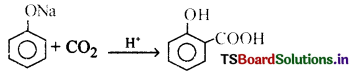
Sodium phenoxide on reaction with carbon dioxide followed by acidification gives
1) benzoic acid
2) salicylic acid
3) phenylacetic acid
4) phthalicacid
Answer:
2) salicylic acid
Sodium phenoxide + CO2 → Kolbe’s reaction.
CO2 attaches at ortho position → after acidification → salicylic acid
Question 7.
What is the major product formed when ethanol is dehydrated with concentrated H2SO4 at 413K? .
1) Ethene
2) Methoxymethane
3) Methoxyethane
4) Ethoxyethane
Answer:
4) Ethoxyethane
Dehydration of alcohol depends on temperature: 413 K → ether formation (intermolecular) 443 K → alkene. So ethanol gives Ethoxyethane at 413 K .
Question 8.
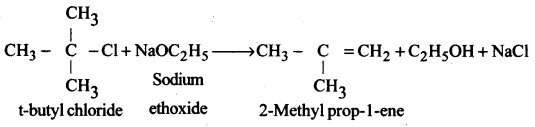
The reaction between tert-Butyl chloride and sodium ethoxide gives
1) tert-butyl ethyl ether
2) tert-butyl methyl ether
3) 2-methylprop-1-ene
4) butene
Answer:
3) 2-methylprop-1-ene
tert-butyl chloride forms stable carbocation → elimination favored.
Strong base (ethoxide) → E2 elimination → alkene formation Gives most substituted alkene. 2-methylprop-1 -ene
Question 9.
One molecule of dialkyl ether produces how many molecules of alkyl halides with excess of halogen acid?
1) 1
2) 2
3) 3
4) 4
Answer:
2) 2
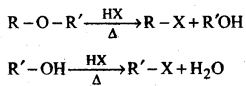
Ether + excess HX → cleavage of both C-O bonds (2 molecules)
Question 10.
On heating aqueous solution of benzene dia/onium chloride, which of the following is formed?
1) benzene
2) chlorobenzene
3) phenol
4) aniline
Answer:
3) phenol
Benzene diazonium salt + water (heat) → hydrolysis.
\(\mathrm{N}_2^{+}\) replaced by -OH group. Forms phenol
Question 11.
When phenol is treated with excess bromine water it gives
1) m-bromophenol
2) o- and p-bromophenol
3) 2,4-dibromophenol
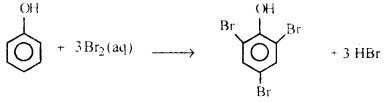
4) 2,4,6-tribromophenol
Answer:
4) 2,4,6-tribromophenol
Phenol is strongly activating (-OH group). Directs substitution to ortho & para positions.
Excess Br2 → substitution at 2,4,6 positions. 2,4,6-tribromophenol
Question 12.
The compound obtained by the reaction of ethene with diborane followed by hydrolysis with alkaline H2O2 is
1) ethanol
2) propanol
3) ethanal
4) triethyl bromide
Answer:
1) ethanol
Reaction is hydroboration-oxidation: Alkene +. diborane → alcohol (anti-Markovnikov addition)
Ethene gives ethanol (-OH adds to less substituted carbon).
Question 13.
Which of the following is formed when phenol is exposed to air?
1) Benzoquinone
2) Benzyl quinone
3) Acetophenone
4) Benzene
Answer:
1) Benzoquinone
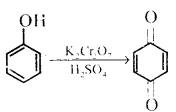
Phenol on exposure to air gets oxidized slowly. Forms quinone (benzoquinone).
Question 14.
The alcohol which does not react with Lucas reagent at room temperature is
1) isobutyl alcohol
2) n-butanol
3) tert-butyl alcohol
4) sec-butyl alcohol
Answer:
2) n-butanol
Lucas test: 3° alcohol → immediate reaction. 2° alcohol → slow. 1 ° alcohol → no reaction at room temp, n-butanol is primary alcohol.
Question 15.
Which statement from the following is true?
1) During dehydration reaction H2O molecule is added to reactant.
2) Lucas test is used for detection of ethers.
3) During esterification OH– from acid molecule and H+ from alcohol are removed.
4) During esterification H+ from acid molecule and OH– from alcohol are removed.
Answer:
3) During esterification OH– from acid molecule and H+ from alcohol are removed.
Esterification: Acid + Alcohol → Ester + Water. Water is formed by removal of: OH from acid.
H from alcohol. Check options carefully OH– from acid and H+ from alcohol are removed
II. Fill in the Blanks
Question 1.
Isopropyl benzene is commonly called ________.
Answer:
cumene.
Question 2.
Boiling points of alcohols and phenols are higher in comparison to other classes of compounds due to __________.
Answer:
intermolecular hydrogen bonding
Question 3.
Alcohols and phenols react with carboxylic acids to form __________.
Answer:
esters
Question 4.
Lucas reagent is _________
Answer:
Cone. HCl/ZnCl2 (anhydrous)
Question 5.
On treating phenol with chloroform in the presence of sodium hydroxide, salicylaldehyde is formed. This reaction is known as ___________.
Answer:
Reimer-Tiemann reaction
III. One Word Answer Questions
Question 1.
Phenol on heating with zinc dust gives a compound X. What is X?
Answer:
Phenol on heating with zinc dust gives Benzene (C6H6)
Question 2.
When an alkyl halide is allowed to react with sodium alkoxide, ether is formed. What is the name given to this reaction?
Answer:
Williamson synthesis: Alkyl halide + sodium alkoxide → Ether (R’-X + R-O-Na → R-O-R’ + NaX)
Question 3.
In the preparation of phenol from cumene, what is the byproduct obtained?
Answer:
The byproduct obtained in the preparation of phenol from cumene is Acetone (CH3COCH3)
Question 4.
What is the HJPAC name of glycerol?
Answer:
IUPAC name of glycerol is Propane-1,2,3-triol.
Question 5.
Which class of compounds are obtained when alkenes react with water in the presence of acid as catalyst?
Answer:
Alkenes when react with water in the presence of acid as catalyst gives Alcohols.

IV. Very Short Answer Questions
Question 1.
Explain why propanol has higher boiling point than that of the hydrocarbon butane.
Answer:
The boiling point of propanol is higher because of the presence of intermolecular hydrogen bonding in the molecules. But, it is not present in butane due to the absence of polar -OH group.
The boiling point (391K) of propanol is more than that of butane (309K).
Question 2.
Alcohols are comparatively more soluble in water than hydrocarbons of comparable j molecular masses. Explain this fact.
Answer:
Alcohols can form H-bonds with water and break the H-bonds already existing between water molecules. Hence, they are soluble in water.
But hydrocarbons cannot form H-bonds with water and hence they are insoluble in water.
Question 3.
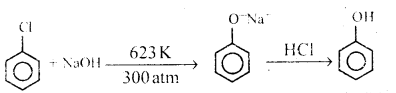
Give the reagents used for the preparation of phenol from chlorobenzene.
Answer:
Question 4.
Give the reagents used for the preparation of phenol from chlorobenzene.
Answer:
Phenol can be obtained by heating chlorobenzene in the presence of a catalyst, with 10% NaOH solution and HC1 at 350°C under 200-300 atm pressure.
Question 5.
Preparation of ethers by acid dehydration of secondary or tertiary alcohols is not a suitable method. Give reason.
Answer:
Ethers cannot be prepared by the dehydration of secondary (or) tertiary alcohols, because alkenes are formed easily in these reactions. This happens due to steric hinderance.
Question 6.
Write the mechanism of the reactions of HI with methoxymethane.
Answer:
The ether molecule is initially protonated by the halogen acid (HI) to form protonated ether.

The protonated ether is then attacked by the halide ion (I–) which acts as nucleophile as follows:

Question 7.
Name the reagents used in the following- reactions:
i) Oxidation of primary alcohol to carboxylic acid
ii) Oxidation of primary alcohol to aldehyde
Answer:
i) Acidified KMnO4(or)acidified K2Cr2O7 is used in the oxidation of primary alcohol to carboxylic acid
ii) CrO3 (or) pyridine chlorochromate (pcc) is used as a reagent in the oxidation of primary alcohol to aldehyde.
Question 8.
Write the equations for the following reactions
i) Broniination of phenol to 2.4,6-trihromophcnil
ii) Benzl alcohol to benzoic acid
Answer:
i) Bromination of phenol to 246-rihron1ophenol:
Phenol when treated with excess of aqueous bromine solution forms 2,4,6-tribromophenol.
ii) Benzl alcohol to benzoic acid:
Benzyl alcohol oxidises into Benzaldehyde and then to Benzoic acid in the presence of alkaline KMnO4.

Question 9.
Identify the reactant needed to form t-butyi alcohol from acetone.
Answer:
CH3MgBr (Methyl magnesium bromide) is needed to form t-butyl alcohol from acetone.

Question 10.
Write the struclures for the foIIoshig compounds
1) Ethoxy Ethane
2) Ethoxybutane
3) Phenoy ethane
Answer:
1) Elbow Elhane : C2H5 — O — C2H5
2) Ethow butane : C2H5 — O — CH2 — CH2 — CH2 — CH3
3) Pheuoy etliane or Elhoy henzene or Ethyl phcnyl ether : C6H5 — O — C2H5
V. Short Answer Questions
Question 1.
Give the equations for the preparation of phenol from Cumene.
Answer:
Cumene is the common name for Isopropylbenzene .
Preparation: When Cumene is oxidised in the presence of air, it is converted into cumene hydroperoxide. When treated with dilute acid, it is then converted into phenol and acetone.

Question 2.
Write the mechanism of hydration of ethene to yield ethanol.
Answer:
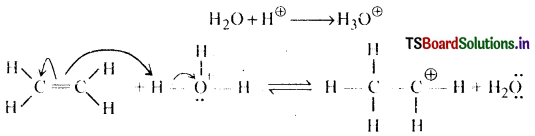
Ethene is converted into alcohol by direct addition of water in the presence of phosphoric Acid (H3PO4).

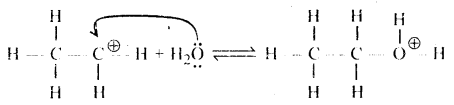
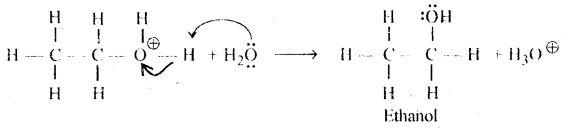
Mechanism(SN1): The mechanism of the reaction involves the following three steps:
Step 1: Protonation of alkene to form carbocation by electrophilic attack of H3O+
Step 2: Nucleophilic attack of water on carbocation.
Step 3: Deprotonation to form an alcohol
Question 3.
Explain the acidic nature of phenols and compare with that of alcohols.
Answer:
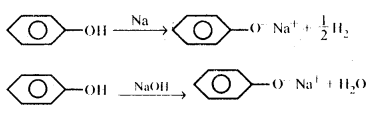
I) Acidic nature of phenols: Phenols are weakly acidic
a) Phenols turn blue litmus to red
b) Phenols react with sodium metal and NaOH to form H2 and H2O.
II) Acidic nature of phenols Vs alcohols:
Phenols are relatively more acidic than alcohols and also water.
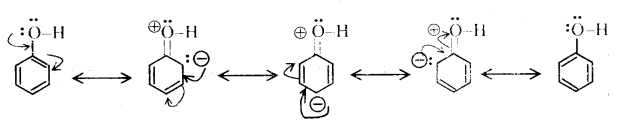
a) The hydroxyl group in phenol is directly attached to SP2 carbon on benzene ring. The carbon acts as an electron withdrawing group and Phenol exhibits resonance.
In these structures oxygen carries positive charge. This oxygen attracts electron pair of O-H bond strongly towards itself and facilitates the release of H+ ion and C6H5O–.
The formed phenoxide ion is more stable than phenol.
Question 4.
Write the products formed by the reduction and oxidation of phenol.
Answer:
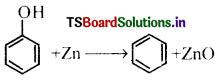
a) Reduction: Phenols on distillation with zinc dust undergo reduction to form benzene
b) Oxidation: Phenol undergo oxidation with chromic acid to produce conjugated diketone which is known as p-benzoquinone.
Question 5.
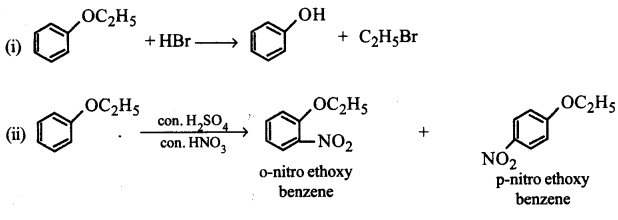
Write the products of the following reactions.

Answer:
Question 6.
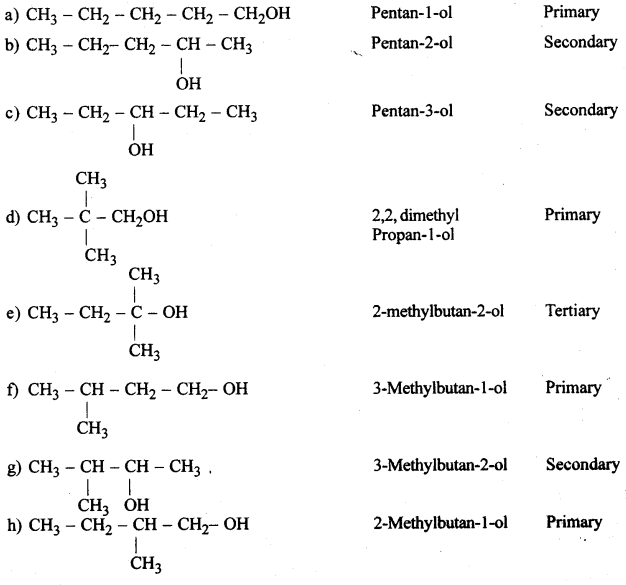
Draw the structures of all isomeric alcohols of molecular formula C5H12O and give their IUPAC names and classify them as primary, secondary, and tertiary alcohols.
Answer:
The structures, IUPAC names and the classification of all isomeric alcohols of molecular formula C5H12O are eight and follows as
Question 7.
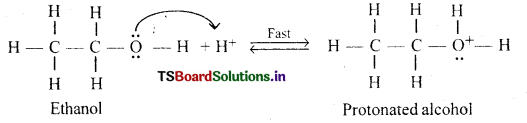
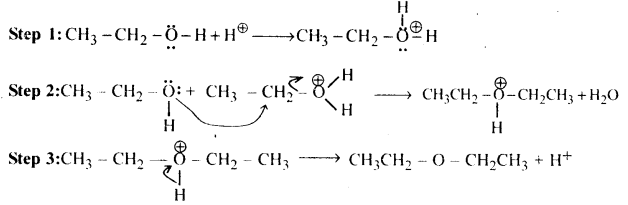
Ethanol reacts with H2SO4 at 443K forms ethene while at 413 K it forms Ethoxy Ethane. Explain the mechanism.
Answer:
I) Formation of Ethene at 443K:
Ethanol undergoes dehydration when it is heated it with concentrated H2SO4 at 443 K..

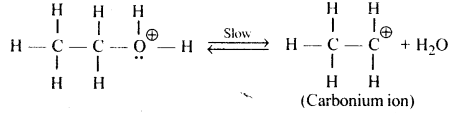
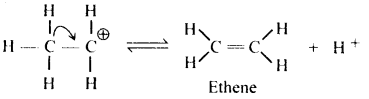
SN1 Mechanism: Dehydration of ethanol involves the following steps.
Step 1: Formation of protonated alcohol (oxonium ion)
Step 2: Formation of carbocation: It is the slowest step and hence it has become the rate determining step of the reaction.
Step 3: Formation of ethene by elimination of proton
II) Formation of ethoxy ethane at 413 K:
Ethanol is dehydrated to ethoxyethane in the presence of sulphuric acid at 413 K.

SN2 Mechanism: The formation of ether is a nucleophilic bimolecular reaction and it involves the attack of alcohol molecule on a protonated alcohol, as indicated below
Question 8.
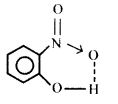
While separating a mixture of ortho and para nitrophenols by steam distillation, name the isomer which will be steam volatile. Cke reason.
Answer:
The ortho and para isomers can be separated by steam distillation. The ortho nitro phenol is steam volatile due to intra molecular hydrogen bonding. The para-nìtrophenol is less volatile due to intermolecular hydrogen bonding which results in the association of molecules.
o- nitrophenol shows intra molecular hydrogen bonding. So, it is relatively more volatile than p-isomer.
p-nitrophenol shows inter molecular hydrogen bonding.
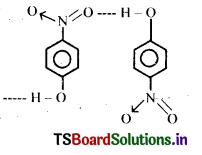
So, this is less volatile than 0-isomer.
Question 9.
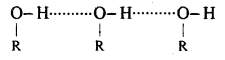
Account for the statement: Alcohols boil at highest temperature than hydrocarbons and ethers of comparable molecular masses.
Answer:
Alcohols have intermolecular attractions due to intermolecular hydrogen bonds. This type of intermolecular hydrogen bonding do not exist in hydrocarbons and ethers. Hence alcohols boil at higher temperature than hydrocarbons and ethers of comparable molecular masses.
Question 10.
Explain why in anisole electrophilic substitution takes place at ortho and para positions and not at meta position.
Answer:
Anisole is the common name for Methoxy benzene
Structure of Anisole:
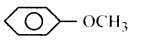
It is the example of alkyl-aryl ethers.
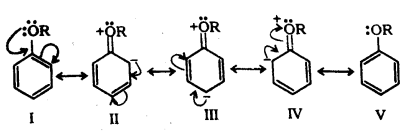
In anisole, Methoxy group (+M group) is electron releasing group and activates the benzene ring at ortho and para positions. Thus the aromatic ethers undergo electrophilic substitution in the benzene ring at the ortho and para positions.
Due to resonance electron density is more at ortho and para positions.
Hence Anisole exhibits electrophilic substitution at ortho and para positions.
Resonance structures of Anisole:
VII. Long Answer Questions
Question 1.
Illustrate hydroboration-oxidation reaction with a suitable example.
Answer:
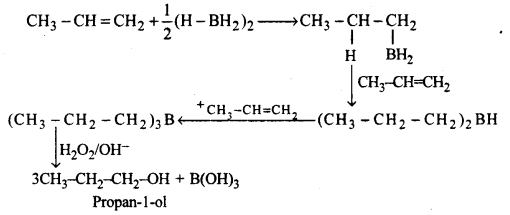
Hydroboration-oxidation reaction: It is the addition of diborane to an alkene followed by
reaction with hydrogen peroxide (H2O2) in the presence of OH– giving an alcohol.
Ex: Alkene reacts with Diborane [B2H6 = (BH3)2] to give trialkyl borane as addition product. This is oxidised to alcohol by hydrogen peroxide in the presence of aqueous sodium hydroxide.
Question 2.
Explain why-
i) ortho-nitrophenol is more acidic than ortho-methoxyphenol
ii) -OH group attached to benzene ring activates it towards electrophilic substitution.
Answer:
i) ortho-nitrophenol is more acidic than ortho- methoxyphenol
The structures of the two compounds are here
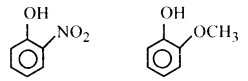
Nitro group(-NO2)is an electron withdrawing group. So,nitrophenol is more aeidic than phenol. Methoxy group (-OCH3) is an electron releasing group. So, methoxyphenol is less acidic than phenol. Thus, ortho nitrophenol is more acidic than ortho-methoxy phenol.
ii) The -OH group is an electron releasing group. It increases the electron density at ortho and para positions on the benzene ring. Hence it activates benzene ring towards electrophilic substitution reactions.

Question 3.
With a suitable example write equations for the following:
i) Kolbe’s reaction
ii) Reimer-Tiemann reaction
iii) Williamsons ether synthesis
iv) Oxidation of alcohol with PCC
Answer:
i) Kolbe’s reaction: When sodium salt of phenol is heated with carbon dioxide at 135°C and under 4-7 atm pressure, a carboxyl group, mainly in the ortho position is introduced.
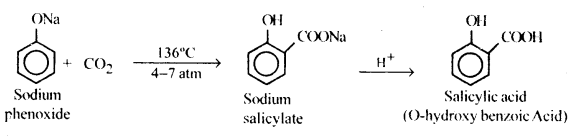
ii) Riemer-Tiemann reaction: On treating phenol with chloroform in the presence of sodium hydroxide, a -CHO group is introduced at ortho position of benzene ring.
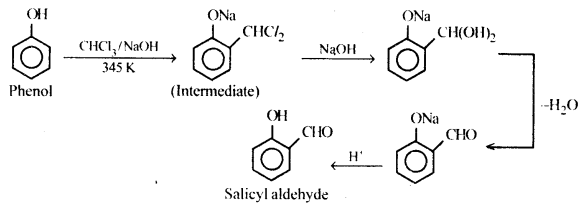
iii) Williamson’s synthesis:
Reaction of Alkyl halides with sodium alkoxide forms ethers.

Ex: When methyl iodide reacts with sodium Ethoxide it forms methoxyethane.
CH3I + C2H5ONa ⟶ CH3O – C2H5 + NaBr
iv) Oxidation of alcohol with PCC:
A better reagent for oxidation of primary alcohols to aldehydes in good yield is pyridinium chlorochromate (PCC), a complex of chromium trioxide with pyridine and HCl.

Question 4.
Explain why phenol with bromine water forms 2,4,6-tribromophenol, while on reaction with bromine in CS2 at low temperatures forms para-bromophenol as the major product.
Answer:
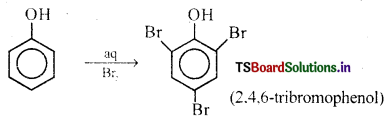
1) Formation of 2,4,6-tribromophenol: Phenol when treated with excess of aqueous bromine solution yields 2,4,6 tribromopehnol. Because in water, phenol ionises to give phenoxide ion which is strongly activating and gives trisubstituted product.
2) Formation of para-bromophenol: However, ifbromination is carried out in a solvent of low dielectric constant, such as chloroform, carbontetrachloride (or) carbon disulphide, ortho and para bromophenols are formed.This is because in these solvents ionisation is less and ring is slightly activated. Hence monosubstituted product is formed.
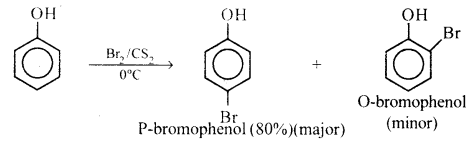
Bromination of phenol takes place even in the absence of Lewisacid, such as FeBr3.
It is due to the highly activating effect of the -OH group on the benzene ring.
Objective Questions
Question 1.
The functional group present in alcohols is:
1. -CHO
2. -OH
3. -COOH
4. -NH2
Answer:
2. -OH
Question 2.
The general formula of phenol is:
1. ArOH
2. RCHO
3. RCOOH
4. RNH2
Answer:
1. ArOH
Question 3.
Which of the following is a primary alcohol?
1. Propan-2-ol
2. Butan-2-ol
3. Ethanol
4. tert-Butanol
Answer:
3. Ethanol
Question 4.
Phenol reacts with NaOH because phenol is:
1. Neutral
2. Basic
3. Acidic
4. Amphoteric
Answer:
3. Acidic
Question 5.
Which reagent converts alcohol into alkyl chloride?
1. NaOH
2. SOCl2
3. H2SO4
4. KMnO4
Answer:
4. KMnO4
Question 6.
Ethanol on oxidation gives:
1. Methanoic acid
2. Ethanoic acid
3. Propanoic acid
4. Acetone
Answer:
2. Ethanoic acid
Question 7.
Phenol reacts with Bromine in CS2 at lower temperature to give
1. p-bromophenol(80%)
2. o-Bromophenol (80%)
3. Tribromophenol
4. di bromophenol
Answer:
1. p-bromophenol(80%)
Question 8.
Which alcohol gives turbidity immediately with Lucas reagent?
1. Primary alcohol
2. Secondary alcohol
3. Tertiary alcohol
4. Phenol
Answer:
3. Tertiary alcohol
Question 9.
Phenol gives violet colour with:
1. NaOH
2. FeCl3
3. HCl
4. NaCl
Answer:
2. FeCl3
Question 10.
Ether contains the functional group:
1. -OH
2. -CO-
3. -O-
4. -CHO
Answer:
3. -O-
Question 11.
The IUPAC name of CH3-O-CH3 is:
1. Methoxy methane
2. Ethoxy methane
3. Dimethyl ether
4. Methanol
Answer:
1. Methoxy methane
Question 12.
Phenol is more acidic than alcohol because:
1. Phenoxide ion is resonance stabilized
2. Alcohol is basic
3. Phenol is neutral
4. Alcohol forms hydrogen bonds
Answer:
1. Phenoxide ion is resonance stabilized
Question 13.
Which compound undergoes Kolbe reaction?
1. Ethanol
2. Phenol
3. Ether
4. Methanol
Answer:
2. Phenol
Question 14.
Which compound undergoes Reimer- Tiemann reaction?
1. Ether
2. Alcohol
3. Phenol
4. Alkene
Answer:
2. Alcohol
Question 15.
Diethyl ether on heating with excess HI gives:
1. Ethene
2. Ethanol
3. Ethyl iodide
4. Acetaldehyde
Answer:
3. Ethyl iodide
Question 16.
Alcohols show hydrogen bonding due to:
1. Presence of carbon
2. Presence of oxygen
3. Presence of hydrogen attached to oxygen
4. Double bond
Answer:
3. Presence of hydrogen attached to oxygen
Question 17.
Which has the highest boiling point?
1. Ether
2. Alkane
3. Alcohol
4. Alkene
Answer:
3. Alcohol
Question 18.
Which compound is commonly called carbolic acid?
1. Methanol
2. Ethanol
3. Phenol
4. Ether
Answer:
3. Phenol
Question 19.
Williamson synthesis is used for preparation of:
1. Alcohols
2. Phenols
3. Ethers
4. Aldehydes
Answer:
3. Ethers
Question 20.
Methanol is also called:
1. Wood spirit
2. Grain alcohol
3. Vinegar
4. Carbolic acid
Answer:
1. Wood spirit
Question 21.
Which compound is most acidic?
1. Ethanol
2. Water
3. Phenol
4. Methanol
Answer:
3. Phenol
Question 22.
Lucas reagent contains:
1. anhydrous ZnCl2 +Conc.HCl
2. NaOH + HCl
3. FeCl3 + HCl
4. H2SO4 + Zn
Answer:
1. anhydrous ZnCl2 +Conc.HCl
Question 23.
Phenol reacts with bromine water to give:
1. Bromobenzene
2. Tribromophenol
3. Dibromophenol
4. Bromoethane
Answer:
2. Tribromophenol
Question 24.
The major product formed when ethanol is heated with cone. H2SO4 at 443 K is:
1. Ethane
2. Ethene
3. Ethanal
4. Ether
Answer:
2. Ethene
Question 25.
Which alcohol gives ketone on oxidation?
1. Primary alcohol
2. Secondary alcohol
3. Tertiary alcohol
4. Methanol
Answer:
2. Secondary alcohol
Question 26.
Which reagent is used to distinguish phenol from ethanol?
1. NaOH
2. FeCl3
3. H2SO4
4. NaCl
Answer:
2. FeCl3
Question 27.
Tertiary alcohols resist oxidation because:
1. They are acidic
2. They lack±-hydrogen
3. They are unstable
4. They are volatile
Answer:
2. They lack±-hydrogen
Question 28.
Anisole is:
1. Alcohol
2. Ether
3. Phenol
4. Ester
Answer:
2. Ether
Question 29.
The product formed when phenol reacts with dilute nitric acid is:
1. Picric acid
2. Nitrobenzene
3. o- and p-nitrophenol
4. Benzoic acid
Answer:
3. o- and p-nitrophenol
Question 30.
Which compound forms explosive peroxides on standing in air?
1. Alcohols
2. Phenols
3. Ethers
4. Aldehydes
Answer:
3. Ethers
Question 31.
Which alcohol is least soluble in water?
1. Methanol
2. Ethanol
3. Propanol
4. Butanol
Answer:
4. Butanol
Question 32.
Hvdroboration-oxidation of alkenes gives:
1. Alcohols
2. Ketones
3. Aldehydes
4. Phenols
Answer:
1. Alcohols
Question 33.
Sodium metal reacts with alcohol to liberate:
1. Oxygen
2. Nitrogen
3. Hydrogen
4. Chlorine
Answer:
3. Hydrogen
Question 34.
Phenol on distillation with zinc dust gives:
1. Cyclohexane
2. Benzene
3. Toluene
4. Benzoic acid
Answer:
2. Benzene
Question 35.
Which compound gives iodoform test?
1. Methanol
2. Ethanol
3. Phenol
4. Ether
Answer:
2. Ethanol
Question 36.
The ether formed by dehydration of ethanol at 413 K is:
1. Methoxy methane
2. Diethyl ether
3. Phenol
4. Ethanal
Answer:
2. Diethyl ether
Question 37.
Which compound does NOT react with NaOH?
1. Phenol
2. Ethanoic acid
3. Ethanol
4. Picric acid
Answer:
3. Ethanol
Question 38.
The hybridisation of oxygen atom in alcohol is:
1. sp
2. sp2
3. sp3
4. dsp2
Answer:
3. sp3
Question 39.
Which is the strongest acid?
1. Phenol
2. p-Nitrophenol
3. Ethanol
4. Methanol
Answer:
2. p-Nitrophenol
Question 40.
Cleavage of ethers by HI proceeds through:
1. Free radical substitution
2. Electrophilic substitution
3. Nucleophilic substitution
4. Addition reaction
Answer:
3. Nucleophilic substitution