
Referring to the AP Inter 1st Year Maths Study Material Chapter Trigonometric Functions Exercise 3a Solutions makes it easier to understand complex problems.
AP Inter 1st Year Maths Trigonometric Functions Exercise 3a
Question 1.
Find the radian measures corresponding to the following degree measures of their radii.
i) 25°
ii) – 47°30′
iii) 240°
iv) 520°
Solution:
i) We know that 180° = π radians
Therefore, 25° = \(\frac{\pi}{180}\) × 25 radians
= \(\frac{5 \pi}{36}\) radians.
Hence, 25° = \(\frac{5 \pi}{36}\) radians.
ii) We know that 180° = π radians
Therefore, – 47°30′ = – 47 . \(\frac{1}{2}\) degrees
= – \(\frac{95}{2}\) degrees
= \(\frac{\pi}{180} \frac{-95}{2}\) radians
= \(-\frac{19 \pi}{72}\) radians
Hence, – 47°30′ = \(-\frac{19 \pi}{72}\) radians
iii) We know that 180° = π radians
Therefore, 240° \(\frac{\pi}{180}\) × 240 radians
= \(\frac{4 \pi}{3}\) radians
Hence, 240° = \(\frac{4 \pi}{3}\) radians.
iv) We know that 180° = π radians
Therefore, 520° = \(\frac{\pi}{180}\) × 520 radians
= \(\frac{26 \pi}{9}\) radians
Hence, 520° = \(\frac{26 \pi}{9}\) radians

Question 2.
Find the degree measures corresponding to the following radian measures (Use π = 22/7).
i) \(\frac{11}{16}\)
ii) – 4
iii) \(\frac{5 \pi}{3}\)
iv) \(\frac{7 \pi}{6}\)
Solution:
i) We know that π radians = 180°
Therefore \(\frac{11}{16}\) radians = \(\frac{180}{\pi} \frac{11}{16}\) degrees
= \(\frac{180 7}{22} \frac{11}{16}\) degrees
= \(\frac{315}{8}\) degrees
= 39° \(\frac{3}{8}\) degrees
= 39° + \(\frac{3}{8}\) × 60 minutes (∵ 1° = 60′)
= 39° + \(\frac{45}{2}\) minutes
= 39° + 22 \(\frac{1}{2}\) minutes
= 39° + 22′ + ½ × 60″ (∵ 1′ = 60′)
= 39° + 22′ + 30″
= 39° 22′ 30″
Hence, \(\frac{11}{16}\) radians = 39°22’30”
ii) We know that π radians = 180°
Therefore, – 4 radians = \(\frac{-180}{\pi}\) × 4 degrees
= \(\frac{-180 7}{22}\) × 4 degrees
= – \(\frac{2520}{11}\) degrees
= – 229 \(\frac{1}{11}\) degrees
= – (229° + \(\frac{1}{11}\) × 60 minutes) (∵ 1° = 60′)
= – (229° + \(\frac{60}{11}\) minutes)
= – ( 229° + 5 \(\frac{5}{11}\) minutes)
= – (229 + 5′ + \(\frac{5}{11}\) × 60″) (∵ 1° = 60′)
= – (229° + 5′ + 27″) = – 229 5’27”
Hence -4 radians = -229 5’27”
iii) We know that π radians = 180°
Therefore, \(\frac{5 \pi}{3}\) radians = \(\frac{180}{\pi} \frac{5 \pi}{3}\) degrees
= 300 degrees = 300°
Hence \(\frac{5 \pi}{3}\) radians = 300°
iv) We know that π radians = 180°
Therefore, \(\frac{7 \pi}{6}\) radians = \(\frac{180}{\pi} \frac{7 \pi}{6}\) degrees
= 210 degrees = 210°
Hence \(\frac{7 \pi}{6}\) radians = 210°.
Question 3.
A wheel makes 360 revolutions in one minute. Through how many radians does it turn in one second ?
Solution:
Number of revolutions in one minute = 360
Therefore, number of revolutions in one second = \(\frac{360}{60}\) = 6
We know that the angle formed in one revolution = 360° = 2π radians
Hence, it will turn 12K radians in one second.
Question 4.
Find the degree measure of the angle subtended at the centre of a circle of radius 100 cm by an arc of length 22 cm (Use π = 22/7).
Solution:
Given, radius r = 100 cm,
length of arc l = 22 cm
Hence, using the relation θ = \(\frac{l}{r}\) we have
θ = \(\frac{22}{100}\) radians = \(\frac{11}{50}\) radians
We know that π radians = 180°
Therefore, \(\frac{11}{50}\) radians = \(\frac{180}{\pi} \frac{11}{50}\) degrees
= \(\frac{180 7}{22} \frac{11}{50}\) degrees
= \(\frac{63}{5}\) degrees
= 12 \(\frac{3}{5}\) degrees
= 12° + \(\frac{3}{5}\) × 60
= 12° + 36 = 12°36′
Hence, the angle formed by an arc at the centre is 12°36′.
Question 5.
In a circle of diameter 40 cm, the length of a chord is 20 cm. Find the length of the minor arc of the chord.
Solution:
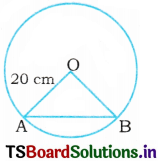
Given diameter =40 cm;
radius r = \(\frac{40}{2}\) = 20 cm
length of the chord AB = 20 cm
In triangle OAB, AB = OA = OB = 20 cm
Therefore, angle AOB = 60 degrees = 60 \(\frac{\pi}{180}\) radians
= \(\frac{\pi}{3}\) radians
Hence, using the relations l = θ × r,
we have l = \(\frac{\pi}{3}\) × 20 cm
= \(\frac{20 \pi}{3}\) cm
Hence, the length of minor arc of the chord is = \(\frac{20 \pi}{3}\) cm.
Question 6.
If in two circles, arcs of the same length subtend angles 60° and 75° at the centre, find the ratio of their radii.
Solution:
Given, the angle formed by the arc of first circle,
θ1 = 60° = 60 × \(\frac{\pi}{180}=\frac{60 \pi}{180}\) radians
Angle formed by the arc of second circle,
θ2 = 75°
= 75 × \(\frac{\pi}{180}=\frac{75 \pi}{180}\) radians
Let, the radius of first circle be r1 and the second circle be r2 hence, using the
relation r = \(\frac{l}{\theta}\) we have
r1 = \(\frac{l}{\theta_1}\)
r2 = \(\frac{l}{\theta_2}\) and
Therefore, \(\frac{\mathrm{r}_1}{\mathrm{r}_2}=\frac{\frac{l}{\theta_1}}{\frac{l}{\theta_2}}=\frac{\theta_2}{\theta_1}\)
= \(\frac{\frac{75 \pi}{180}}{\frac{60 \pi}{180}}\)
= \(\frac{75}{60}=\frac{5}{4}\) = 5 : 4
Hence, the ratio of their radii is 5 : 4.
Question 7.
Find the angle in radian through which a pendulum swings if its length is 75 cm and the tip describes an arc of length,
i) 10 cm
ii) 15 cm
iii) 21 cm
Solution:
i) Given the length of an arc l = 10 cm
length of the pendulum = radius of circle r = 75 cm
Hence, using the relation θ = \(\frac{l}{r}\),
we have θ = \(\frac{10}{75}=\frac{2}{15}\)
Hence, the angle formed by pendulum is \(\frac{2}{15}\) radians
ii) Given the length of an arc l = 15 cm
length of the pendulum = radius of circle = r = 75 cm
Hence, using the relation θ = \(\frac{l}{r}\),
we have θ = \(\frac{15}{75}=\frac{1}{5}\)
Hence, the angle formed by pendulum is 1/5 radians.
ii) Given the length of an arc l = 21 cm
length of the pendulum = radius of circle = r = 75 cm
Hence, using the relation θ = \(\frac{l}{r}\),
we have θ = \(\frac{21}{75}=\frac{7}{25}\)
Hence, the angle formed by pendulum is 7/25 radians.