
Referring to the AP Inter 1st Year Maths Study Material Chapter 14 Probability Exercise 14b Solutions makes it easier to understand complex problems.
AP Inter 1st Year Maths Probability Solutions Exercise 14b
I.
Question 1.
A coin is tossed twice, what is the probability that atleast one tail occurs?
Solution:
When a coin is tossed twice the sample space is given by S = {HH, HT, TH, TT}
Let A be the event of the occurrence of atleast one tail. So, A = {HT, TH, TT}
P(A) = \(\frac{\text { Number of outcomes favourable to A }}{\text { Total number of possible outcomes }}=\frac{3}{4}\)
Question 2.
If \(\frac{2}{11}\) is the probability of an event A, then what is the probability of the event ‘not A’.
Solution:
Given that P(A) = \(\frac{2}{11}\)
We know that P(A) + P(not A) = 1 ⇒ \(\frac{2}{11}\) + P(not A) = 1 ⇒ P(not A) = 1 – \(\frac{2}{11}=\frac{9}{11}\).
Hence the probability of not ‘A’ is 9/11.
Question 3.
A letter is chosen at random from the word ‘ASSASSINATION’. Find the probability that this letter is (i) a vowel (ii) a consonant.
Solution:
There are 13 letters in the word ASSASSINATION.
∴ Hence, n(S) = 13
i) There are 6 vowels in the given word.
∴ Probability of a vowel = 6/13.
ii) There are 7 consonants in the given word.
∴ Probability of a consonant = 7/13
Question 4.
Given P(A) = \(\frac{3}{5}\) and P(B) = \(\frac{1}{5}\). Find P(A or B), if A and B are mutually exclusive events.
Solution:
Here, P(A) = \(\frac{3}{5}\), P(B) = \(\frac{1}{5}\).
We know that, for mutually exclusive events A and B, P( A or B) = P(A) + P(B).
∴ P(A or B) = \(\frac{3}{5}+\frac{1}{5}=\frac{4}{5}\)

II.
Question 1.
Which of the following can not be valid assignment of probabilities for outcomes of sample space S = {ω1, ω2, ω3, ω4, ω5, ω6, ω7)
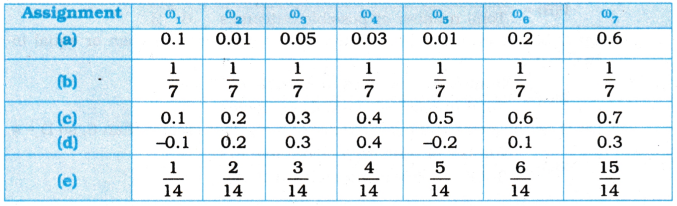
Solution:
a) 0.1, 0.01, 0.05, 0.03, 0.01, 0.2, 0.6
Here, the probabilities of each outcome is positive and less than 1.
Now the sum of probabilities = 0.1 + 0.01 + 0.05 + 0.03 + 0.01 + 0.2 + 0.6 = 1
Hence the assignment is valid.
b) \(\frac{1}{7}\), \(\frac{1}{7}\), \(\frac{1}{7}\), \(\frac{1}{7}\), \(\frac{1}{7}\), \(\frac{1}{7}\), \(\frac{1}{7}\)
Here, the probabilities of each outcome is positive and less than 1.
Now, the sum of probabilities = \(\frac{1}{7}+\frac{1}{7}+\frac{1}{7}+\frac{1}{7}+\frac{1}{7}+\frac{1}{7}+\frac{1}{7}\) = 1.
Hence, the assignment is not valid.
c) 0.1, 0.2, 0.3, 0.4, 0.5, 0.6, 0.7
Here, the probabilities of each outcome is positive and less than 1.
Now, the sum of probabilities = 0.1 + 0.2 + 0.3 + 0.4 + 0.5 + 0.6 + 0.7 = 2.8
Hence, the assignment is not valid.
d) -0.1, 0.2, 0.3, 0.4, -0.2, 0.1, 0.3
Here, the first (-0.1) and the fifth (-0.2) probabilities are negative. We know that the probability of an event can’t be negative.
Hence, the assignment is not valid.
e) \(\frac{1}{14}\), \(\frac{2}{14}\), \(\frac{3}{14}\), \(\frac{4}{14}\), \(\frac{5}{14}\), \(\frac{6}{14}\), \(\frac{5}{14}\)
Hence, the seventh probability (\(\frac{15}{14}\)) is more than 1.
We know that the probability of an event can’t be greater than 1.
Hence, the assignment is not valid.
Question 2.
A dice is thrown, find the probability of following events.
i) A prime number will appear,
ii) A number greater than or equal to 3 will appear,
iii) A number less than or equal to one will appear,
iv) A number more than 6 will appear,
v) A number less than 6 will appear.
Solution:
The sample space of throwing a dice is given by S = {1, 2, 3, 4, 5, 6}
i) Let A be the event of the occurrence of a prime number. So A = {2, 3, 5}.
P(A) = \(\frac{\text { Number of outcomes favourable to } \mathrm{A}}{\text { Total number of possible outcomes }}=\frac{3}{6}=\frac{1}{2}\)
ii) Let B be the event of the occurrence of a number greater than or equal to 3 so, B = {3, 4, 5, 6}.
P(B) = \(\frac{\text { Number of outcomes favourable to } \mathrm{B}}{\text { Total number of possible outcomes }}=\frac{4}{6}=\frac{2}{3}\)
iii) Let C be the event of the occurrence of a number less than or equal to one, so C = {1}.
P(C) = \(\frac{\text { Number of outcomes favourable to } \mathrm{C}}{\text { Total number of possible outcomes }}=\frac{1}{6}\)
iv) Let D be the event of the occurrence of a number greater than 6, so D = Φ.
P(D) = \(\frac{\text { Number of outcomes favourable to } \mathrm{D}}{\text { Total number of possible outcomes }}=\frac{0}{6}\) = 0
v) Let E be the event of the occurrence of a number less than 6, so, E = {1, 2, 3, 4, 5}.
P(E) = \(\frac{\text { Number of outcomes favourable to } \mathrm{E}}{\text { Total number of possible outcomes }}=\frac{0}{6}\) = 0
Question 3.
A card is selected at random from a pack of 52 cards
a) How many points are there in the sample space ?
b) Calculate the probability that the card is an ace of spades.
c) Calculate the probability that the card is (i) an ace, (ii) black card.
Solution:
a) When a card is selected from a pack of 52 cards, the number of possible outcomes is 52. i.e. the sample space contains 52 elements. Therefore, there are 52 points in the sample space.
b) Let A be the event in which the card drawn is an ace of spades. So, n(A) = 1
P(A) = \(\frac{\text { Number of outcomes favourable to } \mathrm{A}}{\text { Total number of possible outcomes }}=\frac{1}{52} .\)
c) i) Let E be the event in which the card drawn is an ace since there are 4 aces in a pack of 52 cards, n(E) = 4.
P(E) = \(\frac{\text { Number of outcomes favourable to } \mathrm{E}}{\text { Total number of possible outcomes }}=\frac{4}{52}=\frac{1}{13} .\)
ii) Let F be the event in which the card drawn is black. Since there are 26 black cards in a pack of 52 cards, n(F) = 26.
P(F) = \(\frac{\text { Number of outcomes favourable to } \mathrm{F}}{\text { Total number of possible outcomes }}=\frac{26}{52}=\frac{1}{2}\)
Question 4.
A fair coin with 1 marked on one face and 6 on the other and a fair dice are both tossed. Find the probability that the sum of numbers that turn up is (i) 3 (ii) 12.
Solution:
Since the fair coin has 1 marked on one face and 6 on the other and the dice has six faces that are numbered 1, 2, 3, 4, 5 and 6. The sample space is given by S = {(1, 1), (1, 2), (1, 3), (1, 4), (1, 5), (1, 6), (6, 1), (6, 2), (6, 3), (6, 4), (6, 5), (6, 6)}. So, n(S) = 12.
i) Let A be the event in which the sum of numbers that turn up is 3. So, A = {(1, 2)}
P(A) = \(\frac{\text { Number of outcomes favourable to } \mathrm{A}}{\text { Total number of possible outcomes }}=\frac{1}{12}\)
ii) Let B be the event in which the sum of numbers that turn up is 12. So, B = {(6, 6)}.
P(B) = \(\frac{\text { Number of outcomes favourable to } \mathrm{B}}{\text { Total number of possible outcomes }}=\frac{1}{12}\)
Question 5.
There are four men and six women on the city council. If one council member is selected for a committee at random, how likely is it that it is a woman?
Solution:
There are four men and six women on the city council. As one council member is to be selected for a committee at random. The sample space contains 10 (4 + 6) elements. Let A be the event in which the selected council member is a woman. So, n(A) = 6.
P(A) = \(\frac{\text { Number of outcomes favourable to A }}{\text { Total number of possible outcomes }}=\frac{6}{10}=\frac{3}{5}\)
Question 6.
In a lottery, a person chooses six different natural numbers at random from 1 to 20, and if these six numbers match with the six numbers already fixed by the lottery committee, he wins the prize. What is the probability of winning the prize in the game? (Hint : Order of the numbers is not important)
Solution:
Total number of ways in which one can choose six different numbers from 1 to 20
= 20C6 = \(\frac{20!}{6!(20-6)!}=\frac{20!}{6!14!}=\frac{20 \times 19 \times 18 \times 17 \times 16 \times 15 \times 14}{1 \times 2 \times 3 \times 4 \times 5 \times 6 \times 14!}\) =38760
Hence, there are 38760 combinations of 6 numbers.
Out of these combinations only one combination is already fixed by the lottery committee.
Hence, the required probability of winning the prize in the game = \(\frac{1}{38760}\).
Question 7.
Check whether the following probabilities P(A) and P(B) are consistently defined
(i) P(A) = 0.5, P(B) = 0.7, P(A ∩ B) = 0.6
(ii) P(A) = 0.5, P(B) = 0.4, P(A ∪ B) – 0.8
Solution:
i) P(A) = 0.5, P(B) = 0.7, P(A ∩ B) = 0.6
We know that if E and F are two events such that E ⊂ F, then P(E) < P(F). However, here, P(A ∩ B)> P(A). Hence, P(A) and P(B) are not consistently defined,
ii) P(A) = 0.5, P(B) = 0.4, P(A ∪ B) = 0.8
We know that if E and F are two events such that E ⊂ F, then P(E) < P(F) Here, it is seen that P(A ∪ B)> P(A) and P(A ∪ B)> P(B).
Hence, P(A) and P(B) are consistently defined.
Question 8.
Fill in the blanks in the following table.

Solution:
i) Here, P(A) = \(\frac{1}{3}\), P(B) = \(\frac{1}{5}\), P(A ∩ B) = \(\frac{1}{15}\).
We know that P(A ∪ B) = P(A) + P(B) – P(A ∩ B).
⇒ P(A ∪ B) = \(\frac{1}{3}+\frac{1}{5}-\frac{1}{15}\)
⇒ P(A ∪ B) = \(\frac{5+3-1}{15}\)
⇒ P(A ∪ B) = \(\frac{7}{15}\).
ii) Here, P(A) = 0.35, P(A ∩ B) = 0.25, P(A uB) = 0.6
We know that P(A ∪ B) = P(A) + P(B) – P(A ∩ B).
∴ 0.6 = 0.35 + P(B) – 0.25
⇒ P(B) = 0.6 – 0.35 + 0.25
⇒ P(B) = 0.5
iii) Here P(A) = 0.5, P(B) = 0.35, P(A ∪ B) = 0.7
We know that P(A ∪ B) = P(A) + P(B) – P(A ∩ B).
∴ 0.7 = 0.5 + 0.35 – P(A ∩ B)
⇒ P(A ∩ B) = 0.5 + 0.35 – 0.7
⇒ P(A ∩ B) = 0.15
Question 9.
If E and F are events such that P(E) = \(\frac{1}{4}\), P(F) = \(\frac{1}{2}\) and P(E and F) = \(\frac{1}{8}\), find
(i) P(E or F).
(ii) P(not E and not F).
Solution:
Here P(E) = \(\frac{1}{4}\), P(F) = \(\frac{1}{2}\) and P(E and F) = \(\frac{1}{8}\).
i) We Know that P(E or F) = P(E) + P(F) – P(E ∩ F)
∴ P(E ∪ F) = \(\frac{1}{4}+\frac{1}{2}-\frac{1}{8}=\frac{2+4-1}{8}=\frac{5}{8}\)
ii) We Know that P(not E and Not F) = 1 – P(E ∪ F)
∴P(Ē ∩ F̄) = 1 – \(\frac{5}{8}=\frac{3}{8}\)
Question 10.
Events E and F are such that P(not E or not F) = 0.25. State whether E and F are mutually exclusive.
Solution:
Given that P(not E or not F) = 0.25 and we know that P(Ē ∪ F̄) = 1 – P(E ∩ F).
∴ P(Ē ∩ F̄) = 1 – P(not E or not F)
= 1 – 0.25
= 0.75 ≠ 0 ⇒ (A ∩ B) ≠ Φ
Hence, E and F are not mutually exclusive.
Question 11.
A and B are events such that P(A) = 0.42, P(B) = 0.48 and P(A and B) = 0.16. Determine (i) P(not A), (ii) P(not B) and (iii) P(A or B).
Solution:
Given that P(A) = 0.42, P(B) = 0.48, P(A and B) = 0.16
i) P (not A) = 1 – P(A) = 1 – 0.42 = 0.58
ii) P (not B) = 1 – P(B) = 1 – 0.48 = 0.52
iii) We know that P(A uB) = P(A) + P(B) – P(A n B)
⇒ P(AuB) = 0.42 + 0.48-0.16 = 0.74
III.
Question 1.
Three coins are tossed once. Find the probability of getting (i) 3 heads (ii) 2 heads (iii) atleast 2 heads (iv) atmost 2 heads (v) no head (vi) 3 tails (vii) exactly two tails (viii) no tail (ix) atmost two tails.
Solution:
S = {HHH, HHT, HTH, THH, HTT, THT, TTH, TTT). So, n(S) = 8.
It is known that the probability of an event A is given by
P(A) = \(\frac{\text { Number of outcomes favourable to } A}{\text { Total number of possible outcomes }}\)
j) Let B be the event of the occurrence of 3 heads. So, B = {HHH}.
P(B) = \(\frac{\text { Number of outcomes favourable to } B}{\text { Total number of possible outcomes }}=\frac{1}{8}\)
ii) Let ‘C’ be the event of the occurrence of 2 heads. So, C = {HHT, HTH, THH).
P(C) = \(\frac{\text { Number of outcomes favourable to } C}{\text { Total number of possible outcomes }}=\frac{3}{8}\)
iii) Let D be the event of the occurrence of atleast 2 heads. So, D = {HHH, HHT, HTH, THH}
P(D) = \(\frac{\text { Number of outcomes favourable to } \mathrm{D}}{\text { Total number of possible outcomes }}=\frac{4}{8}=\frac{1}{2}\)
iv) Let E be the event of the occurrence of at most 2 heads. So, E {HHT, HTH, THH, HTF, THT, TFH, TTT}.
P(E) = \(\frac{\text { Number of outcomes favourable to } E}{\text { Total number of possible outcomes }}=\frac{7}{8}\)
v) Let F be the event of the occurrence of no head. So, F = (TTT).
P(F) = \(\frac{\text { Number of outcomes favourable to } F}{\text { Total number of possible outcomes }}=\frac{1}{8}\)
vi) Let G be the event of the occurrence of 3 tails, so, G = {TTT}.
P(G) = \(\frac{\text { Number of outcomes favourable to } \mathrm{G}}{\text { Total number of possible outcomes }}=\frac{1}{8}\)
vii) Let H be the event of the occurrence of exactly 2 tails, so H = {HTT, THT, TTH}.
P(H) = \(\frac{\text { Number of outcomes favourable to } \mathrm{H}}{\text { Total number of possible outcomes }}=\frac{3}{8}\)
viii) Let I be the event of the occurrence of no tail. So, I = {HHH}.
P(I) = \(\frac{\text { Number of outcomes favourable to } I}{\text { Total number of possible outcomes }}=\frac{1}{8}\)
ix) Let J be the event of the occurrence of at most 2 tails.
J = {HHH, HHT, HTH, THH, HTT, THT, TTH}.
So, P(J) = \(\frac{\text { Number of outcomes favourable to } \mathrm{J}}{\text { Total number of possible outcomes }}=\frac{7}{8} .\)
Question 2.
In Class XI of a school 40% of the students study Mathematics and 30% study Biology. 10% of the class study both Mathematics and Biology. If a student is selected at random from the class, find the probability that he will be studying Mathematics or Biology.
Solution:
Let A be the event in which the selected student studices Mathematics and B be the event in which the selected student studices Biology.
Now, P(A) = 40% = 0.40, P(B) = 30% = 0.30, P(A ∩ B) = 10% = 0.10
We know that P(A ∪ B) = P(A) + P(B) – P(A ∩ B)
⇒ P(A ∪ B) = 0.40 + 0.30 – 0.10 = 0.60
Thus, the probability that the selected student will be studying Mathematics or Biology is 0.6.
Question 3.
In an entrance test that is graded on the basis of two examinations, the probability of a randomly chosen student passing the first examination is 0.8 and the probability of passing the second examination is 0.7. The probability of passing atleast one of them is 0.95. What is the probability of passing both?
Solution:
Let A and B be the event of passing through first and second examination respectively. So, P(A) = 0.8, P(B) = 0.7 and P(A ∪ B) = 0.95
We know that P(A ∪ B) = P(A) + P(B) – P(A ∩ B)
∴ 0.95 = 0.8 + 0.7 – P(A ∩ B)
⇒ P(A ∩ B) = 0.8 + 0.7 – 0.95 = 0.55
Thus, the probability of passing both the examinations is 0.55.
Question 4.
The probability that a student will pass the final examination in both English and Hindi is 0.5 and the probability of passing neither is 0.1. If the probability of passing the English examination is 0.75, what is the probability of passing the Hindi examination ?
Solution:
Let A and B be the events of passing English and Hindi examinations respectively. So, P(A ∩ B) = 0.5, P(A’ ∩ B’) = 0.1 and P(A) = 0.75.
We know that P(A’ ∩ B’) = 1 – P(A ∪ B)
P(A ∪ B) = 1 – P (A’ ∩ B’) = 1 – 0.1 = 0.9.
Using the formula : P(A ∪ B) = P(A) + P(B) – P(A ∩ B).
⇒ 0.9 – 0.75 + P(B) – 0.5
⇒ P(B) = 0.9 – 0.75 +0.5
⇒ P(B) = 0.65
Thus, the probability of passing the Hindi examination is 0.65.
Question 5.
In a class of 60 students, 30 opted for NCC, 32 opted for NSS and 24 opted for both NCC and NSS. If one of these students is selected at random, find the probability that
(i) The student opted for NCC or NSS.
(ii) The student has opted neither NCC nor NSS.
(iii) The student has opted NSS but not NCC.
Solution:
Let A be the event in which the selected student has opted for NCC and B be the event in which the selected student has opted for NSS.
Total number of students = 60
Number of students who have opted for NCC = 30 ⇒ P(A) = \(\frac{30}{60}=\frac{1}{2}\)
Number of students who have opted for NSS = 32 ⇒ P(B) = \(\frac{32}{60}=\frac{8}{15}\)
Number of students who have opted both NCC and NSS = 24 ⇒ P(A ∩ B) = \(\frac{24}{60}=\frac{2}{5}\)
i) We know that P(A ∪ B) = P(A) + P(B) – P(A ∩ B)
P(A ∪ B) = \(\frac{1}{2}+\frac{8}{15}-\frac{2}{5}=\frac{15+16-12}{30}=\frac{19}{30}\)
Thus, the probability that the selected student has opted for NCC or NSS is \(\frac{19}{30}\).
ii) Number of students who opted neither NCC or NSS = P(A’ ∩ B’)
= 1 – P(A ∪ B) = 1 – \(\frac{19}{30}=\frac{11}{30}\)
Thus the probability that the selected student has neither opted for NCC nor NSS is \(\frac{11}{30}\)
iii) Number of students who have opted for NSS but not NCC = n(B) – n(A ∩ B) = 32 – 24 = 8
Thus, the probability that the selected student has opted for NSS but not for NCC = \(\frac{8}{60}=\frac{2}{15}\)
Question 6.
A fair coin is tossed four times, and a person win JRs. 1 for each head and lose Rs. 1.50 for each tail that turns up.
From the sample space, calculate how many different amounts of money you can have after four tosses and the probability of having each of these amounts.
Solution:
Since the coin is tossed four times, there can be a maximum of 4 heads or tails.
When 4 heads turn up, ₹ 1 + ₹ 1 + ₹ 1 + ₹ 1 = ₹ 4 is the gain.
When 3 heads and 1 tail turn up ₹ 1 + ₹ 1 + ₹ 1 – ₹ 1.50 = ₹ 3 – ₹ 1.50 = ₹ 1.50 is the gain.
When 2 heads and 2 tails turn up ₹ 1 + ₹ 1 – ₹ 1.50 – ₹ 1.50 * – ₹ 1
i.e. ₹ 1 is the loss. When 1 head and 3 tails turn up ₹ 1 – ₹ 1.50 – ₹ 1.50 – ₹ 1.50 = – ₹ 3.50 i.e., ₹ 3.50 is the loss.
When 4 tails turns up, -₹ 1.50 – ₹ 1.50 – ₹ 1.50 – ₹ 1.50 = – ₹ 6.00 i.e. ₹ 6.00 is the loss. There are 24 = 16 elements in the sample space S ie., n(S) = 16 which is given by S = {HHHH, HHHT, HHTH, HTHH, THHH, HHTT, HTTH, TTHH, HTHT, THTH, THHT, HTTT, THTT, TTHT, TTTH, TTTT}
The person wins ₹ 4.00 when 4 heads turn up, when the event {HHHH} occurs. Probability of winning ₹ 4.00 = \(\frac{1}{16}\)
The person wins ₹ 1.50 when 3 heads and one tail turn up, when the event {HHHT, HHTH, HTHH, THHH} occurs.
Probability of winning ₹ 1.50 = \(\frac{4}{16}=\frac{1}{4}\)
The person loses ₹ 1.00 when 2 heads and 2 tails turn up, when the event {HHTT, HTTH, TTHH, HTHT, THTH, THHT} occurs.
Probability of losing ₹ 1.00 = \(\frac{6}{16}=\frac{3}{8}\)
The person loses ₹ 3.50 when 1 head and 3 tails turn up, when the event {HTTT, THTT, TTHT, TTTH} occurs.
Probability of losing ₹ 3.50 = \(\frac{4}{16}=\frac{1}{4}\)
The person loses ₹ 6.00 when ‘0’ heads when the event {TTTT} occurs. Probability of losing ₹ 6.00 = \(\frac{1}{16}\)