
Referring to the AP Inter 1st Year Maths Study Material Chapter 2 Relations and Functions Exercise 2f Solutions makes it easier to understand complex problems.
AP Inter 1st Year Maths Relations and Functions Solutions Exercise 2f
Question 1.
Let f : {1, 3, 4} → {1, 2, 5} and g : {1, 2, 5} → {1, 3} be given by f = {(1, 2), (3,5 ), (4, 1)} and g = {(1, 3), (2, 3), (5, 1)}. Write down gof.
Solution:
Given, f = {(1, 2), (3, 5), (4, 1)} and
g = {(1, 3), (2, 3), (5, 1)}
(gof) (1) = g (f (1)) = g (2) = 3;
(gof) (3) = g (f (3)) = g (5) = 1;
(gof) (4) = g (f (4)) = g (1) = 3
∴ gof = {(1, 3), (3, 1), (4, 3)}
Question 2.
Let f,g and h be functions from R to R. Show that (f+g)∘h=f∘h+g∘h; (f⋅g)∘h=(f∘h)⋅(g∘h)
Solution:
[(f + g).h] (x) = (f + g) (h (x)) = f [h (x)] + g [h (x)]
= (f.h) (x) + (g.h) (x)
= {(f.h) + (g.h)} (x)
Hence, (f + g).h = f.h + g.h
[(f⋅g).h] (x) = (f⋅g) (h (x))
= f (h (x))⋅g (h (x))
= (f.h) (x)⋅(g.h) (x)
= {(f.h)⋅(g.h)} (x)
Hence, (f⋅g).h = (f.h) . (g.h)
Question 3.
Find gof and fog, if
i) f (x) = ∣x∣ and g (x) = |5x – 2|
ii) f (x) = 8x3 and g(x) = x1/3
Solution:
i) f (x) = ∣x∣ and
g (x) = |5x – 2|
∴ (gof) (x) = g (f (x))
= g (|x|) = |5x – 2|
(fog) (x) = f (g (x))
= f (|5x − 2|)
= |5x – 2|
= |5x – 2|
ii) f (x) = 8x3
and g (x) = x1/3
∴ (gof) (x) = g [f (x)]
= g (8x3)1/3 = 2x
(fog) (x) = f (g (x))
= f (x1/3)
= 8 (x1/3)3 = 8x

Question 4.
If f (x) = \(\frac{4 x+3}{6 x-4}\), x ≠ \(\frac{2}{3}\), show that fof (x) = x, for all x ≠ \(\frac{2}{3}\). What is the inverse of f?
Solution:
(fof) (x) =
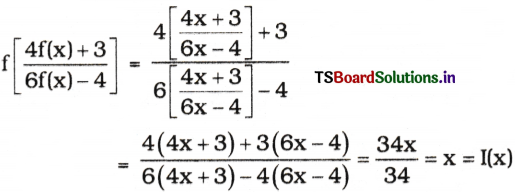
∴ fof = I
⇒ f = f-1.
Thus f-1 (x) = \(\frac{4 x+3}{6 x-4}\).
Question 5.
State with reason whether following functions have inverse
i) f : {1, 2, 3, 4} → {10} with f = {(1, 10), (2, 10), (3, 10), (4, 10)}
ii) g : {5, 6, 7, 8} → {1, 2, 3, 4} with g = {(5, 4), (6, 3), (7, 4), (8, 2)}
iii) h : {2, 3, 4, 5} → {7, 9, 11, 13} with h = {(2, 7), (3, 9), (4, 11), (5, 13)}
Solution:
i) f : {1, 2, 3, 4} → {10} ⇒ f = {(1, 10), (2, 10), (3, 10), (4, 10)}
We know that, given definition of f, f is many one function.
f (1) = f (2) = f (3) = f (4) = 10
∴ f is not one-one, f does not have inverse.
ii) g : {5, 6, 7, 8} → {1, 2, 3, 4}
⇒ g = {(5, 4), (6, 3), (7, 4), (8, 2)}
⇒ g (5) = g (7) = 4
⇒g is not one-one, g does not have inverse.
iii) h : {2, 3, 4, 5} → {7, 9, 11, 13}
⇒ h = {(2, 7), (3, 9), (4, 11), (5, 13)}
It is seen that all distinct elements of the set {2, 3, 4, 5} have distinct images under h.
∴ Function h is one-one.
Also, h is onto as for every element of the set {7, 9, 11, 13} there exists an element x in the set {2, 3, 4, 5} such that h (x) = y.
∴ h is a one-one and onto function.
Hence, h has inverse and
h-1 = {(7, 2), (9, 3), (11, 4), (13, 5)}.
Question 8.
Consider f : R → [4, ∞) given by f (x) = x2 + 4. Show that f is invertible with the inverse f-1 of f given by f-1 (y) = \(\sqrt{y-4}\), where R is the set of all non-negative real numbers.
Solution:
f : R+ → [4, ∞) is given as
f(x) = x2 + 4 for x, y ∈ R+
f (x) = f (y)
⇒ x2 + 4 = y2 + 4
⇒ x2 = y2
⇒ x = y
f is a one-one function.
for y ∈ [4, ∞), let y = x2 + 4
x = \(\sqrt{y-4}\) ∈ R
⇒ y = f (x)
∴ f is onto, thus f is one-one and onto and f-1 exists.
Now f (x) = x2 + 4 = y
⇒ x = \(\sqrt{y-4}\) = f-1 (y).
Question 9.
Consider f : R → [- 5, ∞) given by f (x) = 9x2 + 6x – 5. Show that f is invertible with f-1 (y) = \(\left(\frac{(\sqrt{y+6})-1}{3}\right)\).
Solution:
f : R+ →[- 5, ∞) given that f (x) = 9x2 + 6x – 5
Let a1, a2 ∈ R+.
Now f (a1) = f (a2)
⇒ 9a12 – 9a22 + 6a1 – 6a2 = 0
⇒ 9 (a1 – a2) (a1 + a2) + 6 (a1 – a2) = 0
⇒ (a1 – a2) [9a1 + 9a2 + 6] = 0
(∵ 9a1 + 9a2 + 6 ≠ 0 as a1, a2 ∈ R+)
⇒ a1 – a2 = 0
⇒ a1 = a2, f is one-one.
y ∈ [- 5, ∞). Write y = 9x2 + 6x – 5
Then 9x2 + 6x – 5 – y = 0
⇒ x = \(\frac{-6 \pm \sqrt{36+36(y+5)}}{18}\)
⇒ x = \(\frac{-1 \pm \sqrt{y+6}}{3}\)
as \(\frac{-1+\sqrt{y+6}}{3}\) ∈ R+
as \(\frac{-1-\sqrt{y+6}}{3}\) ∉ R+ is neglected
f-1 (y) = \(\left(\frac{(\sqrt{y+6})-1}{3}\right)\).
Question 10.
Let f : X → Y be an invertible function. Show that f has unique inverse.
(Hint: Suppose g1 and g2 are two inverses of f. Then for all y ∈ Y fog1 (y) = Iy (y) = fog2 (y). Use one-one ness of f.)
Solution:
Let g1 and g2 be two inverses of that is,
fog1 = Iy,
fog2 = Iy
So, for all y ∈ Y,
fog1 = Iy,
fog2 = Iy
So, for all y ∈ Y
f (g1 (y)) = y = f (g2 (y))
Since f is one-one, g1 (y) = g2 (y) for all y ∈ Y.
Hence, g1 = g2, so the inverse is unique.
Question 11.
Consider f : {1, 2, 3} → {a, b, c} given by f (1) = a, f (2) = b and f (3) = c. Find f-1 and show that (f-1)-1 = f.
Solution:
Given : f (1) = a → f-1 (a) = 1,
f (2) = b → f-1 (b) = 2,
f (3) = c → f-1 (c) = 3
So, f-1 :{a, b, c} → {1, 2, 3}, given by,
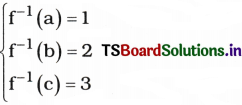
Consider, (f-1)-1, it must map each element of {1, 2, 3} back to {a, b, c} just like f does.
So, (f-1)-1 (1) = a,
(f-1)-1 (2) = b,
(f-1)-1 (3) = c
Thus (f-1)-1 = f
Question 12.
Let f : X → Y be an invertible function. Show that the inverse of f-1{-1} is f i.e., (f-1)-1 = f.
Solution:
Let f : X → Y be an invertible function.
Then, there exists a function g : Y → X such that
gof = IX and fog = IY
⇒ g = f-1
Also, g-1 : X → Y such that g-1 = f .
∴ (f-1)-1 = g-1 = f
Hence proved.
Question 13.
If f : R → R be given by f(x) = (3 – x3)1/3, then fof (x) is:
1) x1/3
2) x3
3) x
4) (3 – x3)
Solution:
f(x) = (3 – x3)1/3
fof(x) = f [(3 – x3)1/3]
= [3 – ((3 – x3)1/3)3]1/3
= (3 – 3 + x3)1/3
= x
Hence, option 3 is correct.
Question 14.
Let f : R – {- \(\frac{4}{3}\)} → R be a function defined as f(x) = \(\frac{4 x}{3 x+4}\). The inverse of f is the map g : Range f → R – {- \(\frac{4}{3}\)} given by:
1) g (y) = \(\frac{3y}{3 – 4y}\)
2) g(y) = \(\frac{4y}{4 – 3y}\)
3) g(y) = \(\frac{4y}{3 – 4y}\)
4) g(y) = \(\frac{3y}{4 – 3y}\)
Solution:
Given that f : R – {- \(\frac{4}{3}\)} → R is defined as
f(x) = \(\frac{4 x}{3 x+4}\) = y ∈ Range of f.
⇒ 4x = 3xy + 4y
⇒ 4x – 3xy = 4y
⇒ x (4 – 3y) = 4y
⇒ x = \(\frac{4y}{4 – 3y}\) = g (y).
∴ Option 2 is correct.