
Referring to the AP Inter 1st Year Maths Study Material Chapter 2 Relations and Functions Exercise 2e Solutions makes it easier to understand complex problems.
AP Inter 1st Year Maths Relations and Functions Solutions Exercise 2e
Question 1.
Show that the function f : R✶ → R, defined by f(x) = \(\frac{1}{x}\) is one-one and onto, where R, is the set of all non-zero real numbers. Is the result true, if the domain R, is replaced by N with co-domain being the same as R. ?
Solution:
Part 1 : f : R✶ → R, then, f(x) = \(\frac{1}{x}\)
Injective (one-one) :
To prove injectivity, Assume that f(x1) = f(x2) ⇒ \(\frac{1}{2}\) ⇒ x1 = x2
So, f is injective.
Surjective (onto) :
To prove surjectivity, for any y ∈ R , we need to find on x ∈ R* such that,
f(x) = y ⇒ \(\frac{1}{x}\) = y ⇒ x = \(\frac{1}{y}\).
Since y ≠ 0, \(\frac{1}{y}\) ∈ R✶. So ‘f’ is surjective.
Conclusion : f(x) = \(\frac{1}{x}\) is both one-one and onto from R, R„
Part-2 ; If domain is N and codomain is R,
Let f : N → R✶, f(x) = \(\frac{1}{x}\)
Injective : f(x1) = f(x2) ⇒ \(\frac{1}{2}\) ⇒ x1 = x2 So, it is injective.
Surjective Now the codomain is R✶, but the image of f is only
{\(\frac{1}{1}, \frac{1}{2}, \frac{1}{3}\),…………..} ⊂ R✶, Which is countable and only positive.

Question 2.
Check the injectivity and surjectivity of the following functions.
(i) f: N → N given by f(x) = x2
(ii) f: Z → Z given by f(x) = x2
(iii) f: R → R given by f(x) = x2
(iv) f: N → N given by f(x) = x3
(v) f: Z → Z given by f(x) = x3
Solution:
i) f:N → N given by f(x) = x2
x, y ∈ N, f(x) = f(y) ⇒ f(y) = x2 = y2 ⇒ x = y.
∴ f is injective.
ii) f: Z → Z given by f(x) = x2; f(-1) = f(1) = 1, but -1 ≠ 1.
∴ f is not injective.
Now, -2 ∈ Z. But x ∈ Z, Such that f(x) = x2 = – Z.
∴ f is not injective.
iii) f: R → R given by f(x) = x2 ⇒ f(- 1) = f(1) = 1, but -1 ≠ 1
∴ f is not injective.
Now, – Z ∈ R. But, X ∈ R; Such that f(x) = x2 = -Z
f is neither injective nor surjective.
iv) f: N → N given by f(x) = x3
x,y ∈ N, f(x) = f(y) ⇒ x3 = y3 ⇒ x = y
∴ f is injective.
Now, 2 ∈ N (codomain); f(x) = x3 = 2.
∴ f is not injective.
v) f : Z → Z given by f(x) = x3
x, y ∈ Z, f(x) = f(y) ⇒ x3 = y3 ⇒ x = y.
∴ f is injective.
Now, 2 ∈ Z. But does not exist only element x in domain Z such that f(x) = x3 = 2.
∴ f is not injective.
Question 3.
Prove that the Greatest Integer Function f : R → R, given by f(x) = {x} is neither one-one nor onto, where [xj denotes the greatest integer less than or equal to x.
Solution:
Given that f(x) = [x] = greatest integer less than or equal to x.
3.4 ≠ 3 but f(3.4) = [3.4] = 3 = [3] = f(3). Thus f is not one-one.
\(\frac{5}{2}\) ∈ R (codomain), but there exists no x ∈ R (domain)
Such taht f(x) = \(\frac{5}{2}\) because, f(x) = [x] is always an integer ∀ x ∈ R. Thus f is not onto.
Question 4.
Show that the Modulus Function f : R → R, given by f(x) = |x|, is neither one- one nor onto, where |x| is x, if x is positive or 0 and |x| is – x, if x is negative.
Solution:
f: R → R is given by, f(x) = |x|,
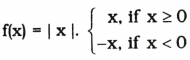
Here f(-1) – | -1 | = 1
∴ f(-1) = f(1), but -1 ≠ 1
f is not one-one.
Consider -1 ∈ R
We know that f(x) = |x| is always non-negative. Thus, there does not exists any element x in domain R such that f(x) = |x | = -1
∴ f is not onto.
Question 5.
Show that the Signum Function f : R → R, given by
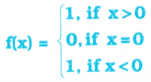
is neither one-one nor onto.
Solution:
Given
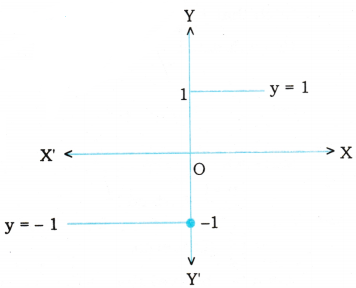
from the graph of the function
f(2) = 1 and f(3)= 1
i.e., f(2) = f(3) = 1, but 2 ≠ 3.
f is not one-one.
∴ for 4 ∈ R (codomain) y = – 1
there exists no x ∈ R (domain) such that f(x) = 4
f is not onto.
Question 6.
Let A = {1, 2, 3}, B = {4, 5, 6, 7} and let f = {(1, 4), (2. 5), (3, 6)} be a function from A to B. Show that f is one-one.
Solution:
It is given that A = {1, 2, 3}, B = {4, 5, 6, 7}
f: A → B is defined as, f = {(1, 4), (2, 5), (3, 6)}
f(1) = 4, f(2) = 5, f(3) = 6
It is seen that the images of distinct elements of A under f are distinct.
Hence, function f is one-one.
Question 7.
In each of the following cases, state whether the function is one-one, onto or bijective. Justify your answer.
i) f : R → R defined by f(x) = 3 – 4x
ii) f : R → R defined by f(x) = 1 + x2.
Solution:
i) f : R → R defined by f(x) = 3 – 4x.
Let x1;x2 ∈ R.
Then f(x1) = f(x2)
⇒ 3 – 4x1 = 3 – 4x2
⇒ -4x1 = -4x2
⇒ x1 = x2 f is one-one
For any real number (y) in R, there exists \(\frac{3-y}{4}\) in R such that
f\(\left(\frac{3-\mathrm{y}}{4}\right)\) = 3 – 4\(\left(\frac{3-\mathrm{y}}{4}\right)\) = y
f is onto. Hence, f is bijective.
ii) f(x) = 1 + x2 for all x e R
we know that f(2) = 1 + 22 = 5 and f(-2) = 1 + (-2)2 = 5
i.e., f(2) = f(-2), but If f(x) = -2
For y = -2 ⇒ x2 = -3 ⇒ x = 3 ∉ R
∴ f is not onto. Then f is not one-one and not onto.
∴ f is not bijection.
Question 8.
Let A and B be sets. Show that f: A × B → B × A such that f(a, b) = (b, a) is bijective function.
Solution:
f : R → R be defined as f(x) = 2x
Let x, y ∈ R. Then f(x) = f(y) ⇒ 2x = 2y ⇒ x = y
∴ f is one-one
Also, for any real number (y) in co-domain R, there exists \(\frac{y}{2}\).
Such that f\(\left(\frac{\mathrm{y}}{2}\right)\) = 2\(\left(\frac{\mathrm{y}}{2}\right)\) = y .
∴ f is onto.
Hence function f is one-one & onto, then it is bijective function.
Question 9.
Let f: N → N be defined by f(n)
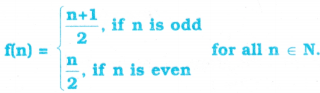
State whether the function f is bijective. Justify your answer.
Solution:
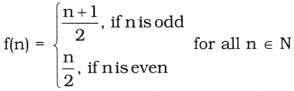
It can be observed that : f(1) = \(\frac{1+1}{2}\) and f(2) = \(\frac{2}{2}\) = 1
∴ f(1) = f(2) but 1 ≠ 2
∴ f is not one-one.
Consider a natural number ‘n’ in co-domain N.
Case I : n is odd
∴ n = 2r + 1 for some r ∈ N. Then, there exists 4r + 1 ∈ N
Such that f(4r + 1) = \(\frac{4 r+1+1}{2}\) = 2r + 1
Case II: n is even
∴ n = 2r for some r ∈ N. Then, there exists 4r ∈ N such that f(4r) = \(\frac{4r}{2}\) = 2r
∴ f is onto. Hence, f is not a bijective function.
Question 10.
Let A = R – {3} and B = R – {1}. Consider the function f : A → B defined by f(x) = \(\left(\frac{x-2}{x-3}\right)\). Is f one-one and onto? Justify your answer.
Solution:
We have f(x) = \(\frac{1}{2}\) for all x ∈ R – {3}. Let f(x1) = f(x2).
Then \(\frac{1}{2}\)
⇒ x1x2 – 2x2 – 3x1 + 6 = x1x2 – 2x1 – 3x2 + 6
⇒ x1 = x2
Thus f is one-one.
Let y ∈ B. Thus for every y ∈ B thus y ≠ 1.
Now y = \(\frac{x-2}{x-3}\),
Then x – 2 = y(x – 3)
⇒ 3y – 2 = x(y – 1)
⇒ x = \(\frac{3 y-2}{y-1}\)
If \(\frac{2-3 y}{1-y}\) = 3, then 2 – 3y = 3 – 3y
⇒ 2 = 3 which is not true.
∴ \(\frac{2-3 y}{1-y}\) ≠ 3
y ∈ B there exists x = \(\frac{2-3 y}{1-y}\) ∈ A such that f(x) = y.
Thus f is onto and hence f is bijective.
Question 11.
Let f : R → R be defined as f(x) = x4. Choose the correct answer.
A) f is one-one onto
B) f is many-one onto
C) f is one-one but not onto
D) f is neither one-one nor onto,
Solution:
f : R → R be defined as f(x) = x4. Now f(1) = f(-1) = 1.
∴ f is not one-one.
Consider an element-2 in co-domain R. It is clear that there does not exists any x in domain R such that
f(x) = -2, i.e., x4 = -2
∴ f is not onto.
Hence, function f is neither one-one nor onto. The correct option is D.
Question 12.
Let f: R → R be defined as f(x) = 3x. Choose the correct answer.
A) f is one-one onto
B) f is many-one onto
C) f is one-one but not onto
D) f is neither one-one nor onto,
Solution:
f : R → R be defined as f(x) = 3x
Let x, y ∈ R. Then f(x) = f(y) ⇒ 3x = 3y ⇒ x = y ⇒ f is one-one.
for any 3x = y; x = \(\frac{y}{3}\) ∉ Z domain o
∴ f is not onto.
Hence the function is one-one but not onto. The correct option is C.