
Regular practice with AP Inter 1st Year Commerce Study Material Chapter 7 Formation of a Joint Stock Company Questions and Answers helps students stay prepared for examinations.
AP Inter 1st Year Commerce 7th Lesson Formation of a Joint Stock Company Questions and Answers
Fill in the blanks
Question 1.
_____________ is the process of organizing and planning the finance of a business enterprise under the corporate form.
Answer:
Promotion
Question 2.
_____________ is the consitution of the company.
Answer:
Memorandum of Association
Question 3.
The proposed name ofa Joint stock company should not be objectionable under the provisions of _____________ Act of 1950.
Answer:
Emblems and Names
Question 4.
The rules and regulations framed for the internal management of the company, are set out in a document named _____________
Answer:
Articles of Association
Question 5.
_____________ is a substitute for the prospectus.
Answer:
Statement-in-lieu of the prospectus
Question 6.
_____________ is to be collected by a Public company before it allots shares.
Answer:
Minimum subscriptions
Question 7.
A public limited company cannot commence its business without receiving a _____________ of business.
Answer:
Certificate of commencement
Question 8.
A public company must get a minimum subscription with days from the date of the issue of a propectus.
Answer:
120
Question 9.
_____________ is an invitation to the public to subscribe to the shares and debentures of a Public company.
Answer:
Prospectus

Question 10.
Every Private company must prepare its own _____________
Answer:
Articles of Association
Very Short Answer Questions
Question 1.
Promotion.
Answer:
“Promotion is the Process of organizing and planning the finance of a business enterprise under the corporate form”. – L.H. Haney
Question 2.
Minimum Subscription.
Answer:
The mininum amount of capital to be collected by a public company before its allotment of shares is known as “minimum subscription”.
A public company cannot commence business unless a minimum subscription as stated in the prospectus has been subscribed. The amount of mininum subscription is fixed by taking into amount the following requirements.
- Amount required for the purchase of property.
- Amount needed for payment of preliminary expenses.
- Amount required for working capital.
- Amount required for any other expenditure for the formation of comapany.
Question 3.
Certificate of commencement of Business.
Answer:
A public limited company cannot commence its business unless it receives a certificate of business commencement. This certificate is not compulsory for Private Limited Companies. It means private company can commence its business without the certificate of Business commencement. The Registrar of companies issues this certificate only when all the legal documents are submitted. Further, the Registrar issued this certificate only on the confirmation of collection of minimum subscription.
Question 4.
Statement in lieu of Prospectus.
Answer:
The statement-in-lieu of prospectus is a substitute for a prospectus. In case a public company raises its capital through some other means (private) is no need to issue a prospectus, but a “statement in lieu of prospectus” must be filled with the registrar at least three days before the first allotment of shares. It must be duly signed by all directors. This statement is drafted strictly in accordance with the particulars set out in Schedule-III of the Act.
Question 5.
Memorandum of Association.
Answer:
The memorandum of Association is the constitution of the company. It is the charter of the company. It provides the foundation on which the company structure is built. It defines the scope of the company’s activities as well as its relation with the outside world. The purpose of the memorandum is to enable the shareholders, creditors and those who deal with the com¬pany to know what is the permitted range of activities of the enterprise.
Question 6.
Articles of Association.
Answer:
The rules and regulations framed for the internal management of the company which are set out in a document are named as “Articles of Association.” It gives the bye-laws which govern the conduct of the company. It also helps in achieving the objectives specified in memorandum of Association. The Articles play a very important role in the affairs of the company. It is a supplementary document to the memorandum of Association.
Question 7.
Prospectus.
Answer:
A Prospectus is a document which invites the Public to promote funds to the company by way of subcribing to its shares and debentures.The history;, nature and profitability of the company is depicted in the prospectus.
Question 8.
Incorporation certificate.
Answer:
A company being an artificial person, comes into existence only after its registration with the Registrar of companies. It is the legal process through which an enterprise, obtains recognition as a separate legal entity. A joint stock company, whether private limited or public limited must file all the necessary documents with the Registrar to obtain the certificate of Incorporation. With this certificte, the company gets a status of legal entity.
Question 9.
Object caluse.
Answer:
This claue difines the sphere of activities of the company. It also determines the powers of the company. This clause may be considered the core of memorandum of Association because it sets out the objects for which a company is formed. This clause contains main objects and other objects. This clause offers protection to the shareholders and creditors by ensuring that ihe funds are not going to be risked.
Question 10.
Association clause.
Answer:
This clause contains the names of the signatories to the memorandum of Association. The full addresses and occupations of subscribers and witnesses are also given. The subscribers declare that they agree to incorporate the company and agree to take the shares stated against their names.
Question 11.
Promotion.
Answer:
Promotion is the first stage in the formation of a company. It involves the identification of a business opportunity or idea, analysis of its prospects, gathering the relevant information and taking steps to implement it. Promotion is considered as putting an idea into practice.
Question 12.
Define memorandum of Association.
Answer:
Definition : Section 2(56) of the companies Act, 2013 defines a memorandum as “The memo- idndum of Association of a company as originally framed or as altered from time to time in pursuance of any previous company laws or of this Act”.
Question 13.
Define Articles of Association.
Answer:
Definition : According to Section 2(5) of the companies Act “Articles of Association of the ompany as oxiginally framed or as altered from time to time in pursuance of any previous . ompanies law or of this Act”. The Articles of a company shall contain the regulations for management of the company.
Question 14.
Define Prospectus.
Answer:
Definition : Section 2(70) of the companies act, 2013 defines the prospectus as “any documet described or issued as prospectus and includes any notice, circular, advertisment or other documents, inviting deposits from the public for the subscription or purchase of any shares in, or debentures of a body corporate”.
Question 15.
Capital Subscription.
Answer:
A Public company connot commence business unless the minimum subscription as stated in ihe prospectus is subscribed. If a company does not receive 90% of the issue amount from the public as subscription within 120 days from the date of issuing prospectus, it must refund the amount to the applicants within 10 days as per the guidelines of Securities Exchange Board of India (SEBI).
Short Answer Questions
Question 1.
What are the differences between a Memorandum of Association and Articles of Association?
Answer:
Differences between M.O.A. and Articles of Association
| Aspects | Memorandum of Association (MOA) | Articles of Association (AOA) |
| Scope | It is the constitution of the company. The company works in the framework given in the memorandum. | The articles contain by laws for the daytoday working of the company as set out in the M.O.A |
| Need | MOA must be prepared by all the companies and filed with the Registrar of Companies. | Public companies may not have their own articles. They can adopt Tables F, G, H, I and J of Schedule I as their articles. |
| Relationship | It defines the relationship between the company and the outside world. | It defines the relationship between the company and its members among themselves. |
| Alteration | It cannot be changed easily. | It can be altered easily by the special resolution of share holders. |
| Status | It is subordinate only to the Act. The company works with in the legal provisions of Memorandum of Association. | It is subordinate to the memorandum and companies Act and cannot contain anything contrary to both. |
| Legal Effects | Any Act of the company beyond the scope of memorandum will become void. | Anything done beyond the scope of the articles will not be void and it can be ratified by passing a special resolution. |
Question 2.
What are the different stages in the promotion of Company ?
Answer:
Promotion is the first stage in the formation of a company. It involves the identification of a business opportunity or idea, analysis of its prospects, gathering the relevant information and taking steps to implement it. Promotion is considered as putting an idea into practice.
Definition : “Promotion is the process of organizing and planning the finances of a business enterprize under the corporate form”. – L.H. Haney
Stages of Promotion :
a) Discovery of an Idea : The success of business depends on the selection of a business line. The promoter has to form an idea about the type of business and its prospects. The promoter should analyse the strengths and weaknesses of the proposed idea and develop the idea with the help of technical experts.
b) Detailed Investigation : At this stage various factors relating to the proposed business are to be studied from the practical point of view. The promoter shall estimate the total demand for the product, and then think of arranging finance. He also considers the availability of labour, machinery, raw-materials, and cost structure of the product.
c) Assembling the Requirements : After making sure that the proposition is practical and profitable, the promoter proceeds to assemble the requirements like appointing directors, selecting the place for company contacting the suppliers of raw-materials, purchasing ma¬chinery etc.
d) Financing Propostion : The promoter decided about the capital structure of the company. In this process, he determines how much share capital will be issued, the type of shares and debentures to be issued, and the amount of loans to be borrowed from finan¬cial institutions for a longer period.
Question 3.
What are the different types of promoters ?
Answer:
- Professional Promoters : They are the promoters who specialize in company promotion. It is their full time occupation.
- Accidental Promoters : They are the promoters who are not specialists in company formation, but promote their own firms. Such enterpreneurs are known as accidental Promoters.
- Financial Promoters : These are the promoters who float new enterprises during favourable conditions in the securities market. They invenrt capital and hold a sizable share in the company.
- Technical Promoters : The promoters who promote new enterprises based on their specialized knowledge and training in technical fields are called technical promoters.
- Institutional Promoters : These are the promoters who provide technical, managenial and financial assistance for the promotion of a company.
Question 4.
What are the contents of a prospectus ?
Answer:
A prospectus is a document which invites the public to promote funds to the company by way of subscribing to its shares and debentures. The history, nature and profitability of the company is depicted in the prospectus.
Definition : Section 2(70) of the company Act, 2013 defines the prospectus as “any document described or issued as prospectus and includes any notice, circular advertisement or other documents, inviting deposits from the public for the subscription or purchase of any shares in, or debentures of a body corporate.”
Contents of Prospectus : Every prospectus should disclose the matter as specified in Part-I of Schedule-II of the companies act. Some of the contents which every prospectus must in¬clude are :
- Name and full address of the company.
- The particulars of the signatories to the memorandum of Association and the number of shares taken up by them.
- Name, addresses and occupations of members of the Board of Directors.
- The mnimum subscription amount is fixed by the promoters.
- The details of property acquired if any.
- The time of opening of the subscription list.
- The capital structure of the company and particulars of the issue.
- The amount payable an application, allotmet and calls.
- Basis for the issue price.
- The particulars of preferential treatment given to any person for subscribing shares or debenutures.
- The addresses of the underwriters if any.
- Particulars about reserves and surpluses.
- The amount of preliminary expenses.
- The name and address of the Auditor.
- Particulars regarding voting rights at the meetings of the company.
- Management perception of risk factors.
- Disclosure of investor’s grievances and redressal system.
Question 5.
What documents are required to obtain certificate of commencement of Business ?
Answer:
Commencement of Business : A public company has to file the following certificates to get the certificate of Commencement of Business.
- A declaration that a prospectus or statement in lieu of a prospectus has been filled.
- A declaration that directors have taken up their qualification shares and paid for them.
- A declaration that the minimum subscription amount has been allotted and collected.
- A statutory declaration by Secretary of the company or a Director that all the formalities relating to the commencement of Business are duly complied with.
The Registrar scrutinizes all the documents and issues a “Certificate of commencement of Business” if he satisfied that all the formalities are in order and the legal formalities are completed. The process of company formation comes to an end with the issue of this certificate. Documents to be prepared for the formation of a company : The important documents to be prepared by a company for its formation are discussed below :
- Memorandum of Association.
- Articles of Association.
- Prospectus.
Long Answer Questions
Question 1.
Explain the process involved in the Incorporation of a company.
Answer:
A company, being an artificial person, comes into existence only after its registration with the Registrar of companies. A Joint stock company, whether private limited or public limited must file all the necessary documents with the Registrar to obtain the certificate of Incorporation.
With this certificate, the company gets a status of legal entity.
Before getting a company registered, several steps have to be taken up. They are
1) Application for Approval of Name : For registration of a company, an application is to be submitted to the Registrar companies of the state and obtain the approval of name. A company may adopt any name which is not prohibited under the Emblems and Names Act of 1950. The Registrar is expected to approve the name within 14 days of the receipt of application. The proposed name must be registered within 3 months of the approved date.
2) Preparation of memorandum of Association (MOA): It is the constitution of company which describes its objects, scope and the relationship with outside world. This document must be carefully drafted, stamped and signed by 7 members incase of public com¬pany and two members incase of a private company. As per the new amendment of the act one member is enough to sign on MOA incase of private company/one person company.
3) Preparation of Articles of Association : It is the document which contains rules and regulations relating to the internal management and also the capital structure of the busi¬ness. A public limited company may not be required to file its own Articles of Association. However, it may adopt model clauses prescribed in Table F, Schedule I of the Act. A private company is required to submit its Articles duly signed by the signatories.
4) Preparation of Other Documents : At the time of incorporation of a company, the following documents are to be prepared and submitted to the Registrar of Companies.
- Consent of the first directors.
- The power of Attorney : Promoters, should execute a power of Attorney in favor of one of the promoters or an advocate who is to carry out the formalities required for registration.
- Notice of Registered Office : When the location of the registered office is finalized, before incorporation, the notice of it is to be filed. If not, within 30 days of its registra¬tion, it is to be submitted. ,
- Particulars of Directors : When a company by its Articles appoints any person to act as Director, manager or Secretary, their Particulars have to be filed with in 30 days along with the memorandum of Association and Articles of Association of the company.
5) Statutory Declaration : A declaration that all the requirements under the companies act have been complied within Form No.l is to be field with the Registrar.
6) Payment of Registration Free : In addition to filling the documents, the prescribed fees have to be paid towards the registration of company.
7) Incorporation Certificate : If the Registrar is satisfied that all the statutory requirements stated above are complied with under the Act, issues a certificate called “certificate of Incorporation.” With the receipt of this certificate, the company gets its recognition as a corporate body.
A private company can start its business as soon as it gets the incorporation certificate. However, a public company should wait till it gets a certificate of commencement of business to start the business.
Question 2.
What is a memorandum of Association? Explain its clauses.
Answer:
Meaning: The memorandum of Association is the constitution of the company. It is the charter of the company. It provides the foundation on which the company structure is built. It defines the scope of the company’s activities as well as its relation with the outside world. The purpose of the memorandum is to enable the shareholders, creditors and those who deal with the company to know what is the permitted range of activities of the enterprise.
Definition : Section 2(56) of the companies Act 2013 defines a memorandum as “The Memo¬randum of Association of a company as originally framed or as altered from time to time in pursuance of any previous company laws or of this Act.”
The memorandum of Association must be signed by atleast 6 members in case of a public limited company and 2 members in case of a Private Limited company. It is the basic document of the company. It cannot be changed easily. So it should be prepared very carefully. The contents of the memorandum of Association known as clauses are explained below.
Clauses of Memorandum of Association :
1) Name clause : A company being a separate legal entity must have a name. A company may select any name which does not resemble the name of any other company. It should not contain the words like king, Queen and name of the Government bodies. The proposed name should not be objectionable under the provisions of Emblems and Names Act 1950 the word “Limited” must be used at the end of the name of a public company and “Private Limited” is used by a private company.
2) Registered office or Situation clause : This clause states the place and address of the registered office of the company. This helps to have correspondence with the company. If the place is not decided at the time of incorporation, it can be intimated to the Registrar with in 30 days from the date of incorporation or commencement of business which ever is earlier.
3) Objects clause This clause defines the sphere of activities of the company. It also determines the powers of the company. This clause may be considered the core of memo¬randum of Association because it sets out the objects for which a company is formed. This clause contains (a) main object (b) other objects. This clause offers protection to the shareholders and creditors by ensuring that the funds are not going to be risked.
4) Liability clause This clause defines the nature of liability of its members. It states that the liability of the members is limited to the value of the shares held by them. This means that the members are liable to pay only the unpaid balance of their shares and nothing further.
5) Capital clause : This clause defines the capital structure of the company. The division of capital into equity shares and preference shares, the number of shares in each category, and their value should be given. It also specifies any special rights and privileges granted to certain types of shareholders.
6) Association clause : This clause contains the names of the signatories to the memorandum of Association. The full addresses and occupations of subscribers and witnesses are also given. The subscribers declare that they agree to incorporate the company and agree to take the shares stated against their names.
Question 3.
What is Articles of Association ? Explain its contents.
Answer:
Meaning : The rules and regulations framed for the internal management of the company, which are set out in a document are named as Articles of Association. It gives the bye-laws which govern the conduct of the company. It also helps in achieving the objetives specified in Memorandum of Association. The Articles play a very important role in the affairs of the company. It is a supplementary document to the memorandum of Association. The Articles must be printed, divided into paragraphs, numbered consecutively, stamped adequately, and signed by each subscriber to the memorandum of Association. It is duly witnessed and filed along with the memorandum of Association.
Definition : According to section 2(5) of the companies Act “Articles of Association of the company as originally framed or as altered from time to time in pursuance of any previous companies law or of this Act. “The Articles of a company shall contain the regulations for management of the company.
The contents of Articles of Association : The Articles of Association contain the following details :
- The procedure of issuing share capital. The amount of share capital issued, types of shares, number of shares, calls on shares, rights and privileges of different categories of share holders must be mentioned in the Articles of Association.
- Procedure for transfer and forfeiture of shares.
- Procedure for issue of debentures and stocks.
- Powers to alter as well as reduce share capital and its procedure for alteration.
- The appointment of the directors, their powers, duties and remuneration.
- The appointment of the managing director.
- Provisions regarding conducting the general meetings, special meetings, voting, proxies, resolutions etc.
- Provisions relating to dividends and reserves.
- Rules for preliminary contracts.
- Provisions regarding the use of common seal.
- Preparation of Accounts and Audit, and method of appropriation of profits.
- Maintenance of Bank Accounts.
- Procedure for winding up the company.
- Other rules and regulations of the company.
Question 4.
Discuss the procedure to form a company.
Answer:
A Joint stock company requires a number of legal formalities to be complied with before it is brought into existence. The important steps in the formation of a company are shown in the following chart:
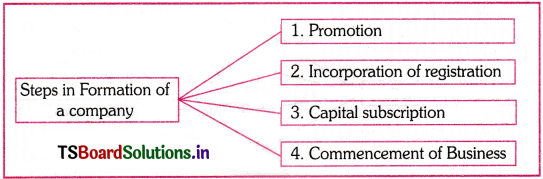
1) Promotion : Promotion is the first stage in the formation of a company. It involves identification of business opportunity or idea, detailed investigation assembling the requirements and financing proposition. Promotion is the process of organization and planning the finance of business enterprises under the corporate firm.
2) Incorporation or Registration : A company being an artificial person comes into existence only after its registration with the Registrar of companies. It is the legal process through which an enterprize obtained recognition as a separate legal entity. Private or Public limited companies must file all the necessary documents with the Registrar to obtain the Incorporation certificate. With this certificate the company gets a separate legal entity. For this purpose a number of steps have to be taken for registration.
3) Capital Subscription : After incorporation of a company the next step will be to raise the capital. A public company cannot commence business unless the minimum subscription as stated in the prospectus is subscribed. If a company does not receive 90% of the issue amount from the Public as subscription within 120 days, it has to refund the amount to the applicant as per the guidelines of Securities Exchange Board of India (SEBI) within 10 days.
4) Commencement of Business: A public company has to file the following certificates to get the certificate of commencement.
- A declaration that a prospectus or statement in lieu of prospectus has been filed.
- A declaration that directors have taken up their qualification shares and paid them.
- A declaration that minimum subscription amount has been allotted and collected.
- A statutory declaration by the Secretary of the company or a Director that all the formalities relating to the commencement of business are duly complied with.
A scrutiny is made by the Registrar with all the documents and issues a “certificate of commencement of business”. The process of Company formation comes to an end with the issue of this cerificate.
Question 5.
Describe various steps involved in Promoting a company.
Answer:
Meaning: Promotion is the first stage in the formation of a company. It involves the identification of a business opportunity or idea, analysis of its prospectus, gathering the relevant information and taking steps to implement it. Promotion is considered as putting an idea into practice.
Definition : “Promotion is the process of organizing and planning the finance of a business enterprise under the corporate form”. – L.H. Haney
- Discovery of an Idea : The success of business depends on the selection of a business line. The promoter has to form an idea about the type of business and its prospectus. The Promoter should analyse the strengths and weaknesses of the proposed idea and develop the idea with the help of technical experts.
- Detailed Investigation : At this stage various factors relating to the proposed business to be studied from the practical point of view. To find out the strong and weak point of the idea a detailed investigation is conducted. The promoter shall estimate demand for the product, and then thinks of arranging finance and also considers the availability of workers, Plant and machinery, raw-materials and cost of production. For this purpose technical experts, financial consultants etc. are consulted.
- Assembling requirements : After making sure that proposed business is feasible and profitable the promoters make arrangements to assemble the requirements like directors appointment, selecting the place for unit, contacting the suppliers of raw-materials purchasing of plant and machinery etc.
- Financing Proposition : The Promoter decides about the capital structure of the company. In this process, he determines how much share capital will be issued, type of shares and debentures to be issued, and the nature of loans to be borrowed from financial institutions or banks for a long period.
Question 6.
What is Prospectus ? What are its contents ?
Answer:
Meaning : Prospectus is an invitation to the Public to subscribe to the shares and debentures of a Public company. This brings to the notice of the Public that a new company has been formed. After incorporation of a company promoters may issue the Prospectus for raising required finance.
Definition : Section 2 (70) of the companies, Act, 2013 defines the Prospectus as “any document described or issued as Prospectus and includes any notice, circular, advertisement or other documents, inviting deposits from the Public for the subscription or purchase of any shares or debentures of a body corporate.”
Contents of Prospectus : Every Prospectus should disclose the matter as specified in Part-I of Schedule-11 of the companies Act. Some of the contents which every Prospectus must include are :
- Name and full address of the company.
- The particulars of the signatories to the Memorandum of Association and the number of shares taken up by them.
- Name addresses and occupations of members of the Board of Directors.
- The minimum subscription amount is fixed by the promoters.
- The details of property acquired if any.
- The capital structure of the company and particulars of the issue.
- The time of opening the subscription list.
- The amount payable on application, allotment, and calls.
- Basis for the issue price.
- The particulars of preferential treatment given to any person for subscribing shares or debentures.
- The addresses of the underwriters if any.
- Particulars about reserves and surpluses.
- The amount of preliminary expenses.
- The name and address of the Auditor.
- Particulars regarding voting rights at the meetings of the company.
- Management perception of risk factors.
- Disclosure of investor’s grievances and redressal system.
Check Your Knowledge
I. Fill in the blanks for the following questions :
Question 1.
A company being an artificial person comes into existence only after its registration with the _____________
Answer:
Registrar of Companies
Question 2.
As per the guidelines of Securities Exchange Board of India, the refund to applicant has to be done within _____________ days.
Answer:
10
Question 3.
The registrar issues Certificate of incorporation after satisfying with all the requirements under the companies Act _____________
Answer:
1950
Question 4.
The promoters who provide technical and financial assistance for promotion of a company are called _____________
Answer:
Institutional Promotions
Question 5.
The Registrar is expected to approve the name with in _____________ days of the receipt of the application.
Answer:
14 days
Question 6.
As per the new amendment of the act _____________ is enough to sign on a MOA incase of a Private company.
Answer:
One member
Question 7.
At the time of incorporation of a company, documents are to be submitted to the _____________ company.
Answer:
Registrar
Question 8.
The _____________ is the most important main document of the company.
Answer:
M.O.A
Question 9.
The memorandum of Association must be signed by at least _____________ members in case of Public Limited company.
Answer:
7
Question 10.
The name of the company should be specified in _____________ clause.
Answer:
Name clause
Question 11.
The _____________ play a very important rote in the affairs of the company.
Answer:
Articles
Question 12.
Any advertisement offering shares or debentures of the company for sale to the Pubic is called _____________
Answer:
Repeated
Question 13.
Every prospectus should disclose the matter as specified in _____________ to the companies Act.
Answer:
Part-1 of Schedule-II
Question 14.
_____________ promoters are not specialish n company formation.
Answer:
Accidental clause
Question 15.
A _____________ company cannot issue prospectus to recure its capital.
Answer:
Private
Question 16.
The statement-in-lies of the prospectus is a _____________ for a prospectus.
Answer:
Substitute
Question 17.
A.O.A. stands for _____________
Answer:
Article of Association
Question 18.
M.O.A. stands for _____________
Answer:
Memorandum of Association
Question 19.
_____________ is the first stage in formation of a company.
Answer:
Promotion
Question 20.
With the certificate of incorporation, the company gets a status of _____________ entity.
Answer:
Legal
Question 21.
Under _____________ liability, the person or company is liable to pay compensation to the opponents.
Answer:
Civil
Question 22.
As per criminal liability, a person may be in prisoned upto 2 years are upto _____________ rupees.
Answer:
50,000
Question 23.
The memorandum of association is the _____________ of the company.
Answer:
Constitution
II. State whether the statement are True or False
Question 1.
Each subscriber to the memorandum must sign the articles in the presence of atleast two witness. (True/False)
Answer:
False
Question 2.
Every prospectus should disclose the matter as specified in Part-11 of Schedule-Ill of the companies act. (True/False)
Answer:
False
Question 3.
A public company must get a minimum subscription within 40 days from the date of issue of the prospectus. (True/False)
Answer:
False
Question 4.
‘Capital clause contains the names of the signatories to the Articles of Association. (True/False)
Answer:
False
Question 5.
Association clause defines the nature of liability of its members. (True/False)
Answer:
False
Question 6.
Every private company must prepare its own objects clause. (True/False)
Answer:
False
Question 7.
A.O.A stands for Authority of Association. (True/False)
Answer:
False
Question 8.
M.O.A.stands for member of Assembly. (True/False)
Answer:
False
Question 9.
Registrar is expected to approve the name within 26 days of the receipt of application. (True/False)
Answer:
False
Question 10.
Promoters types are 6. (True/False)
Answer:
False
Question 11.
The important steps in the formation of company are 3. (True/False)
Answer:
False
Question 12.
Formation means the establishment of a company. (True/False)
Answer:
True
Question 13.
Minimum number of private company 2. (True/False)
Answer:
True
Question 14.
Private co. members cannot transfer their shares. (True/False)
Answer:
True
Question 15.
A company cannot issue prospectus to recure its capital.
Answer:
True
State whether the statements are True or False.
Question 1.
Promotion is the final stage in formation of a company. (True/False)
Answer:
True
Question 2.
Memorandum of Association can be changed easily. (True/False)
Answer:
False
Question 3.
Articles of Association are the basic document of a company. (True/False)
Answer:
False
Question 4.
A private company issues a prospectus to recure its capital. (True/False)
Answer:
True
Question 5.
A public company must get a minimum subscription within 120 days from the date of issue of the prospectus. (Tme/False)
Answer:
True
Question 6.
Certificate of commencement of business is compulsory for public companies. (True/False)
Answer:
True
Question 7.
A private company can start its business as soon as it gets the incorporation certificate. (True/False)
Answer:
True
Question 8.
Statement in lieu of prospectus is a substitute for prospectus. (True/False)
Answer:
True
Question 9.
The Articles of Association can be altered by passing a special resolution. (True/False)
Answer:
True