
Referring to the AP Inter 2nd Year Maths Study Material Chapter 2 Inverse Trigonometric Functions Exercise 2c Solutions makes it easier to understand complex problems.
AP Inter 2nd Year Maths Inverse Trigonometric Functions Solutions Exercise 2c
I.
Question 1.
Find the value of cos-1 \(\left(\cos \frac{13 \pi}{6}\right)\)
Solution:
\(\cos ^{-1}\left(\cos \frac{13 \pi}{6}\right)=\cos ^{-1}\left(\cos \frac{12 \pi+\pi}{6}\right)=\cos ^{-1}\left[\cos \left(2 \pi+\frac{\pi}{6}\right)\right]=\cos ^{-1}\left[\cos \frac{\pi}{6}\right]=\frac{\pi}{6}\)
Question 2.
Find the value of tan-1 \(\left(\tan \frac{7 \pi}{6}\right)\)
Solution:
\(\tan ^{-1}\left(\tan \frac{7 \pi}{6}\right)=\tan ^{-1}\left(\tan \frac{6 \pi+\pi}{6}\right)=\tan ^{-1}\left[\tan \left(\pi+\frac{\pi}{6}\right)\right]=\tan ^{-1}\left(\tan \frac{\pi}{6}\right)=\frac{\pi}{6}\)

Question 3.
Find the value of sin-1 \(\left(\sin \frac{4 \pi}{3}\right)\)
Solution:
\(\sin ^{-1}\left(\sin \frac{4 \pi}{3}\right)=\sin ^{-1}\left[\sin \left(\pi+\frac{\pi}{3}\right)\right]=\sin ^{-1}\left[-\sin \frac{\pi}{3}\right]=-\sin ^{-1}\left[\sin \frac{\pi}{3}\right]=-\frac{\pi}{3}\)
Question 4.
Find the value of cos-1 \(\left(\cos \frac{4 \pi}{3}\right)\)
Solution:
\(\cos ^{-1}\left(\cos \frac{4 \pi}{3}\right)=\cos ^{-1}\left[\cos \left(\pi+\frac{\pi}{3}\right)\right]=\cos ^{-1}\left[-\cos \frac{\pi}{3}\right]=\pi-\cos ^{-1}\left[\cos \frac{\pi}{3}\right]=\pi-\frac{\pi}{3}=\frac{2 \pi}{3}\)
Question 5.
Find the value of tan-1 \(\left(\tan \frac{4 \pi}{3}\right)\)
Solution:
\(\tan ^{-1}\left(\tan \frac{4 \pi}{3}\right)=\tan ^{-1}\left(\tan \left(\pi+\frac{\pi}{3}\right)\right)=\tan ^{-1}\left(\tan \frac{\pi}{3}\right)=\frac{\pi}{3}\)
II.
Question 1.
Prove that 2sin-1\(\left(\frac{3}{5}\right)\) = tan-1\(\left(\frac{24}{7}\right)\)
Solution:
Put sin-1 \(\left(\frac{3}{5}\right)\) = α

Now to show 2α = tan-1 \(\frac{24}{7}\) we know that tan 2α = tan-1\(\frac{24}{7}\)
Now sin α = \(\frac{3}{5}\). Hence tan α = \(\frac{3}{4}\)
∴ tan 2α = \(\frac{2 \tan \alpha}{1-\tan ^2 \alpha}=\left(\frac{2 \times \frac{3}{4}}{1-\left(\frac{3}{4}\right)^2}\right)=\frac{3}{2} \times \frac{16}{7}=\frac{24}{7}\)
Hence proved.
Question 2.
Prove that sin-1\(\frac{8}{17}\) + sin-1\(\frac{3}{5}\) = tan-1\(\frac{77}{36}\)
Solution:
Put sin<sup-1\(\frac{8}{17}\) = α and sin-1\(\frac{3}{5}\) = β
Now to show α + β = tan-1\(\frac{77}{36}\) we show that tan(α + β) = \(\frac{77}{36}\)
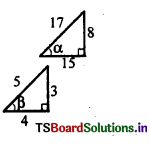
Now sin-1 \(\frac{8}{17}\) = α ⇒ sin α = \(\frac{8}{17}\) ⇒ tan α = \(\frac{8}{15}\) …………. (1)
Now sin-1 \(\frac{3}{5}\) = β ⇒ sin β = \(\frac{3}{5}\) ⇒ tan β = \(\frac{3}{4}\) …………. (2)
From (1) & (2), tan(α + β) = \(\frac{\tan \alpha+\tan \beta}{1-\tan \alpha \tan \beta}=\frac{\frac{8}{15}+\frac{3}{4}}{1-\frac{8}{15} \cdot \frac{3}{4}}=\left[\frac{\frac{32+45}{60}}{\frac{60-24}{60}}\right]=\frac{77}{36}\)
Hence proved.
Question 3.
Prove that + cos-1\(\frac{4}{5}\) + cos-1\(\frac{12}{13}\) = cos-1\(\frac{33}{65}\)
Solution:
Put cos-1\(\left(\frac{4}{5}\right)\) = α, cos-1\(\left(\frac{12}{13}\right)\) = β
Now to show α + β = cos-1\(\left(\frac{33}{65}\right)\) we show that cos(α + β) = \(\frac{33}{65}\)
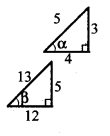
Now cos-1\(\left(\frac{4}{5}\right)\) = α ⇒ cos α = \(\frac{4}{5}\) ⇒ sin α = \(\frac{3}{5}\)
Now cos-1\(\left(\frac{12}{13}\right)\) = β ⇒ cos β = \(\frac{12}{13}\) ⇒ sin β = \(\frac{5}{13}\)
Now cos (α + β) = cosαcosβ – sinαsinβ = \(\left(\frac{4}{5}\right)\left(\frac{12}{13}\right)-\left(\frac{3}{5}\right)\left(\frac{5}{13}\right)=\frac{48-15}{65}=\frac{33}{65}\)
Hence, proved.
Question 4.
Prove that + cos-1\(\frac{12}{13}\) + sin-1\(\frac{3}{5}\) = sin-1\(\frac{56}{65}\)
Solution:
Put cos-1\(\left(\frac{12}{13}\right)\) = α, sin-1\(\left(\frac{3}{5}\right)\) = β
Now to show α + β = sin-1\(\left(\frac{56}{65}\right)\) we show that sin(α + β) = \(\frac{56}{65}\)
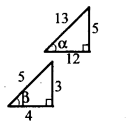
Now cos-1\(\left(\frac{12}{13}\right)\) = α ⇒ cos α = \(\left(\frac{12}{13}\right)\) ⇒ sin α = \(\frac{5}{13}\)
Now sin-1\(\left(\frac{3}{5}\right)\) = β ⇒ sin β = \(\left(\frac{3}{5}\right)\) ⇒ cos β = \(\frac{4}{5}\)
Now sin (α + β) = sinαcosβ – cosαsinβ = \(\left(\frac{5}{13}\right)\left(\frac{4}{5}\right)+\left(\frac{12}{13}\right)\left(\frac{3}{5}\right)=\frac{20+36}{65}=\frac{56}{65}\)
Hence, proved.
Question 5.
Prove that + tan-1\(\frac{63}{16}\) = sin-1\(\frac{5}{13}\) = cos-1\(\frac{3}{5}\)
Solution:
Put sin-1\(\left(\frac{5}{13}\right)\) = α, cos-1\(\left(\frac{3}{5}\right)\) = β
Now to show α + β = tan-1\(\left(\frac{63}{16}\right)\) we show that tan(α + β) = \(\frac{63}{16}\)
Now sin-1\(\left(\frac{5}{13}\right)\) = α ⇒ sin α = \(\left(\frac{5}{13}\right)\) ⇒ tan α = \(\frac{5}{12}\)
Also cos-1\(\left(\frac{3}{5}\right)\) = β ⇒ cos β = \(\left(\frac{3}{5}\right)\) ⇒ tan β = \(\frac{4}{3}\)
Now tan (α + β) = \(\frac{\tan \alpha+\tan \beta}{1-\tan \alpha \tan \beta}=\frac{\frac{5}{12}+\frac{4}{3}}{1-\left(\frac{5}{12}\right)\left(\frac{4}{3}\right)}=\left[\frac{\frac{15+48}{36}}{\frac{36-20}{36}}\right]=\frac{63}{16}\)
∴ tan-1\(\frac{63}{16}\) = sin-1\(\frac{5}{13}\) + cos-1\(\frac{3}{5}\)
Hence, proved.
Question 6.
Prove that sin-1\(\frac{4}{5}\) + sin-1\(\frac{7}{25}\) = sin-1\(\frac{117}{125}\)
Solution:
Put sin-1\(\frac{4}{5}\) = α and sin-1\(\frac{7}{25}\) = β
Required To Prove (RTP): α + β = sin-1\(\frac{117}{125}\) ⇒ sin(α + β) = \(\frac{117}{125}\)
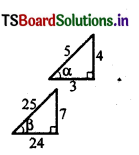
sin-1\(\frac{4}{5}\) = α ⇒ sinα = \(\frac{4}{5}\) ⇒ cosα = \(\frac{3}{5}\)
sin-1\(\frac{7}{25}\) = β ⇒ sinβ = \(\frac{7}{25}\) ⇒ cosβ = \(\frac{24}{25}\)
∴ sin(α + β) = sinαcosβ + cosαsinβ = \(\frac{4}{5} \times \frac{24}{25}+\frac{3}{5} \times \frac{7}{25}=\frac{96+21}{125}=\frac{117}{125}\)
Hence proved
Question 7.
Prove that cot-19 + cosec-1\(\frac{\sqrt{41}}{4}\) = \(\frac{\pi}{4}\)
Solution:
Put cot-19 = α and cosec-1\(\frac{\sqrt{41}}{4}\) = β
Required To Prove (RTP): α + β = \(\frac{\pi}{4}\) (or) tan(α + β) = 1

Now cot-19 = α ⇒ cot α = 9 ⇒ tan α = \(\frac{1}{9}\)
Also, cosec-1\(\frac{\sqrt{41}}{4}\) = β ⇒ cosecβ = \(\frac{\sqrt{41}}{4}\) ⇒ tan β = \(\frac{4}{5}\)
Now, tan(α + β) = \(\frac{\tan \alpha+\tan \beta}{1-\tan \alpha \tan \beta}=\frac{\frac{1}{9}+\frac{4}{5}}{1-\frac{1}{9} \cdot \frac{4}{5}}=\frac{\frac{41}{45}}{\frac{41}{45}}=1=\tan \frac{\pi}{4}\)
Hence proved
Question 8.
Prove that sin-1\(\left(\frac{3}{5}\right)\) + sin-1\(\left(\frac{8}{17}\right)\) = cos-1\(\left(\frac{36}{85}\right)\)
Solution:
Put sin-1\(\frac{3}{5}\) = α and sin-1\(\frac{8}{17}\) = β
Required To Prove (RTP): α + β = cos-1\(\frac{36}{85}\) ⇒ cos(α + β) = \(\frac{36}{85}\)
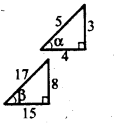
sin-1\(\frac{3}{5}\) = α ⇒ sinα = \(\frac{3}{5}\) ⇒ cosα = \(\frac{4}{5}\)
sin-1\(\frac{8}{17}\) = β ⇒ sinβ = \(\frac{8}{17}\) ⇒ cosβ = \(\frac{15}{17}\)
∴ cos(α + β) = cosαcosβ – sinαsinβ = \(\frac{4}{5} \times \frac{15}{17}-\frac{3}{5} \times \frac{8}{17}=\frac{60-24}{85}=\frac{36}{85}\)
Hence proved
Question 9.
Prove that sin-1\(\left(\frac{3}{5}\right)\) + cos-1\(\left(\frac{12}{13}\right)\) = cos-1\(\left(\frac{33}{65}\right)\)
Solution:
Put sin-1\(\frac{3}{5}\) = α and cos-1\(\frac{12}{13}\) = β
Required To Prove (RTP): α + β = cos-1\(\frac{33}{65}\) ⇒ cos(α + β) = \(\frac{33}{65}\)
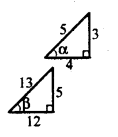
Then sinα = \(\frac{3}{5}\) and cosβ = \(\frac{12}{13}\)
∴ cosα = \(\frac{4}{5}\), sinβ = \(\frac{5}{13}\)
Now cos(α + β) = cosαcosβ – sinαsinβ = \(\frac{4}{5} \times \frac{12}{13}-\frac{3}{5} \times \frac{5}{13}=\frac{48-15}{13}=\frac{33}{65}\)
Hence proved
Question 10.
Prove that tan-1 \(\sqrt{x}=\frac{1}{2} \cos ^{-1}\left(\frac{1-x}{1+x}\right)\), x ∈ [0, 1]
Solution:
Put \(\sqrt{x}\) = tan θ
then x = tan2 θ. Also \(\sqrt{x}\) = tan θ ⇒ θ = tan-1\(\sqrt{x}\)
∴ \(\left(\frac{1-x}{1+x}\right)=\frac{1-\tan ^2 \theta}{1+\tan ^2 \theta}=\) = cos 2θ
Now R.H.S = \(\frac{1}{2} \cos ^{-1}\left(\frac{1-x}{1+x}\right)=\frac{1}{2} \cos ^{-1}(\cos 2 \theta)=\frac{1}{2} \times 2 \theta=\theta=\tan ^{-1} \sqrt{x}\) = L.H.S
Hence Proved
Question 11.
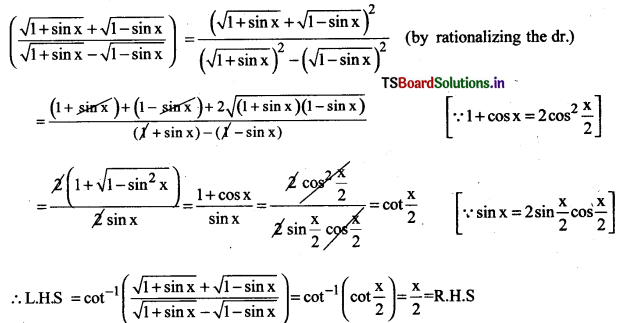
Prove that cot-1 \(\left(\frac{\sqrt{1+\sin \mathrm{x}}+\sqrt{1-\sin \mathrm{x}}}{\sqrt{1+\sin \mathrm{x}}-\sqrt{1-\sin \mathrm{x}}}\right)=\frac{\mathrm{x}}{2}, \mathrm{x} \in\left(0, \frac{\pi}{4}\right)\)
Solution:
Question 12.
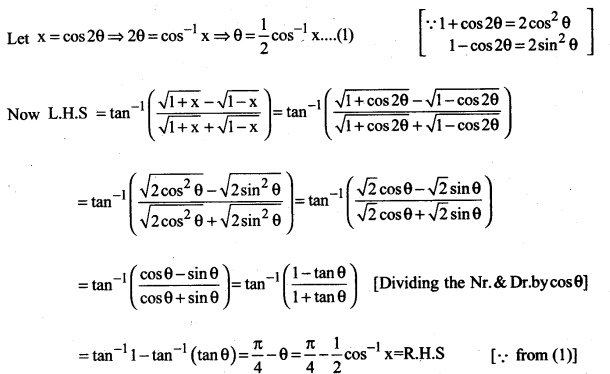
Prove that tan-1\(\left(\frac{\sqrt{1+x}-\sqrt{1-x}}{\sqrt{1+x}+\sqrt{1-x}}\right)=\frac{\pi}{4}-\frac{1}{2} \cos ^{-1} x,-\frac{1}{\sqrt{2}} \leq x \leq 1\)
Solution:
Question 13.
Solve 2tan-1 (cos x) = tan-1 (2 cosec x)
Solution:
Given that 2tan-1 (cos x) = tan-1 (2 cosec x). We know, 2 tan-1 = tan-1\(\left(\frac{2 x}{1-x^2}\right)\)
∴ 2 tan-1 (cos x) = tan-1\(\left(\frac{2 \cos x}{1-\cos ^2 x}\right)\)
∴ tan-1\(\left(\frac{2 \cos x}{1-\cos ^2 x}\right)\) = tan-1(2cosec x) ⇒ \(\left(\frac{2 \cos x}{1-\cos ^2 x}\right)\) = 2 cosec x
⇒ \(\frac{2 \cos x}{\sin ^2 x}=\frac{2}{\sin x}\) ⇒ cot x = 1 ⇒ tan x = 1 ⇒ tan x = tan \(\frac{\pi}{4}\)
∴ x = nπ + \(\frac{\pi}{4}\), where n ∈ Z [∵ tan θ = tan α ⇒ θ = nπ + α, n ∈ Z]
Question 14.
Solve tan-1\(\left(\frac{1-x}{1+x}\right)=\frac{1}{2}\) tan-1x. (x > 0)
Solution:
We know that tan-1x – tan-1y = tan-1\(\left(\frac{x-y}{1+x y}\right)\)
⇒ tan-1\(\left(\frac{1-x}{1+x}\right)=\frac{1}{2}\) tan-1x ⇒ tan-11 – tan-1x = \(\frac{1}{2}\)tan-1x
⇒ tan-11 = tan-1x + \(\frac{1}{2}\)tan-1x + \(\frac{3}{2}\)tan-1x
⇒ \(\frac{\pi}{4}\) = \(\frac{3}{2}\)tan-1x ⇒ tan-1x = \(\frac{\pi}{6}\) ⇒ x = tan\(\frac{\pi}{6}\)
⇒ x = \(\frac{1}{\sqrt{3}}\)
Question 15.
Solve arc sin\(\left(\frac{5}{x}\right)\) + arc sin\(\frac{12}{x}=\frac{\pi}{2}\) (x > 0)
Solution:
Given that arc sin\(\left(\frac{5}{x}\right)\) + arc sin\(\frac{12}{x}=\frac{\pi}{2}\) ⇒ sin-1\(\frac{5}{x}\) + sin-1\(\frac{12}{x}=\frac{\pi}{2}\)
Put sin-1\(\frac{5}{x}\) = α and sin-1\(\frac{12}{x}\) = β ⇒ sin α = \(\frac{5}{x}\) and sin β = \(\frac{12}{x}\)
Now, α + β = \(\frac{\pi}{2}\) α = \(\frac{\pi}{2}\) – β ⇒ sin α = sin (\(\frac{\pi}{2}\) – β) = cos β = \(\sqrt{1-\sin ^2 \beta}\)
On Squaring, we get sin2 α = 1 = sin2β
⇒ \(\left(\frac{5}{x}\right)^2=1-\left(\frac{12}{x}\right)^2 \Rightarrow\left(\frac{5}{x}\right)^2=\frac{x^2-144}{x^2} \Rightarrow \frac{25}{x^2}=\frac{x^2-144}{x^2}\)
⇒ x2 = 169
⇒ x = ± 13
But x = -13 does not satisfy the given equation
∴ x = 13 is only solution of the given equation