TS 6th Class Hindi Guide 6th Lesson चिड़ियाघर

Telangana SCERT 6th Class Hindi Study Material Telangana Pdf 6th Lesson चिड़ियाघर Textbook Questions and Answers.

TS 6th Class Hindi 6th Lesson Questions and Answers Telangana चिड़ियाघर

सुनो-बोलो :

TS 6th Class Hindi Guide 6th Lesson चिड़ियाघर 1

प्रश्न 1.
तुम्हें चिड़ियाघर कैसा लगता है ?
उत्तर :
मुझे चिड़ियाघर बहुत अच्छा लगता है ।
I like zoo very much.

प्रश्न 2.
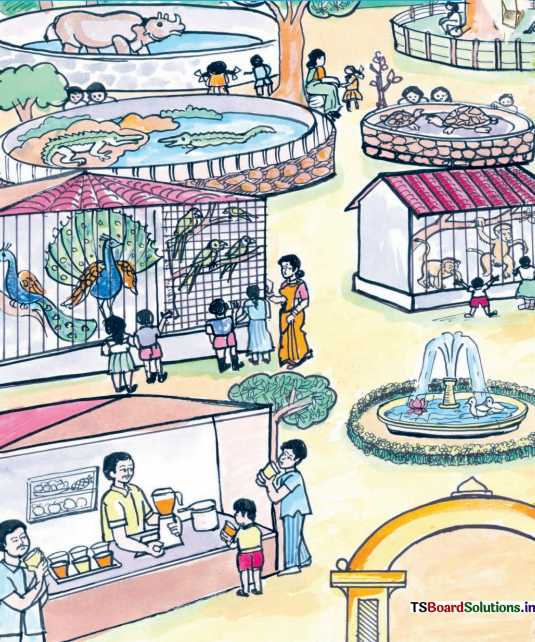
जंगल में कौन-कौन से जानवर दिखाई देते हैं ?
उत्तर :
चिड़ियाघर में गैडडा, मगग, कछुआ, बन्दर, जिगफ़, हिरण, भालू, हाथी, शेर दिखाई दे रहे हैं।
Rhinoceros, crocodile, tortoise, monkey, giraffe, deer, bear, elephant and lion are seen in zoo.

TS 6th Class Hindi Guide 6th Lesson चिड़ियाघर

प्रश्न 3.
चिड़ियाघर में जानवरों को क्यों रखा जाता है ?
उत्तर :
जानवर जंगल में रहते हैं। लेकिन सब लोग जंगल जाकर जानबगों को देख नहीं सकते। बच्चों को भी जानवर अच्छे लगते हैं। बच्चों को जानवरों के बारे में जानना भी जरूरी है । इसलिए जानवरों को चिड़ियाघर में रखा जाता है ।
Animals live in forest. Everyone cannot go to zoo and see these animals. Animals are liked by children. It is important to know about animals. That is why animals are kept in zoo.

पढ़ो :

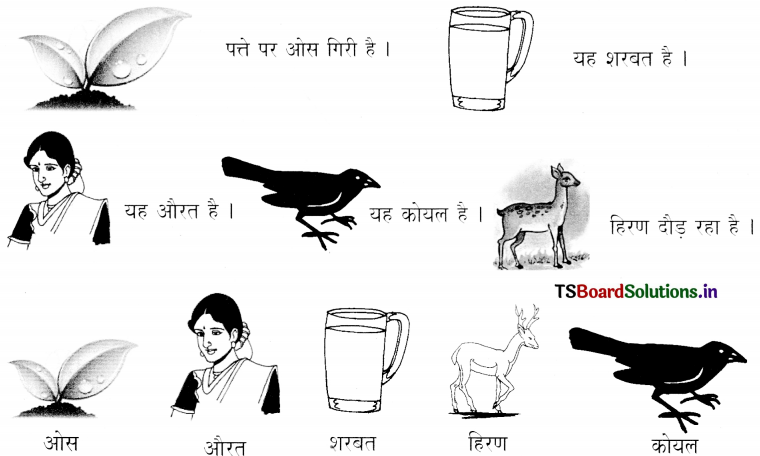
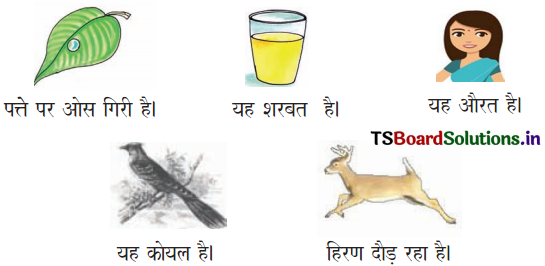
अ. चित्र देखिए। शब्द पढ़िए।

TS 6th Class Hindi Guide 6th Lesson चिड़ियाघर

आ. चित्र वाले शब्द पर ‘○’ लगाइए।

TS 6th Class Hindi Guide 6th Lesson चिड़ियाघर 4
उत्तर :
TS 6th Class Hindi Guide 6th Lesson चिड़ियाघर 3

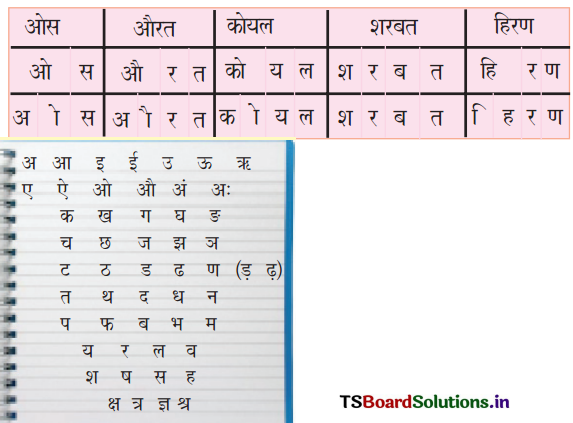
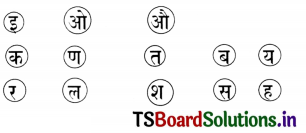
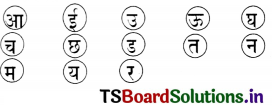
इ. चित्र देखिए। शब्द पढ़िए। वर्ण पढ़िए। इन वर्णों को वर्णमाला चार्ट में पहचानिए।

TS 6th Class Hindi Guide 6th Lesson चिड़ियाघर 6
उत्तर :
TS 6th Class Hindi Guide 6th Lesson चिड़ियाघर 5

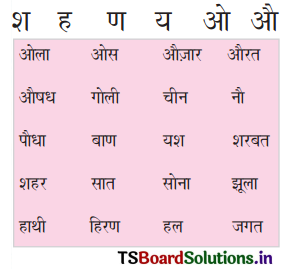
ई. इन्हें पढ़िए।

TS 6th Class Hindi Guide 6th Lesson चिड़ियाघर 7

उत्तर :

TS 6th Class Hindi Guide 6th Lesson चिड़ियाघर 8

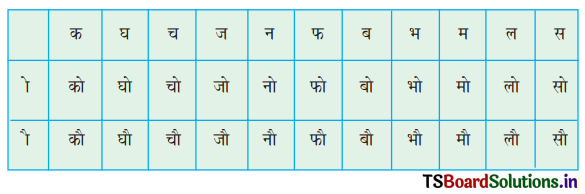
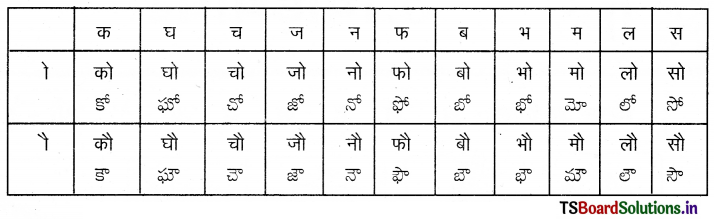
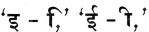
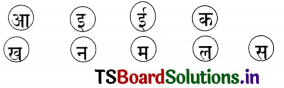
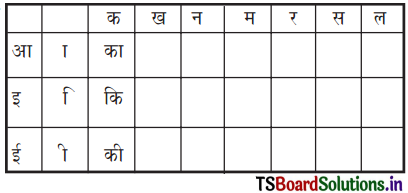
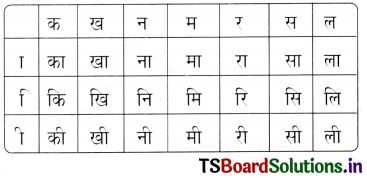
ई. नीचे दिये गये बक्से के अक्षरों में TS 6th Class Hindi Guide 6th Lesson चिड़ियाघर मात्रा के अंतर समझते हुए पढ़िए।

TS 6th Class Hindi Guide 6th Lesson चिड़ियाघर 9
उत्तर :
TS 6th Class Hindi Guide 6th Lesson चिड़ियाघर 15

लिखो :

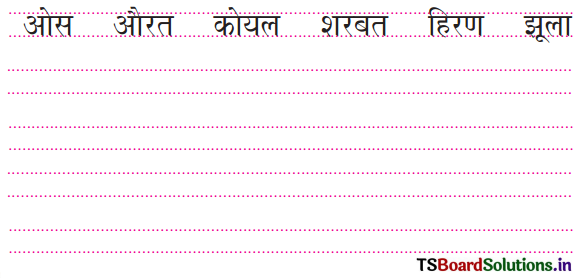
अ. शब्द पढ़ो। लिखो।

TS 6th Class Hindi Guide 6th Lesson चिड़ियाघर 10

आ. मात्रा जोडिए और लिखिए।

TS 6th Class Hindi Guide 6th Lesson चिड़ियाघर 11
उत्तर :
TS 6th Class Hindi Guide 6th Lesson चिड़ियाघर 14

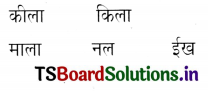
इ. पढ़िए और लिखिए।

TS 6th Class Hindi Guide 6th Lesson चिड़ियाघर 12
उत्तर :

1. चौराहे पर पुलीस है। = నాలుగు వీధులు కలియు కూడలిలో పోలీసు ఉన్నాడు.
(చౌరాహే పర్ పులీస్ హై) There is a police at square ground.

2. औरत खाना बना रही है। = స్త్రీ భోజనము తయారుచేయుచున్నది.
(ఔరత్ ఖానా బనా రహీ హై।) The woman is preparing food.

TS 6th Class Hindi Guide 6th Lesson चिड़ियाघर

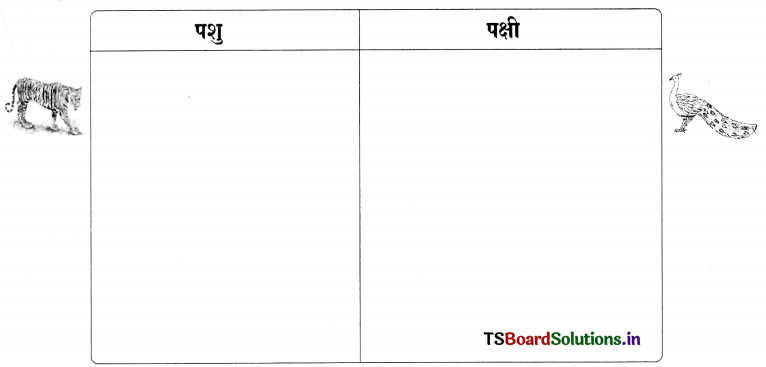
ई. अपने मनपसंद पशु-पक्षियों के नाम लिखिए।

TS 6th Class Hindi Guide 6th Lesson चिड़ियाघर 13

उत्तर :

पशुपक्षी
हाथीकोयल
हिरणतोता
शेरमैना
कछुआकबूतर
बन्दरचिड़ियाँ
कुत्ताकौआ

TS 6th Class Hindi Guide 3rd Lesson रेलवे स्टेशन

Telangana SCERT 6th Class Hindi Study Material Telangana Pdf 3rd Lesson रेलवे स्टेशन Textbook Questions and Answers.

TS 6th Class Hindi 3rd Lesson Questions and Answers Telangana रेलवे स्टेशन

सुनो-बोलो :

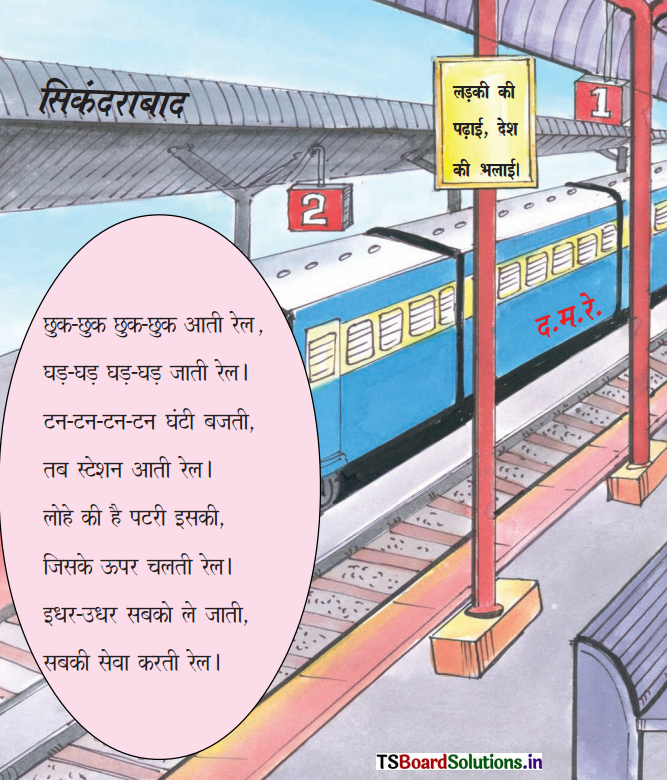
TS 6th Class Hindi Guide 3rd Lesson रेलवे स्टेशन 1

प्रश्न 1.
चित्र में क्या-क्या दिखायी दे रहे हैं ?
उत्तर :
चित्र में रेलगाडी, पटरियाँ, घडी, टेलीविजन, कूडेदान, कुली, टिकट कलक्टर, दो औरतें, एक लड़की, दो सूटकेस, 10 रूपये का नोट, चायघर, छः कप, दो गिलास, दो जार, छतरी दिखाई दे रहे हैं।

प्रश्न 2.
यातायात के साधनों के नाम बताओ।
उत्तर :
रेलगाडी, बस, कार, लॉरी, नाव, जहाज, हवाईजहाज आदि।

TS 6th Class Hindi Guide 3rd Lesson रेलवे स्टेशन

प्रश्न 3.
गीत के बारे में बातचीत करो।
उत्तर :
रेलगाडी छुक छुक करती हुई आती है। घड-घड करती हुई जाती है। टन-टन घंटी बजने पर रेलगाडी स्टेशन में आती है। लोहे की पटरी पर यह चलती है। सब को इधर – उधर ले जाती है। इस प्रकार रेलगाडी सबकी सेवा करती है।

पढ़ो :

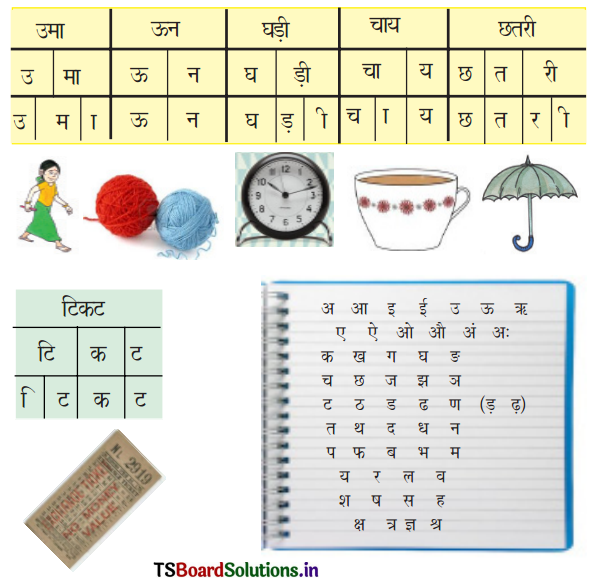
अ. चित्र देखिए। शब्द पढ़िए। इनके वर्ण वर्णमाला चार्ट में पहचानिए। ‘○’ लगाइए।

TS 6th Class Hindi Guide 3rd Lesson रेलवे स्टेशन 2
उत्तर :
TS 6th Class Hindi Guide 3rd Lesson रेलवे स्टेशन 11

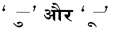
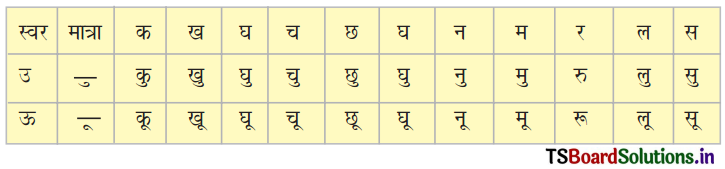
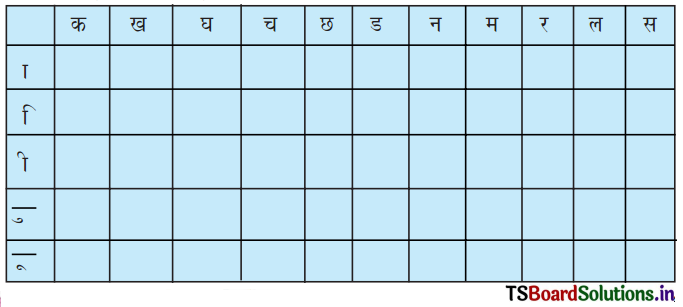
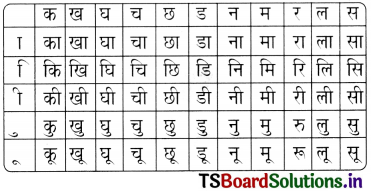
आ. नीचे दिये गये बक्से में TS 6th Class Hindi Guide 3rd Lesson रेलवे स्टेशन 15 की मात्रा के अंतर पहचानते हुए पढ़िए।

TS 6th Class Hindi Guide 3rd Lesson रेलवे स्टेशन 3

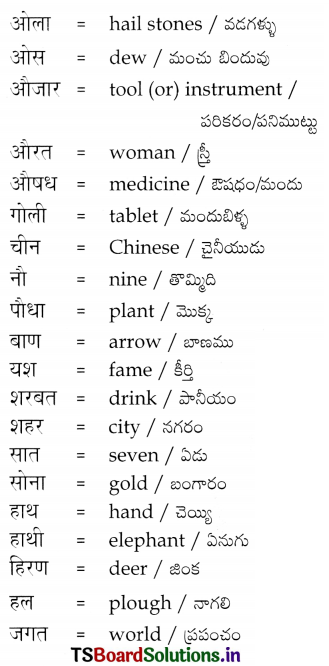
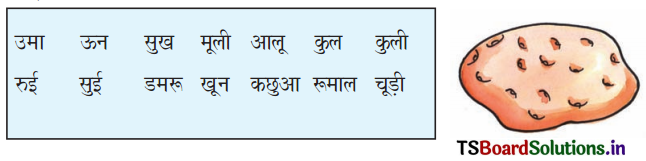
इ. इन्हें पढ़ो।

TS 6th Class Hindi Guide 3rd Lesson रेलवे स्टेशन 4

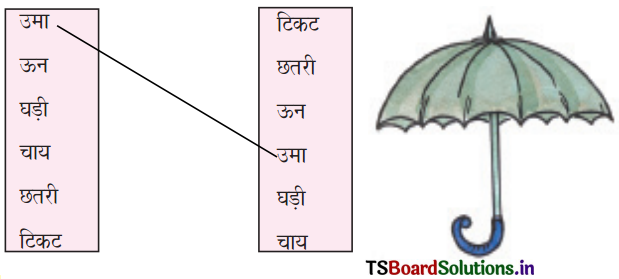
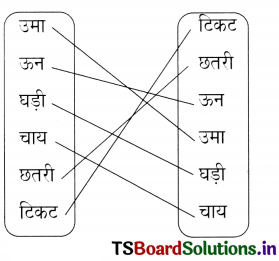
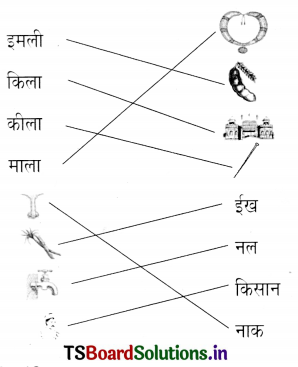
ई. समान शब्दों की जोड़ी बनाइए।

TS 6th Class Hindi Guide 3rd Lesson रेलवे स्टेशन 5
उत्तर :
TS 6th Class Hindi Guide 3rd Lesson रेलवे स्टेशन 12

लिखो :

अ. मात्रा जोड़िए और लिखिए।

TS 6th Class Hindi Guide 3rd Lesson रेलवे स्टेशन 6
उत्तर :
TS 6th Class Hindi Guide 3rd Lesson रेलवे स्टेशन 13

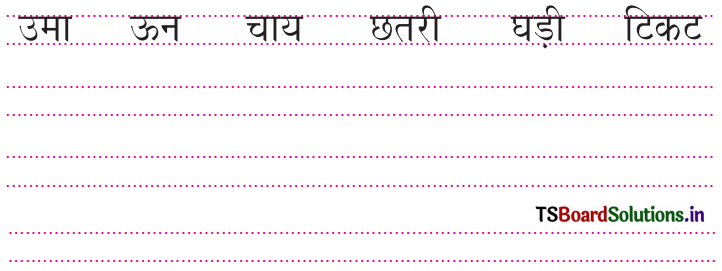
आ. सुंदर अक्षरों में लिखिए।

TS 6th Class Hindi Guide 3rd Lesson रेलवे स्टेशन 7

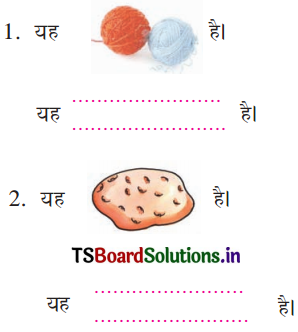
इ. खाली स्थान भरो।

TS 6th Class Hindi Guide 3rd Lesson रेलवे स्टेशन 8
उत्तर :
1. यह ऊन है।
2 . यह आलू है।

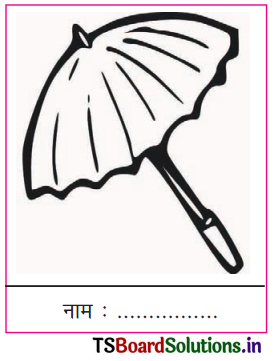
ई. रंग भरो। नाम लिखो।

TS 6th Class Hindi Guide 3rd Lesson रेलवे स्टेशन 9
उत्तर :
नाम : छतरी

अभ्यासकार्य :

1. निम्नलिखित कविता का वाचन कीजिए। प्रश्नों के उत्तर दीजिए :
క్రింది కవిత్వాన్ని చదవండి. ప్రశ్నలకు సమాధానాలు వ్రాయండి.
बादल आए, बादल आए,
काले-काले बादल आए।
बिजली चमकी चम-चम-चम,
पानी बरसा छम-छम-छम,
छाता लेकर चलते हैं हम।।

प्रश्न 1.
कैसे बादल आए है?
1. नीला
2. लाल
3. काला
उत्तर :
3. काला

TS 6th Class Hindi Guide 3rd Lesson रेलवे स्टेशन

प्रश्न 2.
क्या आए?
1. पानी
2. बादल
3. सूर्य
उत्तर :
2. बादल

प्रश्न 3.
क्या चम-चम-चम चमकी?
1. बिजली
2. धर्ता
3. आसमान
उत्तर :
1. बिजली

प्रश्न 4.
छम-छम-छम कर क्या बरसा?
1. खून
2. पसीना
3. पानी
उत्तर :
3. पानी

प्रश्न 5.
हम क्या लेकर चलते हैं?
1. घडी
2. छाता
3. किताब
उत्तर :
2. छाता

TS 6th Class Hindi Guide 3rd Lesson रेलवे स्टेशन

सारांश-సారాంశం :

छुक- छुक – छुक – छुक आती रेल,
घड़ – घड़ – घड़ – घड़ जाती रेल ।
टन – टन – टन – टन घंटी बजती,
तब स्टेशन आती रेल।
लोहे की है पटरी इसकी,
जिसके ऊपर चलती रेल ।
इधर – उधर सबको ले जाती,
सबकी सेवा करती रेल।

Train comes with chuk – chuk – sound
Train goes with ghad – ghad – sound
Bell rings tun – tun – tun
Then comes train to station.
Its tracks are made of iron
On which the train moves
It takes every one here and there
Train serves all.

భావం : రైలు బండి ఛుక్ – ఛుక్ – ఛుక్ – ఛుక్ మంటూ వస్తుంది.
ఘడ – ఘడ – ఘడ – ఘడ మని వెళ్తుంది.
టన్ – టన్ – టన్ – టన్ మని గంట ద్రోగుతుంది.
అప్పుడు రెలలు బండి స్టేషన్లో కొస్తుంది.
ఇనుప పట్టాలపై ఇది నడుస్తుంది.
అక్కడికీ ఇక్కడికీ అందరినీ తీసుకువెళ్తుంది.
రైలు బండి అందరికీ సేవ చేస్తుంది.

TS 6th Class Hindi Guide 3rd Lesson रेलवे स्टेशन

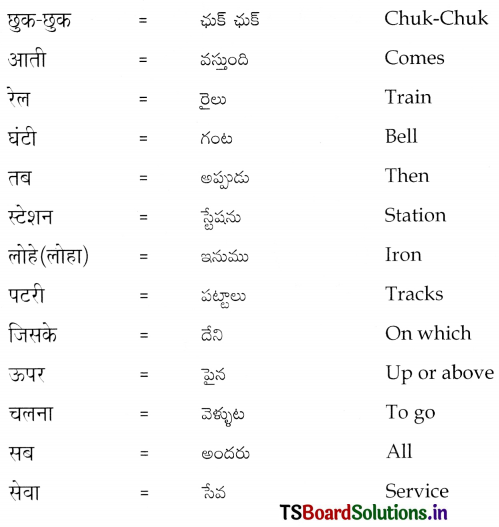
अर्थ (అర్ధములు) (Meanings) :

TS 6th Class Hindi Guide 3rd Lesson रेलवे स्टेशन 10

TS 6th Class Hindi Guide 2nd Lesson हमारा गाँव

Telangana SCERT 6th Class Hindi Study Material Telangana Pdf 2nd Lesson हमारा गाँव Textbook Questions and Answers.

TS 6th Class Hindi 2nd Lesson Questions and Answers Telangana हमारा गाँव

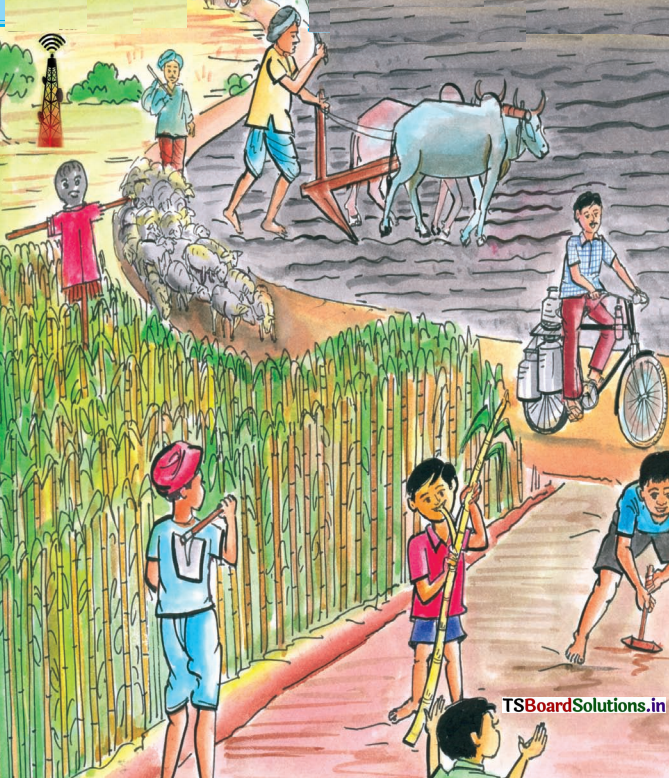
सुनो-बोलो :

TS 6th Class Hindi Guide 2nd Lesson हमारा गाँव 1

प्रश्न 1.
चित्र में क्या दिखायी दे रहा है ?
उत्तर :
चित्र में दो औगतें, तीन लड़कियाँ, दो आदमी, दो लड़के, नल, बाल्टी, छोटा बच्चा, ट्रेक्टर, पेड, घर, पत्ते, कौआ, ईख कुत्ता, फसल दिखाई दे रहे हैं।

प्रश्न 2.
अपने गाँव के बारे में बताओ।
उत्तर :
मेर गाँव छोटा है। इसमें हजार लोग रहते हैं। गाँव में एक पाठशाला, पुस्तकालय और अस्पताल भी हैं। मनोरंजन के लिए सिनेमा हॉल भी है। पानी का एक बडा तालाब है। यहाँ हम सब प्यार से मिलजुलकर रहते हैं।

TS 6th Class Hindi Guide 2nd Lesson हमारा गाँव

प्रश्न 3.
लड़के क्या कर रहे हैं ?
उत्तर :
एक लड़का नल के पास नहा रहा है और एक लडका पेड के नीचे बैठ कर पुस्तक पढ़ रहा है ।

प्रश्न 4.
गीत के बारे में बातचीत करो।
उत्तर :
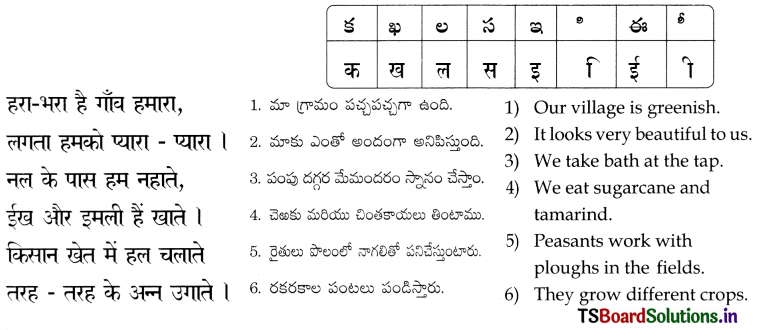
हमारा गाँव हर – भर है। हमको बहुत अच्छा लगता है। हम नल के पास नहाते हैं। इमली और ईख़ाते हैं। किसान खेत में हल चलाता है। वह कई प्रकार के फसल उगाता है।

पढ़ो :

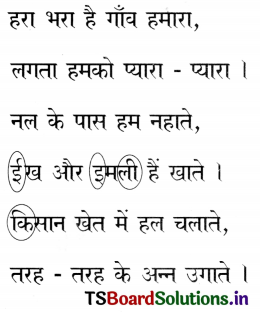
अ. गीत पढ़िए। TS 6th Class Hindi Guide 2nd Lesson हमारा गाँव 4 मात्रा वाले शब्दों पर ‘○’ लगाइए।

हरा भरा है गाँव हमारा,
लगता हमको प्यारा – प्यारा।
नल के पास हम नहाते,
ईख और इमली हैं खाते।
किसान खेत में हल चलाते,
तरह – तरह के अन्न उगाते।
उत्तर :
TS 6th Class Hindi Guide 2nd Lesson हमारा गाँव 5

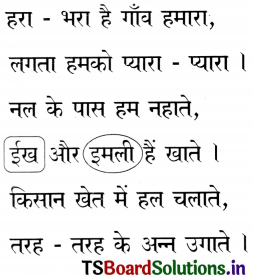
आ. गीत पढ़िए। ‘इमली’ शब्द पर ‘○’ और ‘ईख’ शब्द पर ‘▭’ लगाइए।

हरा – भरा है गाँव हमारा,
लगता हमको प्यारा – प्यारा।
नल के पास हम नहाते,
ईख और इमली हैं खाते।
किसान खेत में हल चलाते,
तरह – तरह के अन्न उगाते।
उत्तर :
TS 6th Class Hindi Guide 2nd Lesson हमारा गाँव 6

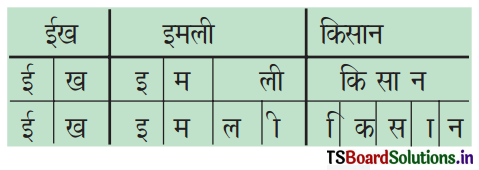
इ. चित्र देखिए। शब्द पढ़िए। इनके अक्षर वर्णमाला चार्ट में पहचानो। ‘○’ लगाइए।

TS 6th Class Hindi Guide 2nd Lesson हमारा गाँव 13
उत्तर :
TS 6th Class Hindi Guide 2nd Lesson हमारा गाँव 7

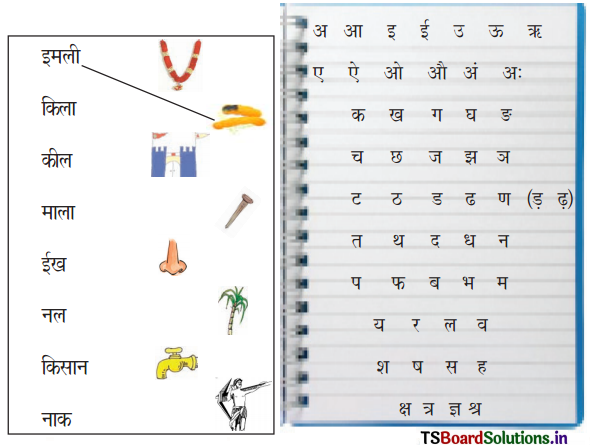
ई. जोड़ी बनाओ।

TS 6th Class Hindi Guide 2nd Lesson हमारा गाँव 14
उत्तर :
TS 6th Class Hindi Guide 2nd Lesson हमारा गाँव 8

लिखो :

अ. मात्राएँ जोड़कर लिखिए और पढ़िए।

TS 6th Class Hindi Guide 2nd Lesson हमारा गाँव 15
उत्तर :
TS 6th Class Hindi Guide 2nd Lesson हमारा गाँव 9

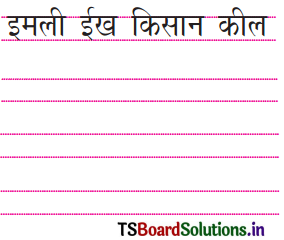
आ. शब्द पढ़िए और लिखिए।

TS 6th Class Hindi Guide 2nd Lesson हमारा गाँव 16

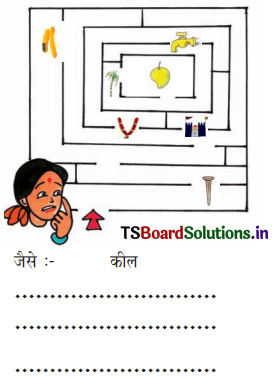
इ. रानी को आम तक पहुँचाइए। रास्ते में मिलने वाली चीज़ों के नाम लिखिए।

TS 6th Class Hindi Guide 2nd Lesson हमारा गाँव 17
उत्तर :
TS 6th Class Hindi Guide 2nd Lesson हमारा गाँव 10

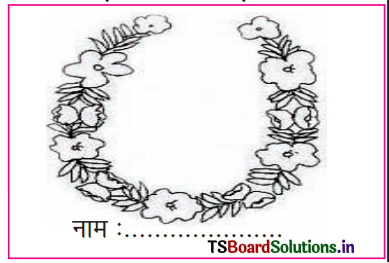
ई. रंग भरिए। नाम लिखिए।

TS 6th Class Hindi Guide 2nd Lesson हमारा गाँव 12
उत्तर :
नाम : फूलों की माल्ना

अभ्यासकार्य :

1. निम्नलिखित कविता का वाचन कीजिए। प्रश्नों के उत्तर दीजिए :
క్రింది కవిత్వాన్ని చదవండి. ప్రశ్నలకు సమాధానాలు వ్రాయండి.
आसमान पर चढ जाएँ हम,
चाँद सितारे ले आएँ हम।
बोल उठी कलियों की सरगम
धरती पर आना न भूलें।

प्रश्न 1.
हम कहाँ पर चढ जाएँ?
1. धरती
2. आसमान
3. पाताल
उत्तर :
2. आसमान

TS 6th Class Hindi Guide 2nd Lesson हमारा गाँव

प्रश्न 2.
हम क्या ले आएँ?
1. चाँद-सितारे
2. चाँद-धग्ती
3. चाँद-पाताल
उत्तर :
1. चाँद-सितारे

प्रश्न 3.
कौन बोल उठी?
1. तारे
2. चाँद
3. कलियाँ
उत्तर :
3. कलियाँ

प्रश्न 4.
चाँद-सितारे कौन ले आएँ?
1. हम
2. तुम
3. मैं
उत्तर :
1. हम

प्रश्न 5.
हम कहाँ पर आना न भूलें?
1. आसमान
2. धरती
3. पाताल
उत्तर :
2. धरती

TS 6th Class Hindi Guide 2nd Lesson हमारा गाँव

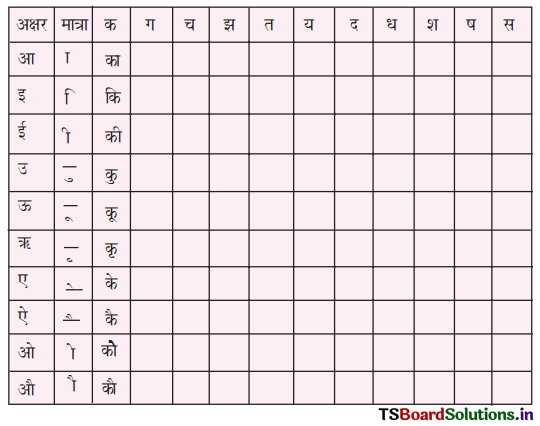
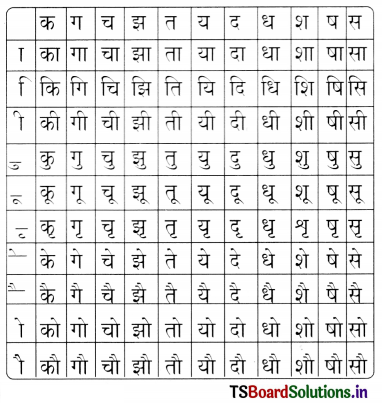
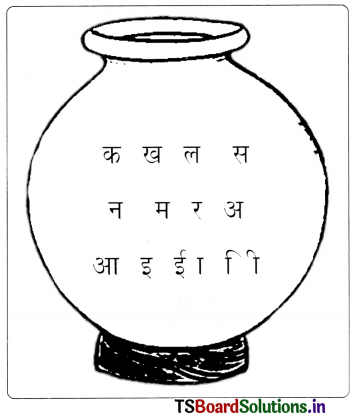
2. इन वर्णों और मात्राओं से शब्द लिखिए।

TS 6th Class Hindi Guide 2nd Lesson हमारा गाँव 11
उत्तर :

  1. कमल
  2. कलम
  3. नर
  4. अनार
  5. कल
  6. आम
  7. लाल
  8. साल
  9. नाक
  10. सिर
  11. नीला
  12. इमली
  13. खर
  14. मिल
  15. आग
  16. आकार
  17. नीम
  18. नाम

TS 6th Class Hindi Guide 2nd Lesson हमारा गाँव

सारांश-సారాంశం :

TS 6th Class Hindi Guide 2nd Lesson हमारा गाँव 2

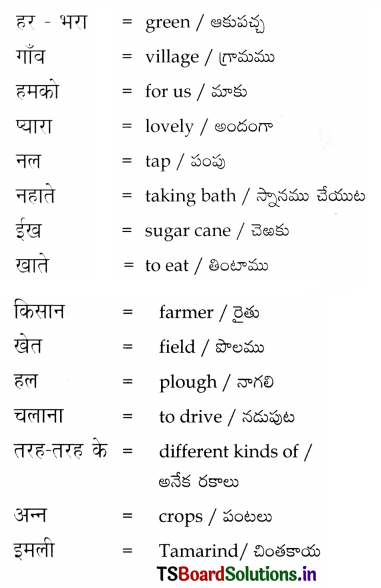
अर्थ (అర్ధములు) (Meanings) :

TS 6th Class Hindi Guide 2nd Lesson हमारा गाँव 3

TS 6th Class Hindi Guide 1st Lesson आम ले लो आम!

Telangana SCERT 6th Class Hindi Study Material Telangana Pdf 1st Lesson आम ले लो आम! Textbook Questions and Answers.

TS 6th Class Hindi 1st Lesson Questions and Answers Telangana आम ले लो आम!

देखो-समझो-बोलो :
చూడండి-అర్ధంచేసుకోండి-చెప్పండి

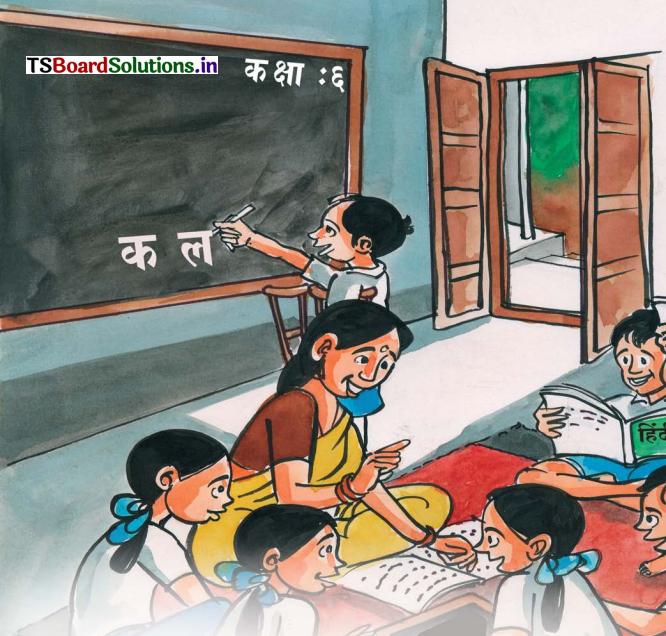
TS 6th Class Hindi Guide 1st Lesson आम ले लो आम! 1

प्रश्न 1.
यह कौन-सी कक्षा है ? कक्षा में क्या – क्या हैं ?
उत्तर :
यह छठी कक्षा है। इस कक्षा मे, एक श्यामपट है, अध्यापिका हैं, दग्वाजा है, पुस्तकें हैं, कुछ लडके और लड़कियाँ हैं ।

प्रश्न 2.
अध्यपिका क्या कर रही हैं ?
उत्तर :
अध्यपिका पाठ पढ़ा रही हैं।

TS 6th Class Hindi Guide 1st Lesson आम ले लो आम!

प्रश्न 3.
जो बच्चे खड़े हैं, वे क्या कर रहे हैं ?
उत्तर :
जो बच्चे खड़े हैं, वे हिन्दी पढ़ रहे हैं।

प्रश्न 4.
जो बच्चे बैठे हैं, वे क्या कर रहे हैं ?
उत्तर :
जो बच्चे बैठे हैं, वे भी पढ़ रहे हैं ।

प्रश्न 5.
तुम्हारी क्क्षा में क्या – क्या हैं ?
उत्तर :
मेरी कक्षा में एक श्यामपट है, कुर्सी है, मेज है, बच्चों के बैठने के लिए कई बेंच हैं, एक अलमारी है और चार पंखे भी हैं।

प्रश्न 6.
तुम अपनी अध्यापिका से क्या बातें करते हो ?
उत्तर :
मैं अपनी अध्यापिका से पाठ के वारे में वातें कर्ता हूँ।

सुनो-बोलो :

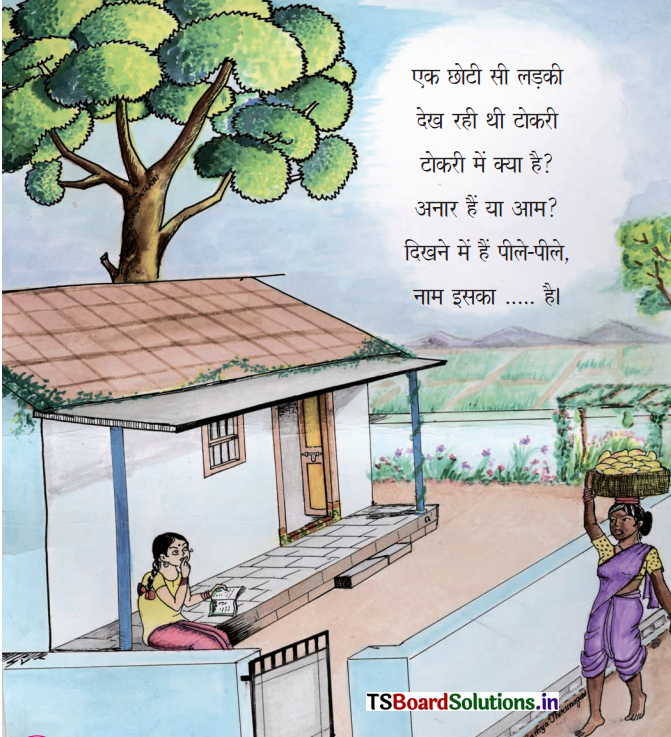
TS 6th Class Hindi Guide 1st Lesson आम ले लो आम! 2

प्रश्न 1.
चित्र में क्या – क्या दिखायी दे रहा हैं ?
उत्तर :
चित्र में – पेड, पप्ते, घर, खिडकी, दरवाजा, लड़की, पुस्तक, पौधे, पहाड़, औरत, टोकरी, फल, फाटक, आकाश दिखाई दे रहे हैं।

TS 6th Class Hindi Guide 1st Lesson आम ले लो आम!

प्रश्न 2.
तुमको कौन – सा फल पसंद है ? क्यों ?
उत्तर :
मुझे आनार बहुत पसंद है क्योंकि यह वहुत मीटा होता है और स्वास्थ्य के लिए भी अच्छा है।

प्रश्न 3.
लड़की क्या कर रही है ?
उत्तर :
लड़की टोकरी को देख रही है।

प्रश्न 4.
गीत के बारे में बातचीत करो।
उत्तर :
इस गीत में एक लड़की है। वह घर के बाहर बैट कर पढ़ ग्ही है । एक औरत टोकरी में फल रख कर जा रही है। टोकरी में कई आम हैं।

पढ़ो :

अ. गीत में TS 6th Class Hindi Guide 1st Lesson आम ले लो आम! 3मात्रा वाले शब्दों पर ‘○’ लगाओ ।
उत्तर :
एक छोटी सी लड़की,
देख रही थी टोकरी।
टोकरी में क्या है ?
अनार हैं या आम ?
दिखने में हैं पीले – पीले,
नाम इसका आम है।

TS 6th Class Hindi Guide 1st Lesson आम ले लो आम!

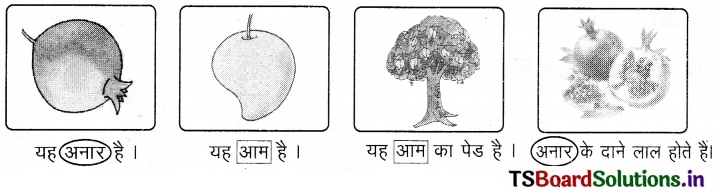
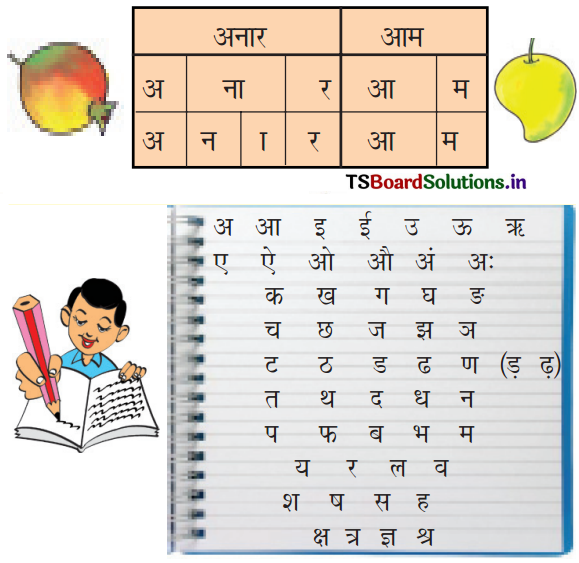
आ. ‘अनार’ शब्द पर ‘○’ और ‘आम’ शब्द पर ‘▭’ लगाओ ।
‘అనార్’ మీద ‘○’ చుట్టండి. మరియు ‘ఆమ్’ మీద ‘▭’ చుట్టండి.
TS 6th Class Hindi Guide 1st Lesson आम ले लो आम! 5
उत्तर :
TS 6th Class Hindi Guide 1st Lesson आम ले लो आम! 12

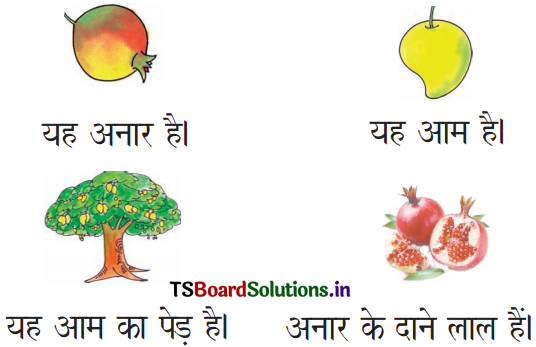
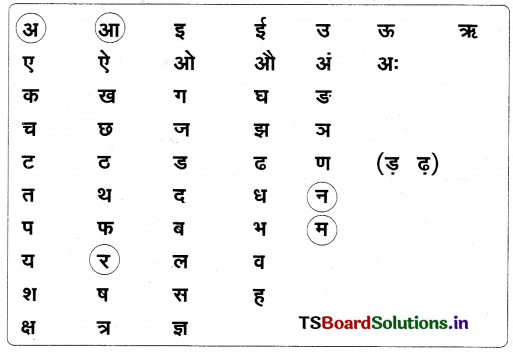
इ. चित्र देखिए। शब्द पढ़ए। इन्हें वर्णमाला चार्ट में पहचानिए ‘○’ लगाइए।

TS 6th Class Hindi Guide 1st Lesson आम ले लो आम! 6
उत्तर :
TS 6th Class Hindi Guide 1st Lesson आम ले लो आम! 15

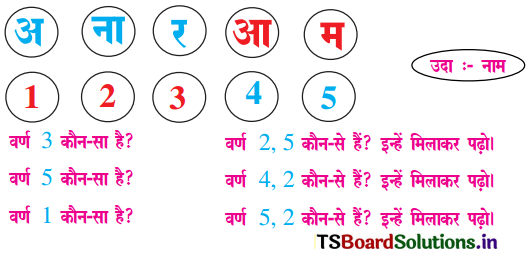
ई. वर्ण बोलो और संख्याओं के अनुसार जोड़कर शब्द बनाइए।
TS 6th Class Hindi Guide 1st Lesson आम ले लो आम! 7
उत्तर :
1. वर्ण 3 कौन – सा है ?
उत्तर :

2. वर्ण 5 कौन – सा है ?
उत्तर :

TS 6th Class Hindi Guide 1st Lesson आम ले लो आम!

3. वर्ण 1 कौन – सा है ?
उत्तर :

4. वर्ण 2,5 कौन – से हैं? इन्हें मिलाकर पढो।
उत्तर :
ना, म ; नाम

5. वर्ण 4,2 कौन – से हैं? इन्हें मिलाकर पढों।
उत्तर :
आ, ना ; आना

6. वर्ण 5,2 कौन – से हैं? इन्हें मिलाकर पढो।
उत्तर :
म, ना ; मना

लिखो :

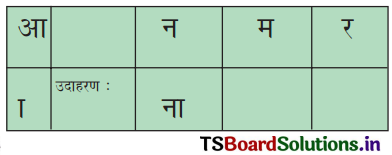
अ. मात्रा जोडो और लिखो।
TS 6th Class Hindi Guide 1st Lesson आम ले लो आम! 8
उत्तर :
TS 6th Class Hindi Guide 1st Lesson आम ले लो आम! 13

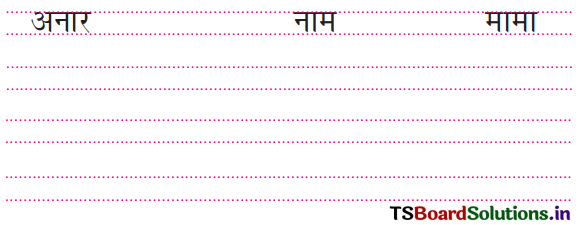
आ. शब्द पढ़ो। लिखो।

TS 6th Class Hindi Guide 1st Lesson आम ले लो आम! 9

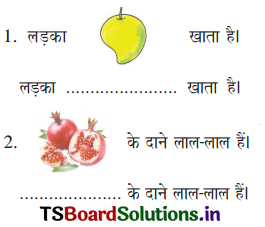
इ. खाली स्थान भरिए।

TS 6th Class Hindi Guide 1st Lesson आम ले लो आम! 10
उत्तर :
1. लडका आम खाता है।
2. अनार के दाने लाल – लाल हैं।

TS 6th Class Hindi Guide 1st Lesson आम ले लो आम!

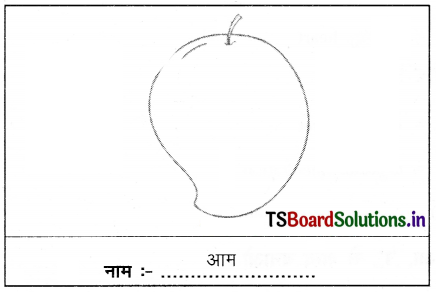
ई. अपने मनपसंद फल का चित्र बनाइए। नाम लिखिए।
TS 6th Class Hindi Guide 1st Lesson आम ले लो आम! 11
उत्तर :
TS 6th Class Hindi Guide 1st Lesson आम ले लो आम! 14

अभ्यासकार्य :

1. निम्नलिखित कविता का वाचन कीजिए। प्रश्नों के उत्तर दीजिए :
క్రింది కవిత్వాన్ని చదవండి. ప్రశ్నలకు సమాధానాలు వ్రాయండి.
चिडिया रानी! आओ, आओ
मुझको भी उडना सिखलाओ।
दूर देश को फिर हम जाएँ,
सबको अपना दोस्त बनाएँ।।

प्रश्न 1.
रानी कौन है?
1. तितली
2. मोग
2. चिडिया
उत्तर :
2. चिडिया

प्रश्न 2.
किसको आओ ……. आओ …….. कहते है?
1. चिडिया
2. तितली
2. मोर
उत्तर :
1. चिडिया

TS 6th Class Hindi Guide 1st Lesson आम ले लो आम!

प्रश्न 3.
क्या सिखलाने को कहते हैं?
1. चढना
2. उडना
2. कूदना
उत्तर :
2. उडना

प्रश्न 4.
हम कहाँ जाएँ?
1. दूर शहर
2. दूर गाँव
2. दूर देश
उत्तर :
2. दूर देश

प्रश्न 5.
सबको अपना क्या बनाएँ?
1. दोस्त
2. शत्रु
2. दुश्मन
उत्तर :
1. दोस्त

TS 6th Class Hindi Guide 1st Lesson आम ले लो आम!

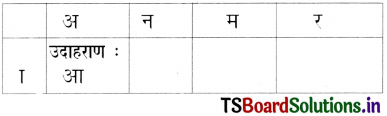
2. न, म, र, अ, आ, ‘ TS 6th Class Hindi Guide 1st Lesson आम ले लो आम! 16 ‘ से शब्द लिखिए।

TS 6th Class Hindi Guide 1st Lesson आम ले लो आम! 17
उत्तर :

  1. नर
  2. मर
  3. मन
  4. नाम
  5. गाम
  6. अनाग
  7. आम
  8. ग्मा
  9. मार
  10. आलू

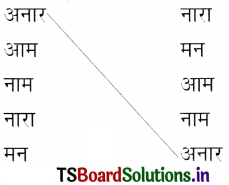
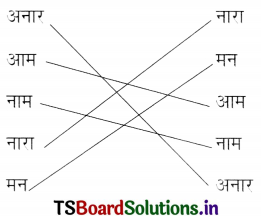
3. समान शब्दों की जोडी बनाओ।

TS 6th Class Hindi Guide 1st Lesson आम ले लो आम! 18
उत्तर :
TS 6th Class Hindi Guide 1st Lesson आम ले लो आम! 19

सारांश-సారాంశం :

एक छोटी सी लड़की,
देख रही थी टोकरी।
टोकरी में क्या है ?
अनार हैं या आम ?
दिखने में हैं पीले – पीले,
नाम इसका ……… है।

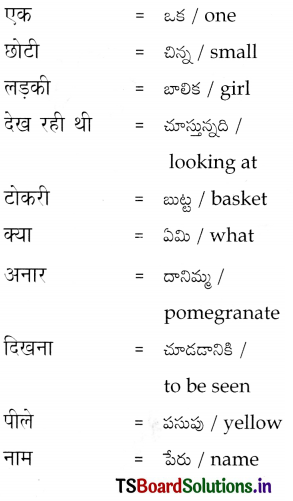
భావం : ఒక చిన్న బాలిక బుట్టకేసి చూచుచున్నది. బుట్టలో ఏమున్నాయి ? దానిమ్మా? లేక మామిడిపండ్లా ? చూడడానికి పసుపు పచ్చగా ఉన్నాయి. వీని పేరు మామిడిపండ్లు.

A girl is looking at the basket. What a e there in the basket ? Pomgranates or mangoes? They look yellow. They are mangoes.

TS 6th Class Hindi Guide 1st Lesson आम ले लो आम!

अर्थ (అర్ధములు) (Meanings) :

TS 6th Class Hindi Guide 1st Lesson आम ले लो आम! 4

TS 6th Class Science Bits 1st Lesson Our Food

Regular practice with TS 6th Class Science Bits with Answers 1st Lesson Our Food improves students’ confidence and readiness for assessments and examinations.

TS 6th Class Science Bits 1st Lesson Our Food

Question 1.
These are common food items in our region as daily menu.
i) rice
ii) dal
iii) vegetables
iv) meat
v) palav
A) i, ii, iv
B) i, ii, iii
C) ii, iii, iv
D) iii, iv, v
Answer:
B) i, ii, iii

TS 6th Class Science Bits 1st Lesson Our Food

Question 2.
The following parts of the plant are widely used in food preparation
A) leaves
B) seeds
C) A and B
D) flowers
Answer:
C) A and B

Question 3.
Example of mineral source ( )
A) peanuts
B) rice
C) wheat
D) salt
Answer:
D) salt

Question 4.
Your mother adds the following ingredients for smell while cooking biryani
A) Dal-Chilli powder
B) Onions – Dal
C) Cloves – Cardamom
D) Salt-Chilli powder
Answer:
C) Cloves – Cardamom

TS 6th Class Science Bits 1st Lesson Our Food

Question 5.
We should daily eat a banana as it is rich in
A) Magnesium
B) Potassium
C) Iron
D) Calcium
Answer:
B) Potassium

Question 6.
Example of dry fruits
A) palmyrah fruit
B) cashew nut
C) apple
D) drumstick
Answer:
B) cashew nut

Question 7.
The part of cabbage used to eat:
A) Leaf
B) Root
C) Flower
D) Plant
Answer:
A) Leaf

Question 8.
Which of the following is not a condiment?
A) Ilaichi
B) Cinnamon
C) Jaggery
D) Cloves
Answer:
C) Jaggery

Question 9.
Cardamom, cloves and pepper are called
A) Condiments
B) Ingredients
C) Dry fruits
D) Minerals
Answer:
A) Condiments

Question 10.
Identify the part of carrot that we eat
A) Stem
B) Root
C) Leaves
D) Flowers
Answer:
B) Root

Question 11.
“Adding salt” is a type of preservation to preserve the
A) Pickles
B) Rice
C) Fruit salad
D) Jam
Answer:
A) Pickles

Question 12.
Edible part of drumstick plant.
A) Roots
B) Stem
C) Seeds & leaves
D) Leaves
Answer:
C) Seeds & leaves

TS 6th Class Science Bits 1st Lesson Our Food

Question 13.
Example of sugandha dravyalu (condiments).
A) Ilaichi
B) Cashew nuts
C) Almonds
D) Kismis
Answer:
A) Ilaichi

Question 14.
Cardamom and cloves are
A) Minerals
B) Spices
C) Pulses
D) Dry fruits
Answer:
B) Spices

Question 15.
The following food items are the common in daily menu in Andhra Pradesh
A) rice
B) dal
C) vegetables
D) above all
Answer:
D) above all

Question 16.
Wheat is produced more than rice in this state.
A) Rajasthan
B) Kerala
C) Andhra Pradesh
D) Kurnool
Answer:
A) Rajasthan

Question 17.
The flower of the following plants can be taken as food
A) Cabbage
B) Cauliflower
C) Cornflour
D) Coriander
Answer:
B) Cauliflower

Question 18.
Beetroots are high in levels
A) Proteins
B) Vitamins
C) Carbohydrates
D) Minerals
Answer:
C) Carbohydrates

Question 19.
The following is obtained from plant
A) Egg
B) Salt
C) Meat
D) Honey
Answer:
D) Honey

TS 6th Class Science Bits 1st Lesson Our Food

Question 20.
We use this as staple food.
A) rice
B) wheat
C) bajra
D) jute
Answer:
A) rice

Question 21.
Methods of preparing food
A) Boiling
B) Steaming
C) Fermentation
D) Above all
Answer:
D) Above all

Question 22.
Tomatoes are an excellent source of vitamin.
A) C
B) A
C) D
D) B
Answer:
A) C

Question 23.
The stem of the plant used as food
A) Carrot
B) Mustard
C) Asafoetida
D) Sugarcane
Answer:
D) Sugarcane

Question 24.
Good example of items which are preserved with sugar
A) jams
B) dal
C) flower
D) roots
Answer:
A) jams

Question 25.
The following preservatives are used to make pickle
A) Salt-water
B) Turmeric – cloves
C) Salt – oil
D) Water – turmeric
Answer:
C) Salt – oil

Question 26.
We need several to cook different types of food.
A) tools
B) ingredients
C) chemicals
D) powders
Answer:
B) ingredients

TS 6th Class Science Bits 1st Lesson Our Food

Question 27.
Making different types of designs and decorations with vegetables
A) Shaping
B) Carving
C) Canning
D) Drying
Answer:
B) Carving

Question 28.
Example of the food materials that are preserved by drying.
A) fish
B) dates
C) grapes
D) all
Answer:
D) all

Question 29.
What are the food products obtained from Hen and Emu?
A) Milk
B) Meat
C) Eggs
D) B & C
Answer:
D) B & C

Question 30.
Dry fruit
A) Almond
B) Dalchini
C) Lavang
D) Pepper
Answer:
A) Almond

TS 6th Class Science Bits 1st Lesson Our Food

Question 31.
One of the following is not used for preparing upma
A) Ravva
B) Taalimpu dinusulu
C) Tomato
D) Rice
Answer:
D) Rice

Question 32.
The taste of food depends on
A) ingredients
B) method of preparation
C) cultural practices of the region
D) above all
Answer:
D) above all

Question 33.
Find out dry fruits from the following
A) Almond, ilaichi, pepper
B) Cashew nuts, kismis, almond
C) Biyani leaves, ilaichi, daichini
D) Almond, ilaichi, cashew nuts
Answer:
B) Cashew nuts, kismis, almond

Question 34.
Read the following statements
a) We use condiments in biryani preparation
b) Condiments are grown in some places only
A) a & b are correct
B) a is correct b is wrong
C) bis correct a is wrong
D) a & b are wrong
Answer:
A) a & b are correct

Question 35.
This animal is not used as meat.
1. Goat, 2. Dog, 3. Sheep, 4. Fish
A) 2
B) 1
C) 3
D) 4
Answer:
A) 2

TS 6th Class Science Bits 1st Lesson Our Food

Question 36.
Match the following
1. Boiling — a) Prawn
2. Roasting — b) Idly
3. Fermentation — c) Eggs
A) 1-a, 2-b, 3-c
B) 1-b, 2-c, 3-a
C) 1-c, 2-a, 3-b
D) 1-c, 2-b, 3-a
Answer:
C) 1-c, 2-a, 3-b

Question 37.
Eatable part in groundnut?
A) Stem
B) Leaves
C) Seeds
D) Leaves & Seeds
Answer:
C) Seeds

Question 38.
If rice is meant for Telugu people what is important for North Indian states?
A) Roti
B) Chapathi
C) A & B
D) Pulav
Answer:
C) A & B

Question 39.
Find out the source of each ingredient. If it is a plant (P) mark. (or) Animal (A) (or) Something else (E).

IngredientP (or) A (or) E
1. Honey
2. Chips
3. Salts

A) 1-P, 2-A, 3-E
B) 1-A & P,2-P, 3-E
C) 1-E, 2-P, 3A
D)1-P, 2-E, 3-A
Answer:
B) 1-A & P,2-P, 3-E

TS 6th Class Science Bits 1st Lesson Our Food

Question 40.
Match the following
1. Fenugreek — a) root
2. Sugarcane — b) leaves & seeds
3. Carrot — c) stem
A) 1-b, 2-c, 3-a
B) 1-a, 2-c, 3-b
C) 1-a, 2-b, 3-c
D) 1-c, 2-b, 3-a
Answer:
A) 1-b, 2-c, 3-a

Question 41.
Read the following statements
a) Potatoes and eggs are cooked by steaming
b) Potatoes and eggs are prepared as curry
A) both ‘a’ and ‘b’ are true
B) ‘a’ is false, ‘b’ is true
C) ‘a’ is true, ‘b’ is false
D) both ‘a’ and ‘b’ are false
Answer:
A) both ‘a’ and ‘b’ are true

Question 42.
One of the following is not a leafy vegetable.
A) Spinach
B) Coriander
C) Cabbage
D) Garlic
Answer:
D) Garlic

Question 43.
What would happen If certain types of foods are not preserved carefully?
A) They will spoil
B) We can’t obtain them all the seasons
C) They will become toxic
D) All the above
Answer:
D) All the above

Question 44.
The following relevant question will be asked by you on ingredients for tomato curry
A) How do we use ingredients for curry?
B) Where shall we grow the tomatoes?
C) Is the curry very tasty?
D) What are the ingredients used for sambar?
Answer:
A) How do we use ingredients for curry?

TS 6th Class Science Bits 1st Lesson Our Food

Question 45.
Find the odd one out.
A) Pepper
B) Ilaichi
C) Cashew
D) Daichini
Answer:
C) Cashew

Question 46.
Find the mis-matched pair

PlantEating part
A) OnionBulb (leaves)
B) CabbageLeaves
C) AsafoetidaRoot
D) CarrotRoot

Answer:
C.

Question 47.
Carrot can be eaten with or without cooking and tomato can be eaten cooking. ( )
A) only after
B) with or without
C) mild
D) steam
Answer:
B) with or without

TS 6th Class Science Bits 1st Lesson Our Food

Question 48.
If you want to eat plant origin food what will you take?
A) tomato
B) brinjal
C) carrot
D) all
Answer:
D) all

Question 49.
If you like jaggery or sugar, through which food item you can take them?
A) Kheer
B) Biryani
C) Veg. soup
D) Above all
Answer:
A) Kheer

Question 50.
Chicken is cooked as
A) fry
B) curry
C) roast
D) all the above
Answer:
D) all the above

Question 51.
What can you prepare from egg?
A) omelette
B) egg fry
C) egg soup and curry
D) all the above
Answer:
D) all the above

Question 52.
For making idly dough is followed by eating.
A) fermented
B) steamed
C) stored
D) cooked
Answer:
Answer:
B) steamed

TS 6th Class Science Bits 1st Lesson Our Food

Question 53.
The following plants are found in Ravi’s kitchen garden.
i) Mustard
ii) Gongoora
iii) Amaranth
iv) Spinach
Find the leafy vegetables:
A) i, ii
B) ii, iii, iv
C) i, iii
D) i, ii
Answer:
B) ii, iii, iv

Question 54.
Find the odd one out.
Based on the required veg and non-veg ingredients.
A) Payasam
B) Dum-biryani
C) Pallikarani
D) Pulihora
Answer:
B) Dum-biryani

Question 55.
Among these which of the following food items is prepared by means of steaming and fermentation.( )
A) Chapathi
B) Idly
C) Upma
D) Puri
Answer:
B) Idly

Question 56.
The food material prepared by fermentation
A) Upma
B) Poori
C) Chips
D) Dosa
Answer:
D) Dosa

Question 57.
If you are given wheat flour what food Items can be prepared by you?
A) Biscuits
B) Chapathi
C) Roti
D) All ( )
Answer:
D) All

Question 58.
What will you use to prepare jam?
A) Sugar syrup
B) Honey
C) A or B
D) Salt
Answer:
C) A or B

TS 6th Class Science Bits 1st Lesson Our Food

Question 59.
Arrange the correct sequence of procedure in the preparation of tomato curry.
1) Clean the vegetables
2) Adding salt
3) Chilli powder and turmeric
4) Pouring oil
5) Chopping vegetables
A) 1, 2, 3, 4, 5
B) 1, 5, 4, 3, 2
C) 5, 4, 3, 2, 1
D) 2, 3, 1, 4, 5
Answer:
B) 1, 5, 4, 3, 2

Question 60.
Generally what method do you follow to cook potato chips and fish?
A) Fry
B) Fermentation
C) Boiling
D) B & C
Answer:
A) Fry

Question 61.
What will you collect from Fenugreek for food preparation?
A) Leaves
B) Seeds
C) A & B
D) Roots
Answer:
C) A & B

Question 62.
One of the following is not a food preparation method?
A) Boiling
B) Steaming
C) Fermentation
D) Drying
Answer:
D) Drying

Question 63.
For making upma what do you use?
A) upma ravva & oil
B) water
C) taalimpu dinusulu
D) all the above
Answer:
D) all the above

Question 64.
Which of the following food material is preserved by drying
A) Pickles
B) Fish
C) Idly
D) Eggs
Answer:
B) Fish

Question 65.
The method used for perparation of idly.
A) Boiling
B) Steaming
C) Roasting
D) Fermentation
Answer:
B) Steaming

Question 66.
Read the table:

Name of the studentFood eaten
KiranRice, dal, milk, vegetables, jam, idly, bread
NeelimaBiryani, chilli chutney, roti

Who eats regular food items?
A) Neelima
B) Kiran
C) Both Kiran and Neelima
D) We cant say
Answer:
B) Kiran

TS 6th Class Science Bits 1st Lesson Our Food

Question 67.
The following ingredients is used for preservation of pickels
A) Sugar
B) Salt
C) Spices
D) Water
Answer:
B) Salt

Question 68.
When do people of Andhra Pradesh eat a larger variety of food?
A) Regularly
B) On special occasions
C) In alternative das
D) A.P. people dislike it
Answer:
B) On special occasions

Question 69.
Some of the following are not famous crops in Rajasthan.
i) bajra
ii) maize
iii) rice
iv) wheat
A) i & ii
B) iv
C) iii
D) ii & iv
Answer:
C) iii

Question 70.
Observe the following table and identify which one of the following set is not correct.

S. No.MaterialsTypes of preservation
iFishSmoking
iiPickleAdding salt
iiiJamAdding sugar
ivMeatSoaking in water

A) i
B) ii
C) iii
D) iv
Answer:
D) iv

Question 71.
In coastal areas the common method for preservation of fish.
A) Smoking
B) Fermentation
C) Hydrogenation
D) Mobilization
Answer:
A) Smoking

Question 72.
Read the following lines. Answer the questions.
When you purchase any food item in the market, don’t forget to read about its ingredients and manufacturing date. What should we observe before purchasing a packed food item in the market?
A) Date of manufacturing and ingredients
B) Type of packet
C) Date of eating
D) A & C
Answer:
A) Date of manufacturing and ingredients

TS 6th Class Science Bits 1st Lesson Our Food

Question 73.
What preservative methods are followed by your mother at home to store different food materials?
A) Drying, Salting, Canning etc.
B) Frying, Cooking, Canning etc.
C) Cooking, Fermenting, Deep frying etc.
D) Salting, Frying, Cooking etc.
Answer:
A) Drying, Salting, Canning etc.

Question 74.
Read the following lines and answer the question.
If you observe carefully you will notice that there are a number of sources from which we get different kinds of food. Table salt is a mineral and obtained from
A) the plants
B) the sea
C) the animals
D) All of these
Answer:
B) the sea

Question 75.
Which of the following is not a root vegetable?

TS 6th Class Science Bits 1st Lesson Our Food 1
Answer:
C.

Question 76.
TS 6th Class Science Bits 1st Lesson Our Food 2
Give an example for animal present in ‘B’
A) Hen
B) Duck
C) Goat
D) Rabbit
Answer:
C) Goat

Question 77.
TS 6th Class Science Bits 1st Lesson Our Food 5Identify the spice given in the diagram.
A) Ilaichi
B) Cashew
C) Almond
D) Clove
Answer:
D) Clove

Question 78.
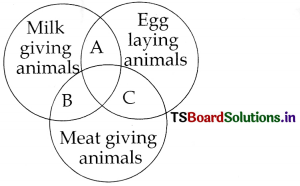
Meat and egg giving animals come under
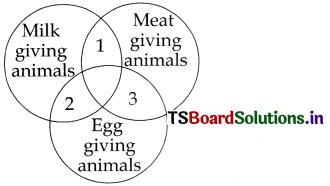
TS 6th Class Science Bits 1st Lesson Our Food 4
A) 1
B) 3
C) 2
D) 1 & 3
Answer:
B) 3

TS 6th Class Science Bits 1st Lesson Our Food

Question 79.
Taste of food is based on its
A) Serving
B) Carving
C) Ingredients
D) Preservation
Answer:
C) Ingredients

Question 80.
Which of the following is not a dry fruit?
A) Cashew
B) Cinnamon
C) Almond
D) Kismis
Answer:
B) Cinnamon

Question 81.
We take food for our
A) Health and energy
B) Body growth
C) Satisfaction
D) A & B
Answer:
D) A & B

Question 82.
What is the common food item that is grown in our area?
A) Wheat
B) Maize
C) Rice / Paddy
D) A & B
Answer:
C) Rice / Paddy

Question 83.
What should we do before eating packaged food item
A) We should see date of manufacturing
B) We should find out date of expiry of food
C) Whether it is government certified food
D) Above all
Answer:
D) Above all

Question 84.
Find out the wrong pair
A) Chapathi – Steaming
B) Fish-Fry
C) Dosa – Fry on pan
D) Chicken – Fry / Curry
Answer:
A) Chapathi – Steaming

Question 85.
The following food material are not to be fermented
A) Dosa flour
B) idli ravva
C) Pun
D) Baking item
Answer:
C) Pun

Question 86.
Why should we check date of manufacturing and ingredients written on the packed food item before purchasing from the market?
A) Out – dated food spoils our health
B) Packet will he sold again
C) It is a good idea to sell everywhere
D) Out-dated food is good for health
Answer:
A) Out – dated food spoils our health

Question 87.
Why do farmers store the rice after it is harvested?
A) To protect from pests
B) To be used whenever they are needed
C) To keep the rice fresh for so long
D) All the above
Answer:
D) All the above

TS 6th Class Science Bits 1st Lesson Our Food

Question 88.
We should make a habit of eating all varieties of vegetable food items. This makes us
A) weak and feeble
B) weak and unhealthy
C) strong and energetic
D) strong and unhealthy
Answer:
C) strong and energetic

Question 89.
The following ones are used for preservation while making pickles.
A) salt and water
B) turmeric powder and ilaichi
C) salt and turmeric powder
D) water and turmeric powder
Answer:
C) salt and turmeric powder

TS 6th Class Science Bits 12th Lesson Simple Electric Circuits

The multiple-choice format of TS 6th Class Science Bits with Answers 12th Lesson Simple Electric Circuits allows students to practice decision-making and selecting the most appropriate answer.

TS 6th Class Science Bits 12th Lesson Simple Electric Circuits

Question 1.
A filament converts
A) heat energy to light energy
B) light energy to heat energy
C) attraction to repulsion
D) None
Answer:
A) heat energy to light energy

TS 6th Class Science Bits 12th Lesson Simple Electric Circuits

Question 2.
The part of the bulb that glows is
A) tube
B) metal rubber
C) fuse
D) filament
Answer:
D) filament

Question 3.
An electric cell is a source of
A) water
B) filament
C) electricity
D) light
Answer:
C) electricity

Question 4.
Electric generator was invented by
A) Edison
B) Godalming
C) Fardav
D) Oersted
Answer:
C) Fardav

Question 5.
A switch in an electric circuit is used to or the circuit.
A) open, close
B) speed up, shows down
C) move up, move down
D) B or C
Answer:
A) open, close

Question 6.
Electricity flows only in a circuit.
A) many
B) open
C) closed
D) double
Answer:
C) closed

Question 7.
Flow of electrons is called
A) electromotive force
C) static electricity
B) current
D) electrolysis
Answer:
B) current

TS 6th Class Science Bits 12th Lesson Simple Electric Circuits

Question 8.
…………. is the source of electricity in a torch light.
A) Solar power
B) Vire
C) Switch
D) Battery
Answer:
D) Battery

Question 9.
A good conductor among the following
A) wax candle
B) iron nail
C) piece of paper
D) pencil lead
Answer:
B) iron nail

Question 10.
An insulator among the following
A) wax candle
B) safety pin
C) iron nail
D) water
Answer:
A) wax candle

Question 11.
The electrical bulb was invented by
A) Marconi
B) Edison
C) Edward
D) Johnson
Answer:
B) Edison

Question 12.
Substances which allow electricity through them are called …………..
A) conductors
B) insulators
C) semi conductors
D) catalysts
Answer:
A) conductors

TS 6th Class Science Bits 12th Lesson Simple Electric Circuits

Question 13.
Substances which do not allow electricity through them are called
A) conductors
B) stoppers
C) insulators
D) rectifiers
Answer:
C) insulators

Question 14.
Thomas Alva Edison used wire as his first filament.
A) tungsten
B) platinum
C) iron
D) aluminium
Answer:
B) platinum

Question 15.
Many times in our houses we observe that though electricity is available some bulbs glow and some don’t glow. What could be the reason for that?
A) Connecting a fused bulb to the circuit.
B) Disconnecting a fused bulb to the circuit.
C) Switch OFF the hoard.
D) Problems in the electricity station.
Answer:
C) Switch OFF the hoard.

Question 16.
The amazing fact about Edison’s invention of electric bulb.
A) He used bamboo filament
B) He used cotton fibre as filament
C) He used tungsten as filament
D) A and B
Answer:
D) A and B

Question 17.
Static electricity was discovered by
A) Gilbert
B) Edison
C) Franklin
D) Thales of Miletus
Answer:
D) Thales of Miletus

TS 6th Class Science Bits 12th Lesson Simple Electric Circuits

Question 18.
Match the following.
1. Metal spring ( ) a) Conductor
2. Plastic ( ) b) Torch light
3. Copper wire ( ) c) Insulator
A) 1 – a, 2 – b, 3 – c
B) 1 – c, 2 – b, 3 – a
C) 1 – b, 2 – c, 3 – a
D)1 – b, 2 – a, 3 – c
Answer:
C) 1 – b, 2 – c, 3 – a

Question 19.
1. The flow of electricity is called current.
2. All the materials are good conductors of electricity.
3. Tungsten filament is used in electric bulb.
Correct sentences from the above
A) 1 & 3 sentences
B) 2 & 3 sentences
C) 1 & 2 sentences
D) All the sentences
Answer:
A) 1 & 3 sentences

Question 20.
The parts that do not belong to torch light.
1. cylindrical barrel
2. bulb
3. switch
4. rod
5. glass cover
6. switch board
7. metal spring
A) 1,2 & 3
B) 3,4,& 5
C) 4,5 & 6
D) 4 & 6
Answer:
D) 4 & 6

Question 21.
Match the following.
1. Live and neutral ( ) a) Insulator
2. Eraser ( ) b) Conductor
3. Safety pin ( ) c) Wire supply
A) 1 – a, 2 – b, 3 – c
B) 1 – c, 2 – a, 3 – b
C) 1 – b, 2 – a,3 – c
D) 1 – b, 2 – c, 3 – a
Answer:
B) 1 – c, 2 – a, 3 – b

Question 22.
One of the parts that do not belong to the electric bulb
1. Terminal cap
2. Switch
3. Metal cap
4. Fuse
5. Filament
6. Glass chamber
A) 1 & 2
B) 2 & 4
C) 5 & 4
D) 3 & 4
Answer:
B) 2 & 4

TS 6th Class Science Bits 12th Lesson Simple Electric Circuits

Question 23.
The difference between modern bulb and the bulb invented by Thomas Alva Edison.
A) Arranging fuse
B) Designing wires
C) Fixing switch board
D) Tungsten filament
Answer:
D) Tungsten filament

Question 24.
Why should we use copper or aluminium wires to make the electric circuit?
A) They are good conductors of electricity
B) They are moderate conductors of electricity
C) They are bad conductors of electricity
D) They are insulators of electricity
Answer:
A) They are good conductors of electricity

Question 25.
If you use eraser in the place of pen cell (small battery) as a source of electricity, the bulb …………
A) will glow
B) will glow with dimlight
C) never glow
D) will glow with bright light
Answer:
C) never glow

Question 26.
Find out the odd one regarding current of flow through the substances
A) piece of chalk
B) paper
C) match stick
D) iron nail
Answer:
D) iron nail

Question 27.
When the circuit is closed it provides
A) incomplete flow of electricity
B) complete open of electricity
C) complete path for electricity
D) irregular path for electricity
Answer:
C) complete path for electricity

TS 6th Class Science Bits 12th Lesson Simple Electric Circuits

Question 28.
Why do we cover the wires with plastic covering?
A) plastic is good conductor of electricity
B) plastic is good insulator
C) plastic doesn’t stop electricity
D) A and B
Answer:
B) plastic is good insulator

Question 29.
Why does the bulb not glow when the safety pin is left free at one end?
A) The circuit is connected
B) The switch is ON
C) The circuit is interconnected
D) The circuit is opened
Answer:
D) The circuit is opened

Question 30.
Find out the wrong sentence
A) Aluminium is a good insulator
B) Copper is a good conductor of electricity
C) Flow of electrons is called current
D) Tungsten is used as filament in bulbs
Answer:
A) Aluminium is a good insulator

Question 31.
Find the odd one out regarding conductors and insulators of electricity
A) Match stick
B) Divider from geometry box
C) Chalk piece
D) Paper
Answer:
B) Divider from geometry box

Reason : Divider from geometry box is a metal.
It works as good conductor of electricity remaining 3 are insulators.

Question 32.
1 – Substances which do not allow electricity through them are called insulators.
2 – All the materials are insulators
A) Both sentences are correct
B) Sentence – 1 is wrong, Sentence – 2 is correct
C) Sentence 1 & 2 are wrong
D) Sentence – 1 is correct, Sentence – 2 is wrong
Answer:
D) Sentence – 1 is correct, Sentence – 2 is wrong

TS 6th Class Science Bits 12th Lesson Simple Electric Circuits

Question 33.
If you want to ask any question about one of the following which one is relevant?
A) What makes the bulb glow?
B) What does a torch consist of?
C) A & B
D) Where do we see torch switches?
Answer:
C) A & B

Question 34.
Guess the reasons for not glowing the bulb in a torch light
1. Fuse in the bulb melted
2. Batteries discharged
3. Wires not working properly
4. Switch is not working properly
A) 1,2
B) 1,2,3
C) 3,2
D) All of the above
Answer:
D) All of the above

Question 35.
You have observed the torch cell. What were the parts observed by you?
1. carbon rod
2. metal cap
3. sealed can
4. chemicals
5. ‘+‘&‘—‘signs
A) 1, 2, 3, & 4 parts
B) 1, 2 & 5 parts
C) 1,2,3,4, & 5 parts
D) 2,4 & 5 parts
Answer:
C) 1,2,3,4, & 5 parts

TS 6th Class Science Bits 12th Lesson Simple Electric Circuits

Question 36.
If you want to make a simple electric circuit what are the materials required?
1 – cell holder
2 – wire
3 – bulb
4-fuse
5-board
A) 1,2 & 3
B) 2,3 & 4
C) 1,2 & 4
D) 1 & 4
Answer:
A) 1,2 & 3

Question 37.
You made an electric switch with the help of following material
A) wooden plank
B) safety pin
C) drawing pins
D) all the above
Answer:
D) all the above

Question 38.
Circuit is connected on a wooden plank as shown in the figure. One end of the safety pin is in contact with ‘B’ and the other end is left free.
TS-6th-Class-Science-Bits-12th-Lesson-Simple-Electric-Circuits-1
A) The bulb will glow
B) The bulb will not glow
C) The bulbs never glows
D) The switch board will glow
Answer:
B) The bulb will not glow

Question 39.

ObjectMaterial nameDoes the bulb glow (Yes/No)
Iron nailPQ
Safety pinMetalYes
Glass bangleGlassNo

What type of material is that iron nail ? Does the bulb glow while connecting with wire, cells and bulb ? Give answers for P and Q
A) P – metal, Q – Yes
B) P – Plastic, Q – Yes
C) P – metal, Q – No
D) P – rubber, Q – Yes
Answer:
A) P – metal, Q – Yes

Question 40.
What are the insulators you see in your school?
A) Eraser
B) Chalk piece
C) Paper
D) All the given
Answer:
D) All the given

TS 6th Class Science Bits 12th Lesson Simple Electric Circuits

Question 41.
If you want to find the material whether it is conductor or insulator what should you do?
A) To keep them in water
B) To keep them in light
C) To allow electric current through them
D) Not to allow electric current through them
Answer:
C) To allow electric current through them

Question 42.
Read the following lines and answer the question.
electric circuit provides a complete path for electricity to flow between cell andi the bulb. What provides flow of current? ( )
A) electric circuit
B) battery
C) bulb
D) wire
Answer:
A) electric circuit

Read the given paragraph. Answer the following questions (43-46)

Thomas Alva Edison began experimenting with different materials while searching for a better choice of filament. He tried cotton thread coated with soot. This filament burned continuously for 45 hours. He tried different kinds of thread. One summer day he saw a man fanning himself with a bamboo fan.

An idea striked his curious mind – “Well, why not try bamboo fiber as a filament?” He executed his idea and amazingly the bamboo filament burned continuously for a number of days. Finally he succeeded in making a cotton filament that was even better than the bamboo one.

Question 43.
What did Edison use as filament in his first experiment?
A) Tungsten
B) Cotton thread
C) Cotton thread with fuse
D) iron nail
Answer:
B) Cotton thread

Question 44.
What was coated on cotton thread used by Alva Edison in order to prepare the filament?
A) soot and oil
B) soot and metal
C) bamboo and soot
D) soot
Answer:
D) soot

Question 45.
How long did the cotton filament burn in the device?
A) For 45 hours
B) For 45 minutes
C) For 45 seconds
D) For 45 days
Answer:
A) For 45 hours

TS 6th Class Science Bits 12th Lesson Simple Electric Circuits

Question 46.
What made Edison to bring a good material for filament instead of using cotton thread?
A) Use of Tungsten by a man
B) Use of Mango leaves by a man
C) Use of Bamboo fan by a man
D) Use of Bamboo hut by a man
Answer:
C) Use of Bamboo fan by a man

Read the given table and answer the questions that follow.

ObjectMaterialDoes the bulb glow
Metal bangle Glass bangle Paper clip Chalk piecemetal
glass
metal
lime stone
Yes
No
Yes
No

Question 47.
What do you say about the given table?
A) All the materials are conductors of electricity.
B) All the materials are insulators of electricity.
C) All the materials are good heaters.
D) Some materials are good conductors and some materials are insulators.
Answer:
D) Some materials are good conductors and some materials are insulators.

Question 48.
What are good conductors of electricity based on the table?
A) metal bangle
B) glass bangle
C) chalk piece
D) paper
Answer:
A) metal bangle

TS 6th Class Science Bits 12th Lesson Simple Electric Circuits

Question 49.
Metal paper clip is a
A) good conductor of electricity
B) insulator
C) bad conductor of electricity
D) good restrictor of electricity
Answer:
A) good conductor of electricity

Read the given paragraph. Answer the questions that follow
Torch consists a hollow cylindrical barrel in which cells are fitted. At one end the lid with screw which can be opened and closed.

Question 50.
Where are the cells fitted in a torch?
A) on the switch board
B) in the hollow cylindrical barrel
C) A & B
D) in front of the barrel
Answer:
B) in the hollow cylindrical barrel

Question 51.
When does the bulb glow?
A) when switch is ON
B) completed the circuit
C) circuit is incompleted
D) A & B
Answer:
D) A & B

Question 52.
Label the part that is indicated with ’?’ mark
TS-6th-Class-Science-Bits-12th-Lesson-Simple-Electric-Circuits-2
A) copper wire
B) iron filament
C) tungsten filament
D) aluminium wire
Answer:
C) tungsten filament

Question 53.
Observe the picture of electric circuit. Does the bulb glow as per the given figure?
TS-6th-Class-Science-Bits-12th-Lesson-Simple-Electric-Circuits-4
A) Yes
B) Cant say
C) Yes or No
D) No
Answer:
D) No

Question 54.
See the picture and observe carefully, the given electric circuit is …………..
TS-6th-Class-Science-Bits-12th-Lesson-Simple-Electric-Circuits-1
A) open
B) closed
C) open or closed
D) switch on
Answer:
A) open

Question 55.
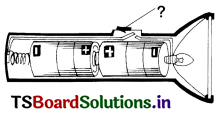
In the given picture of torch light, name the part that indicates with ‘?’ mark.
TS-6th-Class-Science-Bits-12th-Lesson-Simple-Electric-Circuits-5
A) closed circuit
B) open circuit
C) switch
D) cylinder
Answer:
C) switch

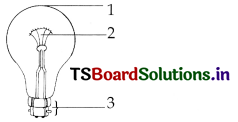
Question 56.
TS-6th-Class-Science-Bits-12th-Lesson-Simple-Electric-Circuits-6
Label the parts of a bulb correctly
A) 1 – Glass chamber
2 – TerminaI
3 – Filament

B) 1 – Glass chamber
2 – Switch
3 – Terminai

C) 1 – Glass chamber
2 – Filament
3 – Terminal

D) 1 – Filament
2 – Glass chamber
3 – Terminal
Answer:
C) 1 – Glass chamber
2 – Filament
3 – Terminal

Question 57.
Which part is working as a switch in the given set up?
TS-6th-Class-Science-Bits-12th-Lesson-Simple-Electric-Circuits-1
A) cell
B) wire
C) safety pin
D) wooden plank
Answer:
C) safety pin

Question 58.
Give the correct option based on the diagram
TS-6th-Class-Science-Bits-12th-Lesson-Simple-Electric-Circuits-9
A) Edison’s first ball
B) Thomas Alva Edison’s first bulb
C) Bulb invented by an Italian
D) Edison’s first balloon
Answer:
B) Thomas Alva Edison’s first bulb

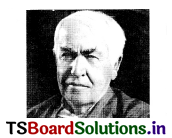
Question 59.
Find the name of the famous personality given in the photo
TS-6th-Class-Science-Bits-12th-Lesson-Simple-Electric-Circuits-11
A) Thomas Alva Edison – Scientist of thousand inventions
B) Robert brown – Scientist of hundred inventions
C) George W shaw – A man of electricity
D) Foraden – A scientist of thousand inventions
Answer:
A) Thomas Alva Edison – Scientist of thousand inventions

Question 60.
Now a days the wires that are used in different colours. Because ………….
A) to give connection between bulb and cell with similar way
B) to give connection between bulb and cell to complete the circuit
C) to give switch off the connection completely
D) to give switch on the connection immediately
Answer:
B) to give connection between bulb and cell to complete the circuit

TS 6th Class Science Bits 12th Lesson Simple Electric Circuits

Question 61.
The inspiration for inventing different types of bulbs by modern scientists
A) Inventions of Thomas Alva Edison
B) Bulb invented by Thomas Alva Edison
C) Radio invented by Edison
D) Wires invented by Michael Faraday
Answer:
B) Bulb invented by Thomas Alva Edison

Question 62.
What was the speciality of Thomas Alva Edison?
A) Inquisitive nature from childhood.
B) Innovative ideas in the middle age
C) Late images at the age of 50
D) Richness of Edison
Answer:
A) Inquisitive nature from childhood.

Question 63.
Use of insulators
A) To protect from fire
B) To protect from electric shock
C) To give electric shock
D) To stop current
Answer:
B) To protect from electric shock

TS Board 6th Class Science Important Questions 3rd Lesson Rain: Where Does it Come From? 

These TS 6th Class Science Important Questions 3rd Lesson Rain: Where Does it Come From? serves as a valuable tool for students to prioritize their studying and revision efforts.

TS 6th Class Science Important Questions 3rd Lesson Rain: Where Does it Come From?

I. Conceptual Understanding :

Question 1.
What are the three forms of the water ?
Answer:
Water on the earth can exist in 3 forms :
Ice (solid form), water (liquid form) and water vapour (gaseous form).

Question 2.
Define the following. Give suitable examples.
1) Evaporation
2) Condensation
(Or)
What is the process in which water changes to water vapour ?
Answer:
1) Evaporation: The process of changing of water into water vapour is called evaporation.
Eg : Cloud formation.

2) Condensation : The process of conversion of water vapour into water is called condensation.
Eg : Formation of rain.

Question 3.
What causes rain on the earth ?
Answer:
The cycle of evaporation and condensation of water, present on the earth’s surface, causes rain.

TS Board 6th Class Science Important Questions 3rd Lesson Rain: Where Does it Come From?

Question 4.
What is water cycle ?
Answer:
The conversion of water into water vapour, water vapour to clouds, clouds to rain is known as water cycle.

Question 5.
Write a few lines about the cause of floods or droughts.
Answer:

  1. Deforestation and pollution from factories are now causing global warming.
  2. So, the atmospheric conditions are not favourable for clouds to get cooled.
  3. Consequently, there is a decrease in the rainfall. This leads to disturbance of water cycle and causes either floods or droughts.

Question 6.
Write the changes that take place in the following blank. Ice water ?
Answer:
Ice \(\rightleftharpoons\) water \(\rightleftharpoons\) ………………?
Ice \(\rightleftharpoons\) water \(\rightleftharpoons\) water vapour.

Question 7.
In our state rains occur normally from June to September. What is the name of this monsoon ?
Answer:

  1. In our state rains occur normally from June to September.
  2. During that season we observe in the sky that clouds move along with the winds blowing from western directions.
  3. These winds are called “south – west monsoon”.

TS Board 6th Class Science Important Questions 3rd Lesson Rain: Where Does it Come From?

Question 8.
Explain north east monsoon and south east monsoon.
(Or)
What is meant by north – east monsoon ? In which season the rain occurs due to north east monsoon ?

  1. Generally, we get rains in some particular months during the year.
  2. In our state, rains occur normally from June to September .
  3. During that season you might have observed in the sky that clouds are moving along with the winds blowing from western direction (south west side).
  4. These winds are called “south west monsoon”.
  5. Similarly, we observe in the months of November and December rains occur due to movements of clouds in the direction of winds blowing from eastern side (north – east side).
  6. These winds are called “north – east monsoon”.

Question 9.
Explain various forms of water with suitable examples.
(Or)
In how many forms water exists on the earth ? How does water convert from one form to another ?
Answer:
Water is available in 3 forms

  1. Solid
  2. Liquid
  3. Gaseous

1. Solid form of water:
Solid form of water is ice. The lowest temperature below 0°C converts water into ice.
Eg : Ice cubes in fridge

2. Liquid form of water:
When ice melts it will change into water, normal temperature converts the ice into liquid. :
Eg : Water in rivers, lakes, oceans

3. Gaseous form of water:
The gaseous form of water is water vapour which is present in the air around us.
Eg: Water vapour releasing from boiling vessel.
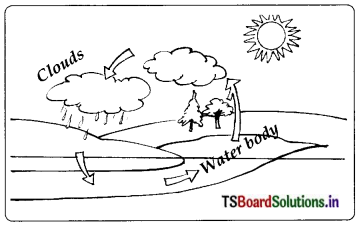
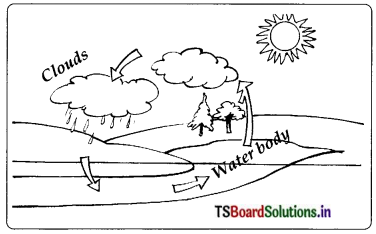
TS Board 6th Class Science Important Questions 3rd Lesson Rain Where Does it Come From 1

Question 10.
Describe the various stages of water cycle ? Explain what changes will occur in water cycle due to deforestation.
Answer:
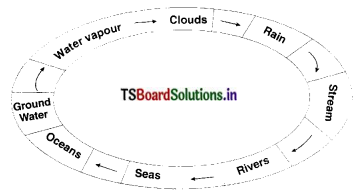
Definition: The circulation of water into water vapour by evaporation, water vapour to clouds and clouds to rain by condensation is known as water cycle.

TS Board 6th Class Science Important Questions 3rd Lesson Rain Where Does it Come From 2

When it rains water bodies are filled with water. Some of this rain water seeps into the ground and becomes ground water. As it is very hot during summer, large quantity of water evaporates from water bodies and converts into water vapour.

This goes up into the air to form clouds. These clouds again cool and produce rain. Deforestation and pollution from factories cause global warming. Therefore atmospheric conditions become unfavourable for cooling of clouds. Consequently there will be decrease in rainfall. This disturbs the water cycle and causes either floods or droughts

TS Board 6th Class Science Important Questions 3rd Lesson Rain: Where Does it Come From?

Question 11.
Suppose you heard that there is raining in some area, but at the same time there may not be raining in other area. Why is it so ? (Conceptual Understanding)
Answer:

  1. Often we see that there may be rain in some area, where it may not be in its adjacent areas.
  2. This is because of condensation of clouds due to cool air which affects them in the specific area.
  3. Occurrence of winds won’t be same in all the areas. Pressure influences the presence of air.
  4. Clouds along with winds move from high pressure area to low pressure area at which cool air occurs.
  5. That’s why rain is seen only in some areas, where we can’t see it in its adjacent areas.

Question 12.
If there is no evaporation and condensation (or) in the nature what would happen. What are the consequences of decrease in rainfall ?
Answer:
Absence of evaporation and condensation in the nature causes lack of rainfall. Consequences that occur due to lack of rains or less rain fall.

  1. Fertile lands become unfit for harvestation.
  2. Water scarcity occurs.
  3. Rain based agriculture will face many problems. As a result, crops and plants will not grow.
  4. Global warming will affect the earth.
  5. Plants will die in every region.

Question 13.
What questions do you ask a meteorologist to know about clouds ?
Answer:

  1. Why are clouds formed only in the sky ?
  2. How are clouds formed ?
  3. Why do we have rains only in some seasons ?
  4. Why don’t we have rains in summer ?

TS Board 6th Class Science Important Questions 3rd Lesson Rain: Where Does it Come From?

Question 14.
In winter mornings we observe small dew drops on grass leaves. What is this process ?
Answer:
Especially during winter water vapour present in the air cools down due to cold weather. Therefore condensation occurs and as a result water vapour appears in the form of dew on the leaves.

Question 15.
Though it is rainy season, we are not getting enough rains. To find out the reason, what questions do you ask your teacher ?
Answer:

  1. Why do not we have sufficient rains ?
  2. What are the reasons for less rains ?
  3. Who are responsible for having less rains ?
  4. What should we do to have good rains ?

Question 16.
What changes are seen if there is no occurrence of condensation in the water cycle ?
(Or)
What happens if evaporated water does not condense ?
Answer:
If there is no occurrence of condensation in the water, water cycle stops due to lack of rains. If there are no rains water sources will not be filled with water. Even ground water level decreases. Low percentage of water levels in the natural water bodies cause damage to the living kingdom, thus it finally leads to destruction of nature. Hence condensation process is very essential in the water cycle.

Question 17.
“Clouds lead to falling of rains.” There are some other concepts like above in the lesson. Find out and write them.
Answer:
Some important concepts :

  1. Three forms of water are interchangeable.
  2. Evaporation is the process of water into water vapour.
  3. Condensation is the process of water vapour into water.
  4. The circulation of water in three forms in the nature is called water cycle.

TS Board 6th Class Science Important Questions 3rd Lesson Rain: Where Does it Come From?

Question 18.
Frame three innovative questions on the following.
(1) Evaporation
(2) Condensation
Answer:

  1. Evaporation:
    • What is the importance of evaporation ?
    • How do we get clouds due to evaporation ?
    • Where do you find evaporation ?
  2. Condensation :
    • Where do we see condensation ?
    • Define condensation.
    • What are the uses of condensation ?
    • What is the relation between rains and condensation ?

Question 19.
What happens if size of the evaporated water molecules increases in the cloud ?
Answer:
If size of the water molecules in the cloud increases, they convert into water droplets and condense to form rains.

III. Experimentation and field Investigation :

Question 20.
Explain the procedure to prove the conversion of water vapour into water.
(OR)
What is condensation ? How do you prove the process by condensation ?
Answer:
Definition : The process of conversion of water vapour into water is called condensation.

Procedure:

  1. A vessel is taken and filled with water.
  2. It is kept on a stove and heated slowly.
  3. It is observed for sometime. Now the vessel is covered with a plate.
  4. The plate is removed after a couple of minutes.

Observation : The water vapour that lied beneath the lower suface of plate converts into water.

Inference : This proves how water vapour condenses into water.

TS Board 6th Class Science Important Questions 3rd Lesson Rain: Where Does it Come From?

Question 21.
Explain the procedure to be followed in the experiment condensation.
(OR)
When we poured cool (water) drink in a glass, we observed water droplets on the outer surface of the glass. Why ?
Answer:

  1. Ice cold water in the glass cools its surface.
  2. Air around the glass contains water vapour which is warmer than the surface of the glass.
  3. Due to the cold glass, air close to its surface will also become cooler.
  4. This changes the water vapour in the air around the surface of the glass into water and forms small drops on the outer surface of glass. It occurs if there is only either ice or cold water.

Question 22.
You feel happy while raining. Ask any two questions to your teacher to clarify your doubts on raining.
Answer:

  1. How do rains fall ?
  2. Why don’t we see rains in all the seasons ?
  3. Rain falling in one place is not seen in other place. Why ?
  4. How does rain start in the sky ?

IV. Information Skills and Projects :

Question 23.
Read the information given below and answer the questions.
We call solid form of water ice. Snow occurs naturally. If we heat ice, it will change into water. Water in liquid form is present in oceans, seas, lakes, rivers and even underground. The gaseous form of water is water vapour which is present in the air around us. We know that when ice is heated, it converts into water and if water is heated it turns into water vapour. Similarly when water vapour is cooled we can get back water. If water is cooled further we get ice.

1. Name few sources of water in liquid form.
Answer:
Oceans, seas, rivers etc.

2. How do you interchange the three states of water ?
Answer:
Solid form of water (ice) is heated to convert into liquid state. Liquid form of water is further heated to convert into water vapour. Ice <— Water <— Water vapour

3. Name the process which converts water into water vapour.
Answer:
Evaporation

4. Where do you find solid ice in nature ?
Answer:
Polar regions and glaciers

TS Board 6th Class Science Important Questions 3rd Lesson Rain: Where Does it Come From?

Question 24.
Visit your school library or internet, collect information about (Kashmir) Dal Lake. In which season water in the lake becomes ice and snow fall is very high and why the place attracts more tourists ?
Answer:

  • Project Work on Dal Lake
    1. Dal Lake is the beautiful, naturally formed resource in the Kashmir valley.
    2. To obtain information about it, I collected necessary points by visiting internet.
    3. Dal Lake premises are the famous tourism hub for so many visitors all over the world.
    4. During winter (between December and February) Dal Lake freezes due to freezing atmosphere with minus
  • degree Celsius.
    1. It forms like solidified ice snow area due to freezing conditions.
    2. It looks like a playground during freezing winter season.
    3. During summer, it shows beauty of the nature of Kashmir in the name of

V. Communication through Drawing and Model Making :

Question 25.
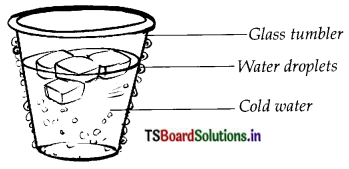
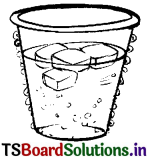
In the given diagram you can observe droplets of water on the surface of ice containing glass.
TS Board 6th Class Science Important Questions 3rd Lesson Rain Where Does it Come From 3

1) Why are those drops formed ?
2) Do they form if there is no ice in the glass ?
Answer:

  1. Ice cold water in the glass cools its surface.
  2. Air around the glass contains water vapour which is warmer than the surface of the glass.
  3. Due to the cold glass, air close to its surface will also become cooler.
  4. This changes the water vapour in the air around the surface of the glass into water and forms small drops on the outer surface of glass. It will occur if there is only either ice or cold water. Draw the diagram of showing water cycle on the earth and label it.

Question 26.
Draw the diagram of showing water cycle on the earth and label it.
Answer:
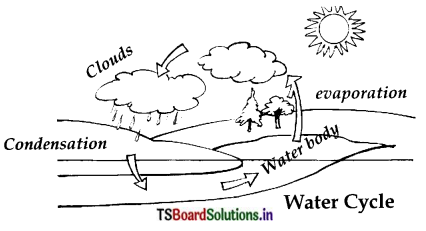
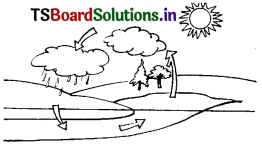
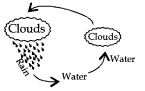
TS Board 6th Class Science Important Questions 3rd Lesson Rain Where Does it Come From 4

Question 27.
Draw the diagram of water cycle and write a note on it.
TS Board 6th Class Science Important Questions 3rd Lesson Rain Where Does it Come From 5
Answer:
Definition : The circulation of water into water vapour by evaporation, water vapour to clouds and clouds to rain by condensation is known as water cycle.
TS Board 6th Class Science Important Questions 3rd Lesson Rain Where Does it Come From 6
When it rains water bodies are filled with water. Some of this rain water seeps into the ground and becomes ground water. As it is very hot during summer, large quantity of water evaporates from water bodies and converts into water vapour. This goes up into the air to form clouds. These clouds again cool and produce rain.

VI. Aesthetic Sence. Values and Application to Daily Life and Concern to Bio-diversity:

Question 28.
Harsha appreciated that the nature is a great gift of giving rain. How can you appreciate it ?
Answer:
Nature is the great gift of giving rain.

  1. Hills stop the clouds and cool them and give sufficient rains.
  2. Forests in the nature stop the clouds and convert them into rains.
  3. The entire nature is like heaven to sustain our life by giving rains seasonally. Therefore we should protect this precious environment.

TS Board 6th Class Science Important Questions 3rd Lesson Rain: Where Does it Come From?

Question 29.
How do you appreciate the contribution of water cycle in making the water available for various needs of plants and animals ?
Answer:

  1. When it rains ponds, lakes etc., are filled with water.
  2. Water from rainfall runs down as small streams.
  3. These small streams join together and make bigger streams. These bigger streams join the rivers.
  4. The rivers flow down to seas and oceAnswer:Some of this rain water seeps into the ground and becomes ground water.
  5. The plants and animals depend on water bodies such as ponds filled with rain water.
  6. The water bodies are ponds, lakes, streams, rivers, seas and oceans.
  7. All the living things sustain their life by utilizing water resources.

TS Board 6th Class Science Important Questions 2nd Lesson Playing with Magnets

These TS 6th Class Science Important Questions 2nd Lesson Playing with Magnets serves as a valuable tool for students to prioritize their studying and revision efforts.

TS 6th Class Science Important Questions 2nd Lesson Playing with Magnets

I. Conceptual Understanding :

Question 1.
What is a magnet ?
Answer:
The substance which holds or attracts other substance naturally is called a magnet.

Question 2.
Give two examples of magnetic material.
Answer:
Iron, cobalt, magnetite etc.

TS Board 6th Class Science Important Questions 2nd Lesson Playing with Magnets

Question 3.
Explain the discovery of the story of the magnet.
Answer:

  1. Around 2500 years ago, a shephered named Magnus used to take his sheep in the hills for grazing.
  2. He used to carry an iron cap stick to control the sheep.
  3. One day, on the way towards the stream at the site of grazing, he felt that his iron cap stick was stuck to the bottom of the water.
  4. He found the stone that stuck his stick. It is called lode stone.
  5. It is a natural magnet and possesses the property of attracting iron. Since then the stone is called “Magnet”.

Question 4.
What are magnetic materials and non – magnetic materials ? Give ex¬amples.
Answer:

  1. The materials that are attracted by magnets are called magnetic materials. Eg : Iron, cobalt, magentite etc.
  2. The materials that are not attracted by magnets are called non – magnetic materials.
    Eg : Plastic, paper, cloth etc.

Question 5.
What is meant by the directional property of the magnet ?
(or)
What directions does a freely suspended bar magnet show ?
Answer:
Magnet always comes to rest in the North – South direction. One end of the magnet which points towards north is called north pole. The other end of the magnet which points towards the south is called south pole. This is the directional property of magnet.

Question 6.
Describe the structure (construction) of magnetic compass ? Write its uses.
Answer:

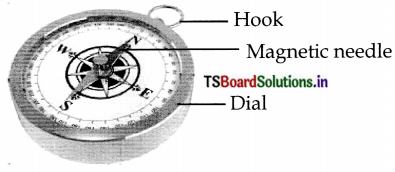
  1. A compass is usually a small box with a glass covering on it.
  2. A magnetised needle is pivoted inside the box in such a way that it can rotate freely.
  3. The compass also has a dial with directions marked on it.
  4. The needle in the compass indicates the North-South direction when it comes to rest.
  5. Both ends of the needle are painted in different colours to specify the North-South directions.

Uses:

  1. A compass is used to find directions.
  2. It is mostly used in ships and aeroplanes.
  3. Mountaineers and army people also carry a compass with them to avoid confusion over unknown area.

TS Board 6th Class Science Important Questions 2nd Lesson Playing with Magnets

Question 7.
Observe the following table. Write which are magnetic or non – magnetic materials in the relevant column.
Answer:
Plastic, iron, wood, gold.

MaterialMagnetic/non -magnetic
PlasticNon – magnetic
IronMagnetic
WoodNon – magnetic
GoldNon – magnetic

Question 8.
Which instrument is used to find the directions ?:
Answer:
Bar magnet.

Question 9.
What is magnetic induction ?
Answer:
Magnetic property possessed by a magnetic substance due to the presence of a magnet near to it, is called magnetic induction.

TS Board 6th Class Science Important Questions 2nd Lesson Playing with Magnets

Question 10.
What do the letters denote in magnetic compass ?
Answer:
The letter N that is indicated at one end of the compass shows north pole. The letter that is indicated at another end shows south pole.

II. Asking Questions and Making Hypothesis :

Question 11.
Find out the following material attracted by magnets or not.
(a) nail,
(b) knife,
(c) steel,
(d) blade,
(e) pen

Name of the objectMaterial of which the object is madeAttracted by magnet yes / no
jump clipironyes

Answer:
The above given material is tested with the magnet and the results are taken as follows.

Name of the objectMaterial of which the object is madeAttracted by magnet yes / no
1) nailironyes
2) knifesteelno
3) steelsteelno
4) bladeironyes
5) penplasticno

Question 12.
Prepare three analytical questions on
(1) Magnetic induction
(2) Magnetic property
Answer:

  1. Magnetic induction :
    • What is magnetic induction ?
    • How can we use magnetic induction in our daily life?
    • Conduct an experiment on magnetic induction.
  2. Magnetic property:
    • Define magnetic property.
    • Can we find out magnetic property in the bar magnet?
    • Write the nature of magnetic property.

TS Board 6th Class Science Important Questions 2nd Lesson Playing with Magnets

Question 13.
What questions will you ask your teacher about uses of magnet ?
Answer:

  1. How are magnets useful ?
  2. Where do we use magnets ?
  3. Which places are suitable to use magnets ?

Question 14.
What would happen if magnets do not have poles ?
Answer:

  1. If magnets do not have poles it will be impossible to find the North – South directions of the earth.
  2. We cannot magnetise any magnetic material properly.

Question 15.
What are the problems to be seen if there are no magnets ?
Answer:
The following problems arise due to absence of magnets :

  1. We cannot construct a compass.
  2. Cranes and lifts cannot gain extra strength for working properly.
  3. It will be impossible to frame automatic closing doors.
  4. It will be difficult to find the North – South directions of the earth.
  5. We cannot see magnetic dependent toys.

Question 16.
To know about magnets in detail what questions will you ask ?
Answer:

  1. Where do we see natural magnets ?
  2. Why do only some substances show magnetic property ?
  3. What is the importance of magnetic substances ?
  4. Can’t we create magnetism in all the substances ?
  5. What are the uses of magnets ?

III. Experimentation and Field Investigation :

Question 17.
How can you separate iron filings from soil ?
Answer:
Aim : To separate iron filings from soil.

Procedure : A bar magnet is rolled in the soil in the school ground for some time. Then it is pulled out.

Observation : It is observed that the dark particles of soil are sticking to the magnet.

Result: The dark particles are collected in a sheet of paper. They are called iron filings.

TS Board 6th Class Science Important Questions 2nd Lesson Playing with Magnets

Question 18.
If an iron piece is given to you, how do you make it as a magnet ?
(Or) :
How can you make your own magnet with simple material ?
(Or)
What are the cheapest and simple material to prepare a magnet ? Write the procedure of making it.
(Or)
Explain the experiment, method and observations of magnetic force/ inspiration.

Write an hypothesis when the edge of a nail is rubbed with the pole of bar magnet.
Answer:
Aim: To make a magnet with simple material.

Required material: Iron nail, bar magnet, table etc.

Procedure:

  1. Iron nail is taken and kept on a table.
  2. A bar magnet is taken and one of its poles is placed near one edge of the nail.
  3. Without lifting the bar magnet it is moved along the length of the iron nail till it reached the other end.
  4. Then the bar magnet is lifted and brought to the first end of the nail. It is moved along the length again.
  5. Magnet is taken among some iron filings or alpins and brought close to the nail

Observation: The iron filings or alpins get attracted by the nail.

Result: Thus making own magnet is a success by using nail.

Question 19.
How can you conclude that every bar magnet has two ends, (or) Explain the procedure and observations in the experiment knowing magnetic poles position.
Answer:
Aim : To conclude that every bar has two ends.

Apparatus : Sheet of paper, iron filings, bar magnet.

Procedure : Certain amount of iron filings are placed on the white paper. A bar magnet is placed below the sheet.

Observation : It is observed that the uniformly spread iron filings tried to concentrate at two points of the paper sheet at some distance. We found some scattered iron filings between these two points whereas the iron filings are mostly concentrated on the two ends of the magnet.

Inference: The ends of the bar magnet attract more iron filings than the middle part of the magnet.

TS Board 6th Class Science Important Questions 2nd Lesson Playing with Magnets

Question 20.
Find out the directions with a bar magnet, (or) Explain the experiment to know the directions with the help of bar magnet with the precautions.
Answer:

  1. A bar magnet is suspended freely with the help of a thread tied around its centre.
  2. It is noticed that the magnet finally takes a position in the North – South direction.
  3. Mark the end that points towards the North with same colour. Precautions : We should see that the magnet should be suspended with the help of a thread.

Question 21.
What is the magentic induction ? Describe a simple experiment to show magnetic induction, (or) Explain magnetic induction.
Answer:
Magnetic property possessed by a magnetic substance due to the presence of a magnet near it, is called magnetic induction. Experiment to show magnetic induction :

  1. One safety pin is taken and brought close to one pole of a bar magnet.
  2. It is observed that the safety pin gets attached to the magnet.
  3. Then an alpin is brought close to the magnet.
  4. It is observed that an alpin gets attached to safety pin.
  5. We noticed that the safety pin acts as a magnet. Magnetic property is induced in safety pin due to the bar magnet.

V. Communication through Drawing and Model Making :

Question 22.
Which property of magnet is explained by this diagram ?
TS Board 6th Class Science Important Questions 2nd Lesson Playing with Magnets 1
Answer:
First picture shows unlike poles of two bar magnets attract each other. Second picture shows like poles of two bar magnets repel each other.

TS Board 6th Class Science Important Questions 2nd Lesson Playing with Magnets

Question 23.
Draw diagrams of
(a) Bar magnet
(b) Ring magnet
(c) Horse shoe magnet,
(d) Disc magnet (or) Draw and name four different types of magnets.
Answer:
TS Board 6th Class Science Important Questions 2nd Lesson Playing with Magnets 2

Question 24.
Observe the following diagram. What do you find from this ?
Answer:

  1. Freely suspended magnet always shows north and south poles.
  2. One end of the bar magnet shows north pole. The other end of the magnet shows south pole.
  3. This property of magnet is called directional property.

TS Board 6th Class Science Important Questions 2nd Lesson Playing with Magnets 3

Question 25.
Draw a neat labelled diagram of a magnetic compass.
Answer:
TS Board 6th Class Science Important Questions 2nd Lesson Playing with Magnets 4

Question 26.
Draw a neat labelled diagram showing the earth magnetism by labelling North – South directions.
Answer:
TS Board 6th Class Science Important Questions 2nd Lesson Playing with Magnets 5

TS 6th Class Science Bits 2nd Lesson Playing with Magnets

Regular practice with TS 6th Class Science Bits with Answers 2nd Lesson Playing with Magnets improves students’ confidence and readiness for assessments and examinations.

TS 6th Class Science Bits 2nd Lesson Playing with Magnets

Question 1.
The story of magnet was told by
A) Magnus
B) Hippocrates
C) Aristotle
D) Magenta
Answer:
A) Magnus

Question 2.
Magnusisa
A) Business man
B) Teacher
C) Shepherd
D) Book seller
Answer:
C) Shepherd

TS 6th Class Science Bits 2nd Lesson Playing with Magnets

Question 3.
Example of non-magnetic substance
A) pins
B) eraser
C) nails
D) jump-clips
Answer:
B) eraser

Question 4.
Natural magnet
A) Ring magnet
B) Lode stone
C) Disc magnet
D) Horse shoe magnet
Answer:
B) Lode stone

Question 5.
The strongest magnet currently known:
A) Samarium
B) Neodyminum
C) Ceramium
D) Aluminium
Answer:
B) Neodyminum

Question 6.
The materials that are attracted by magnets are called material
A) magnetic
B) non-magnetic
C) ferro – magnetic
D) water magnetic
Answer:
C) ferro – magnetic

TS 6th Class Science Bits 2nd Lesson Playing with Magnets

Question 7.
Identify magnetic substances
1. nail
2. aluminium
3. door locks
4. bolt
A) 1 & 2
B) 2 & 3
C) 1,2,3 & 4
D) 3 & 4
Answer:
C) 1,2,3 & 4

Question 8.
Magnet has poles.
A) 4
B) 1
C) 0
D) 2
Answer:
D) 2

Question 9.
A freely suspended magnet rests in
(Or)
The sides which show the free-state magnetic bar
A) East-West
B) West – South
C) East – North
D) North-South
Answer:
D) North-South

Question 10.
A magnet exhibits property.
A) directional
B) addition
C) rectilinear
D) All the above
Answer:
A) directional

TS 6th Class Science Bits 2nd Lesson Playing with Magnets

Question 11.
Read the following paragraph.
Magnets always come to rest in the North-South direction. In each case, the marked end points towards North.This end is known as North pole of the magnet.The other end which points towards the south is known as south pole of the magnet. This property of magnets is called ‘directional property’. It is exhibited only by magents. We use this property to make the ‘magnetic compass’. According to above information on the basis of directional property principle is made.
A) Index
B) Map
C) Magnetic compass
D) Globe
Answer:
C) Magnetic compass

Question 12.
We find more attractive force in the magnet at
A) whole magnet
B) upside
C) poles
D) in the middle
Answer:
C) poles

Question 13.
If an object is attracted by both the poles of a bar magnet and not repelled by any pole then you can say
A) that is a magnet and a magnetic substance
B) that is a magnet but not a magnetic substance
C) that is not a magnet, hut a magnetic substance
D) that is not a magnet, but not a magnetic substance
Answer:
C) that is not a magnet, hut a magnetic substance

Question 14.
A compass is used to find
A) height
B) length
C) direction
D) none of these
Answer:
C) direction

TS 6th Class Science Bits 2nd Lesson Playing with Magnets

Question 15.
Like poles of magnet
A) attract
B) repel
C) not attract
D) none of the above
Answer:
B) repel

Question 16.
Magnets unlike poles
A) attract
B) repel
C) not attract
D) not repel
Answer:
A) attract

Question 17.
The earth possesses magnetic property which acts upon the
A) Round magnet
B) ‘U’ shaped magnet
C) Cylindrical magnet
D) Bar magnet
Answer:
D) Bar magnet

Question 18.
The magnetic property of the earth is called force.
A) Mechanical
B) Gravitational
C) Electrical
D) Frictional
Answer:
B) Gravitational

Question 19.
A freely suspended bar magnet shows and directions.
A) South, East
B) North, South
C) East, West
D) North, East
Answer:
B) North, South

Question 20.
Read the given statements
a) A bar magnet has two poles.
b) Bar magnet always shows North-West directions.
A) Both a and b statement are true
B) a is true b is false
C) Both a and b are false
D) a is false b is true
Answer:
B) a is true b is false

Question 21.
Match the following.
i) Compass — a. Magnetic material
ii) Plastic — b. Non – magnetic material
iii) Iron nail — c. Magnetic directional property
A) i-a, ii-b, iii-c
B) i-b, ii-c, iii-a
C) i-a, ii-c, iii-b
D) i-c, ii-b, iii-a
Answer:
D) i-c, ii-b, iii-a

TS 6th Class Science Bits 2nd Lesson Playing with Magnets

Question 22.
Guess what happens, when the bar magnet is cut Into 4 pieces
A) Each piece is like a complete magnet
B) Some pieces show only north pole
C) Some pieces show only south pole
D) All pieces lose magnetic property
Answer:
A) Each piece is like a complete magnet

Question 23.
Observe the following statements and choose the right choice
a) Like poles repel
b) Unlike poles attract
A) a and b correct
B) a wrong and b correct
C) a correct and b wrong
D) a and b wrong
Answer:
A) a and b correct

Question 24.
If earth loses Its capacity of magnetism the consequence will be ()
A) losing atmosphere
B) gaining power
C) generating energy
D) losing gravitational force
Answer:
D) losing gravitational force

Question 25.
Magnetic property possessed by a non-magnetic substance due to the presence of a magnet is called
A) Magnetic industry
B) Magnetic approach
C) Magnetic induction
D) Magnetic test
Answer:
C) Magnetic induction

Question 26.
Which of the following sentences is correct?
A) Like poles of magnet are attractive
B) Like poles of magnet are repulsive
C) Unlike poles of magnet are repulsive
D) Unlike poles of magnet do not show any reaction
Answer:
B) Like poles of magnet are repulsive

TS 6th Class Science Bits 2nd Lesson Playing with Magnets

Question 27.
The property to identify the magnet is
A) Attraction
B) Repulsion
C) Attraction – repulsion
D) None
Answer:
C) Attraction – repulsion

Question 28.
Find the odd one out regarding magnetic material.
A) Iron rod
B) Cobalt
C) Rubber
D) Lode stone
Answer:
C) Rubber

Question 29.
One of the following is not magnetic meterial.
A) Paper
B) Wood
C) Cement stone
D) Lode stone
Answer:
D) Lode stone

Question 30.
Find the odd one out regarding magnetic substances.
A) Plastic
B) Paper
C) Wood
D) Iron
Answer:
D) Iron

Question 31.
What question will you pose on earth’s magentic directional property?
A) How does earth show magnetic directional property?
B) Where are bar magnets on the earth?
C) How do we know north and south directions of earth?
D) How many directions are there?
Answer:
A) How does earth show magnetic directional property?

Question 32.
You have made own magnetic compass. In order to make the cork float on water surface, what is added to the water?
A) sand
B) nails
C) a little amount of detergent
D) oil
Answer:
C) a little amount of detergent

Question 33.
Precaution to be taken while magnetising a needle
A) magnet is moved in any direction
B) magnet is moved in one direction
C) magnet is unmoved
D) magnet is moved in both direction
Answer:
B) magnet is moved in one direction

Question 34.
What materials do you use for showing magnetic induction?
A) alpin
B) safety pin
C) bar magnet
D) All
Answer:
D) All

TS 6th Class Science Bits 2nd Lesson Playing with Magnets

Question 35.
What would you do if you want to magnetise the nail? Pick up correct precaution.
TS 6th Class Science Bits 2nd Lesson Playing with Magnets 1
A) Move the magnet on the nail roughly
B) Move the magnet on the nail slowly ‘
C) Move the magnet on the nail in one direction
D) Don’t move magnet
Answer:
C) Move the magnet on the nail in one direction

Question 36.
List out the materials used for making a simple magnetic compass
1. Magnetised needle
2. Bar magnet
3. Disc magnet
4. Water
5. Glass
6. Light cork
A) 1,2,3,4
B) 2,3,4,5
C) 1,3,2,5
D) 4,1,5,6
Answer:
D) 4,1,5,6

Question 37.
Find the correct order of procedure while doing the experiment magnetic induction
1. Safety pin is brought close to magnet
2. Safety pin is brought close to alpine
3. Alpine is brought to safety pin
A) 1, 2, 3
B) 3, 2, 1
C) 2, 3, 1
D) 1, 3, 2
Answer:
D) 1, 3, 2

TS 6th Class Science Bits 2nd Lesson Playing with Magnets

Question 38.
Observe the table given below and answer the questions.

ObjectMaterialAttracted by magnet
Jump clipIron?
ScalePlastic?

Net result of the experiment based on the above table.
A) Jump clip – attracted, Scale – attracted
B) Jump clip – not attracted, Scale – not attracted
C) Jump clip – attracted, Scale – not attracted
D) Jump clip – not attracted, Scale – attracted
Answer:
C) Jump clip – attracted, Scale – not attracted

Question 39.
When we forget our route we can find out the direction with the help of
A) Disc magnet
B) Ring magnet
C) Compass
D) Bar magnet
Answer:
C) Compass

Question 40.
What precaution you should take while doing experiment to know magnet’s N-S directions?
A) Two magnets are kept close to each other
B) Suspended magnet is kept close to the one kept on the table
C) Two magnets are kept separately
D) B or C
Answer:
B) Suspended magnet is kept close to the one kept on the table

Question 41.
Earth magnet can be …………. times more powerful than a fridge magnet
A) 20
B) 30
C) 40
D) 50
Answer:
A) 20

Question 42.
Using magnets is seen here
A) Office doors
B) Radio
C) TVs
D) All the above
Answer:
D) All the above

Question 43.
Which of the following are not considered magnetic materials-pen, knife, pen cap, plastic scale, iron nail, iron bar?
A) pen, pen cap, plastic scale
B) pen cap, iron bar
C) iron nail, iron bar, knife
D) plastic scale, iron bar
Answer:
A) pen, pen cap, plastic scale

TS 6th Class Science Bits 2nd Lesson Playing with Magnets

Read the following given lines. Answer the question.
Tan object is attracted by one pole of the bar magnet and repeated by its other pole it is a magnet.

Question 44.
A magnet always
A) Attract
B) Repel
C) A and B
D) Only expel
Answer:
C) A and B

Question 45.
Read the table given below and answer the questions

ObservationObject -1Object – 2Object – 3
Changes observed when one substance is brought close to a magnetattractedrepellednot attracted

Which are considered magnets based on the table given?
A) Object 1&3
B) Object 2&3
C) Object 1&2
D) Object 1,2&3
Answer:
C) Object 1&2

Question 46.
This scientist used lode stone in battles.
A) Archimedis
B) Robert Hooke
C) Miyoshi
D) Faraday
Answer:
A) Archimedis

Question 47.
The picture shows …….. magnet
TS 6th Class Science Bits 2nd Lesson Playing with Magnets 2
A) Horse shoe
B) Round
C) Bar
D) Disc
Answer:
A) Horse shoe

Question 48.
Magnet attracts
TS 6th Class Science Bits 2nd Lesson Playing with Magnets 3
Answer:
D.

Question 49.
Identify the given diagram
TS 6th Class Science Bits 2nd Lesson Playing with Magnets 4
A) Bar magnet
B) Horse shoe magnet
C) Ring magnet
D) Disc magnet
Answer:
A) Bar magnet

Question 50.
Identify the type of magnet in the given diagram
TS 6th Class Science Bits 2nd Lesson Playing with Magnets 5
A) Disc magnet
B) Bar magnet
C) East
D) Ring magnet
Answer:
D) Ring magnet

Question 51.
What is missing in the given diagram?
TS 6th Class Science Bits 2nd Lesson Playing with Magnets 6
A) North pole
B) South pole
C) East pole
D) West pole
Answer:
B) South pole

Question 52.
What is the purpose of the given experiment?
TS 6th Class Science Bits 2nd Lesson Playing with Magnets 7
A) Finding directions with a bar magnet
B) Finding the directional property of earth
C) Constructing magnetic campass
D) Attracting capacity of poles of a bar magnet
Answer:
A) Finding directions with a bar magnet

Question 53.
Identify the given diagram………..
TS 6th Class Science Bits 2nd Lesson Playing with Magnets 8
A) Bar magnet
B) Magnetic compass
C) Wall clock
D) Water clock
Answer:
B) Magnetic compass

Question 54.
In the given diagram the like poles …………….
TS 6th Class Science Bits 2nd Lesson Playing with Magnets 9
A) Attracts
B) Repeles
C) Do not respond
D) None of the above
Answer:
B) Repeles

Question 55.
See the given picture. What does it represent?
TS 6th Class Science Bits 2nd Lesson Playing with Magnets 10
A) Magnetic compass
B) Magnetic induction
C) Magnetic inspiration
D) A or C
Answer:
A) Magnetic compass

TS 6th Class Science Bits 2nd Lesson Playing with Magnets

Question 56.
In the adjacent diagram, missed one. [ ]
TS 6th Class Science Bits 2nd Lesson Playing with Magnets 11
A) South
B) North
C) East
D) West
Answer:
A) South

Question 57.
Identify the north and south poles of the second bar magnet shown in the figure.
TS 6th Class Science Bits 2nd Lesson Playing with Magnets 12
A) N-N
B) S-S
C) N-S
D) S-N
Answer:
C) N-S

Question 58.
The earth is a gigantic electro magnetic because of its
A) minerals
B) water in oceans
C) vegetation
D) current in liquid centre of earth
Answer:
D) current in liquid centre of earth

Question 59.
The given picture tells
TS 6th Class Science Bits 2nd Lesson Playing with Magnets 13
A) Magentic induction of the earth
B) Magnetic directional property of the earth
C) Magentic inspiration of the earth
D) Earth as a non-magnet
Answer:
B) Magnetic directional property of the earth

Question 60.
The given picture shows
TS 6th Class Science Bits 2nd Lesson Playing with Magnets 14
A) Poles of a horseshoe magnet
B) Poles of a ring magnet
C) Poles of a bar magnet
D) Pole of a disc magnet
Answer:
C) Poles of a bar magnet

Question 61.
The given picture of magnet and nail explains
TS 6th Class Science Bits 2nd Lesson Playing with Magnets 15
A) Magnetising the substance
B) Magnetising the air
C) Magnetic induction
D) All the above
Answer:
A) Magnetising the substance

TS 6th Class Science Bits 2nd Lesson Playing with Magnets

Question 62.
The given picture shows….
TS 6th Class Science Bits 2nd Lesson Playing with Magnets 16
A) Magnetism
B) Non magnetism
C) Magnetic induction
D) Non magnetic material
Answer:
C) Magnetic induction

Question 63.
TS 6th Class Science Bits 2nd Lesson Playing with Magnets 17
What will be the poles of 2nd magnet to attract?
TS 6th Class Science Bits 2nd Lesson Playing with Magnets 18
Answer:
B.

Question 64.
Sailors and travellers use this for direction
A) Bar magnet
B) Compass
C) Needle
D) Radio
Answer:
B) Compass

Question 65.
What activity can you do with bar magnet, alpin and saftey pin?
A) Magnetic compass
B) Magnetic property
C) Magnetic direction
D) Magnetic induction
Answer:
D) Magnetic induction

Question 66.
The wondering magnetic object in the universe
A) Ball
B) Moon
C) Earth
D) Air
Answer:
C) Earth

Question 67.
Through usage of magnet for magnetizing substance results in
A) decreasing magnetism
B) increase in magnetism
C) no change in magnetism
D) magnet melts
Answer:
A) decreasing magnetism

TS 6th Class Science Bits 2nd Lesson Playing with Magnets

Question 68.
Because of magnetism we are benefited in the following industries
A) Jewellery purchase
B) Dose and open the doors
C) Radio transmission
D) All the above
Answer:
D) All the above

TS Board 6th Class Science Important Questions 1st Lesson Our Food

These TS 6th Class Science Important Questions 1st Lesson Our Food serves as a valuable tool for students to prioritize their studying and revision efforts.

TS 6th Class Science Important Questions 1st Lesson Our Food

Question 1.
What are lnqrodients?
Answer:
The substances us which are required to prepare food are known as ingredients.

Question 2.
What should we observe when we purchase various packed food items?
Answer:
When we purchase packed food, biscuits or any cold drink we should find their ingredients and manufacturing date written on their packets.

Question 3.
Write any two food items that are preserved in your house by salting.
Answer:
Mango pieces, dry fish etc.

TS Board 6th Class Science Important Questions 1st Lesson Our Food

Question 4.
What are the ingredients necessary for preparation of biryani or kheer?
Answer:

  1. Fresh milk is the main and base ingredient of kheer.
  2. Other ingredients include sugar or jaggery, ilachi, sago and semya.

Question 5.
Write the condiments used by your mother ¡n preparing tasty biryani on holiday?
Answer:
Biryani rice, ilachi, daichini, biryani leaves, pepper, cloves etc. are the ingredients which are used for preparing spicy foods such as biryani, pulav etc.

Question 6.
Name any two food items made by fermentation process.
Answer:
Dosa dough and bakery items like bread, cakes etc.

TS Board 6th Class Science Important Questions 1st Lesson Our Food

Question 7.
What did you eat yesterday ? Make a list and identify the food components present in them.
Answer:
I ate following food items yesterday.

(a) BreakfastFood Components
IdliRice flour, black gram
ChutneyGroundnuts, oil, taalimpu, salt
(b) LunchFood Components
RiceRice
Dal soupDal, oil, taalimpu, green chilly, onion chilly powder, salt
(c) DinnerFood Components
Rice and veg curryTomato, onion, brinjal, oil, chillies, garlic and salt etc

Question 8.
Write about a few tips or the preparation of food items which are prepared in your house.
Answer:

  1. Preparing food is an extremely important art, essential for life.
  2. There are many ways of preparing food.
  3. Rice is boiled but idly along with rice is to be fermented followed by steaming.
  4. Potato chips are fried in oil.

Question 9.
How do farmers protect rice from pests and store it after it is harvested?
Answer:
The farmers store the rice in different storage bins. Before preserving the rice, farmers keep the harvested grains for drying. After complete drying, the rice will be stored in the bins. Various storage bins are widely used in Andhra Pradesh for preserving of rice. Eg : Pun, metallic bins, pucca kotlu, asbestos roof godowns etc.

TS Board 6th Class Science Important Questions 1st Lesson Our Food

Question 10.
Why curry gets spoiled when kept out for a couple of days but pickle stays fresh for so long?
Answer:
Curry gets spoiled when kept out for a couple of days but pickle stays fresh for so long. IFs only because of preservation. For preserving certain food items, they are salted and dried.

Question 11.
What are the food materials preserved by smoking? Find out more about the process of smoking.
Answer:
Fish and meat are the foods usually preserved by smoking method. In this method smoking, heat from the smoke helps in removal of moisture. Exposure to smoke also gives a characteristic flavour of the food.

Question 12.
What is vegetable carving?
Answer:
Preparation of food using vegetables and fruits is an art. Some people make different types of designs and decorations with vegetables. This is called vegetable carving.

Question 13.
Write the methods of storage of food.
Answer:

  1. Drying
  2. Mechanical drying
  3. Saltin
  4. Fuming
  5. Canning etc.

TS Board 6th Class Science Important Questions 1st Lesson Our Food

Question 14.
How is tea prepared ? What are the ingredients to prepare tea?
Answer:
Ingredients needed for preparation of tea: Milk, water, tea powder, sugar etc.

  1. First required amount of water is taken into the vessels.
  2. It is boiled. Then sufficient amount of tea powder is added to boiling water.
  3. It is allowed to boil for a few minutes.
  4. Then milk is added to the boiling decoction. Required amount of sugar is added. Tea is ready.

Question 15.
Some food materials are given below. What are the different possible ways of cooking them ? Write in a tabular form. Meat, Groundnuts, Potatoes, Spinach, Eggs, Fish, Rice, Tomatoes
Answer:

MeatCurry, fry, dum biryani
GroundnutMasala, chutney, pakodi
PotatoesFry, curry, chips
SpinachCurry, fry
EggsFry, curry, omelette
FishCurry, fry etc.
RiceSweets, Rice dosa etc.
TomatoPickle, curry, fry, chutney

Question 16.
Give examples for vegetables and leafy vegetables which are in your surroundings.
Answer:
Vegetables : Bitter gourd, Ridge gourd, Bhendi, Brinjal, Tomatoes, Green chilli etc.

Leafy vegetables: Amaranth, Karivepaku, Mint, Cabbage, Spinach, Palak etc.

TS Board 6th Class Science Important Questions 1st Lesson Our Food

Question 17.
Explain the different methods of food preservation.
(Or)
Write any two types of food preservation methods with suitable examples.
Answer:
Drying : Drying is a method to dry the food material under sunlight. Food material like fish, kishmis etc, are preserved with the help of drying method.

Salting : Food material such as mango, tomato and other vegetable pieces are preserved by adding salt. Required amount of oil is also added to the material.

Canning : Jams, pickles and some fruits are preserved in the cans. Air-tight cans are used in this method.

Mechanical drying: Electrical machine plates are used to dry the flour or wheat, rice and other food products in this mechanical drying.

Question 18.
What are the different food items you eat in your breakfast?
Answer:
Dosa, vada, idli, pun, chapathi, pulihora, kichidi, bajji, punugulu etc.

Question 19.
What questions do you ask your teacher about food preservation methods ?
Answer:

  1. How can we preserve food material ?
  2. Are there any methods to preserve food items ?
  3. What method should we follow to preserve pickles ?
  4. Can we preserve foods like chapathi or rice for some days ?
  5. What are the benefits of preserving foods ?

Question 20.
Cooked curries get spoiled when kept out for a couple of days but pickles stay fresh for a long time. Imagine and write the reasons for this.
Answer:
Cooked food materials are added with more water whereas pickles are added with more salt. The salt in the pickles make them fresh and preserve for a long time. Hence cooked curries get spoiled when kept out for a couple of days.

TS Board 6th Class Science Important Questions 1st Lesson Our Food

Question 21.
Collect the information from any five of your classmates about what food they had taken previous day.

Name of the studentFood eaten
Eg : AshokRice, dal, milk, vegetables, idly

Answer:
I collected the information from 5 of my classmates, about what food they had taken previous day. The tabulated list is given below.

Student NameFood eaten
1. NeelamBiryani, chilli chutney, roti
2. RaviVegetable curry, rice, dosa, soup
3. KiranCurd rice, sambar, idli, chapathi
4. RamuChicken biryani, pakoda, vada
5. SrinuMilk, ice cream, chocolate, vegetable rice

Question 22.
Anil has been asked by his teacher to collect the information of required ingredients for the following food items which he likes. He has to prepare the chart, display it in the class. The favourite food Items are …
(a) payasam
(b) chicken curry
(c) pallikaram rice
(d) dal soup (pappu charu)
(e) Tamarind rice (pulihora). If you were in the place of Anil how would you collect and what can you write for needed food items?
Answer:

Favourite food itemRequired ingredients
1. PayasamSemiya, Sugar, Sago (sabudana) cashew nut, kismis, ilaichi etc.
2. Chicken curryChicken pieces, chilli powder, onions,oil, salt, spices like cloves, ginger, coriander etc.
3. Pallikaram – ricePallis, rice, dry chillies, oil
4. Dal – soup (pappu charu)Dal (Red gram / green gram), oil, water, chillies, onions, jeera, mustard, garlic, chilli powder, tomatoes, tamarind
5. PulihoraRice, Tamarind, oil, dry chillies, green chillies, ground nut, red gram mustard, jeera, green gram etc.

Question 23.
Some ingredients have been listed below. Find out the source of each ingredient, if it is a plant mark (P) or an animal (A), or something else (E).
1. Cooking oil
2. Honey
3. Chips
4. Turmeric powder
5. Salt
6. Dough
7. Mutton
8. Rice
9. Eggs
10. Sugar
11. Peanuts
Answer:

IngredientsP or A or EName of plant or animal
1. HoneyAA Honey bees
2. ChipsPPotato or Banana
3. Turmeric PowderPTurmeric Plant
4. SaltE
5. DoughPWheat
6. MuttonAGoat or sheep
7. RicePPaddy
8. EggsAHen
9. SugarPSugarcane
10. PeanutsPPea plants

TS Board 6th Class Science Important Questions 1st Lesson Our Food

Question 24.
Identify the part of the plant eaten by us in the given products? Discuss with you friends. Tabulate the information.
Answer:

1. FenugreekName of the plantParts that we eat
2. Mustard1. Mustard (Avalu)seeds
3. Sugarcane2. Sugarcane stemstem
4. Carrot3. Carrot rootroot
5. Cabbage4. Onion bulb, leavesbulb, leaves
6. Asafoetida5. Cabbage leavesleaves
7. Onion6. Asafoetida (Inguva)leaves, fruit

Question 25.
Write the procedure for preparing any two food items you like most
(Or)
Write the procedure for making idli/puri/pulihora. Write their ingredients.
Answer:
1. idli:
Ingredients: Black gram, rice flour, salt, water etc.
Procedure:

  1. Black gram is soaked for few hours.
  2. Then it is ground. It is added to rice flour (Uppudu ravva).
  3. The mixture is allowed to ferment for one night. Next day morning the dough is ready for preparing idli.

2. Puri:
Ingredients: Myda flour, oil, potatoes, onion, taalimpu dmusulu, water etc.

Procedure:

  1. Myda flour is mixed with water.
  2. It is mixed thoroughly until it becomes like a ball.
  3. It is divided into small balls and made as round flattened items.
  4. They are fried in boiling oil.
  5. Curry is prepared with potatoes, onion, chillies and oil.

3. Pulihora:
Ingredients : Rice, oil, tamarind/lemon, taalimpu dinusulu, water etc.

Procedure:

  1. Rice is cooked at first and kept aside.
  2. Sufficient juice of tamarind or lemon is prepared.
  3. Taalimpu dinusulu are fried in the oil.
  4. If it is lemon pulihora, lemon juice is added to rice and followed by adding taalimpu dinusulu.
  5. If it is tamarind juice, all taalimpu is added with tamarind.
  6. Then tamarind taalimpu is mixed with rice. Pulihora is ready.

TS Board 6th Class Science Important Questions 1st Lesson Our Food

Question 26.
List out the ingredients that are needed to make vada. Are they same for dosa?
Answer:
Ingredients for vada preparation: Black gram, coriander, green chilli, rice flour, edible oil etc. They are not same for dosa.

Question 27.
What material would you use to preserve pickles?
Answer:
Oil and salt are primarily used. Taalimpu dmusulu are also added to get flavour of the pickle.

Question 28.
Write the names of any two milk and meat giving animals.
Answer:
Goat, sheep etc are both milk giving and meat giving animals.

Question 29.
Read the roiowcng table and answer the given questions

Types of PreservationPreserved Items
Salt, Chilli Powder, OilPickles
Adding SaltMango pieces
DryingFish
Adding Sugar SyrupFruit Juices, Jams


a) Which items do you use for preserving pickles ? Ans. Salt, chilli powder, oil etc.
b) Which items do you preserve at your home by drying ? Ans. Fish, Dates etc.
c) Which items do you use to preserve jams and fruit juices ? Ans. Sugar syrup.
d) What are the other methods to preserve the food items ? Ans. Canning, mechanical drying etc.

Question 30.
Method of preparing food items.
Answer:

Method of PreparationFood Items
FermentationIdly, Dosa
FryingChopped vegetables, Groundnuts, Bengal gram
Deep FryingFish, Chicken
Shallow FryingGreen chillies, Dosa

(a) Which food items are prepared by fermentation process ?
Answer:
Idly, Dosa

(b) How are fish and chicken cooked ?
Answer:
Deep frying

(c) Which process is used to prepare dosa ?
Answer:
Fermentation followed by frying.

(d) Which food items are prepared by steaming process ?
Answer:
Idli

Question 31.
List out the different ingredients that are used to make the items given

Mixture / ItemRequired ingredients
1) TeaMilk, water, sugar, tea powder, ginger etc.
2) Laddu
3) Lemon Juice
4) Payasam

Answer:

Mixture / ItemRequired ingredients
1) TeaMilk, water, sugar, tea powder, ginger etc.
2) LadduJaggery, ghee, dal flour etc
3) Lemon JuiceLemon, water, sugar etc.
4) PayasamMilk, ghee, jaggery, semya ere

Question 32.
List out any 8 methods of preparing food items with suitable examples. Tabulate the information.

Eg : Method of preparing foodFood items
FryingChicken

Answer:

Method of preparing foodFood items
BoilingPotatoes, eggs
SteamingIdlis
FermentationDosa :
RoastingChicken
Deep fryingFish, mutton etc.
Shallow fryingGroundnut, dal
Chopping and mixingVegetables fry
Cutting and mixingVegetable salad or fruit salad

Question 33.
Identify the following vegetables, label them, write the names of the dishes that can be prepared by using them in the kitchen.
TS Board 6th Class Science Important Questions 1st Lesson Our Food 2

The above given vegetables are
(a) Brinjal
(b) Beans and
(c) Potato.

The following food varieties can be prepared from these three.
Answer:
(a) Brinjal : Curry, guthi vankava curry, fry, brinjal pickle (preserved one), roti chutney (grinding chutney)
(b) Beans : Curry, fry, bean pickle
(c) Potatoes : Curry, fry, potato chips, potato kurma etc.

Question 34.
Draw the diagrams of fruits of your interest.
Answer:
TS Board 6th Class Science Important Questions 1st Lesson Our Food 1

Question 35.
Write your feelings about preparation of different shapes in vegetables carving ?
Answer:

  1. Vegetable carving is a skill that shows one’s aesthetic sense and creativity.
  2. If anyone does vegetables carving we can’t keep quiet without appreciating him/her.
  3. The vegetables or fruits that are carved make us to attract towards them ’ to consume.
  4. Carving vegetables or fruits reveal us the importance of growing plants.

Question 36.
What food habits did you learn from the lesson “Our Food” ?
Answer:

  1. Eat only vegetables and healthy food items.
  2. Do not eat junk foods.
  3. Check the date of manufacturing and expiry date of packed food items before eating them.
  4. Eat only protein, energy giving and protective food items.
  5. Drink sufficient water for proper digestion.
  6. Take fibre rich food to avoid constipation.

TS 6th Class Science Bits 3rd Lesson Rain: Where Does it Come From?

Regular practice with TS 6th Class Science Bits with Answers 3rd Lesson Rain: Where Does it Come From? improves students’ confidence and readiness for assessments and examinations.

TS 6th Class Science Bits 3rd Lesson Rain: Where Does it Come From?

Question 1.
Raining season in our state with monsoons is
A) June – September
B) January March
C) November – September
D) March – April
Answer:
A) June – September

TS 6th Class Science Bits 3rd Lesson Rain: Where Does it Come From?

Question 2.
Fill up the blank.
TS 6th Class Science Bits 3rd Lesson Rain Where Does it Come From 1
A) cloud
B) ice
C) fog
D) water
Answer:
D) water

Question 3.
This is the form of water vapour
A) Gaseous
B) Solid
C) Liquid
D) All
Answer:
A) Gaseous

Question 4.
Changing of water into water vapour
A) Condensation
B) Sublimation
C) Evaporation
D) Liquifaction
Answer:
C) Evaporation

TS 6th Class Science Bits 3rd Lesson Rain: Where Does it Come From?

Question 5.
Conversion of water vapour into water is called
A) Condensation
B) Evaporation
C) Sublimation
D) Liquification
Answer:
A) Condensation

Question 6.
The solid form of water
A) gas
B) liquid
C) ice
D) above all
Answer:
C) ice

Question 7.
If water receives more heat it
A) evaporates fast
B) condenses fast
C) solidifies fast
D) none of these
Answer:
A) evaporates fast

Question 8.
Kavitha wants to dry the washed clothes. Where do they immediately get dry?
A) Under the fan
B) In the sunlight
C) In the shade
D) In the dark room
Answer:
B) In the sunlight

Question 9.
Dew formation on grass is due to
A) Evaporation
B) Condensation
C) Melting
D) Solidification
Answer:
B) Condensation

TS 6th Class Science Bits 3rd Lesson Rain: Where Does it Come From?

Question 10.
In winter when Ramu speaks, some smoke like vapour comes out from his mouth. Can you imagine the reason?
A) Condensation
B) Evaporation
C) Decantation
D) Water vapour
Answer:
D) Water vapour

Question 11.
Water → ? → Clouds → Rains. Find out the missing one.
A) Sublimation
B) Condensation
C) Liquification
D) Evaporation
Answer:
D) Evaporation

Question 12.
As we move away from the surface of the earth the air becomes
A) hot
B) cooler
C) ice
D) humid
Answer:
B) cooler

Question 13.
These monsoons occur during June to September.
A) South-West
B) North-West
C) East – North
D) South-North
Answer:
A) South-West

Question 14.
The monsoons occur during November and December
A) South-North
B) East-West
C) North-East
D) West – South
Answer:
C) North-East

Question 15.
The period of South-West monsoons
A) October – January
B) June – September
C) February – May
D) April – July
Answer:
B) June – September

TS 6th Class Science Bits 3rd Lesson Rain: Where Does it Come From?

Question 16.
North-East monsoon occurs in
A) June to September
B) August to October
C) November and December
D) January and February
Answer:
C) November and December

Question 17.
Certain amount of rain water seeps into the ground and becomes
A) Ground water
B) Soil erosion
C) Forestation
D) Deforestation
Answer:
A) Ground water

Question 18.
i) South-West monsoon – November and December
ii) North-East monsoon – June to September
A) Both true
B) Both false
C) j – true
D) j – false 2- true
Answer:
B) Both false

Question 19.
What happens when water is heated in high temperature?
A) Water cycle
B) Evaporation
C) Cloud
D) Solid state
Answer:
B) Evaporation

Question 20.
If rain falls along with pieces of ice, they are called
A) Rain stones
B) Ice rains
C) Flail stones
D) Acid rains
Answer:
C) Flail stones

TS 6th Class Science Bits 3rd Lesson Rain: Where Does it Come From?

Question 21.
What is the example for solid form of water?
A) Water in a pot
B) Water in the clouds
C) Boiling water
D) Ice cubes
Answer:
D) Ice cubes

Question 22.
If we don’t have the process of evaporation
A) We never see rains
B) We can not cook the food
C) We never see the seasons
D) All the above are correct
Answer:
D) All the above are correct

Question 23.
If water vapor = Evaporation then rain =?
A) Sublimation
B) Condensation
C) Solidification
D) Allocation
Answer:
B) Condensation

Question 24.
Find out the odd one
A) Evaporation
B) Condensation
C) Crystallisation
D) Water cycle
Answer:
C) Crystallisation

TS 6th Class Science Bits 3rd Lesson Rain: Where Does it Come From?

Question 25.
Identify the correct pair.
A) Water changing to vapour – Sublimation
B) Water changing to ice – Condensation
C) Water changing to vapour – Evaporation
D) Ice changing into water – Evaporation
Answer:
C) Water changing to vapour – Evaporation

Question 26.
Solid form of water is ice, then gaseous form of water is
A) Cubes
B) Rain
C) Vapour
D) Stones
Answer:
C) Vapour

Question 27.
Water drops on grass plants can be observed in this season:
A) Rain season
B) Summer season
C) Winter season
D) Spring season
Answer:
C) Winter season

Question 28.
Read the passage and answer the questions.
Often big drops of water solidify into ice and fall as pieces of ice known as hailstones. Hail stones are
A) Clouds
B) Ice pieces as rain
C) Clouds fall as rain
D) Cool breeze as rain
Answer:
B) Ice pieces as rain

TS 6th Class Science Bits 3rd Lesson Rain: Where Does it Come From?

Question 29.
Read the given lines and answer the questions.
Water in rivers and lakes evaporates continuously from their surface.This evaporated water is formed as clouds.
Water vapour from rivers and lakes is formed due to heat supply by …
A) Heat geasers
B) Volcanoes
C) Winter cool
D) Sunlight
Answer:
D) Sunlight

Question 30.
TS 6th Class Science Bits 3rd Lesson Rain Where Does it Come From 2The given diagram shows
A) condensation
B) evaporation
C) solidification
D) rains
Answer:
B) evaporation

Question 31.
The given diagram indicates
TS 6th Class Science Bits 3rd Lesson Rain Where Does it Come From 3
A) Vapourisation
B) Solidification
C) Evaporation
D) Condensation
Answer:
D) Condensation

Question 32.
Choose the correct sequence of events that occur in the water cycle based on the given picture.
TS 6th Class Science Bits 3rd Lesson Rain Where Does it Come From 4
A) Evaporation → Condensation → Water
B) Water → Condensation → Evaporation
C) Condensation → Water → Evaporation
D) Water → liquid → Clouds
Answer:
B) Water → Condensation → Evaporation

Question 33.
Water cycle gets disturbed due to the following reason:
A) Global warming
B) Pollution
C) Deforestation
D) All the above
Answer:
D) All the above

Question 34.
What is missing in the water cycle?
TS 6th Class Science Bits 3rd Lesson Rain Where Does it Come From 5
A) Stars
B) Sun
C) Air
D) Moon
Answer:
B) Sun

TS 6th Class Science Bits 3rd Lesson Rain: Where Does it Come From?

Question 35.
Deforestation and pollution from factories cause
A) afforestation
B) condensation
C) globalisation
D) global warming
Answer:
D) global warming

Question 36.
Rama wanted to dry this towel with in a short time. But there is no sun light.What might had he done for fast drying in that situatIon?
A) He dried the towel under fan.
B) He dried under water.
C) He dried under bench.
D) All the above
Answer:
A) He dried the towel under fan.

Question 37.
Acid rain is the combination of
A) Sulphur dioxide and Nitrogen dioxide
B) Carbon dioxide and Carbon monoxide
C) Nitrogen dioxide and Carbon dioxide
D) Sulphur dioxide and Carbon dioxide
Answer:
A) Sulphur dioxide and Nitrogen dioxide

Question 38.
If the rain drops are very small, they are collectively termed
A) drizzle
B) snow
C) monsoon
D) fog
Answer:
A) drizzle

TS 6th Class Science Bits 3rd Lesson Rain: Where Does it Come From?

Question 39.
The speed of rain drops is
B) 2-4 mts/sec
B) 15-20 mts/sec
C) 5 – 10 mts/sec
D) 3-8 mts/sec
Answer:
D) 3-8 mts/sec