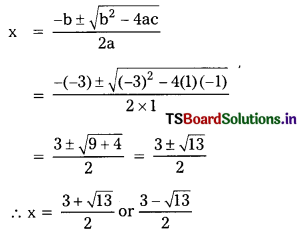
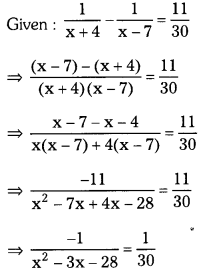
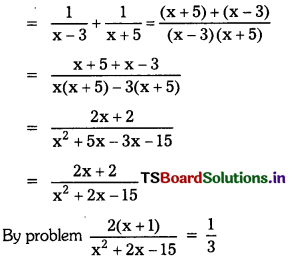
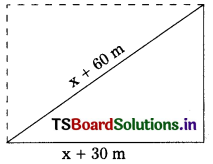
TS 10th Class Maths Solutions Chapter 1 Real Numbers InText Questions

Students can practice TS 10th Class Maths Solutions Chapter 1 Real Numbers InText Questions to get the best methods of solving problems.

TS 10th Class Maths Solutions Chapter 1 Real Numbers InText Questions

Do This

Question 1.
Find ‘q’ and ‘r’ for the following pairs of positive integers ‘a’ and ‘b’, satisfied a = bq + r
i) a = 13, b = 3
Solution:
a = 13, b = 3
a = bq + r
13 = 3(4) + 1 Here q = 4; r = 1
13 = 13

ii) a = 8, b = 80
Solution:
a = 8, b = 80
a = bq + r Here q = \(\frac{1}{10}\) and r = 0
8 = 80\(\left(\frac{1}{10}\right)\) + 0, 8 = 8

TS 10th Class Maths Solutions Chapter 1 Real Numbers InText Questions

iii) a = 125; b = 5
Solution:
a = 125; b = 5
a = bq + r
q = 25, r = 0
125 = 5(25) + 0
125 = 125

iv) a = 132; b = 11
Solution:
a = 132; b = 11
a = bq + r
q = 12, r = 0
132 = 11(12) + 0
132 = 132

Question 2.
Find the HCF of the following by using Euclid division lemma (Page No. 4)
i) 50 and 70
ii) 96 and 72
iii) 300 and 550
iv) 1860 and 2615
Euclid Division Lemma
a = bq + r, q > 0 and 0 ≤ r < b
Solution:
i) 50 and 70 When 70 is divided by 50, the remainder is 20 to get 70 = 50 × 1 + 20
Now consider the division of 50, with the remainder 20 in the above and apply the division lemma to get 50 = 20 × 2 + 10
Now consider the division of 20, with the remainder 10 in apply the division lemma to get 20 = 10 × 2 + 0
The remainder = 0, when we cannot proceed further.
We conclude that the HCF of 50 and 70 is the divisor at this stage, i.e., 10
∴ So, HCF of 50 and 70 is 10.

ii) 96 and 72 When 96 is divided by 72, the remainder is 24 to get 96 = 72 × 1 + 24
Now consider the division of 72, with the remainder 24 in the above and apply the division lemma to get, 72 = 24 x 3 + 0
The remainder = 0, when we cannot proceed further.
We conclude that the HCF of 96 and 72 is the divisor at this stage, i.e., 24 so, the HCF of 96 and 72 is 24

iii) 300 and 550 When 550 is divided by 300, the remainder is 250, to get 550 = 300 × 1 + 250
Now consider the division of 300 with the remainder 250, and apply the division lemma to get 300 = 250 × 1 + 50
Now consider the division of 250 with the remainder 50, and apply the division lemma to get 250 = 50 × 5 + 0. The remainder is zero, when we cannot proceed further. We conclude that the H.C.F of 300 and 550 is the divisor at this stage i.e., 50. So, the H.C.F of 300 and 550 is 50.

iv) 1860 and 2015 When 2015 is divided by 1860, the remainder is 155, to get 2015 = 1860 × 1 + 155
Now consider the division of 1860 with the remainder 155, and apply the division lemma to get 1860 = 155 × 12 + 0
The remainder is zero, then we cannot proceed further.
We conclude that the HCF of 1860 and 2015 is the divisor at this stage i.e., 155 So, the HCF of 1860 and 2015 is 155

TS 10th Class Maths Solutions Chapter 1 Real Numbers InText Questions

Think – Discuss

Question 1.
From the above questions in do this what is the nature of q and r ? (Page No. 3)
Solution:
Given a = bq + r q > 0 and r ≤ 0 r < b r lies between 0 and b

Question 2.
Can you find the HCF of 1.2 and 0.12 ? Justify your answer. (Page No. 4)
Solution:
1.2 = \(\frac{12}{10}\) and 0.12 = \(\frac{12}{100}\)
When \(\frac{12}{10}\) is divided by \(\frac{12}{100}\), then the remainder is 0.
\(\frac{12}{10}\) = \(\frac{12}{100}\) × 10 + 0
∴ yes, we can find the HCF of 1.2 and 0.12 HCF (1.2, 0.12) = 10

Textual Examples

Question 1.
Show that every positive even integer is of the form 2q, and that every positive odd integer is of the form 2q + 1, where q is some integer. (Page No. 5)
Solution:
Let a be any positive integer and b = 2. Then, by Euclid’s algorithm, a = 2q + r, for some integer q ≥ 0, and r = 0 or r = 1, because 0 ≤ r < 2. So, a = 2q or 2q + 1.
If a is of the form 2q, then a is an even integer. Also, a positive integer can be either even or odd. Therefore, any positive odd integer is of the form 2q + 1.

Question 2.
Show that any positive odd integer is of the form 4q + 1 or 4q + 3, where q is some integer. (Page No. 5)
Solution:
Let us start with taking a, where a is a positive odd integer. We apply the division algorithm with a and b = 4. Since 0 ≤ r < 4, the possible remainders are 0, 1, 2 and 3.
That is, a can be 4q, or 4q + 1, or 4q + 2, or 4q + 3, where q is the quotient. However, since a is odd, a cannot be 4q or 4q + 2 (since they are both divisible by 2).
Therefore, any odd integer is of the form 4q + 1 or 4q + 3.

Think – Discuss

Question 1.
If r = 0, then what is the relationship between a, b and q in a = bq + r of Euclid division lemma? (Page No. 6)
Solution:
a = bq + 0 (∵ r = 0) ⇒ a = bq

Do This

Question 1.
Express 2310 as a product of prime factors. Also see how your friends have factorized the number. Have they done it like you ? Verify your final product with your friend’s result. Try this for 3 or 4 more numbers. What do you conclude ?
(Page No. 7)
Solution:
2310 = 2 × 1155
= 2 × 5 × (231)
= 2 × 5 × 3 × 77
= 2 × 5 × 3 × 7 × 11
= 2 × 3 × 5 × 7 × 11
Ramu, Kiran and Mohan are my friends. They factorized the number in the following way :
Ramu : 2310 = 231 × 10
= 3 × 77 × 2 × 5
= 3 × 7 × 11 × 2 × 5
Kiran : 2310 = 3 × 770
= 3 × 10 × 77
= 3 × 10 × 11 × 7
= 3 × 2 × 5 × 11 × 7
Mohan : 2310 = 7 × 330
= 7 × 3 × 110
= 7 × 3 × 11 × 10
= 7 × 3 × 11 × 2 × 5
No, but the prime factors are same.
The final product with your friends result is same.
Conclusion : The order in which the prime factors occur, the composite number is unique.

TS 10th Class Maths Solutions Chapter 1 Real Numbers InText Questions

Question 2.
Find the HCF and LCM of the following given pairs of numbers by prime factorisation.
i) 120, 90
ii) 50, 60
iii) 37, 49 (Page No. 8)
H.C.F. : (Product of smallest power of each common prime factor of the numbers)
L.C.M. : (Product of greatest power of each prime factors of the numbers)
Solution:
i) 120, 90
120 = 2 × 2 × 2 × 3 × 5 = 23 × 31 × 51
90 = 2 × 3 × 3 × 5 = 21 × 32 × 51
HCF (120, 90) = 21 × 31 × 51 = 30
LCM (120, 90) = 23 × 32 × 51 = 360

ii) 50, 60
50 = 2 × 5 × 5 = 21 × 52
60 = 2 × 2 × 3 × 5 = 22 × 31 × 51
HCF (50, 60) = 21 × 51 = 10 (Product of smallest power of each common prime factors of the numbers)
LCM (50, 60) = 22 × 52 × 31 = 300 (Product of greatest power of each prime factors of the numbers)

iii) 37, 49
37 is a prime number and 49 is a composite number, so the HCF(37, 49) is 1 and LCM(37, 49) is 1813.

Textual Examples

Question 1.
Consider the numbers 4n, where n is a natural number. Check whether there is any value of n for which 4n ends with the digit zero. (Page No. 5)
Solution:
For the number 4n to end with digit zero for any natural number n, it should be divisible by 5. This means that the prime factorisation of 4n should contain the prime number 5. But it is not possible because 4n = (2)2n so 2 is the only prime in the factorization of 4n. Since 5 is not present in the prime factorization, so there is no natural number n for which 4n ends with the digit zero.

Question 2.
Find the HCF and LCM of 12 and 18 by the prime factorization method. (Page No. 7)
Solution:
We have 12 = 2 × 2 × 3 = 22 × 31
18 = 2 × 3 × 3 = 21 × 32
Note that HCF (12, 18) = 21 x 31 = 6
HCF : Product of the smallest power of each common prime factors in the numbers.
LCM (12, 18) = 22 × 32 = 36 = Product of the greatest power of each prime factors in the numbers.

Try This

Question 1.
Show that 3n × 4m cannot end with the digit 0 or 5 for any natural numbers ‘n’ and ‘m’. (Page No. 8)
Solution:
Let the number 3n × 4m
= 3n × (22)m
= 3n × 22m
Number 3n × 22m to end with ‘0’ or ‘5’. It should be divisible by 2 and 5. This means that the prime factorization of 3n × 4m should contain prime numbers. But it is not possible because 3n × 4m = 3n × 22m
So 2 or 3 are the only prime factors in its factorization. Since 5 is not present in the prime factorization 3n × 4m can not end with the digits 0 or 5.

Try This

Question 1.
Show that 3n × 4m cannot end with the digit 0 or 5 for any natural numbers ‘n’ and’m’. (Page No. 8)
Solution:
Let the number 3n × 4m = 3n × (22)m
= 3n × 22m
Number 3n × 22m to end with ‘0’ or ‘5’. It should be divisible by 2 and 5. This means that the prime factorization of 3n × 4m should contain prime numbers. But it is not possible because 3n × 4m = 3n × 22m
So 2 or 3 are the only prime factors in its factorization. Since 5 is not present in the prime factorization 3n × 4m can not end with the digits 0 or 5.

Do This

Question 1.
Write the following terminating decimals in the form of \(\frac{\mathbf{p}}{\mathbf{q}}\). q ≠ 0 and p, q are co-primes.
i)15.265
ii) 0.1255
iii) 0.4
iv) 23.34
v) 1215.8
What can you conclude about the denominators through this process? (Page No. 6)
Solution:
i) 15.265 = \(\frac{15265}{10^3}\) = \(\frac{152625}{2^3 \times 5^3}\) = \(\frac{3053}{2^3 \times 5^2}\) = \(\frac{3053}{200}\)

ii) 0.1255 = \(\frac{1255}{10^4}\) = \(\frac{1255}{2^4 \times 5^4}\) = \(\frac{3053}{200}\)

TS 10th Class Maths Solutions Chapter 1 Real Numbers InText Questions

iii) 0.4 = \(\frac{4}{10}\) = \(\frac{2}{5}\)

iv) 23.34 = \(\frac{2334}{10^2}\) = \(\frac{2334}{2^2 \times 5^2}\) = \(\frac{1167}{50}\)

v) 1215.8 = \(\frac{12158}{10}\) = \(\frac{12158}{2 \times 5}\) = \(\frac{6079}{5}\)

We can conclude that the denominator in the problems have only power of 2 or power of 5 or both.

Question 2.
Write the following rational numbers in the form of \(\frac{\mathbf{p}}{\mathbf{q}}\), where q is of the form 2n5m where n, m are non-negative integers and these write the negative Integers and then write the numbers in their decimal form.

i) \(\frac{3}{4}\)
ii) \(\frac{7}{5}\)
iii) \(\frac{51}{64}\)
iv) \(\frac{14}{25}\)
v) \(\frac{80}{100}\)
Solution:
TS 10th Class Maths Solutions Chapter 1 Real Numbers InText Questions 1
TS 10th Class Maths Solutions Chapter 1 Real Numbers InText Questions 2

Question 3.
Write the following rational numbers as decimals and find out the block of digits, repeating ¡n the quotient.
i) \(\frac{1}{3}\)
ii) \(\frac{2}{7}\)
iii) \(\frac{5}{11}\)
iv) \(\frac{10}{13}\) (Page No. 11)
Solution:
i) \(\frac{1}{3}\) = 0.33333 …….
TS 10th Class Maths Solutions Chapter 1 Real Numbers InText Questions 3
The block of digits repeating in the quotient is only 3.

ii) \(\frac{2}{7}\) = 0.285714285714 ……
TS 10th Class Maths Solutions Chapter 1 Real Numbers InText Questions 4
TS 10th Class Maths Solutions Chapter 1 Real Numbers InText Questions 5
The block of digits repeating in the quotient is only 285714.

iii) \(\frac{5}{11}\) = 0.454545…..
TS 10th Class Maths Solutions Chapter 1 Real Numbers InText Questions 6
The block of digits repeating in the quotient is only 45.

TS 10th Class Maths Solutions Chapter 1 Real Numbers InText Questions

iv) \(\frac{10}{13}\) = 0.769230769230 …..
TS 10th Class Maths Solutions Chapter 1 Real Numbers InText Questions 7
TS 10th Class Maths Solutions Chapter 1 Real Numbers InText Questions 8
The block of digits repeating in the quotient is only 769230.

Textual Examples

Question 1.
Using the above theorems, without actual division, state whether the following rational numbers are terminating or non-terminating, repeating decimals.
i) \(\frac{16}{125}\)
ii) \(\frac{25}{32}\)
iii) \(\frac{100}{81}\)
iv) \(\frac{41}{75}\)
Solution:
\(\frac{16}{125}\) = \(\frac{16}{555}\) = \(\frac{16}{5^3}\)
is terminating decimal.

ii) \(\frac{25}{32}\) = \(\frac{25}{2 \times 2 \times 2 \times 2 \times 2}\) = \(\frac{25}{2^5}\)
is terminating decimal.

iii) \(\frac{100}{81}\) = \(\frac{100}{3 \times 3 \times 3 \times 3}\) = \(\frac{10}{3^4}\)
is non-terminating, repeating decimal.

iv) \(\frac{41}{75}\) = \(\frac{41}{3 \times 5 \times 5}\) = \(\frac{41}{3 \times 5^2}\)
is non-terminating, repeating decimal.

Question 2.
Write the decimal expansion of the following rational numbers without actual division.
i) \(\frac{35}{40}\)
ii) \(\frac{21}{25}\)
iii) \(\frac{7}{8}\)
Solution:
TS 10th Class Maths Solutions Chapter 1 Real Numbers InText Questions 9
TS 10th Class Maths Solutions Chapter 1 Real Numbers InText Questions 10

Do This

Question 1.
Verify the statement proved above for p = 2, p = 5 and for a2 = 1, 4, 9, 25, 36, 49, 64 and 81. (Page No. 14)
Solution:
The statement proved already is as follow.
Let p be a prime number.
If p divides a2 where ‘a’ is a positive integer then ‘p’ divides ‘a’ when p = 2 if 2 divides a (= 4, 36, 64) then p divide ‘a’ (= 2, 6, 8)
In other cases when a2 = 1, 9, 25, 49 and 81 the statement is not correct.
When p = 5 if 5 divide a2 then p divide ‘a’
In other cases i.e., when a2(= 1, 4, 9, 16, 36, 49, 64, 81). the statement is not correct.

Textual Examples

Question 1.
Prove that \(\sqrt{2}\) is irrational. (Page No. 14)
Solution:
Since we are using proof by contradiction, let us assume the contrary, i.e., \(\sqrt{2}\) is rational.
If it is rational, then there must exist two integers r and s (s ≠ 0) such that
\(\sqrt{2}\) = \(\frac{\mathrm{r}}{\mathrm{s}}\)
Suppose r and s have a common factor other than 1. Then, we divide by the common factor to get \(\sqrt{2}\) = \(\frac{a}{b}\)’ w^ere a and b are co-primes.
So, b\(\sqrt{2}\) = a
On squaring both sides and rearranging, we get 2b2 = a2. Therefore, 2 divides a2.
Now, by statement 1, it follows that if 2 divides a2 it also divides a.
So, we can write a = 2c for some integer c. Substituting for a, we get 2b2 = 4c2, that is, b2 = 2c2.
This means that 2 divides b2, and so 2 divides b (again using statement 1 with p = 2).
Therefore, both a and b have 2 as a common factor.
But this contradicts the fact that a and b are co-prime and have no common factors other than 1.
This contradiction has arisen because of our assumption that \(\sqrt{2}\) is rational. So, we conclude that \(\sqrt{2}\) is irrational.

TS 10th Class Maths Solutions Chapter 1 Real Numbers InText Questions

Question 2.
Show that 5 – \(\sqrt{3}\) is irrational. (Page No. 14)
Solution:
Let us assume, to the contrary, that 5 – \(\sqrt{3}\) is rational.
That is, we can find co-primes a and b (b ≠ 0)
such that 5 – \(\sqrt{3}\) = \(\frac{\mathrm{a}}{\mathrm{b}}\)
Therefore, 5 – \(\frac{\mathrm{a}}{\mathrm{b}}\) = \(\sqrt{3}\)
Rearranging this equation,
we get \(\sqrt{3}\) = 5 – \(\frac{\mathrm{a}}{\mathrm{b}}\) = \(\frac{5 b-a}{b}\)
Since a and b are integers, we get 5 – \(\frac{\mathrm{a}}{\mathrm{b}}\) is rational so \(\sqrt{3}\) is rational.
But this contradicts the fact that \(\sqrt{3}\) is irrational.
This contradiction has arisen because of our incorrect assumption that
5 – \(\sqrt{3}\) is rational.
So, we conclude that 5 – \(\sqrt{3}\) is irrational.

Question 3.
Show that 3\(\sqrt{2}\) is irrational.(Page No. 15)
Solution:
Let us assume, the contrary, that 3\(\sqrt{2}\) is rational.
i.e., we can find co-primes a and b (b ≠ 0) such that 3\(\sqrt{2}\) = \(\frac{\mathrm{a}}{\mathrm{b}}\)
Rearranging, we get \(\sqrt{2}\) = \(\frac{a}{3 b}\)
Since 3, a and b are integers, \(\frac{a}{3 b}\) is rational, and so \(\sqrt{2}\) is rational.
But this contradicts the fact that \(\sqrt{2}\) is irrational.
So, we conclude that 3\(\sqrt{2}\) is irrational.

Question 4.
Prove that \(\sqrt{2}\) + \(\sqrt{3}\) is irrational. (Page No. 15)
Solution:
Let us suppose that \(\sqrt{2}\) + \(\sqrt{3}\) is rational.
Let \(\sqrt{2}\) + \(\sqrt{3}\) = \(\frac{a}{b}\), where a, b are integers and
b ≠ 0.
Therefore, \(\sqrt{2}\) = \(\frac{a}{b}\) – \(\sqrt{3}\)
Squaring on both sides, we get
TS 10th Class Maths Solutions Chapter 1 Real Numbers InText Questions 11
∴ Since a, b are intetgers, \(\frac{a^2+b^2}{2 a b}\) is rational, and so, \(\sqrt{3}\) is rational.
This contradicts the fact that \(\sqrt{3}\) is irrational.
∴ Hence, \(\sqrt{2}\) + \(\sqrt{3}\) is irrational

Think – Discuss

Question 1.
Draw the graphs of y = 2x; y = 4x; y = 8x and y = 10x in a single graph and mention your observation. (Page No. 17)
TS 10th Class Maths Solutions Chapter 1 Real Numbers InText Questions 12
TS 10th Class Maths Solutions Chapter 1 Real Numbers InText Questions 13

Observations:

1. The curve never cuts the X – axis.
2. The value of y is same x = 0.
i.e., y = 2x = 4x = 8 = 1ox = 1 where x = 0.
3. The value of y gets very close to zero for the values of x.
4. All curves meet Y-axis at the same point when x = 0.
Solution:
TS 10th Class Maths Solutions Chapter 1 Real Numbers InText Questions 14

Question 2.
Write the nature of y, a and x in y = a,sup>x. Can you determine the value of x ford given y justify your answer. (Page No. 17)
Solution:
y = ax means, the relative change is not same for all real values of x.
We are unable to determine the value of x for a given value of y in y = ax.
For example y = 3 in y = 7x
What should be the power to which 7 must be raised to get 3.

Question 3.
From the graph y = 2x, y = 4x, y = 8x and y = 10x you have drawn earlier have you noticed the value log 1 (any base) (Page No. 18)
Solution:
Yes, log 1 to any base is zero.

TS 10th Class Maths Solutions Chapter 1 Real Numbers InText Questions

Question 4.
You know that 21 = 2, 41 = 4, 81 = 8 and 101 = 10. What do you notice about the values of \(\log _2^2\), \(\log _4^4\), \(\log _8^8\) and \(\log _10^10\)?
What can you generalise from this? (Page No. 18)
Solution:
We know that 21 = 2, 41 = 4, 81 = 8 and 101 = 10.
\(\log _2^2\) = 1, \(\log _4^4\) = 1, \(\log _8^8\) = 1 and \(\log _10^10\) = 1
∴ We generalise from this, a = N then the \(\log _a^a\) = 1

Question 5.
Does \(\log _0^10\) exist?
Solution:
No, \(\log _0^10\) does not exist.
ax ≠ 0, a, x ∈ N

Question 6.
We know that, if 7 = 2x then x = \(\log _2 7\). Then what is the value of \(2^{\log _2^7}\) = ? Justify your answer. Generalise the above by taking same more examples for \(a^{\log _a^N}\). (Page No. 23)
Solution:
TS 10th Class Maths Solutions Chapter 1 Real Numbers InText Questions 15

Do THIS

Question 1.
Write the powers to which the bases to be raised in the following:

i) 7 = 2x
ii) 10 = 5b
iii) \(\frac{1}{81}\) = 3c
iv) 100 = 10z
v) \(\frac{1}{257}\) = 4a.
Solution:
i) 7 = 2x
We cannot determined the power of x.

ii) 10 = 5b
2 × 5 = 5b
We can not determined the power of b.

TS 10th Class Maths Solutions Chapter 1 Real Numbers InText Questions

iii) \(\frac{1}{81}\) = 3c
(81)-1 = 3c
(34)-1 = 3c
(3)-4 = 3c
∴ C = -4

iv) 100 = 10z
102 = 10z
∴ z = 2

v) \(\frac{1}{257}\) = 4a
We cannot determine the power of a.

Question 2.
Express the logarithms of the following Into sum of the logarithms:
i) 35 × 46
ii) 235 × 437
iii) 2437 × 3568 (Page No. 19)
Solution:
i) 35 × 46
log xy = log x + log y
∴ log10 35 × 46 = log10 35 + log10 46

ii) 235 × 437
log10 35 × 437 = log10 235 + log10 437
[∵ log xy = log x + log y]

iii) 2437 × 3568
log10 2437 × 3568 = log10 2437 + log10 3568
[∵ log xy = log x + log y]

Question 3.
Express the logarithms of the following into difference of the logarithms

i) \(\frac{23}{34}\)
ii) \(\frac{373}{275}\)
iii) 4525 ÷ 3734
iv) 5055/3303
Solution:
TS 10th Class Maths Solutions Chapter 1 Real Numbers InText Questions 16

Question 4.
By using the formula \(\log _a^{x^n}\) = \(n \log _a^{\mathbf{x}}\) convert the following

i) \(\log _2^{7^{25}}\)
ii) \(\log _5^{8^{50}}\)
iii) \(\log 5^{23}\)
iv) log1024 (Page No. 21)
Solution:
TS 10th Class Maths Solutions Chapter 1 Real Numbers InText Questions 17

TRY THIS

Question 1.
Write the following relation in exponential form and find the values of respective variables. (Page No. 18)
i) \(\log _2^{32}\) = x
ii) \(\log _5^{625}\) = y
iii) \(\log _{10}^{10000}\) = z
iv) \(\log _7\left(\frac{1}{343}\right)\) = -a
Solution:
TS 10th Class Maths Solutions Chapter 1 Real Numbers InText Questions 18

Question 2.
i) Find the value of \(\log _2^{32}\) (Page No. 21)
log xm = m log x and \(\log _a^a\) = 1
Solution:
= \(\log _2^{2^5}\) = \(5 \log _2^2\) = 5 × 1 = 5

ii) Find the value of \(\log _c^{\sqrt{c}}\) (Page No. 21)
Solution:
TS 10th Class Maths Solutions Chapter 1 Real Numbers InText Questions 19

iii) Find the value of \(\log _{10}^{0.001}\) (Page No. 21)
Solution:
TS 10th Class Maths Solutions Chapter 1 Real Numbers InText Questions 20

iv) Find the value of TS 10th Class Maths Solutions Chapter 1 Real Numbers InText Questions 21 (Page No. 21)
Solution:
TS 10th Class Maths Solutions Chapter 1 Real Numbers InText Questions 22

Textual Examples

Question 1.
Expand log \(\frac{343}{125}\).
Solution:
As you know, loga \(\frac{x}{y}\) = logax – logay
So, log \(\frac{343}{125}\) = log343 – log125
= log73 – log53
∴ Since, logaxm = m logax
= 3log7 – 3log5
TS 10th Class Maths Solutions Chapter 1 Real Numbers InText Questions 23

TS 10th Class Maths Solutions Chapter 1 Real Numbers InText Questions

Question 2.
Write 2log3 + 3log5 – 5log2 as a single logarithm.
Solution:
2log3 + 3log5 – 5log2
= log32 + log53 – log25
(Since in m logax=logaxm)
= log9 + log125 – log32
= log (9 × 125) – log32
(Since logax + logay = logaxy)
= log1125 – log32
= logl \(\frac{1125}{32}\) (Since logax – logay = \(\log _a \frac{x}{y}\))

Question 3.
Solve 3x = 5x-2 (Page No. 22)
Solution:
Taking log on both the sides
x log10 3 = (x – 2) log10 5
x log10 3 = x log10 5 – 2 log10 5
x log10 5 – 2 log10 5 = x log10 3
x(log10 5 – log10 3) = 2 log10 5
TS 10th Class Maths Solutions Chapter 1 Real Numbers InText Questions 24

Question 4.
Find x if 2 log 5 + \(\frac{1}{2}\) log 9 – log 3 = log x. (Page No. 22)
Solution:
log x = 21og 5 + \(\frac{1}{2}\) log 9 – log 3
= log 52 + log \(9^{\frac{1}{2}}\) – log 3
= log 25 + log \(\sqrt{9}\) – log 3
= log 25 + log 3 – log 3
log x = log 25
∴ x = 25

TS 6th Class Maths Solutions Chapter 3 Playing with Numbers Ex 3.7

Students can practice TS 6th Class Maths Solutions Chapter 3 Playing with Numbers Ex 3.7 to get the best methods of solving problems.

TS 6th Class Maths Solutions Chapter 3 Playing with Numbers Exercise 3.7

Question 1.
Which of the following numbers are divisible by 4 ?
(i) 572
Answer:
The given number is 572.
The number formed by its last two digits is 72.
It is divisible by 4. So, the given number is divisible by 4.

TS 6th Class Maths Solutions Chapter 3 Playing with Numbers Ex 3.7

(ii) 21,084
Answer:
The given number is 21,084.
The number formed by its last two digits is 84.
It is divisible by 4. So, the given number is divisible by 4.

(iii) 14,560
Answer:
The given number is 14,560.
The number formed by its last two digits is 60.
It is divisible by 4. So, the given number is divisible by 4.

(iv) 1,700
Answer:
The given number is 1,700.
1700 = 1000 + 600 + 100
1000, 600 and 100 are multiples of 100, they are completely divisible by 4.
So, the given number is divisible by 4.

(v) 2,150
Answer:
The given number is 2,150.
The number formed by its last two digits is 50.
It is not divisible by 4.
So, the given number is not divisible by 4.

Question 2.
Test whether the following numbers are divisible by 8.
(i) 9774
Answer:
The given number is 9774.
The number formed by its last three digits is 774.
It is not divisible by 8.
So, the given number is not divisible by 8.

(ii) 531048
Answer:
The given number is 531048.
The number formed by its last three digits is 048.
It is divisible by 8.
So, the given number is divisible by 8.

(iii) 5500
Answer:
The given number is 5500.
The number formed by its last three digits is 500.
It is not divisible by 8.
So, the given number is not divisible by 8.

(iv) 6136
Answer:
The given number is 6136.
The number formed by its last three digits is 136.
It is divisible by 8.
So, the given number is divisible by 8.

(v) 4152
Answer:
The given number is 4152.
The number formed by its last three digits is 152.
It is divisible by 8.
So, the given number is divisible by 8.

TS 6th Class Maths Solutions Chapter 3 Playing with Numbers Ex 3.7

Question 3.
Check whether the following numbers are divisible by 11.
(i) 859484
Answer:
The given number is 859484.
Sum of the digits at odd places = 4 + 4 + 5 = 13
Sum of the digits at even places = 8 + 9 + 8 = 25
Their difference = 25 – 13 = 12
This difference is not either 0 or divisible by 11.
So, the given number is not divisible by 11.

(ii) 10824
Answer:
The given number is 10824.
Sum of the digits at odd places. = 4 + 8 + 1 = 13
Sum of the digits at even places = 2 + 0 = 2
Their difference =13 – 2 = 11
This difference 11 is divisible by 11.
∴ The given number is divisible by 11.

(iii) 20801
Answer:
The given number is 20801.
Sum of the digits at odd places = 1 + 8 + 2 = 11
Sum of the digits at even places = 0 + 0 = 0
Their difference = 11 – 0 = 11
This difference 11 is divisible by 11.
∴ The given number is divisible by 11.

Question 4.
Verify whether the following numbers are divisible by 4 and by 8 ?
(i) 2104
Answer:
The given number is 2104.
The number formed by its last two digits is 04.
It is divisible by 4. So, the given number is divisible by 4,
The number formed by its last three digits is 104. It is divisible by 8.
So, the given number is divisible by 8.

(ii) 726352
Answer:
The given number is 726352.
The number formed by its last two ‘ digits is 52.
It is divisible by 4. So, the given number is divisible by 4.
The number formed by its last three digits is 352. It is divisible by 8.
So, the given number is divisible by 8.

(iii) 1800
Answer:
The given number is 1800.
1800 = 1000 + 800
1000 and 800 are multiples of 100.
We know that 100 is divisible by 4. So, the given number is divisible by 4.
The number formed by its last three digits is 800. It is divisible by 8.
So, the given number is divisible by 8.

Question 5.
Find the smallest number that must be added to 289279, so that it is divisible by 8 ?
Answer:
The given number is 289279.
The number formed by its last three digits is 279.
If 279 is to be exactly divisible by 8, we have to add 1 to it.
(i.e.,) 279 + 1 = 280; it is divisible by 8.
So, 1 must be added to the given number, so that it is divisible by 8.

TS 6th Class Maths Solutions Chapter 3 Playing with Numbers Ex 3.7

Question 6.
Find the smallest number that can be subtracted from 1965, so that it becomes divisible by 4 ?
Answer:
The given number is 1965.
The number formed by its last two digits is 65.
The smallest number that can be subtracted from 65 is 1, so that it becomes divisible by 4.
(i.e.) 65 – 1 = 64
We know that 64 is divisible by 4.

Question 7.
Write all the possible numbers between 1000 and 1100, that are divisible by 11 ?
Answer:
We know that 990 is divisible by 11 (∵ 90 × 11 = 990)
990 is a multiple of 11.
The possible numbers divisible by 11 are 1001, 1012, 1023, 1034, 1045, 1056, 1067, 1078, 1089.

Question 8.
Write the nearest number to 1240 which is divisible by 11 ?
Answer:
11 × 112 = 1232
11 × 113 = 1243
∴ The nearest number to 1240 is 1243 but not 1232.
∴ 1243 is the nearest number to 1240 which is divisible by 11.

Question 9.
Write the nearest number to 105 which is divisible by 4?
Answer:
We know that 4 × 25 = 100
4 × 26 = 104
4 × 27 = 108
∴ 104 is the nearest number to 105 which is divisible by 4.

TS 10th Class Maths Solutions Chapter 1 Real Numbers Optional Exercise

Students can practice TS 10th Class Maths Solutions Chapter 1 Real Numbers Optional Exercise to get the best methods of solving problems.

TS 10th Class Maths Solutions Chapter 1 Real Numbers Optional Exercise

Question 1.
Can the number 6n, n being a natural number, end with the digit 5 ? Give reason.
Solution:
Given number = 6n; n ∈ N
6n to be end in 5; it should be divisible by 5.
6n = (2 × 3)n
The prime factors of 6n are 2 and 3.
∴ It can’t end with the digit 5.

Question 2.
Is 7 × 5 × 3 × 2 + 3 a composite number? Justify your answer.
Solution:
Given : 7 × 5 × 3 × 2 + 3
= 3(7 × 5 × 2 + 1)
= 3 × (70 + 1)
= 3 × 71
The given number has two factors namely 3 and 71.
∴ Hence it is a composite number.

TS 10th Class Maths Solutions Chapter 1 Real Numbers Optional Exercise

Question 3.
Prove that (2\(\sqrt{3}\) + \(\sqrt{5}\) is an irrational number. Also check whether (2\(\sqrt{3}\) + \(\sqrt{5}\))(2\(\sqrt{3}\) – \(\sqrt{5}\)) is rational or irrational.
Solution:
To prove : 2\(\sqrt{3}\) + \(\sqrt{5}\) is an irrational number. On contrary, let us suppose that 2\(\sqrt{3}\) + \(\sqrt{5}\) be a rational number then 2\(\sqrt{3}\) + \(\sqrt{5}\) = \(\frac{\mathrm{p}}{\mathrm{q}}\)
Squaring on both sides, we get
TS 10th Class Maths Solutions Chapter 1 Real Numbers Optional Exercise 1
L.H.S = an irrational number
R.H.S. = p, q being integers, \(\frac{p^2-17 q^2}{4 q^2}\) is a rational number.
This is a contradiction to the fact that \(\sqrt{15}\) is an irrational. This is due to our assumption that 2\(\sqrt{3}\) + \(\sqrt{5}\) is a rational. Hence our assumption is wrong and 2\(\sqrt{3}\) + \(\sqrt{5}\) is an irrational number.
Also,
(2\(\sqrt{3}\) + \(\sqrt{5}\)) (2\(\sqrt{3}\) – \(\sqrt{5}\)) = (2\(\sqrt{3}\))2 -(\(\sqrt{5}\))2
[∵ (a + b) (a – b) = a2 – b2]
= 4 × 3 – 5 = 12 – 5 = 7, a rational number.

TS 10th Class Maths Solutions Chapter 1 Real Numbers Optional Exercise

Question 4.
If x2 + y2 = 6xy, prove that 2 log (x +y) = logx + logy + 3 log 2
Solution:
Given : x2 + y22 = 6xy Adding both sides
⇒ x2 + y2 + 2xy = 6xy + 2xy (x + y)2 = 8xy
Taking logarithms on both sides
log (x + y)2 = log 8xy
⇒ 2 log(x + y) = log 8 + log x + log y
[∵ log xm = mlog x]
[∵ log xy = log x + log y]
= log 23 + log x + log y
⇒ 2log (x + y) = log x + log y + 3 log 2

Question 5.
Find the number of digits in 42013, if log10 2 = 0.3010.
Solution:
Given log102 = 0.3010
42013 = (22)2013 = 24026
∴ log10 24026 = 4026 log 2
[∵ log xm = m log x]
= 4026 × 0.3010
= 1211.826 \(\simeq\) 1212
∴ 42013 has 1212 digits in its expansion.

TS Inter 2nd Year Maths 2B Solutions Chapter 5 Hyperbola Ex 5(a)

Students must practice this TS Intermediate Maths 2B Solutions Chapter 5 Hyperbola Ex 5(a) to find a better approach to solving the problems.

TS Inter 2nd Year Maths 2B Solutions Chapter 5 Hyperbola Exercise 5(a)

I.

Question 1.
One focus of a hyperbola is located at the point (1, -3) and the corresponding directrix is the line y = 2. Find the equation of the hyperbola if its eccentricity is \(\frac{3}{2}\). (May 2009)
Solution:
Given one focus of hyperbola is at (1, -3)
∴ S = (1, -3) and directrix is y – 2 = 0
Given e = \(\frac{3}{2}\).
Let P(x1, y1) be a point on the locus. Then
SP = e . PM
⇒ SP2 = e2 . PM2
TS Inter 2nd Year Maths 2B Solutions Chapter 5 Hyperbola Ex 5(a) I Q1
∴ Locus of (x1, y1) is the equation of hyperbola 4x2 – 5y2 – 8x + 60y + 4 = 0.

Question 2.
If the lines 3x – 4y = 12 and 3x + 4y = 12 meets on a hyperbola \(\frac{x^2}{a^2}-\frac{y^2}{b^2}=1\) then find the eccentricity of the hyperbola.
Solution:
Given the equation of lines are
3x – 4y = 12 …….(1)
3x + 4y = 12 ………(2)
The combined equations of lines (1) and (2) is (3x – 4y) (3x + 4y) = 144
⇒ 9x2 – 16y2 = 144
⇒ \(\frac{x^2}{16}-\frac{y^2}{9}=1\) which represents a hyperbola of the form \(\frac{x^2}{a^2}-\frac{y^2}{b^2}=1\).

TS Inter 2nd Year Maths 2B Solutions Chapter 5 Hyperbola Ex 5(a)

Question 3.
Find the equations of hyperbola whose foci are (±5, 0); the transverse axis is of length 8.
Solution:
Given foci as (±5, 0)and comparing with the standard equation we get
ae = 5 …….(1)
and the length of the transverse axis is 2a = 8
⇒ a = 4
∴ ae = 5
⇒ e = \(\frac{5}{4}\)
since b2 = a2(e2 – 1)
⇒ b2 = 16\(\left(\frac{25}{16}-1\right)\) = 9
∴ Equation of hyperbola whose foci are (±5, 0) and the transverse axis of length ‘8’ is \(\frac{x^2}{16}-\frac{y^2}{9}=1\)
⇒ 9x2 – 16y2 = 144

Question 4.
Find the equation of hyperbola whose asymptotes are the straight lines (x + 2y + 3) = 0 and (3x + 4y + 5) = 0 and which passes through the point (1, -1).
Solution:
Given asymptotes are x + 2y + 3 = 0 and 3x + 4y + 5 = 0.
∴ The equation of point of asymptotes is (x + 2y + 3) (3x + 4y + 5) = 0
⇒ 3x2 + 6xy + 9x + 4xy + 8y2 + 10y + 9x + 12y + 15 = 0
⇒ 3x2 + 10xy + 8y2 + 14x + 22y + 15 = 0
∴ The equation of hyperbola having the given lines as asymptotes are
3x2 + 10xy + 8y2 + 14x + 22y + k = 0 ……..(1)
Given (1) is passing through (1, -1) then
3 – 10 + 8 + 14 – 22 + k = 0
⇒ k = 7
∴ From (1) the equation of the required hyperbola is 3x2 + 10xy + 8y2 + 14x + 22y + 7 = 0

Question 5.
If 3x – 4y + k = 0 is a tangent to x2 – 4y2 = 5, find the value of k.
Solution:
Given the equation of the hyperbola is x2 – 4y2 = 5
⇒ \(\frac{x^2}{5}-\frac{y^2}{\left(\frac{5}{4}\right)}=1\)
Comparing with \(\frac{x^2}{a^2}-\frac{y^2}{b^2}=1\)
We get a2 = 5 and b2 = \(\frac{5}{4}\)
Given 3x – 4y + k = 0
⇒ 4y = 3x + 3
⇒ y = \(\frac{3}{4} x+\frac{k}{4}\)
TS Inter 2nd Year Maths 2B Solutions Chapter 5 Hyperbola Ex 5(a) I Q5

Question 6.
Find the product of lengths of perpendiculars from any point on the hyperbola \(\frac{x^2}{16}-\frac{y^2}{9}=1\) to its asymptotes.
Solution:
Let S ≡ \(\frac{x^2}{16}-\frac{y^2}{9}-1=0\) be the given hyperbola.
Let P = (a sec θ, b tan θ) be any point on S = 0.
The equation of asymptotes of the hyperbola S = 0 are \(\frac{x}{4}+\frac{y}{3}=0\) and \(\frac{x}{4}-\frac{y}{3}=0\)
⇒ 3x + 4y = 0 ………(1) and 3x – 4y = 0 ………(2)
Let PM be the length of the perpendicular drawn from P(4 sec θ, 3 tan θ) to the line (1) then
PM = \(\left|\frac{12 \sec \theta+12 \tan \theta}{\sqrt{9+16}}\right|\) = \(\left|\frac{12 \sec \theta+12 \tan \theta}{5}\right|\)
Let PN be the length of the perpendicular from P(4 sec θ, 3 tan θ) on line (2). Then
PN = \(\frac{|12 \sec \theta-12 \tan \theta|}{\sqrt{9+16}}=\frac{|12 \sec \theta-12 \tan \theta|}{5}\)
∴ Product of perpendiculars = PM . PN
= \(\frac{|12 \sec \theta+12 \tan \theta|}{5} \cdot \frac{|12 \sec \theta-12 \tan \theta|}{5}\)
= \(\frac{144\left(\sec ^2 \theta-\tan ^2 \theta\right)}{25}\)
= \(\frac{144}{25}\)
∴ Product of length of perpendiculars = \(\frac{144}{25}\)

TS Inter 2nd Year Maths 2B Solutions Chapter 5 Hyperbola Ex 5(a)

Question 7.
If the eccentricity of a hyperbola is \(\frac{5}{4}\), then find the eccentricity of its conjugate hyperbola. (March 2012, 2013)
Solution:
If S ≡ \(\frac{x^2}{a^2}-\frac{y^2}{b^2}-1=0\) is the equation of hyperbola then S’ ≡ \(\frac{x^2}{a^2}-\frac{y^2}{b^2}+1=0\) is the equation of the conjugate hyperbola.
Let e and e1 be the eccentricities of the hyperbola and its conjugate respectively,
TS Inter 2nd Year Maths 2B Solutions Chapter 5 Hyperbola Ex 5(a) I Q7
∴ The eccentricity of the conjugate hyperbola is \(\frac{5}{3}\).

Question 8.
Find the equation of the hyperbola whose asymptotes are 3x = ±5y and the vertices and (±5, 0).
Solution:
The equation of asymptotes is given by 3x – 5y = 0 and 3x + 5y = 0.
∴ The equation of hyperbola is of the form (3x – 5y) (3x + 5y) = k
⇒ 9x2 – 25y2 = k
If the hyperbola passes through the vertex (±5, 0) then 9(25) = k
⇒ k = 225
Hence the equation of asymptotes of a hyperbola is 9x2 – 25y2 = 225

Question 9.
Find the equation of normal at θ = \(\frac{\pi}{3}\) to the hyperbola 3x2 – 4y2 = 12.
Solution:
The given equation of the hyperbola is 3x2 – 4y2 = 12
⇒ \(\frac{x^2}{4}-\frac{y^2}{3}=1\)
The equation of normal at P(a sec θ, b tan θ) to the hyperbola S = 0 is
TS Inter 2nd Year Maths 2B Solutions Chapter 5 Hyperbola Ex 5(a) I Q9

Question 10.
If the angle between asymptotes is 30° then find its eccentricity.
Solution:
The angle between asymptotes of the hyperbola
TS Inter 2nd Year Maths 2B Solutions Chapter 5 Hyperbola Ex 5(a) I Q10

II.

Question 1.
Find the centre, foci, eccentricity, equation of directrices, and length of the latus rectum of the following hyperbolas.
(i) 16y2 – 9x2 = 144 (June 2010)
Solution:
The given equation of the hyperbola is 16y2 – 9x2 = 144
⇒ \(\frac{y^2}{9}-\frac{x^2}{16}=1\)
⇒ \(\frac{x^2}{16}-\frac{y^2}{9}=-1\)
Comparing with \(\frac{x^2}{a^2}-\frac{y^2}{b^2}=-1\) We get
a2 = 16 and b2 = 9
⇒ a = 4 and b = 3
(i) Centre of the hyperbola = (0, 0)
TS Inter 2nd Year Maths 2B Solutions Chapter 5 Hyperbola Ex 5(a) II Q1(i)

(ii) x2 – 4y2 = 4 (May 2011)
Solution:
This can be written as \(\frac{x^2}{4}-\frac{y^2}{1}=1\)
⇒ a2 = 4 and b2 = 1
⇒ a = 2 and b = 1
(i) Centre = (0, 0)
TS Inter 2nd Year Maths 2B Solutions Chapter 5 Hyperbola Ex 5(a) II Q1(ii)

(iii) 5x2 – 4y2 + 20x + 8y – 4 = 0 (Mar 2012)
Solution:
The given equation is 5x2 – 4y2 + 20x + 8y – 4 = 0
⇒ 5x2 + 20x – 4y2 + 8y = 4
⇒ 5(x2 + 4x) – 4(y2 – 2y) = 4
⇒ 5(x2 + 4x + 4) – 4(y2 – 2y + 1) = 20 + 4 – 4 = 20
⇒ 5(x + 2)2 – 4(y – 1)2 = 20
⇒ \(\frac{\left(\mathrm{x}-(-2)^2\right)}{4}-\frac{(\mathrm{y}-1)^2}{5}=1\)
This is of the form \(\frac{(x-h)^2}{a^2}-\frac{(y-k)^2}{b^2}=1\)
Where a2 = 4 and b2 = 5, h = -2, k = 1
(i) Centre of the hyperbola = C(h, k) = (-2, 1)
(ii) Eccentricity = \(\sqrt{\frac{a^2+b^2}{a^2}}=\sqrt{\frac{4+5}{4}}=\frac{3}{2}\)
(iii) Foci = (h ± ae, k)
= (-2 ± 2(\(\frac{3}{2}\)), 1)
= (1, 1), (-5, 1)
∴ Foci of the hyperbola = (1, 1), (-5, 1)
(iv) Equations of directrices are x = h ± \(\frac{a}{e}\)
= \(-2 \pm \frac{2}{(3 / 2)}=-2 \pm \frac{4}{3}\)
∴ 3x = -6 ± 4
⇒ 3x = -2 and 3x = -10
⇒ 3x + 2 = 0 and 3x + 10 = 0
(v) Length of the latus rectum = \(\frac{2 b^2}{a}=\frac{2 \times 5}{2}\) = 5

(iv) 9x2 – 16y2 + 72x – 32y – 16 = 0
Solution:
The given equation is 9x2 – 16y2 + 72x – 32y – 16 = 0
⇒ 9x2 + 72x – 16y2 – 32y = 16
⇒ 9(x2 + 8x) – 16(y2 + 2y) = 16
⇒ 9(x2 + 8x + 16) – 16(y2 + 2y + 1) = 16 + 144 – 16 = 144
⇒ \(\frac{(x-(-4))^2}{16}+\frac{[y-(-1)]^2}{9}=1\)
This is of the form \(\frac{(x-h)^2}{a^2}+\frac{(y-k)^2}{b^2}=1\)
Where a2 = 16 and b2 = 9
⇒ a = 4 and b = 3
(i) Coordinates of centre = C(h, k) = C(-4, -1)
(ii) Eccentricity e = \(\sqrt{\frac{a^2+b^2}{a^2}}=\sqrt{\frac{16+9}{16}}=\frac{5}{4}\)
(iii) Coordinates of foci = (h ± ae, k)
= (-4 ± 4(\(\frac{5}{4}\)), -1)
= (-9, -1), (1, -1)
(iv) Equations of directrices are x = ±\(\frac{a}{e}\)
= \(-4 \pm \frac{4}{(5 / 4)}\)
= \(-4 \pm \frac{16}{5}\)
⇒ x + 4 = ±\(\frac{16}{5}\)
⇒ 5x + 20 = 16 or 5x + 20 = -16
⇒ 5x + 4 = 0 (or) 5x + 36 = 0
(v) Length of the latus rectum = \(\frac{2 b^2}{a}=\frac{2(9)}{4}=\frac{9}{2}\)

TS Inter 2nd Year Maths 2B Solutions Chapter 5 Hyperbola Ex 5(a)

Question 2.
Find the equation to the hyperbola whose foci are (4, 2) and (8, 2) and whose eccentricity is 2. (March 2009)
Solution:
Let S = (4, 2) and S’ = (8, 2) be the foci.
Since the Y-coordinate of S and S’ are the same, the hyperbola’s major axis is parallel to the X-axis.
The equation of required hyperbola is \(\frac{(x-h)^2}{a^2}-\frac{(y-k)^2}{b^2}=1\)
Centre of Hyperbola C = Midpoint of SS’
= \(\left(\frac{4+8}{2}, \frac{2+2}{2}\right)\)
= (2, 2)
Given that e = 2
Distance between the foci is SS’ = 2ae
∴ 2ae = \(\sqrt{(4-8)^2+(2-2)^2}\) = 4
⇒ ae = 2
⇒ a(2) = 2
⇒ a = 1
But b2 = a2(e2 – 1) = 1(4 – 1) = 3
The equation of required hyperbola is \(\frac{(x-6)^2}{1}-\frac{(y-2)^2}{3}=1\)
⇒ (x2 – 12x + 36) – \(\frac{\left(y^2-4 y+4\right)}{3}\) = 1
⇒ 3x2 – y2 – 36x + 4y + 101 = 0
∴ Equation of Hyperbola is 3x2 – y2 – 36x + 4y + 101 = 0

Question 3.
Find the equation of hyperbola of a given length of transverse axis 6 whose vertex bisects the distance between the centre and the focus.
Solution:
Let C be the centre.
S is the focus and A, A’ are vertices of the required hyperbola.
TS Inter 2nd Year Maths 2B Solutions Chapter 5 Hyperbola Ex 5(a) II Q3
C = (0, 0), S = (ae, 0);
Given AA’ = 2a = 6
⇒ CA = a = 3; A = (3, 0)
Given that A bisects \(\overline{\mathrm{CS}}\)
∴ A is midpoint of \(\overline{\mathrm{CS}}\)
∴ (\(\frac{ae}{2}\)) = a
⇒ e = 2
But b2 = a2(e2 – 1)
⇒ b2 = a2(4 – 1) = 3a2 = 27
∴ The equation of the required hyperbola is \(\frac{x^2}{a^2}-\frac{y^2}{b^2}=1\)
⇒ \(\frac{x^2}{9}-\frac{y^2}{27}=1\)
⇒ 3x2 – y2 = 27

Question 4.
Find the equation of the tangents to the hyperbola x2 – 4y2 = 4 which are (i) parallel (ii) perpendicular to the line x + 2y = 0. (May 2011)
Solution:
Given the equation of Hyperbola x2 – 4y2 = 4
⇒ \(\frac{x^2}{4}-\frac{y^2}{1}=1\) ……..(1)
∴ a2 = 4, b2 = 1
Given line is x + 2y = 0 ……..(2)
(i) Equation of any line parallel to (2) is x + 2y + k = 0
⇒ 2y = -x – k
⇒ y = \(-\frac{x}{2}-\frac{k}{2}\) ……(3)
Condition for (3) to be a tangent to the hyperbola (1) is c2 = a2m2 – b2
where c = \(-\frac{k}{2}\), m = \(-\frac{1}{2}\)
∴ \(\frac{k^2}{4}=4\left(\frac{1}{4}\right)-1\)
⇒ \(\frac{k^2}{4}\) = 0
⇒ k = 0
The equation of tangent parallel to x + 2y = 0 is x + 2y = 0.
(ii) Equation of line perpendicular to x + 2y = 0 is 2x – y + k = 0.
⇒ y = 2x + k, where m = 2 and c = k
∴ c2 = a2m2 – b2
⇒ k2 = 4(4) – 1 = 15
⇒ k = ±√15
∴ Equation of tangent perpendicular to x + 2y = 0 is 2x – y ± √15 = 0.

TS Inter 2nd Year Maths 2B Solutions Chapter 5 Hyperbola Ex 5(a)

Question 5.
Find the equations of tangents drawn to the hyperbola 2x2 – 3y2 = 6 through (-2, 1).
Solution:
Given equation of hyperbola 2x2 – 3y2 = 6
⇒ \(\frac{x^2}{3}-\frac{y^2}{2}=1\) …….(1)
Comparing (1) with \(\frac{x^2}{a^2}-\frac{y^2}{b^2}=1\) we get a2 = 3, b2 = 2
Equation of any tangent to the hyperbola (1) having slope ‘m’ is y = mx ± \(\sqrt{a^2 m^2-b^2}\)
⇒ y = mx ± \(\sqrt{3 m^2-2}\) ……….(2)
If the tangent (2) passes through (-2, 1) then 1 = -2m ± \(\sqrt{3 m^2-2}\)
⇒ (2m + 1)2 = 3m2 – 2
⇒ 4m2 + 4m + 1 = 3m2 – 2
⇒ m2 + 4m + 3 = 0
⇒ (m + 3) (m + 1) = 0
⇒ m = -1 (or) m = -3
∴ The equations of tangents from (2) are y = -x ± √1 and y = -3x ± √25 = -3x ± 5
∴ x + y ± 1 = 0 and 3x + y ± 5 = 0 are the equations.
But the point (-2, 1) does not satisfy x + y – 1 = 0 and 3x + y – 5 = 0.
Hence the equations of required tangents passing through (-2, 1) are x + y + 1 = 0 and 3x + y + 5 = 0.

Question 6.
Prove that the product of the perpendicular distances from any point on a hyperbola to its asymptotes is constant.
Solution:
Let S ≡ \(\frac{x^2}{a^2}+\frac{y^2}{b^2}-1=0\) be the given hyperbola.
Let P = (a sec θ, b tan θ) be any point on S = 0.
The equations of asymptotes of hyperbola S = 0 are \(\frac{x}{a}+\frac{y}{b}=0\) and \(\frac{x}{a}-\frac{y}{b}=0\)
⇒ bx + ay = 0 (1) and bx – ay = 0 ………(2)
Let PM be the perpendicular length drawn from P(a sec θ, b tan θ) on line (2).
∴ PM = \(\frac{|b a \sec \theta+a b \tan \theta|}{\sqrt{a^2+b^2}}\)
Let PN be the perpendicular length drawn from P(a sec θ, b tan θ) on line (2).
TS Inter 2nd Year Maths 2B Solutions Chapter 5 Hyperbola Ex 5(a) II Q6
∴ The product of the perpendicular distances from any point on a hyperbola to its asymptotes is a constant.

III.

Question 1.
Tangents to the hyperbola \(\frac{x^2}{a^2}-\frac{y^2}{b^2}=1\) make angles θ1, θ2 with transverse axis of a hyperbola. Show that the point of intersection of these tangents lies on the curve 2xy = k(x2 – a2) when tan θ1 + tan θ2 = k.
Solution:
Given hyperbola is \(\frac{x^2}{a^2}-\frac{y^2}{b^2}=1\)
The transverse axis of the hyperbola is the x-axis, (i.e., y = 0)
Let P(x1, y1) be the point of intersection of the tangents drawn to the given hyperbola.
The equation of any tangent to the hyperbola is of the form y = mx ± \(\sqrt{a^2 m^2-b^2}\)
If this passes through (x1, y1) then
TS Inter 2nd Year Maths 2B Solutions Chapter 5 Hyperbola Ex 5(a) III Q1
This is a quadratic equation in ‘m’ and be m1, m2 be the roots which corresponds to the slopes tan θ1, tan θ2 of tangents.
TS Inter 2nd Year Maths 2B Solutions Chapter 5 Hyperbola Ex 5(a) III Q1.1
∴ Locus of (x1, y1) is the curve 2xy = k(x2 – a2).

TS Inter 2nd Year Maths 2B Solutions Chapter 5 Hyperbola Ex 5(a)

Question 2.
Show that the locus of feet of the perpendiculars drawn from foci to any tangent of the hyperbola \(\frac{x^2}{a^2}-\frac{y^2}{b^2}=1\) is the auxiliary circle of the hyperbola.
Solution:
Let S ≡ \(\frac{x^2}{a^2}-\frac{y^2}{b^2}-1=0\) be the given hyperbola.
Foci of the hyperbola S = 0 are (±ae, 0).
Equation of any tangent to S = 0 having slope ‘m’ is y = mx ± \(\sqrt{a^2 m^2-b^2}\)
⇒ y – mx = ±\(\sqrt{a^2 m^2-b^2}\) ………(1)
Let P(x1, y1) be the locus of feet of the perpendicular form foci of the hyperbola to the tangent (1).
The equation of the perpendicular from either focus (±ae, 0) on the above tangent is
y – 0 = \(-\frac{1}{m}\)(x – (±ae))
⇒ my + x = ±ae …….(2)
P(x1, y1) lies on (1) and (2).
y1 – mx1 = \(\pm \sqrt{a^2 m^2-b^2}\) …….(3)
and my1 + x1 = ±ae ………(4)
Eliminating m from equations (3) and (4)
TS Inter 2nd Year Maths 2B Solutions Chapter 5 Hyperbola Ex 5(a) III Q2
∴ The Locus of (x1, y1) is x2 + y2 = a2 which is the equation of the Auxiliary circle of the Hyperbola.

Question 3.
Show that the equation \(\frac{x^2}{9-c}+\frac{y^2}{5-c}=1\) represents
(i) an ellipse if ‘c’ is a real constant less than 5.
(ii) a hyperbola if ‘c’ is any real constant between 5 and 9.
(iii) show that each ellipse in (i) and each hyperbola (ii) has foci at the two points (±2, 0), independent of the value of ‘c’.
Solution:
Given equation \(\frac{x^2}{9-c}+\frac{y^2}{5-c}=1\) ……(1) represents an ellipse
if 9 – c > 0 and 5 – c > 0
⇒ 9 > c and 5 > c
⇒ c < 9 and c < 5
⇒ c < 5 ∴ c is a real constant and less than 5 if (1) represents an ellipse.
(i) The equation of the hyperbola is of the form \(\frac{x^2}{a^2}-\frac{y^2}{b^2}=1\) and the given equation (1) represents a hyperbola
if 9 – c > 0 and 5 – c < 0
⇒ 9 > c and 5 < c
⇒ 5 < c < 9
∴ (1) represents hyperbola if C is a real constant such that 5 < c < 9
(ii) If \(\frac{x^2}{9-c}+\frac{y^2}{5-c}=1\) represents ellipse then
a2 = 9 – c and b2 = 5 – c
Eccentricity b2 = a2(1 – e2)
⇒ 5 – c = (9 – c) (1 – e2)
TS Inter 2nd Year Maths 2B Solutions Chapter 5 Hyperbola Ex 5(a) III Q3(i)
Hence each ellipse in (i) and each hyperbola in (ii) has foci at the two points (±2, 0) independent of the value of C.

TS Inter 2nd Year Maths 2B Solutions Chapter 5 Hyperbola Ex 5(a)

Question 4.
Show that the angle between the two asymptotes of a hyperbola \(\frac{x^2}{a^2}-\frac{y^2}{b^2}=1\) is \(2 {tan}^{-1}\left(\frac{b}{a}\right)\) (or) 2 sec-1(e). [New Model Paper, May 2012]
Solution:
Let the equation of the hyperbola be \(\frac{x^2}{a^2}-\frac{y^2}{b^2}=1\)
The asymptotes of hyperbola are y = ±\(\frac{b}{a}\)x where m1 = \(\frac{b}{a}\) and m2 = \(-\frac{b}{a}\).
If θ is the angle between asymptotes of the hyperbola then
TS Inter 2nd Year Maths 2B Solutions Chapter 5 Hyperbola Ex 5(a) III Q4
TS Inter 2nd Year Maths 2B Solutions Chapter 5 Hyperbola Ex 5(a) III Q4.1
TS Inter 2nd Year Maths 2B Solutions Chapter 5 Hyperbola Ex 5(a) III Q4.2

TS 10th Class Maths Solutions Chapter 1 Real Numbers Ex 1.2

Students can practice TS 10th Class Maths Solutions Chapter 1 Real Numbers Ex 1.2 to get the best methods of solving problems.

TS 10th Class Maths Solutions Chapter 1 Real Numbers Exercise 1.2

Question 1.
Express each of the following numbers as a product of its prime factors.

(i) 140
Answer:
140
TS 10th Class Maths Solutions Chapter 1 Real Numbers Ex 1.2 1
∴ 140 = 2 × 2 × 5 × 7 = 22 × 5 × 7

(ii) 156
Answer:
156
TS 10th Class Maths Solutions Chapter 1 Real Numbers Ex 1.2 2
∴ 156 = 2 × 2 × 3 × 13 = 22 × 3 × 13

TS 10th Class Maths Solutions Chapter 1 Real Numbers Ex 1.2

(iii) 3825
Answer:
3825
TS 10th Class Maths Solutions Chapter 1 Real Numbers Ex 1.2 3
∴ 3825 = 3 × 3 × 5 × 5 × 17
= 32 × 52 × 17

(iv) 5005
Answer:
5005
TS 10th Class Maths Solutions Chapter 1 Real Numbers Ex 1.2 4
∴ 5005 = 5 × 7 × 11 × 13

(v) 7429
Answer:
7429
TS 10th Class Maths Solutions Chapter 1 Real Numbers Ex 1.2 5
∴ 7429 = 17 × 19 × 23

Question 2.
Find the LCM and HCF of the following integers by the prime factorization method.
(i) 12, 15 and 21
Answer:
12, 15, 21
12 = 2 × 2 × 3, 15 = 3 × 5
21 = 3 × 7
H.C.F of 12, 15, 21 is 3.
L.C.M of 12, 15, 21 = 2 × 2 × 3 × 5 × 7 = 420

(ii) 17, 23, and 29
Answer:
17, 23, 29
17 = 1 × 17, 23 = 1 × 23
29 = 1 × 29
H.C.F of 17, 23 and 29 is 1.
L.C.M of 17, 23, 29 is 17 × 23 × 29 = 11339

(iii) 8, 9 and 25
Answer:
8, 9, 25
8 = 1 × 2 × 2 × 2, 9 = 1 × 3 × 3
25 = 1 × 5 × 5
H.C.F. = 1
L.C.M = 2 × 2 × 2 × 3 × 3 × 5 × 5
= 1800

TS 10th Class Maths Solutions Chapter 1 Real Numbers Ex 1.2

(iv) 72 and 108
Answer:
72, 108
TS 10th Class Maths Solutions Chapter 1 Real Numbers Ex 1.2 6
72 = 2 × 36
= 2 × 2 × 18
= 2 × 2 × 2 × 9
= 2 × 2 × 2 × 3 × 3

108 = 2 × 54
= 2 × 2 × 27
= 2 × 2 × 3 × 9
= 2 × 2 × 3 × 3 × 3
H.C.F. = 2 × 2 × 3 × 3 = 36
L.C.M. = 2 × 2 × 2 × 3 × 3 × 3 = 216

(v) 306 and 657
Answer:
306, 657
TS 10th Class Maths Solutions Chapter 1 Real Numbers Ex 1.2 7
H.C.F. = 9
L.C.M. = 9 × 34 × 73
= 22338

Question 3.
Check whether 6″ can end with the digit 0 for any natural number n.
Answer:
If the number 6n for any n, were to end with digit ‘0’ then it would be divisible by 5.
The prime factorisation of 6n would contain the prime 5.
6n = (2 × 3)n
Prime factorisation of 6n does not contain 5 as a factor, so 6n can never end with the digit 0 for any natural number.

Question 4.
Explain why 7 × 11 × 13 + 13 and 7 × 6 × 5 × 4 × 3 × 2 × 1 + 5 are composite numbers.
Answer:
Given number is 7 × 11 × 13 + 13
= 13 (7 × 11 + 1)
= (7 × 11 + 1) × 13 distributive law
= (77 + 1) × 13
= 78 × 13
= (2 × 3 × 13) × 13
= 2 × 3 × 132
= Product of prime factors
Hence the given number is a composite number.
Given number is
7 × 6 × 5 × 4 × 3 × 2 × 1 + 5
= 5(7 × 6 × 4 × 3 × 2 × 1 + 1)
= 5 (1008 + 1)
= 5 × 1009
= Product of prime numbers
Hence the given number is a composite number.

TS 10th Class Maths Solutions Chapter 1 Real Numbers Ex 1.2

Question 5.
How will you show that (17 × 11 × 2)+ (17 × 11 × 5) is a composite number? Explain.
Answer:
Given number is
(17 × 11 × 2) + (17 × 11 × 5)
= 17 × 11 × (2 + 5)
= 17 × 11 × 7 = Product of primes
We know that every composite number can be expressed as a product of primes.

Question 6.
Which digit would occupy the units place of 6100.
Answer:
6100 = (2 × 3)100
So the last digit of 6100 is 6.

TS Inter 2nd Year Maths 2B Solutions Chapter 4 Ellipse Ex 4(a)

Students must practice this TS Intermediate Maths 2B Solutions Chapter 4 Ellipse Ex 4(a) to find a better approach to solving the problems.

TS Inter 2nd Year Maths 2B Solutions Chapter 4 Ellipse Exercise 4(a)

I.

Question 1.
Find the equation of the ellipse with focus at (1, -1), e = \(\frac{2}{3}\) and directrix as x + y + 2 = 0. (Mar. 2001)
Solution:
Given that focus S = (1, -1) and e = \(\frac{2}{3}\) and
equation of directrix is L = x + y + 2 = 0
Let (x1, y1) be any point on the ellipse and PM is the perpendicular distance from P to the directrix L = 0.
TS Inter 2nd Year Maths 2B Solutions Chapter 4 Ellipse Ex 4(a) I Q1

Question 2.
Find the equation of the ellipse in the standard form whose distance between foci is 2 and the length of latus rectum is \(\frac{15}{2}\).
Solution:
The equation of an ellipse in the standard form is \(\frac{x^2}{a^2}+\frac{y^2}{b^2}=1\), a > b
Given that the length of the latus rectum = \(\frac{15}{2}\)
∴ \(\frac{2 b^2}{a}=\frac{15}{2}\)
⇒ 4b2 = 15a
Given that the distance between foci = 2
∴ 2ae = 2
⇒ ae = 1 ……(2)
From (1), 4a2(1 – e2) = 15a (∵ b2 = a2(1 – e2))
⇒ 4(a2 – a2e2) = 15a
⇒ 4(a2 – 1) = 15a (∵ ae = 1)
⇒ 4a2 – 15a – 4 = 0
⇒ 4a2 – 16a + a – 4 = 0
⇒ 4a(a – 4) + 1(a – 4) = 0
⇒ a = 4 or a = \(-\frac{1}{4}\)
∴ a = 4 (∵ a > 0)
∴ From (1), 4b2 = 15(4) = 60
⇒ b2 = 15
Hence the required equation of the ellipse is \(\frac{x^2}{16}+\frac{y^2}{15}\) = 1

TS Inter 2nd Year Maths 2B Solutions Chapter 4 Ellipse Ex 4(a)

Question 3.
Find the equation of the ellipse in the standard form such that the distance between foci is 8 and the distance between directrices is 32.
Solution:
Given that the distance between foci = 8
∴ 2ae = 8
⇒ ae = 4 ……(1)
The distance between the directrices is ZZ’ = 32
⇒ 2 \(\frac{a}{e}\) = 32
⇒ \(\frac{a}{e}\) = 16 ……..(2)
From (1) and (2),
(ae) (\(\frac{a}{e}\)) = 4(16)
⇒ a2 = 64
⇒ a = 8
b2 = a2(1 – e2)
= a2 – a2e2
= 64 – 16
= 48
∴ The equation of the required ellipse is \(\frac{x^2}{a^2}+\frac{y^2}{b^2}=1\)
⇒ \(\frac{x^2}{64}+\frac{y^2}{48}=1\)

Question 4.
Find the eccentricity of the ellipse (in standard form), if the length of the latus rectum is equal to half of its major axis.
Solution:
Let the ellipse be \(\frac{x^2}{a^2}+\frac{y^2}{b^2}=1\)
Length of the latus rectum of the ellipse = \(\frac{2 b^2}{a}\)
Length of major axis = 2a
∴ \(\frac{2 b^2}{a}\) = a
⇒ 2b2 = a2
⇒ 2a2(1 – e2) = a2
⇒ 2(1 – e2) = 1
⇒ 1 – e2 = \(\frac{1}{2}\)
⇒ e2 = \(\frac{1}{2}\)
⇒ e = \(\frac{1}{\sqrt{2}}\)
∴ The eccentricity of the ellipse is \(\frac{1}{\sqrt{2}}\).

Question 5.
The distance of a point on the ellipse x2 + 3y2 = 6 from its centre is equal to 2. Find the eccentric angles.
Solution:
Given ellipse is x2 + 3y2 = 6
\(\frac{x^2}{6}+\frac{y^2}{2}=1\) ……(1)
Comparing with \(\frac{x^2}{a^2}+\frac{y^2}{b^2}=1\), we have a2 = 6, b2 = 2.
∴ a = √6, b = √2
The Centre of the ellipse (1) is C = (0, 0)
Let P = (a cos θ, b sin θ) = (√6 cos θ, √2 sin θ) which is a point on the ellipse whose distance from C(0, 0) is equal to 2.
∴ CP = 2
⇒ \(\sqrt{6 \cos ^2 \theta+2 \sin ^2 \theta}\) = 2
⇒ 6 cos2θ + 2 sin2θ = 4
⇒ 6 cos2θ + 2 (1 – cos2θ) = 4
⇒ 4 cos2θ = 2
⇒ cos2θ = \(\frac{1}{2}\)
⇒ cos θ = ±\(\frac{1}{\sqrt{2}}\)
⇒ θ = \(\frac{\pi}{4}, \frac{3 \pi}{4}, \frac{5 \pi}{4}, \frac{7 \pi}{4}\)

TS Inter 2nd Year Maths 2B Solutions Chapter 4 Ellipse Ex 4(a)

Question 6.
Find the equation of the ellipse in the standard form, if it passes through the points (-2, 2) and (3, -1).
Solution:
Let the equation of the ellipse be \(\frac{x^2}{a^2}+\frac{y^2}{b^2}=1\) …….(1)
since (1) passes through (-2, 2) we have \(\frac{4}{a^2}+\frac{4}{b^2}=1\) ……..(2)
since (1) passes through (3, -1) we have \(\frac{9}{a^2}+\frac{1}{b^2}=1\) ……(3)
From (2) and (3)
TS Inter 2nd Year Maths 2B Solutions Chapter 4 Ellipse Ex 4(a) I Q6

Question 7.
If the ends of the major axis of an ellipse are (5, 0) and (-5, 0). Find the equation of the ellipse in the standard form if its focus lies on line 3x – 5y – 9 = 0.
Solution:
Let A(5, 0), A’ = (-5, 0) are the ends of the major axis of an ellipse.
Since the Y coordinates of A, A’ is zero,
The major axis is y = 0
⇒ Major axis lies along the x-axis
∴ The equation of the required ellipse is \(\frac{x^2}{a^2}+\frac{y^2}{b^2}=1\) (a > b)
Also 2a = AA’ = \(\sqrt{(-5-5)^2}=\sqrt{(-10)^2}\) = 10
⇒ a = 5
Focus is S = (+ae, 0) = (5e, 0).
Given that focus lies on line 3x – 5y – 9 = 0
⇒ 3(5e) – 5(0) – 9 = 0
TS Inter 2nd Year Maths 2B Solutions Chapter 4 Ellipse Ex 4(a) I Q7

Question 8.
If the length of the major axis of an ellipse is three times the length of its minor axis then find the eccentricity of the ellipse.
Solution:
Let the ellipse in the standard form be \(\frac{x^2}{a^2}+\frac{y^2}{b^2}=1\) ……(1)
The length of the major axis is ‘a’ and the length of the minor axis is ‘b’.
Given that a = 3b
⇒ a2 = 9b2
⇒ a2 = 9a2(1 – e2)
⇒ 1 – e2 = \(\frac{1}{9}\)
⇒ e2 = \(\frac{8}{9}\)
⇒ e = \(\frac{2 \sqrt{2}}{3}\)
∴ Eccentricity of the ellipse = \(\frac{2 \sqrt{2}}{3}\)

II.

Question 1.
Find the length of the major axis, minor axis, latus rectum, eccentricity, coordinates of centre, foci, and the equations of directrices of the following ellipse. (New Model Paper)
(i) 9x2 + 16y2 = 144
Solution:
The given equation of the ellipse is 9x2 + 16y2 = 144
Writing this in the standard form we get \(\frac{x^2}{16}+\frac{y^2}{9}=1\) and comparing with S = 0.
We get a2 = 16, and b2 = 9
⇒ a = 4 and b = 3
Here a > b
(i) Length of the major axis = AA’= 2a = 2(4) = 8
(ii) Length of the minor axis is = BB’ = 2b = 2(3) = 6
(iii) Length of the latus rectum = \(\frac{2 b^2}{a}=\frac{2(9)}{4}=\frac{9}{2}\)
(iv) Eccentricity = \(\sqrt{\frac{a^2-b^2}{a^2}}=\sqrt{\frac{16-9}{16}}=\sqrt{\frac{7}{4}}\)
(v) Coordinates of centre = (0, 0)
(vi) Foci = (±ae, 0) = (±√7, 0)
(vii) Equation of directrices are x = \(\pm \frac{a}{e}\)
⇒ x = \(\pm \frac{4}{\frac{\sqrt{7}}{4}}=\pm \frac{16}{\sqrt{7}}\)
⇒ √7x = ±16
⇒ √7x ± 16 = 0

(ii) 4x2 + y2 – 8x + 2y + 1 = 0 (Mar. ’10, ’11)
Solution:
4x2 – 8x + y2 + 2y + 1 = 0
⇒ 4x2 – 8x + 4 + y2 + 2y + 1 = 4
⇒ 4(x2 – 2x + 1) + y2 + 2y + 1 = 4
⇒ 4 (x – 1)2 + (y + 1)2 = 4
⇒ \(\frac{(x-1)^2}{1}+\frac{(y+1)^2}{4}=1\)
Comparing with \(\frac{(x-h)^2}{a^2}+\frac{(y-k)^2}{b^2}=1\)
Where a2 = 1 and b2 = 4
⇒ a = 1 and b = 2 and a < b.
(i) Length of the major axis = BB’ = 2b = 2(2) = 4
(ii) Length of the minor axis = AA’ = 2a = 2(1) = 2
(iii) Length of the latus rectum = \(\frac{2 a^2}{b}=\frac{2(1)}{2}\) = 1
(iv) Eccentricity = \(\sqrt{\frac{b^2-a^2}{b^2}}=\sqrt{\frac{4-1}{4}}=\frac{\sqrt{3}}{2}\)
(v) Coordinates of centre = (1, -1)
(vi) foci = (h, k ± be)
= \(\left(1 , -1 \pm 2\left(\frac{\sqrt{3}}{2}\right)\right)\)
= (1, -1 ± √3)
(vii) Equations of directrices is y = k ± \(\frac{b}{e}\) = \(-1 \pm \frac{2}{\left(\frac{\sqrt{3}}{2}\right)}=-1 \pm \frac{4}{\sqrt{3}}\)
⇒ √3y + √3 ± 4 = 0

TS Inter 2nd Year Maths 2B Solutions Chapter 4 Ellipse Ex 4(a)

(iii) x2 + 2y2 – 4x + 12y + 14 = 0
Solution:
The given equation can be written as x2 – 4x + 2y2 + 12y = -14
⇒ x2 – 4x + 4 + 2(y2 + 6y) = -14 + 4
⇒ x2 – 4x + 4 + 2(y2 + 6y + 9) = -14 + 4 + 18
⇒ (x – 2)2 + 2(y + 3)2 = 8
⇒ \(\frac{(x-2)^2}{8}+\frac{(y+3)^2}{4}\) = 1 …….(1)
Comparing the given ellipse (1) with \(\frac{(x-h)^2}{a^2}+\frac{(y+k)^2}{b^2}\) = 1, we get
h = 2, k = -3, a2 = 8, b2 = 4
⇒ a = 2√2, b = 2
Clearly a > b
(i) Length of the major axis = AA’
= 2a
= 2(2√2)
= 4√2
(ii) Length of the minor axis is BB’ = 2b
= 2(2)
= 4
(iii) Length of the latus rectum = \(\frac{2 b^2}{a}\)
= \(\frac{2(4)}{2 \sqrt{2}}\)
= 2√2
(iv) Eccentricity = \(\sqrt{\frac{a^2-b^2}{a^2}}=\sqrt{\frac{8-4}{8}}=\sqrt{\frac{4}{8}}=\frac{1}{\sqrt{2}}\)
(v) Coordinates of centre = (2, -3)
(vi) Foci = (h ± ae, k)
= \(\left(2 \pm 2 \sqrt{2} \cdot\left(\frac{1}{\sqrt{2}}\right),-3\right)\)
= (2 ± 2, -3)
= (4, -3),(0, -3)
(vii) Equation of directrices are x = \(h \pm \frac{a}{e}\)
= \(2 \pm \frac{2 \sqrt{2}}{(1 / \sqrt{2})}\)
= 2 ± 4
∴ x = 6, x = -2 are the equations of directrices.

Question 2.
Find the equation of the ellipse in the form \(\frac{(x-h)^2}{a^2}+\frac{(y-k)^2}{b^2}\) = 1, given the following data.
(i) Centre (2, -1), one end of the major axis (2, -5), e = \(\frac{1}{3}\)
Solution:
Centre C(h, k) = (2, -1)
Let one end of the major axis is B = (2, -5)
Since the x-coordinates of C and B are the same and equal to ‘2’,
the major axis of an ellipse is x = 2 which is a line parallel to the y-axis.
The equation of ellipse is \(\frac{(x-h)^2}{a^2}+\frac{(y-k)^2}{b^2}\) = 1 where a < b.
CB = b where C = (2, -1) and B = (2, -5)
∴ b = \(\sqrt{(2-2)^2+(-1+5)^2}\) = 4
But a2 = b2(1 – e2)
= 16(1 – \(\frac{1}{9}\))
= \(\frac{128}{9}\)
∴ The equation of the required ellipse is \(\frac{(\mathrm{x}-\mathrm{h})^2}{\left(\frac{128}{9}\right)}+\frac{(\mathrm{y}+1)^2}{16}=1\)
⇒ \(\frac{9(x-2)^2}{128}+\frac{(y+1)^2}{16}=1\)
⇒ 9(x – 2)2 + 8(y + 1)2 = 128

(ii) Centre = (4, -1) one end of the minor axis is (-1, -1) and passes through (8, 0).
Solution:
Given centre C(h, k) = (4, -1) and one ends of the minor axis is (-1, -1).
Let A = (-1, -1)
Since the y-coordinates of C and A are the same and equal to ‘-1’, the minor axis is parallel to the X-axis.
∴ Major axis parallel to Y-axis.
∴ a = CA = \(\sqrt{(4+1)^2+(-1+1)^2}\) = 5
∴ The equation of the required ellipse is \(\frac{(\mathrm{x}-\mathrm{h})^2}{\mathrm{a}^2}+\frac{(\mathrm{y}+\mathrm{k})^2}{\mathrm{~b}^2}=1\)
⇒ \(\frac{(x-4)^2}{25}+\frac{(y+1)^2}{b^2}=1\) ……(1)
Since Ellipse is passing through the point (8, 0) we have \(\frac{(8-4)^2}{25}+\frac{1}{b^2}=1\)
TS Inter 2nd Year Maths 2B Solutions Chapter 4 Ellipse Ex 4(a) II Q2(ii)
∴ Required equation of ellipse is (x – 4)2 + 9(y + 1)2 = 25.

(iii) Centre (0, -3), e = \(\frac{2}{3}\), semi minor axis is 5.
Solution:
Given that centre C(h, k) = (0, -3), e = \(\frac{2}{3}\)
Semi minor axis = 5
The equation of the required ellipse is \(\frac{(x-h)^2}{a^2}+\frac{(y-k)^2}{b^2}=1\)
Case (1): If a > b then b2 = a2(1 – e)2
Given semi-minor axis b = 5
TS Inter 2nd Year Maths 2B Solutions Chapter 4 Ellipse Ex 4(a) II Q2(iii)
Case (2): If a < b then a2 = b2( 1 – e2)
semi minor axis = 5
⇒ a = 5
TS Inter 2nd Year Maths 2B Solutions Chapter 4 Ellipse Ex 4(a) II Q2(iii).1

(iv) Centre (2, -1), e = \(\frac{1}{2}\), length of latus rectum = 4.
Solution:
Given C(h, k) = (2, -1), e = \(\frac{1}{2}\), length of latus rectum = 4
Case (1): Where a > b, we have b2 = a2(1 – e2)
and length of latus rectum =
TS Inter 2nd Year Maths 2B Solutions Chapter 4 Ellipse Ex 4(a) II Q2(iv)
TS Inter 2nd Year Maths 2B Solutions Chapter 4 Ellipse Ex 4(a) II Q2(iv).1
⇒ (x – 2)2 + 9(y + 1)2 = 64 is the required equation of ellipse.

TS Inter 2nd Year Maths 2B Solutions Chapter 4 Ellipse Ex 4(a)

Question 3.
Find the radius of the circle passing through the foci of an ellipse 9x2 + 16y2 = 144 and having the least radius.
Solution:
Given the equation of the ellipse is 9x2 + 16y2 = 144
\(\frac{x^2}{16}+\frac{y^2}{9}=1\)
Compared with the general equation we have
a2 = 16, b2 = 9
⇒ a = 4 and b = 3
Foci of ellipse = (±ae, 0)
Also since a2 > b2 we have b2 = a2(1 – e2)
⇒ 9 = 16(1 – e2)
⇒ 1 – e2 = \(\frac{9}{16}\)
⇒ e2 = 1 – \(\frac{9}{16}\) = \(\frac{7}{16}\)
⇒ e = \(\frac{\sqrt{7}}{4}\)
Eccentricity of ellipse (e) = \(\frac{\sqrt{7}}{4}\)
∴ Focus = (±ae, 0)
= \(\left(\pm 4\left(\frac{\sqrt{7}}{4}\right), 0\right)\)
= (±√7, 0)
Now the equation of a circle having (√7, 0) and (-√7, 0) as extremities of diameter is given by
(x – √7 ) (x + √7 ) + (y – 0) (y – 0) = 0
⇒ x2 + y2 = 7
Hence the least radius of the circle x2 + y2 = 7 is √7.

Question 4.
A man running on a race course notices that the sum of the distances between the two flag posts is always 10m. and the distance between the flag posts is 8m. Find the equation of the race course traced by the man.
Solution:
TS Inter 2nd Year Maths 2B Solutions Chapter 4 Ellipse Ex 4(a) II Q4
Given AA’ = 2a = 10
⇒ a = 5 (Taking flag posts located at A & A’)
Also given the distance between two fixed points S and S’ = 8m
∴ 2ae = 8
⇒ ae = 4
∴ b2 = a2(1 – e2)
⇒ a2 – a2e2 = 25 – 16 = 9
⇒ b2 = 9
Hence the equation of ellipse is \(\frac{x^2}{25}+\frac{y^2}{9}\) = 1.

III.

Question 1.
A line of fixed length (a + b) moves so that its ends are always on two fixed perpendicular straight lines. Prove that a marked point on the line, which divides this line into portions of length ‘a’ and ‘b’ describes an ellipse and also finds the eccentricity of the ellipse when a = 8, b = 12.
Solution:
TS Inter 2nd Year Maths 2B Solutions Chapter 4 Ellipse Ex 4(a) III Q1
Let AB be a line of fixed length and a + b which moves with its end A, B on the x and y-axis.
AB = a + b
Let P(x1, y1) be any point on the line AB and BP = a, and AP = b.
Let M and N be the projections of P on the x and y-axis.
Such that OM = x1 and ON = y1
TS Inter 2nd Year Maths 2B Solutions Chapter 4 Ellipse Ex 4(a) III Q1.1

TS Inter 2nd Year Maths 2B Solutions Chapter 4 Ellipse Ex 4(a)

Question 2.
Prove that the equation of the chord joining the points ‘α’ and ‘β’ on the ellipse \(\frac{x^2}{a^2}+\frac{y^2}{b^2}=1\) is \(\frac{{x}}{a} \cos \left(\frac{\alpha+\beta}{2}\right)+\frac{y}{b} \sin \left(\frac{\alpha+\beta}{2}\right)=\cos \left(\frac{\alpha-\beta}{2}\right)\).
Solution:
Let S = \(\frac{x^2}{a^2}+\frac{y^2}{b^2}-1\) = 0 be the given ellipse
and let P = (a cos α, b sin α) and Q = (a cos β, b sin β) be the two given points on the ellipse S = 0.
The equation of the chord PQ is
TS Inter 2nd Year Maths 2B Solutions Chapter 4 Ellipse Ex 4(a) III Q2
Dividing by ‘ab’ on both sides, the equation of the chord joining the points (α, β) on the ellipse S = 0 is \(\frac{{x}}{a} \cos \left(\frac{\alpha+\beta}{2}\right)+\frac{y}{b} \sin \left(\frac{\alpha+\beta}{2}\right)=\cos \left(\frac{\alpha-\beta}{2}\right)\)

TS 6th Class Maths Solutions Chapter 3 Playing with Numbers Ex 3.5

Students can practice TS 6th Class Maths Solutions Chapter 3 Playing with Numbers Ex 3.5 to get the best methods of solving problems.

TS 6th Class Maths Solutions Chapter 3 Playing with Numbers Exercise 3.5

Question 1.
Find the LCM of the following numbers by prime factorisation method.
(i) 12 and 15
Answer:
The given numbers are 12 and 15.
Let us e×press each number as a product of prime factors.
TS 6th Class Maths Solutions Chapter 3 Playing with Numbers Ex 3.5 1
The common factor of both = 3
Take the extra factors of both 12 and 15, (i.e.,) 2, 2 and 5
∴ LCM = 2 × 2 × 5 × 3 = 60

TS 6th Class Maths Solutions Chapter 3 Playing with Numbers Ex 3.5

(ii) 15 and 25
Answer:
The given numbers are 15 and 25.
Let us express each number as the product of prime factors.
TS 6th Class Maths Solutions Chapter 3 Playing with Numbers Ex 3.5 5
The common factor of both = 5
The extra factors of both = 3 and 5
∴ LCM = 3 × 5 × 5 = 75.

(iii) 14 and 21
Answer:
The given numbers are 14 and 21.
Let us express each number as the product of prime factors.
TS 6th Class Maths Solutions Chapter 3 Playing with Numbers Ex 3.5 2
The common factor of both = 7
The extra factors of both = 2 and 3
∴ LCM = 2 × 3 × 7 = 42
(iv) 18 and 27
Answer:
The given numbers are 18 and 27
Let us express each number as the product of prime factors.
TS 6th Class Maths Solutions Chapter 3 Playing with Numbers Ex 3.5 3
The common factor of both = 3 × 3
The extra factors of both = 2 and 3
∴ LCM = 3 × 3 × 2 × 3 = 54

(v) 48, 56 and 72
Answer:
The given numbers are 48, 56 and 72.
Let us express each number as the product of prime factors.
TS 6th Class Maths Solutions Chapter 3 Playing with Numbers Ex 3.5 4
The common factor of the three numbers = 2 × 2 × 2 × 3
The extra factors of the three numbers = 2 × 3 × 7
∴ LCM = 2 × 2 × 2 × 3 × 2 × 3 × 7 = 1008

(vi) 26, 14 and 91
Answer:
The given numbers are 26, 14 and 91
Let us express each number as the product of prime factors
TS 6th Class Maths Solutions Chapter 3 Playing with Numbers Ex 3.5 6
The common factors of the three numbers = 2 × 13 × 7
There are no extra factors of all the numbers.
∴ LCM = 2 × 13 × 7 = 182

Question 2.
Find the LCM of the following numbers by division method,
(i) 84, 112, 196
Answer:
The given numbers are 84, 112 and 196.
TS 6th Class Maths Solutions Chapter 3 Playing with Numbers Ex 3.5 7
∴ LCM = 2 × 2 × 7 × 3 × 4 × 7 = 2352

TS 6th Class Maths Solutions Chapter 3 Playing with Numbers Ex 3.5

(ii) 102, 119, 153
Answer:
The given numbers are 102, 119 and 153.
TS 6th Class Maths Solutions Chapter 3 Playing with Numbers Ex 3.5 8
∴ LCM = 17 × 3 × 2 × 7 × 3 = 2142
(iii) 45, 99, 132, 165
Answer:
The given numbers are 45, 99, 132 and 165.
TS 6th Class Maths Solutions Chapter 3 Playing with Numbers Ex 3.5 9
∴ LCM = 3 × 11 × 5 × 3 × 4 = 1980

Question 3.
Find the smelliest number which when added to 5 is exactly divisible by 12, 14 and 18.
Answer:
Let us find the LCM of 12, 14 and 18.
TS 6th Class Maths Solutions Chapter 3 Playing with Numbers Ex 3.5 10
∴ LCM = 2 × 3 × 2 × 7 × 3 = 252
∴ The required smallest number = 252 – 5 = 247

Question 4.
Find the greatest 3 digit number which when divided by 75,45 and 60 leaves:
(i) no remainder
(ii) the remainder 4 in each case.
Answer:
(i) The given numbers are 75, 45 and 60.
TS 6th Class Maths Solutions Chapter 3 Playing with Numbers Ex 3.5 11
∴ LCM = 5 × 3 × 5 × 3 × 4 = 900
∴The required number with no remainder = 900

(ii) The required number with
remainder 4 in each case = 900 + 4 = 904

TS 6th Class Maths Solutions Chapter 3 Playing with Numbers Ex 3.5

Question 5.
Prasad and Raju met in the market on 1st of this month. Prasad goes to the market every 3rd day and Raju goes every 4th day. On what day of the month will they meet again ?
Answer:
The day on which Prasad and Raju met in the market is 1st of this month.
Prasad goes to the market every 3rd day.
Raju goes to the market every 4th day.
To find the day on which they meet again, we have to find the LCM of 3 and 4.
LCM of 3 and 4 = 3 × 4 = 12
So, Raju and Prasad meet again after 12 days.
(i.e.,) They meet again on 13th day of this month.

TS 10th Class Maths Solutions Chapter 1 Real Numbers Ex 1.4

Students can practice TS 10th Class Maths Solutions Chapter 1 Real Numbers Ex 1.4 to get the best methods of solving problems.

TS 10th Class Maths Solutions Chapter 1 Real Numbers Exercise 1.4

Question 1.
Prove that the following are irrational.

(i) \(\frac{1}{\sqrt{2}}\)
Solution:
\(\frac{1}{\sqrt{2}}\)
Let us assume to the contrary that \(\frac{1}{\sqrt{2}}\) is rational. Then there exist co-prime positive integers ‘a’ and ‘b’ such that 1 a
\(\frac{1}{\sqrt{2}}\) = \(\frac{\mathrm{a}}{\mathrm{b}}\)
\(\sqrt{2}\)a = b
\(\sqrt{2}\) = \(\frac{b}{a}\)
Here ‘a’ and ‘b’ are integers, \(\frac{b}{a}\) is rational.
∴ \(\sqrt{2}\) is rational.
This contradicts the fact that \(\sqrt{2}\) is irrational.
So our assumption is wrong.
Hence \(\frac{1}{\sqrt{2}}\) is irrational.

(ii) \(\sqrt{3}\) + \(\sqrt{5}\)
Solution:
\(\sqrt{3}\) + \(\sqrt{5}\)
Let us assume to the contrary that \(\sqrt{3}\) + \(\sqrt{5}\) is a rational number.
Then there exist co-prime positive integers ‘a’ and ‘b’ such that
\(\sqrt{3}\) + \(\sqrt{5}\) = \(\frac{a}{b}\)
\(\frac{a}{b}\) – \(\sqrt{3}\) = \(\sqrt{5}\)
S.B.S.
TS 10th Class Maths Solutions Chapter 1 Real Numbers Ex 1.4 1
This contradicts the fact that \(\sqrt{3}\) is irrational.
∴ Hence, \(\sqrt{3}\) + \(\sqrt{5}\) is irrational.

TS 10th Class Maths Solutions Chapter 1 Real Numbers Ex 1.4

(iii) 6 + \(\sqrt{2}\)
Solution:
6 + \(\sqrt{2}\)
Let us assume on the contrary that 6 + \(\sqrt{2}\) is rational. Then there exist co-prime positive integers ‘a’ and ‘b’ such that
6 + \(\sqrt{2}\) = \(\frac{a}{b}\)
⇒ \(\sqrt{2}\) = \(\frac{a-6 b}{b}\)
\(\sqrt{2}\) is rational.
\(\frac{a-6 b}{b}\) is rational.
This contradicts the fact that \(\sqrt{2}\) is irrational, so our assumption is wrong.
∴ 6 + \(\sqrt{2}\) is irrational.

(iv) \(\sqrt{5}\)
Solution:
\(\sqrt{5}\)
Let us assume, to the contrary that \(\sqrt{5}\) is irrational then there exist co-prime positive integers a and b such that
\(\sqrt{5}\) = \(\frac{a}{b}\)
\(\sqrt{5}\) b = a
S.B.S. we get
(\(\sqrt{5}\) b)2 = (a)2
5b2 = a2 ……. (1)
5 divides a2.
Hence 5 divides a.
We can write a = 5c for some integer c.
Substitute a = 5c in (1) we get
5b2 = (5c)2
5b2 = 25c2
b2 = \(\frac{25 c^2}{5}\)
b2 = 5c2
5 divides b2 and 5 divide b.
‘a’ and ‘b’ have atleast as a common factor.
This contradicts the fact that ‘a’ and ‘b’ have no common factor other than 1.
So our assumption is wrong.
∵ \(\sqrt{5}\) is irrational.

(v) 3 + 2\(\sqrt{5}\)
Solution:
3 + 2\(\sqrt{5}\)
Let us assume, to the contrary that 3 + 2\(\sqrt{5}\) is rational. Then there exist co-prime positive integers ‘a’ and ’b’ such that
3 + 2\(\sqrt{5}\) = \(\frac{a}{b}\)
2\(\sqrt{5}\) = \(\frac{a}{b}\) – 3
\(\sqrt{5}\) = \(\frac{a-3 b}{2 b}\)
\(\sqrt{5}\) is rational.
\(\frac{a-3 b}{2 b}\) is rational.
This contradicts the fact that \(\sqrt{5}\) is irrational, so our assumption is wrong.
3 + 2\(\sqrt{5}\) is irrational.

TS 10th Class Maths Solutions Chapter 1 Real Numbers Ex 1.4

Question 2.
Prove that \(\sqrt{p}\) + \(\sqrt{q}\) is an irrational, where p, q are primes.
Solution:
Let us assume to the contrary that \(\sqrt{p}\) + \(\sqrt{q}\) is rational. Then there exist co-prime positive in-tegers ‘a’ and ‘b’.
TS 10th Class Maths Solutions Chapter 1 Real Numbers Ex 1.4 2
We know that square root of any prime number is irrational, we get \(\sqrt{q}\) is rational.
This contradicts the fact that \(\sqrt{q}\) is irrational.
So our assumption is wrong.
∵ \(\sqrt{q}\) is irrational.
∵ \(\sqrt{p}\) + \(\sqrt{q}\) is irrational.

TS 6th Class Maths Solutions Chapter 3 Playing with Numbers Ex 3.4

Students can practice TS 6th Class Maths Solutions Chapter 3 Playing with Numbers Ex 3.4 to get the best methods of solving problems.

TS 6th Class Maths Solutions Chapter 3 Playing with Numbers Exercise 3.4

Question 1.
Find the HCF of the following numbers by prime factorisation and continued division method.
(i) 18, 27, 36
Answer:
The given numbers are
18, 27, 36

Prime factorisation method:
TS 6th Class Maths Solutions Chapter 3 Playing with Numbers Ex 3.4 1
The common factor of 18, 27 and 36 is 3 × 3 = 9
Hence, HCF of 18, 27 and 36 is 9.

Continued division method :
The given numbers are 18, 27 and 36.
Let us find the HCF of 18 and 27.
TS 6th Class Maths Solutions Chapter 3 Playing with Numbers Ex 3.4 2
∴ HCF of 18 and 27 is 9.
Let us find the HCF of third number and the HCF of first.two numbers.
Let us find the HCF of 36 and 9.
TS 6th Class Maths Solutions Chapter 3 Playing with Numbers Ex 3.4 3
HCF of 18, 27 and 36 is 9.

TS 6th Class Maths Solutions Chapter 3 Playing with Numbers Ex 3.4

(ii) 106, 159, 265
Answer:
The given numbers are 106, 159 and 265.

Prime factorisation method:
TS 6th Class Maths Solutions Chapter 3 Playing with Numbers Ex 3.4 4
∴ The common factor of 106, 159 and 265 is 53.
Hence, HCF of 106,159 and 265 is 53.

Continued division method:
Let us find the HCF of 106 and 159.
TS 6th Class Maths Solutions Chapter 3 Playing with Numbers Ex 3.4 5
The HCF of 106 and 159 is 53.
Let us find the HCF of 265 and 53.
TS 6th Class Maths Solutions Chapter 3 Playing with Numbers Ex 3.4 6
Again the HCF of 265 and 53 is 53.
So, the HCF of 106, 159 and 265 is 53.

(iii) 10, 35, 40
Answer:
The given numbers are 10, 35 and 40.

Prime factorisation method:
TS 6th Class Maths Solutions Chapter 3 Playing with Numbers Ex 3.4 7
∴ The common factor of 10, 35 and 40 is 5.
Hence, HCF of 10, 35 and 40 is 5.

Continued division method:
The given numbers are 10, 35 and 40.
Let us find the HCF of 10 and 35.
TS 6th Class Maths Solutions Chapter 3 Playing with Numbers Ex 3.4 8
∴HCF of 10 and 35 is 5.
Let us find the HCF of third number and the HCF of first two numbers.
Let us find the HCF of 40 and 5.
TS 6th Class Maths Solutions Chapter 3 Playing with Numbers Ex 3.4 9
∴ HCF of 40 and 5 is 5.
∴ HCF of 10, 35 and 40 is 5.

TS 6th Class Maths Solutions Chapter 3 Playing with Numbers Ex 3.4

(iv) 32, 64, 96, 128
Answer:
The given numbers are 32, 64, 96 and 128.

Prime factorisation method:
TS 6th Class Maths Solutions Chapter 3 Playing with Numbers Ex 3.4 10
∴ The common factor of 32, 64, 96 and 128 is 2 × 2 × 2 × 2 × 2 = 32
∴ HCF of 32, 64, 96 and 128 is 32.

Continued division method:
Let us find the HCF of 32 and 64.
TS 6th Class Maths Solutions Chapter 3 Playing with Numbers Ex 3.4 11
∴ HCF of 32 and 64 is 32.
Again find the HCF of 32 and 96.
TS 6th Class Maths Solutions Chapter 3 Playing with Numbers Ex 3.4 12
∴ HCF of 32 and 96 is 32.
Again find the HCF of 32 and 128.
TS 6th Class Maths Solutions Chapter 3 Playing with Numbers Ex 3.4 13
∴ HCF of 32 and 128 is 32.
∴ The HCF of the given numbers is 32.

Question 2.
Find the largest number which is a factor of each of the numbers 504, 792 and 1080.
Answer:
Largest number which is a factor of the given numbers is HCF.
Let us find the HCF of 504 and 792.
TS 6th Class Maths Solutions Chapter 3 Playing with Numbers Ex 3.4 14
∴ HCF of 72 and 1080 is 72.
The HCF of 504, 792 and 1080 is 72.

TS 6th Class Maths Solutions Chapter 3 Playing with Numbers Ex 3.4

Question 3.
The length, breadth and height of a room are 12m, 15m and 18m respectively. Determine the length of longest stick that can measure all the dimensions of the room in exact number of times?
Answer:
The HCF of 12, 15 and 18 will give us the length of the stick which can measure all the three dimensions of the room exactly.
TS 6th Class Maths Solutions Chapter 3 Playing with Numbers Ex 3.4 15
∴ HCF of 12, 15 and 18 is 3.
The length of stick is 3 m.

Question 4.
HCF of co-prime numbers 4 and 15 was found as follows by factorization. 4 = 2 × 2 and 15 = 3 × 5. Since there is no common prime factor, HCE of 4 and 15 is ‘0’. Is the answer correct? If not, what Is the correct HCF?
Answer:
The numbers which have only 1 as the common factor are called co-primes.
In the problem it is given that 4 and 15 are co-prime numbers.
∴ Their common factor is 1.
HCF of 4 and 15 is ‘0’ given in the problem. This is not correct.
The correct HCF is 1.

Question 5.
What is the capacity of the largest vessel which can empty the oil from three vessels containing 32 litres, 24 litres and 48 litres an exact number of times ?
Answer:
The quantity of oil in three vessels is 32 litres, 24 litres and 48 litres.
TS 6th Class Maths Solutions Chapter 3 Playing with Numbers Ex 3.4 16
∴ LCM = 2 × 2 × 2 × 3 × 2 × 2 = 96
The capacity 4 the largest vessel = 96 litres.

TS 6th Class Maths Solutions Chapter 3 Playing with Numbers Ex 3.2

Students can practice TS 6th Class Maths Solutions Chapter 3 Playing with Numbers Ex 3.2 to get the best methods of solving problems.

TS 6th Class Maths Solutions Chapter 3 Playing with Numbers Exercise 3.2

Question 1.
Write all the factors of the following numbers.
(i) 36
Answer:
The factors of 36 are
1, 2, 3, 4, 6, 9, 12, 18, 36.

TS 6th Class Maths Solutions Chapter 3 Playing with Numbers Ex 3.2

(ii) 23
Answer:
The factors of 23 are 1 and 23.

(iii) 96
Answer:
The factors of 96 are
1, 2, 3, 4, 6, 8, 12, 16, 24, 32, 48, 96

(iv) 115
Answer:
The factors of 115 are 1, 5, 23, 115

Question 2.
Which of the following pairs are co-prime ?
(i) 16 and 35
Answer:
The factors of 18 are 1, 2, 3, 6, 9, 18.
The factors of 35 are 1, 5, 7, 35.
The common factor for both 18 and 35 is 1 only.
∴ 18 and 35 are co-primes.

(ii) 216 and 215
Answer:
The factors of 216 are 1,2,3,4,9,24, 36, 54, 72, 108,216.
The factors of 215 are 1, 5, 43.
The common factor for both 216 and 215 is 1 only.
∴ 216 and 215 are co-primes.

(iii) 30 and 415
Answer:
The factors for 30 are
1, 2, 3, 5, 6, 10, 15, 30.
The factors for 415 are 1, 5, 83.
The common factors for both 30 and 415 are 1, 5.
They have two common factors.
∴ 30 and 415 are not co-primes.

(iv) 17 and 68
Answer:
The factors for 17 are 1,17.
The factors for 68 are 1, 2, 4, 17, 34, 68.
The common factor for both 17 and 68 is 1 only.
∴ 17 and 68 are co-primes.

Question 3.
What is the greatest prime number between 1 and 20 ?
Answer:
The prime numbers between 1 and 20 are 2, 3,5, 7, 11,13, 17, 19.
∴ The greatest prime number is 19.

Question 4.
Find the prime ‘ and composite numbers between 10 and 30 ?
Answer:
The prime numbers between 10 and 30 are 11, 13, 17, 19, 23, 29.
The composite numbers between 10 and 30 are 12, 14, 15, 16, 18, 20, 21, 22, 24, 25, 26, 27, 28.

Question 5.
The numbers 17 and 71 are prime numbers. Both these numbers have same digits 1 and 7. Find 2 more such pairs of prime numbers below 100.
Answer:
13 and 31; 37 and 73 are two pairs of prime numbers.

TS 6th Class Maths Solutions Chapter 3 Playing with Numbers Ex 3.2

Question 6.
Write three pairs of twin primes below 20?
Answer:
(3, 5); (5, 7); (11, 13) are twin primes.

Question 7.
Write two prime numbers whose product is 35.
Answer:
The two prime numbers whose product is 35 are 5 and 7.

Question 8.
Express 36 as the sum of two odd primes.
Answer:
The two odd primes whose sum is 36 are 13 and 23.
∴ 36 = 13 + 23

Question 9.
Write seven consecutive composite numbers less than 100.
Answer:
4, 6, 8, 10, 12, 14 and 16

Question 10.
Express 53 as the sum of three primes.
Answer:
53 = 3 + 19 + 31

Question 11.
Write two prime numbers whose difference is 10.
Answer:
19 and 29. (∵ 29 – 19 = 10)

Question 12.
Write three pairs of prime numbers less than 20 whose sum is divisible by 5?
Answer:
(3, 7), (7, 13), (17, 3)
These pairs of prime numbers are less than 20. The sum of each pair is divisible by 5.

TS 6th Class Maths Solutions Chapter 3 Playing with Numbers Ex 3.1

Students can practice TS 6th Class Maths Solutions Chapter 3 Playing with Numbers Ex 3.1 to get the best methods of solving problems.

TS 6th Class Maths Solutions Chapter 3 Playing with Numbers Exercise 3.1

Question 1.
Which of the following numbers are divisible by 2, by 3 and by 6 ?
(i) 321729
Answer:
The given number is 321729.
Since 9 is in units place, it is not divisible by 2.
Sum of the digits = 3 + 2 + 1 + 7 + 2 + 9 = 24 (a multiple of 3)
So, it is divisible by 3.
∴ The given number is not divisible by 6 as it is not divisible by 2.

TS 6th Class Maths Solutions Chapter 3 Playing with Numbers Ex 3.1

(ii) 197232
Answer:
The given number is 197232.
Since 2 is in units place, it is divisible by 2.
Sum of the digits = l+ 9 + 7 + 2 + 3 + 2 = 24 (a multiple of 3)
So, it is divisible by 3.
∴ The given number is divisible by 6 because it is divisible by both 2 and 3.

(iii) 972132
Answer:
The given number is 972132.
Since 2 is in units place, it is divisible by 2.
Sum of the digits = 9 + 7 + 2 + 1 + 3 + 2 = 24 (a multiple of 3)
So, it is divisible by 3.
∴ The given number is divisible also because it is divisible by both 2 and 3.

(iv) 1790184
Answer:
The given number is 1790184.
Since 4 is in units place, it is divisible by 2.
Sum pf the digits = 1 + 7 + 9 + 0 + 1 + 8 + 4 = 30 (a multiple of 3)
So, it is divisible by 3.
∴The given number is divisible by 6 also because it is divisible by both 2 and 3.

(v) 312792
Answer:
The given number is 312792.
Since 2 is in units place, it is divisible by 2.
Sum of the digits = 3 + 1 + 2 + 7 + 9 + 2 = 24 (a multiple of 3) So, it is divisible by 3.
∴ The given number is divisible by 6 also because it is divisible by both 2 and 3.

(vi) 800552
Answer:
The given number is 800552
Since 2 is in units place, it is divisible by 2.
Sum of the digits = 8 + 0 + 0 + 5 + 5 + 2 = 20 (not a multiple of 3)
∴ The given number is not divisible by 3.
∴ The given number is divisible by 2 but not by 3.
So, it is not divisible by 6.

(vii) 4335
Answer:
The given number is 4335.
Since 5 is in units place, it is not divisible by 2.
Sum of the digits = 4 + 3 + 3 + 5 = 15 (a multiple of 3)
So, it is divisible by 3.
∴ The given number is divisible by 3 but not by 2.
So, it is not divisible by 6.

(viii) 726352
Answer:
The given number is 726352.
Since 2 is in units place, it is divisible by 2.
Sum of the digits = 7 + 2 + 6 +3 + 5 + 2 = 25 (not a multiple of 3)
So, it is not divisible by 3.
∴ The given number is divisible by 2 but not by 3.
So, it is not divisible by 6.

Question 2.
Determine which of the following numbers are divisible by 5 and by 10. 25,125,250,1250,10205,70985,45880. Check whether the numbers that are divisible by 10 are also divisible by 2 and 5.
Answer:
Since ‘5’ or ‘0’ is in units place of the above given numbers, they are divisible by 5.
The numbers having ‘0’ in units place (i.e.,)
250, 1250, 45880 are divisible by 10.
250 is divisible by 2 and also by 5. (∵ If ‘0’ is in units place, it is divisible by 2 and by 5).
So, the other two numbers (i.e.,) 1250 and 45880 are also divisible by 2 and by 5.

TS 6th Class Maths Solutions Chapter 3 Playing with Numbers Ex 3.1

Question 3.
Fill the table using divisibility test for 3 and 9.

NumberSum of the digits in the numberDivisible by
39
72…………………………………………
197…………………………………………
4689…………………………………………
79875…………………………………………
9889749 + 8 + 8 + 9 + 7 + 4 = 45YesYes

Answer:

NumberSum of the digits in the numberDivisible by
39
727 + 2 = 9YesYes
1971 + 9 + 7 = 17NoYes
46894 + 6 + 8 + 9 = 27YesYes
798757 + 9 + 8 + 7 + 5 = 36YesYes
9889749 + 8 + 8 + 9 + 7 + 4 = 45YesYes

Question 4.
Make 3 different 3 digit numbers using 1, 9 and 8, where each digit can be used only once. Check which of these numbers are divisible by 9.
Answer:
The 3 different 3 digit numbers using 1, 9 and 8 are 981, 819, 198
Sum of the digits in 981 = 9 + 8 + 1 = 18
18 is divisible by 9. So the number 981 is also divisible by 9.
Sum of the digits in 819 = 8 + 1 + 9 = 18
Sum of the digits in 198 = 1 + 9 + 8 = 18
So these .two numbers (i.e.,) 819 and 198 are also divisible by 9.
(∵ 18 is divisible by 9)

Question 5.
Which numbers among 2, 3, 5, 6, 9 divides 12345 exactly ?
Write 12345 in reverse order and test now which numbers divide it exactly ?
Answer:
(i) 2 does not divide 12345 exactly.
3 divides 12345 exactly.
(∵ Sum of the digits 1 + 2 + 3 + 4 + 5 = 15isa multiple of ‘3’)
5 divides 12345 exactly.
(∵ 5 is in units place)
6 does not divide 12345 exactly
(∵ 12345 is divisible by 3 but not by 6)
9 does not divide 12345 exactly.
(∵ Sum of the digits (i.e.,) 15 is not divisible by 9)

(ii) 2,5, 6, 9 does not divide 54321 exactly.
(iii) 3 divides 54321 exactly.
∴ Sum of the digits is 5 + 4 + 3 + 2 + 1 = 15 is a multiple of 3.

TS 6th Class Maths Solutions Chapter 3 Playing with Numbers Ex 3.1

Question 6.
Write different 2 digit numbers using digits 3, 4 and 5. Check whether these numbers are divisible by 2, 3, 5, 6 and 9.
Answer:
The two digit numbers formed with 3, 4 and 5 are 34, 35, 45, 43, 53, 54.
34 is divisible by 2. .
35 is divisible by 5.
45 is divisible by 3, 5 and 9.
43 is not divisible by 2, 3, 5, 6 or 9.
53 is not divisible by 2, 3, 5, 6 or 9.
54 is divisible by 2, 3, 6 and 9.

Question 7.
Write the smallest digit and the great-est possible digit in the blank space of each of the following numbers so that the number formed are divisible by 3.
(i) …………………… 6724
(ii) 4765 ……………………. 2
(iii) 7221 …………………….. 5
Answer:
(i) 2 6724 and 56724
(ii) 476532 and 476592
(iii) 722145 and 722175

Question 8.
Find the smallest number that must be added to 123, so that it becomes exactly divisible by 5.
Answer:
The given number is 123.
The digit in ones place should be 5 so that it becomes exactly divisible by 5.
∴ 2 is to be added to 123.
Then the number becomes
123 + 2 = 125, divisible by 5.

TS 6th Class Maths Solutions Chapter 3 Playing with Numbers Ex 3.1

Question 9.
Find the smallest number that has to be subtracted from 256, so that it becomes exactly divisible by 10.
Answer:
The given number is 256.
The digit in units place should be ‘0’ so that it becomes exactly divisible by 10.
6 has to be subtracted from 256. Then the number becomes 256 – 6 = 250 which is exactly divisible by 10.