
For systematic learning, students can include AP Inter 2nd Year English Grammar with Answers and Interpretation of Non-Verbal Information in English Inter 1st Year in their daily study routine.
AP Inter 2nd Year English Interpretation of Non-Verbal Information with Answers
Verbal forms are linguistic expressions which involve oral or written words in speeches or writings.
Ex: Lectures, Seminars, Letter writings, E-mails etc.,
Non-Verbal Information refers to data or messages conveyed without words, usually through visuals or symbolic representations. It is a critical skill in academics, competitive exams, and professional life. Examples: Charts, Graphs, Tables, Diagrams, Pictures, Symbols, Maps, Flowcharts, Infographics.
Non-verbal representation is used to understand when the basic information is involved with
- Various categories and related sub-categories
- An organisational hierarchy
- Directional steps of a process.
Commonly used non-verbal forms :
1. Table: in table format, data is arranged systematically in columns and rows for easy comparision.
Ex 1: The price list of various commodities with their discounts are exhibited in the table format, in a super market.
Ex 2: The marks, percentage, grade and ranks of top 10 students of a class can be represented in a table format.
2. Pie-chart : A Pie-chart is a circle which is divided into various segments. Each segment represents a certain fraction or percentage of the whole 360 degrees.
Ex: The ‘budget allocations’ are generally depicted in terms of pie-chart.
3. Flow Chart: Flow chart depicts various ‘sequential and directional steps’ in a process.
Ex : Usually computer programs are written in flow chart format.
4. Bar Graph : Bar Graph is used to represent the data with vertical bars of varying heights.
Ex 1: The runs per over in a T-20 cricket match are depicted vividly by means of a bar graph.
Ex 2: The number of bikes sold by a company over a period of five years can be shown by means of a bar graph.
5. Tree Diagram: A tree diagram starts with one item and branches into two or more and so on. It is used to represent
- classification of information into categories and sub-categories
- organisational hierarchy.
Ex : Classification of number system, classification of spices, hierarchial designations of the department of police, family member relation chart etc.
6. Flowchart : Flow chart depicts various ‘sequential and directional steps’ in a process.
Ex : Usually computer programs are written in flow chart format.
7. Maps : Maps represent geographic or spatial information.
Ex : Political map, Route map, Resource Distribution.
8. Pictures / Cartoons / Posters : They convey messages, opinions, or social issues.
Ex : Environmental awareness posters, Political cartoons.
9. Symbols / Icons : They represent concepts in a simple, universal way.
Ex : Traffic signs, Chemical symbols, Infographics.
10. Time lines: They represent chronology or plot of a story in a simple way.
Ex : Historical Events, Outlines of Plays or Novels.

Pie-chart – 1
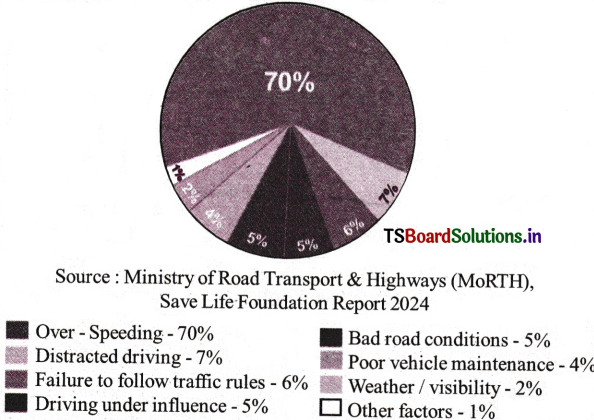
Reasons for Road Accidents in India (2023-2024)
Data representation for Road Safety Awareness
Questions:
Question 1.
What is the major cause of road accidents in India according to the report?
Answer:
The major cause is Over-speeding, which accounts for 70 % of all road accidents.
Question 2.
Name two human factors that contribute to road accidents other than speeding.
Answer:
Two other human factors are Distracted driving (7 %) and Failure to follow traffic rules (6 %). (Driving under influence at 5 % is also a human factor).
Question 3.
What percentage of road accidents are caused by bad road conditions?
Answer:
5 % of road accidents are caused by bad road conditions.
Question 4.
What is the purpose of this data representation?
Answer:
The purpose is for Road Safety Awareness, as mentioned in the “Data representation” subtitle.
Question 5.
What is the source of information?
Answer:
The source is the Ministry of Road Transport & Highways (MoRTH) and the Save Life Foundation Report 2024.
Pie Chart – 2
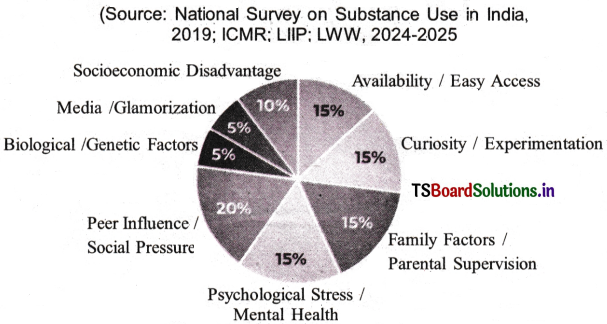
Major cause of DRUG ABUSE Among youth in India
Questions:
Question 1.
Which factor is shown as the leading cause of drug abuse among youth in India?
Answer:
The leading cause is Peer Influence / Social Pressure, which accounts for 20% of the cases.
Question 2.
What is the pie chart about?
Answer:
The pie chart represents the Major Causes of Drug Abuse Among Youth in India.
Question 3.
What percentage of drug abuse is linked to Psychological Stress or Mental Health?
Answer:
15% of drug abuse is linked to Psychological Stress / Mental Health.
Question 4.
What is the source of this information?
Answer:
The source is the National Survey on Substance Use in India, 2019; ICMR; LIIP; LWW, 2024-2025.
Question 5.
What is the percentage of Media / Glamorization as a cause?
Answer:
The percentage for Media / Glamorization is 5%.
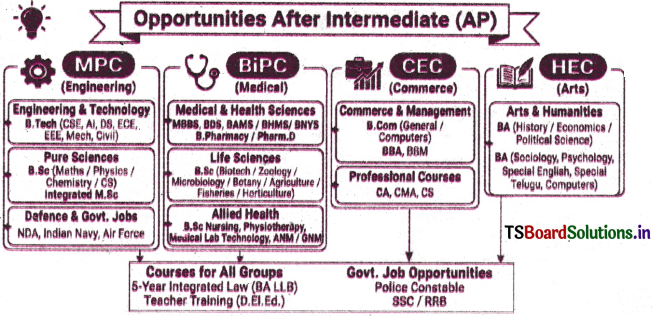
Tree Diagram – 1
Questions:
Question 1.
What are some career options available for students who choose the MPC group?
Answer:
Career options for MPC students include:
Engineering & Technology: B.Tech in fields like CSE, AI, DS, ECE, EEE, Mech, and Civil.
Pure Sciences: B.Sc (Maths / Physics / Chemistry / CS) Integrated M.Sc.
Defence & Govt. Jobs: NDA, Indian Navy, and Air Force.
Question 2.
Which medical-related courses can BiPC students pursue after Intermediate?
Answer:
Medical and health-related courses for BiPC students include MBBS; BDS, BAMS / BHMS / BNYS, B.Pharmacy / Pharm.D, B.Sc Nursing, Physiotherapy, Medical Lab Technology, and ANM / GNM.
Question 3.
What professional courses are available for CEC students?
Answer:
The professional courses available for CEC students are CA (Chartered Accountancy), CMA (Cost and Management Accountancy), and CS (Company Secretary).
Question 4.
What are the courses available for HEC?
Answer:
Students in the HEC group can pursue Bachelor of Arts (BA) degrees in subjects such as History, Economics, Political Science, Sociology, Psychology, Special English, Special Telugu, and Computers.
Question 5.
State TRUE or FALSE: Only Students from the HEC group can apply for SSC/RRB jobs.
Answer:
FALSE. The chart categorizes “Govt. Job Opportunities” (like SSC/RRB) under a section that applies broadly to various streams, not just HEC.
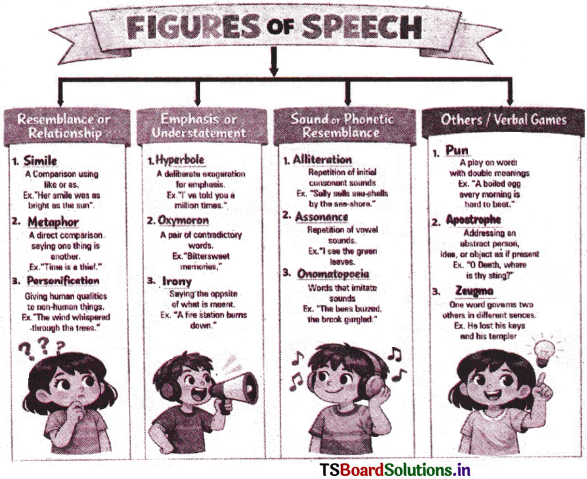
Tree Diagram – 2
Questions:
Question 1.
Which figure of speech uses words that imitate sounds?
Answer:
Onomatopoeia is the figure of speech that uses words imitating sounds.
Question 2.
What is Irony?
Answer:
Irony is saying the opposite of what is meant (e.g., “A fire station burns down”).
Question 3.
Give an example for ‘Simile’?
Answer:
An example of a Simile provided in the chart is: “Her smile was as bright as the sun.”
Question 4.
Which figure of speech gives human qualities to non-living things?
Answer:
Personification is the figure of speech that gives human qualities to non-human or non- living things.
Question 5.
Identify the figure of speech in this sentence “a boiled egg every morning is hard to beat.”
Answer:
This is a Pun, which is a play on words with double meanings.
Table – 1
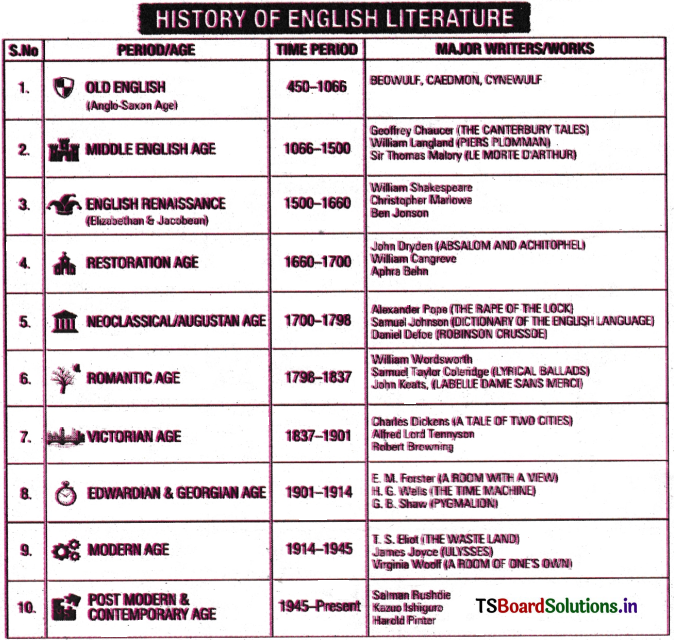
Questions:
Question 1.
Which period of English literature lasted from 450 to 1066?
Answer:
The Old English (Anglo-Saxon Age).
Question 2.
Who wrote The Canterbury Tales?
Answer:
Geoffrey Chaucer
Question 3.
Who compiled “Dictionary of the English Language”?
Answer:
Samuel Johnson.
Question 4.
State TRUE or FALSE: The Restoration Period is best known for writers like John Dryden and Aphra Behn.
Answer:
TRUE.
Question 5.
What is the best work by T.S. Eliot?
Answer:
The Waste Land.
Table – 2
Punctuation Marks Uses & Examples:
| Name of the Punctuation Mark | Usage | Example in a Sentence | |
| 1. • | Full Stop / Period | Ends a statement, used in abbreviations. | I went to school. |
| 2. / | Comma | Separates items in a list, clauses, or phrases. | I bought apples, oranges, mangoes, pineapples and bananas. |
| 3. ; | Semicolon | Connects closely related independent clauses; separates items in complex lists. | I have a meeting tomorrow; however, I might still join you later. |
| 4. : | Colon | Introduces a list, explanation or quotation. | She packed three things : clothes, shoes and books. |
| 5. ? | Question Mark | Indicates a direct question. | Where is she going ? |
| 6. ! | Exclamation Mark | Shows strong feeling, surprise, command. | Watch out ! |
| 7. //// | Quotation Marks (Inverted Commas) | Shows direct speech or quoted text. | He said, “I am sad” |
| 8. ` | Apostrophe | Show possession or contractions. | It’s a nice day/Sam’s book is missing. |
| 9. & | Ampersand | Means“and” (informal use, names) | Johnson & Johnson. |
| 10. / | Slash (Virgule) | Separates alternatives, fractions or dates. | Please press yes / no. |
Questions:
Question 1.
Which punctuation mark is used to end a statement?
Answer:
The Full Stop / Period.
Question 2.
Which punctuation mark is used to show possession or contractions?
Answer:
The Apostrophe.
Question 3.
Which punctuation mark is used to introduce a list or explanation?
Answer:
The Colon.
Question 4.
State TRUE or FALSE: The exclamation mark (!) shows strong feelings or Surprise.
Answer:
TRUE. (According to the usage column for Exclamation Mark).
Question 5.
Which punctuation mark is used to separate items in a list?
Answer:
The Comma.
Bar Graph – 1
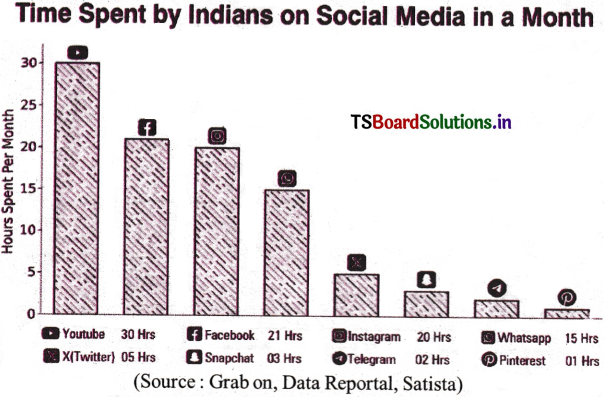
Questions:
Question 1.
What does the bar graph show?
Answer:
The bar graph shows the Time Spent by Indians on Social Media in a Month.
Question 2.
Which social media app do Indians spend the most time on?
Answer:
Indians spend the most time on Youtube (30 hours per month).
Question 3.
How many hours per month are spent on Facebook?
Answer:
21 hours per month are spent on Facebook.
Question 4.
Which two social media apps have the least usage time?
Answer:
Telegram (2 hours) and Pinterest (1 hour) have the least usage time.
Question 5.
How many social media apps are shown in the bar graph?
Answer:
There are 8 social media apps shown in the bar graph (Youtube, Facebook, Instagram, Whatsapp, X(Twitter), Snapchat, Telegram, and Pinterest).
Bar Graph – 2
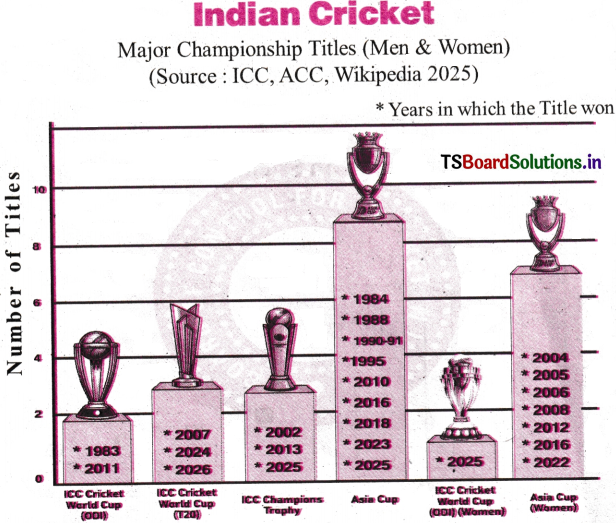
Questions:
Question 1.
Which year did India win its first Women’s Cricket World Cup?
Answer:
India won its first ICC Cricket World Cup (ODI) (Women) in 2025.
Question 2.
How many times has the Indian women’s team won the Women’s Asia Cup?
Answer:
The Indian women’s team has won the Asia Cup 7 times (in 2004, 2005, 2006, 2008, 2012, 2016, and 2022).
Question 3.
In which years-did India win the ICC Cricket World Cup (ODI)?
Answer:
India won the ICC Cricket World Cup (ODI) in 1983 and 2011.
Question 4.
How many times has India won the ICC Cricket World Cup (T20)?
Answer:
India has won the ICC Cricket World Cup (T20) 3 times (in 2007, 2024, and 2026).
Question 5.
State TRUE or FALSE: India has won the ICC Champions Trophy twice.
Answer:
FALSE. (The chart shows India has won the ICC Champions Trophy 3 times: in2002,2013, and2025).
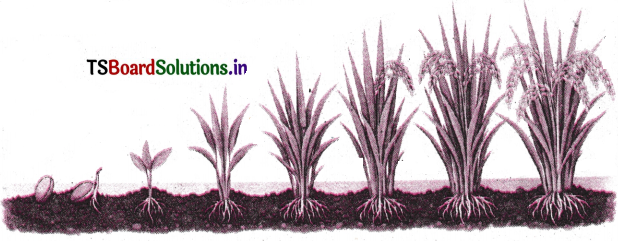
Flow Chart – 1
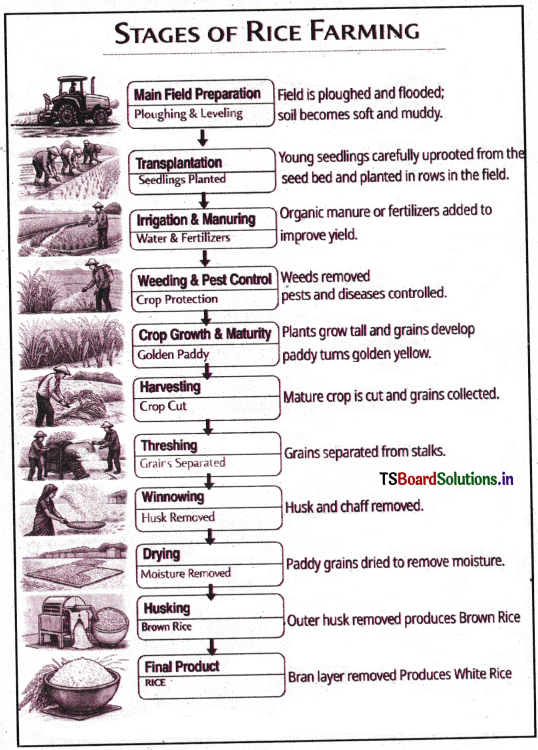
Questions:
Question 1.
How many steps are involved before we get the final product of rice?
Answer:
There are 10 steps involved before reaching the final product (starting from “Main Field Preparation” and ending with “Husking”).
Question 2.
In which step are the grains separated from the stalks?
Answer:
This happens during the Threshing step.
Question 3.
What is removed to get brown rice?
Answer:
The Outer husk is removed during the Husking stage to produce brown rice.
Question 4.
In which step are the young seedlings carefully uprooted and planted in the main field?
Answer:
This occurs during the Transplantation step.
Question 5.
What is winnowing?
Answer:
Winnowing is the process where the husk and chaff are removed from the grains.
Flow Chart – 2
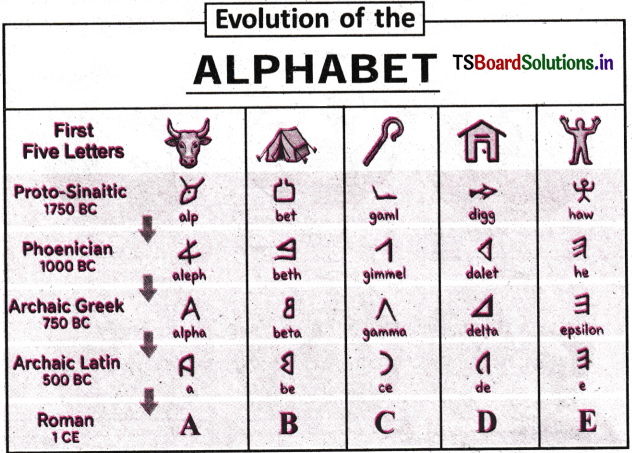
Questions:
Question 1.
Which ancient script is considered the earliest form in the evolution of the modem English alphabet shown in the chart?
Answer:
The Proto-Sinaitic (1750 BC) script.
Question 2.
From which alphabet did the Archaic Greek letters develop?
Answer:
They developed from the Phoenician (1000 BC) alphabet.
Question 3.
What is the Archaic Greek equivalent of the Phoenician letter “Aleph”?
Answer:
Alpha.
Question 4.
In which stage (step) did the letters take the recognizable Roman forms A, B, C, D, E?
Answer:
In the final stage, labeled Roman (1 CE).
Question 5.
What is the name of the Phoenician letter that evolved into the English letter ‘B’?
Answer:
Beth.
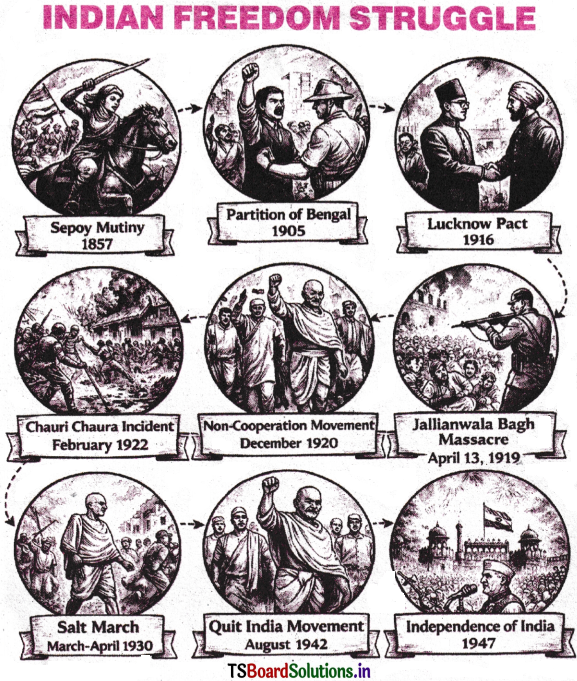
Timeline – 1
Questions:
Question 1.
When was the first endeavour for the freedom struggle initiated?
Answer:
The first endeavor shown is the Sepoy Mutiny in 1857.
Question 2.
When did India get freedom?
Answer:
India achieved Independence in 1947.
Question 3.
In which year did the Quit India .Movement take place?
Answer:
The Quit India Movement took place in August 1942.
Question 4.
Who led the Salt March?
Answer:
The image depicts Mahatma Gandhi leading the Salt March.
Question 5.
What happened in 1919?
Answer:
The Jallianwala Bagh Massacre occurred on April 13, 1919.
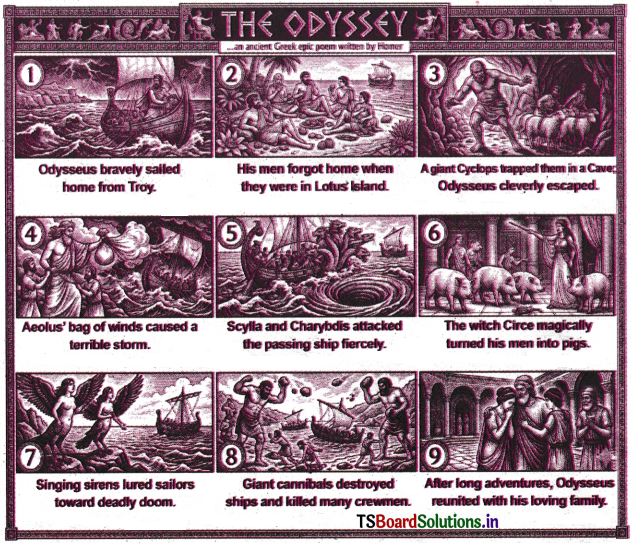
Time Line – 2
Questions:
Question 1.
Who wrote the Greek Epic Poem “The Odyssey”?
Answer:
The poem was written by Homer.
Question 2.
State TRUE or FALSE: “Odysseus begin his journey from Troy.”
Answer:
TRUE. The chart indicates that Odysseus sailed home from Troy in step 1.
Question 3.
What did Odysseus’ men do in the land of the Lotus-Eaters?
Answer:
His men forgot home when they were on Lotus Island.
Question 4.
Who trapped Odysseus and his men in a cave?
Answer:
A giant Cyclops trapped them in a cave.
Question 5.
Who turned Odysseus’ men into pigs?
Answer:
The Witch Circle magically turned his men into pigs.
Time Line – 3
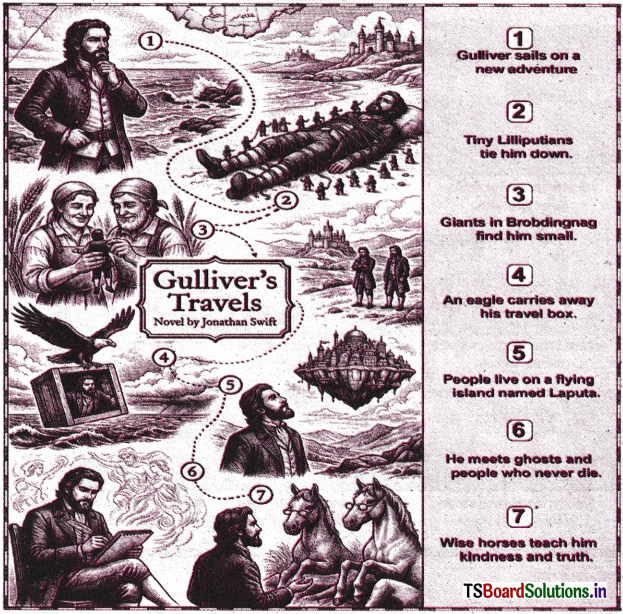
Questions:
Question 1.
Who wrote Gulliver’s Travels?
Answer:
The novel was written by Jonathan Swift.
Question 2.
Where do Giants live?
Answer:
Giants live in Brobdingnag.
Question 3.
What is the name of the flying island?
Answer:
The flying island is named Laputa.
Question 4.
Who taught kindness and truth to Gulliver?
Answer:
Wise horses taught him kindness and truth.
Question 5.
Who tied Gulliver down?
Answer:
Tiny Lilliputians tied him down.
Time Line – 4
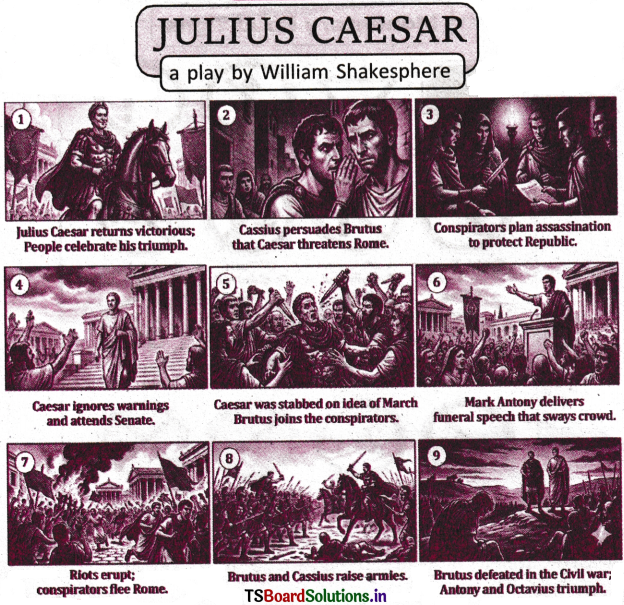
Questions:
Question 1.
Who wrote Julius Caesar?
Answer:
The play was written by William Shakespeare.
Question 2.
Who persuaded Brutus to assassinate Caesar?
Answer:
Cassius persuaded Brutus by convincing him that Caesar threatened Rome.
Question 3.
Who delivered the funeral speech?
Answer:
Mark Antony delivered the funeral speech that swayed the crowd.
Question 4.
What happened to Brutus in the civil war?
Answer:
Brutus was defeated in the Civil War.
Question 5.
On which day was Caesar assassinated?
Answer:
Caesar was assassinated on the Ides of March.
Safety Road
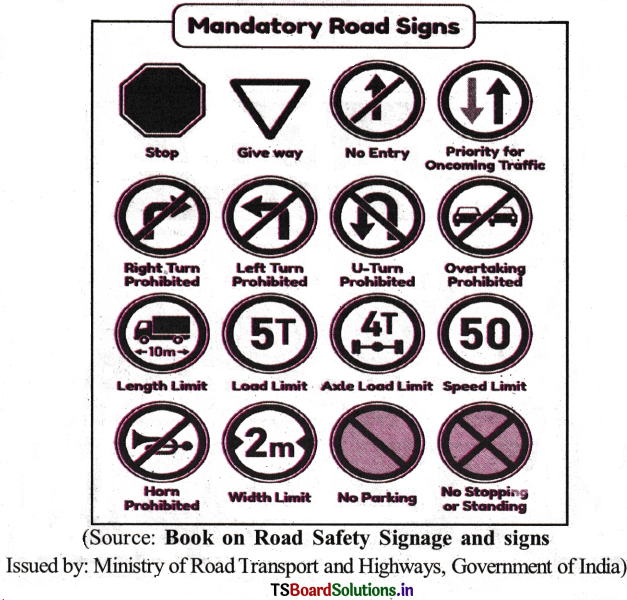
Question 1.
What are these symbols?
Answer:
These are Mandatory Road Signs.
Question 2.
Who issued these symbols?
Answer:
They were issued by the Ministry of Road Transport and Highways, Government of India.
Question 3.
What does the  symbol represent?
Answer:
This symbol represents Give way.
Question 4.
What is the source of the information?
Answer:
The source is the Book on Road Safety Signage and signs.
Question 5.
What does the  symbol represent?
Answer:
This symbol represents Stop.