Referring to the AP Inter 1st Year Maths Study Material Chapter 12 Introduction to 3D Geometry Exercise 12b Solutions makes it easier to understand complex problems.
AP Inter 1st Year Maths Introduction to 3D Geometry Solutions Exercise 12b
I.
Question 1.
Find the derivative of x2 – 2 at x = 10
Solution:
Method I: Let f(x) = x2 – 2
f'(10) = \(\lim _{h \rightarrow 0} \frac{f(10+h)-f(10)}{h}\)
= \(\lim _{h \rightarrow 0} \frac{\left[(10+h)^2-2\right]-\left(10^2-2\right)}{h}\)
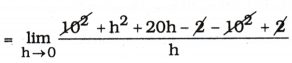
= \(\lim _{h \rightarrow 0} \frac{20 h+h^2}{h}\)
= \(\lim _{\mathrm{h} \rightarrow 0}\) (20 + h)
= (20 + 0)
= 20
Thus the derivative of x2 – 2 at x = 10 is 20
Method II: Let y = x2 – 2 at x = 10
D.w.r. to ‘x’ \(\frac{d y}{d x}\) = 2x
∴ At x = 10
⇒ \(\left(\frac{d y}{d x}\right)_{x=10}\) = 2x = 2(10) = 20
Question 2.
Find the derivative of x at x = 1
Solution:
Method I: Let f(x) = x
f'(1) = \(\lim _{h \rightarrow 0} \frac{f(1+h)-f(1)}{h}=\lim _{h \rightarrow 0} \frac{(1+h)-(1)}{h}=\lim _{h \rightarrow 0} \frac{h}{h}=\lim _{h \rightarrow 0}\) (1) = 1
Thus, the derivative of x at x = 1 is 1
Method II: Let y = x at x = 1
D.w.r. to ‘x’ \(\frac{d y}{d x}\) = 1
∴ At x = 1 ⇒ \(\left(\frac{d y}{d x}\right)_{x=1}\) = 1
Question 3.
Find the derivative of 99x at x = 100.
Solution:
Method I: Let f(x) = 99x
f'(100) = \(\lim _{h \rightarrow 0} \frac{f(100+h)-f(100)}{h}\)
= \(\lim _{h \rightarrow 0} \frac{99(100+h)-99(100)}{h}\)
= \(\lim _{h \rightarrow 0} \frac{99 \times 100+99 h-99 \times 100}{h}\)
= \(\lim _{h \rightarrow 0} \frac{99 h}{h}\)
= \(\lim _{\mathrm{h} \rightarrow 0}\)(99) = 99
Thus the derivative of 99x at x = 100 is 99
Method II:
Let y = 99x at x = 100. d.w.r. to ‘x’
\(\frac{d y}{d x}\) = 99
At x = 100, \(\left(\frac{d y}{d x}\right)\) = 99

Question 4.
For some constants a and b, find the derivative of
(i) (x – a) (x – b)
Solution:
Let f(x) = (x – a)(x – b)
⇒ f(x) = x2 – (a + b)x + ab
⇒ f'(x) = \(\frac{d}{d x}\)(x2 – (a + b)x + ab)
= \(\frac{d}{d x}\)(x2) – (a + b)\(\frac{d}{d x}\)(x) + \(\frac{d}{d x}\)(ab)
On using theorem \(\frac{d}{d x}\)xn = nxn-1, we have
f'(x) = 2x – (a + b) + 0
= 2x – a – b
(ii) (ax2 + b)2
Solution:
Let f(x) = (ax2 + b)2
⇒ f(x) = a2x4 + 2abx2 + b2
f'(x) = \(\frac{d}{d x}\)(a2x4 + 2abx2 + b2)
= a2\(\frac{d}{d x}\)(x2) + 2ab\(\frac{d}{d x}\)(x2) + \(\frac{d}{d x}\)(b2)
On using theorem \(\frac{d}{d x}\)xn = nxn-1, we have
f'(x) = a2(4x3) + 2ab(2x) + b2(0)
= 4a2x3 + 4abx
= 4ax(ax2 + b)
(iii) \(\frac{(\mathrm{x}-\mathrm{a})}{(\mathrm{x}-\mathrm{b})}\)
Solution:
Let f(x) = \(\frac{(x-a)}{(x-b)}\)
⇒ f'(x) = \(\frac{d}{d x}\left(\frac{(x-a)}{(x-b)}\right)\)
By quotient rule f'(x) = \(\frac{(x-b) \frac{d}{d x}(x-a)-(x-a) \frac{d}{d x}(x-b)}{(x-b)^2}\)
= \(\frac{(x-b)(1)-(x-a)(1)}{(x-b)^2}=\frac{x-b-x+a}{(x-b)^2}=\frac{a-b}{(x-b)^2}\)
Question 5.
Find the derivative of \(\frac{x^n-a^n}{x-a}\) for some constants a.
Solution:
Let f(x) = \(\frac{x^n-a^n}{x-a}\)
⇒ f'(x) = \(\frac{d}{d x}\left(\frac{x^n-a^n}{x-a}\right)\)
By quotient rule f'(x) = \(\frac{(x-a) \frac{d}{d x}\left(x^n-a^n\right)-\left(x^n-a^n\right) \frac{d}{d x}(x-a)}{(x-a)^2}\)
= \(\frac{(x-a)\left(n x^{n-1}-0\right)-\left(x^n-a^n\right)}{(x-a)^2}\)
f'(x) = \(\frac{n x^n-a n x^{n-1}-x^n+a^n}{(x-a)^2}\)
= \(\frac{(n-1) x^n-n a x^{n-1}+a^n}{(x-a)^2}\)
Question 6.
Find the derivative of
(i) 2x – \(\frac{3}{4}\)
Solution:
Let f(x) = 2x – \(\frac{3}{4}\), f'(x) = \(\frac{\mathrm{d}}{\mathrm{dx}}\)(2x – \(\frac{3}{4}\))
= 2\(\frac{d}{d x}\)(x) – \(\frac{d}{d x}\left(\frac{3}{4}\right)\)
= 2 – 0
= 2
(ii) (5x3 + 3x – 1)(x – 1)
Solution:
Let f(x) = (5x3 + 3x – 1)(x – 1)
By the Leibniz product rule.
f'(x) = (5x3 + 3x – 1)\(\frac{d}{d x}\)(x – 1) + (x – 1)\(\frac{d}{d x}\)(5x3 + 3x – 1)
= (5x3 + 3x – 1)(1) + (x – 1)(5.3x2 + 3 – 0)
= (5x3 + 3x – 1) + (x – 1)(15x2 + 3)
= 5x3 + 3x – 1 + 15x3 + 3x – 15x2 – 3
= 20x3 – 15x2 + 6x – 4
(iii) x-3(5 + 3x)
Solution:
Let f(x) = x-3(5 + 3x)
By the Leibniz product rule.
f'(x) = x-3\(\frac{\mathrm{d}}{\mathrm{dx}}\)(5 + 3x) + (5 + 3x)\(\frac{\mathrm{d}}{\mathrm{dx}}\)x-3
= x-3 (0 + 3) + (5 _ 3x)(-3x-3-1)
= x-3(3) + (5 + 3x)(-3x-4)
= 3x-3 – 15x-4 – 9x-3
= -6x-3 – 15x-4
= – 3x-3(2 + \(\frac{5}{x}\))
= \(\frac{-3 x^{-3}}{x}\)(2x + 5)
= \(\frac{-3}{x^4}\)(5 + 2x)
(iv) x5(3 – 6x-9)
Solution:
Let f(x) = x5(3 – 6x-9)
By the Leibniz product rule.
f'(x) = x5\(\frac{d}{d x}\)(3 – 6x-9) + (3 – 6x-9)\(\frac{d}{d x}\)(x5)
= x5[0 – 6(-9)x-9-1] + (3 – 6x-9)(5x4)
= x5(54x-10) + 15x4 – 30x-5
= 54x-5 + 15x4 – 30x-5
= 24x-5 + 15x4
= 15x4 + \(\frac{24}{x^5}\)
(v) x-4(3 – 4x-5)
Solution:
Let f(x) = x-4(3 – 4x-5)
By the Leibniz product rule.
f'(x) = x-4\(\frac{d}{d x}\)(3 – 4x-5) + (3 – 4x-5)\(\frac{d}{d x}\)(x-4)
= x-4[0 – 4(-5)x-5-1] + (3 – 4x-5)(-4)x-4-1
= x-4(20x-6) + (3 – 4x-5)(-4x-5)
= 20x-10 – 12x-5 + 16x-10
= 36x-10 – 12x-5
= \(\frac{-12}{x^5}+\frac{36}{x^{10}}\)
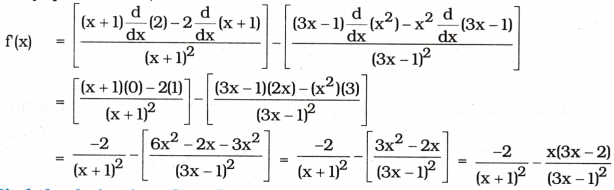
(vi) \(\frac{2}{x+1}-\frac{x^2}{3 x-1}\)
Solution:
Let f(x) = \(\frac{2}{x+1}-\frac{x^2}{3 x-1}\)
f'(x) = \(\frac{d}{d x}\left(\frac{2}{x+1}\right)-\frac{d}{d x}\left(\frac{x^2}{3 x-1}\right)\)
By quotient rule,
Question 7.
Find the derivative of the following functions.
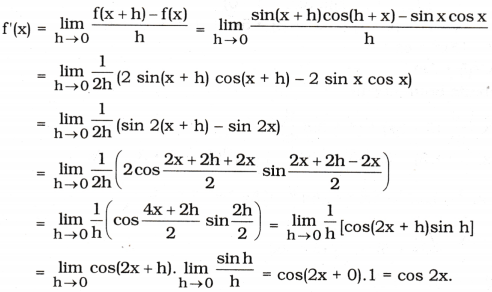
(i) sin x cos x
Solution:
Let f(x) = sin x cos x
According from the first principle
(ii) sec x
Solution:
Let f(x) = sec x
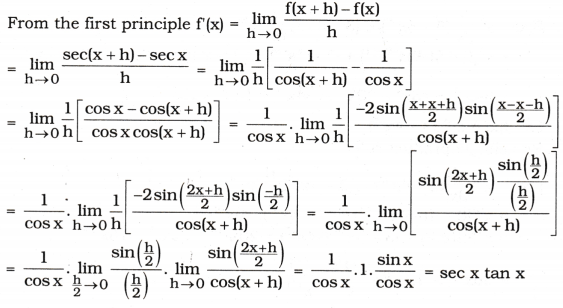
(iii) 5 sec x + 4 cos x
Solution:
Let f(x) = 5 sec x + 4 cos x
Differentiate w.r.to ‘x’, f'(x) = 5sec x . tan x – 4 sin x
According from the first principle
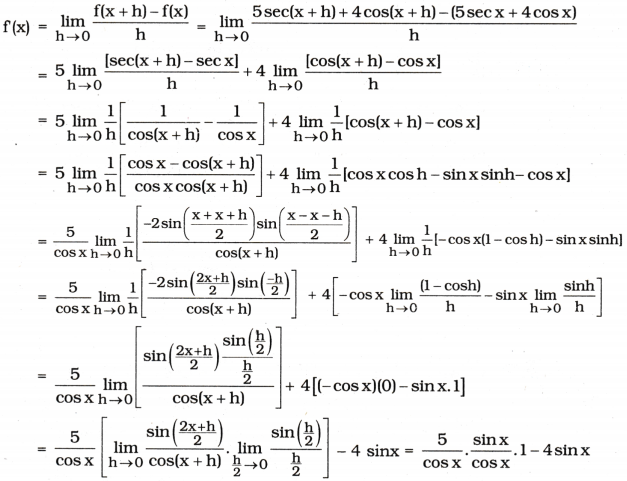
f'(x) = 5sec x . tan x – 4 sin x
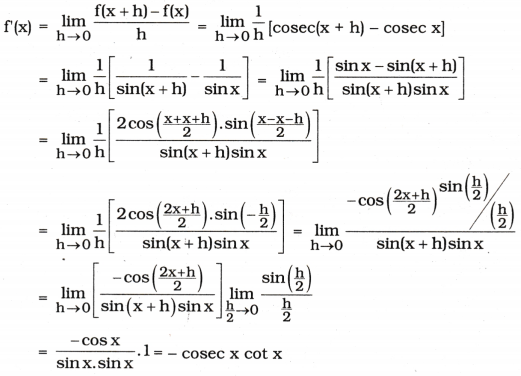
(iv) cosec x
Solution:
Let f(x) = cosec x
According from the first principle
(v) 3 cot x + 5 cosec x
Solution:
Let f(x) = 3 cot x + 5 cosec x
Let y = 3 cot x + 5 cosec x
Differentiate w.r.to ‘x’,
\(\frac{d y}{d x}=\frac{d}{d x}\) (3 cost x + 5 cosec x)
⇒ \(\frac{d y}{d x}\) = -3 cosec2x – 5 cosec x . cot x
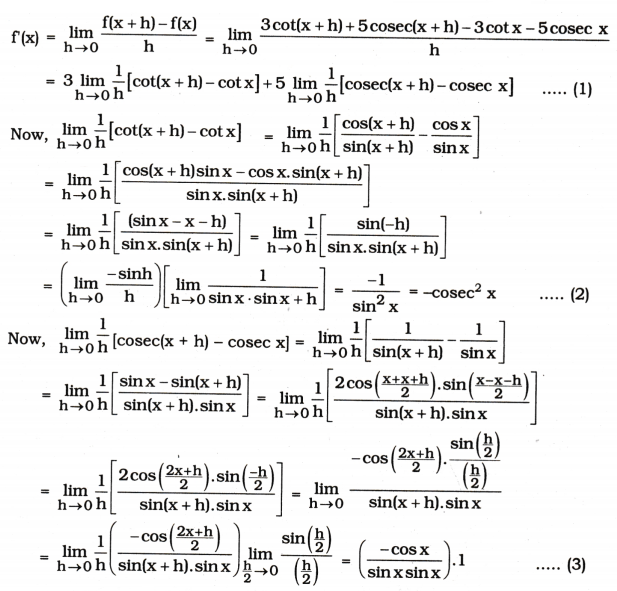
= -cosec x cot x
From eqns (1) and (2) & (3)
f'(x) = -3cosec2x – 5 cosec x cot x
(vi) 5 sin x – 6 cos x + 7
Solution:
Let f(x) = 5 sin x – 6 cos x + 7
Differentiate w.r.to ‘x’,
\(\frac{d y}{d x}=\frac{d}{d x}\) (5 sin x – 6 cos x + 7)
⇒ \(\frac{d y}{d x}\) = 5 cos x + 6 sin x
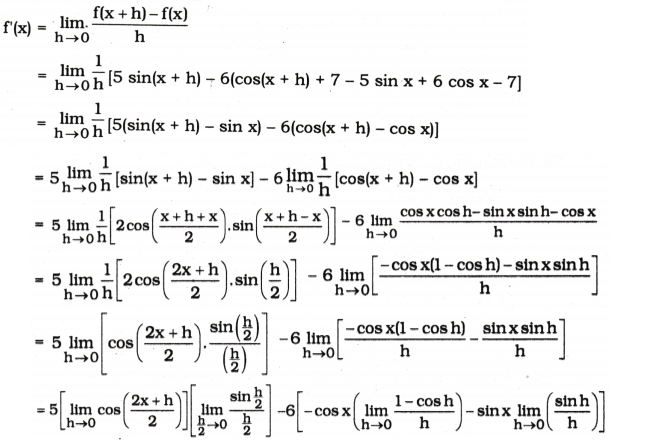
= 5 cos x.1 – 6[(-cos x).(0) – sin x.1]
= 5cos x + 6 sin x
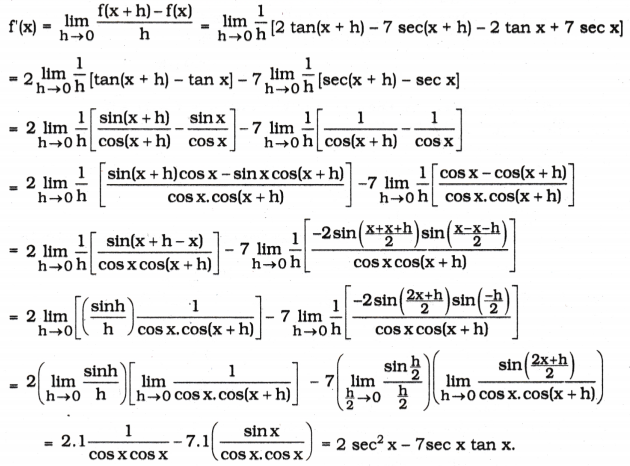
(vii) 2 tan x – 7 sec x
Solution:
Let f(x) = 2 tan x – 7 sec x
Let y = 2 tan x – 7 sec x
Differentiate w.r.to ‘x’,
\(\frac{d y}{d x}=\frac{d}{d x}\)(2 tan x – 7 sec x)
⇒ \(\frac{d y}{d x}\) = 2 sec2x – 7 sec x tan x
Question 8.
Find the derivative of 5 sin x + ex log x.
Solution:
Let y = 5 sin x + exlog x
Differentiating on both sides with respect to x.
\(\frac{d y}{d x}=\frac{d}{d x}\)[5 sin x + exlog x]
= 5\(\frac{d}{d x}\)sin x + \(\frac{d}{d x}\)(ex.log x)
= 5 cos x + ex \(\frac{d}{d x}\)log x + log x \(\frac{d}{d x}\)ex
= 5 cos x + ex.\(\frac{1}{x}\) + log x. ex
Question 9.
Find the derivative of 5x log x + x3ex.
Solution:
Given that 5x log x + x3ex
Differentiating w.r.t ‘x’ = \(\frac{d}{d x}\)[5x.log x + x3.ex]
= \(\frac{d}{d x}\)(5x.log x) + \(\frac{d}{d x}\)(x3.ex)
= 5x.\(\frac{\mathrm{d}}{\mathrm{dx}}\)(log x) + log x\(\frac{d}{d x}\)(5x) + x3\(\frac{d}{d x}\) (ex) + ex.\(\frac{d}{d x}\) (x3)
= 5x\(\left(\frac{1}{\mathrm{x}}\right)\) + log x. 5x.log.5 + x3ex + ex3x2
= 5x(\(\frac{1}{x}\) + log 5 . log x) + ex(x3 + 3x2)
Question 10.
If f(x) = 1 + x + x2 + …………. + x100, then find f'(1).
Solution:
Given f(x) = 1 + x + x2 + …………. + x100
Differentiating on both sides with respect to x.
f'(x) = \(\frac{\mathrm{d}}{\mathrm{dx}}\)(1 + x + x2 + …………. + x100)
= \(\frac{\mathrm{d}}{\mathrm{dx}}\)(1) + \(\frac{\mathrm{d}}{\mathrm{dx}}\)(x) + \(\frac{\mathrm{d}}{\mathrm{dx}}\)(x2) + ……… \(\frac{\mathrm{d}}{\mathrm{dx}}\)(x100)
= 0 + 1 + 2x + 3x2 + ……….. + 100 x99
= 1 + 2x + 3x2 + ……… + 100x99
Put x = 1 tehn, f'(1) = 1 + 2(1) + 3(1)2 + ……….. + 100(1)99
= 1 + 2 + 3 + ……… + 100
= \(\frac{100(100+1)}{2}\)
= 50(101)
= 5050
Question 11.
If f(x) = 2x2 + 3x – 5, then prove that f'(0) + 3.f'(-1) = 0
Solution:
Given f(x) = 2x2 + 3x – 5
Now f'(x) = 2(2x) + 2(1) = 4x + 3
f'(0) = 4(0 ) + 3 = 3; f'(-1) = 4(-1) + 3
= -4 + 3 = -1
LHS = f'(0) + 3.f'(-1)
= 3 + 3(-1)
= 3 – 3
= 0 = RHS
∴ f'(0) + 3f'(-1) = 0
II.
Question 1.
Find the derivative of the following functions from first principle
(i) x3 – 27
Solution:
Let f(x) = x3 – 27, accordingly from the first principle
f'(x) = \(\lim _{h \rightarrow 0} \frac{f(x+h)-f(x)}{h}\)
= \(\lim _{h \rightarrow 0} \frac{\left[(x+h)^3-27\right]-\left(x^3-27\right)}{h}\)
= \(\lim _{h \rightarrow 0} \frac{x^3+h^3+3 x^2 h+3 x h^2-x^3}{h}\)
= \(\lim _{\mathrm{h} \rightarrow 0}\)(h2 + 3x2 + 3xh)
= 0 + 3x2 + 0
= 3x2
(ii) (x – 1)(x – 2)
Solution:
Let f(x) = (x – 1)(x – 2), accordingly from the first principle
f'(x) = \(\lim _{h \rightarrow 0} \frac{f(x+h)-f(x)}{h}\)
= \(\lim _{h \rightarrow 0} \frac{(x+h-1)(x+h-2)-(x-1)(x-2)}{h}\)
= \(\lim _{h \rightarrow 0} \frac{\left(x^2+h x-2 x+h x+h^2-2 h-x-h+2\right)-\left(x^2-2 x-x+2\right)}{h}\)
= \(\lim _{h \rightarrow 0} \frac{\left(h x+h x+h^2-2 h-h\right)}{h}=\lim _{h \rightarrow 0} \frac{2 h x+h^2-3 h}{h}\)
= \(\lim _{h \rightarrow 0}\)(2x + h – 3)
= (2x + 0 – 3)
= 2x – 3
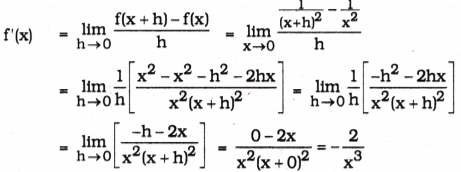
(iii) \(\frac{1}{x^2}\)
Solution:
Let f(x) = \(\frac{1}{x^2}\)
Accordingly from the first principle
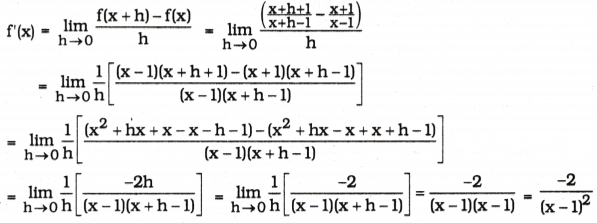
(iv) \(\frac{x+1}{x-1}\)
Solution:
Let f(x) = \(\frac{x+1}{x-1}\) accordingly from the first principle
Question 2.
For the function f(x) = \(\frac{x^{100}}{100}+\frac{x^{99}}{99}+\ldots .+\frac{x^2}{2}\) + x + 1. Prove that f'(1) = 100f'(0)
Solution:
The given function is f(x) = \(\frac{x^{100}}{100}+\frac{x^{99}}{99}+\ldots .+\frac{x^2}{2}\) + x + 1
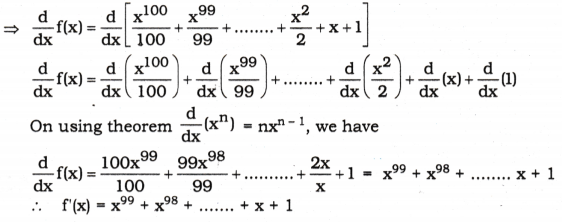
At x = 0, f'(0) = 1
At x = 1, f'(1) = 199 + 198 + ……. 1 + 1
= [1 + 1 …….. 1 + 1]100 term
= 1 × 100
Thus, f'(1) = 100 × f'(0)
Question 3.
Find the derivative of xn + axn-1 + a2xn-2 + ………… + an-1x + an for some fixed real number a.
Solution:
Let f(x) = xn + axn-1 + a2xn-2 + ………… + an-1x + an
∴ f'(x) = \(\frac{\mathrm{d}}{\mathrm{dx}}\)(xn + axn-1 + a2xn-2 + ……….. + an-1x + an)
= \(\frac{\mathrm{d}}{\mathrm{dx}}\)(xn) + a\(\frac{\mathrm{d}}{\mathrm{dx}}\)(xn-1) + a2\(\frac{\mathrm{d}}{\mathrm{dx}}\)(xn-2) + …………. + an-1\(\frac{\mathrm{d}}{\mathrm{dx}}\)(x) + an\(\frac{\mathrm{d}}{\mathrm{dx}}\)(1)
On using theorem \(\frac{\mathrm{d}}{\mathrm{dx}}\)xn = nxn-1, we have
f'(x) = nxn-1 + a(n-1)xn-2 + a2(n – 2)xn-3 + …….. + an-1 + an(0)
= nx2 + a(n – 1)xn-2 + a2(n – 2)xn-3 + ……. + an-1
Question 4.
Find the derivative of cos x from first principle.
Solution:
Let f(x) = cos x, According, from the first principle
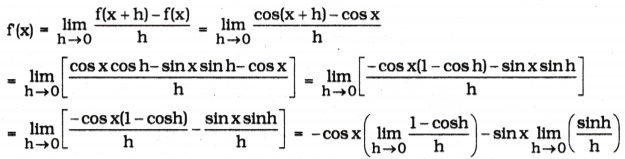
= – cos x(0) – sin x(1)
= -sin x
∴ f'(x) = -sin x
Question 5.
Find the derivatives of the following functions from the first principle.
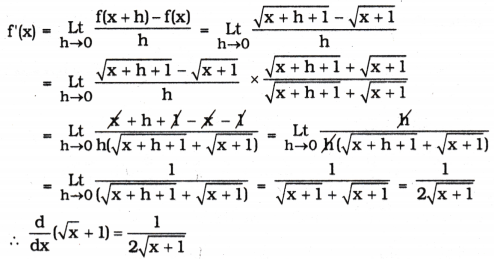
(i) \(\sqrt{x+1}\)
Solution:
Let f(x) = \(\sqrt{x+1}\)
⇒ f(x + h) = \(\sqrt{x+h+1}\)
(ii) sin 2x
Solution:
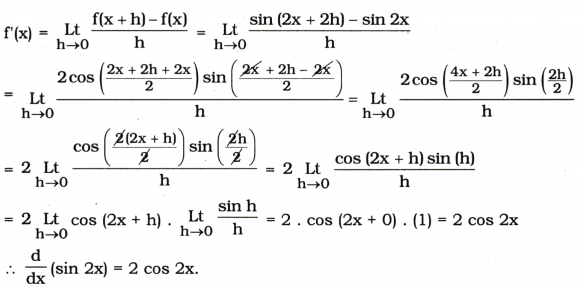
Let f(x) = sin 2x
f(x + h) = sin2(x + h) = sin (2x + 2h)
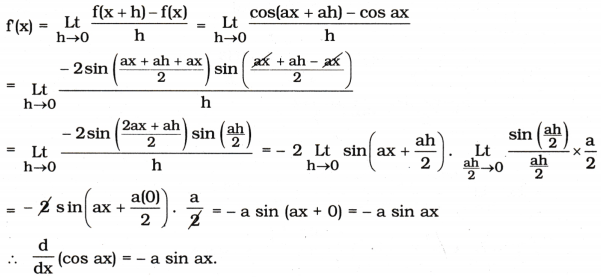
(iii) cos ax
Solution:
Let f(x) = cos ax
f(x + h) = cos a(x + h) = cos (ax + ah)
(iv) sec 3x
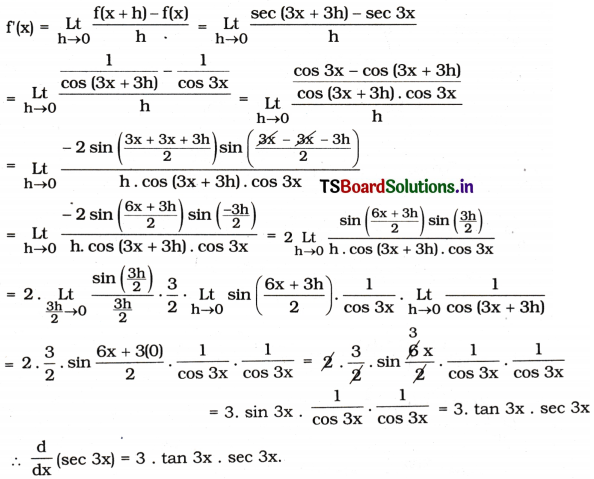
Solution:
Let f(x) = sec 3x
f(x + h) = sec 3(x + h) = sec (3x + 3h)
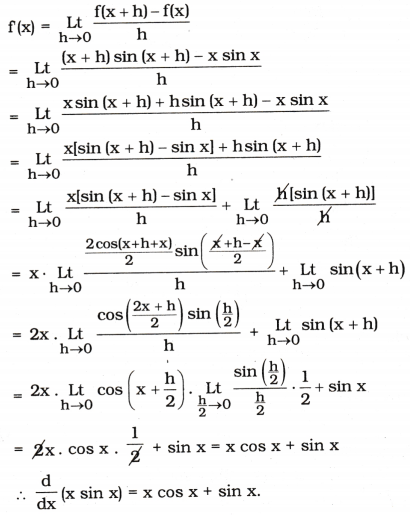
(v) x sin x
Solution:
Let f(x) = x sin x
f(x + h) = (x + h) sin (x + h)
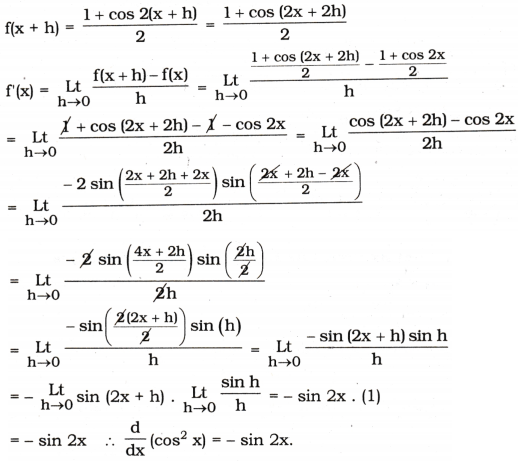
(vi) cos2x
Solution:
Let f(x) = cos2x = \(\frac{1+\cos 2 x}{2}\)