Reviewing AP Inter 2nd Year Accounts Study Material Chapter 4 Admission of a Partner Questions and Answers can help students prepare confidently for exams.
AP Inter 2nd Year Accountancy 4th Lesson Admission of a Partner Questions and Answers
I. Fill in the blanks
Question 1.
According to the Indian Partnership Act, 1932, a new partner can be admitted only with the consent of _____________.
Answer:
All the existing Partners
Question 2.
The monetary value of a firm’s reputation in respect of its ability to earn profits above the normal profit is known as _____________.
Answer:
Goodwill
Question 3.
The account prepared for revaluation of assets and reassessment of liabilities at the time of a partner’s admission is _____________ account.
Answer:
Revaluation
Question 4.
A decrease in the value of liabilities is a gain and is _____________ to the Revaluation Account.
Answer:
Credited
Question 5.
Unrecorded liabilities are debited to the _____________ Account.
Answer:
Revaluation
Question 6.
If there is an accumulated loss, it is _____________ to the existing partners’ capital accounts in the existing ratio.
Answer:
Debited
Question 7.
When a new partner pays for _____________ privately, no journal entries are made in the books of the firm.
Answer:
Goodwill
II. Very Short Answer Questions
Question 1.
What is the purpose of Revaluation Account?
Answer:
The Revaluation Account is prepared to distribute the profit or loss arising from the revaluation of assets and liabilities among the existing partners before the admission of a new partner.
Question 2.
Define Goodwill.
Answer:
Goodwill is the worth of a firm’s reputation that enables it to earn future profits exceeding the normal level of profits.
Question 3.
What is interest on capital?
Answer:
If the partnership deed permits, the firm pays interest to the partners as compensation for the capital invested by them in the business. This payment is known as Interest on Capital.

Question 4.
What is new profit-sharing ratio?
Answer:
- When a new partner is admitted into an existing partnership firm, the new partner obtains a share in the future profits, and a fresh profit-sharing ratio is formed among all the partners.
- This is known as the New Profit-Sharing Ratio.
III. Short Answer Questions
Question 1.
List out adjustments to be made at the time of admission of a new partner?
Answer:
When a new partner is admitted into a partnership firm, the existing partnership agreement comes to an end and a fresh agreement is formed. Therefore, the following adjustments are required at the time of admission:
- Calculation of the new profit-sharing ratio.
- Revaluation of assets and liabilities.
- Distribution of accumulated profits, losses, and reserves.
- Treatment of goodwill.
- Adjustment of partners’ capital accounts.
Question 2.
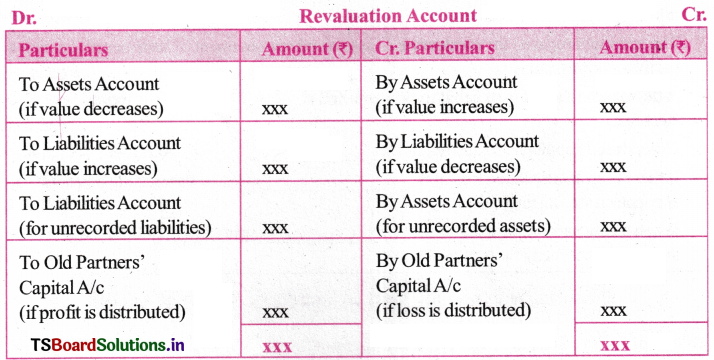
Describe the proforma of Revaluation Account.
Answer:
Proforma of Revaluation Account
Question 3.
Explain how a new partner’s sharing ratio is determined.
Answer:
The new profit-sharing ratio is determined according to the agreement between the existing partners and the incoming partner.
The new ratio may be worked out under the following situations:
- When the new partner’s share is given along with the existing profit-sharing ratio.
- When the new partner receives an equal share from all the existing partners.
- When the new partner’s share is taken in a specified ratio from the shares of the old partners.
- When the existing partners sacrifice a certain proportion of their shares in favour of the new partner.
- When the entire share of the new partner is obtained from one specific partner.
Question 4.
Explain the treatment for goodwill when a new partner pays for it privately.
Answer:
Different methods are followed for the treatment of goodwill when a new partner is admitted. Normally, goodwill is credited to the old partners in their sacrificing ratio. However, if the new partner pays the goodwill amount directly to the existing partners in a private arrangement, no journal entry is recorded in the books of the firm.
Question 5.
How accumulated profits or losses are treated in accounting upon a new partner’s admission?
Answer:
Any accumulated profits or reserves shown in the balance sheet at the time of admitting a new partner are credited to the existing partners’ capital accounts in their old profit-sharing ratio. Likewise, any accumulated loss is debited to the existing partners’ capital accounts in the same ratio.
Question 6.
Explain how to distribute a Revaluation Account’s gain or loss among existing partners prior to admission of a new partner?
Answer:
The Revaluation Account is credited with the increase in the value of assets and the decrease in the value of liabilities. It is debited with the decrease in the value of assets and the increase in the value of liabilities. The resulting balance, whether profit or loss, is transferred to the existing partners’ capital accounts in their old profit-sharing ratio.
Question 7.
How goodwill should be treated when the new partner brings his/her share of goodwill in cash?
Answer:
When the new partner brings their share of goodwill in cash, it is considered an additional amount paid to compensate the existing partners for sacrificing part of their future profit share. The goodwill brought in cash is distributed among the old partners according to their Sacrificing Ratio.
Exercises
Question 1.
Raju and Rani are partners sharing profit and losses in the 3 : 2 ratio. They have decided to admit Kumar by giving him 1/4th share in future profits. Calculate the new profit-sharing ratio.
Solution:
If we assume the total share is 1
The new partner Kumar’s share = \(\frac{1}{4}\) share out of 1
Rest of the share = 1 – \(\frac{1}{4}\) = \(\frac{3}{4}\)
Old Ration = 3 : 2
New Share = Rest of the share × old share
Raju’s new share = \(\frac{3}{4}\) × \(\frac{3}{5}\) = \(\frac{9}{20}\), Raju’s new share = \(\frac{3}{4}\) × \(\frac{2}{5}\) = \(\frac{6}{20}\)
New Ratio = \(\frac{9}{20}\) : \(\frac{6}{20}\) : \(\frac{1}{4}\)
To compare Kumar’s Share (Equating the Denominators all partners share), we convert 1/4 to a denominator of 20 by multiplying both numerator and denominator with 5:
= \(\frac{1}{4}\) × \(\frac{5}{5}\) = \(\frac{5}{20}\)
Therefore, the new profit sharing ratio of Raju, Vinay and Rani = \(\frac{9}{20}\) : \(\frac{6}{20}\) : \(\frac{5}{20}\) or 9 : 6 : 5
Question 2.
P & Q are partners sharing in the ratio of 2 : 3. They admit R for 1/4th share and he gets this share equally from P & Q. Calculate new ratio.
Solution:
If we assume the total share is 1
The new partner R’s share = 1/4 share out of 1
Since R gets this share “equally” from both each old partner gives up half of R’s share.
P’s sacrifice = \(\frac{1}{4}\) × \(\frac{1}{2}\) = \(\frac{1}{8}\) ; Q’s sacrifice = \(\frac{1}{4}\) × \(\frac{1}{2}\) = \(\frac{1}{8}\)
New Share = old share – sacrifice share
P’s new share = \(\frac{2}{5}\) – \(\frac{1}{8}\) = \(\frac{16-5}{40}\) = \(\frac{11}{40}\) ; Q’s new share = \(\frac{3}{5}\) – \(\frac{1}{8}\) = \(\frac{24-5}{40}\) = \(\frac{19}{40}\)
New Ratio = \(\frac{11}{40}\) : \(\frac{19}{40}\) : \(\frac{1}{4}\)
To compare R’s Share (Equating the Denominators all partners share), we convert 1/4 to a denominator of 40 by multiplying both numerator and denominator with 10:
= \(\frac{1}{4}\) × \(\frac{10}{10}\) = \(\frac{10}{40}\) = \(\frac{1}{4}\)
Therefore, the new profit sharing ratio of P, Q and R = \(\frac{11}{40}\) : \(\frac{19}{40}\) : \(\frac{10}{40}\) or 11 : 19 : 10
Question 3.
X and Y share profits and losses in the Ratio of 4 : 3, they admit Z with 3/7th share; which he gets 2/7th from X and 1/7 from Y. What is the new profit sharing ratio?
Solution:
If we assume the total share is 1
The new partner Z’s share = \(\frac{3}{7}\) share Out of 1
X’s sacrifice = \(\frac{2}{7}\), Y‘s sacrifice = \(\frac{1}{7}\)
New Share = Old share – sacrifice share
X’s new share = \(\frac{4}{2}\) – \(\frac{2}{7}\) = \(\frac{2}{7}\) ; Y’s new share = \(\frac{3}{7}\) – \(\frac{1}{7}\) = \(\frac{2}{7}\)
New Ratio = \(\frac{2}{7}\) : \(\frac{2}{7}\) = \(\frac{3}{7}\)
Since all the denominators are the same, i.e., 7, the new profit sharing ratio of X, Y and Z = 2 : 2 : 3
Question 4.
Tarun & Nisha are partners share profits in the ratio of 5 : 3. Ramu the new partner gets 1/5 of Tarun’s share and 1/3rd of Nisha’s share. Calculate new profit-sharing ratio.
Solution:
If we assume the total share is 1
The new partner Ramu’s share = \(\frac{1}{5}\) + \(\frac{1}{3}\) = \(\frac{2}{8}\) = \(\frac{1}{4}\)
Tarun’s sacrifice = \(\frac{5}{8}\) × \(\frac{1}{5}\) = \(\frac{5}{40}\) = \(\frac{1}{8}\), Nisha’s sacrifice = \(\frac{3}{8}\) × \(\frac{1}{3}\) × \(\frac{3}{24}\) = \(\frac{1}{8}\)
Old Partners New Share = Old Share – Sacrifice Share
Tarun’s new share = \(\frac{5}{8}\) – \(\frac{1}{8}\) = \(\frac{4}{8}\) = \(\frac{1}{2}\); Nisha’s new share = \(\frac{3}{8}\) – \(\frac{1}{8}\) = \(\frac{2}{8}\) = \(\frac{1}{4}\)
New Ratio = \(\frac{1}{2}\) : \(\frac{1}{4}\) : \(\frac{1}{4}\)
To compare Tarun’s Share (Equating the Denominators all partners share), we convert 1/2 to a denominator of 4 by multiplying both numerator and denominator with 2:
= \(\frac{1}{2}\) × \(\frac{2}{2}\) = \(\frac{2}{4}\)
Therefore, the new profit sharing ratio of Tarun, Nisha and Ramu = \(\frac{2}{4}\) : \(\frac{1}{4}\) : \(\frac{1}{4}\) or 2 : 1 : 1.
Question 5.
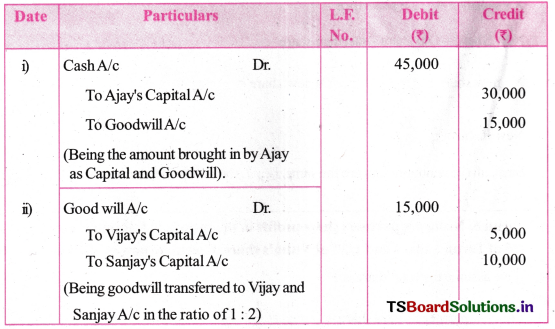
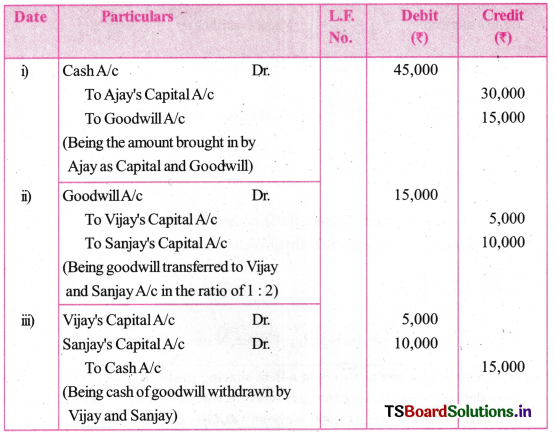
Vijay and Sanjay are partners in a firm sharing profits and losses in the ratio of 1 : 2. They decide to admit Ajay into partnership with 1/4 share in profits. Ajay brings in ₹ 30,000 for capital and ₹ 15,000 for goodwill. Give necessary journal entries,
a) When the amount of goodwill is retained in the business.
b) When the amount of goodwill is fully withdrawn.
Solution:
a) When the amount of goodwill is retained in the business
b) When the amount of goodwill is fully withdrawn.
Question 6.
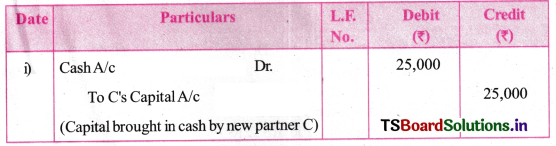
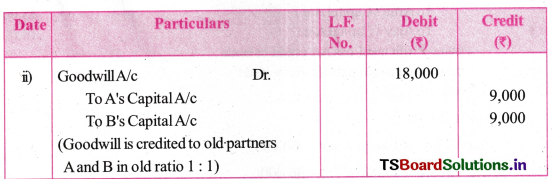
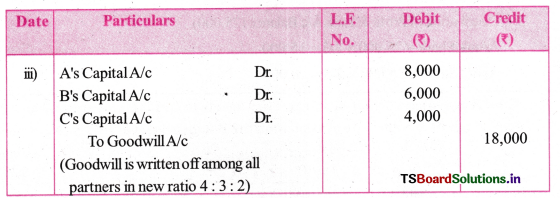
A and B are partners sharing profits and losses equally. They admit C into partnership and the new ratio is fixed as 4 : 3 : 2. C is unable to bring anything for goodwill but brings ₹ 25,000 as capital. Goodwill of the firm is valued at ₹ 18,000. Give the necessary journal entries assuming that the partners do not want goodwill to appear in the Balance Sheet.
Solution:
Entry for capital brought by C
Entry to create goodwill
Entry to write off goodwill
Note:
1. Goodwill is written off in new ratio:
A’s share = 18,000 × 4/9 = ₹ 8,000 ;
B’s share = 18,000 × 3/9 = ₹ 6,000 ;
C’s share = 18,000 × 2/9 = ₹ 4,000
2. Net gain to A = 9,000 – 8,000 = 1,000
3. Net gain to B = 9,000 – 6,000 = 3,000
4. New partner C compensates old partners ₹ 4,000
Question 7.
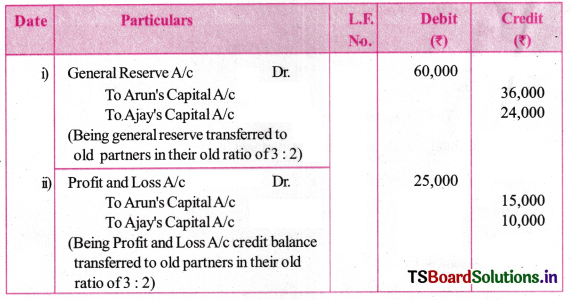
Arun and Ajay are partners sharing profit in the ratio of 3 : 2. On 1st April 2025 they admit Anil as a new partner for 1/6 share in profits. On that date the balance sheet of the firm shows a balance of ₹ 60,000 in general reserve and Credit balance of Profit and Loss A/c of ₹ 25,000. Make the necessary journal entries.
Solution:
Journal Entries
Working Note:
1. Distribution of General Reserve (60,000)
Arun’s Share = 60,000 × 3/5 = 36,000
Ajay’s Share = 60,000 × 2/5 = 24,000
2. Distribution of Profit & Loss A/c Balance (25,000)
Arun’s Share = 25,000 × 3/5 = 15,000
Ajay’s Share = 25,000 × 2/5 = 10,000
Question 8.
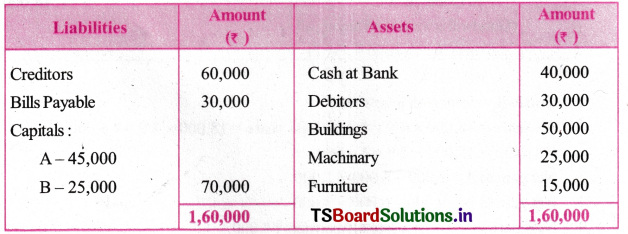
A and B are equal partners in a firm. They decide to admit C as a new partner for 1/5th share in profit. On the date of admission the balance sheet of firm was as follows:
The terms of agreement on C’s admission were as follows:
1. Building will be valued at ₹ 65,000 and machinery at ₹ 20,000
2. Creditors included ₹ 1,000 is no longer payable.
Pass necessary Journal entries for revaluation of assets and liabilities.
Solution:
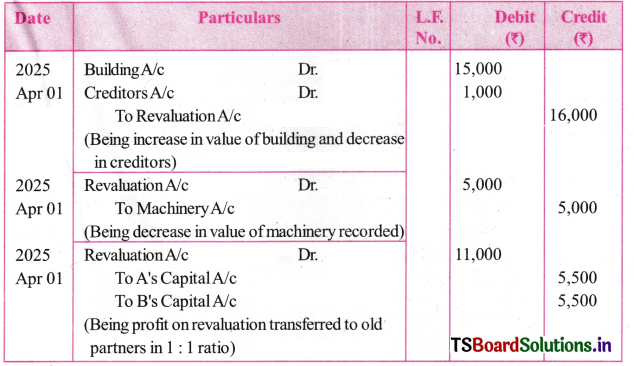
Working Note:
1. Profit on Revaluation:
- A Building: New Value (65,000) – Old Value (50,000) = ₹ 15,000
- Creditors: Amount no longer payable = 1,000
2. Loss on Revaluation:
- A Machinery: Old Value (25,000) – New Value (20,000) = ₹ 5,000
3. Net Revaluation Profit:
- Net Profit = Total Profit (16,000) – Total Loss (5,000) = ₹ 11,000
4. Distribution of Profit (Ratio 1 : 1):
- A’s Share = 11,000 × 1/2 = 5,500
- B’s Share = 11,000 × 1/2 = 5,500
Question 9.
Krishna and Balaram are partners sharing profit and losses in the ratio of 4 : 1. Their Balance Sheet was as follows:
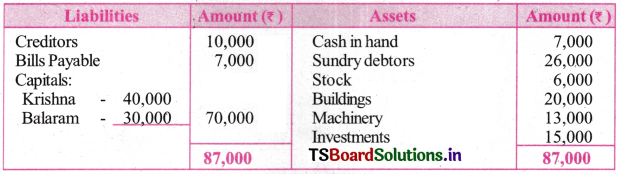
Arjun is admitted as a partner and assets are revalued and liabilities reassessed as follows:
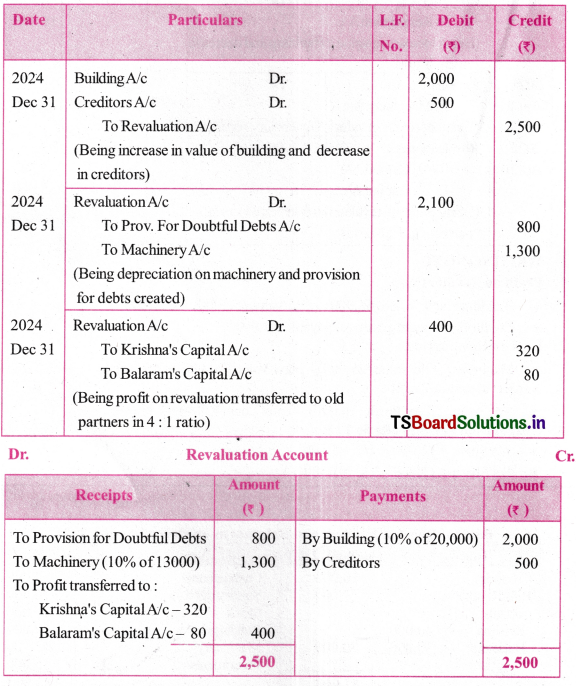
- Create a Provision for doubtful debt on debtors at ₹ 800.
- Buildings are appreciated by 10%.
- Machinery is depreciated at 10%
- Creditors were written off by ₹ 500.
Make journal entries and prepare a revaluation account before the admission of Arjun.
Solution:
Question 10.
Balance Sheet of Sudheer and Kiran as on 31.03.2024.
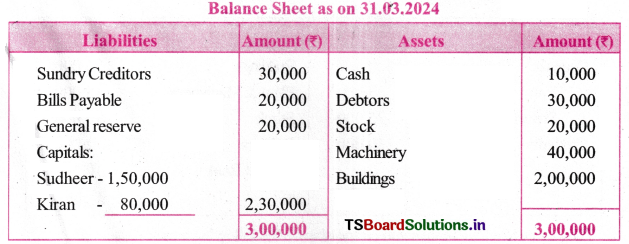
The other terms of agreements on Surya’s admission were as follows:
- Surya will bring ₹ 12,000 for his share of capital.
- Building will be valued at ₹ 1,80,000
- Machinery valued at ₹ 50,000.
- A provision of 5% will be created on debtors for bad debts. Prepare Revaluation Account and Partners Capital Accounts.
Solution:
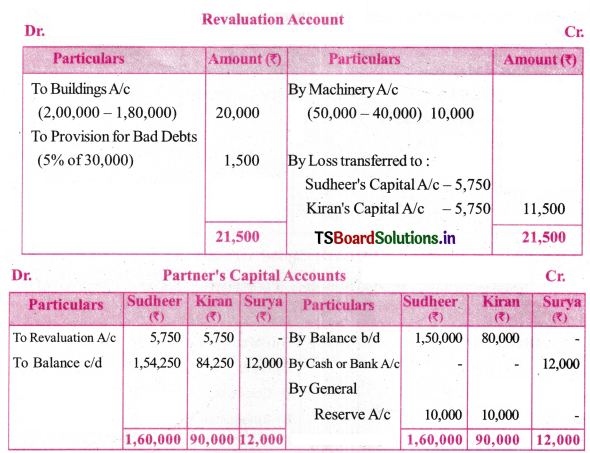
Note: Since profit sharing ratio of old partners not mentioned, it is assumed to be 1 : 1.
Question 11.
The following is the balance sheet of Ram and Shyam, who are sharing profit as 4/7 and 3/7 as on 31st March 2024.
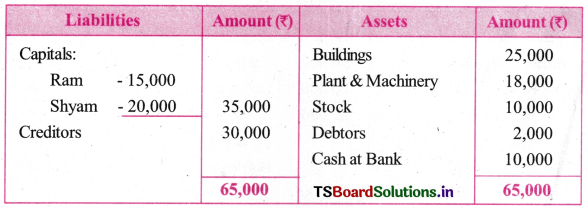
They agree to admit Mohan into partnership on the following terms:
- Mohan was to be given 1/3 share in the profit and to bring ₹ 7,500 as his capital and 2800 as his share of goodwill.
- That the value Plant & Machinery were to be reduced by 5%.
- That a reserve of 10% was to be created in respect of Sundry Debtors.
- The buildings were to be appreciated by 10%.
Prepare necessary Accounts.
Solution:
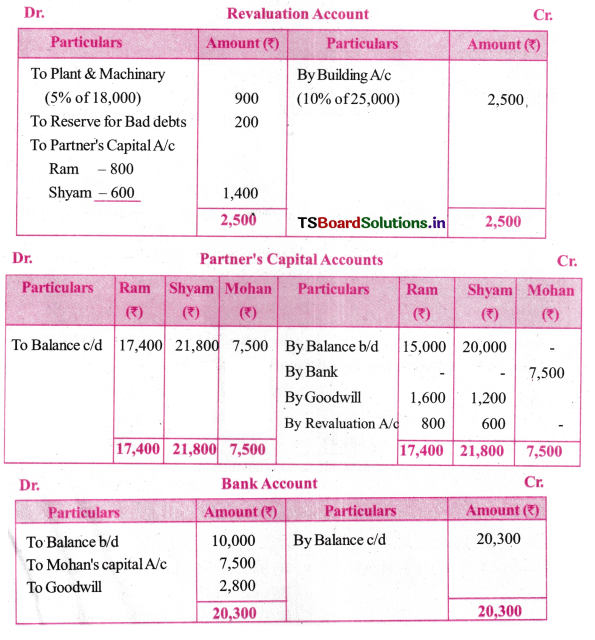
Working Note:
1. Distribution of Profits
- Total Profit on Revaluation: ₹ 1,400
- Ram’s Share: 1400 × 4/7 = 800
- Shyam’s Share: 1400 × 3/7 = 600
2. Distribution of Goodwill
- Total Profit on Revaluation: ₹ 2,800
- Ram’s Share: 2800 × 4/7 = 1600
- Shyam’s Share: 2800 × 3/7 = 1200
Question 12.
Ishan and Vihan are partners in a firm, sharing profits and losses in the ratio of 5 : 3, on 31st December, 2024 their Balance sheet was as under:
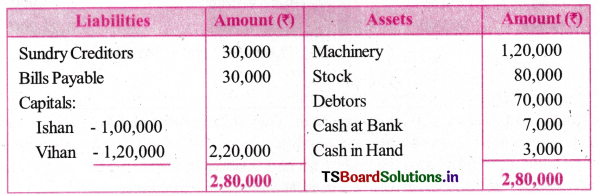
On the above date they decided to admit Vishwa as a partner on the following terms:
- Vishwa will bring ₹ 90,000 as his capital and ₹ 24,000 for his share of goodwill for 1/4th share in the profit.
- Machinery is to be valued at ₹ 1,50,000 and stock to be valued at ₹ 1,00,000
- Provision for bad debts of ₹ 10,000 is to be created.
Prepare Revaluation A/c, Partners’ Capital A/c and new Balance Sheet.
Solution:
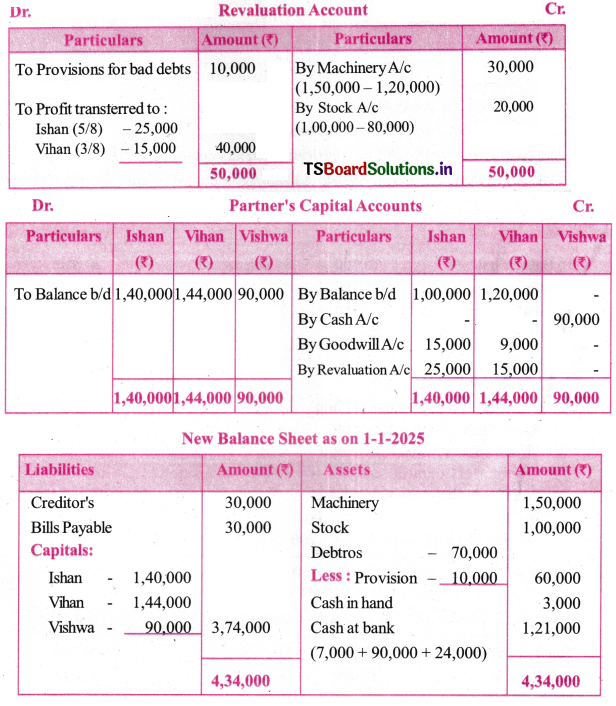
Question 13.
Rashmi and Pooja are partners in a firm. They share profits and losses in the ratio of 2 : 1. They admit Santoshi into partnership firm on the condition that she will bring ₹ 1,50,000 for capital and she will be given 1/3 share in future profits. At the time of admission, the Balance Sheet of Rashmi and Pooja was as under:
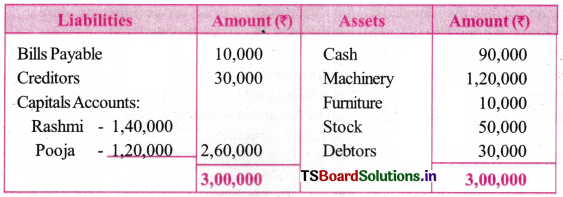
It was decided to:
- Revaluate stock at ₹ 45,000.
- Depreciate furniture by 10% and machinery by 5%.
- Make provision of ₹ 3,000 for bad debts on sundry debtors.
Prepare Revaluation Account, Partners’ Capital Accounts and Balance Sheet of the new firm.
Solution:
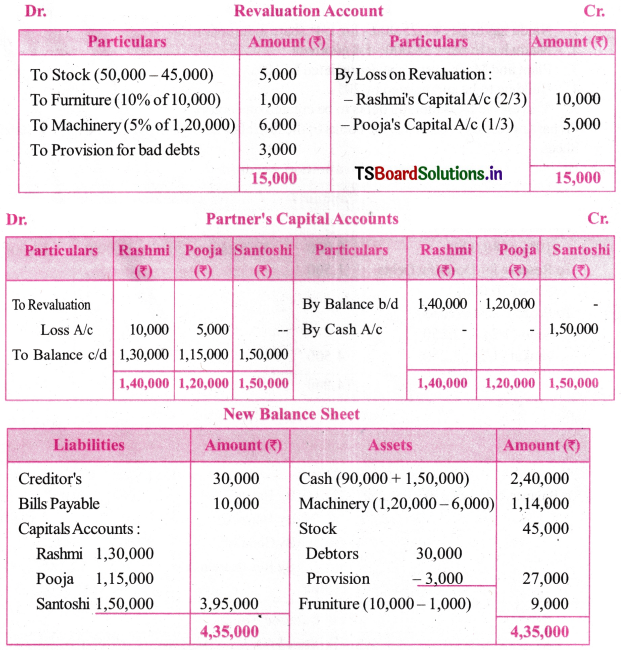
Question 14.
Venu & Venkat are partners in a business sharing profits and losses equally. Their Balance Sheet on 31-3-2024 stood as under;
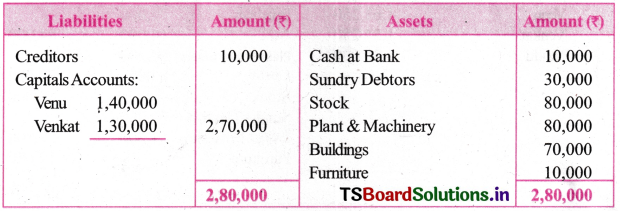
They decided to admit Naidu into firm on 1st April, 2024 on following terms and conditions.
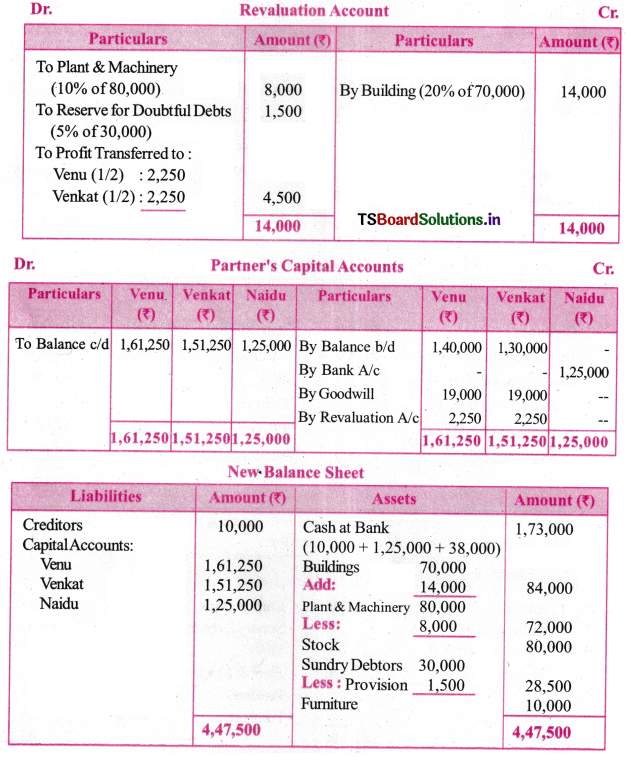
- Naidu has to pay ₹ 1,25,000/- for 1/4th share in future profits.
- Naidu has to pay ₹ 38,000/- for goodwill.
- Plant and Machinery to be depreciated by 40%.
- Buildings to be appreciated by 20%.
- 5% reserve for doubtful debts to be created on debtors
Prepare necessary accounts in the books of the firm after admission of Naidu with new Balance Sheet.
Solution:
Question 15.
Arun and Karthik are carrying on business in a partnership, sharing profit & loss in the ratio of 2:3. Their Balance sheet as on 31-12-2024 was as under.
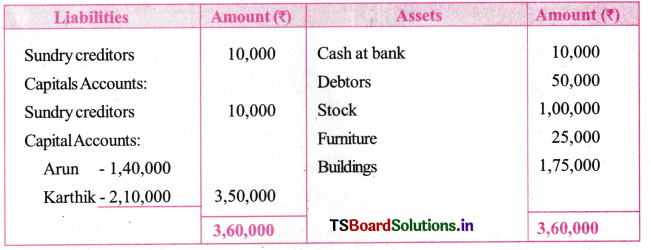
On that day they admitted Naveen into partnership and gave him 1/6th share in the future profits on the following terms.
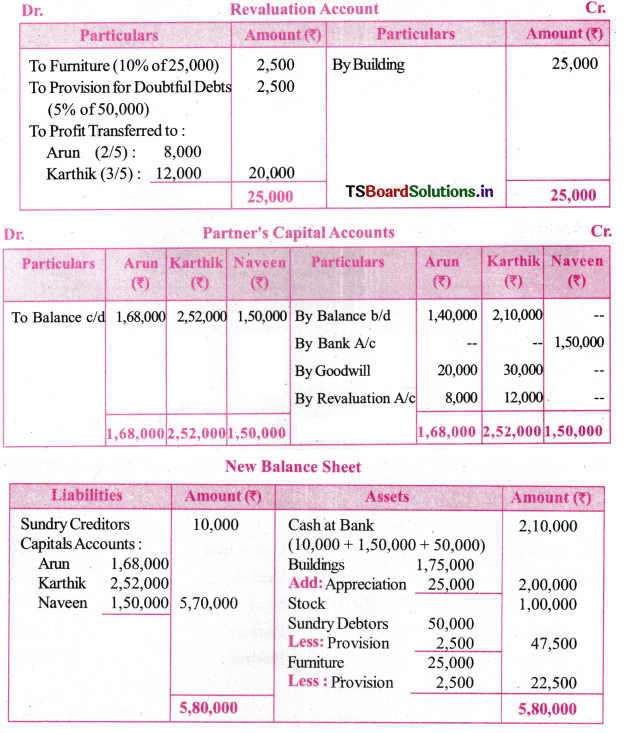
- Naveen is to bring in ₹ 1,50,000 as his capital and ₹ 50,000 as Goodwill, which sum is to remain in the business.
- Furniture is to be reduced in value by 10%.
- Buildings are to be appreciated by ₹ 25,000.
- A provision of 5% to be created for doubtful debts.
Make necessary Ledger Accounts and Balance Sheet of the new firm.
Solution:
Question 16.
Bhanu and Prasad are partners sharing profit and losses in the ratio of 3 : 2 respectively. Their Balance Sheet as on March 31st, 2025 was as under:
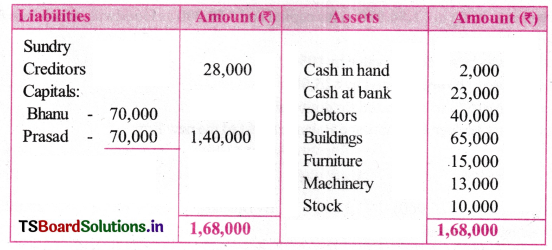
On that date, they admit Deepak into partnership for 1/3 share in future profit on the following terms:
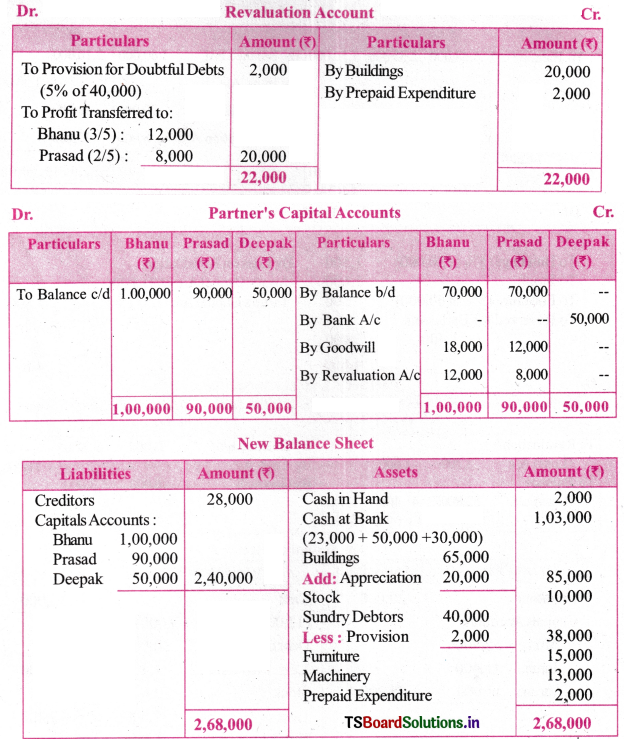
- Building is appreciated by ₹ 20,000.
- 5% provision is to be created on Debtors for doubtful debts.
- Prepaid expenditure of ₹ 2000 was not recorded in the books.
- Deepak is to bring in ₹ 50,000 as his capital and ₹ 30,000 as goodwill.
Make necessary Ledger Accounts and Balance Sheet of the new firm.
Solution:
Question 17.
The following is the Balance Sheet of Arun and Tarun sharing profit and losses in the ratio of 2 : 1.
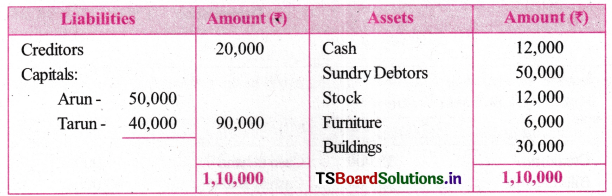
They agreed to admit Varun into partnership on the following terms:
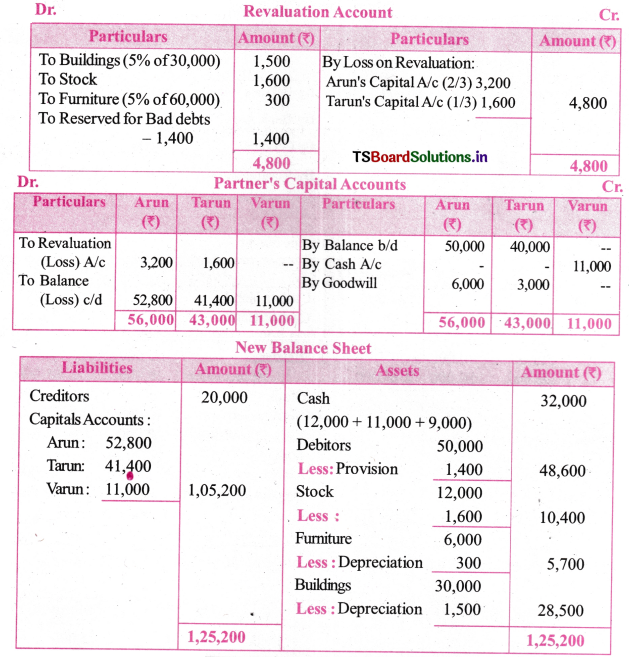
- Varun to pay ₹ 9,000 as Goodwill.
- Varun brings ₹ 11,000 as Capital for 1/4 share of profit in the business.
- Building and furniture to be depreciated at 5%.
- Stock is reduced by ₹ 1,600 and Reserve of Bad Debt ₹ 1,400 to be provided. Prepare necessary ledger account and balance sheet after admission.
Solution:
Question 18.
Ashish and Pankaj are partners sharing profit in the ratio of 5 : 3, their Balance sheet on March 31st, 2025 was as follows:
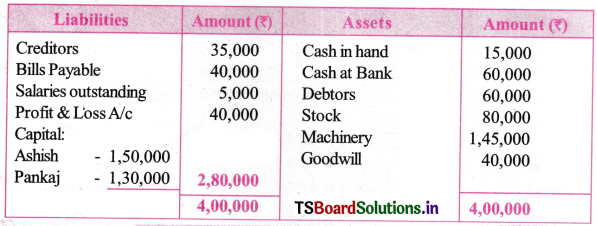
They admitted Guru deep into partnership for 1/4th share on the following terms on March 31st, 2025.
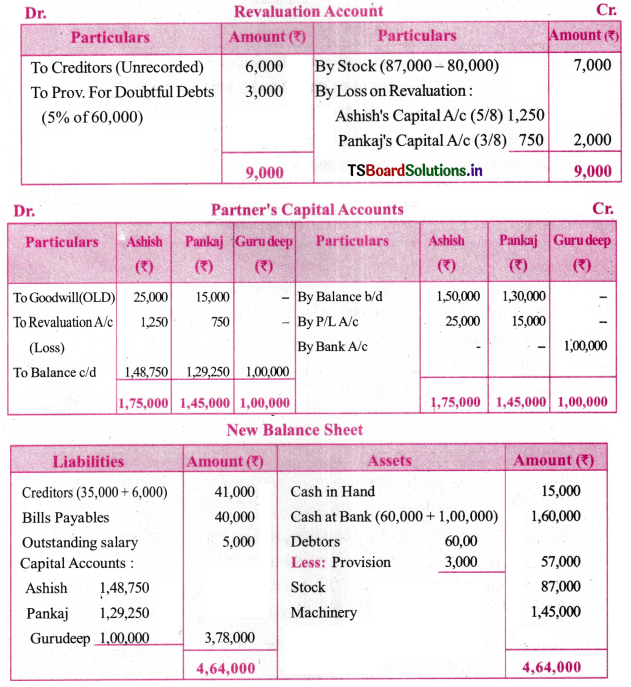
- He will bring in ₹ 1,00,000 as his shared capital.
- Stock is valued at ₹ 87,000.
- Creditors of ₹ 6,000 are not shown in the books.
- A provision for doubtful debts is to be created by 5% on debtors.
Prepare Revaluation account, Capital Accounts, Bank account and Balance Sheet of the new firm after admission of Guru deep.
Solution:
Question 19.
The Balance Sheet of Sarath and Sindhu as on 31.12.2024, who are sharing profits and losses in the ratio of 4 : 1 is as follows:
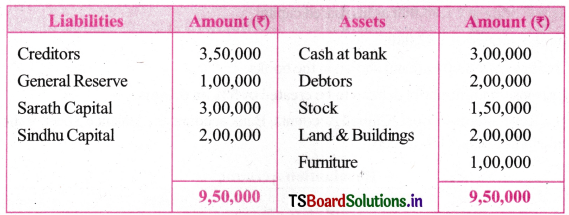
They have agreed to admit Sameer under the following conditions:
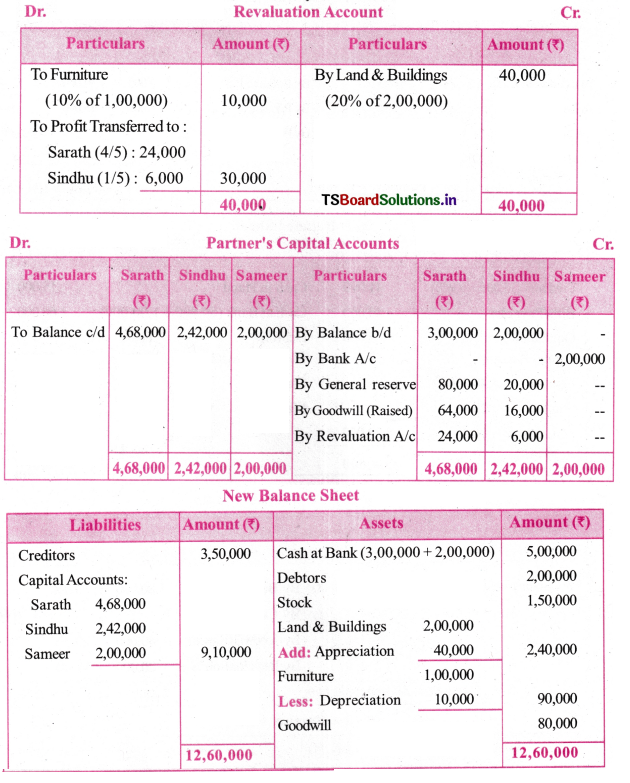
1. Sameer has to bring a capital of ₹ 2,00,000 for his 1/5th share of profits.
2. Furniture have to be depreciated by 10%
3. Land and Buildings has to be appreciated by 20%
4. Goodwill has to be raised by ₹ 80000
Prepare necessary ledger A/c and the balance sheet of the new firm.
Solution:
Question 20.
Given below is the Balance Sheet of Venu and Suresh, who are carrying on partnership business on 31.12.2024. Venu and Suresh are sharing profits and losses in the ratio of 2 : 1.
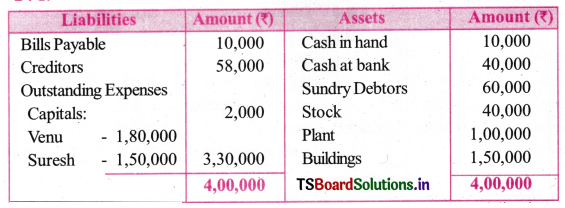
Mahesh is admitted as a partner on the date of the balance sheet on the following terms:
- Mahesh will bring in ₹ 1,00,000 as his capital and ₹ 60,000 as his share of goodwill for 1/4 share in the profits.
- Plant is to be appreciated to ₹ 1,20,000 and the value of buildings is to be appreciated by 10%.
- A provision for bad and doubtful debts is to be created at 5% of debtors.
- Creditors were unrecorded to the extent of ₹ 2,000.
Prepare the revaluation account and partners’ capital accounts, and show the Balance Sheet after the admission of Mahesh.
Solution:
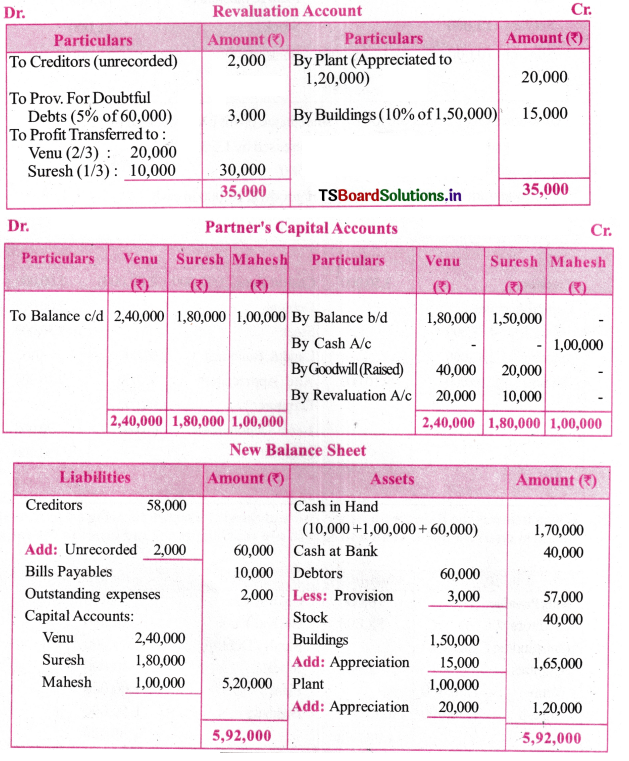
Question 21.
Following is the Balance Sheet of Satyam and Shivam sharing profit as 3 : 2.
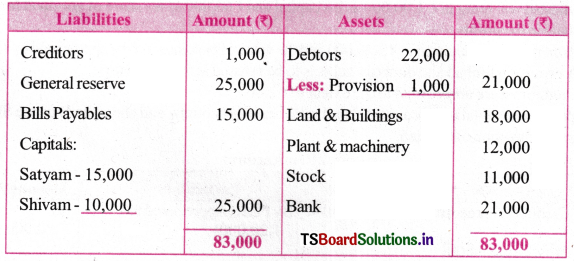
On admission of Sundaram for 1/6th share in the profit it was decided that:
- Provision for doubtful debts to be increased by 1,500.
- Value of stock to be increased by 2,500.
- Sundaram brought in as his share of goodwill 10,000 in cash.
- Sundaram was to bring further cash of 15,000 for her capital.
Prepare Revaluation A/c, Partners’ Capital A/c and the Balance Sheet of the new firm.
Solution:
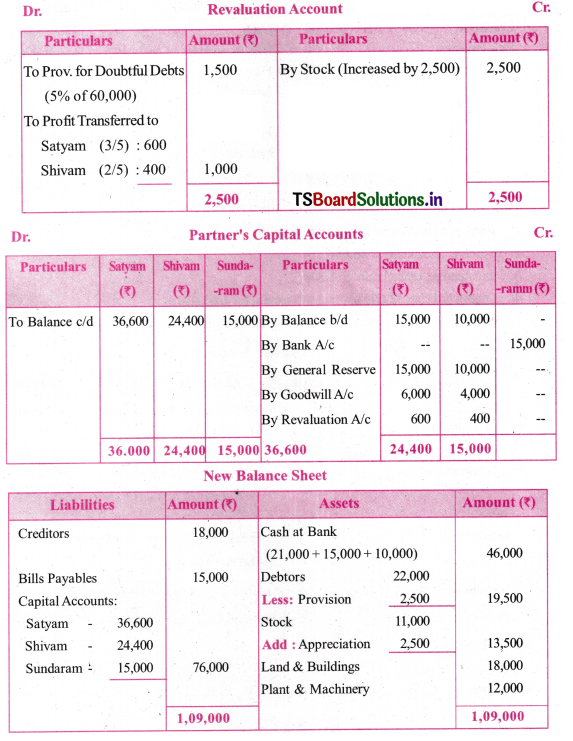
Note : New Provision 1,000 (Existing) + 1,500 (increase) = ₹ 2,500
Question 22.
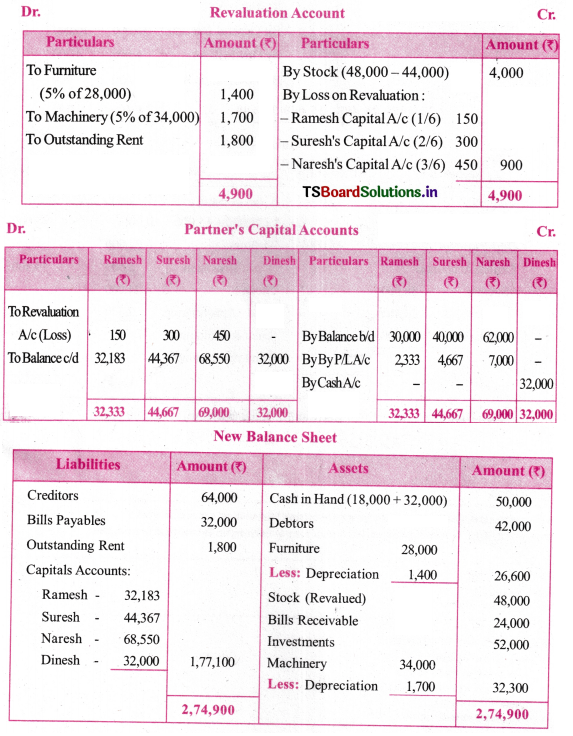
Ramesh, Suresh and Naresh are partners sharing profits and losses in the ratio of 1:2:3. On 31st March 2024, their Balance Sheet was as follows;
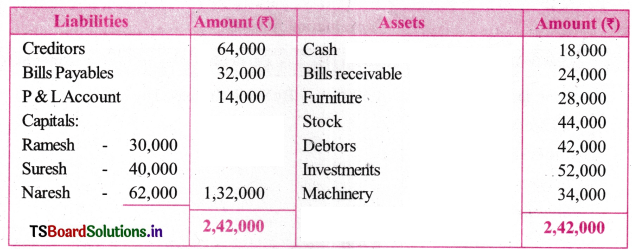
They admit Dinesh into partnership on the following terms:
- Furniture and Machinery to be depreciated by 5%.
- Stock is revaluated at 48,000.
- Outstanding rent amount to 1,800.
- Dinesh to bring 32,000 towards his capital for l/6th share.
Prepare Revaluation Account, Partners’ Capital Accounts and Balance Sheet of the new firm.
Solution: