
Regular practice with AP Inter 1st Year Physics Study Material Chapter 2 Motion in a Straight Line Questions and Answers helps students stay prepared for examinations.
AP Inter 1st Year Physics 2nd Lesson Motion in a Straight Line Questions and Answers
I. Multiple Choice Questions
Question 1.
The velocity of a body depends on time according to the equation V = 10 + 2t2. The body undergoing
(1) uniform acceleration
(2) uniform retardation
(3) non-uniform acceleration
(4) zero acceleration
Answer:
(3) non-uniform acceleration
Question 2.
Which of the following is true?
(1) Speed is always equal to magnitude of velocity.
(2) Speed is always greater than the magnitude of velocity.
(3) Velocity is always greater than the speed.
(4) Speed in general is either equal to or greater than the magnitude of velocity.
Answer:
(1) Speed is always equal to magnitude of velocity.
Question 3.
A bullet is dropped from the same time another bullet is fired horizontally. They will hit the ground
(1) one after the other
(2) simultaneously
(3) depends on the observer
(4) depends on the velocity of the fired bullet
Answer:
(2) simultaneously
Question 4.
If a car is moving with a uniform velocity of 60 km/h. Then its acceleration is
(1) 0km / h2
(2) 10km / h2
(3) 20km / h2
(4) 30km / h2
Answer:
(1) 0km / h2
Question 5.
A ball is thrown vertically upward with an initial velocity of 50 m/s. Its maximum height is (take g = 10/s2)
(1) 125m
(2) 250 m
(c) 500 m
(d) 1000 m
Answer:
(1) 125m
Question 6.
A particle moves in a straight line with an initial velocity of 10m/s and a constant acceleration of 2m/s2. Its displacement after 5 seconds will be
(1) 50 m
(2) 75 m
(3) 150 m
(4) 200 m
Answer:
A = ut + \(\frac{1}{2}\)at2 (or) x = v0t + \(\frac{1}{2}[latex]at2, ∴ x = (10 × 5) + [latex]\frac{1}{2}\)(2) × 52 = 50 + 25 = 75 m
Question 7.
A body starts from rest and moves with a uniform acceleration of 2m / s2. Its velocity after 10 seconds will be
(1) 5 m/s
(2) 10 m/s.
(3) 15 m/s
(4) 20 m/s
Answer:
(4) 20 m/s
V = u + at = 0 + (2 × 10) = 20m/s
Question 8.
For the motion with uniform velocity, the slope of the velocity-time graph is equal to
(1) 1 m/s
(2) zero
(3) initial velocity
(4) final velocity
Answer:
(2) zero
Question 9.
If a cyclist takes two minutes to complete half revolution on a circular path of 120 m radius, what is the average speed?
(1) 1 m/s
(2) 2 m/s
(3) 3.14 m/s
(4) 4.14 m/s
Answer:
(3) 3.14 m/s
Average Speed = \(\frac{\text { Total distance }}{\text { Total Time }}=\frac{\pi \mathrm{r}}{2 \times 60}=\frac{3.14 \times 120}{2 \times 60}\) = 3.14 m/s
Question 10.
In a particular time, the net displacement travelled by the body is equal to
(1) the area which v -1 graph encloses with displacement axis
(2) the area which x -1 graph encloses with the time axis
(3) the area which v -1 graph encloses with time axis
(4) the area which a -1 graph encloses with displacement axis
Answer:
(3) the area which v -1 graph encloses with time axis
Question 11.
A particle moves along a straight line. At a time t, the distance x of the particle from the origin given by x = 20 + 12t – t3 where x is in meters and t in sec, the time taken for the particle fo coming to rest is
(1) 1 s
(2) 2 s
(3) 4 s
(4) 6 s
Answer:
(2) 2 s
x = 20 + 12t – t3, \(\frac{d x}{d t}\) = 12 – 3t2 = V, 12 – 3t2 = 0 ⇒ 3t2 = 12 ⇒ t2 = 4, t = 2s
Question 12.
A car travels half of the distance with speed v and the remaining distance with speed 2v. Its average speed is
(1) \(\frac{4 v}{3}\)
(2) \(\frac{3 v}{3}\)
(3) \(\frac{v}{3}\)
(4) \(\frac{2 v}{3}\)
Answer:
(1) \(\frac{4 v}{3}\)
Average Speed = \(\frac{2 u v}{u+v}=\frac{2 \times(v)(2 v)}{v+2 v}=\frac{2 \times v \times 2}{3}=\frac{4}{3} v\)
Question 13.
A car runs at constant speed on a circular track of radius 100 m, taking 62.8 seconds for every circular lap. The average velocity and average speed of each circular lap respectively is
(1) 10 m/s, 0 m/s
(2) 0m/s. 0 m/s
(3) 0 m/s, 10 m/s
(4) 10 m/s, 10 m/s
Answer:
(3) 0 m/s, 10 m/s
Hint: Average Velocity = 0
Average Speed = \(\frac{2 \pi \mathrm{r}}{62.8}=\frac{2 \times 3.14 \times 100}{62.8}=\frac{6.28 \times 100}{62.8}\) = 10m/s
Question 14.
The motion of the particle is given by the equation S = (2t3 + 5t2 + 16t + 8)m. The value of acceleration of the particle at t = 1 sec is
(1) 20 m/s2
(2) 22 m/s2
(3) 24 m/s2
(4) 26 m/s2
Answer:
(2) 22 m/s2
S = 2t3 + 5t2 + 16t + 8, v = \(\frac{\mathrm{ds}}{\mathrm{dt}}\) = 6t2 + 10t + 16; a = \(\frac{\mathrm{dv}}{\mathrm{dt}}\) = 12t + 10
at t = 1, a = 12 + 10 = 22m/s2
Question 15.
The ratio of distances travelled by a freely falling body in the 1st, 2nd, 3rd, 4th second
(1) 1:2:3:4
(2) 1:4:9:16
(3) 1:3:5:7
(4) 1:1:1:1
Answer:
(3) 1:3:5:7
Sn = u + \(\frac{\mathrm{a}}{2}\)(2n – 1), S1 = \(\frac{\mathrm{g}}{2}\)(2(1) – 1) = \(\)
S2 = \(\frac{\mathrm{g}}{2}\)(2(2)- 1) = \(\frac{\mathrm{3g}}{2}\), S3 = \(\frac{\mathrm{g}}{2}\)(2(3) – 1) = \(\frac{\mathrm{5g}}{2}\) ⇒ S1 : S2: S3 : S4 = 1 : 3 : 5 : 7
Question 16.
A stone falls freely under gravity. It covers distances h1, h2 and h3 in the first 5 seconds, the next 5 seconds and the next 5 seconds respectively. The relation between h1, h2 and h3 is
(1) h2 = 3h1 and h3 = 3h2
(2) h1 = h2 = h3
(3) h1 = 2h2 = 3 h3
(4) h1 = \(\frac{\mathrm{h}_2}{3}=\frac{\mathrm{h}_3}{5}\)
Answer:
(4) h1 = \(\frac{\mathrm{h}_2}{3}=\frac{\mathrm{h}_3}{5}\)
h1 = \(\frac{1}{2}\)g(52) = \(\frac{1}{2}\)g(25), x1 = \(\frac{1}{2}\)g(102) = \(\frac{1}{2}\)g(100)
h2 = x1 – h1 = \(\frac{1}{2}\)g (100 – 25) = \(\frac{1}{2}\)g(75), x2 = \(\frac{1}{2}\)g (152) = \(\frac{1}{2}\)g(225)
h3 = x2 – x1 = \(\frac{1}{2}\)g(225 – 100) = \(\frac{1}{2}\)g(125), h, = \(\frac{\mathrm{h}_2}{3}=\frac{\mathrm{h}_3}{5}\) (or) 1:3:5:7
II. Fill in the Blanks
Question 1.
________ deals with the study of motion of objects without taking into account, factors which cause the motion.
Answer:
Kinematics
Question 2.
The shortest path travelled by a moving object in a given time from initial to final position is called _______.
Answer:
displacement
Question 3.
The distance covered by a body along a semicircular path of radius r is _______ .
Answer:
πr
Question 4.
The slope of velocity-time graph gives _______.
Answer:
acceleration
Question 5.
The slope of displacement-time graph gives _______.
Answer:
velocity
Question 6.
The area under acceleration-time graph gives _____.
Answer:
change in velocity
Question 7.
The acceleration of a body moving with uniform velocity is ________.
Answer:
zero
Question 8.
The velocity of a body at any instant of time is called _______.
Answer:
instantaneous velocity
Question 9.
The value of an acceleration of a freely falling body is ________.
Answer:
g = 9.8 m/s2]
Question 10.
The ratio of distances travelled by a freely falling body from the rest in the first three seconds is ______.
Answer:
1 : 3 : 5
III. One Word Answer Questions
Question 1.
What is uniform motion ?
Answer:
If an object moving along a straight line covers equal displacement in equal intervals of time, said to be in uniform motion along a straight line.
Question 2.
What is acceleration ?
Answer:
The rate of change of velocity is called acceleration.
Question 3.
What is average speed ?
Answer:
The ratio of total distance travelled by a body to total time is called average speed.
Question 4.
What is instantaneous velocity ?
Answer:
The velocity of a particle at a particular instant is called instantaneous velocity.
Question 5.
Draw position – time graph for an object at rest.
Answer:

Question 6.
What represents the area under the cure of velocity – time graph ?
Answer:
Area = v × t = displacement.
Question 7.
What is the maximum height reached by a body when it is vertically projected up with an initial velocity ‘u’ ?
Answer:
Hmax = \(\frac{u^2}{2 g}\)
Question 8.
Mention one similarity between speed and velocity.
Answer:
Having same units and dimensions.
Question 9.
Draw velocity-time graph for a particle moving with uniform velocity.
Answer:
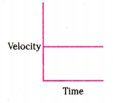
Question 10.
What is the time taken by the body, when it is freely dropped from a height “h” ?
Answer:
h = \(\frac{1}{2}\)gt2; t2 = \(\frac{2 h}{g} \Rightarrow t=\sqrt{\frac{2 h}{g}}\)
IV. Very Short Answer Questions
Question 1.
The states of motion and rest are relative. Explain. [dlarch – 2026]
Answer:
REST: If the position of a body does not change with respect to surroundings, it is said to be at “Rest”.
MOTION : If the position of a body changes with respect to surroundings, it is said to be in “Motion”. By definitions, rest and motion are relative with respect to surroundings.
Question 2.
Is it necessary that the direction of acceleration and velocity of a body should be the same? Give an example.
Answer:
No. For a decelerating body velocity is in forward direction and acceleration will be in opposite direction.
Question 3.
Is it possible for a body to have acceleration but zero velocity? Give an example.
Answer:
In case of vertically projected body at maximum height its velocity v = 0. But acceleration due to gravity ‘g’ is not zero.
So even though velocity v = 0 ⇒ acceleration is not zero.
Question 4.
Which is greater, a velocity of 72kmph or 25m/s ?
Answer:
V1 = 72 × \(\frac{5}{18}\) = 20m/s; V2 = 25m/s ∴ 25m/s is greater than 72kmph.
Question 5.
Give an example of one-dimensional motion where a particle moving along a straight line comes to rest and moves backward.
Answer:
- A body projected vertically upwards.
- When the length of pendulum is high and amplitude is less then its motion is along a straight line. The pendulum will come to a stop at extreme position and moves back in forward direction (‘x’ + ve) periodically.
Question 6.
A vehicle travels half the distance L with speed Vj and the other half with speed v2. What is the average speed ?
Answer:
The average speed of a vehicle for the two equal parts \(\frac{\mathrm{L}}{2}, \frac{\mathrm{~L}}{2}\) is
Vavg = \(\frac{\text { Total distance }}{\text { Total time }}=\frac{\frac{\mathrm{L}}{2}+\frac{\mathrm{L}}{2}}{\mathrm{t}_1+\mathrm{t}_2}\)
Vavg = \(\frac{\mathrm{L}}{\left(\frac{\frac{\mathrm{~L}}{2}}{\mathrm{~V}_1}+\frac{\frac{\mathrm{L}}{2}}{\mathrm{~V}_2}\right)}=\frac{\mathrm{L}}{\frac{\mathrm{~L}}{2}\left(\frac{1}{\mathrm{~V}_1}+\frac{1}{\mathrm{~V}_2}\right)}=\frac{1}{\frac{1}{2}\left(\frac{\mathrm{~V}_1+\mathrm{V}_2}{\mathrm{~V}_1 \mathrm{~V}_2}\right)}\) (∵ t = \(\frac{\mathrm{L} / 2}{\mathrm{~V}}\)) ⇒ Vavg = \(\frac{2 V_1 V_2}{V_1+V_2}\)
Question 7.
A body covers a distance of 5m along a semicircular path from its one end to another end. What is the ratio of its distance covered to its displacement ?
Answer:
πr = 5; r = 5/π
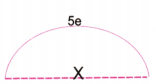
\(\frac{\text { Distance }}{\text { Displacement }}=\frac{\pi \mathrm{r}}{2 \mathrm{r}}=\frac{\pi}{2}=\frac{22}{7 \times 2}=\frac{11}{7}\)
Question 8.
Displacement travelled by a body is given by S = 2t + 5t2 m. What is the acceleration of that body ?
Answer:
S = 2t + 5t2; V = \(\frac{\mathrm{ds}}{\mathrm{dt}}\) = 2 + 10t; a= \(\frac{\mathrm{dv}}{\mathrm{dt}}\) = 10m/s2
Question 9.
An object falling through a fluid is observed to have an acceleration given by a = g – bv where g is the gravitational acceleration and b is a constant. After a long time it is observed to fall with a constant velocity. What would be the value of this constant velocity ?
Answer:
Acceleration, a- = g – bv when moving with constant velocity, a = 0 ⇒ 0 = g – bv
∴ Constant velocity, v = \(\frac{\mathrm{g}}{\mathrm{~b}}\) m/sec.
Question 10.
Under what circumstances is the relationship s = vt valid ?
Answer:
Body moving with uniform velocity (a = 0).
V. Short Answer Questions
Question 1.
Can the equations of kinematics be used when the acceleration varies with time ? If not, what form would these equations take ?
Answer:
The equations of motion are 1) v =u + at 2) s = ut + 1/2at2 and 3) v2 – u2 = 2as. All these three equations applicable to a body moves with uniform acceleration ‘a’.
No, the equations are not applicable when the acceleration varies with time.
Question 2.
A particle moves in a straight line with uniform acceleration. Its velocity at time t = 0 is V1 and at time t = t is v2. The average velocity of the particle in this time interval is (v1 + v2) / 2. Is this correct ? Substantiate your answer.
Answer:
t1 = 0 ⇒ u = v1 ; t2 = t ⇒ v = v2; Average velocity = \(\frac{u+v}{2}=\frac{v_1+v_2}{2}\)
Question 3.
Can the velocity of an object be in a direction other than the direction of acceleration of the object ? If so, give an example.
Answer:
Yes. Velocity of a body and its acceleration may be in different directions.
Ex :
1) In case of vertically projected body ⇒ velocity of body is in the upward direction and acceleration is in downward direction.
2) When brakes are applied the velocity of body before coming to rest is opposite to retarding acceleration.
Question 4.
Obtain the equation of motion x = ut + \(\frac{1}{2}\)at2 for constant acceleration using graphical method.
Answer:
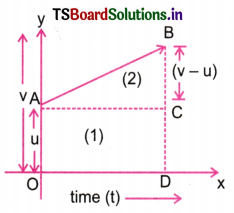
The velocity – time graph of a body moving with initial velocity ‘u’ and with uniform acceleration ‘a’ as shown. Let V be the velocity of the body after a time t.
In v – t graph, area of velocity-time graph = total displacement travelled by it. Area under velocity – time graph = area of OABCD
∴ Area of Rectangular part OACD = Area of OACD + Area of ABC.
A1 = OA × OD = ut …..(1)
Area of triangle ABC = A2
A2 = \(\frac{1}{2}\) × Base × height = \(\frac{1}{2}\) × AC × (BC) = \(\frac{1}{2}\)t(u – v)
But v – u = at; ∴ A2 = \(\frac{1}{2}\)t. at = \(\frac{1}{2}\)at2
∴ Total area under graph = s = A1+ A2; s(n) = ut + \(\frac{1}{2}\)at2.
∴ s = ut + \(\frac{1}{2}\)at2 is graphically proved.
Question 5.
Explain the terms the average velocity and instantaneous velocity. When are they equal?
Answer:
Average velocity : It is the ratio of total displacement to total time taken. It is independent of path of the body.
∴ Average velocity = \(\frac{\mathrm{s}_2-\mathrm{s}_1}{\mathrm{t}_2-\mathrm{t}_1}\) (Or) Vavg = \(\frac{\mathrm{ds}}{\mathrm{dt}}\)
Velocity of a particle at a particular instant of time is known as instantaneous velocity. Here time interval is very small. V = \(\frac{\mathrm{dx}}{\mathrm{dt}}\)
Only in uniform motion, instantaneous velocity = average velocity. For all other cases instantaneous velocity may differ from average velocity.
Problems
Question 1.
A man walks on a straight road from his home to a market 2.5 km away with a speed of km h-1. Finding the market closed, he instantly turns and walks back home with a speed of 7.5 km h-1. What is the (a) magnitude of average velocity mid (b) average speed of the man over the time interval 0 to 50 minutes ?
Solution:
Time taken by man to go from his home to market, t1 = \(\frac{\text { distance }}{\text { speed }}=\frac{2.5}{5}=\frac{1}{2} \mathrm{~h}\)
Time taken by man to go from market to his home, t1 = \(\frac{2.5}{7.5}=\frac{1}{3} h\)
∴ Total time taken = t1 + t2 = \(\frac{1}{2}+\frac{1}{3}=\frac{5}{6} h\) = 50min.
In time interval 0 to 50 min,
Total distance travelled = 2.5 + 2.5 = 5 km.; Total displacement = zero.
- Average velocity = \(\frac{\text { displacement }}{\text { time }}\) = 0
- Average speed = \(\frac{\text { distance }}{\text { time }}=\frac{5}{5 / 6}\) = 6 km/h
Question 2.
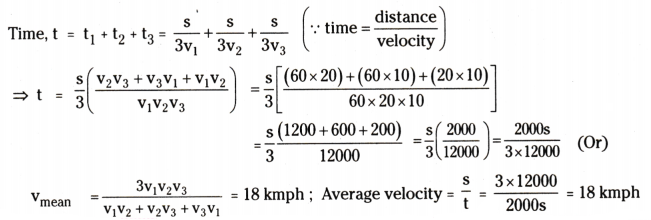
A car travels the first third of a distance with a speed of 10 kmph, the second third at 20 kmph and the last third at 60 kmph. What is its mean speed over the entire distance ?
Solution:
Total distance = s; distance travelled, S1 = \(\frac{s}{3}\); velocity, v1 = 10 kmph ; distance, s2 = \(\frac{s}{3}\) velocity, v2 = 20 kmph; distance, s3 = \(\frac{s}{3}\); velocity, v3 = 60 kmph
Average velocity = \(\frac{\text { total distance }}{\text { total time }}\)
Question 3.
A bullet moving with a speed of 150 m s-1 strikes a tree and penetrates 3.5 cm before stopping. What is the magnitude of its retardation in the tree and the time taken for it to stop after striking the tree?
Solution:
Velocity of bullet, u = 150 m/s; Final velocity, v = 0 ; Distance travelled, s = 3.5 cm = 3.5 × 10⁻² m,
a) Acceleration, a = \(\frac{v^2-u^2}{2 s}=\frac{0^2-150^2}{2 \times 3.50 \times 10^{-2}}=\frac{-22500}{7 \times 10^{-2}}\)
= -3.214 × 10⁵ m/sec2 (-ve sign for retardation)
b) Time taken to stop, t = \(\frac{v-u}{a}=\frac{-150}{-3.214 \times 10^5}\) = 4.67 × 10⁻⁴ sec.
Question 4.
A motorist drives north for 30 min at 85 km/h and then stops for 15 min. He continues travelling north and covers 130 km in 2 hours. What is his total displacement and average velocity ?
Solution:
In first part:
Velocity, v1 = 85 kmph ; Time, t1 = 30 min ; Distance travelled, s1 = v1 t1 = 85 × \(\frac{30}{60}\) = 42.5 km
In second part:
Distance travelled, s2 = 0 ; Time, t2 = 15.0 min.
In third part:
Distance travelled, s3 = 130 km ; Time, t3 = 2 hours = 120 min.
a) Total distance of the motorist, s = s1 + s2 + s3 = 42.5 + 0 + 130 = 172.5 km
b) Total time travelled,
t = t1 + t2 + t3 = 30 + 15 + 120 = 165 minutes = 2 hrs 45 minutes = 2\(\frac{3}{4}\) hrs. = \(\frac{11}{4}\) hrs.
∴ Average velocity, vavg = \(\frac{\text { total displacement }}{\text { total time }}=\frac{172.5}{(11 / 4)}\) = 62.7 kmph.
Question 5.
A ball A is dropped from the top of a building and at the same time an identical ball B is thrown vertically upward from the ground. When the balls collide the speed of A is twice that of B. At what fraction of the height of the building did the collision occur ?
Solution:
Given at time of collision velocity of A = VA = 2 × VB (velocity of B)
Let the body be dropped from a height ‘h’. Let the two stones collide at x from the ground.
For the body dropped, s = h – x = \(\frac{1}{2}\)gt2 → (1); For the body thrown up, x = ut – \(\frac{1}{2}\)gt2 → (2)
For the body dropped, v = u + at ⇒ VA = gt → (3)
For the body thrown up, v = u – gt ⇒ VB = u – gt → (4)
Given VA = 2VB ⇒ gt = 2 (u – gt) or u = \(\frac{3gt}{2}\) → (5)
Divide equation (1) with equation (2)
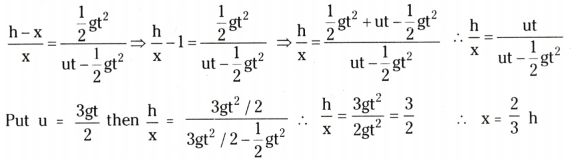
∴ Fraction of height of collision = \(\frac{2}{3}\)
Question 6.
Drops of water fall at regular intervals from the roof of a building of height 16 m. The first drop strikes the ground at the same moment as the fifth drop leaves the roof. Find the distances between successive drops.
Solution:
Height of building, h = 16 m
∴ Time taken to reach the ground, t = \(\sqrt{\frac{2 h}{g}}\)
∴ Time taken to fall, t = \(\sqrt{\frac{2 \times 16}{9.8}}=\sqrt{\frac{32}{9.8}}=\sqrt{3.26}\) = 1.80
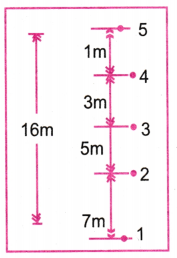
Number of drops, n = 5
∴ Number of intervals = n – 1 = 5 – 1 = 4
Time interval between drops = \(\frac{1.8}{4}\) = 0.45 sec
Time of travel of 1st drop, t1 = 4 × 0.45 = 1.8
∴ Distance travelled by
1st drop, S1 = \(\frac{1}{2}\)gt12 = \(\frac{1}{2}\) × 9.8 × 1.8 × 1.8 = 16 m
For 2nd drop, t2 = 3 × 0.45 = 1.35 sec., S2 = \(\frac{1}{2}\)gt22 ;
∴ S2 = \(\frac{1}{2}\) × 9.8 × 1.352 = 4.9 × 1.822 = 8.9278 ≅ 9m
For 3rd drop, t3 = 2 × 0.45 = 0.9 sec.
Distance, S3 = \(\frac{1}{2}\)gt32 = \(\frac{1}{2}\) × 9.8 × 0.92 = 3.97 ≅ 4m
For 4th drop, t4 = 1 × 0.45 = 0.45 sec.
Distance travelled, S4 = \(\frac{1}{2}\)gt42 = \(\frac{1}{2}\) × 9.8 × (0.45)2 ≅ 1
For 5 th drop, t5 = 0 ⇒ S5 = 0
Distance between 1st and 2nd drop S1, 2 = S1 – S2 = 16 – 9 = 7m
Distance between 2nd and 3rd drop S2, 3 = S2 – S3 = 9 – 4 = 5 m
Distance between 3rd and 4th drop S3, 4 = S3 – S4 = 4 – 1 = 3m
Distance between 4th and 5th drop S4, 5 = S4 – S5 = 1 – 0 = 1 m
∴ Distances between successive drops are 7m, 5m, 3m and 1m.
Question 7.
A food packet is dropped from an aeroplane, moving with a speed of 360 kmph in a horizontal direction, from a height of 500m. Find (i) its time of descent (ii) the horizontal distance between the point at which the food packet reaches the ground and the point above which it was dropped.
Solution:
Velocity of plane, V = 360 kmph = 360 × \(\frac{5}{18}\) = 100 m/s.
Height above the ground, h = 500 m; g = 10 m/s2
i) Time of descent, t = \(\) = 10sec.
ii) Horizontal distance between point of dropping and point where it reaches the ground = Range R.
∴ R = u \(\sqrt{\frac{2 \mathrm{~h}}{\mathrm{~g}}}\) = 100 \(\sqrt{\frac{2 \times 500}{10}}\) = 100 x 10 = 1000 m.
Motion in a Straight Line Class 11 NCERT Solutions
Question 1.
In which of the following examples of motion, can the body be considered approximately point object.
(a) a railway carriage moving without jerks between two stations.
(b) a monkey sitting on the top of a man cycling smoothly on a circular track.
(c) a spinning cricket ball that turns sharply on hitting the ground.
(d) a tumbling beaker that has slipped off the edge of a table.
Answer:
(a) A railway carriage can be considered as a point object because the size of carriage is much smaller than the distance between the two stations.
(b) A monkey sitting on the top of the cyclist can be considered as a point object if the cyclist describes a circular path of radius which is sufficiently larger than the size of monkey.
(c) A spinning cricket ball cannot be considered as a point object because the size of ball is not negligible as compared to the distance through which the ball may turn on hitting the ground.
Remark: The spinning motion of cricket ball is due to its size. A point mass cannot have spin motion.
(d) A beaker slipping off the edge of a table cannot be considered as a point object because the size of beaker is not negligible as compared to the height of the table.
Question 2.
The position – time (x – t) graphs for two children A and B returning from their school O to their homes P and Q respectively as the shown in Fig.
Choose the correct entries in the brackets below :
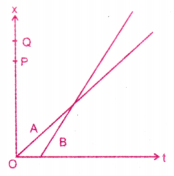
(a) (A/B) lives closer to the school than (B/A).
(b) (A/B) starts from the school earlier than (B/A).
(c) (A/B) walks faster than (B/A).
(d) A and B reach home at the (same/different) time.
(e) (A/B) overtakes (B/A) on the road (once/twice).
Answer:
(a) As OP < OQ ; A lives closer to school than B.
(b) For A, x = 0 at t = 0 and for B, x = 0 at t = t0 (let)
This implies that A starts from the school earlier than B.
(c) The speed = slope of x – t graph. As slope of B is greater than the slope of A, therefore, B walks faster than Answer:
(d) From graph, it is clear that the positions P and Q are attained at the same time, this implies that both A and B reach home at the same time.
(e) x – t graphs for A and B intersect each other only once, so B overtakes A on the road once.
Question 3.
A woman starts from her home at 9.00 am, walks with a speed of 5 kmh-1 on a straight road upto her office 2.5 km away, stays at the office upto 5.00 pm and returns home by an auto with a speed of 25 kmh-1. Choose suitable scales and plot the x-t graph of her motion.
Answer:
For motion from home to office :
Time to which woman leaves the office = 09.00 am
Speed = 5 km/h, distance traversed, s = 2.5 km
Time taken, t1 = \(\frac{\text { Distance traversed }}{\text { Speed }}=\frac{2.5}{5}\) = 0.5 h = 30 min.
Time at which woman reaches office
= 9.00 am + 0.30 = 9.30 am
Stay at office : 9.30 am – 5.00 pm (position fixed)

For motion from office to home :
Time at which she leaves office = 5.00 pm
Speed of auto = 25 km/h, distance = 2.5 km
Time spent, t2 = \(\frac{\text { Distance }}{\text { Speed }}=\frac{2.5}{25}\) = 0.1 h = 0.1 × 60 min = 6 min
Time at which she reaches home = 5.06 pm
The position-time (x – t) graph of motion of woman is as shown in the Fig.
Question 4.
A drunkard walking in a narrow lane takes 5 steps forward and 3 steps backward, followed again by 5 steps forward and 3 steps backward, and so on. Each step is 1 m long and requires 1 s. Plot the x – t graph of his motion. Determine graphically and otherwise how long the drunkard takes to fall in a pit 13 m away from the start.
Answer:
The drunkard takes 5 steps forward and 3 steps backward. Each step is of 1 m length and takes 1 second. Therefore, the displacement of drunkard as a function of time is as shown below.
| t (seconds) | 0 | 5 | 8 | 13 | 16 | 21 | 24 | 29 | 32 | 37 |
| x (m) | 0 | 5 | 5 – 3 = 2 | 2 + 5 = 7 | 7 – 3 = 4 | 4 + 5 = 9 | 9 – 3 = 6 | 6 + 5 = 11 | 11 – 3 = 8 | 8 + 5 = 13 |
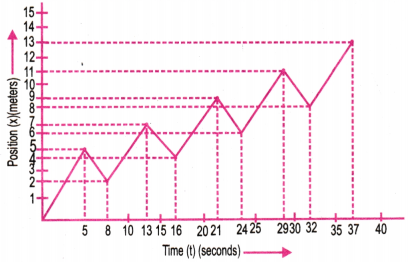
The position – time graph of motion of drunkard is as shown in the Fig.
From graph, it is clear that the drunkard will fall into the pit 37 seconds after the beginning.
Question 5.
A car moving along a straight highway with a speed of 126 kmir1 is brought to a stop within a distance of 200 m. What is the retardation of the car (assumed uniform); and how long does it take for the car to stop ?
Answer:
Initial speed of car, u = 126 km/h
1 km/h = \(\frac{1000 \mathrm{~m}}{3600 \mathrm{~s}}=\frac{5}{18}\) m/s ; u = 126 × \(\frac{5}{18}\) = 35 m/s
Final speed of car, v = 0, Distance traversed, s = 200 m
Using the formula v2 = u2 + 2as, we get
0 = (35)2 + 2a × 200 ⇒ -400a = (35)2 ⇒ a = \(\frac{(35)^2}{400}\) = -3.06 ms-2
Retardation of Car = 3.06 ms-2
If t is the time taken, then formula v = u + at gives
0 = 35 – 3.06 t ⇒ 3.06t = 35 ⇒ t = \(\frac{35}{3.06}\) = 11.4 s
Question 6.
A player throws a ball upwards with an initial speed of 29.4 ms1.
(a) What is the direction of acceleration during the upward motion of the ball ?
(b) What are the velocity and acceleration of the ball at the highest point of its motion ?
(c) Choose the x = 0 m and t = 0 s to be the location and time of the ball at its highest point, vertically downward direction to be the positive direction of x-axis and give the signs of position, velocity and acceleration of the ball during its upward and downward motion.
(d) To what height does the ball rise and after how long does the ball return to the player’s hands ?[Take g = 9.8 ms-2 and neglect air resistance].
Answer:
(a) The ball moves under gravity throughout its motion. The acceleration due to gravity is always directed vertically downward. So, the direction of acceleration during the upward motion of the ball is vertically downward.
(b) At the highest point of motion, the velocity of ball is zero and the acceleration is 9.8 ms-2 directed vertically downward.
(c) As the ball remains between highest point and earth, so during upward and downward motion of ball, x > 0 (or x is positive).
During vertically upward direction v is negative (v < 0) and during vertically downward direction v is positive (v > 0).
Acceleration is always g = + 9.8 ms-2 (positive).
(d) Using formula v2 = u2 + 2as, we have
a = + g = 9.8 ms-2, s = – H, v = 0 (at highest point)
u = – 29.4 ms-1 (given)
0 = (-29.4)2 – 2 × 9.8 × H ⇒ H = \(\frac{(29.4)^2}{2 \times 9.8}\) m = 44.1 m
Also from relation, s = ut + \(\frac{1}{2}\)at2,
we have s = 0, u = -29.4 m/s, a = 98m/s2
0 = -29.4 t + \(\frac{1}{2}\) × 9.8t2 or \(\frac{1}{2}\) 9.8t2 = 29.4 t ⇒ t = \(\frac{29.4}{4.9}\) = 6s.
∴ Height, (H) = 44.1m and time taken (t) = 6s.
Question 7.
Read each statement below carefully and state with reasons and examples, if it is true or false.
A particle in one-dimensional motion
(a) with zero speed at an instant may have non-zero acceleration at that instant.
(b) with zero speed may have non-zero velocity,
(c) with constant speed must have zero acceleration,
(d) with positive value of acceleration must be speeding up.
Answer:
(a) True; at highest point of particle thrown in vertically upward direction, the speed is zero but acceleration is g = 9.8 ms-2 vertically downward.
(b) False; because velocity = speed + direction. As speed is zero, velocity must be zero.
(c) True; as v = constant; acceleration a = \(\frac{d v}{d t}\) = 0
(d) False, when a body is thrown upward its speed decreases, but gravitational acceleration is downward (assumed positive direction).
However, if body continues to move along a straight line on a smooth horizontal surface, then positive acceleration will necessarily imply speeding up.
Question 8.
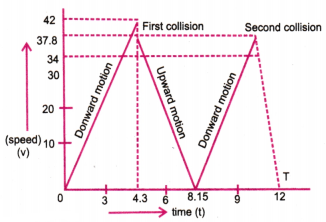
A ball is dropped from a height of 90 m on a floor. At each collision with the floor, the ball loses one-tenth of its speed. Plot the speed-time graph of its motion between t = 0 to 12 s.
Answer:
Let t1 be the time taken by the ball to hit the floor.
Given, u = 0, h = 90 m, g = 9.8 m/s2
Formula, h = ut + \(\frac{1}{2}\)gt2 gives
90 = 0 + \(\frac{1}{2}\)9.8t12 ⇒ t12 = \(\frac{90}{4.9}=\frac{900}{49}\) ⇒ t1 = \(\frac{30}{7}\) = 4.3 s.
The speed of the ball when it hits the floor first time is given by
v1 = u + gt1 = 0 + 9.8 × \(\frac{30}{7}\) = 42 m/s
Now the ball bounces upward after collision. As the ball loses one-tenth of speed during collision, therefore, upward speed of ball just after collision
v2 = \(\frac{9}{10}\) × 42 = 37.8 m/s
The ball now starts moving upward with retardation g = 9.8 m/s2. The speed of ball at any instant t will be (u1 = v2 = 37.8 m/s).
∴ v = u1 – gt = 37.8 – 9.8 t
The speed of ball becomes zero at highest point after time t21 is given by
0 = 37.8 – 9.8 t21 ⇒ t21 = \(\frac{37.8}{9.8}\) = 3.85 s
Now the ball begins to fall downward and attains a speed of 37.8 m/s just before collision with the floor. As time of ascent = time of descent.
∴ Time taken by ball to hit the floor
t211 = 3.85 s
Total time upto this instant
T = t2 + t21 + t211 = 4.3 + 3.85 + 3.85 = 12 s
The speed of ball just after second collision
v3 = \(\frac{9}{10}\) × 37.8 ≅ 34m/s
The graph of speed and time is as shown in the Fig.
Remark: Speed is never negative.
Question 9.
Explain clearly, with examples, the distinction between
a) magnitude of displacement (sometimes called distance) over an interval of time and the total length of the path covered by a particle over the same interval.
b) magnitude of average velocity over an interval of time, and the average speed over the same interval. [Average speed of a particle over an interval of time is defined as the total paths length divided by the time interval].
Show in both (a) and (b) that the second quantity is either greater than or equal to the first. When is the equality sign true ? [For simplicity, consider one-dimensional motion only].
Answer:
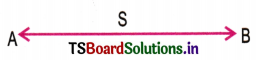
For simplicity we suppose one-dimensional motion, where an object traverses from A to B and then returns back in total time t where AB = s.
(a) Displacement = 0 and total path length = AB + AB = 2s.
(b) Average velocity = \(\frac{\text { Displacement }}{\text { Time }}=\frac{0}{t}\) = 0
Average speed = \(\frac{\text { Total path length }}{\text { Time }}=\frac{2 \mathrm{~s}}{\mathrm{t}}\)
In both the cases (a) and (b), the second quantity (i.e., total path length and speed) turns out to be greater than the first (i.e., magnitude of displacement and velocity respectively). However, if the motion takes place along a straight line without change in direction, then equality sign will be true.
That is then, magnitude of displacement = Total path length
(i.e., motion along a straight line in one direction) and magnitude of velocity = Speed.
Question 10.
A man walks on a straight road from his home to a market 2.5 km away with a speed of 5 kmh-1. Finding the market closed, he instantly turns and walks back home with a speed of 7.5 kmh ‘. What is the
(a) Magnitude of average velocity, and
(b) The average speed of the man over the interval of time
(i) 0 to 30 min,
(ii) 0 to 50 min,
(iii) 0 to 40 min ?
Answer:
Distance of market from home = 2.5 km; Speed of man from home to market = 5 km/h
Time taken by man to reach market, t =Speed of man, while returning from the market = 7.5 km/h
∴ Time taken by man to return the home, t1 = \(\frac{\text { Distance }}{\text { Speed }}=\frac{2.5}{5}=\frac{1}{2} \mathrm{~h}\) = 20 min
Speed of man, while returning from the market = 7.5 km/h
Time taken by man to return the home, t2 = \(\frac{2.5}{7.5}=\frac{1}{3} h\) = 20 min
Total time of man returning to his home = 30 min + 20 min = 50 min
(i) Over the interval 0 to 30 min :
During this time, man goes from home to market; therefore, displacement, s = 2.5 km
Average velocity = \(\frac{\text { Displacement }}{\text { Time }}=\frac{2.5}{1 / 2}\) = 5km/h
Average speed = \(\frac{\text { Distance }}{\text { Time }}=\frac{2.5}{1 / 2}\) = 5 km/h
Clearly, during motion along a straight line (without turn), the average speed and average velocity are equal in magnitude.
(ii) Over the interval 0 to 50 min :
In 50 min the man goes from home to market and returns back to home.
Net displacement = zero
Average velocity = \(\frac{\text { Net displacement }}{\text { Total time }}=\frac{0}{50}\)
Average speed = \(\frac{\text { Total distance }}{\text { Total time }}=\frac{2.5 \mathrm{~km}+2.5 \mathrm{~km}}{(50 \mathrm{~min})}+\frac{5 \mathrm{~km}}{50 \times \frac{1}{60} \mathrm{~h}}\) = 6 km/h.
(iii) Over the interval 0 to 40 min :
During first 30 min man goes from home to market covering a distance of 2.5 km; in next 10 min the man is in path from market to home and covers a distance
= (75 km/h) × \(\left(\frac{10}{60} h\right)\) = 1.25 km
Displacement = 2.5 – 1.25 = 1.25 km
Distance = 2.5 + 1.25 = 3.75 km
Average velocity = \(\frac{\text { Displacement }}{\text { Time }}=\frac{1.25}{40 \times \frac{1}{60} \mathrm{~h}}\) = 1.875 km/h
Average speed = \(\frac{\text { Distance }}{\text { Time }}=\frac{3.75 \mathrm{~km}}{40 \times \frac{1}{60} \mathrm{~h}}\) = 5.625 km/h
Question 11.
In problems 9 and 10, we have carefully distinguished between average speed and magnitude of average velocity. No such distinction is necessary when we consider instantaneous speed and magnitude of velocity. The instantaneous speed is always equal to the magnitude of instantaneous velocity. Why ?
Answer:
Instantaneous velocity, v = \(\frac{\mathrm{ds}}{\mathrm{dt}}\)
Where ds is infinitesimal displacement in infinitesimal time interval.
For infinitesimal interval of time there is no change in direction so the magnitude of displacement is equal to the length of the path; hence magnitude of instantaneous velocity = instantaneous speed.
Question 12.
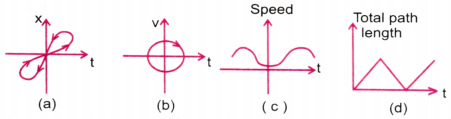
Look at the graphs (a) to (d) carefully and state, with reasons, which of these cannot possibly represent one-dimensional motion of a particle.
Answer:
(a) It does not represent one-dimensional motion because according to this graph particle has two positions at the same time, which is impossible.
(b) It does not represent one dimensional motion because according to this graph the particle have equal positive and negative velocity at the same time, which is impossible.
(c) It cannot represent one-dimensional motion because according to graph speed is negative at certain instants, which is impossible (speed can never be negative).
(d) It cannot represent one-dimensional motion because according to this graph after a certain time the total path length begins to decrease with increase of time, which is impossible (total path length will always increase with increase of time).
Question 13.
Fig. shows the x – t graph of one-dimensional motion of a particle. Is it correct to say from the graph that the particle moves in a straight line for t < 0 and on a parabolic path for t > 0 ? If not suggest a suitable physical context for this graph.
Answer:
For t < 0, the particle is at rest; since, its position remains at x = 0. For t > 0, x – t graph is parabolic, it is possible if motion of particle is uniformly accelerated since x = ut + \(\frac{1}{2}\)at2
If u = 0, x = \(\frac{1}{2}\)at2 or x ∝ t2 (parabola)
Thus, it is not correct to say that the particle moves in a straight line for t < 0, because during t < 0, the particle does not move at all. However, for t > 0, the trajectory is parabolic which is possible if particle moves along a straight line with uniform acceleration. It is again not correct to say that particle moves on parabolic path for t > 0.
Physical context: The graph may represent the motion of a particle released from the top of a hill or tower.
Question 14.
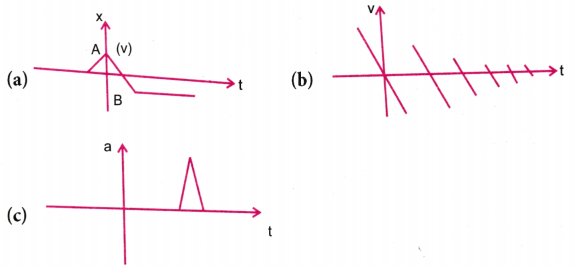
Suggest a suitable physical situation for each of the following graphs.
Answer:
(a) The given x – t graph shows that initially x = 0, then ball gains constant velocity which then reverses in direction and finally its velocity becomes zero.
Physical situation : The ball is initially at rest on a smooth floor. It is kicked and given a constant velocity. Then, it strikes a wall, rebounds with reduced speed and strikes the opposite wall which stops it.
(b) The given velocity – time graph (v – t) shows that the velocity changes sign again and again with the passage of time and each time, it loses some speed.
Physical situation : A ball thrown up with some initial velocity rebounding from the floor with reduced speed after each collision.
(c) The given a – t graph shows that initially acceleration of object is zero. It gains acceleration for a very short duration and immediately it is decelerated and again, its acceleration is zero.
Physical situation: A cricket ball moving with a uniform speed is hit back with a bat for a very short duration.
Question 15.
Fig. gives the x – t plot of a particle executing one-dimensional simple harmonic motion. Give the signs of position velocity and acceleration variables of the particle at t = 0.3 s, 1.2 s and – 1.2 s.
Answer:
Position is positive when particle is above t – axis and negative if particle is below t – axis. Velocity is positive, when x increases with increase of time and velocity is negative when x decreases with increase of time. Acceleration is positive when the slope of x – t curve increases and negative when slope of x – t curve decreases.
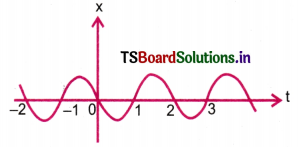
At 0.3 s, x is negative, v is negative and a is positive.
At 1.2 s, x is positive, v is positive and a is negative.
At – 1.2 s, x is negative, v is positive and a is positive.
Question 16.
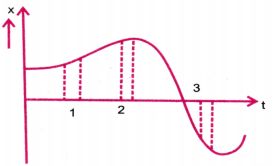
Fig. shows x – t plot of a particle in one-dimensional motion. Three different equal intervals of time are shown. In which interval is the average speed greatest, and in which is it the least ? Give the sign of average velocity for each interval.
Answer:
The average speed inx-t graph is equal to the slope of line joining the initial and final points in that interval. From the graph the slope is greatest in interval 3 and least in interval 2. Therefore, average speed is greatest in interval 3 and average speed is least in interval 2. Slope is positive in intervals 1 and 2 and negative in interval 3, so the average velocity is positive during intervals 1 and 2 and negative during interval 3.
Question 17.
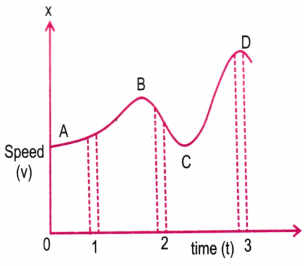
Fig. shows a speed – time graph of a particle in motion along a constant direction. Three equal intervals of time are shown. In which intervals is the average acceleration greatest in magnitude ? In which interval is the average speed greatest ? Choosing the positive direction as the constant direction of motion, give the signs of v and a in the three intervals. What are the accelerations at the points A, B, C and D ?
Answer:
The average acceleration is given by the slope of line joining the two points onv-f graph for given interval of time. From the graph, out of three intervals the slope is maximum in interval (2) but it is negative. Therefore, the magnitude of average acceleration is greatest in interval 2.
Average speed in a given interval = \(\frac{v_1+v_2}{2}\)
From the graph, it is clear that the magnitudes of v1 and v2 are maximum in interval 3, so average speed is maximum in interval 3.
Signs of v: The speed v is always positive. Therefore, it is positive in all the three intervals.
Signs of a: In interval T slope at v -1 graph is positive, therefore, acceleration is positive. In interval 2, the slope of v – t graph is negative, therefore, the acceleration is negative. In interval 3, the slope of v – t graph is positive, therefore, the acceleration is positive.
The instantaneous acceleration is equal to the slope of tangent on v – t graph at given instant. The tangents drawn on given v – t curve at points A, B, C and D are parallel to time axis, so slope is zero.
Hence, acceleration at points A, B, C and D are zero.
Question 18.
A police van moving on a highway with a speed of 30 km/h fires a bullet at a thief’s car speeding away in the same direction with a speed of 192 km/h, if the muzzle speed of the bullet is 150 m/s, with what speed does the bullet hit the thief’s car ?
(Note : Obtain that speed which is relevant for damaging thief’s car ?)
Answer:
Let vp be the velocity of police van, vT be the velocity of thief’s car and uBP the muzzle velocity of bullet. Muzzle velocity means the velocity with respect to gun (or police van).
Given, vP = 30 km/h = 30 × \(\frac{1100 \mathrm{~m}}{(60 \times 60) \mathrm{s}}=\frac{25}{3} \mathrm{~m} / \mathrm{s}\)
vT = 192 km/h = 192 x \(\frac{1100 \mathrm{~m}}{(60 \times 60) \mathrm{s}}=\frac{160}{3} \mathrm{~m} / \mathrm{s}\)
uB = 150 m/s
All velocities are in same direction, therefore, if uB is the velocity of bullet with respect to earth, the velocity of bullet with respect to police van
uBP = uB + vP = 150 + \(\frac{25}{3}=\frac{475}{3}\)m/s
Relative velocity of bullet with respect to thief’s car
uBT = uB – vT = \(\frac{475}{3}-\frac{160}{3}=\frac{315}{3}\)= 105 m/s.