
Regular practice with AP Inter 1st Year Physics Study Material Chapter 1 Units and Measurements Questions and Answers helps students stay prepared for examinations.
AP Inter 1st Year Physics 1st Lesson Units and Measurements Questions and Answers
I. Multiple Choice Questions
Question 1.
Pascal is the unit of
(1) power
(2) pressure
(3) potential energy
(4) pressure gradient
Answer:
(2) pressure
Question 2.
When the number 0.046508 is reduced to four significant figures then it becomes
(1) 0.04651
(2) 4650
(3) 4.651
(4) 4.650
Answer:
(1) 0.04651
Question 3.
Which of the following physical quantity has no dimensions?
(1) Angular Velocity
(2) Angular Acceleration
(3) Angular Displacement
(4) Stress
Answer:
(3) Angular Displacement
Question 4.
Mention same dimensions in the dimensional formula of torque and angular momentum.
(1) mass, time
(2) time, length
(3) mass, length
(4) mass
Answer:
(3) mass, length
Question 5.
The velocity of an object varies with time as v = At2 + Bt + C. If v and t are expressed in SI,
what are the units of A, B and C ?
(1) LT-1
(2) LT-2
(3) LT-3
(4) LT4
Answer:
(1) LT-1
V = At2 + Bt + C, From principal of Homogeneity. V = [LT-1]
Question 6.
Which of the following equation is dimensionally correct?
(1) \(\frac{1}{2}\)mV2 = mgh
(2) V = ut + at
(3) s = ut + at3
(4) t = s + uv
Answer:
(1) \(\frac{1}{2}\)mV2 = mgh
Question 7.
The velocity (V) of sound with air pressure (P) and density (d) of air are related as V ∝ Pxdy. The value of x and y are.
(1) 1, 1/2
(2) -1/2, 1/2
(3) 1/2, -1/2
(4) 1/2, 1/2
Answer:
(3) 1/2, -1/2
V = Pxdy → LT-1 = [ML-1T-2]x [ML-3]y.
equality powers of M → x + y = 0 ……….(1), L → 1 = -x – 3y ….(2)
1 = y – 3y ⇒ -2y = 1 ⇒ y = -1/2, x = 1/2
Question 8.
The velocity of a body is given by V = At2 + Bt + C. If V and t are expressed in SI units, then unit of A is
(1) m/s
(2) m/s2
(3) m/s3
(4) ms
Answer:
(3) m/s3
From principle of homogeneity, V = At2 → A = \(\frac{\mathrm{v}}{\mathrm{t}^2}=\frac{\mathrm{LT}^{-1}}{\mathrm{~T}^2}\) = [LT3]
Question 9.
The dimensional formula for product of two physical quantities P and Q is ML2 T-2 and dimensional formula of P/ Q is MT-2 then P is
(1) force
(2) displacement
(3) acceleration
(4) velocity
Answer:
(1) force
P × Q = ML2T-2 ………(1), \(\frac{P}{Q}\) = mT2 …(2)
(1) × (2), P2 M2L2T-2 × MT-2 = M2L2T-4 ⇒ P = MLT-2 = Force.
Question 10.
E, M, L and G denote energy, mass, angular momentum and gravitational constant respectively. Then the dimension of EL2M-5G-2 is
(1) angle
(2) length
(3) mass
(4) time
Answer:
(1) angle
II. Fill in the Blanks
Question 1.
Plane angle is the ratio of length of arc to ________.
Answer:
Radius

Question 2.
The unit of plane angle is ________.
Answer:
Radian
Question 3.
The SI unit of luminous intensity is ______.
Answer:
Candela
Question 4.
The dimensional formula for the coefficient of viscosity is _______.
Answer:
ML-1T-1
Question 5.
The number of significant figures in 0.02308 is _____.
Answer:
4
Question 6.
If F, M and T are the force, mass and time, then FM-1T2 denotes _____.
Answer:
Length
FM-1T2 = MLT-2 M-1T2 = [L]
Question 7.
A number 2.735 is rounded off to three significant figures is _______.
Answer:
2.74
Question 8.
Planck’s constant and ______ have same dimensions.
Answer:
angular momentum
Question 9.
The dimensional formula of angular impulse is ________.
Answer:
ML2T-1
Question 10.
A force is represented by F = Ax2 + Bt2, where x = distance and t = time then the dimensions of ‘A’ ________.
Answer:
ML-1T2
Principle of Homogeneity:
F = Ax2 ⇒ A = \(\frac{\mathrm{F}}{\mathrm{x}^2}=\frac{\mathrm{MLT}^{-2}}{\mathrm{~L}^2}\), A = [ML-1T-2]
III. One Word Answer Questions
Question 1.
What is fundamental physical quantity?
Answer:
Fundamental Quantity : A fundamental quantity is one which is unique and freely existing. It does not depend on any other physical quantity.
Ex : Length (L), Time (T), Mass (M) etc.
Question 2.
What is derived physical quantity?
Answer:
Derived quantity: A derived quantity is produced by the combination of fundamental quanti¬ties (i.e., by division or by multiplication of fundamental quantities).
Ex: Velocity = \(\frac{\text { displacement }}{\text { time }}=\frac{\mathrm{L}}{\mathrm{~T}}\) or LT-1
Acceleration = \(\frac{\text { change in velocity }}{\text { time }}=\frac{\mathrm{LT}^{-1}}{\mathrm{~T}}\) = LT-2 etc.
Question 3.
What is the SI unit of solid angle?
Answer:
Steradian (SI)
Question 4.
Write any one physical constant that is having dimensions.
Answer:
Planck’s constant (D.F : M1 L2 T-1), Gravitational Constant (G) : M-1L3T-2
Question 5.
Which physical quantity has negative dimensions in mass?
Answer:
Universal Gravitational Constant (G) = [M-1 L3 T-2]
Question 6.
Which physical quantity is represented by gR, where R is the radius of the Earth?
Answer:
\(\sqrt{\mathrm{gR}}=\sqrt{\mathrm{LT}^{-2} \times \mathrm{L}}\) = [LT-1 ] = Velocity
Question 7.
Which physical quantity is represented by PV, where P is pressure and V is volume?
Answer:
PV = M1L1T-2 × L3 = [ML2T-2] = Work
Question 8.
Name atleast one physical quantity whose SI unit is Nm .
Answer:
Pressure = force/area \(\frac{\mathrm{MLT}^{-2}}{\mathrm{~L}^2}\)
= [M1L1T-2]; Nm-2 (or) Pascal
IV. Very Short Answer Questions
Question 1.
What are significant figures and what do they represent when reporting the result of a measurement ?
Answer:
Significant figures represent all practically measured digits plus one uncertain digit at the end. When a result is reported in this way we can know up to what extent the value is reliable and also the amount of uncertainty in that reported value.
Question 2.
Distinguish between fundamental units and derived units.
Answer:
The units of fundamental physical quantities are called fundamental units.
Ex : Kg, m, sec, etc.,
The units of derived physical quantities are called derived units.
Ex: m/sec, J, m/sec2 etc.
Question 3.
What are the two fundamental physical quantities used to measure angle ?
Answer:
Plane angle (θ) = Radian.
Solid angle (ω) = Steradian.
Question 4.
Why do we have different units for the same physical quantity ?
Answer:
To measure the same physical quantity we use different units because sometimes the magnitude of the measured quantity value may be very big or very small.
Ex:
1. To measure astronomical distances, we will use light year.
1 light year = 9.468 × 10¹⁵m.
2. To measure atomic distances, we will use Angstrom A (or) Fermi.
Question 5.
Define plane angle.
Answer:
Plane angle is the ratio of length of arc ‘dS’ to the radius “r”.

Question 6.
What is meant by dimension of a physical quantity?
Answer:
Dimension : The power of a fundamental quantity in the given derived quantity is called dimension.
Ex : Force dimensional formula MLT-2.
Here dimensions of Mass → 1, Length → 1, Time → 2.
Question 7.
What is meant by dimensional formula?
Answer:
Dimensional formula : It is a mathematical expression giving relation between various funda-mental quantities of a derived physical quantity.
Ex : Momentum (\(\overline{\mathrm{P}}\)) MLT-1, Energy (E) ML2T-2 etc.
Question 8.
Write the physical quantities that are having J m-1 and J m-2 as their units.
Answer:
Force and Surface Tension.
V. Short Answer Questions
Question 1.
In a system of units, the unit of force is 100N, unit of length is 10m and the unit of time is 100s. What is the unit of mass in this system ?
Answer:
Here, F = MLT-2 = 100 N → (1) ; L = 10 m ; T = 100s
∴ From equation (1)
M × (10) × (100)-2 = 100 ⇒ M × 10-3 = 100 ⇒ M = \(\frac{100}{10^{-3}}\) ⇒ M = 105 kg.
Question 2.
1 calorie = 4.2 J where 1J = 1 kg m2 s-2. Suppose we employ a system of units in which the unit of mass is α kg, the unit of length is β in and the unit of time γs, show that a calorie has a magnitude 4.2 α-1 β-2 γ2 term of new units.
Answer:
Here, 1 calorie = 4.2 J = 4.2 kg m2 / s2 → (1)
As new unit of mass = α kg
∴ 1 kg = \(\frac{1}{\alpha}\) new unit of mass ⇒ α-1 new unit of mass
Similarly lm = β-1new unit of length and Is = γ-1 new unit of time
Putting these values in (1) we get
1 calorie = 4.2 (α-1 new unit of mass) (β-1 new unit of length)2 (γ-1 new unit of time)-2
= 4.2 α-1β-2γ2 new unit of energy, which was proved.
Question 3.
The velocity of a body is given by v = At2 + Bt + C. If v and t are expressed in SI, what are the units of A, B and C ?
Answer:
From principle of Homogeneity the terms At2, Bt and C must have same dimensional formula of velocity ‘v’.
v = Velocity = LT-1 ⇒ LT-1 = A [ T2 ]
∴ A = \(\frac{\mathrm{LT}^{-1}}{\mathrm{~T}^2}\) = LT-3. So unit of A is m/sec3
LT-1 = BT ⇒ B = LT-2 So unit of B is m/sec2
LT-1 = C So unit of C is m/sec.
Question 4.
What are fundamental quantities? State their units in SI system.
Answer:
(i) Fundamental unit: The units of the fundamental quantities are called the “fundamental units”.
Ex : Length → Meter (m), Mass → Kilogram (kg), Time → Second (s) etc.
Basic units or fundamental units of SI system :
| Type of Unit Fundamental Units | Quantity | Unit | Symbol |
| 1. | Length | Metre | m |
| 2. | Mass | kilogram | kg |
| 3. | Time | second | s |
| 4. | Electric current | Ampere | A |
| 5. | Thermodynamic temperature | Kelvin | K |
| 6. | Luminous intensity of a source | candela | cd |
| 7. | Amount of a substance | mole | mol |
| Supplementary Units | Angle Solid Angle | radian steradian | rad sr |
Question 5.
Explain the uses of Dimensional methods with examples.
Answer:
Uses of dimensional methods :
- To convert units from one system to another system.
- To check the validity of given physical equations. For this purpose, we will use homogeneity of dimensions on L.H.S and on R.H.S.
- To derive new relations between various physical quantities.
Question 6.
What are the rules for arithmetic operations with significant figures ?
Answer:
Rules for arithmetic operations with significant figures
1. In multiplication or division, the final result should retain as many significant figures as there in the original number with the least significant figures.
Ex: In the division \(\frac{4.237}{2.51}\) the significant figures are 4 and 3, so least significant figures are ‘3’.
∴ \(\frac{4.237}{2.51}\) = 1.69 i.e., final answer must have only ‘3’ significant digits.
2. In addition or subtraction, the final result should retain as many decimal places are there in the number with the least decimal places.
Ex : 436.26g + 227.2 g Here least number of significant figures after decimal point is one.
∴ 436.26 + 272.2 = 708.46 must be expressed as 708.5 (after rounding off the last digit).
Question 7.
What is the rounding off a number and what are the rules to be followed in it?
Answer:
Rounding off the uncertain digits
Rules for rounding off procedure : In rounding off the numbers to the required number of significant digits the following rules are followed.
- The preceding significant digit is raised by one if the first non-significant digit is more than 5.
- The preceding significant digit is left unchanged if the first non-significant digit is less than 5.
- If the first non-significant figure is 5, then
- If the preceding significant figure is an odd number, then add one to it.
- If the preceding significant figure is an even number, then it is unchanged and 5 is discarded.
Problems
Question 1.
If the velocity of light (c). Planck’s constant (h) and the gravitational constant (G) are taken as fundamental quantities; then express mass, length and time in terms of dimensions of these quantities.
Solution:
Here, c = [L T-1] ; h = [M L2T-1] ; G = [M-1L3T-2]
∴ E = hv, h = \(\frac{\mathrm{E}}{v}\) ; G = \(\left(\frac{\mathrm{Fd}^2}{\mathrm{~m}_1 \mathrm{~m}_2}\right)\)
Let mass (M) = cxhyGz → (1)
⇒ [M1L0T0]=(LT-1 )x (M L2T-1)y (M-1L3T-2 )z
⇒ [M1L0T0] = My-zLx+2y+3zT-x-y-2z
Applying the principle of homogeneity of dimensions, we get
y – z = 1 → (2) ; x + 2y + 3z = 0 → (3) ; – x – y – 2z = 0 → (4)
Adding eq. (2), eq. (3) and eq. (4),
∴ From eq. (2) z = y – 1 = \(\frac{1}{2}\) – 1 = \(\frac{-1}{2}\), From eq. (4) x = -y – 2z = \(\frac{-1}{2}\) + 1 = \(\frac{1}{2}\)
Substituting the values of x, y & z in eq. (1), we get ⇒ M = c1/2 h1/2 G1/2 ⇒ M = \(\sqrt{\frac{\mathrm{ch}}{\mathrm{G}}}\)
Proceeding as above we can show that L = \(\sqrt{\frac{\mathrm{hG}}{\mathrm{c}^3}} \text { and } \mathrm{T}=\sqrt{\frac{\mathrm{hG}}{\mathrm{c}^5}}\)
Question 2.
An artificial satellite is revolving around a planet of mass M and radius R. in a circular orbit of radius r. Using dimensional analysis show that the period of the satellite“where k is a dimensionless constant and g is acceleration due to gravity.
Solution:
Given that, T2 ∝ r3 or T ∝ r3/2. Also T is a function of g and R.
Let T ∝ r3/2 ga Rb where a, b are the dimensions of g and R. (or) T = k r3/2 ga Rb → (1)
where k is a dimensionless constant of proportionality
From equation (1) [M0L0T1] = L3/2 (LT-2)a (L)b = M0La+b+\(\frac{3}{2}\)T-2a Applying the principle of homogeneity of dimensions, we get
a + b + \(\frac{3}{2}\) = 0 → (2)
∴ -2a = 1 ⇒ a = \(\frac{-1}{2}\)
From eq (1), \(\frac{-1}{2}\) + b + \(\frac{3}{2}\) = 0 ⇒ b = -1
Substituting the values of ‘a’ and ‘b’ in eq. (1), we get
∴ T = k r3/2 g-1/2 R-1 = \(\frac{k}{R} \sqrt{\frac{r^3}{g}}\) This is the required relation.
Question 3.
State the number of significant figures in the following.
a) 6729
b) 0.024
c) 0.08240
d) 6.032
Solution:
a) In 6729 all are significant figures.
∴ Number of significant figures are Four.
b) In 0.024 the zeros to the left of 1st non-zero digit of a number less than one are not significant.
∴ Number of significant figures are Two.
c) 0.08240 – Significant figures are Four.
d) In 6.032 the zero between two non-zero digits is significant.
So, number of significant figures in 6.032 are 4.
e) 4.57 × 10⁸– Significant figures are Three.
[In the representation of powers of Ten our rule is only significant figures must be given].
Question 4.
A stick has a length of 12.132 cm and another has a length of 12.4 cm. (a) If the two sticks are placed end to end what is the total length ? (b)If the two sticks are placed side by side, what is the difference in their lengths?
Solution:
a) When placed end to end total length is l = l1 + l2
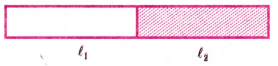
l1 = 12.132 cm and l2 = 12.4 cm.
∴ l1 + l2 = 12.132 + 12.4 = 24.532 cm.
In addition final answer must have least number of significant numbers in that addition, i.e., one after decimal point. So our answer is 24.5 cm.
b) For difference use, l1 – l2 ⇒ 12.4 – 12.132 = 0.268 cm.
In subtraction, final answer must be adjusted to least number of significant figures in that operation.
Here least number is one digit after decimal. By applying round off procedure our answer is 0.3 cm.
Question 5.
Each side of a cube is measured to be 7.203 m. What is
(i) the total surface area and
(ii) the volume of the cube, to appropriate significant figures ?
Solution:
Side of cube, a = 7.203 m.
So number of significant figures are Four.
i) Surface area of a cube = 6a2 = 6 × 7.203 × 7.203 = 311.299
But our final answer must be rounded to least number of significant figures is four digits.
So surface area of a cube = 311.3 m2
ii) Volume of a cube, .
V = a3 = (7.203)3 = 373.147
But the answer must be limited to Four significant figures.
∴ Volume of a cube, V = 373.1 m3.
Units and Measurements Class 11 NCERT Solutions
Question 1.
Fill in the blanks.
(a) The volume of a cube of side 1 cm is equal to m3.
(b) The surface area of a solid cylinder of radius 2.0 cm and height 10.0 cm is equal to ________ (mm)2.
(c) A vehicle moving with a speed of 18 km h-1 covers ______ m in 1 s.
(d) If the relative density of lead is 11.3. Its density is _________ g cm-3 or _______ kg m-3.
Answer:
(a) Volume of a cube = l3
1 cm = 10-2 m
Side of a cube, l = 1 cm = 10-2 m
Volume of a cube of side ‘l’ is V = l3 = (10-2)3 = 10-6 m3.
(b) Surface area of a solid cylinder of radius r and length l is A = 2πrl + 2πr2
Here, r = 2.0 cm, l = 10 cm ; As 1 cm = 10 mm; r = 2.0 × 10 mm = 20 mm
l = 10.0 × 10 mm = 100 mm
A = 2πrl + 2πr2 = 2πr (l + r)
= 2 × 3.14 × 20(100 + 20) = 125.6 (120) = 15072 mm2 = 1.5 x 104 mm2 .
(c) Distance = Velocity × Time ⇒ 1 km/h = \(\frac{1000}{3600}\) m/s = \(\frac{5}{18}\)m/s.
Given velocity of vehicle, v = 18 km/h = 18 × \(\frac{5}{18}\) m/s = 5 m/s.
Distance traversed = velocity × time = 5 × 1 = 5 m.
(d) 
Density, (p) = Relative Density × Density of water = 11.3 × 1 g cm-3 = 11.3 g cm-3
But 1 g cm-3 = 1000 kg m-3; p = 11.3 × 1000 kg/m3 = 1.13 × 10⁴ kgm-3.
Question 2.
Fill in the blanks by suitable conversion of units.
(a) 1 kg m2 s-2 = g cm2 s-2.
(b) 1 m = _______ light years.
(c) 3 ms-2 = _________ km h-2.
(d) G = 6.67 × 10⁻¹¹ Nm2kg-2 = g-1 cm3 s-2.
Ans .
(a) 1 kg = 1000 g, 1 m = 100 cm
1 kg m2 s-2 = 1000 g (100 cm)2 s-2 = 107 g cm2s-2
1 kg m2 s-2 = 107 g cm2 s-2
(b) 1 light year = 9.46 × 10¹⁵ m
1m = \(\frac{1}{9.46 \times 10^{15}}\) light year = 1.057 × 10⁻¹⁶ light year.
(c) 1 km = 1000m ⇒ 1 m = \(\frac{1}{1000}\)km
1 h = 3600s ⇒ 1s = \(\frac{1}{3600}\) h
3 ms-2 = 3 × \(\left(\frac{1}{1000} \mathrm{~km}\right) \times\left(\frac{1}{3600} \mathrm{~h}\right)^{-2}=3 \times \frac{1}{1000} \times(3600)^2 \mathrm{~km} \mathrm{~h}^{-2}\)
= 3.888 × 10⁴ km h-2.
(d) 1 N = 1 kg ms-2
G = 6.67 × 10⁻¹¹ Nm2 kg-2
= 6.67 × 10⁻¹¹(kg ms-2) m2kg-2
= 6.67 × 10⁻¹¹kg-1 m3 s-2
= 6.67 × 10⁻¹¹ × \(\frac{1}{1000}\) × (10)6 g-1 cm3s-2 = 6.67 × 10⁻⁸ g-1 cm3 s-2
Question 3.
A calorie is a unit of heat (energy in transit) and it equals about 4.2 J, where 1 J = 1 kg m2 s-2. Suppose we employ a system of units in which the unit of mass equals α kg, the unit of length equals β m and the unit of time is γ s. Show that a calorie has a magnitude 4.2 α-1 β-2 γ2 in terms of new units.
Answer:
Dimension of energy are [ML2T-2]
n1[u1] = m2[u2]
n1[M1L12T1-2] = n2[M2L22T2-2] ………(i)
In SI system, n1 = 4.2 J, M1 = 1 kg, L1 = 1 m, T1 = 1 s
In new system, M2 = α kg, L2 = β m, T2 = γ s
So equation (i), gives
n2 = n1 \(\left(\frac{\mathrm{M}_1}{\mathrm{M}_2}\right) \cdot\left(\frac{\mathrm{L}_1}{\mathrm{~L}_2}\right)^2 \cdot\left(\frac{\mathrm{~T}_1}{\mathrm{~T}_2}\right)^{-2}\) = 4.2 \(\left(\frac{1 \mathrm{~kg}}{\alpha \mathrm{~kg}}\right) \cdot\left(\frac{1 \mathrm{~m}}{\beta \mathrm{~m}}\right)^2 \cdot\left(\frac{1 \mathrm{~s}}{\gamma \mathrm{~s}}\right)^{-2}\) = 4.2 α-1 β-2 γ2
i.e., 1 calorie = 4.23 J = 4.2 α-1 β-2 γ2.
Question 4.
Explain this statement clearly :
“To call a dimensional quantity ‘large’ or ‘small’ is meaningless without specifying a standard for comparison”. In view of this, reframe the following statements wherever necessary.
(a) atoms are very small objects.
(b) a jet plane moves with great speed.
(c) the mass of Jupiter is very large.
(d) the air inside this room contains a large number of molecules.
(e) a proton is much more massive than an electron.
(f) the speed of sound is much smaller than the speed of light.
Answer:
The statement is true; it is meaningless to say that Meerut is a big city because it is bigger as compared to Bijnor and smaller as compared to Calcutta. Hence, to call a dimensionless quantity larger or small it is essential to specify a standard for comparison.
(a) Atoms are very small objects as compared to edge of a sharp blade.
(b) The jet plane moves with greater speed than that of a superfast train.
(c) The mass of Jupiter is very large as compared to that of the Earth.
(d) The air inside a room contains more number of molecules than the Avogadro number.
(e) Mass of proton = 1.67 × 10⁻²⁷ kg; Mass of electron = 9.1 × 10⁻³¹ kg
\(\frac{\text { Mass of proton }}{\text { Mass of electron }}=\frac{1.67 \times 10^{-27} \mathrm{~kg}}{9.1 \times 10^{-31} \mathrm{~kg}} \approx 1836 .\)
Hence, the given statement is correct.
(f) Speed of sound in air, v = 332 m/s; Speed of light, c = 3 × 10⁸ m/s
\(\frac{v}{c}=\frac{332}{3 \times 10^8} \approx 10^{-6}\)
Hence, the statement is correct.
Question 5.
A new unit of length is chosen such that the speed of light in vacuum is unity. What
is the distance between the Sun and the Earth in terms of the new unit of light takes 8 min and 20 s to cover this distance ?
Answer:
Given, c = 1 un s-1 where un is new unit
Time, t = 8 min 20 s = 8 × 60 + 20 = 500 s
Distance between the Sun and the Earth
x = ct = 1 un s-1 × 500 un = 500 new unit of length.
Question 6.
Which of the following is the most precise device for measuring length ?
(a) a vernier callipers with 20 divisions on the sliding scale.
(b) a screw gauge of pitch 1 mm and 100 divisions on the circular scale.
(c) an optical instrument that can measure length to within a wavelength of light ?
Answer:
The most precise measurement is that in which least count of the measuring instrument is minimum.
(a) Least count of Vernier callipers = \(\frac{s}{n}=\frac{\text { Value of one part of main scale }(s)}{\text { Number of divisions on Vernier scale }}\)
= \(\frac{0.1 \mathrm{~cm}}{20}=\frac{1}{200} \mathrm{~cm}\) = 0.005 cm
(b) Least count of screw guage \(=\frac{\text { Pitch }}{\text { Number of divisions on circular scale }}\)
= \(\frac{1 \mathrm{~mm}}{100}\) = 0.01 mm = 0.001 cm
(c) Least count of optical instrument = Wavelength of visible light = 5 × 10⁻⁷ m
Clearly, the least count of optical instrument is minimum, hence optical instrument is more precise device for measuring length.
Question 7.
A student measures the thickness of a human hair by looking at it through a microscope magnification 100. He makes 20 observations and finds that the average width of the hair in the field of view of the microscope 3.5 mm. What is the estimate on the thickness of hair?
Answer:
Magnification of microscope, m = \(\frac{\text { Size of image (I) }}{\text { Size of object (O) }}\)
The thickness of hair will contain two significant figures as given in average width
∴ Size of object, O = \(\frac{\text { Size of image (I) }}{\text { Magnification (m) }}\)
Given magnification = 100, size of image = 3.5 mm
∴ Size of object = \(\frac{3.5}{100}\)mm = 0.035 mm = 35 pm (two significant figures)
That is, average thickness of human hair = 35 µm.
Question 8.
Answer the following.
(a) You are given a thread and a metre scale. How will you estimate the diameter of the thread ?
(b) A screw gauge has a pitch of 1.0 mm and 200 divisions on the circular scale. Do you think it is possible to increase the accuracy of the screw gauge arbitrarily by increasing the number of divisions on the circular scale ?
(c) The mean diameter of a thick brass rod is to be measured by vernier callipers. Why is a set of 100 measurements of the diameter expected to yield a more reliable estimate that a set of 5 measurements only ?
Answer:
(a) The diameter of thread is so small that it cannot be measured directly by a metre scale. For this, we measure the length of the thread by metre scale; fold the thread along its length repeatedly for a known number of times and place all the lengths fold touching one another. The thickness is measured by the metre scale. The diameter of thread will be equal to the fold thickness divided by the number of folds.
(b) Least count of screw gauge = \(=\frac{\text { Pitch }(\mathrm{P})}{\text { Number of divisions on circular scale }(\mathrm{N})}\)
Obviously, by increasing the number of divisions on a circular scale, the least count would decrease and hence, accuracy will increase. But it can be done arbitrarily due to low resolution of the eye. Hence the number of turns on the circular scale may be increased upto a certain limit.
(c) The accuracy of a measurement increases with the increase in number of observations; so a set of 100 measurements will give more accurate results then a set of 5 measurements.
Analytically accuracy ∝ \(\sqrt{N}\)
where N is the number of measurements.
Question 9.
The photograph of a house occupies an area of 1.75 cm2 on a 35 mm slide. The slide is projected onto a screen and the area of house on the screen is 1.55 m2. What is the linear magnification of the projector-screen arrangement ?
Answer:
Significant figures in given areas in an object and image is 3, number of significant figures
in magnifications must be 3.
Area of house on the slide = 1.75 cm2 = 1.75 × 10⁻⁴ m2
Area of house projected on the screen = 1.55 m2
Areal magnification = \(\frac{\text { Area of image (of house) }}{\text { Area of an object (house) }}=\frac{1.55}{1.75 \times 10^{-4}}=0.8857 \times 10^4\)
Linear magnification, m = \(\sqrt{\text { Areal magnification }}=\sqrt{0.8857 \times 10^4}=94.1\)
∴ m = 94.1 (three significant figures).
Question 10.
State the number of significant figures in the following.
(a) 0.007 m2
(b) 2.64 × 1024 kg
(c) 0.2370 g cm-3
(d) 6.320 J
(e) 6.032 Nm-2
(f) 0.0006032 m2
Answer:
(a) The number of significant figures in the measurement 0.007 m2 is 1 (zeros on left are not counted).
(b) The number of significant figures in the measurement 2.64 × 1024 kg is 3 (powers of 10 are not counted).
(c) The number of significant figures in 0.2370 g cm-3 is 4 (zeros on right having a decimal place are counted).
(d) The number of significant figures in 6.320 J is 4.
(e) The number of significant figures in 6.032 Nm-2 is 4.
(f) The number of significant figures in 0.0006032 is 4 (zeros on left are not counted).
Question 11.
The length, breadth and thickness of a rectangular metallic sheet are 4.234 m, 1.005m and 2.01 cm respectively, Give the area and volume of the sheet to correct significant figures.
Answer:
Given, length, l = 4.234 (4 significant figures)
breadth, b = 1.005 m (4 significant figures)
thickness, t = 2.01 cm = 2.01 × 10⁻² m (3 significant figures)
A rectangular sheet has six faces, out of which parallel faces have equal areAnswer:
Area of sheet, A = 2 (lb + bt + lt)
= 2(4.234 × 1.005 + 1.005 × 2.01 × 10-2 + 4.234 × 2.01 × 10-2)
= 2(4.25517 + 0.0202005 + 0.0851034)
= 2 (4.3604739) = 8.7209478 m2
According to an idea of significant figures, there should be three significant figures in area; so Area of sheet, A = 8.72 m2.
Volume, V = lbt = 4.234 × 1.005 × 2.01 × 10-2 = 8.5528917 × 10⁻² m3
According to idea of significant figures, there should be 3 significant figures in volume.
∴ Volume, V = 8.55 × 10⁻² m3
Question 12.
The mass of a box measured by a grocer’s balance is 2.30 kg. Two gold pieces of masses 20.15 g and 20.17 g are added to the box, what is
(a) Total mass of the box,
(b) The difference in the masses of the pieces of correct significant figures ?
Answer:
Mass of empty box, m0 = 2.30 kg (two decimal places)
If m1 and m2 are masses of pieces, then
m1 = 20.15 g = 20.15 × 10⁻³ kg = 0.02015 kg (5 decimal places)
m2 = 20.17 g = 20.17 × 10⁻³ kg = 0.02017 kg (5 decimal places)
(a) Total mass, M = m0 + m1 + m2 = 2.30 + 0.02015 + 0.02017 = 2.34032 kg.
In the sum, the result must contain minimum number of decimal places. In the first measurement there are two decimal places, therefore, only two figures after the decimal point is retained.
Total mass, M = 2.34 kg (upto 1 decimal place)
(b) Difference of masses = m2 – m1
= 20.17 g – 20.15 g (Each has two decimal places)
= 0.02 g (Two decimal places)
Question 13.
A famous relation in physics relates ‘moving mass’ m to the ‘rest mass’ m0 of a particle terms of its speed v and the speed of light c. (This relation first arose as a consequence special relativity due to Albert Einstein). A boy recalls the relation almost correctly but forgets where to put the constant c. He writes : m = \(\frac{m_0}{\left(1-v^2\right)^{1 / 2}}\)
Guess where to put the missing c.
Answer:
Given relation is m = \(\frac{m_0}{\left(1-v^2\right)^{1 / 2}}\)
From the principle of homogeneity, the dimensions of two sides must be equal. For (1 – v2)1/2 should be dimensionless. As v and c both are velocities, therefore for (1 – v2)1/2 to dimensionless, v must be replaced by \(\frac{\mathrm{v}}{\mathrm{c}}\), i.e.,
Question 14.
The unit of length convenient on the atomic scale is known as an angstrom and is denoted by A0. 1 A0 = 10-10 m. The size of the hydrogen atom is about 0.5 A0. What is the total atomic volume in m3 of a mole of the hydrogen atoms ?
Answer:
Volume of a spherical hydrogen atom is \(\frac{4}{3}\)πR3. The number of significant figures in volume must be 1 as given in size.
Radius (size) of the hydrogen atom, R = 0.5 A = 0.5 × 10⁻¹⁰ m,.
Volume of the hydrogen atom = \(\frac{4}{3}\)πR3
= \(\frac{4}{3}\) × 3.14 × (0.5 × 10-10 m)3
= 5.233 × 10⁻³¹ m3
Number of hydrogen atoms in 1 mole of hydrogen = Avogadro number = 6.023 × 10²³ Volume of atoms in mole of hydrogen = 6.023 × 1023 × 5.233 × 10-31 = 3.15 × 10⁻⁷ m3 As given, size of H – atom contains 1 significant figure, so volume must contain 1 significant figure; therefore, volume of H – atom = 3 × 10⁻⁷ m3.
Question 15.
One mole of an ideal gas at standard temperature and pressure occupies 22.4 L (molar volume). What is the ratio of molar volume to the atomic volume of a mole of hydrogen ? (Take the size of hydrogen molecule to be about 1Å). Why is this ratio so large ?
Answer:
Molar volume, V = 22.4 litres ⇒ Molar volume, Vmolar = 22.4 × 10⁻³ m3
molar
Size of hydrogen molecule, r = 1 Å = 10-10 m
Volume of one hydrogen molecule, V = \(\frac{4}{3}\)πr3
= \(\frac{4}{3}\) × 3.14 × (10-10)3
= 4.2 × 10⁻³⁰m3
Atomic volume of a mole of hydrogen,
vatomic = Volume of one molecule × Avogadro Number
= 4.2 × 10-30 × 6.02 × 1023 ≈ 25 × 10-7 m3
\(\frac{\text { Molar Volume }}{\text { Atomic Volume }}=\frac{22.4 \times 10^{-3}}{25 \times 10^{-7}}\) ≈ 104
This means that the intermolecular separation in hydrogen at S.T.P. is much larger than the size of a molecule.
Question 16.
Explain this common observation clearly : If you look out of the window of a fast moving train, the nearby trees, houses etc. seem to move rapidly in a direction opposite to the train’s motion, but the distant objects (hill tops, Moon, the stars etc.) seem to be stationary. (In fact, since you are aware that you are moving, these distant objects seem to move with you).
Answer:
The line joining the object to the eye is called the line of sight. When a train moves fast, the angular change in line of sight of nearby objects (e.g., tree, house), is large, therefore, the nearby objects appear to move in the opposite direction. On the other hand the angular change in line of sight of distant objects (e.g., hill tops, moon, etc.) is negligibly small, hence, distant objects appear stationary.
Question 17.
The Sun is a hot plasma (ionized matter) with its inner core at a temperature exceeding 107 K, and its outer surface at a temperature of about 6000 K. At these high temperatures, no substance remains in a solid or liquid phase. In what range do you expect the mass density of the Sun to be, in the range of densities of solids and liquids or gases ? Check if your guess is correct from the following data : mass of the Sun = 2.0 × 1030 kg, radius of the Sun = 7.0 × 10⁸ m.
Answer:
At high temperatures no substance can remain in solid or liquid phase. Therefore, at a first thought it is expected that the density of sun plasma should be in the range of gases.
Given, mass of Sun, M = 2.0 × 1030 kg ; Radius of Sun, R = 7.0 × 10⁸ m
Density = \(\frac{\text { Mass }}{\text { Volume }}\)
= \(\frac{\mathrm{M}}{\frac{4}{3} \pi \mathrm{R}^3}=\frac{3 \mathrm{M}}{4 \pi \mathrm{R}^3}\)
= \(\frac{3 \times 2.0 \times 10^{30}}{4 \times 3.14 \times\left(7 \times 10^8\right)^3}=1.39 \times 10^3 \mathrm{~kg} / \mathrm{m}^3\)
This is the order of density of solids and liquids and not of gases. The reason is that the ionised particles in the Sun are very close to one another as in the case of solids and liquids due to enormous gravitational attraction.