
Regular practice with AP Inter 1st Year Chemistry Study Material Chapter 3 Classification of Elements and Periodicity in Properties Questions and Answers helps students stay prepared for examinations.
AP Inter 1st Year Chemistry 3rd Lesson Classification of Elements and Periodicity in Properties Questions and Answers
I. Multiple Choice Questions
Question 1.
Which of the following oxide, when dissolved in water form an acidic solution?
1) Na2O
2) CO
3) Al2O3
4) Cl2O7
Answer:
4) Cl2O7
Cl2O7 + H2O → 2HClO4 (Cl2O7 is acidic oxide)
Question 2.
The maximum covalency of Be in [BeF4]– and Al in [AlF6]3- are respectively?
1) 4, 6
2) 4, 4
3) 6, 4
4) 6, 6
Answer:
1) 4, 6
Maximum covalency of Be in [BeF4]– = 4
Maximum covalency of Al in [AlF6]-3 = 6
No.of Chemical bonds formed by an atom by sharing electrons with other atoms is covalency.
Question 3.
The increasing order of ionization enthalpy of second period elements is
1) Li < B < Be < C < NO < F < Ne
2) Li < Be < B < C < N < O < F < Ne
3) Li < B < Be < C < O < N < F < Ne
4) Li < Be < B < C < O < N < F < Ne
Answer:
3) Li < B < Be < C < O < N < F < Ne
Question 4.
The difference in electronegativities of elements give information regarding
1) bond length
2) nature of bond
3) volume of anion
4) volume of cation
Answer:
2) nature of bond Difference in electronegative values Of elements give information about nature of bond. Electronegativity difference > 1.7 (ionic bond) < 1.7 (covalent bond)
= 1.7 (50% covalent bond and 50% ionic bond)
Question 5.
The atomic radius of fluorine is 64 pm. What is the ionic radius of fluoride ion ?
1) 64 pm
2) 136 pm
3) 32 pm
4) 60 pm
Answer:
2) 136 pm
F- has higher radius than F (Parent atom) so 136 pm

Question 6.
The atomic number Of the element unnilennium is
1) 102
2) 108
3) 119
4) 109
Answer:
4) 109
Unnilennium
un – 1
nil – 0
enn – 9
Question 7.
Which one of the following sets of ions represents a collection of iso electronic series?
1) Li+, Na+, Mg2+, Ca2+
2) Ba2+, Sr2+, K+, Ca2+
3) N3-, O2-, F–, S2-
4) K+, Cl–, Ca2+, Sc3+
Answer:
4) K+, Cl–, Ca2+, Sc3+
K+ (18), Cl– (18), Ca+2 (18) and Sc+3 (18) have some no.of electrons so they are iso electronic series.
Question 8.
Three elements X, Y and Z are in the third period of the periodic table. The oxides of X,Y and Z respectively are basic, amphoteric and acidic. The correct order of the atomic numbers of X,Y and Z is [ 3 ]
1) X < Z < Y
2) Z < Y < X
3) X < Y < Z
4) Y<X<Z
Answer:
3) X < Y < Z
X – basic ; Y – Amphoteric ; Z – acidic ; X < Y < Z.
Question 9.
In which of the following, elements are arranged in the decreasing order of their metallic nature?
1) Na > Mg > Be > Si > P
2) P > Si > Be > Mg > Na
3) Si > P > Be > Na > Mg
4) Be > Na > Mg > Si > P
Answer:
1) Na > Mg > Be > Si > P
Na > Mg > Be > Si > P is the decreasing order of metallic nature.
Question 10.
What is the atomic number of the element present in the 4th period and 17th group of the periodic table?
1) 29
2) 35
3) 37
4) 30
Answer:
2) 35
4th period and 17th group element is Bromine. Atomic no is 35.
Question 11.
If the formula of oxide of Eka-aluminium is E2O3, its chloride can be
1)AlCl3
2) GaCl3
3) GeCl3
4) Ga2Cl3
Answer:
2) GaCl3
Eka Aluminium is gallium, chloride is Gallium trichloride GaCl3.
Question 12.
To which group of an element having atomic number 84.
1) Group-12
2) Group-17
3) Group-16
4) Group-11
Answer:
3) Group-16
Atomic no(Z) = 84 having Element is polonium. Polonium is belongs to group – 16
Question 13.
As we move from left to right across a period, the non-metallic character and as we go down in the group, metallic character
1) Increases, Decreases
2) Decreases, Increases
3) Decreases, Increases
4) Increases, Increases
Answer:
4) Increases, Increases
In periods, non-metallic character from left to right increases.
In groups, metallic character from top to bottom increases.
Question 14.
The IUPAC official name of unnilquadium
1) Seaborgium
2) Lawrencium
3) Dubnium
4) Rutherfordium
Answer:
4) Rutherfordium
Unnilquadium Atomic no = 104
104th Element is Rutherfordium (Rf).
II. Fill in the Blanks
Question 1.
Among the alkali metals, the metal with the highest ionization enthalpy is _______.
Answer:
Lithium (From top to bottom I.E. decreases)
Question 2.
The examples of neutral oxides are ________.
Answer:
Nitrous oxide (N2O), Nitric oxide (NO) and Carbon monoxide (CO) are examples of neutral oxides.
Question 3.
Beryllium more closely resembles with ______.
Answer:
Beryllium more closely resembles with Aluminium (Diagonal relationship)
Question 4.
The element with highest electronegativity on Pauling scale is _______.
Answer:
Fluorine (F), According to pauling scale it’s electronegativity = 4.0
Question 5.
In an atom the decrease in the attractions between nucleus and outer most electrons by the core electrons is called _____.
Answer:
Screening effect (or) shielding effect
III. One Word Answer Questions
Question 1.
State Mendeleev’s periodic law.
Answer:
The physical and chemical properties of elements are periodic functions of their atomic weights.
Question 2.
State Moseley’s modern periodic law.
Answer:
The physical and chemical properties of elements are periodic functions of their atomic numbers.
Question 3.
What are the elements having highest electronegativity and electron gain enthalpy?
Answer:
High electronegative element is fluorine (F).
High electron gain enthalpy (electron affinity) element is chlorine (Cl).
Question 4.
What is a diagonal relationship?
Answer:
The first element of a group shows similarities in properties with the second element of the next group. This is called, ‘diagonal relationship’.
| Group | I | II | III | IV |
| 2nd period | Li | Be | B | c |
| 3rd period | Na | Mg | Al | Si |
But this relation continues effectively upto to the IV group only.
Question 5.
What is an amphoteric oxide ?
Answer:
The oxide which contains both acidic as well as basic nature is called an amphoteric oxide.
Eg : Al2O3, Ga2Os3 etc ……
Question 6.
What is iso-electronic series.
Answer:
Series of species having same no.of electrons is called iso-electronic series.
Eg : N-3, O-2, F–, Na+, Mg+2, Al+3, Ne
Question 7.
What are transuranic elements ?
Answer:
In actinoids after uranium the elements are synthesized artificially. These are called transuranic elements.
Question 8.
What is the starting element of fifth period?
Answer:
Rubidium (Rb) is the starting element of 5th period.
Question 9.
What are the units of electron gain enthalpy ?
Answer:
Units of electron gain enthalpy are KJ/mol (or) eV/atom
Question 10.
For which group, valency and group number has no relation.
Answer:
Group 18 has no relation between valency and group number.
IV. Very Short Answer Questions
Question 1.
An element ‘X’ has atomic number 34. Give it’s position in the periodic table.
Answer:
Given element’s Atomic number (Z) = 34 and its electronic configuration is [Ar] 4s23d104p4.
Total number of shells represents the period and the number of valence electrons represents the group. So it belongs to 4th period and VIth A group (Z = 34).
Question 2.
Mg2+ is smaller than O2- in size. Why?
Answer:
- Mg+2 and O-2 are iso-electronic.
- In iso-electronic series nuclear charge (or) positive charge increases size decreases. So Mg+2 smaller than O-2 in size.
Question 3.
How does the nature of oxides change along third period from Na2O to Cl2O7 ?
Answer:
The basic nature decreases and the acidic nature increases from Na2O to Cl2O7, as shown below.
| Element | Na | Mg | Al | Si | P | S | Cl |
| Oxide | Na2O | MgO | Al2O3 | SiO2 | P2O5 | SO3 | Cl2O7 |
| Nature | Strongly basic | Basic | Amphoteric | Weakly acidic | Acidic | Strongly acidic | Strongly acidic |
Question 4.
Consider the following species N3-, O2-, Na+, Mg2+ and Al3+.
(a) What is common in them?
(b) Arrange them in an increasing order of their ionic radii.
Answer:
a) All the ions contain same number of electrons (10 electrons).
b) Al+3 < Mg2+ < Na+ < F– < O-2 < N-3
Question 5.
Name any two bridge elements.
Answer:
2nd period elements are bridge elements.
Lithium (Li), Beryllium (Be), Boron (B), Carbon (C) etc…
Question 6.
Define metallic radius and covalent radius.
Answer:
Metallic radius The half of the distance between centre of nucleus of two adjacent metal atoms is called metallic radius.
Covalent radius : The half of the distance between centre of nucleus of two atoms bonded covalently is called covalent radius.
Question 7.
Why cation is smaller and anion is larger in radii than their parent atoms?
Answer:
Cations after losing electron, nuclear attraction increases. Where as in anions after gaining electron, where as electron repulsion increases.
∴ Cation is smaller and anion is larger in radii than parent atom.
Question 8.
How are electronegativity and metallic and non-metallic characters related ?
Answer:
- As the electronegativity increases metallic character decreases.
Electronegativity ∝ \(\frac{1}{\text { Metallic character }}\) - As the electronegativity increases non-metallic character also increases. Electronegativity oc non-metallic character
Question 9.
Ionisation enthalpy (IE1) of O is less than that of N. Why?
Answer:
Electronic configuration of N is – 1s22s22p3, lectronic configuration of O is 1s2 2s2 2p4. Nitrogen has stable half filled 2p orbital electronic configuration. So high amount of I.E. required.
So I.E. of ‘O’ is less than ‘N’.
Question 10.
What are the oxidation state and covalency of Al in [AlCl (H2O)5]2+ ?
Answer:
In the given complex [AlCl (H2O)5]+2
Oxidation state of ‘Al’ = +3 and Covalency of ‘Al’ = 6
V. Short Answer Questions
Question 1.
Give any four characteristic properties of transition elements.
Answer:
Characteristic properties of transition elements.
- They exhibit variable oxidation states.
- They exhibit para magnetic property.
- They form coloured compounds.
- They form alloys.
- They form complex compounds.
- They form interstitial compounds.
Question 2.
Assign the position of the element having outer electronic configuration
a) ns2 np4 for n = 3
b) (n – 1)d2 ns2 for n = 4.
Answer:
a) ns2np4 for n = 3
3s2 3p4 outer electronic configuration element is sulphur 1s2 2s2 2p6 3s2 3p4.
It belongs to 3rd period and group – 16 (VI A),
n = 3 refers third period and
3s2 3p4 total six valence electrons refers VIA group.
b) (n – 1)d2 ns2 for n = 4
3d2 4s2 outer electronic configuration element is titanium (Ar) 4s2 3d2.
It belongs to 4th period and IVB Group.
Question 3.
Which of the following will have the most negative electron gain enthalpy and which is the least electronegative among P, S, Cl, F.
Answer:
The most negative electron gain enthalpy element among P, S, Cl, F is chloride (Cl).
The least electronegative element among P, S, Cl, F is Phosphorus (P).
Question 4.
Arrange the following an increasing order.
1. EA : O, S and Se
2. Radius : Fe, Fe2+ and Fe3+
3. IE : Na, K and Rb.
4. EN : F, Cl, Br and I.
Answer:
1. O < Se < S increasing order of electron affinity
2. Fe+3 < Fe+2 < Fe increasing order of radius .
3. Rb < K < Na increasing order of I.E.
4. I < Br < Cl < F increasing order of electronegativity
Question 5.
Write a note on
1. Atomic radius 2. Metallic radius 3. Covalent radius
Answer:
Atomic radius refer to both metallic radius and covalent radius.
1. Atomic radius : As the atomic radius increases, the distance between the nucleus and the outermost electrons increases. Hence, the effective nuclear charge on the outermost electrons decreases. As a result of which the energy required to remove the electrons decreases. From this it is evident that as atomic radius increases I.P decreases. Similarly as atomic radius decreases I.P increases.
2. Metallic radius (Crystal radius) : It is defined as one – half of the inter – nuclear distance between two adjacent atoms of a metal.
Eg: Metallic radius of sodium = \(\frac{3.72}{2}\) = 1.86 Å
Metallic radius of potassium = \(\frac{4.62}{2}\) = 2.31 Å
3. Covalent radius : It is defined as one – half of the equilibrium distance between the nuclei of two atoms bonded by a covalent bond.
Eg: Covalent radius of hydrogen = 0.37 Å
Covalent radius of chlorine = 0.99 Å
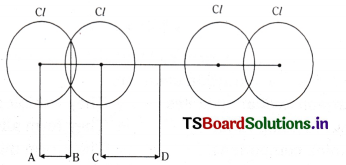
AB = covalent radius = 0.99 Å ; CD = van der Waal’s radius = 1.8 Å
Covalent, van der Waal’s radii of chlorine :
van der Waal’s radius : It is defined as one – half of the inter – nuclear distance between atoms of two adjacent molecules of an element bonded by van der Waal’s forces facing each other, in solid state.
Eg: van der Waal’s radius of hydrogen = 1.2 Å
van der Waal’s radius of chlorine = 1.80 Å
Note : van der Waal’s radius of an atom is 40% larger than its covalent radius.
VI. Long Answer Questions
Question 1.
Discuss the construction of long form of the periodic table.
Answer:
- The important characteristic property of an element is found to be its ‘atomic number’ and not atomic weight.
- Accordingly, the periodic law was modified – “The physical and chemical properties of the elements are periodic functions of their atomic numbers”.
- Later on it was found that while deciding the properties of an element, its electronic configuration plays a very important role.
- So Bohr constructed the long form of the periodic table, based on the electronic configurations of the elements.
- The periodic law can be stated as “The physical and chemical properties of the elements are periodic functions of their electronic configurations”.
Salient features :
- This table is prepared based on a fundamental property “atomic number”.
- This table can be easily studied, remembered and reproduced.
- Similarities, differences and trends in properties are more clearly reflected in this table.
- Vertical columns are known as groups and horizontal rows are called periods.
- There are seven periods in this table. The first period consists of two elements only. Second and third periods contain 8 elements each. Fourth and fifth periods contain 18 elements each. Sixth period consists of 32 elements. Seventh period is an incomplete period and consists of 19 elements.
- There are eighteen groups in this table. They are designated IA, IIA, IIIB, IVB, VB, VIB, VIIB, VIII, IB, IIB, IIIA, IVA, VA, VIA, VIIA, 0 (American Convention of naming).
- The elements in IA, IIA, IIIA, IVA, VA, VIA and VILA are known as representative elements or normal elements.
- The elements in IB, IIB, IIIB, IVB, VB, VIB, VIIB and VIII are called Transition elements.
- Zero group elements are placed at the extreme right of the table. These are called inert gases or noble gases. They possess stable ns2np6 configuration.
- Short periods are broken and long periods are extended to accommodate transition elements.
- Lanthanides and actinides are placed separately at the bottom of the periodic table.
- Based on the entrance of differentiating electron, the table is divided into four blocks. They are s – block, p – block, d – block and f – block. In the elements of s – block, differentiating electron enters into s – orbital. Similarly in the elements of p – block, d – block and f – block, the differentiating electron enters into s, p, d and f – orbitals respectively.
- Based on complete and incomplete electron shells and chemical properties, the elements are classified into four types. They are
- Type I – Inert gas elements),
- Type II – Representative elements),
- Type III – Transition elements,
- Type IV – Inner transition elements.
- All the elements in a group possess similar properties, because they possess the same valence electron configuration.
Question 2.
Write an essay on s,p,d, and f-block elements.
Answer:
Depending upon the entering of differentiating electron into the atomic orbitals, the elements of long form of periodic table are divided into four blocks. They are s, p, d and f – blocks. s- Block:
1) The elements, in which the differentiating electron enters the s – sub-level are called s-block elements.
2) In this block, there are two groups. They are IA and IIA.
3) The valence electron configuration of elements of IA group is ns1 and that of IIA is ns2.
4) The elements of IA are Alkali metals and IIA are Alkaline earth metals.
5) These are metals and are highly reactive.
p – Block: .
- The elements in which the differentiating electron enters the p – sub-level are called p – block elements.
- In this block, there are six groups. They are IIIA, IVA, VA, VIA, VIIA, and ‘O’.
- The valence electron configuration of the elements of these groups varies from ns2 np1 to ns2 np6.
- It includes metals, non-metals, metalloids, noble gases.
d- Block:
- The elements in which the differentiating electron enters into d – sub-level are called d – block elements.
- In this block, there are ten groups. They are IIIB, IVB, VB, VIB, VIIB, VIII, IB, IIB.
- The general outer configuration of d – block elements is (n – 1)d1-10 ns1-2.
- These elements are also known as Transition elements.
- These are all metals having high M.P and B.P
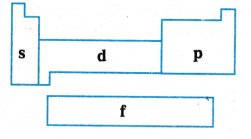
f – Block:
- The elements in which the differentiating electron enters into f – orbital are called f-block elements.
- In this block, there are 14 groups. They have no designation.
- Their general outer configuration is, (n – 2)f1-14 (n – 1)d0-1 ns2.
- The f – block elements are arranged separately at the bottom in two rows.
- The elements of first row are called lanthanides and in these elements the valence electron enters into 4f orbital.
- The elements of second row are called actinides and in these elements the valence electron enters into 5f orbital.
- All the f – block elements are also known as Inner Transition elements.
- These are all metals.
Question 3.
Relate the electronic configuration of elements and their properties in the classification of elements.
Answer:
All the elements are divided into four types on the basis of their properties and electronic configurations. They are: (i) Noble gas elements (ii) Representative elements (iii) Transition elements and (iv) Inner transition elements.
i) Noble gas elements: Elements in which the outermost and p sub-shells are completely filled are called inert gas elements. “0” group elements belong to this type.
- Due to completely filled shells they show chemical inertness and possess more stability.
- The general outer configuration of these elements is ns2np6 (except helium.)
- The configura-tion of helium is 1s2. They are called noble gases.
ii) Representative elements : Elements in which the outermost s and p sub shells are incompletely filled are called representative elements.
- These elements are so named because they represent most of the chemical reactions known.
Elements of s – block and p – block (except ‘O’ group) belong to this type. - The general outer electronic configuration of these elements is ns1, ns2, ns2np6 to ns2np5.
- These elements enter into chemical reactions either by losing or gaining or sharing of electrons.
- Many of the non-metals, metalloids and some metals belong to this type.
iii) Transition elements : Elements in which the outermost and penultimate shells are partially filled are called transition elements.
They belong to d-block. Their general configuration is (n -1 )d1-9 ns1-2. They are so named because there is a gradation from electro + ve nature to electro – ve nature. They possess the following characteristic properties.
- They exhibit variable oxidation states.
- They form coloured compounds.
- They are all paramagnetic.
- They and their oxides act as catalysts.
- They form alloys and interstitial compounds.
- They form complex compounds.
iv) Inner transition elements : Elements in which the outermost, penultimate and antepenultimate shells are partially filled are called Inner transition elements.
- They belong to f – block and are placed separately at the bottom of the table.
- Their general outer configuration is (n – 2)f1-14 (n – 1)d0-1ns1-2.
- They are so named as they represent a transition of physical and chemical properties among them.
- There are two series of inner transition elements corresponding to 4f and 5f series.
- 4f series are called lanthanides and elements of 5f series are called actinides. Lanthanides are also called rare earths.
- Majority of actinides are synthetic.
Question 4.
What is a periodic property? How the following properties vary in a period and group?
(a) Atomic radius
(b) Ionisation enthalpy
(c) Electronegativity
Answer:
Periodic property : The property of elements which change gradually with change in electronic configuration and repeats in regular intervals are called periodic properties. This repetition is called periodicity.
a) Atomic radius: The distance between centre of nucleus and outer most shell electrons is called atomic radius.
Variation in a group In groups from top to bottom atomic radius increases.
Reason : In a group from top to bottom valance electron enter into new shell. So size increases as a result atomic radius increases.
Variation in a period : In periods from left to right atomic radius decreases.
Reason : In a period from left to right valency electron enters into same orbit. So atomic size decreases as a result atomic radius decreases.
b) Ionisation Enthalpy: The minimum amount of energy required to remove the electron from the outer most shell of isolated neutral gaseous atom is called ionisation enthalpy.
Variation in a group : In groups from top to bottom ionisation enthalpy decreases.
Reason: In a group from top to bottom atomic size increases. This results in the decrease of nuclear attraction on outer most shell electrons.
Variation.in a period : In periods from left to right ionisation enthalpy increases.
Reason: In a period from left to right atomic size decreases. This results in increase of nuclear attraction on outer most shell electrons.
c) Electronegativity : The tendency of an atom to attract the shared pair of electrons toword? it self in a molecule is called electro negativity.
Variation in a group In groups from top to bottom electro-negativity decreases.
Reason In a group top to bottom atomic size increases. This result in the decrease of nuclear attraction on outer most shell electrons.
Variation in a period : In periods from left to right electronegativity increases.
Reason: In a period left to right atomic size decreases. This result in increase of nuclear attraction on outer most shell electrons.
Question 5.
What is a periodic property ? How the following properties vary in a period and group?
(a) Electron gain enthalpy
(b) Metallic and covalent radius
(c) Nature of oxides
Answer:
a) Electron gain enthalpy (Electron affinity) :
The amount of energy released when an electron is added to outer most shell of isolated neutral gaseous atom is called electron gain enthalpy.
Variation in a period: In periods from left to right electron gain enthalpy increases.
Reason: In a period from left to right atomic size decreases. This results in increase in nuclear attraction on outer most electrons.
Variation in a group : In groups from top to bottom electron gain enthalpy decreases.
Reason : In a group from top to bottom atomic size increases. This results in decrease in nuclear attraction on outer most electrons. .
b) Metallic and covalent radius :
Variation in periods: In periods from left to right metallic and covalent radius decreases.
Reason: In periods the no.of electron shells remains same and nuclear charge increases.
Variation in group: In groups from top to bottom metallic and covalent radius increases.
Reason : In groups the no.of electron shells increases and nuclear charge decreases.
c) Nature of oxides : Generally oxides are three types.
1) Acidic oxides.
2) Basic oxides.
3) Amphoteric oxides
1) Acidic oxides : Oxides which reacts with water to give acids are acidic oxides. Eg : SO2, N2O5, CO2
2) Basic oxides : Oxides which reacts with water to form bases (Alkalis) are called basic oxides. Eg : Na2O, K2O
3) Amphoteric oxides : Oxides which contains both acidic as well as basic nature are called amphoteric oxides. Eg : Al2O3, Ga2O3
Variation in a Period : In periods from left to right basic nature of oxides decreases and acidic nature increases.
Variation in a group : In groups from top to bottom basic nature of oxides increases.
Question 6.
Define IE1 and IE2. Why IE2 is always greater than IE1 for a given atom? Discuss the factors that effect IE of an element.
Answer:
The minimum amount of energy required to remove an electron present in the outermost orbit of a neutral, isolated gaseous atom is called ionisation potential. It is denoted by I1 and is measured in kilocalories (K. cals) or electron volts (e.v).
M(g) + I1 → \(\mathrm{M}_{(\mathrm{g})}^{+}\) + e–
The amount of energy required to remove another electron from a uni +ve ion is called second ionisation potential. It is denoted as I2.
\(\mathrm{M}_{(\mathrm{g})}^{+}\) I2 → \(\mathrm{M}_{(\mathrm{g})}^{+2}\) + e–
Ionisation energy is measured in eV/atom (or) k cal/mole (or) KJ/mole.
The uni +ve ion formed, by the removal of an electron from a neutral atom will have more nuclear attractions over the electron cloud because the number of protons will be more than the number of electrons.
As a result of which more energy is required to remove an electron from this uni +ve ion than a neutral atom. Hence second I.P values are always greater than first I.P values.
Factors affecting Ionisation potential:
1. Atomic radius : As the atomic radius increases, the distance between the nucleus and the outermost electrons increases. Hence, the effective nuclear charge on the outermost electrons decreases.
- As a result of which the energy required to remove the electrons decreases.
- From this it is evident that as atomic radius increases I.P decreases. Similarly as atomic radius decreases I.P increases.
2. Nuclear Charge: As nuclear charge increases, the nuclear attractions over the valence electrons increases. So, more amount of energy is required to remove these electrons. From this it is evident that as nuclear charges increases I.P increases. Similarly as nuclear charge decreases I.P. decreases.
3. Screening effect (or) Shielding effect: In multi-electron atoms, the electrons present in the inner shells screen the electron present in the outermost shells from the nuclear attractions. This effect is known as screening effect. Screening effect depends upon the number of screens (no. of inner orbits). As the screening effect increases, ionisation potential decreases. Similarly as the screening effect decreases, I.P. increases.
4. Extent of penetration of orbitals of valence electrons : As the penetration power of orbitals increases, IP also increases. Order of penetration of orbitals is S > P > d > f. Hence, order of IP is also S > P > d > f.
5. Electron configuration: Atoms of elements with half-filled or completely filled electron configuration are more stable. Such atoms have more IP values. Eg : N > O.
Question 7.
Explain the following.
1) Noble gases
2) Representative elements
3) Transition elements
4) Inner Transition elements
Answer:
All the elements are divided into four types on the basis of their properties and electronic configurations. They are : (1) Noble gas elements (2) Representative elements (3) Transition elements and (4) Inner transition elements.
1) Noble gas elements: Elements in which the outermosts and p sub-shells are completely filled are called inert gas elements. “0” group elements belong to this type.
- Due to completely filled shells they show chemical inertness and possess more stability. The general outer configuration of these elements is ns2np6 (except helium.)
- The configuration of helium is 1s2. They are called noble gases.
2) Representative elements : Elements in which the outermost s and p sub shells are incompletely filled are called representative elements.
- These elements are so named because they represent most of the chemical reactions known.
- Elements of s – block and p – block (except ‘O’ group) belong to this type. The general outer electronic configuration of these elements is ns1, ns2, ns2np1 to ns2np5.
- These elements enter into chemical reactions either by losing or gaining or sharing of electrons. .
- Many of the non-metals, metalloids and some metals belong to this type.
3) Transition elements : Elements in which the outermost and penultimate shells are partially filled are called transition elements.
They belong to d-block. Their general configuration is ( n -1 )d1-9 ns1-2. They are so named because there is a gradation from electro + ve nature to electro – ve nature. They possess the following characteristic properties.
- They exhibit variable oxidation states.
- They form coloured compounds.
- They are all paramagnetic.
- They and their oxides acts as catalysts.
- They form alloys and interstitial compounds.
- They form complex compounds.
4) Inner transition elements : Elements in which the outermost, penultimate and antepenultimate shells are partially filled are called Inner transition elements.
- They belong to f – block and are placed separately at the bottom of the table. Their general outer configuration is (n – 2)f1-14 (n – 1)d0-1ns1-2.
- They are so named as they represent a transition of physical and chemical properties among them.
- There are two series of inner transition elements corresponding to 4f and 5f series. 4f series are called lanthanides and elements of 5f series are called actinides.
- Lanthanides are also called rare earths. Majority of actinides are synthetic.
Classification of Elements and Periodicity in Properties Class 11 NCERT Solutions
Question 1.
What is the basic theme of organisation in the periodic table ?
Answer:
The basic theme of organisation of elements in the periodic table is to simplify and systematize study of the properties of all the elements and their compounds.
Question 2.
Which important property did Mendeleev use to classify the elements in his periodic table and did he stick to that ?
Answer:
- Mendeleev recognised atomic weight as the fundamental property of elements and arranged the elements on the basis of a law called as Mendeleev’s Periodic law.
- He sincerely stuck to this basis as many gaps were left in the periodic table for undiscovered elements and by studying the properties of adjacent elements he predicted the properties of undiscovered elements to be filled in the gaps when discovered in future.
Question 3.
What is the basic difference in approach between the Mendeleev’s Periodic Law and the Modern Periodic Law ?
Answer:
Mendeleev’s Periodic Law states that “the physical and chemical properties of the elements are periodic function of their atomic weights.”
Modern Periodic Law : “The physical and chemical properties of elements are a periodic function of their atomic numbers.” The difference between Mendeleev’s Periodic Law and Modem Periodic Law classification of elements from atomic weight to atomic number.
Question 4.
On the basis of quantum numbers, justify that the sixth period of the periodic table should have 32 elements.
Answer:
- The 6(h period begins with the filling of principal quantum number, n = 6. But on the basis of Aufbau principle, the electrons in the 6th period can be filled in 6s, 4f, 5d and 6p subshells whose energies increases in the order 6s < 4f < 5d < 6p.
- Therefore, there will be 16 (1 + 7 + 5 + 3) orbitals that can be filled in this period.
- Thus, these orbitals can accommodate maximum of 32 electrons in accordance with Pauli’s exclusion principle.
- Thus, this period contains 32 elements.
Question 5.
In terms of period and group where would you locate the element with Z = 114 ?
Answer:
- The electronic configuration of Z = 114 is [Rn]86 7s2 5f14 6d10 7p2
- Now, period number is equal to the principal quantum number of the valence electrons of the respective elements and group number for p-block elements is equal to the (10 + number of ns and np electrons).
- Therefore, Z = 114 belongs to 7th period and group 14.
Question 6.
Write the atomic number of the element present in the third period and seventeenth group of the periodic table.
Answer:
- In the third period, the filling up of only 3s and 3p orbitals occurs. Moreover, the general electronic configuration for 17th group element is ns2 np5.
- Thus, the given element has electronic configuration of valence shell as 3s2 3p5.
- Since third period starts with Z = 11 and ends at Z = 18, therefore, elements with Z = 11 and Z = 12 are s-block elements.
- The next six elements with Z = 13 to 18 are p-block elements and belong to groups 13, 14, 15, 16, 17 and 18.
- Therefore, the element which will lie in the third period and seventeenth group will have atomic number (Z) = 10 + 7 = 17.
Question 7.
Which element do you think would have been named by (i) Lawrence Berkeley Laboratory (ii) Seaborg’s group ?
Answer:
- Lawrencium (Z = 103) and Berkelium (Z = 97)
- Seaborgium (Z = 106)
Question 8.
Why do elements in the same group have similar physical and chemical properties ?
Answer:
Elements in the same group have similar electronic configuration of valence shell and hence have similar physical and chemical properties.
Question 9.
What does atomic radius and ionic radius really mean to you ?
Answer:
- Atomic radius is defined as the distance from the centre of the nucleus to the outermost shell containing electrons.
- It is measured indirectly by measuring the distance between the two bonded atoms, i.e., bond length.
- Ionic radius is defined as the distance from the nucleus of an ion upto which it has influence on its electron cloud.
Question 10.
How do atomic radius vary in a period and in a group ? How do you explain the variation?
Answer:
i) In a period, atomic radius of elements decreases from left to right. This is because on moving left to right, incoming electron is added to the same valence shell,
ii) In a group, the atomic radius increases from top to bottom. This is because as we descend a group, the principal quantum number increases and the distance between valence electrons and the nucleus increases.
Question 11.
What do you understand by isoelectronic species ? Name a species that will be isoelectronic with each of the following atoms or ions.
(i) F–
(ii) Ar
(iii) Mg2+
(iv) Rb+
Answer:
Isoelectronic species are those atoms or ions which have the same number of electrons but different magnitude of the nuclear charge.
i) F– has 10(9 + 1) electrons. Therefore, the species nitride ion has N3- (7 + 3), oxide ion has O2- (8 + 2), neon has Ne(10 + 0), sodium ion has Na+(11 – 1), Magnesium ion has Mg2+ (12 – 2), Aluminium ion has Al3+(13 – 3), etc. Each one of which contains 10 electrons are isoelectronic with it.
ii) Ar has 18 electrons. Therefore, the species phosphide ion, P3-(15 + 3); sulphate ion, S2-(16 + 2); chloride ion, Cl–(17 + 1); potassium ion, K+(19 – 1); calcium ion, Ca2+(20 – 2), etc. Each one of which contains 18 electrons are isoelectronic with it.
iii) Mg2+ has 10(12 – 2) electrons, therefore, the species N3-, O2-, F–, Ne, Na+, Al3+, etc. Each one of which contains 10 electrons are isoelectronic with it.
iv) Rb+ has 36(37 – 1) electrons. Therefore the species, bromide ion Br–(35 + 1), krypton, Kr (36 + 0) and Strontium ion Sr2+(38 – 2) each one of which has 36 electrons are isoelectronic with it.
Question 12.
Consider the following species : N3-, O2-, F–, Na+, Mg2+ and Al3+.
a) What is common in them ?
b) Arrange them in the order of increasing ionic radii.
Answer:
a) Each one of these species contain 10 electrons and hence all are isoelectronic species, b) The ionic radii of isoelectronic species decreases with the increase in the magnitude of the nuclear charge. For example, consider the isoelectronic ions N3-, O2-, F–, Na+, Mg2+ and Al3+.
- All these ions have 10 electrons but their nuclear charges increases in the order : N3- (+7), O2- (+8), F– (+9), Na+ (+11), Mg2+ (+12) and Al3+ (+13).
- Hence their ionic radii decreases in the order,
Al3+ < Mg2+ < Na+ < F– < O2- < N3-
Question 13.
Explain why cations are smaller and anions larger in radii than their parent atoms ?
Answer:
- The ionic radius of a cation is always smaller than the parent atom because the loss of
one or more electrons increases the effective nuclear charge. - As a result, the force of attraction of nucleus for the electrons increases and hence the ionic radii decreases. Moreover, number of shells also decreases.
- Whereas, the ionic radius of an anion is always larger than its parent atom because the
addition of one or more electrons decreases the effective nuclear charge. - As a result the force of attraction of the nucleus for the electrons decreases and therefore the ionic radii increases.
Question 14.
What is the significance of the terms – ‘isolated gaseous atom’ and ‘ground state’ while defining the ionization enthalpy and electron gain enthalpy ?
Hint: Requirements for comparison purposes.
Answer:
i) Ionization enthalpy is the minimum amount of energy required to remove the most loosely bound electron from an isolated atom in a gaseous state resulting in the formation of a cation. .
- The force by which an electron is attracted by the nucleus of an atom is appreciably affected by presence of other atoms within its molecule or in the neighbourhood.
- Therefore, for the purpose of determination of ionization enthalpy, it is essential that these interatomic forces of attraction should be minimum.
- Since in the gaseous state, the atoms are widely separated, therefore, their interatomic forces are minimum.
- Moreover, since it is not possible to isolate a single atom for the purpose of determination of its ionization enthalpy, therefore, the interatomic distances are further reduced by carrying out the measurement at a low pressure of the gaseous atom.
- It is because of these reasons, that the term isolated gaseous atom in the ground state has been included in the definition of ionization enthalpy.
ii) Electron gain enthalpy is the energy released when an extra electron is added to an isolated gaseous atom in the ground state to form the gaseous negative ion.
- The term isolated gaseous atom has already been explained above. The term ground state here means that the atom must be present in the most stable state, i.e., the ground state.
- If the isolated gaseous atom is in the excited state, lesser amount of energy will be released when it gets converted into gaseous anion after accepting an electron.
- Hence, for comparison purposes, the electron gain enthalpies of gaseous atom must be determined in their respective more stable state, i.e., ground state.
Question 15.
Energy of an electron in the ground state of the hydrogen atom is -2.18 × 10⁻¹⁸J. Calculate the ionisation enthalpy of atomic hydrojgen in terms of J mol-1.
Hint: Apply the idea of mole concept to derive the answer.
Answer:
Ionization energy is the amount of energy required to remove the electron from the ground state to infinity.
Energy of the electron in the ground state (E1) = -2.18 × 10⁻¹⁸ J (Given)
Energy of the electron at infinity (E∞) = 0
The energy required to remove an electron in the ground state of hydrogen atom
(∆E) = E∞ – E1 = 0 – E1 = 0 – (-2.18 × 10⁻¹⁸ J) = 2.18 × 10⁻¹⁸ J
∴ Ionisation enthalpy per mole of hydrogen atoms = 2.18 × 10-18 × 6.02 × 1023 J/mol
= 13.12 × 10⁵ J/mol
Question 16.
Among the second period elements the actual ionization enthalpies are in the order.
Li < B < Be < C < 0 < N < F < Ne
Explain why i) Be has higher AH than B
ii) O has lower ∆iH than N and F ?
Answer:
i)
- The electronic configuration of 4Be is 1s2 2s2 and that of 5B is 1s2 2s2 2p1.
- Since fully filled 2s-orbital in Be is more stable than partially filled 2p-orbital of B and hence would require more energy to pull off the 2s electrons.
- Thus, ionisation energy of Be is higher than that of B.
ii)
- The electronic configuration of N (1s2 2s2 \(2 p_x^1 2 p_y^1 2 p_z^1\)) in which 2p-orbitals are half filled and the electronic configuration of O (1s2 2s2 \(2 p_x^2 2 p_y^1 2 p_z^1\)) in which 2p-orbitals are neither exactly half-filled nor completely filled.
- Therefore, it is difficult to remove an electron from N than from O. As a result, ∆iH of N is higher than that of O.
- Further, the electronic configuration of F is 1s2 2s2 \(2 p_x^2 2 p_y^2 2 p_z^1\)).
- Because of higher nuclear charge (+9), the first ionisation enthalpy of F is higher than that of O.
Question 17.
How would you explain the fact that the first ionization enthalpy of sodium is lower than that of magnesium but its second ionization enthalpy is higher than that of magnesium?
Answer:
- The electronic configuration of Na is 1s2 2s2 2p6 3s1 and electronic configuration of Mg is 1s2 2s2 2p6 3s2.
- In both the cases, first electron is to be removed from the 3s orbital but nuclear charge of Mg (+12) is higher than that of Na (+11).
- Moreover, 3s-orbital in Mg is completely filled (more stable) while in Na it is incompletely filled (less stable).
- Therefore, ∆iHi of Na is lower than that of Mg.
- Now, after the removal of the first electron, Na+ acquires the more stable neon gas configuration.
- Thus, the second electron from Na is to be removed from the more stable noble gas configuration.
- Thus, ∆iH2 of Na is more than ∆iH2 of Mg.
Question 18.
What are the various factors due to which the ionization enthalpy of the main group elements tends to decrease down a group ?
Answer:
On moving down a group, the ionisation energy of elements gradually decreases. It is due to the following three factors.
i) The atomic size of elements increases gradually down a group due to addition of new shells. So the distance between nucleus and valence electron increases and less amount of energy is required to remove electron from the valence shell. Therefore, I.E. should decrease.
ii) The screening effect on the valence electrons of element gradually increases due to increase in number of inner shells. So the valence electrons experience less nuclear attraction. Hence the I.E should decrease.
iii) The nuclear charge increases with increase in atomic number of elements down a group, which results in increased force of attraction between nucleus and valence electrons. Hence I.E should increase.
The combining effect of increase in atomic size and screening effect compensates the increase in nuclear charge. As a result, the valence electrons are weakly held by the nucleus.
Hence the I.E decreases down the group.
Question 19.
The first ionization enthalpy values (in kJ mol-1) of group 13 elements are.
| B | A1 | Ga | In | 11 |
| 801 | 577 | 579 | 558 | 589 |
How would you explain this deviation from the general trend ?
Answer:
- On moving down the group 13 from B to Al, the ionization enthalpy decreases due to an increase in atomic size and screening effect (of s- and p-electrons of the 2nd shell) as expected.
- However, IE1 of Ga is only slightly higher than that of Al while that of Tl is much higher than those of Al, Ga and In. This is due to the following reasons.
- As we move from Al to Ga, due to ineffective shielding of the valence electrons by 3d- electrons, the effective nuclear charge on Ga is slightly more than that on Pd. As a result, IE1 of Ga is slightly higher than that of Al.
- Further, on moving down the group from Ga to In, the nuclear charge increases.
- Here, the shielding effect of all the inner electrons overweighs the effect of the increased nuclear charge and hence IE1 of In is lower than that of Ga.
- On further moving from In to Tl, the nuclear charge further increases. This increased nuclear charge over weighs the shielding effect of all the electrons present in the inner shells including those of 4f- and 5d-electrons and hence IE1 of Tl is higher than that of In.
Question 20.
Which of the following pairs of elements would have a more negative electron gain enthalpy?
i) O or F
ii) F or Cl
Answer:
i) Both O and F belongs to 2nd period, as we move from O to F, the atomic size decreases and the nuclear charge increases.
- Both these factors tend to increase the attraction of the nucleus for the incoming electron and thus electron gain enthalpy becomes more negative.
- Further, gain of one electron by F gives F– ion which has stable inert gas configuration while gain of one electron by O gives O– ion which does not have stable inert gas configuration.
- Consequently, electron gain enthalpy of F is much more negative (-328 kJ mol-1) than that of oxygen (-141 kJ mol-1).
ii) In general, the electron gain enthalpy becomes less negative on moving down the group.
But the electron gain enthalpy of chlorine (-349 kJ mol-1) is more negative than that of fluorine (-328 kJ mol-1). This is because of the small size of F atom.
- Due to its small size, the electron-electron repulsions in the relatively compact 2p- subshell are comparatively large and hence the incoming electron is not accepted with the same ease as in the case with the larger Cl atom.
- Therefore, electron gain enthalpy of Cl is more negative than that of F.
Question 21.
Would you expect the second electron gain enthalpy of O as positive, more negative or less negative than the first ? Justify your answer.
Answer:
When an electron is added to O atom to form O– ion, energy is released. Thus, first electron gain enthalpy of oxygen is negative.
O(g) + e–(g) → O–(g) ; ∆egH = -141 kJ mol-1
But when another electron is added to O– ion, energy is absorbed to overcome the strong electrostatic repulsion between the negatively charged O– and the second electron been added. Hence, the second electron gain enthalpy of oxygen is positive.
O–(g) + e–(g) → O2-(g) ; ∆egH = +780 kJ mol-1
Question 22.
What is the basic difference between the terms electron gain enthalpy and electronegativity?
Answer:
The basic difference between the terms electron gain enthalpy and electronegativity is that the electron gain enthalpy is related to the isolated atom in a gaseous state but electronegativity is the property of atom in the bonded state.
The electron gain enthalpy of an element has a constant value but electronegativity does not have a constant value.
Question 23.
How would you react to the statement that the electronegativity of N on Pauling scale is 3.0 in all the nitrogen compounds ?
Answer:
- The statement that the electronegativity of N on Pauling scale is 3.0 in all nitrogen compound is incorrect. This is because the value of electronegativity does not remain constant for any given element.
- In actual, electronegativity varies with the state of hybridization and the oxidation state of the element.
- The electronegativity increases as the percentage of s-character of a hybrid orbital increases or the oxidation state of the element increases.
- For example, the electronegativity of ‘N’ decreases as we move from sp-sp2-sp3 hybrid orbital. Similarly, the electronegativity of N in NO where oxidation state of N is +4 is higher than that in NO where the oxygen state of N is +2.
Question 24.
Describe the theory associated with the radius of an atom as it
i) gains an electron
ii) loses an electron
Answer:
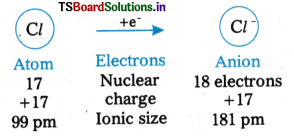
i) Gain of electrons : The addition of electron is not compensated by the nuclear charge.
- As a result of which there is increased repulsion among the electrons and a decrease in effective nuclear charge.
- In other words, the electron cloud in the anion expands. As a result of which the size of the anion increases.
- Hence, the ionic radius of an anion is larger than the atomic radius of that element.
- For example, the ionic radius of fluoride ion (F ) is 1.36 A whereas the atomic radius of fluorine is 0.72 Å.
ii) Loss of electrons: When a neutral atom loses one electron to form a cation, its atomic radius decreases.
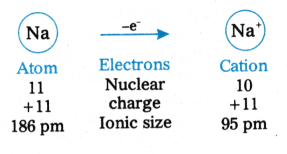
- This is because the number of electrons in the cation decreases while its nuclear charge remains the same as the parent atom.
- Since the same nuclear charge now attracts lesser number of electrons, therefore, the force of attraction of the nucleus on the electrons of all the shells increases (i.e., effective nuclear charge increases) and hence the radius of cation decreases.
Question 25.
Would you expect the first ionization enthalpies for two isotopes of the same element to be the same or different ? Justify your answer.
Answer:
- Ionization enthalpy depends upon the electronic configuration (number of electrons) and effective nuclear charge (number of protons).
- Since the isotopes of an element have the same electronic configuration and same nuclear charge, therefore, they are expected to have same ionization enthalpy.
Question 26.
What are the major differences between metals and non-metals ?
Answer:
- Elements which have a strong tendency to loose electrons to form cations are called metals while those which have a strong tendency to accept electrons to form anions are called non-metals.
- Thus, metals are strong reducing agents, they have low ionization enthalpies, less negative electron gain enthalpies, low electronegativity, good conductors of heat and electricity.
- Non-metals, on the other hand, are strong oxidising agents, they have high ionization enthalpies, high negative electron gain enthalpies, high electronegativity, poor conductors of heat and electricity (except graphite and diamond).
Question 27.
Use the periodic table to answer the following questions.
i) Identify an element with five electrons in the outer subshell.
ii) Identify an element that would tend to lose two electrons.
iii) Identify an element that would tend to gain two electrons.
iv) Identify the group having metal, non-metal, liquid as well as gas at the room temperature.
Answer:
i) The general electronic configuration of the elements having five electrons in the outer subshell is ns2 np5. This electronic configuration is characteristic of elements of group 17 (halogens), i.e., F, Cl; Br, I, Ar, etc.
ii) The elements which have a tendency to lose two electrons must have two electrons in the valence shell. Therefore, their general electronic configuration should be ns2. This electronic configuration is the characteristic of group 2 elements (alkaline earth metals), for example, Mg, Ca, Sr, Ba, etc.
iii) The elements which have a tendency to accept two electrons must have six electrons in the valence shell. Therefore, their general electronic configuration is ns2np4. This electronic configuration is characteristic of group 16 elements such as O, S, Se, etc.
iv) Group 1 and 17 contains metal, non-metal in liquid as well as gaseous state at the room temperature. For example, hydrogen is a non-metal and is present in the gaseous state. And the other elements of this group are metals. Further, Cesium (Cs) is a liquid metal. Similarly, Bromine is a liquid non-metal in group 17 while other elements of this group exists as gaseous non-metals.
Question 28.
The increasing order of reactivity among group I elements is Li < Na < K < Rb < Cs whereas that among group 17 elements is F > Cl > Br > I. Explain.
Answer:
- The elements of group 1 have only one electron in their respective valence shells and thus have a strong tendency to loose this electron.
- Since the ionization enthalpy decreases down the group, therefore, the reactivity of group 1 elements increases in the same order : Li < Na < K < Rb < Cs.
- In contrast, the elements of group 17 has seven electrons in their respective valence shells and thus have a strong tendency to accept one more electron. Since, the electrode potential of group in the same order : F > Cl > Br > I.
- Moreover, electron gain enthalpy becomes less and less negative as we move from Cl to I, therefore, reactivity increases from Cl to I.
- Fluorine is most reactive due to its low bond dissociation energy.
Question 29.
Write the general outer electronic configuration of s-, p-, d- and f-block elements.
Answer:
- s-Block element: ns1-2 (where n = 1,2, )
- p-Block element: ns2 np1-6 (where n = 1, 2 )
- d-Block element: (n – 1)d1-10 ns1-2 (where n = 4, 5, 6, 7)
- f-Block element: (n – 2)f1-14 (n – 1)d0-2 ns2 (where n = 6 and 7)
Question 30.
Assign the position of the element having outer electronic configuration
i) ns2 np4 for n = 3
ii) (n – 1)d2 ns2 for n = 4 and
iii) (n – 2)f7 (n – 1)d1 ns2 for n = 6, in the periodic table.
Answer:
i)
- n = 3 suggest that the element belongs to third period. Since the last electron
enters the p-orbital, therefore, the given element is a p-block element. - Further, since the valence shell contain 6(2 + 4) electrons.
- Therefore, group number of element = 10 + number of electrons in the valence shell = 10 + 6 = 16.
- The complete electronic configuration of the element is 1s2 2s2 2p6 3s2 3p4 and the element is S (sulphur).
ii)
- n = 4 suggest that the element belongs to the fourth period.
Since the d-orbital is incomplete, therefore, it is a d-block element. The group number of the element = Number of electrons in (n – l)d subshell + number of ns-electrons = 2 + 2 = 4. Thus, the element lies in group 4 and 4th period. - The complete electronic configuration of the element is 1s2 2s2 2p6 3s2 3p6 3d2 4s2 and the element is Ti (titanium).
iii) n = 6 means that the element belongs to the sixth period. Since the last electron goes to the f-orbital, therefore, the element is a f-block element.
- All f-block elements lie in group 3. The complete electronic configuration of the element is [Xe] 4f7 5d1 6s2.
- The atomic number of the element = 54 + 7+1+2 = 64 and the element is Gd (gadolinium).
Question 31.
The first (∆iH1) and the second (∆iH2) ionization enthalpies (in kJ mol1) and the (∆egH) electron gain enthalpy (in kJ mol-1) of a few elements are given below.
| Elements | ΔH1 | ΔH2 | ∆egH |
| I | 520 | 7300 | -60 |
| II | 419 | 3051 | -48 |
| III | 1681 | 3374 | -328 |
| IV | 1008 | 1846 | -295 |
| V | 2372 | 5251 | +48 |
| VI | 738 | 1451 | -40 |
Which of the above elements is likely to be
i) the least reactive element.
ii) the most reactive metal.
iii) the most reactive non-metal.
iv) the least reactive non-metal.
v) the metal which can form a stable binary halide of the formula MX2 (X = halogen).
vi) the metal which can form a predominantly stable covalent halide of the formula MX (X = halogen) ?
Answer:
i) The element V which has highest first ionization enthalpy (∆iH1) and positive electron gain enthalpy (∆egH) and therefore it is the least reactive element.
- Since, inert gases have positive ∆egH1 thus, the element V must be an inert gas.
- The values of ∆iH1, ∆iH2 and ∆egH match with that of He (helium).
ii) The element which has the least first ionization enthalpy (∆iH1) and small negative electron gain enthalpy (∆egH) is the most reactive metal (element II).
- The values of ∆iH1, ∆iH2, and ∆egH match with that of K (potassium).
iii) The element which has high first ionization enthalpy (∆iH1) and second ionization enthalpy (∆iH2) and a very high negative electron gain enthalpy (∆egH) is the most reactive non-metal (element III).
- The values of ∆iH1, ∆iH2 and ∆egH match with that of F (fluorine).
iv) The element IV has a high negative electron gain enthalpy (∆egH) but not so high first ionization enthalpy (∆iH1).
- Therefore, it is the least reactive non-metal.
- The values of ∆iH1, ∆iH2 and ∆egH match with that of I (iodine).
v) The element VI has low first ionization enthalpy (∆iH1) but higher than that of alkali metals.
- Thus, it appears that the element is an alkaline earth metal and hence will form binary halide of the formula MX2 where X = halogen.
- The values of ∆iH1, ∆iH2 and ∆egH match with that of Mg (magnesium).
vi) The element I has low first ionization (∆iH1) but a very high second ionization enthalpy (∆iH2).
Therefore, it must be an alkali metal.
- Since the metal forms a predominantly stable covalent halide of the formula MX (X = hydrogen).
- The values of ∆iH1, ∆iH2 and ∆egH match with that of Li (lithium).
Question 32.
Predict the formulas of the stable binary compounds that would be formed by the combination of the following pairs of elements.
i) Lithium and oxygen
ii) Magnesium and nitrogen
iii) Aluminium and iodine
iv) Silicon and oxygen
v) Phosphorus and fluorine
v) Element 71 and fluorine
Answer:
i) Lithium is an alkali metal (Group 1).
- It has only one electron in the valence shell, therefore, its valency is 1.
- Oxygen is group 16 element with valency of 2.
- Therefore, formula of the compound formed would be Li2O (lithium oxide).
ii) Magnesium is an alkaline earth metal (Group 2) and hence has 2 valence electrons. Nitrogen is a group 15 element with valency of 8 – 5 = 3.
- Thus, the formula of the compound formed would be Mg3N2 (magnesium nitride).
iii) Aluminium is a group 13 element with a valency of 3 while iodine is a halogen (group 17) with valency of 1.
- Therefore, the formula of the compound formed would be AlI3 (aluminium hydride).
iv) Silicon is a group 14 element with valency of 4 while oxygen is group 16 element with valency of 2. Hence, the formula of the compound formed would be SiO2 (silicon dioxide).
v) Phosphorus is a group 15 element with valency of 3 or 5 while fluorine is a group 17 element with valency of 1. Hence, the formula of the compound formed would be PF3 or PF5.
vi) Element with atomic number 71 is a lanthanide called lutetium (Lu). Its common valency is 3. Fluorine is a group 17 (halogen) element with valency of 1.
Therefore the formula of the compound formed would be LuF3 (lutetium fluoride).
Question 33.
In the modern periodic table, the period indicates the value of
a) atomic number
c) principal quantum number
b) atomic mass
d) azimuthal quantum number.
Answer:
In the modem periodic table, each period begins with the filling of a new shell. Therefore each period represents the principal quantum number of the valence electrons of the represent elements. Thus, option (c) is correct.
Question 34.
Which of the following statements related to the modern periodic table is incorrect ?
a) The p-block has 6 columns, because a maximum of 6 electrons can occupy all the orbitals in a p-shell.
b) The d-block has 8 columns, because a maximum of 8 electrons can occupy all the orbital in a d-subshell.
c) Each block contains a number of columns equal to the number of electrons that can occupy that subshell.
d) The block indicates value of azimuthal quantum number (l) for the last subshell the received electrons in building up the electronic configuration.
Answer:
Statement (b) is incorrect, while the other statements are correct.
The correct statement is the d-block has 10 columns, because a maximum of 10 electrons can occupy all the orbitals in a d-subshell.
Question 35.
Anything that influences the valence electrons will affect the chemistry of the element. Which one of the following factors does not affect the valence shell ?
a) Valence principal quantum number (n)
b) Nuclear charge (Z)
c) Nuclear mass
d) Number of core electrons
Answer:
Nuclear mass does not affect the valence shell because it consists of protons and neutrons, when proton, i.e., nuclear charge affects the valence shell but neutrons do not. Thus, option (c) is correct.
Question 36.
The size of isoelectronic species – F–, Ne and Na+ is affected by
a) nuclear charge (Z)
b) valence principal quantum number (n)
c) electron-electron interaction in the outer orbitals
d) none of the factors because their size is the same.
Answer:
- The size of isoelectronic ions depends upon the nuclear charge (Z).
- As the nuclear charge increases, the size decreases.
- For example, F– (+9) > Ne (+10) > Na+ (+11). Thus, option (a) is correct.
Question 37.
Which one of the following statements is incorrect in relation to ionization enthalpy ?
a) Ionization enthalpy increases for each successive electron
b) The greatest increase in ionization enthalpy is experienced on removal of electron from core noble gas configuration.
c) End of valence electrons is marked by a big jump in ionization enthalpy.
d) Removal of electron from orbitals bearing lower n value is easier than from orbital having higher n value.
Answer:
Statement (d) is incorrect. Its correct form is removal of electron from orbitals bearing lower n value is difficult than from orbital having higher n value.
Question 38.
Considering the elements B, Al, Mg and K, the correct order of their metallic character is
a) B > Al > Mg > K
b) Al > Mg > B > K
c) Mg > Al > K > B
d) K > Mg > Al > B
Answer:
d) K > Mg > Al > B
- In a period, electronegativity increases and hence the metallic character decreases as we move from left to right.
- Therefore, metallic character of K, Mg and Al decreases in the order: K > Mg > Al. Further, within a group, the electronegativity decreases and hence the metallic character increases from top to bottom.
- Therefore, Al is more metallic than B. Hence, the correct order of decreasing metallic character will be K > Mg > Al > B.
Question 39.
Considering the element B, C, N, F and Si, the correct order of their non-metallic character is:
a) B > C > Si > N > F
b) Si > C > B > Sl > F
c) F > N > C > B > Si
d) F > N > C > Si > B
Answer:
c) F > N > C > B > Si
- In a period, the non-metallic character increases from left to right.
- Thus, among B, C, N and F, non-metallic character decreases in order: F > N > C > B. Further, within a group, non-metallic character decreases from the top to bottom.
- Therefore, C is more non-metallic than Si.
- Hence, the correct sequence of decreasing non-metallic character will be F > N > C > B > Si.
Question 40.
Considering the elements F, Cl, O and N, the correct order of their chemical reactivity in terms of oxidizing property is
a) F > Cl > O > N
b) F > O > Cl > N
c) Cl > F > O > N
d) O > F > N > Cl
Answer:
b) F > O > Cl > N
- Within a period, the oxidising character increases from left to right. Therefore, among F, O and N, oxidising power decreases in the order : F > O > N.
- Further, within a group, oxidising power decreases from top to bottom.
- Thus, F is a stronger bxidising agent than Cl. Moreover, because O is more electronegative than Cl, therefore, O is a stronger oxidising agent than Cl.
- Hence, overall decreasing order of oxidising power will be F > O > Cl > N.