
Regular practice with AP Inter 2nd Year Physics Study Material Chapter 13 Nuclei Questions and Answers helps students stay prepared for examinations.
AP Inter 2nd Year Physics 13th Lesson Nuclei Questions and Answers
I. Multiple Choice Questions
Question 1.
Identify the artificially produced hydrogen isotope among the following. [ ]
1) 1H1
2) 1H2
3) 1H3
4) 1H4
Answer:
3) 1H3
Among hydrogen isotopes, only tritium 1H3 is radioactive and mostly produced artificially.
Question 2.
The nuclei having the same atomic numbers but different mass numbers are called [ ]
1) Isotopes
2) isotones
3) isobars
4) isodiaphers
Answer:
1) Isotopes
The nuclei having the same atomic numbers but different mass numbers are called isotopes
Question 3.
Isotones are nuclei with
1) same atomic number
2) same number of neutrons
3) same atomic weight
4) same excess number of neutrons
Answer:
2) same number of neutrons
Isotones are nuclei with same number of neutrons.
Question 4.
The energy equivalent lg of substance is
1) 9 × 10¹⁵J
2) 9 × 10¹⁶J
3) 9 × 10⁶J
4) 9 × 10¹³J
Answer:
4) 9 × 10¹³J
Given m = 1g = 10-3kg, c = 3 × 10⁸ m/s
E = mc2 = 10-3 × (3 × 108)2 = 9 × 10¹³J
Question 5.
The radius of a nucleus is directly proportional to
1) A2
2) A3
3) A1/3
4) A1/2
Answer:
3) A1/3
Nuclear radius R = R0A1/3 ⇒ R is is directly proportional to A1/3
Question 6.
If M is the mass of the nuclei, mn, mp are the mass of the neutron and proton respectively. Then the mass defect is written as [ ]
1) ΔM = [Zmn + (A-Z)mp] -M
2) ΔM = [Zmp + (A-Z)mn] – M
3) ΔM = M – [Zmn + (A-Z)mp]
4) ΔM = M – [Zmn + (A-Z)mn]
Answer:
2) ΔM = [Zmp + (A-Z)mn] – M
Mass defect = Mass of nucleons – Mass of nucleus
ΔM = [Mass of proton + Mass of neutrons ] – Mass of nucleus
= [Zmp + (A-Z)mn] – M.

Question 7.
Choose the correct statement regarding binding energy curve. [ ]
1) Very heavy nuclei involve in nuclear fusion to get stability
2) Very light nuclei involve in nuclear fission to get stability
3) Very heavy nuclei involve fission to get stability
4) Very light nuclei doesn’t involve in fission or fusion
Answer:
3) Very heavy nuclei involve fission to get stability
On the binding energy curve, nuclei with high mass numbers have lower binding energy per nucleon. To reach more stable state, they split into smaller fragments.
Question 8.
Choose the incorrect statement regarding nuclear force. [ ]
1) Nuclear forces are short range forces
2) Nuclear forces are charge independent
3) Nuclear forces are spin dependent
4) Nuclear forces are central forces
Answer:
4) Nuclear forces are central forces
Nuclear force is not purely a simple central force but short range, charge independent & spin dependent.
Question 9.
Identify the emitted particles in γ-decay.
1) Helium
2) Electrons
3) Photons
4) Positrons
Answer:
3) Photons
Gamma decay emits gamma rays made of photons.
Question 10.
Identify the number of protons and neutrons in 92U235 nuclei
1) 92, 143
2) 143, 92
3) 92, 92
4) 235, 235
Answer:
1) 92, 143
Given A = 235, Z = 92
∴ No.of neutrons = A – Z = 235 – 92 = 143
Question 11.
Density of nucleus is
1) proportional to A1/3
2) proportional to A
3) independent of A
4) inversely proportional to A1/3
Answer:
3) independent of A
Density of nucleus is constant which is independent of A.
Question 12.
Fusion reaction takes place at high temperature, because
1) nuclei break up at high temperature
2) atom get ionized at high temperature
3) kinetic energy should be high enough to overcome the coulomb repulsive force among nucleons
4) molecules break up at high temperature
Answer:
3) kinetic energy should be high enough to overcome the coulomb repulsive force among nucleons
Nuclei are positively charged, so they repel each other.
High temperature gives enough kinetic energy to overcome Coulomb’s repulsion.
Question 13.
Mass equivalent to energy 931 MeV is [ ]
1) 6.02 × 10⁻²⁷kg
2) 1.66 × 10⁻²⁷ kg
3) 16.66 × 10⁻³¹ kg
4) 6.02 × 10⁻²⁶kg
Answer:
2) 1.66 × 10⁻²⁷ kg
E = mc2 ⇒ m = \(\frac{E}{c^2}\) = \(\frac{931 \times 10^6 \times 1.6 \times 10^{-19}}{9 \times 10^{16}}\) = 1.66 × 0-27 kg
Question 14.
The binding energy per nucleon is maximum for [ ]
1) 2He4
2) 26Fe56
3) 56Ba141
4) 92U235
Answer:
2) 26Fe56
Binding energy curve peaks near iron (Fe) region.
II. Fill in the Blanks
Question 1.
1 atomic mass unit = ____
Answer:
1.66 × 10⁻²⁷ kg
1 amu = 1.66 × 10⁻²⁷kg
Question 2.
Einstein’s mass-energy relation is ___.
Answer:
E = MC2.
Einstein’s mass-energy relation:E = mc2
Question 3.
The average binding energy of nucleon inside an atomic nucleus is about ___.
Answer:
8 MeV.
Average binding energy per nucleon for stable nuclei is nearly constant and is around 8 MeV
Question 4.
1 amu = ___ MeV.
Answer:
931.5
1 amu= 931.5Mev.
Question 5.
____ process is responsible for the energy produced in the stars.
Answer:
Nuclear fusion
Nuclear fusion is responsible for the energy produced in the stars.
Question 6.
In a thermo nuclear reaction 1 kg of hydrogen is converted into 0.993 kg of helium. The energy released in this reaction is ___.
Answer:
63 × 1013 J
Initial mass 1 kg, Final mass = 0.993kg. Mass defect Δm = 1 – 0.993 = 0.007 kg
E = Δmc2 = (0.007) (3 × 10⁸)2 = 6.3 × 1o14J
Question 7.
A nucleus has a binding energy of 72MeV and contains 12 nucleons. Then the binding energy per nucleon is ___.
Answer:
6 MeV
Binding energy per nucleon \(=\frac{\text { B.E }}{\text { no.of nucleons }}\) = \(\frac{72 \mathrm{Mev}}{12}\) = 6Mev per nucleon.
Question 8.
Energy in an atomic bomb is produced by the process of ____.
Answer:
uncontrolled nuclear fission
Energy in an atomic bomb is due to nuclear fission.
Question 9.
Energy in hydrogen bomb is produced by the process of ____.
Answer:
nuclear fusion
Energy in hydrogen bomb is duc to nuclear fusion.
III. One Word Answer Questions
Question 1.
Who discovered neutron?
Answer:
James Chadwick discovered, neutron in 1932.
Question 2.
What is the average number of secondary neutrons emitted in the fission of 92U235?
Answer:
On average 2.5 neutrons.
On average,, each fission of a Uranium-235 nucleus releases between 2 and 3 neutrons.
Question 3.
Define mass defect.
Answer:
Mass defect is the difference in mass of a nucleus and its constituent particles.
Question 4.
Why is the mass of a nucleus less than the sum of its nucleons?
Answer:
Reason: Some of that mass of nucleus was converted into binding energy to bind the nucleons together.
Question 5.
Which particle usually initiates a fission reaction?
Answer:
Thermal Neutron initiates fission reaction.
Question 6.
What are the elements produced in the fission of 92U235?
Answer:
Fission of 92U235produces isotopes of Krypton and Barium (or) Xenon and Strontium.
Question 7.
What are the number of protons and neutrons in 11Na23?
Answer:
No. of protons = Atomic number = Z = 11;
No.of neutrons = A – Z = 23 – 11 = 12
Question 8.
What is binding energy?
Answer:
Binding energy is the energy required to break the nucleus into its consitutent nucleons.
Question 9.
What will be the ratio of the radii of two nuclei of mass numbers A1 and A2?
Answer:
\(\frac{R_1}{R_2}\) = \(\left[\frac{A_1}{A_2}\right]^{1 / 3}\)
The radius of a nucleus R = R0A1/3. As R0 is a constant we have R ∝ A1/3
IV. Very Short Answer Questions
Question 1.
Compare the radii of the nuclei of mass numbers 27 and 64.
Answer:
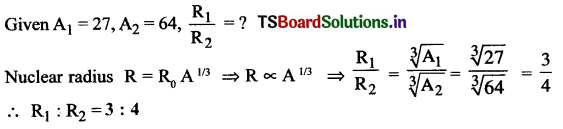
Question 2.
What is the significance of a mass defect in a nucleus?
Answer:
The mass defect represents the stability of the nucleus.
A large mass defect generally means a larger binding energy, which makes the nucleus more stable. It proves that mass and energy are interchangeable according to E = mc2.
Question 3.
A fusion reaction releases energy of 1.6 × 10⁻¹²J. Find the equivalent mass defect in kg.
Answer:
Given E = 1.6 × 10⁻¹²J. We knów c = 3 × 10⁸ m / s . We have E = mc2
∴ Mass defect Δm = \(\frac{E}{c^2}\) = \(\frac{1.6 \times 10^{-12}}{\left(3 \times 10^8\right)^2}\) = 1.78 × 10⁻²⁹kg
Question 4.
The radius of germanium (Ge) nuclide is measured to be twice the radius of 4Be9. The number of nucleons in Ge are
Answer:
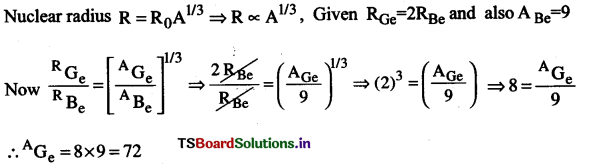
Given m = 1g = 10-3kg, c = 3 × 10⁸ m/s
E = mc2 = 10-3 × (3 × 108)2 = 9 × 10¹³J
Question 5.
An unstable heavy nucleus at rest breaks into two nuclei move away with velocities in the ratio of 8:27. What is the ratio of radii of the nuclei (assumed to be spherical)?
Answer:
From the law of conservation of momentum m1v1 = m2v2 ⇒ \(\frac{\mathrm{m}_1}{\mathrm{~m}_2}\) = \(\frac{v_2}{v_1}\) ….. (1)
Mass(m) is proporitonal to mass number (A) ∴ \(\frac{\mathrm{m}_1}{\mathrm{~m}_2}\) = \(\frac{A_1}{A_2}\) …….. (2)
From (1) and (2); \(\frac{A_1}{A_2}\) = \(\frac{v_2}{v_1}\) = \(\frac{27}{8}\)
Nuclear radius R ∝ A1/3 ⇒ \(\frac{R_1}{R_2}\) = \(\left[\frac{A_1}{A_2}\right]^{1 / 3}\) = \(\left[\frac{27}{8}\right]^{1 / 3}\) = \(\left[\frac{3^3}{2^3}\right]^{1 / 3}\) = \(\frac{3}{2}\)
∴ Ratio of radii of nuclei is 3 : 2.
Question 6.
What are isotopes and isobars?
Answer:
1) Isotopes are the nuclei having same atomic number (Z), but different mass numbers (A)
Ex: 1H1, 1H2, 1H3
2) Isobars are the nuclei having same mass number (A), but different atomic numbers (Z)
Ex: 6C14, 7N14
Question 7.
What are isotones and isomers?
Answer:
1) Isotones are the nuclei having the same neutron number (N), but different atomic numbers (Z).
Ex; 20Ca40, 19K39. Here number of neutrons in each = 20
2) Isomers are the nuclei having same atomic number (Z) and same mass number (A) but different nuclear properties such as radioactive decay and magnetic moments.
Ex: \(80
35\)Br (metastable), \(80
35\)Br (ground state)
Question 8.
Why are nuclear fusion reactions called thermo nuclear reactions?
Answer:
Nuclear fusion reactions take place at extremely high temperature (of the order 107K ) in order to overcome strong electrostatic repulsions between positively charged nuclei. Hence, the nuclear fusion reactions are called thermo nuclear reactions.
V. Short Answer Questions
Question 1.
What is nuclear fission? Give an example to illustrate it.
Answer:
Nuclear Fission :
- Nuclear fission is the splitting of a heavy nucleus into two or more fragments with the release of large energy.
- It is the source of energy in nuclear reactors.
- It takes place at ordinary temperature.
- This principle is used in atom bomb.
- The energy produced in the fission is low when compared to fusion.
Ex: The fission of Uranium-235 may be as follows :
92U235 + 0n1 → 92U236 → 56Ba144 + 36Kr89 + 3 0n1 + 200MeV
Question 2.
What is nuclear fusion? Explain with concerned reactions.
Answer:
Nuclear Fusion :
- Nuclear fusion is the fusing of two or more light nuclei to form a single nucleus with the release of extremely large energy.
- It is the source of energy in the stars.
- It takes place at very high temperature of the order 107 K.
- This principle is used in hydrogen bomb.
- The energy produced in the fusion is 7 times that of fission.
Ex: In sun 4 hydrogen nuclei fuse together to form a helium nucleus.
41H1 + 4-1e° → 2He4 + 2-1e° + 2v + 6γ + 26.7MeV
Question 3.
Explain the properties of nuclear forces?
Answer:
Nuclear Forces are the forces that hold the nucleons together within the nucleus.
Properties of Nuclear Forces:
- The nuclear force is the strongest attractive in nature,
- Nuclear force is a short range force.
- Nuclear force is independent of charge of protons.
- Nuclear force is spin dependent.
- Nuclear force is an exchange force.
Question 4.
Explain the terms mass defect and binding energy with mathematical expressions.
Answer:
a) Mass Defect (ΔM) is the difference between the total mass of all the nucleons of a nucleus and the actual mass of a nucleus.
ΔM [Zmp + (A-Z)mn]-M where Zmp = total mass of protons,
(A-Z)mn = total mass of neutrons, M = mass of nucleus,
b) Binding Energy is the energy required to bind the nucleons in the nucleus or the energy required to break the nucleus into its constituent protons and neutrons.
From E = mc2 we can write Binding energy B.E = AM c2
Here ΔM is the mass defect and c is the velocity of light.
Question 5.
Distinguish between nuclear fission and fusion
Answer:
| Nuclear fission | Nuclear Fusion |
| 1. It is the splitting of a heavy nucleus into two or more fragments with the release of large energy. | 1. It is the fusing of two or more light nuclei to form a single nucleus with the release of large energy |
| 2. It is the source of energy in nuclear reactors. | 2. It is the source of energy in the stars. |
| 3. It takes place at ordinary temperature. | 3. It takes place at very high temperature of the order 107 K. |
| 4. This principle is used in atom bomb. | 4. This principle is used in hydrogen bomb. |
| 5. The energy produced in the fission is low when compared to fusion. Ex : 92U235 + 0n1 → [92U236] → 56Ba144 + 36Kr89 + .0n1 + 200 MeV | 5. The energy produced in the fusion is 7 times that of fission. Ex: In the Sun, 4 hydrogen nuclei fuse together to form a helium nucleus. 41H1 + 4-1e0 → 2He4 + 2-1e0 + 2v + 6γ +26.7 MeV |
VI. Long Answer Questions
Question 1.
a) Explain the composition of nucleus and express the atomic masses of nucleons in terms of atomic mass units.
b) Draw and explain the potential energy curve of pair of nucleons. Show that the density of nucleus doesn’t depend on mass number A.
Answer:
a) Composition of Nucleus: Nucleus consists of positively charged protons and electically netural neutrons. Charge of proton = +1.6 × 10⁻¹⁹ C
The number of protons is called the atomic number (Z)
Mass number A = Atomic number (Z) + Number of neutrons (N)
Atomic Masses of Nucleons:
The masses of nucleons are expressed in atomic mass unit (u).
1 atomic mass unit: 1u = \(\frac{1}{12}\) mass of carbon-12 atom. Here 1u = 1.66 × 10⁻²⁷ kg
Mass of Proton: mp = 1.007276;
Mass of Neutron: mn = 1.008665;
Mass of Electron me = 0.000548
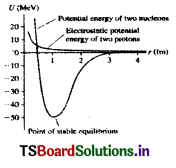
b) POTENTIAL ENERGY CURVE OF PAIR OF NUCLEONS:
Explanation: The force between two nucleons depends on the distance between them.
1. At intermediate distances:
Nuclear force is attractive. Potential energy is negative.
2. At very small distances:
Force becomes strongly repulsive. Potential energy rises sharply.
3. Beyond a few femtometres Nuclear force becomes negligible.
The minimum point of the curve indicates stable binding of nucleons.
Density of Nucleus is Independent of Mass Number A:
Radius of nucleus: R = R0A1/3 Here R0 = 1.2 × 10⁻¹⁵
Volume of nucleus is V = \(\frac{4}{3}\)πR3 We know R=R0A1/3
∴ V = \(\frac{4}{3}\)π(R0A1/3)3V = \(\frac{4}{3}\)π\(\mathrm{R}_0^3\)A . Thus V ∝ A
Mass of Nucleus: M ∝ A
Density of Nucleus: ρ = \(\frac{\mathrm{M}}{\mathrm{~V}}\)
Here density ρ is constant because both mass and volume are proportional to A.
Hence, the density of nucleus is independent of mass number A.
Question 2.
Define mass defect and binding energy. How does binding energy per nucleon vary with mass number? What is its significance?
Answer:
a) Mass Defect(ΔM) is the difference between the total mass of all the nucleons of a nucleus and the actual mass of a nucleus.
ΔM = [Zmp + (A-Z)mn]-M where Zmp = total mass of protons,
(A-Z)mn = total mass of neutrons, M = mass of nucleus.
b) Binding Energy is the energy required to bind the nucleons in the nucleus or the energy required to break the nucleus into its constituent protons and neutrons.
From E = mc2 we can write Binding energy B.E = ΔM c2
Here ΔM is the mass defect and c is the velocity of light.
Also 1 amu =931.5 MeV
∴ B.E = ΔM × 931.5 MeV
c) Binding Energy per Nucleon: The binding energy of a nucleus (B.E) divided by its mass number (A) is called binding energy per nucleon \((\overline{\mathbf{B . E}})\). Formula \((\overline{\mathbf{B . E}})\) = B.E/A
Variation of binding energy per nucleon with mass number :
The graph shown in the figure explains how the binding energy per nucleon \((\overline{\mathbf{B . E}})\) varies with mass number (A).
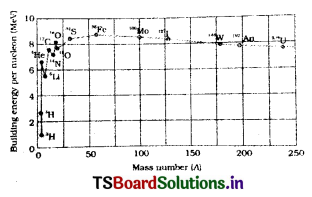
The graph shows the following facts :
1) From A = 30 to A = 170, the binding energy per nucleon ( B.E ) is constant.
B.E =8.75 MeV is maximum for Fe-56 and B.E =7.6 MeV lower for U-238.
2) B.E is low for both light nuclei (A < 30) and heavy nuclei (A > 170).
Significance: Greater binding energy per nucleon means greater stability to the nucleus.
The light nuclei of A < 30 and heavy nuclei of A > 170 are unstable because their \((\overline{\mathbf{B . E}})\) is low. That is why, properties like radioactivity, fission, fusion exist in this region only. The mid nuclei are stable because their \((\overline{\mathbf{B . E}})\) is high.
Question 3.
Explain nuclear fission and fusion with suitable nuclear reactions.
Answer:
Nuclear fission: The process of breaking a heavy nucleus like Uranium-235 in two or more roughly equal fragments with the release of enormous amount of energy is called nuclear fission.
Nuclear fission was discovered by Otto Hahn and Strassman.
Ex: The fission of Uranium-235 may be as follows :
on1 + 9U235 → 92U236 → 56Ba144 + 36Kr89 + 30n1 + 200MeV
Nuclear fusion: The process in which two or more light nuclei fuse together to form a single nucleus with the release of enormous energy is called nuclear fusion.
Nuclear fusion takes place only at high temperature of the order of 10 K.
Ex : In sun 4 hydrogen nuclei fuse together to form a helium nucleus.
41H1 + 4-1e° → 2He4 + 2-11e° + 2v + 6y + 26.7MeV
Question 4.
a) What is the source of stellar energy? Explain it with the help of proton-proton cycle.
b) Briefly explain the formation of red giant stage of sun.
Answer:
a) Source of stellar Energy: The energy from the sun and other stars is called stellar energy.
The source of stellar energy is thermo nuclear fusion.
Nuclear fusion in Sun, stars takes place m multi steps in which the hydrogen is bum to form helium.
Proton-Proton Cycle:
The nuclear reactions of proton-proton cycle are as follows.
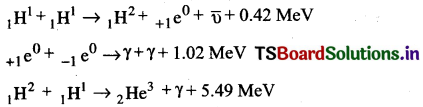
The above three reactions should take place twice so that following reaction occurs.

The combination of the above four reactions results the following reaction.

Thus 4 hydrogen atoms combine to form a helium atom with a release of 26.7 MeV energy.
b) Red giant stage of sun:
The Sun enters the red giant stage after 5 billion years when most of the hydrogen in its core is exhausted. Then due to lack of hydrogen fuel, nuclear fusion in the core slows down.The core contracts under gravity and its temperature increases.Hydrogen fusion starts occurring in a shell surrounding the core. The large amount of energy produced causes the outer layers of the Sun to expand enonnously. As the surface expands, it cools and appears red in colour.
Thus, the Sun becomes a red giant – a very large, cool, and luminous star.
Exercise Problems
Question 1.
Find the radius of Aluminum nucleus 13Al27. (Given that R0 = 1.2 × 10⁻¹⁵m).
Answer:
Given constant Ro = 1.2 × 10⁻¹⁵m
From 13Al27, we have mass number of Aluminium is A=27
Radius of Aluminium is R = R0A1/3 = 1.2 × 10⁻¹⁵ (27)1/3 = 3.6 × 10⁻¹⁵ m
Question 2.
Find the binding energy of 26Fe56. Atomic mass of Fe is 55.9349u and that of hydrogen is 1.00783u and mass of neutron is 1.00876u.
Answer:
From 26Fe56, we have Z = 26, A = 56, Number of neutrons = A-Z = 30
Atomic mass of Fe is M = 55.9349 u, mass of proton mp = 1.00783 u, mass of neutron mn = 1.00876 u
Mass defect ΔM = [Zmp + (A – Z)mn] – M = [26 × 1.00783 + 30 × 1.00876] – 55.9349
= 26.20358 + 30.2628 – 55.9349 = 0.53148 u
Binding energy B.E = ΔM × 931.5 MeV = 0.53148 × 931.5 MeV= 495.07 MeV
Question 3.
How much energy is required to separate the typical middle mass nucleus 50Sn120 into its constituent nucleons? (mass of 50Sn120 = 119.902199u, mass of proton 1.007815u and mass of ñeutron = 1.008685u)
Answer:
From 50Sn120, we have Z = 50, A = 120, Number of neutrons A – Z = 70,
Mass of Sn is M= 119.902199 u, mass of proton mp = 1.007815 u,
mass of neutron mn = 1.008665 u,
Mass defect ΔM = [Zmp + (A-Z)mn]-M = 50 × 1.007815 + 70 × 1.008665 – 1 19.902 199
= 50.39075 + 70.60795 – 119.902199 = 1.096501 u
Binding energy B.E = ΔM × 931.5 MeV= 1.096501 × 931.5 MeV = 1021.39 MeV
Question 4.
Calculate the binding energy of an α-particle. Given that mass of proton = 1.0073u, mass of neutron 1.0087u and mass of alpha particle = 4.0015u.
Answer:
An α particle 2He4 contains 2 protons and 2 neutrons.
Here Z = 2, A = 4, Number of neutrons A – Z = 2, mass of alpha particle mn = 4.0015 u,
mass of proton m = 1.0073 u, mass of neutron m = 1.0087 u,
Mass defect ΔM = [Zmp + (A – Z)mn] – M = 2 × 1.0073 + 2 × 1.0087 – 4.0015
= 2.0146 + 2.0174 – 4.0015 = 0.0305 u
Binding energy B.E = ΔM × 931.5 MeV= 0.0305 × 931.5 MeV = 28.41 MeV
Question 5.
Find the energy required to split 8O16 nucleus into four α – particles. The mass of an a – particle is 4.002692u and that of oxygen is 15.994915u.
Answer:
For splitting 8O16 into 4 alpha particles are required.
Here mass of α particle mα = 4.002602 u, Mass of oxygen = 15.994915 u,
Binding energy B.E = Δmc2 = (mass of 4 helium atoms – mass of oxygen atom)c2
∴ B.E = (4 × 4.002602 – 15.994915) 931.5 = (16.010408 – 15.994915)931.5
= 0.015493 × 931.5 MeV = 14.43 MeV
Question 6.
Bombardment of lithium with proton gives rise to the following reaction:
3Li7 + 1H1 → 2 2He4 + Q. Find the Q value of the reaction. The atomic masses of lithium, proton and helium are 7.016u, 1.0084u and 4.004u respectively.
Answer:
Given mass of the Lithium mLi = 7.016 u, Mass of the proton mp = 1.008 u,
Mass of the Helium mHe = 4.004 u,
Mass defect, ΔM = (Mass of reactants ) – (Mass of products) = (7.016 + 1.0084) – (2 × 4.004)
ΔM = 8.0244 – 8.008 = 0.0164u
Q-value = ΔM × 931.5 MeV = 0.0164 × 931.5 = 15.276 MeV
Question 7.
If one microgram of 92U235 is completely destroyed in an atom bomb, how much energy will be released?
Answer:
Mass of uranium destroyed, m = 1 microgram = 10-6g = 10-9kg, c = 3 × 10⁸ ms-1, E = ?
Formula: Energy E = mc2 = 10-9 × (3 × 108)2 = 9 × 10⁻⁹+8+8 ∴ E = 9 × 10⁷ J
Question 8.
200MeV energy is released when one nucleus of 92U235 undergoes fission. Find the number of fissions per second required for producing a power of 1 megawatt.
Answer:
Required power to be produced P = 1 mega watt = 106 J/s
Energy released for per fission in E = 200 meV = 200 × 106 × 1.6 × 10-19 = 3.2 × 10⁻¹¹J
Number of fissions per second = \(\frac{P}{E}\) = \(\frac{10^6}{3.2 \times 10^{-11}}\) = 3.125 × 10¹⁶
Objective Questions
Question 1.
A nucleus represented by the symbol \({ }_{\mathrm{Z}}^{\mathrm{A}} \mathrm{X}\) has
1) Z neutrons and A – Z protons
2) Z protons and A – Z neutrons
3) Z protons and A neutrons
4) A protons and Z – A neutrons
Answer:
2) Z protons and A – Z neutrons
Question 2.
The constituents of atomic nuclei are believed to be
1) neutrons and protons
2) protons only
3) electrons and protons
4) electrons, protons and neutrons
Answer:
1) neutrons and protons
Question 3.
In the nucleus of 11Na23, the number of protons, neutrons and electrons are
1) 11, 12, 0
2) 23, 12, 11
3) 12, 11, 0
4) 23, 11, 12
Answer:
1) 11, 12, 0
Question 4.
The nuclei 6C12 and 7N14 can be described as
1) isotones
2) isobars
3) isotopes of carbon
4) isotopes of nitrogen
Answer:
1) isotones
Question 5.
The radius or germanium (Ge) nuclide is measured to be twice the radius of \({ }_4^9 \mathrm{Be}\). The number of nucleons in Ge are
1) 72
2) 73
3) 74
4) 75
Answer:
1) 72
Question 6.
A nucleus ruptures into two nuclear parts, which have their velocity ratio equal to 2:1. What will be the ratio of their nuclear size (nuclear radius)?
1) 31/2 : 1
2) 1 : 3
3) 21/3 : 1
4) 1 : 21/3
Answer:
4) 1 : 21/3
Question 7.
The mass density of a nucleus varies with mass number A as
1) A2
2) A
3) constant
4) 1/A
Answer:
Question 8.
The energy required to break one bond in DNA is 10-20 J. This value in eV is nearly
1) 6
2) 0.6
3) 0.06
4) 0.006
Answer:
3) 0.06
Question 9.
The energy equivalent of 0.5 g of a substance is
1) 4.5 × 10¹⁶J
2) 4.5 × 10¹³J
3) 1.5 × 10¹³ J
4) 0.5 × 10¹³J
Answer:
2) 4.5 × 10¹³J
Question 10.
The mass of a \({ }_3^7 \mathrm{Li}\) nucleus is 0.042 u less than the sum of the masses of all its nucleons. The binding energy per nucleon of \({ }_3^7 \mathrm{Li}\) nucleus is nearly
1) 46 MeV
2) 5.6MeV
3) 3.9 MeV
4) 23 MeV
Answer:
2) 5.6MeV
Question 11.
Which of the following are suitable for the fusion process?
1) Light nuclei
2) Heavy nuclei
3) Element lying in the middle of the periodic table
4) Middle elements, which are lying on binding energy curve.
Answer:
1) Light nuclei
Question 12.
The binding energy per nucleon is maximum in case of
1) \({ }_2^4 \mathrm{He}\)
2) \({ }_{26}^{56} \mathrm{Fe}\)
3) \({ }_{56}^{141} \mathrm{Ba}\)
4) \({ }_{92}^{235} \mathrm{U}\)
Answer:
2) \({ }_{26}^{56} \mathrm{Fe}\)
Question 13.
The energy equivalent of one atomic mass unit is
1) 1.6 × 10¹⁹ J
2) 6.02 × 10²³ J
3) 931 MeV
4) 9.31 MeV
Answer:
3) 931 MeV
Question 14.
A radioactive nucleus undergoes spontaneous decay in the sequence \({ }_Z^A \mathrm{X}\) –  where Z is the atomic number of element X. The possible decay particles in the sequence are
1) β–, α,β+
2) α,β–, β+
3) α,β+, β–
4) β+, α,β–
Answer:
4) β+, α,β–
Question 15.
The half-life of a radioactive nuclide is 100 hours. The fraction of original activity that will remain after 150 hours would be
1) 2/3\(\sqrt{2}\)
2) 1/2
3) 1/2\(\sqrt{2}\)
4) 2/3
Answer:
3) 1/2\(\sqrt{2}\)
Question 16.
α-particle consists of
1) 2 protons only
2) 2 protons and 2 neutrons only
3) 2 electrons, 2 protons and 2 neutron
4) 2 electrons and 4 protons only
Answer:
2) 2 protons and 2 neutrons only
Question 17.
The half-life of a radioactive substance is 30 minutes. The time (in minutes) taken between 40% decay and 85% decay of the same radioactive substance is
1) 15
2) 30
3) 45
4) 60
Answer:
2) 30
Question 18.
α-particles, β-particles and γ-rays are having same energy. Their penetrating power in a given medium in increasing order will be
1) γ, α, β
2) α, β-particles and γ
3) β, α, γ
4) β, γ, α
Answer:
2) α, β-particles and γ
Question 19.
The half life of a radioactive nucleus is 50 days. The time interval (t2 – t1) between the time t2 when 2/3 of it has decayed and the time t1 when 1/3 of it had decayed is
1) 30 days
2) 50 days
3) 60 days
4) 15 days
Answer:
2) 50 days
Question 20.
A nucleus \({ }_{\mathrm{n}}^{\mathrm{m}} \mathrm{X}\) emits one α particle and two β particles. The resulting nucleus is
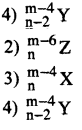
Answer:

Question 21.
The number of beta particles emitted by a radioactive substance is twice the number of alpha particles emitted by it. The resulting daughter is an
1) isomer of parent
2) isotone of parent
3) isotope of parent
4) isobar of parent
Answer:
3) isotope of parent
Question 22.
The half life of radium is about 1600 years. If 100 g of radium existing now, 25 g will remain unchanged after
1) 4800 years
2) 6400 years
3) 2400 years
4) 3200 years
Answer:
4) 3200 years
Question 23.
Which rays contain (positive) charged particles?
1) α-rays
2) β-rays
3) γ-rays
4) X-rays
Answer:
1) α-rays
Question 24.
Alpha particles are
1) neutrally charged
2) positron
3) protons
4) ionized helium atoms
Answer:
4) ionized helium atoms
Question 25.
After 1α and 2β-emissions
1) mass number reduces by 6
2) mass number reduces by 4
3) mass number reduces by 2
4) atomic number remains unchanged
Answer:
2) mass number reduces by 4
Question 26.
The most penetrating radiation out of the following are
1) β-rays
2) γ-rays
3) X-rays
4) α-rays.
Answer:
2) γ-rays
Question 27.
A certain mass of Hydrgen is changed to Helium by the process of fusion. The mass defect is
1) 6.675 MeV
2) 13.35 MeV
3) 2.67 MeV
4) 26.7 MeV
Answer:
1) 6.675 MeV
Question 28.
A heavy nucleus rest and breaks into two fragments which fly off with velocities 8 : 1. The ratio of radii of the fragments is
1) 1 : 2
2) 1 : 4
3) 4 : 1
4) 2 : 1
Answer:
Question 29.
If in nuclear reactor using U23 as fuel, the power output is 4.8 mega watts, the number of fissions per second is (Energy released per fission of U235 = 200 MeV, 1eV = 1.6 × 10⁻¹⁹J)
1) 1.5 × 10¹⁷
2) 3 × 10¹⁹
3) 1.5 × 1025
4) 3 × 1025
Answer:
Question 30.
A nucleus with Z=92 emits the following in a sequence.
α, β–, β–, α, α, α, α, α, β–, β–, α, β+, β–, α The Z of the resultant nucleus is
1) 74
2) 76
3) 78
4) 82
Answer:
3) 78