
Regular practice with AP Inter 2nd Year Physics Study Material Chapter 3 Current Electricity Questions and Answers helps students stay prepared for examinations.
AP Inter 2nd Year Physics 3rd Lesson Current Electricity Questions and Answers
I. Multiple Choice Questions
Question 1.
A wire of 50 cm long and I min-2 in cross-sec (ion carries a current of 4 A when connected to a 2V’ battery. The resistivity of wire is
1) 4 × 10⁻⁶ Ωm
2) 1 × 10⁻⁶ Ωm
3) 2 × 10⁻⁷ Ωm
4) 5 × 10⁻⁷ Ωm
Answer:
2) 1 × 10⁻⁶ Ωm
Length l = 50cm = 0.5m; Area = 1 mm2 = 10-6 m2, Potential V = 2V; Current I = 4A
Resistance R = \(\frac{V}{I}=\frac{2}{4}\) = 0.5Ω; Resistivity ρ = \(\frac{\mathrm{RA}}{l}=\frac{0.5 \times 10^{-6}}{0.5}\) = 10-6 Ωm
Question 2.
A charged particle having drift velocity of 7.5 × 10⁻⁴ m/s in an electric field of 3 × 10⁻¹⁰ V/m has a mobility in m2V-1s-1
1) 2.25 × 10¹⁵
2) 2.5 × 10⁶
3) 2.5 × 10⁻⁶
4) 2.25 × 10⁻¹⁵
Answer:
2) 2.5 × 10⁶
Drift velocity vd = 7.5 × 10⁻⁴ m/s; Electric field E = 3 × 10⁻¹⁰ V/m
Mobility μ = \(\frac{v_d}{E}=\frac{7.5 \times 10^{-}}{3 \times 10^{-10}}\) = 2.5 × 10⁻⁶ m2v-1s-1
Question 3.
Which of the following material has the largest resistivity?
1) Silicon
2) Germanium
3) Glass
4) Silver
Answer:
3) Glass
Insulator have much higher resistivity than conductors & semi conductors.
Question 4.
As the temperature increases, the electrical resistance
1) increases for both conductors and semiconductors
2) decreases for both conductors and semiconductors
3) increases for conductors but decreases for semiconductors
4) decreases for conductors but increases for semiconductors
Answer:
3) increases for conductors but decreases for semiconductors
Conductors have positive temperature coefficient.
Here resistance increases with increase in temperature.
Semiconductors have negative temperature coefficient, hence resistance decreases.
Question 5.
An electric bulb is rated 60 W, 220 V’. The resistance of the filament is close to
1) 807 Ω
2) 870 Ω
3) 708 Ω
4) 780 Ω
Answer:
1) 807 Ω
Power P = 60W, voltage V = 220V
Resistance R = \(\frac{\mathrm{V}^2}{\mathrm{P}}=\frac{(220)(220)}{60}\) = 806.67 Ω = 807 Ω

Question 6.
The internal resistance of a 2.1 V cell which gives a current of 0.2 A through the resistance of 10 Ω is
1) 0.8 Ω
2) 1.0 Ω
3) 0.2 Ω
4) 0.5 Ω
Answer:
4) 0.5 Ω
Emf E = 2.1V, Current I = 0.2 A, External resistance R = 10 Ω
E = I (R + r) ⇒ 2.1 = 0.2(10 + r) ⇒ 10 + r = 10.5
⇒ r = 10.5 – 10 = 0.5 Ω
Question 7.
The internal resistance of a cell of emf 2V is 0.1 Ω. It is connected to a resistance of 3.9 Ω. The voltage across the cell will be
1) 1.95 V
2) 1.9 V
3) 0.5 V
4) 2V
Answer:
1) 1.95 V
I = \(\frac{E}{R+r}=\frac{2}{3.9+0.1}\) = 0.5 A
Potential difference across cell is V= E – Ir = 2 – (0.5 × 0.1 ) = 2 – 0.05 = 1.95V
Question 8.
Kirchhoff’s first and second rules of electrical circuits are consequences of
1) conservation of energy and electric charge respectively
2) conservation of energy
3) conservation of electric charge and energy respectively
4) conservation of electric charge
Answer:
3) conservation of electric charge and energy respectively
KirchhofFs first law states that the sum of currents entering a junction equals to sum of
currents leaving it. It is based on the conservation of electric charge.
KirchhofFs second law states that the algebraic sum of potential differences is zero.
It is based on the conservation of energy.
Question 9.
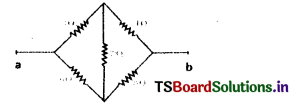
A bridge circuit is shown in figure . The equivalent resistance between points a and b is
1) 21 Ω
2) 7 Ω
3) \(\frac{252}{85}\)Ω
4) \(\frac{14}{3}\)Ω
Answer:
4) \(\frac{14}{3}\)Ω
Given circuit is a balanced Wheatstone bridge. Here \(\frac{3}{6}=\frac{4}{8}\) ⇒ \(\frac{R_1}{R_2}=\frac{R_3}{R_4}\)
In the equivalent circuit the resistors 7Ω, 14Ω are parallel.
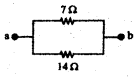
∴ \(\frac{1}{R_{a b}}=\frac{1}{R_1}+\frac{1}{R_2}=\frac{1}{7}+\frac{1}{14}=\frac{2+1}{14}=\frac{3}{14}\)
∴ Rab = \(\frac{14}{3}\) Ω
Question 10.
The potential difference (VA – VB) between the points A and B in Figure

1) -3V
2) +3V
3) +6V
4) +9V
Answer:
4) +9V
Given current I = 2A
Applying KirchhofFs second law we have VA – IR1 – 3 – IR2 – VB = 0
⇒ VA – [2 × 2] – 3 – [2 × 1] – VB = 0 ⇒ VA – VB = 9V
II. Fill in the Blanks
Question 1.
The electric current in a conductor is due to the flow of ________.
Answer:
electrons.
The current flow through the circuit is due to flow of free electrons.
Question 2.
The electric current in an electrolytic solution is due to the flow of ________.
Answer:
ions.
The current flow through electrolytic solution is due to both positive & negative ions.
Question 3.
The average velocity that the electrons move in a conductor due to an applied electric field is called _________.
Answer:
drift velocity.
The electrons move in a conductor due to the application of electric field intensity with drift velocity.
Question 4.
The electromotive force (emf) is not a force, but it is __________.
Answer:
potential difference.
The potential difference is the energy per unit charge which is equal to emf.
Question 5.
The SI unit of resistivity is __________
Answer:
Ωm .
Resistivity P = \(\frac{\mathrm{RA}}{l}=\frac{\Omega \mathrm{m}^2}{\mathrm{~m}}\) = Ωm
Question 6.
The SI unit of current density is _________
Answer:
A/m2.
Current density = \(\frac{I}{A}=\frac{A}{m^2}\) = Am-2
Question 7.
The reciprocal of resistivity is __________.
Answer:
conductivity.
Conductivity is the reciprocal of resistivity.
Question 8.
The current per unit area (i/A) is called _________
Answer:
current density.
Current density J = \(\frac{I}{A}\)
Question 9.
In an open circuit, the potential difference between the ends of a battery is equal to its
Answer:
electromotive force (emf).
In an open circuit, the potential difference between the ends of a battery is equal to emf.
Question 10.
Null point condition for a Wheatstone bridge arrangement for four resistances R1, R2, R3, R4 is
Answer:
\(\frac{\mathrm{R}_1}{\mathrm{R}_2}=\frac{\mathrm{R}_3}{\mathrm{R}_4}\)
According to Wheatstone bridge principle, \(\frac{R_1}{R_2}=\frac{R_3}{R_4}\)
III. One Word Answer Questions
Question 1.
What is the SI unit of electric current?
Answer:
SI unit of electric current is the ampere (A).
Question 2.
What Is the SI unit of Resistance?
Answer:
SI unit of electric resistance is the ohm (Ω).
Question 3.
What is current density?
Answer:
Current density (J) is the amount of electric current (I) flowing per unit cross sectional area (A) of a conductor. Formula: J = \(\frac{\mathrm{I}}{\mathrm{~A}}\)
Question 4.
What is conductivity?
Answer:
Conductivity is the ability of a material to allow the flow of electric charge.
Question 5.
What is the sign of temperature coefficient of resistivity for metals?
Answer:
The sign of the temperature coefficient of resistivity for metals is positive.
Because the resistivity increases with temperature.
Question 6.
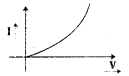
Draw the V-I graph for non-ohmic conductor (diode).
Answer:
For a non-ohmic conductor, V-I graph is is a non-linear curve.
Question 7.
Give the relation between emf and potential difference in open circuit.
Answer:
In an open circuit, EMF is equal to the potential difference across the terminals (E = V).
Question 8.
Give the relation between emf and potential difference in closed circuit.
Answer:
In a closed circuit, the relationship between emf and terminal voltage is given by V = E – Ir.
Here I is the current flow through the circuit and r is the internal resistance of the cell.
Question 9.
What are the dimensions of Resistivity?
Answer:
The dimensional formula of resistivity is [ML3T-3A-2]
Question 10.
Define the relaxation time of colliding electron.
Answer:
Relaxation time (𝜏) is the average time interval between two successive collisions of free electrons with ions (impurities) when they drift through a conductor.
IV. Very Short Answer Questions
Question 1.
State Ohm’s Law and write its mathematical form.
Answer:
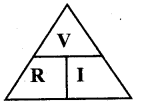
Ohm’s Law : At constant temperature, the potential difference (V) between the ends of a conductor is directly proportional to the current (1) passing through it.
V ∝ I V = RI (or) I = \(\frac{V}{R}\) (Or) R = \(\frac{V}{I}\)
Here R is the resistance of the conductor.
Question 2.
If the voltage V applied across a conductor is increased to how will the drift velocity of the electrons change?
Answer:
Drift velocity Vd = \(\frac{I}{n e A}=\frac{V}{n e A R}\) (∵ I = \(\frac{V}{R}\))
⇒ vd oc V (∵ n, e, A, R are constants)
∴ \(\frac{v_d^1}{v_d}=\frac{v^1}{v}=\frac{2 v}{v}\) = 2
∴ v1d = 2vd.
Thus, the drift velocity becomes double.
Question 3.
Define temperature coefficient of resistance.
Answer:
The temperature coefficient of resistance(α) is the ratio of change in resistance per unit original resistance per degree centigrade change in temperature.
[∵ α = \(\frac{\Delta \mathrm{R}}{\mathrm{R}_0 \Delta \mathrm{~T}}\)]
Question 4.
Define resistivity or specific resistance.
Answer:
Resistivity (ρ) is the resistance of a conductor per unit length per unit area of cross section .
Formula: ρ = \(\frac{\mathrm{RA}}{l}\) . Its SI unit is Ωm.
Question 5.
Define mobility of charge carriers.
Answer:
Mobility(μ) of a charge carrier is the magnitude of its drift velocity (vd) per unit electric field strength (E).
Formula: μ = \(\frac{\mathrm{v}_{\mathrm{d}}}{\mathrm{E}}\)
Question 6.
Two wires of equal length, of copper and manganin, have the same resistance. Which wire is thicker? (Given ρmanganin > ρcopper)
Answer:
We know that resistivity ρ = \(\frac{\mathrm{RA}}{l}\). As length l and resistance R are constant, ρ ∝ A
Resistivity ρ is high for manganin. Hence manganin has more area and more thicker.
Question 7.
If a wire is stretched to double its original length without the loss of mass, how will the resistivity of the wire be influenced?
Answer:
Resistivity is the property of material of a wire and it does not change with the change in dimensions (length) of the wire.
Note: When a wire is stretched to double its length, its resistivity does not change but its resistance becomes 4 times. Because for a given mass, volume is constant. Here R ∝ l2
Question 8.
Write the vector form of Ohms law. Explain the terms in it.
Answer:
Vector form of ohm’s law: Current density \(\vec{\mathrm{J}}=\sigma \vec{\mathrm{E}}\)
Here σ is conductivity and \(\vec{\mathrm{E}}\) is the electric field intensity.
Question 9.
Electrical power is transmitted from power stations to homes and factories at high voltages, why?
Answer:
Electric power is transmitted at high voltages in primarily to reduce heat energy loss.
Power P= VI ⇒ V and I are related inversely and also Heat loss = I2R
∴ High voltages give low current and hence low heat energy loss.
Question 10.
The electron drift speed in metals is small (~mm/s) and the charge of the electron is also very small (~10-19C ), but we can still obtain a large amount of current in a metal. Why?
Answer:
Current in a conductor is I = nAevd
Though the values of e and vd are very small, the value of number of free electrons per unit volume n is very very large(~1028) for metals. Hence large currents are possible in metals.
Question 11.
State Kirchhoff rules for electric network.
Answer:
Kirch offs First Law : The algebraic sum of currents meeting at any junction in an electric circuit is zero. Total current enters the junction is equal to total current leaving.
Kirchoffs Second Law : The algebraic sum of changes in potential around any closed loop involving resistors and cells is zero.
V. Short Answer Questions
Question 1.
Define electric resistance and write its SI unit. How does the resistance of a conductor vary if
a) conductor is stretched to 4 times of its length?
b) temperature of the conductor is increased?
Answer:
Electric Resistance of a conductor is the ratio of the potential difference (V) across the ends of a conductor to the electric current (i) passing through it.
Formula: R = \(\frac{V}{i}\). SI unit: ohm (Ω).
Also resistance of a conductor is given by R = ρ\(\frac{l}{\mathrm{~A}}\)
where ρ is resistivity of material, l is length and A is area of cross section of the conductor.
a) Conductor stretched 4 times of its Length : When a conductor is stretched, its length increases but its area of cross section decreases so that its volume (Al) remains constant.
R = ρ\(\frac{l}{\mathrm{~A}}\) = ρ\(\frac{l^2}{\mathrm{~A} l}\) When ρ and Al are constant then R ∝ l2
Thus if length / stretched 4 times, its resistance R becomes 42 = 16 times.
b) When temperature of a conductor is increased, its resistance R increases.
Resistivity of a conductor ρ = \(\frac{m}{n e^2 \tau}\). Here m is mass of electron, n is number of electrons per unit volume, e is charge of electron and x is average time of collisions.
When temperature is increased, the number of collisions increases and the average time of collisions x decreases.’ The’ term in the denominator decreases. – Thus, its resistivity and hence resistance increases.
Question 2.
Derive equivalent emf and internal resistance of two cells in series combination.
Answer:
Consider two cells of emf’s E1 and E2 and their internal resistances r1, r2 connected in series.
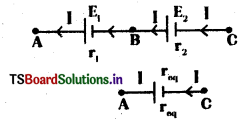
Let VA, VB, VC be the potentials at points A, B, C .
The potential difference between positive and negative terminals of the first cells between A and B is
VAB = VA – VB = E1 – I r1 ………… (1)
Similarly, VBC = VB – VC = E2 – Ir2 …………. (2)
The potential difference between positive and negative terminals of A and C is
VAC = VA – VC; = (VA – VB) + (VB – VC) = (E1 – Ir1) + (E2 – Ir2)
∴ VAC = (E1 + E2) – I[r1 + r2] ………….. (3)
If we replace the combination by a single cell between A and C of emf (Eeq) and internal resistance (req) then VAC = Eeq – Ireq ………… (4)
Comparing (3) and (4), we get Eeq = E1 + E2 and req = r1 + r2
Question 3.
Derive equivalent emf and internal resistance of two cells in parallel combination.
Answer:
Resistors in Parallel : Consider two cells of emfs Ej and E2 and internal resistance rt and r2 connected in parallel as shown in fig.
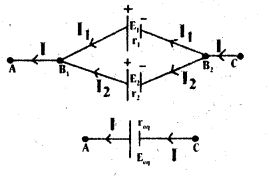
Let I1 and I2 be the currents leaving the positive terminals of the cells. At junction B1 the currents I1 and I2 flow in whereas the current I flows out.
Total current at junction B is I = I1 + I2 ……………. (1)
Let VB1 and VB2 be the potentials at B1 and B2.
For the first cell, potential difference is V = VB1 – VB2 = E1 – I1r1
⇒ I1r1 = E1 – V ⇒ I1 = \(\frac{E_1-V}{r_1}\) ………… (2)
For the second cell, potential difference is V = VB1 – VB2 = E2 – I2r2
⇒ I2r2 = E2 – V ⇒ I2 = \(\frac{E_2-V}{r_2}\) ………… (3)
From (1), (2) and (3) we have I = I1 + I2 = \(\frac{E_1-V}{r_1}\) + \(\frac{E_2-V}{r_2}\)
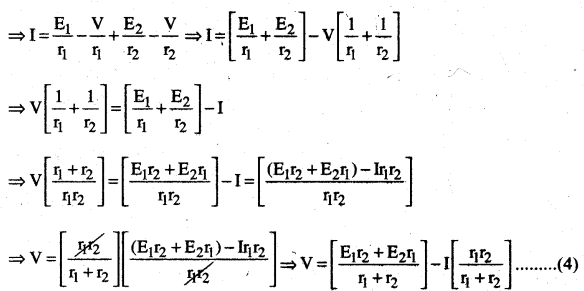
If we replace the combination by a single cell between A and C of emf (Eeq) and internal resistance (req) then VAC = Eeq – Ireq ………. (5)
Comparing (4) and (5) we get Eeq = \(\frac{E_1 r_2+E_2 r_1}{r_1+r_2}\) and req = \(\frac{r_1 r_2}{r_1+r_2}\)
Question 4.
When the resistance connected in series with the cell is halved, the current is equal to or slightly less or slightly greater than double, Why? .
Answer:
The current in a circuit with a battery of emf E, internal resistance r and external resistance R is given by I = \(\frac{E}{R +r}\)
When the resistance is halved (R/2) we have the new current I’ = \(\frac{E}{(R / 2)+r}\)
If r is negligible when compared to R/2 then we get I’ = \(\frac{2 \mathrm{E}}{\mathrm{R}}\) = 2I (∵ \(\frac{\mathrm{E}}{\mathrm{R}}\) = I)
Also if r << (R/2) then the new current I’ is slightly greater than 2I and if r > R then the new current I is slightly less than 2I.
Question 5.
State and explain Kirchhoff rules for an electric network.
Answer:
Kirchhoff s First Law : The algebraic Sum of currents meeting at any junction in an electric circuit is zero.
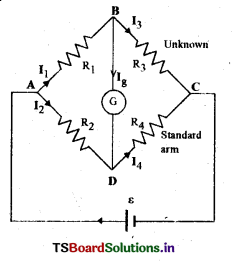
Applying Kirchhoff s first law at B,
we have I1 – Ig – I3 = 0
Kirchhoff s Second Law : The algebraic sum of changes in potential around any closed loop involving resistors and cells in the loop is zero.
Applying Kirchhoff s second law to closed loop ABDA,
we have I1R1 + IgG – I2R2 = 0
Question 6.
Using Kirchhoffs rules deduce the condition for balance in a Wheatstone bridge.
Answer:
Wheatstone’s Bridge consists of four resistors R1, R2, R3, R4 with four junctions A,B,C, D as shown in the figure. AC is battery arm, BD is galvanometer arm.
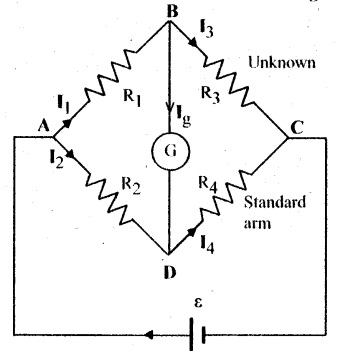
When the bridge is balanced, the current flowing through the galvanometer Ig = 0,.
Applying Kirchoff s first law at B, we have I1 – Ig – I3 = 0 ⇒ I1 = I3 ………. (1)[∵ Ig = 0]
Applying Kirchoff s first law at D, we have I2 + I1 – I4 =0 ⇒ I2 = I4………… (2) [∵ Ig = 0]
Applying KirchofFs second law to closed loop ABDA, we have I1 R1 + IgG – I2 R2 = 0
⇒ I1 R1 = I2 R2 ⇒ \(\frac{I_1}{I_2}=\frac{R_2}{R_1}\) ………… (3) [∵ Ig = 0]
Applying Kirchoff s second law to closed loop BDCB, we have IgG + I4R4 – I3R3 = 0
⇒ I3 R3 = I4 R4 ⇒ \(\frac{I_3}{I_4}=\frac{R_4}{R_3}\) ………… (4)
But from (1) & (2), I1 = I3 and I2 = I4 From (4), we have \(\frac{I_1}{I_2}=\frac{R_4}{R_3}\) ……….. (5)
Now from (3) & (5) we get \(\frac{R_2}{R_1}=\frac{R_4}{R_3}\) …………… (6)
∴ \(\frac{R_1}{R_2}=\frac{R_3}{R_4}\)\(\frac{R_1}{R_3}=\frac{R_2}{R_4}\) (or) \(\frac{I_1}{I_2}=\frac{R_2}{R_1}\)
This is the balance condition of Wheatstone’s bridge to make Ig = 0.
VI. Long Answer Questions
Question 1.
State Kirchhoff’s rules for electric network. Using these rules deduce the condition for balance in a Wheatstone bridge.
Answer:
Kirchhoff s First Law : The algebraic Sum of currents meeting at any junction in an electric circuit is zero.
Applying Kirchhoff s first law at B,
we have I1 – Ig – I3 = 0
Kirchhoff s Second Law : The algebraic sum of changes in potential around any closed loop involving resistors and cells in the loop is zero.
Applying Kirchhoff s second law to closed loop ABDA,
we have I1R1 + IgG – I2R2 = 0
Wheatstone’s Bridge consists of four resistors R1, R2, R3, R4 with four junctions A,B,C, D as shown in the figure. AC is battery arm, BD is galvanometer arm.
When the bridge is balanced, the current flowing through the galvanometer Ig = 0,.
Applying Kirchoff s first law at B, we have I1 – Ig – I3 = 0 ⇒ I1 = I3 ………. (1)[∵ Ig = 0]
Applying Kirchoff s first law at D, we have I2 + I1 – I4 =0 ⇒ I2 = I4………… (2) [∵ Ig = 0]
Applying KirchofFs second law to closed loop ABDA, we have I1 R1 + IgG – I2 R2 = 0
⇒ I1 R1 = I2 R2 ⇒ \(\frac{I_1}{I_2}=\frac{R_2}{R_1}\) ………… (3) [∵ Ig = 0]
Applying Kirchoff s second law to closed loop BDCB, we have IgG + I4R4 – I3R3 = 0
⇒ I3 R3 = I4 R4 ⇒ \(\frac{I_3}{I_4}=\frac{R_4}{R_3}\) ………… (4)
But from (1) & (2), I1 = I3 and I2 = I4 From (4), we have \(\frac{I_1}{I_2}=\frac{R_4}{R_3}\) ……….. (5)
Now from (3) & (5) we get \(\frac{R_2}{R_1}=\frac{R_4}{R_3}\) …………… (6)
∴ \(\frac{R_1}{R_2}=\frac{R_3}{R_4}\)\(\frac{R_1}{R_3}=\frac{R_2}{R_4}\) (or) \(\frac{I_1}{I_2}=\frac{R_2}{R_1}\)
This is the balance condition of Wheatstone’s bridge to make Ig = 0.
Question 2.
Derive equivalent emf and internal resistance of two cells connected in i) series ii) parallel.
Answer:
Consider two cells of emf’s E1 and E2 and their internal resistances r1, r2 connected in series.
Let VA, VB, VC be the potentials at points A, B, C .
The potential difference between positive and negative terminals of the first cells between A and B is
VAB = VA – VB = E1 – I r1 ………… (1)
Similarly, VBC = VB – VC = E2 – Ir2 …………. (2)
The potential difference between positive and negative terminals of A and C is
VAC = VA – VC; = (VA – VB) + (VB – VC) = (E1 – Ir1) + (E2 – Ir2)
∴ VAC = (E1 + E2) – I[r1 + r2] ………….. (3)
If we replace the combination by a single cell between A and C of emf (Eeq) and internal resistance (req) then VAC = Eeq – Ireq ………… (4)
Comparing (3) and (4), we get Eeq = E1 + E2 and req = r1 + r2
Resistors in Parallel : Consider two cells of emfs Ej and E2 and internal resistance rt and r2 connected in parallel as shown in fig.
Let I1 and I2 be the currents leaving the positive terminals of the cells. At junction B1 the currents I1 and I2 flow in whereas the current I flows out.
Total current at junction B is I = I1 + I2 ……………. (1)
Let VB1 and VB2 be the potentials at B1 and B2.
For the first cell, potential difference is V = VB1 – VB2 = E1 – I1r1
⇒ I1r1 = E1 – V ⇒ I1 = \(\frac{E_1-V}{r_1}\) ………… (2)
For the second cell, potential difference is V = VB1 – VB2 = E2 – I2r2
⇒ I2r2 = E2 – V ⇒ I2 = \(\frac{E_2-V}{r_2}\) ………… (3)
From (1), (2) and (3) we have I = I1 + I2 = \(\frac{E_1-V}{r_1}\) + \(\frac{E_2-V}{r_2}\)
If we replace the combination by a single cell between A and C of emf (Eeq) and internal resistance (req) then VAC = Eeq – Ireq ………. (5)
Comparing (4) and (5) we get Eeq = \(\frac{E_1 r_2+E_2 r_1}{r_1+r_2}\) and req = \(\frac{r_1 r_2}{r_1+r_2}\)
Textual Solved Problems
Question 1.
(a) The electron drift speed is estimated to be only a few mm s_1 for currents in the range of a few amperes? How then is current established almost the instant a circuit is closed?
(b) The electron drift arises due to the force experienced by electrons in the electric field inside the conductor. But force should cause acceleration. Why then do the electrons acquire a steady average drift speed?
(c) If the electron drift speed is so small, and the electron’s charge is small, how can we still obtain large amounts of current in a conductor?
(d) When electrons drift in a metal from lower to higher potential, does it mean that all the ‘free’ electrons of the metal are moving in the same direction?
(e) Are the paths of electrons straight lines between successive collisions (with the positive ions of the metal) in the (i) absence of electric field, (ii) presence of electric field?
Solution:
(a) Electric field is established throughout the circuit, almost instantly (with the speed of light) causing at every point a local electron drift. Establishment of a current does not have to wait for electrons from one end of the conductor travelling to the other end.
However, it does take a little while for the current to reach its steady value.
(b) Each ‘free’ electron does accelerate, increasing its drift speed until it collides with a positive ion of the metal. It loses its drift speed after collision but starts to accelerate and increases its drift speed again only to suffer a collision again and so on.
Therefore on the average, electrons acquire only a drift speed.
(c) This happens as the electron number density is enormous, ~1029 m-3.
(d) By no means. The drift velocity is superposed over the large random velocities of electrons.
(e) In the absence of electric field, the paths are straight lines; in the presence of electric field, die paths are, in general, curved.
Question 2.
The resistance of the platinum wire of a platinum resistance thermometer at the ice point is 5 Ω and at steam point is 5.23 Ω. When the thermometer is inserted in a hot bath, the resistance of the platinum wire is 5.795 Ω Calculate the temperature of the bath.
Solution:
Given R0 = 5 Ω, R100 = 5.23 Ω and Rt = 5.795 Ω
Temperature of the bath, t = \(\frac{R_t-R_0}{R_{100}-R_0}\) × 100 = \(\frac{5.795-5}{5.23-5}\) × 100 = \(\frac{0.795}{0.23}\) × 100 = 345.65°C
Exercise Problems
Question 1.
A 10 Ω thick wire is stretched so that its length becomes three timeS. Assuming that there is no change in its density on stretching, calculate the resistance of the stretched wire.
Solution:
When a conductor is stretched, its length increases but its area of cross section decreases so that its volume (Al) remains constant.
Given R1 = 10 Ω, l2 = 3 l1, R2 = ?
Ressitance of the wire , R = ρ\(\frac{l}{\mathrm{~A}}\) = ρ\(\frac{l^2}{\mathrm{~A} l}\) ⇒ R ∝ l2
∴ \(\frac{R_2}{R_1}=\frac{l_2^2}{l_1^2}=\frac{\left(3 l_1\right)^2}{l_1^2}=\frac{9 l_1^2}{l_1^2}\) = 9
∴ R2 = 9R1 = 9(10) = 90 Ω
Question 2.
Find the resistivity of a conductor which carries a current density of 2.5 × 10⁶ A m-2 when an electric field of 15 Vm-1 is applied across it.
Solution:
Given J = 2.5 × 10⁶ A/m2, E = 15 V/m, ρ = ?
Resistivity ρ = \(\frac{E}{J}=\frac{15}{2.5 \times 10^6}\) = 6 × 10⁻⁶ Ωm
Question 3.
A silver wire has a temperature coefficient of resistivity 4 × 10⁻³ °C-1 arid its resistance at 20°C is 10 Ω, neglecting any change in dimensions due to change in temperature. What is resistance at 40° C.
Solution:
Initial resistance R0 = 10Ω, Temperature coefficient α = 4 × 10⁻³ °C-1
Initial temperature T1 = 20° C, Final temperature T2 = 40° C .
Change in temperature ∆T = T2 – T1 = 40° – 20° = 20°C
Resistance with temperature t is Rt = R0 (1 + α∆T)
R40° = 10[1 + (4 × 10⁻³)20] = 10 × 1.08 = 10.8Ω
∴ The resistance of the wire at 40°C is 10.8 Ω
Question 4.
If the length of the conductor is doubled by stretching it while keeping the potential difference constant, by what factor will the drift of electrons change?
Solution:
Lengths of the conductors be taken as l1 = l, l2 = 2l
We know that drift velocity is inversely porportional to l
Vd ∝ \(\frac{1}{l}\) ⇒ \(\frac{\mathrm{V}_{\mathrm{d}_2}}{\mathrm{~V}_{\mathrm{d}_1}}=\frac{l_1}{l_2}=\frac{l}{2 l}=\frac{1}{2}\) ⇒ Vd2 = \(\frac{V_{d_1}}{2}\).
Thus drift velocity changes by half
Question 5.
Two 120V light bulbs, one of 25W and another of 200W are connected in series. One bulb burnt out almost instantaneously. Which one was burnt and why?
Solution:
Resistance of a bulb R = V2/P When V is constant R ∝ 1/P.
Lower power bulb will have high resistance . Hence, 25 W bulb will bum out first.
(or)
Resistance of 25 W bulb R1 = 1202/25 = 576 Ω
Resistance of 200 W bulb R2 = 1202/200 = 72 Ω
When bulbs are connected in series, the bulb with higher resistance consumes more power and bums because same current passes in series. P = I2 R ⇒ P ∝ R.
Here 25 W bulb has higher resistance (576 Ω) and hence it bums out instantaneously.
Question 6.
A cylindrical metallic wire is stretched to increase its length by 5%. Calculate the percentage change in resistance. ‘
Solution:
When a wire is stretched, R ∝ l2 [∵ R ∝ l2 ⇒ R = kl2 ⇒ log R = logk + 2logl]
∴ Rate of change in resistance \(\frac{\Delta R}{R}\) × 100 = 2 \(\left(\frac{\Delta l}{l} \times 100\right)\) = 2 × 5 = 10
∴ \(\frac{\Delta R}{R}\) = 10%
Question 7.
Two wires A and B of same length and same material, have their cross-sectional areas in the ratio 1:4. What would be the ratio of heat produced in these wires when the voltage across each is constant.
Solution:
Heat produced H = V2 t/R. When voltage is constant, H ∝ 1/R
Now R = ρ \(\frac{l}{\mathrm{~A}}\) ⇒ R ∝ \(\frac{1}{A}\) (∵ l and p are constants.)
∴ H ∝ 1/R ∝ A ⇒ H ∝ A ⇒ H1 : H2 = A1 : A2
Here A1 : A2 = 1 : 4
∴ H1 : H2 = 1 : 4
Question 8.
Two bulbs whose resistances are in the ratio 1:2 are connected in parallel to the source of constant voltage. What will be the ratio of power dissipation in these?
Solution:
Power dissipation is given by P = V2/R . When voltage is constant, P ∝ \(\frac{1}{R}\)
\(\frac{\mathrm{P}_1}{\mathrm{P}_2}=\frac{\mathrm{R}_2}{\mathrm{R}_1}=\frac{2}{1}\)
So P1 : P2 = 2 : 1
Question 9.
A battery of emf 2.5 V and internal resistance r is connected in series with a resistor with a resistor of 45 Ω through an ammeter of resistance 1 Ω. The ammeter reads a current of 50 mA. Draw the circuit diagram and calculate the value of r.
Solution:
Given current I = 50 mA = 50 × 10-3 A, Emf E = 2.5 V
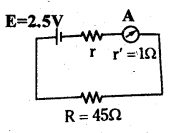
Ammeter’s resistance = 1 Ω
Total resistance in the circuit R = 45 + 1 + r = 46 + r
From Ohm’s law, E = IR
⇒ 2.5 = 50 × 10-3 × (46 + r) ⇒ 46 + r = \(\frac{2.5}{50 \times 10^{-3}}\) = 50
⇒ r = 50 – 46 = 4Ω
Question 10.
Amount of charge passing through the cross section of wire is q(t) = at2 + bt + c. t Write the dimensional formula for a, b and c in SI unit are 6, 4, 2 respectively, find the value of current at t = 6 sec.
Solution:
We know dimensional formula of charge q is [IT].
Charge passing through the cross section of wire is given by q(t) = at2 + bt + c.
From the principle of homogeneity q = at2 ⇒ a = \(\frac{\mathrm{q}}{\mathrm{t}^2}\), q = bt ⇒ b = \(\frac{\mathrm{q}}{\mathrm{t}}\), c = q
a = \(\frac{\mathrm{q}}{\mathrm{t}^2}=\frac{[\mathrm{IT}]}{\left[\mathrm{T}^2\right]}\) = [IT-1] ; b = \(\frac{q}{t}=\frac{[\mathrm{IT}]}{[\mathrm{T}]}\) = [I]; c = q = [IT]
If a = 6, b = 4,-sc = 2 then q = 6t2 + 4t + 2
∴ Current I = \(\frac{d q}{d t}\) = 12 t + 4
When t = 6s, we get I = 12(6) + 4 = 72 + 4 = 76 A
Objective Questions
Question 1.
The length of a hollow cylindrical conductor is 1m and its inner and outer radii are 1mm and 2mm respectively. If its resistivity is 2.35 × 10⁻⁸Ω-m, its resistance will be
1) 2.15 × 10⁻⁴ Ω
2) 2.25 × 10⁻³ Ω
3) 2.15 × 10⁻³Ω
4) 2.25 × 10⁻⁴ Ω
Answer:
2) 2.25 × 10⁻³ Ω
Question 2.
Two identical cells, when connected either in parallel or in series, give same current in an external resistance of 2. The internal resistance of each cell will be
1) 2 Ω
2) 1 Ω
3) 1/2 Ω
4) 4 Ω
Answer:
1) 2 Ω
Question 3.
A piece of wire is divided into four equal parts. These are put together to form a bundle. The resistance of the bundle as compared to that of original wire will be
1) \(\frac{1}{8}\)
2) \(\frac{1}{6}\)
3) \(\frac{1}{4}\)
4) \(\frac{1}{16}\)
Answer:
4) \(\frac{1}{16}\)
Question 4.
If the balancing lengths corresponding to two cells are 400cm and 800cm respectively, then the ratio of e.m.f s of two cells will be
1) 1:2
2) 2:1
3) 3:6
4) 6:4
Answer:
1) 1:2
Question 5.
A wire emits 80J energy in 10 seconds, when a current of 2A is passed through it. The resistance of the wire in ohm will be
1) 0.5
2) 2
3) 4
4) 20
Answer:
2) 2
Question 6.
The resistance of a wire is ‘R’ ohm. If it is melted and stretched to ‘n,’ times its original length, its new resistance will be
1) R/n
2) n2R
3) R/n2
4) nR
Answer:
2) n2R
Question 7.
A wire of resistance 4 Q is stretched to twice original length. The resistance of stretched would be
1) 8Ω
2) 16Ω
3) 2Ω
4) 4Ω
Answer:
2) 16Ω
Question 8.
A wire 50 cm long and 1 mm2 in cross-section carries a current of 4 A when connected to a 2 V battery. The resistivity of the wire is
1) 4 × 10⁻⁶ Ω m
2) 1 × 10⁻⁶ Ω m
3) 2 × 10⁻⁷ Ω m
4) 5 × 10⁻⁶ Ω m
Answer:
2) 1 × 10⁻⁶ Ω m
Question 9.
The masses of the wires of copper is in the ratio of 1 : 3 : 5 and their lengths are in the ratio of 5 : 3 : 1. The ratio of their electrical resistance is
1) 1:3:5
2) 5:3:1
3) 1:25:125
4) 125:15:1
Answer:
4) 125:15:1
Question 10.
A charged particle having drift velocity of 7.5 × 10⁻⁴ ms-1 in an electric field of 3 × 10⁻¹⁰ V m-1, has a mobility in m2 V-1s-1 of
1) 2.25 × 10¹⁵
2) 2.5 × 10⁶
3) 2.5 × 10⁻⁶
4) 2.25 × 10⁻¹⁵
Answer:
2) 2.5 × 10⁶
Question 11.
The resistance of a discharge tube is
1) non-ohmic
2) ohmic
3) zero
4) both (2) and (3)
Answer:
1) non-ohmic
Question 12.
The solids which have the negative temperature coefficient of resistance are
1) metals
2) insulators only
3) semiconductors only
4) insulators and semiconductors.
Answer:
4) insulators and semiconductors.
Question 13.
Which of the following acts as a circuit protection device?
1) fuse
2) conductor
3) inductor
4) switch
Answer:
1) fuse
Question 14.
The charge flowing through a resistance R varies with time t as Q = at – bt2, where a and b are positive constants. The total heat produced in R is
1) \(\frac{a^3 R}{2 b}\)
2) \(\frac{a^3 R}{b}\)
3) \(\frac{a^3 R}{6 b}\)
4) \(\frac{a^3 R}{3 b}\)
Answer:
3) \(\frac{a^3 R}{6 b}\)
Question 15.
A (100 W, 200 V) bulb is connected to a 160 volts supply. The power consumption would be
1) 100 W
2) 125 W
3) 64 W
4) 80 W
Answer:
3) 64 W
Question 16.
The effective resistance of a parallel connection that consists of four wires of equal length, equal area of cross-section and same material is 0.25 Ω. What will be the effective resistance if they are connected in series?
1) 4Ω
2) 0.25 Ω
3) 0.5 Ω
4) 1Ω
Answer:
1) 4Ω
Question 17.
The power dissipated in the circuit shown in the figure is 30. watts. The value of R is
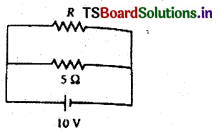
1) 20 Ω
2) 15 Ω
3) 10 Ω
4) 30 Ω
Answer:
3) 10 Ω
Question 18.
When a wire of uniform cross-section a, length 1 and resistance R is bent into a complete circle, resistance between any two of diametrically opposite points will be
1) R/4
2) 4R
3) R/8
4) R/2
Answer:
1) R/4
Question 19.
Resistance n, each of r ohm, when connected in parallel give an equivalent resistance of R ohm. If these resistances were connected in series, the combination would have a resistance in ohms, equal to
1) n2R
2) R/n2
3) R/n
4) nR
Answer:
1) n2R
Question 20.
When three identical bulbs of 60 watt, 200 volt rating are connected in series to a 200 volt supply, the power drawn by them will be
1) 60 watt
2) 180 watt
3) 10 watt
4) 20 watt
Answer:
4) 20 watt
Question 21.
If two bulbs, whose resistances are in the ratio of 1 : 2 are connected in series, the power dissipated in them has the ratio of
1) 2:1
2) 1:4
3) 1:1
4) 1:2
Answer:
4) 1:2
Question 22.
What will be the equivalent resistance between the two points A and D?
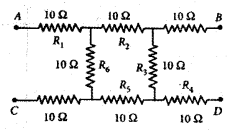
1) 30 Ω
2) 40 Ω
3) 20 Ω
4) 10 Ω
Answer:
1) 30 Ω
Question 23.
The internal resistance of a 2.1 Y cell which gives a current of 0.2 A through a resistance of 10 Q is
1) 0.8Ω
2) 1.0 Ω
3) 0.2 Ω
4) 0.5 Ω
Answer:
4) 0.5 Ω
Question 24.
A car battery of emf 12 V and internal resistance 5 × 10⁻² Ω, receives a current of 60 amp from external source, then terminal potential difference of battery is
1) 12 V
2) 9 V
3) 15 V
4) 20 V
Answer:
3) 15 V
Question 25.
The internal resistance of a cell of e.m.f. 2 V is 0.1 Ω. It is connected to a resistance of 3.9 Ω. The voltage across the cell will be
1) 1.95 V
2) 1.9 V
3) 0.5 V
4) 2 V
Answer:
1) 1.95 V
Question 26.
Two cells, having the same emf are connected in series through an external resistance R. Cells have internal resistances r1 and r2 (r1 > r2) respectively. When the circuit is closed, the potential difference across the first cell is zero. The value of R is
1) r1 + r2
2) r1 – r2
3) \(\frac{r_1+r_2}{2}\)
4) \(\frac{r_1-r_2}{2}\)
Answer:
2) r1 – r2