
Regular practice with AP Inter 2nd Year Chemistry Study Material Chapter 6 Haloalkanes and Haloarenes Questions and Answers helps students stay prepared for examinations.
AP Inter 2nd Year Chemistry 6th Lesson Haloalkanes and Haloarenes Questions and Answers
I. Multiple Choice Questions
Question 1.
What is the general formula for haloalkanes? (X=haIogen atom, n = 1, 2, 3…)
1) CnH2nX
2) CnH2n+1X
3) CnH2n-1X
4) CnH2n-3X
Answer:
2) CnH2n+1X
Haloalkanes are derived from alkanes by replacing one H with X.
Alkane formula = CnH2n+2⟶ replace one H ⟶ ?CnH2n+1X
Question 2.
Which of the following reagents is used for replacement of -OH group in an alcohol by Cl group?
1) SO2Cl2
2) AqueousHCl
3) PCl3, SOCl2
4) Nacl
Answer:
3) PCl3, SOCl2
Converting alcohol (-OH) ⟶ alkyl chloride (-Cl) needs chlorinating agents.
Best reagents: PCl3, SOCl2
3R-OH +PCl3⟶ 3R-Cl + H3PO3
R-CH + SOCl2 ⟶ R-Cl + SC2 + HCl
Question 3.
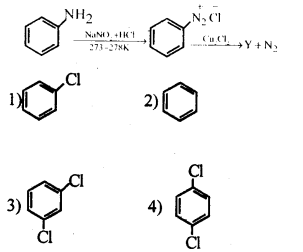
Identify the compound Y in the following reaction sequence
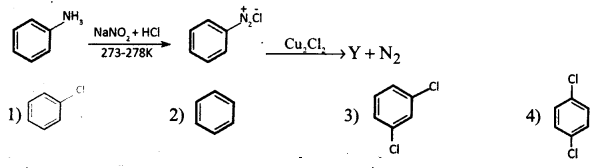
Answer:

Reaction sequence: Aniline ⟶ diazonium salt ⟶ Sandmeyer reaction (Cu2Cl2/ HCl).
Gives chlorobenzene.

Question 4.
A primary alkyl halide would prefer to undergo
1) SN1 reaction
2) SN2 reaction
3) α-elimination
4) racemization
Answer:
2) SN2 reaction
Primary alkyl halides favor backside attack (less steric hindrance).So SN2 dominates.
Question 5.
Which of the following is the suitable medium for preparing Grignard reagents?
1) Dry acetone
2) Dry ether
3) Concentrated HCl
4) Alcoholic KOH
Answer:
2) Dry ether
Grignard reagents are destroyed by water/protic solvents.
Need dry, aprotic medium → Dry ether
Question 6.
Compared to haloalkanes, the reactivity of haloarenes towards nucleophilic substitution reactions is
1) low
2) high
3) very high
4) equal
Answer:
1) low
Haloarenes are less reactive due to:resonance stabilization partial double bond character So substitution is difficult.
Question 7.
Chlorobenzene is formed by the reaction of chlorine with benzene in the presence of anhydrous AlCl3. Which of the following species attacks the benzene ring in this reaction?
1) Cl–
2) Cl+
3) AlCl3
4) [AlCl4]-1
Answer:
2) Cl+
Electrophilic substitution → attacking species must be electrophile,
Cl+ is the actual attacking species.
Question 8.
Arrange the following compounds in increasing order of their boiling points.

1) (b) < (a) < (c)
2) (a) < (b) < (c)
3) (c) < (a) < (b)
4) (c) < (b) < (a)
Answer:
3) (c) < (a) < (b)
Boiling point depends on: molecular mass branching (more branching → lower BP)
Arrange accordingly. Answer: (c) < (a) < (b)
Question 9.
Which of the following alky! halide will undergo SN1 reaction most readily?
1) (CH3)3C—F
2) (CH3)3C—Cl
3) (CH3)3C—Br
4) (CH3)3C—I
Answer:
4) (CH3)3C—I
SN1 favors tertiary carbocation stability. (CH3)3C-I forms most stable carbocation + best leaving group.
Question 10.
Which reagent will you use for the following reaction?
CH3CH2CH2CH3 ⟶ CH3CH2CH2CH2CI + CH3CH3CHCICH3
1) Cl2/UV light
2) NaCl + H2SO4
3) Cl2 gas in dark
4) Cl2 gas in the presence of iron in dark
Answer:
1) Cl2/UV light
Reaction shows free radical substitution → needs UV light
Chlorination of alkanes occurs under UV.
Question 11.
Which of the following represents the correct name of the compound, CH3CHCl2?
1) Ethylidene chloride
2) Ethylene dichloride
3) 1,2-Dichloroethane
4) Vic-dichloride
Answer:
1) Ethylidene chloride
CH3-CHCl2 has both Cl atoms on the same carbon (geminal dihalide),
Common name: Ethylidene chloride (not ethylene dichloride),
Question 12.
In alkyl halides, carbon-halogen bond is polarized due to
1) greater electronegativity of halogen atom than carbon
2) greater electronegativity of carbon than halogen atom
3) partial positive charge on halogen atom and a partial negative charge on carbon
4) tendency of halogen atom to donate electrons
Answer:
1) greater electronegativity of halogen atom than carbon
Halogens are more electronegative than carbon.
So they pull electron density → C becomes δ+ and X becomes δ–.
Greater electronegativity of halogen atom than carbon
Question 13.
Chlorobenzene is
1) less reactive than benzyl chloride
2) more reactive than ethyl bromide
3) nearly as reactive as methyl chloride
4) more reactive than isopropyl chloride
Answer:
1) less reactive than benzyl chloride
Chlorobenzene is less reactive due to: resonance stabilization, partial double bond character of C-Cl.
So it reacts slower than alkyl halides. Less reactive than benzyl chloride
Question 14.
The set of compounds in which the reactivity of halogen atom in the ascending order is
1) Vinyl chloride, chloroethane, chlorobenzene
2) Vinyl chloride, chlorobenzene, chloroethane
3) Chloroethane, chlorobenzene, vinyl chloride
4) Chlorobenzene, vinyl chloride, chloroethane
Answer:
4) Chlorobenzene, vinyl chloride, chloroethane
Reactivity order: Aryl halide (least) < Vinyl halide < Alkyl halide (most)
Because: aryl: strong resonance, vinyl: sp2 (C-X), alkyl: sp3 (C-X) (easiest to break)
Chlorobenzene < Vinyl chloride < Chloroethane
Question 15.
The Wurtz-Fittig reaction involves
1) two molecules of aryl halides
2) two molecules of alkyl halides
3) one molecule each of aryl halide and alkyl halide
4) one molecule each of aryl halide and phenol
Answer:
3) one molecule each of aryl halide and alkyl halide
Wurtz-Fittig reaction couples; aryl halide + alkyl halide → alkylbenzene (in presence of Na/dry ether).
II. Fill in the Blanks
Question 1.
Our body produces an iodine containing hormone, thyroxine, the deficiency of which causes a disease called ________.
Answer:
Goiter
Question 2.
Alkyl iodides are often prepared by the reaction of alkyl chlorides/ bromides with NaI in dry acetone. This reaction is known as ________ reaction.
Answer:
Finkelstein
Question 3.
Groups like cyanides and nitrites possess two nucleophilic centers and are called ________
Answer:
amhident nucleophiles
Question 4.
The compounds which rotate the plane polarized light are called ________.
Answer:
Optically active or Chiral
Question 5.
The compounds which are obtained by the reaction of haloalkanes with magnesium metal in dry ether are called _________
Answer:
Grignard Reagents
III. One Word Answer Questions
Question 1.
Preservation of the spatial arrangement of bonds to an asymmetric center during a chemical reaction or transformation is called
Answer:
Preservation of the spatial arrangement of bonds is called Retention of Configuration.
Question 2.
Diazonium salt with cuprous chloride or cuprous bromide results in the replacement of the diazonium group by -Cl or -Br. This reaction is called
Answer:
Sandmeyer reaction is the replacement of the diazonium group by -Cl or -Br.
Question 3.
Synthesis of alkyl fluorides by heating an alkyl chloride/bromide in the presence of a metallic fluoride such as AgF is named as
Answer:
Swarts reaction is the synthesis of alkyl fluorides by heating an alkyl chloride/bromide.
Question 4.
If the compound rotates the plane of plane polarized light to the right, i.e., clockwise direction, it is called
Answer:
Dextro rotatory compound rotates the plane polarized light to the right.
Question 5.
The stereoisomers which are related to each other as non- superimposable mirror images are called
Answer:
Enantiomers are non- superimpòsable mirror images
IV. Very Short Answer Questions
Question 1.
Write the structure of the following compounds
(i) 2-chloro-3-methylpentane
(ii) 1-bromo-4-sec-butyl-2-methylbenzene
Answer:

Question 2.
Which one of the foll4rning has highest dipole moment?
(i) CH2Cl2
(ii) CHCl3
(iii) CCl4
Answer:
CH2Cl2 has highest dipole moment
i) If CH2Cl2, the resultant dipolements of two C-Cl bonds is reinforced by two C-H bond moments.
Its dipole moment is µ =1 .62D.
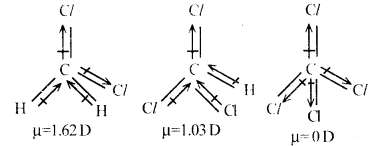
ii) In CHCl3, the resultant dipole moment of two C-Cl bonds is opposed by resultant dipolemoment of C-Cl and C-H bonds. Here the net dipolemoment is µ = 1.03D
iii) CCl4 is a symmetrical molecule. Its dipole moment is µ = 0.
Question 3.
What are ambident nucleophiles?
Answer:
Ambident Nucleophile are nucleophiles that have two different attacking atoms (two nucleophilic centers) through which they can attack an electrophile, but only one atom attacks at a time.
Ex: Cyanide ion, Nitrite ion
Question 4.
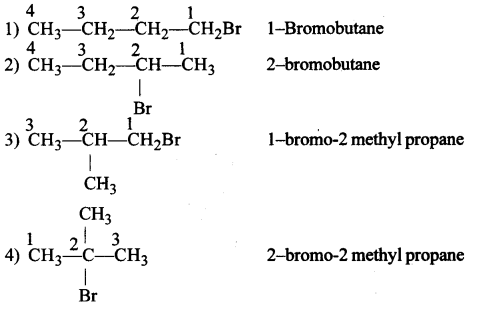
Write the isomers of the compound having molecule formula C4H9Br?
Answer:
Question 5.
Which compound in each of the following pairs will react faster in SN2 reaction with OH?
(i) CH3Br or CH3I
(ii) (CH3)3CCI (or) CH3Cl
Answer:
i) CH3I reacts faster because C-I has less dissociation energy than that of C- Br bond,
ii) CH3Cl reacts faster because it has less steric hinderance as compared to (CH3)3CCl.
Question 6.
Explain why the alky! halides though polar are immiscible with water?
Answer:
Alkyl halides (R-X) are polar due to the presence of polar C-X bond.
Alkyl halides are immiscible with water because
a) Alkyl halides are not able to form hydrogen bonds with water molecules.
b) Alkyl halides are not able to break hydrogen bonds in water.
Question 7.
Between C6H5CH3CI and C6H5CHCIC6H5, which is more easily hydrolysed by aqueous KOH?
Answer:
C6H5CHC/C6H5 will be more easily hydrolysed than C6H5CH2Cl.
Because its carbocation(2°) is stabilised by two phenyl groups ( C6H5 -) due to resonance under SN1 reaction.
Question 8.
What is the stereochemical outcome of SN1 and SN2 reactions?
Answer:
The stereochemical outcome of SN1 reaction is a racemic mixture of two optical isomers(50:50).
The stereochemical outcome of SN2 reaction is Walden inversion (inversion of configuration).
Question 9.
What type of isomerism is exhibited by o-, m- and p-dichlorobenzenes?
Answer:
o-, m- and p-dichlorobenzenes exhibit Position isomerism.
Question 10.
What are Enantiomers?
Answer:
Enantiomers are a pair of stereo isomers which are non -super imposable mirror images.
V. Short Answer Questions
Question 1.
Give the IUPAC names of the foIIowin compounds.
(i) CH3—CH(CI)—CH(I)CH3
(ii) CICH2.CH=CH—CH2Br
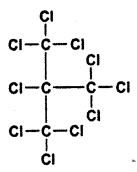
(iii) (CCl3)3CCI
(iv) CH3C(p—CI-C6H4)2-CH(Br)CH3
Answer:
(i) 2-chioro. 3- iodobutane
(ii) 1 -hromo-4-chlorobut-2ene
(iii) 1,1,1,2,3,3,3 hepta chioro 2-(trichloromethyl)propane
(iv) 3-bromo-2,2-bis(4-chlorophenyl )butane
Question 2.
Write the structures of the following organic halides.
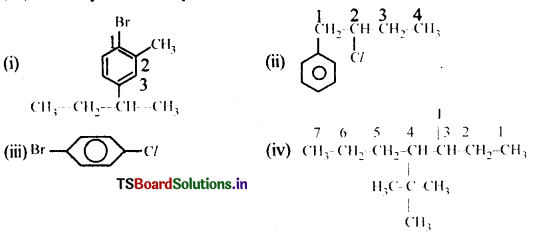
(i) 1-hromo-4-scc-butyl-2 methyiheniene
(ii) 2-chloro-1-phenylbutane
(iii) p-bromochlornbenzene
(iv) 4-t-butyl-3-iodoheptane
Answer:
Question 3.
How will you carry out the following conversions?
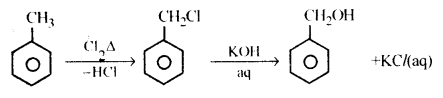
(i) Ethane to bromoethane (ii) Toluene to benzvl alcohol
Answer:
i) Ethane to bromoethane:

ii) Toluene to hcnzvl alcohol: When chlorine is passed into boiling toluene it gives benzyl chloride, which on boiling with KOH (aq) gives benzyl alcohol.
Question 4.
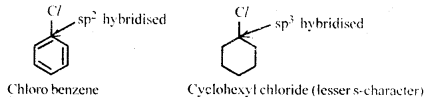
Explain why the dipole moment of chlorobenzene is lower than that of cyclohexvl chloride.
Answer:
Carbon atom in chlorobenzene is sp3 hybridised which is more electronegative than sp3 carbon atom of cyclohexylchloride. Less electronegative leads to lesser s-character.
So, polarity of C-Cl bond in chlorobenzene is less than the C-Cl bond in cyclohexyl chloride.
Hence the dipole moment of chlorobenzene is lower than that of cyclohexyl chloride.
Question 5.
Explain the mechanism of SN1 with example.
Answer:
SN1 is a substitution nucleophilic unimolecular reaction.
Its order is two. It happens in two steps.
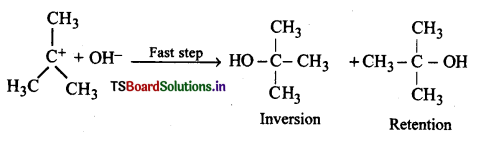
Ex: Hydrolysis of 2-Bromo methyl propane with aq KOH forms tert-butyl alcohol.
Mechanism of SN1:
Step 1: Formation of Carbocation from alkyl bromide molecule.
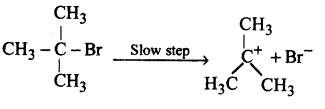
Step 2: Attack of the Nucleophile on the Carbocation to found the final product.
Question 6.
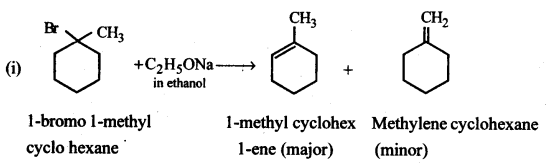
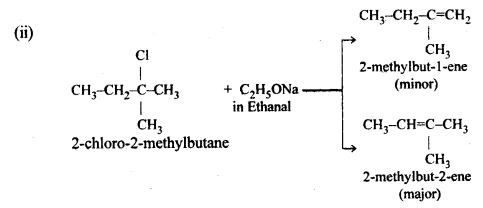
Predict the alkenes that would be formed in the following reactions and identify the major alkene.

Answer:
Question 7.
Write the mechanism of the following reaction.

Answer:
KCN is a resonance hybrid of two contributing structures

Here the cyanide ion is an ambident nucleophile. Hence the nucleophilic attack is possible either through carbon atom or nitrogen atom resulting in cyanides and isocyanides respectively.
In the presence of polar solvent, KCN readily ionises to furnish ions.
The nucleophile attack takes place predominantly through carbon atom and not through nitrogen atom because C-C bond is more stable C-N bond.

Question 8.
Write the mechanism of dehydrohaIogcnaion of 2-bromobutane.
Answer:
Dehvdrohalogenation of 2-bromobutanc is an Elimination reaction.
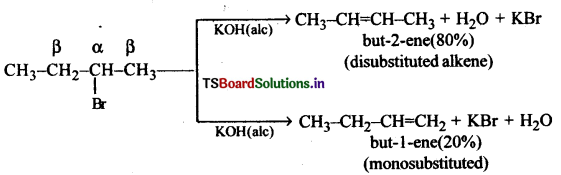
It involves the removal of one molecule of HX, from the molecule of a haloalkane. In elimination reactions, the halogen atom of the haloalkane β-bromobutane) and a hydrogen atom from the adjacent carbon atom (n-carbon) are involved. Hence these reactions are also called β-elimination reactions. These reactions follow Saytzeff s rule.
Savtieff rule: In dehydrohalogenation reactions, the preferred product is that alkene which has greater number of alkyl groups attached to the doubly bonded carbon atoms. i.e., more substituted
alkane is the major product (but-2-ene(80%)).
Mechanism: In this reaction, but-2-ene is more substituted alkene than but-l-ene.
Hence, but-2-ene is the major product.
2-bromobutane can eliminate one molecule of HBr in the following two ways.
Question 9.
Describe the stereochemical effect on the hydrolysis of 2-bromobutane.
Answer:
Hydrolysis of 2-bromobutane in aqueous KOH forms 2-butanol.
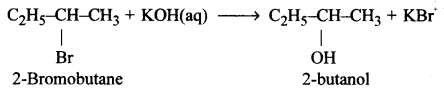
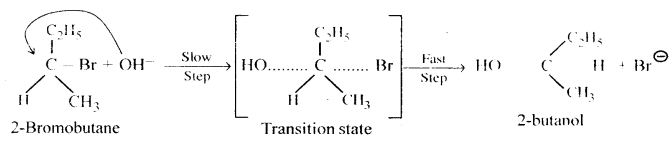
Mechanism (SN2 reaction): The nucleophile (OH–) approaches the carbon from the opposite side of the halogen atom (Br) to form transition state. It is the slowest step. Then the transition state is dissociated to form substituted product and halide ion.
The product has inverted configuration (Walder inversion).
Question 10.
Write the differences between SN1 and SN2 reactions.
Answer:
| SN1 reaction | SN2 reaction |
| 1) Order of SN1 reaction is one. | 1) Order of SN2 reaction is tyro. |
| 2) SN1 mechanism takes place in two steps. | 2) SN2 mechanism takes place in one step. |
| 3) SN1 is a ‘unimolecular substitution reaction’. | 3) SN2 is a ‘bimolecular substitution reaction’. |
| 4) Order of reactivity of alkyl halides: 3°>2°> 1° | 4) Order of reactivity of alkyl halides: 1°>2° > 3° |
| 5) Rate of reaction of SN1 depends on concentration of reactants only. | 5) Rate of reaction of SN2 depends on concentration of reactants and nucleophile. |
| 6) Ex: Hydrolysis of 2-Bromo methyl propane with aqueous KOH forms tert-butyl alcohol. | 6) Ex: Hydrolysis of 2-bromobutane in aqueous KOH forms 2-butanol. |
| 7) When optically active alkyl halide is subjected to SN1 reaction, the product formed is racemic mixture (d & l isomers) | 7) When optically active alkyl halide is subjected to SN2 reaction, the product formed is an inverted product. (Walden Inversion) |
VI. Long Answer Questions
Question 1.
Explain the mechanism of nucleophilic bimoiecular substitution (SN2) reaction with one example.
Answer:
SN2 is a substitution nucleophilic bimoiecular reaction.
Its order is one. It happens in one single step.
In SN2 rate of reaction depends on the concentrations of both alkyl halide and nucleophile.
∴ Rate ∝ [RX] [Nu–]
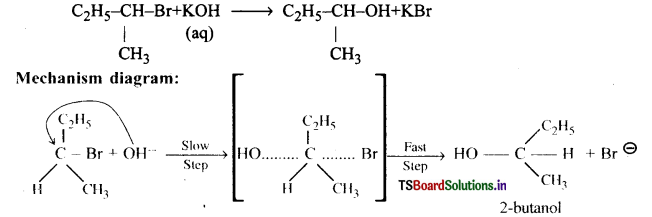
Mechanism: The nucleophile approaches the carbon from the opposite side of the halogen atom to form transition state. It is the slowest step. The transition state is dissociated into substituted product and halide ion.
In these reactions, the configuration of the compound is completely inverted like an inverted umbrella. Such inverted configuration is called ‘Walden inversion’.
Ex: Hydrolysis of 2-Bromo butane in aqueous KOH forms 2-butanol.
Question 2.
Define the following (i) Raceniic mixture (ii) Retention of configuration (iii) Enanliomers
Answer:
i) Racemic mixture is the mixture of equimolar quantities of d-form & l-form.
It is optically inactive due to external compensation.
A racemic mixture is represented by prefixing dl (or) (±) before the name.
Fx: (±) butan-2,ol.
ii) Retention of configu ration: The preservation of the spacial arrangement of bonds around an assymetric centre during a chemical reaction is called retention of configuration.
Retention is also the configurational correlation when a chemical species XCabc is transformed into another chemical species YCabc.
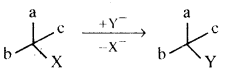
This XCabc and YCabc have relatively the same configuration.
Ex: When (-)-2-methyl butan-1-ol heated with concentrated hydrochloric acid, (+)-1 -chloro-2-methyl butane is formed.
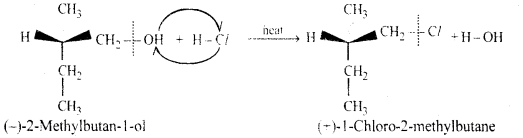
(iii) Enantiomers: These are a pair of stereoisomers which are non-superimposable mirror images. The enantiomers are optical isomers.
They are described as dextrorotatory (d) or (+); and levorotatory (l) (or) (-)
Question 3.
Explain the preparation and applications of Grignard reagents with suitable example.
Answer:
Grignard Reagent is alkyl magnesium halide. Its general formulae is RMgX.
Preparation:
1) Grignard reagents are obtained by the reaction ofhaloallcanes with magnesium metal in dry ether.

2) Bromo and iodoarenes react with magnesium powder in presence of dry ether to form aryl magnesium halides (Grignards reagent)

Applications:
1) Grignard reagents are highly reactive and they react with any source of proton (like water, alcohols, amines…) to give hydrocarbons.
RMgX + H2O ⟶ RH + Mg(OH)X
2) CO2 on reaction with RMgX followed by hydrolysis gives carboxylic acids.
O = C = O + RMgX ⟶ R-COOMgX

3) Aldehydes on reaction with RMgX followed by hydrolysis gives 2° alcohols.

Question 4.
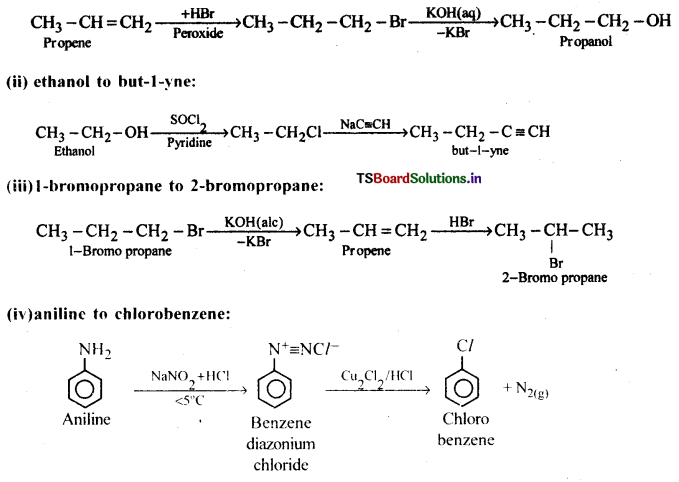
Explain how the following conversions are carried out.
(i) propene to propanol-1
(ii) ethanol to but-l-yne
(iii) 1-bromopropane to 2-bromopropane
(iv) aniline to chlorobenzene
Answer:
(i) propene to propanol:
Objective Questions
Question 1.
Which reagent will you use for the following reaction?
CH3CH2CH2CH3 → CH3CH2CH2CH2CI + CH3CH2CHCICH3
1) Cl2/UV light
2) NaCl + H2SO4
3) Cl2 gas in dark
4) Cl2 gas in the presence of iron in dark
Answer:
1) Cl2/UV light
Question 2.
The correct IUPAC name for
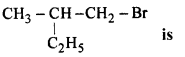
1) 1-Bromo-2-ethylpropane
2) 1-Bromo-2-ethyl-2-methylethane
3) 1-Bromo-2-methylbutane
4) 2-Methyl-1-bromobutane
Answer:
3) 1-Bromo-2-methylbutane
Question 3.
Which of the following is an example of vic-dihalide?
1) Dichloromethane
2) 1, 2-dichloroethane
3) Ethylidene chloride
4) Allyl chloride
Answer:
2) 1, 2-dichloroethane
Question 4.
What should be the correct IUPAC name for diethylbromomethane?
1) 1 -Bromo-1,1 -diethylmethane
2) 3-Bromopentane
3) 1-Bromo-1-ethylpropane
4) 1-Bromopentane
Answer:
2) 3-Bromopentane
Question 5.
Ethylidene chloride is a/an
1) vic-dihalide
2) gem-dihalide
3) allylic halide
4) vinylic halide
Answer:
2) gem-dihalide
Question 6.
The position of -Br in the compound in CH3CH=CHC(Br)(CH3)2 can be classified as _______
1) Allyl
2) Aryl
3) Vinyl
4) Secondary
Answer:
1) Allyl
Question 7.
Arrange the following compounds in increasing order of their boiling points.
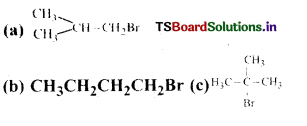
1) (b) < (a) < (c)
2) (a) < (b) < (c)
3) (c) < (a) < (b)
4) (c) < (b) < (a)
Answer:
3) (c) < (a) < (b)
Question 8.
Which of the following is responsible for depletion of the ozone layer in the upper stratosphere of the atmosphere?
1) Polyhalogens
2) Ferrocenes
3) Fullerenes
4) Freons
Answer:
4) Freons
Question 9.
Which of the following alcohols will yield the corresponding alkyl chloride on reaction with concentrated HCl at room temperature?
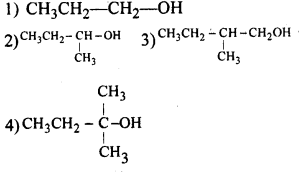
Answer:
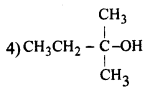
Question 10.
2-bromopentane is heated with potassium ethoxide in ethanol. The major product obtained is
1) 2-ethoxypentane
2) pentene-1
3) trans-pentene-2
4) cis-pentene-2
Answer:
3) trans-pentene-2
Question 11.
A primary alkyl halide would prefer to undergo ________
1) SN1 reaction
2) SN2 reaction
3) α-Elimination
4) Racemisation
Answer:
2) SN2 reaction
Question 12.
Which of the following alkyl halides will undergo SN1 reaction most readily?
1) (CH3)3C—F
2) (CH3)3C—Cl
3) (CH3)3C—Br
4) (CH3)3C—I
Answer:
4) (CH3)3C—I
Question 13.
Reaction of C6H5CH2Br with aqueous sodium hydroxide follows ________
1) SN1 mechanism
2) SN2 mechanism
3) Any of the above two depending upon the temperature of reaction
4) Saytzeff rule
Answer:
1) SN1 mechanism
Question 14.
Chlorobenzene is formed by reaction of chlorine with benzene in the presence of AlCl3. Which of the following species attacks the benzene ring in this reaction?
1) Cl–
2) Cl+
3) AlCl3
4) [AlCl4]–
Answer:
2) Cl+
Question 15.
Molecules whose mirror image is non superimposable over them are known as chiral. Which of the follow ing molecules is chiral in nature?
1) 2-Bromobutane
2) 1-Bromobutane
3) 2-Bromopropane
4) 2-Bromopropan-2-ol
Answer:
1) 2-Bromobutane
Question 16.
Which of the following structures is enantiomeric with the molecule (A) given below:
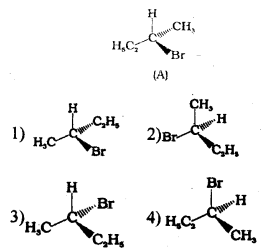
Answer:
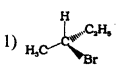
Question 17.
Toluene reacts with a halogen in the presence of iron (III) chloride giving ortho and para halo compounds. The reaction is
1) Electrophilic elimination reaction
2) Electrophilic substitution reaction
3) Free radical addition reaction
4) Nucleophilic substitution reaction
Answer:
2) Electrophilic substitution reaction
Question 18.
The order of reactivity of following alcohols with halogen acids is
(A) CH3CH2 —CH2—OH
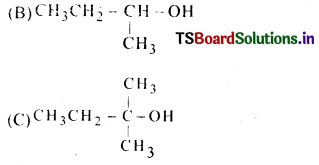
1) (A) >(B) > (C)
2) (C) > (B) > (A)
3) (B) > (A) > (C)
4) (A) > (C) > (B)
Answer:
2) (C) > (B) > (A)
Question 19.
Identify the compound Y in the following reaction.
Answer:

Question 20.
Arrange the following compounds in the increasing order of their densities.
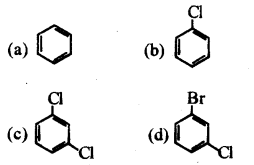
1) (a) < (b) < (c) < (d)
2) (a) < (c) < (d) < (b)
3) (d) < (c) < (b) < (a)
4) (b) < (d) < (c) < (a)
Answer:
1) (a) < (b) < (c) < (d)