
Regular practice with AP Inter 2nd Year Chemistry Study Material Chapter 9 Amines Questions and Answers helps students stay prepared for examinations.
AP Inter 2nd Year Chemistry 9th Lesson Amines Questions and Answers
I. Multiple Choice Questions
Question 1.
Which of the following amines cannot be prepared by Gabriel phthalimide reaction?
1) Benzylamine
2) Aniline
3) Ethylamine
4) Methylamine
Answer:
2) Aniline
Gabriel synthesis gives only aliphatic primary amines.
Aromatic amines (like aniline) cannot be prepared.
Question 2.
Which of the following reaction does not produce amine?
1) Gabriel phthalimide synthesis
2) Hoffmann bromamide degradation reaction
3) Carbylamine reaction
4) Reduction of nitriles
Answer:
3) Carbylamine reaction
Gabriel, Hofmann, Reduction → all give amines.
Carbylamine reaction is only a test (does not prepare amine)

Question 3.
Classification of amines into 1°, 2″, 3″ is based on the
1) number of amino groups
2) nature of carbon atom
3) degree of substitution at nitrogen
4) degree of unsaturation
Answer:
3) degree of substitution at nitrogen
Classification (1°, 2°, 3°) depends on how many groups are attached to nitrogen.
Not number of -NH2 groups. Degree of substitution at nitrogen
Question 4.
Which of the following amines does not react with Hinsberg reagent?
1) CH3CH2NH2
2) (CH3CH2)2NH
3) (CH3CH2)3N
4) all will react
Answer:
3) (CH3CH2)3N
Hinsberg reagent reacts with: 1 ° amine → soluble product
2° amine → insoluble product; 3° amine → no reaction (CH3CH2)3N
Tertiary amines do not react.
Question 5.
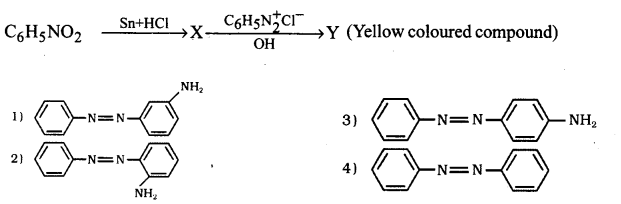
Identify the product Y in the given reaction sequence.
Answer:
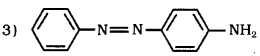
Sequence: Nitrobenzene → (Sn/HCl) → aniline (X)
Aniline → diazonium salt → coupling with phenol (in basic medium)
Gives azo dye (-N=N-) with -OH group on ring.
Azo compound with -OH substituted benzene ring
Question 6.
Propanoic acid on reaction with NH3 followed by heating gives a compound X, which on reaction with Br2 and aqueous KOH gives.
1) Propylamine
2) Ethanamine
3) Ethanenitrile
4) Propanenitrile
Answer:
2) Ethanamine
Propanoic acid + NH3 → amide
Amide + Br2/KOH → Hofmann bromamide reaction
Gives amine with one less carbon → ethylamme

Question 7.
Benzene diazonium chloride salt solution is heated at about 283 K the salt gets hydrolysed to compound “A”: A can be identified with
1) Lucas reagent
2) Neutral ferric chloride
3) Tollens’reagent
4) Hinsberg reagent
Answer:
2) Neutral ferric chloride
Diazonium salt + water (heat) → phenol
Phenol gives violet color with FeCl3
Question 8.
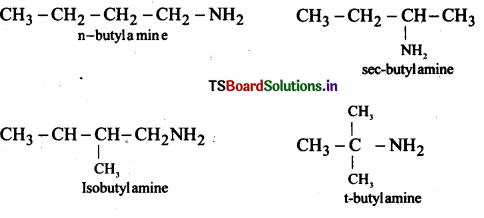
The number of primary amines possible for a compound with molecular formula C4H11N are
1) 1
2) 2
3) 3
4) 4
Answer:
4) 4
Count possible structures of primary amines (—NH2) for C4H11N
Different carbon skeletons give multiple isomers. Total = 4
Question 9.
Which of the following is most volatile?
1) CH3CH2CH2NH2
2) (CH3)3N
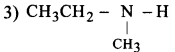
4) CH3OH
Answer:
2) (CH3)3N
Volatility ∝ lower intermolecular forces. H-bonding decreases volatility
Tertiary amine has no N—H → least H-bonding → most volatile (CH3)3N
Question 10.
Aliphatic primary amine on heating with chloroform and ethanolic KOH gives
1) an alcohol
2) an alkanediol
3) an alkyl isocyanide
4) an alkyl cyanide
Answer:
3) an alkyl isocyanide
Reaction with CHCl3 + alcoholic KOH → CarIylamine reaction.
Only primary amines give isocyanides (foul smell).
Question 11.
Which of the following does not reduce C3H5NO2 to C6H5NH2?
1) Fe/ HCl
2) Zn/ HCl
3) LiAlH4
4) SnCl2 in HCl
Answer:
3) LiAlH4
Reduction of nitrobenzene to aniline is done by metal + acid (Fe/HCl, Zn/HCl, SnCl2/HCl).
LiAlH4 generally reduces different functional groups, not used here.
Question 12.
The end product in the given reaction sequence is

1) CH3-CH2-NH2
2) CH3CONH2
3) CH3-NH-CH3
4) CH3CH2OH
Answer:
4) CH3CH2OH

Question 13.
Which among the following has the lowest pKb value in aqueous medium?
1) NH3
2) CH3NH2
3) (CH3)2NH
4) (CH3)3N
Answer:
3) (CH3)2NH
Basicity in aqueous medium depends on +I effect + solvation.
Secondary amines are most basic due to balance of both.
Order: 2° > 1° > 3° > NH3 (CH3)2NH
Question 14.
Formation of benzene from benzene diazonium chloride can be carried out with
1) H3PO3
2) H3PO4
3) H3PO2
4) HPO3
Answer:
3) H3PO2
Benzene diazonium salt → benzene requires reduction.
H3PO2 acts as reducing agent (replaces N2+ with H)
Question 15.
Aniline reacts with the following to give benzanilide
1) Benzyl chloride
2) Benzal chloride
3) Benzoyl chloride
4) Benzo tri chloride
Answer:
3) Benzoyl chloride
Aniline + acyl chloride → benzoylation (Schotten—Baumann reaction).
Gives benzanilide. Beuzoyl chloride
II. Fill in the Blanks
Question 1.
The shape of trimethyl amine is _________
Answer:
pyramidal
Question 2.
Benzenesulphonyl chloride (C6H5SO2Cl), is also known as _________
Answer:
Hinsbere’s reagent
Question 3.
Carbylamine reaction or isocyanide test is used for the identification of ___________
Answer:
primary amines or 1° amines
Question 4.
The conversion of primary aromatic amines into diazonium salts is known as ___________
Answer:
diazotisation
Question 5.
Coupling reaction of aryl diazonium salts with phenols or aryl amines gives rise to the formation of __________
Answer:
azodyes
III. One Word Answer Questions
Question 1.
What is the IUPAC name of ethyl methyl amine?
Answer:
IUPAC name of ethyl methyl amine is N-methyl ethanamine.
Question 2.
The process of cleavage of the C-X bond of alkyl halides by ammonia molecule is known as
Answer:
Ammonolysis is the cleavage of the C-X bond of alkyl halides by ammonia molecule.
Question 3.
Aniline and other arylamines are usually colourless but get coloured on storage why?
Answer:
Aniline and other arylamines get coloured on storage due to Atmospheric oxidation.
Question 4.
Tertiary amines like trimethylamine are used as
Answer:
Tertiary amines are used to attract flies or insects.
IV. Short Answer Questions
Question 1.
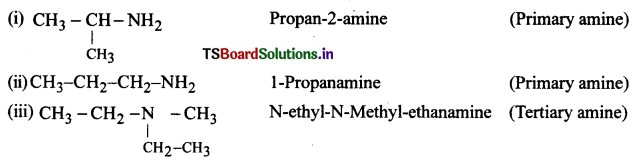
Write the IUPAC names of the following compounds and classify into primary, secondary and tertiary amines.
(i) (CH3)2CHNH2
(ii) CH3(CH2)2NH2
(iii) (CH3CH2)2NCH3.
Answer:
Question 2.
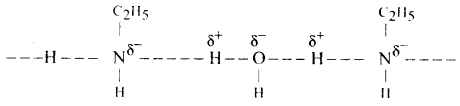
Explain why ethylamine is more soluble in water where as aniline is sparingly soluble.
Answer:
Ethylamine forms hydrogen bonds with water molecules and hence dissolves in water. Aniline, due to its large hydrocarbon part, develops hydrophobic character. As a result it does not dissolve in water.
Question 3.
Why aniline does not undergo Friedel-Craft reactions?
Answer:
Aniline doesnot undergo Friedel-Crafts reaction. Actually, aniline being a Lewis base forms a complex with AlCl3 which is a Lewis acid. The amino group is not in a position to activate the benzene ring towards electrophilic substitution. Hence, alkylation (or) acylation which lead to Fridel Crafts reaction is not possible.

Question 4.
Gabriel phthalimide synthesis exclusively forms primary amines . Explain.
Answer:
Gabriel phthalimide synthesis is preferred for synthesizing aliphatic primary amines because aryl halides do not undergo nucleophilic substitution with the anion formed by phthalimide.
Question 5.
Arrange the following bases in decreasing order of pKb values C2H5NH2, C6H5NHCH3, (C6H5)2NH and C6H5NH2.
Answer:
Decreasing order of pKb : C6H5NH2 > C6H5NHCH3 > C2H5NH2 > (C6H5)2NH
pKb values: 9.38 > 9.30 > 3.29 > 3.00
[Decreasing order of Basicity: (C6H5)2NH > C2H5NH2 > C6H5NHCH3 > C6H5NH2
Question 6.
Arrange the following bases in increasing order of their basic strength. Aniline, p-nitroaniline and p-toluidine.
Answer:
Increasing order (low’ to high) of basic strength:
p-nitroaniline < Aniline < p-toluidine.
Question 7.
Write equations for carbylamine reaction of an aliphatic amine.
Answer:
When a primary amine is heated with alcoholic caustic potash and chloroform, an offensive
smelling compound called carbylamine (Ethylisocyanide) is formed. The reaction is used as a test for chloroform (or) for a primary amine.

Question 8.
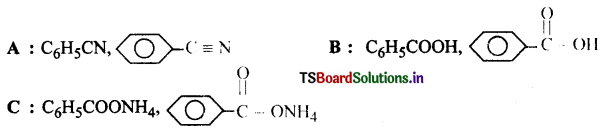
Give structures of A, B and C in the following reaction.

Answer:
Question 9.
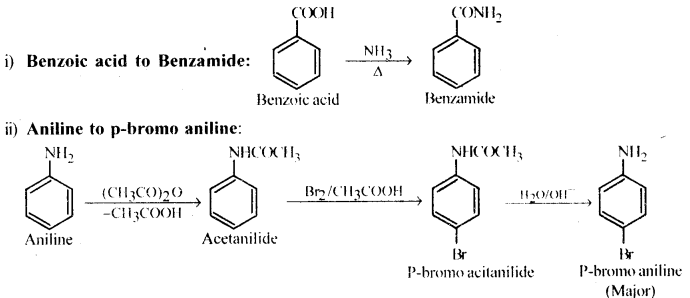
Accomplish the following conversions:
(i) Benzoic acid to benzamide
(ii) Aniline to p-bromoaniline
Answer:
Question 10.
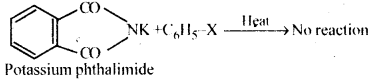
Why aromatic primary amines cannot be prepared by Gabriel phthalimide?
Answer:
Aryl halides does not react with potassium phthalimide. Because C-X bond in haloarene is difficult to be cleaved due to partial double bond character. They do not undergo nucleophilic substitution with the anion formed by phthalimide. So, aromatic primary amines cannot be prepared by Gabriel phthalimide synthesis.
V. Short Answer Questions
Question 1.
Give one chemical test to distinguish between the following pairs of compounds:
i) Methylamine and dimethvlamine
ii) Aniline and N-methylaniline
iii) Ethylamine and aniline
Answer:
i) Methylamine is a primary amine, while dimethyl amine is a secondary amine.
So, methyl amine undergoes carbylamine test, while dimethylamine does not.
When methylamine is heated with chloroform and alcohalic KOH, an offensive smelling compound methyl carbylamine is formed.

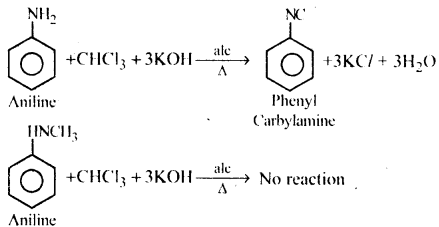
ii) Aniline is a primary amine, while N-methylaniline is a secondary amine.
So aniline undergoes carbylamine test, while N-methylaniline doesnot.
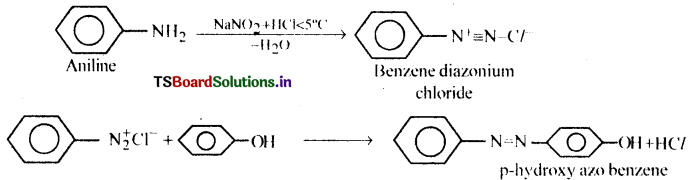
iii) Ethylamine and aniline are primary aromatic amines.
Aniline undergoes azodye test, while ethylamine doesnot.
Question 2.
How do you prepare the following?
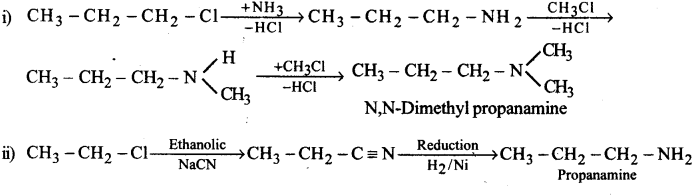
i) N, N-Dimethyl propanamine from ammonia
ii) Propanamine from chloroethane
Answer:
Question 3.
Compare the basicity of the following in gaseous state and in aqueous state and arrange them in increasing order of basicity.
CH3NH2, (CH3)2NH, (CH3)3N and NH3
Answer:
Pkb values of NH3, CH3NH2, (CH3)2NH, (CH3)3N are 4.74, 3.35, 3.27, 4.22 respectively.
“Smaller is the value of Pkb, greater is the basic nature of amine.
Hence, increasing order of basicity: NH3 < (CH3)3N < CH3NH2 < (CH3)2NH
In gaseous phase, basic character of amines increases with the increase in number of electron releasing groups(+I groups). Due to +1 effect, the order of basicity of amines is as follows
[(CH3)3N > (CH3)2NH > CH3NH2 > NH3]
In aqueous state, basicity depends on stability of protonated amines.
Greater the strength of H-bonding greater will be stability and more is the basic strength.
Hence order of basicity : NH3 > CH3NH2 >(CH3)2NH > (CH3)3N
But overall basic strength of Amines depends on combined effect of steric, solvation and Inductive effect. Hence overall order is (CH3)2NH > CH3NH2 > (CH3)3N > NH3
Question 4.
How do you carry out the following conversions?
i) N-ethylamine to N,N-diethvl propanamine
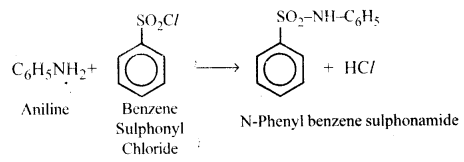
ii) Aniline to Benzene sulphonamide
Answer:
i) N-ethylamine to N,N-diethyl propanamine:

ii) Aniline to Benzene sulphonamide
Question 5.
Explain with a suitable example, how benzene sulphonylchloride can distinguish primary, secondary and tertiary amines.
Answer:
Benzene Sulphonyl chloride (C6H5SO2Cl) is used to distinguish 1 °, 2°, 3° Amines.
This is also known as Hinsberg’s reagent.
i) 1 ° Amines (Ethylamine) react with Benzene sulphonyl chloride to form N-Ethyl benzene sulphonamide.
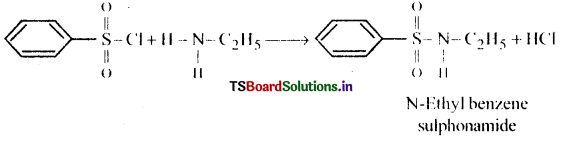
The hydrogen attached to nitrogen in sulphonamide is strongly acidic due to the presence of strong electron withdrawing sulphonyl group. Hence it is soluble in alkali.
ii) 2° Amines (Diethylamine) react with Benzene sulphonyl chloride to form N,N-Diethyl- benzene sulphonamide.

Since N,N-Diethylbenzene sulphonamide doesnot contain any hydrogen atom attached to nitrogen atom, it is not acidic and hence insoluble in alkali.
iii) Tertiary amines do not react with benzene sulphonyl chloride. Hence Hinsberg reagent is useful to distinguish primary, secondary and tertiary amines.
Question 6.
Write the reactions of
(i) aromatic and (ii) aliphatic primary amines with nitrous acid, highlighting the differences.
Answer:
i) Aromatic amines react with nitrous acid at low temperatures (273-278K) to form diazonium salts.

ii) Aliphatic primary amines react with nitrous acid to form aliphatic diazonium salts which being unstable, liberate nitrogen gas and alcohols. Quantitative evolution ofnitrogenis used for the estimation of amino acids and proteins.

Question 7.
Explain why amines are less acidic than alcohols of comparable molecular masses.
Answer:
Electronegativity of oxygen is more than that of nitrogen. Thus the oxygen in alcohols tends to pull electrons twoards itself and releases H+ more easily. On the other hand, the presence of alkyl group on the nitrogen atom in amines increases electron density to make it more basic than alcohol. Therefore, amines are less acidic than alcohols.
Question 8.
Write the equations involved in the reaction of Nitrous acid with ethylamine and aniline.
Answer:
1) Primary aliphatic amines like C2H5NH2 react with nitrous acid and form aliphatic diazonium salts. But it being unstable, dissociates to give ethyl alcohol and N2 gas.

2) Aromatic amines like C6H5NH2 react with nitrous acid at low temperatures (273-278K) and form diazonium salts.

Question 9.
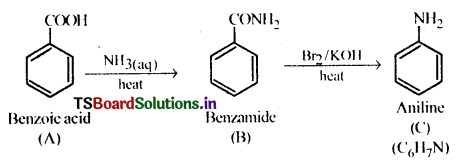
An aromatic compound ‘A’ on treatment with aqueous ammonia and heating forms compound ‘B’, which on heating with Br2 and KOH forms compound ‘C’ of molecular formula C6H7N. Write the structures and IUPAC names of compounds A, B and C.
Answer:
From the given data, compound B upon heating with Br2 and KOH forms a compound C .
This indicates that the compound B is an acid amide and C is amine.
Since B has been formed upon heating compound A which is an aromatic acid and it is benzoic acid.
The reactions involved are given as follows:
Question 10.
Account for the following:
pKb of aniline is more than thit of methyla mine
Answer:
In aniline due to resonance, the lone pair of electrons on the N atom are delocalized over the benzerie ring. Due to this, electron density on the nitrogen decreases.
But in CH3NH2, +1-effect of CH3 increases the electron density on the N-atom.
Thus, aniline is a weaker hase than methylamine and hence its pKb value is more than that of methylamine.
VI. Long Answer Questions
Question 1.
Explain why the order of basicity for methylamine, N,N-dimethyl amine and N,N,N-trimethylamine changes in gaseous and aqueous medium.
Answer:
In gaseous phase, due to +1 effect, basic character of amines increases with increase in number of electron releasing groups.
So the order of basicity: [(CH3)3N > (CH3)2NH > CH3NH2 > NH3]
In aqueous state, basicity depends on stability of protonated amines. Greater the strength of El- bonding greater will be stability and more is the basic strength.
So order of basicity :NH3 > CH3NH2 >(CH3)2NH > (CH3)3N
But overall basic strength of Amines depends on combined effect of steric, solvation and Inductive effect.
Hence overall order : (CH3)2NH > CH3NH2 > (CH3)3N > NH3
Question 2.
Complete the following conversions.
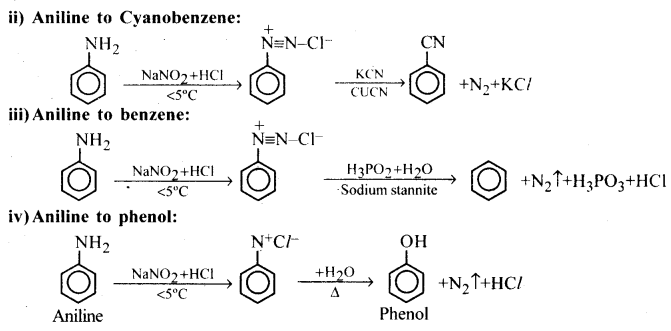
Aniline to (i) Fluorobenzene (ii) Cyanobenzene (iii) Benzene and (iv) Phenol.
Answer:
i) Aniline to Fluorobenzene: This conversion involves two stages:
a) Preparation of Benzenediazonium chloride: Benzene diazonium chloride is prepared by the reaction of aniline with nitrous acid at 273-278K.

b) Preparation of Fluorobenzene: Benzene diazonium chloride on heating with fluoroboric acid gives fluorobenzene.

The reaction is called Balz-Schiemann reaction.
Question 3.
Explain the following name reactions:
i) Sandmeyer reaction
ii) Gattermann reaction
Answer:
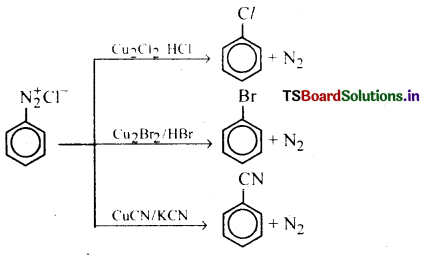
i) Sandmeyer reaction: This reaction is used to convert aniline into an alkyl halide (Cl–, Br–) or Cyanide (CN–). It is used in the synthesis of chlorobenzene, bromobenzene and benzionitris.
This process involves forming a dizaonium salt at 0-5°C, which undergoes copper catalysed radical substitution releasing nitrogen gas.
The Cl–, Br– and CN– nucleophiles can be introduced in the benzene ring in the presence of Cu2Cl2 / HCl (or) Cu2Br2 / HBr (or) CuCN/KCN.
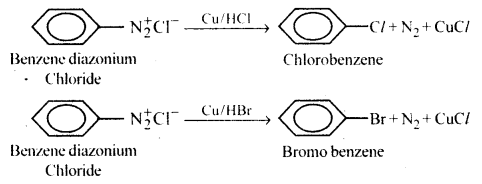
ii) Gattermann reaction: This reaction is used for obtaining chiorobenzene (or) bromobenzene from benzene diazonium chloride by treating it with Cu/HCl (or) Cu/HBr respectively.
Question 4.
Write the steps involved in the coupling of benzene diazonium chloride with aniline and phenol.
Answer:
Coupling reactions: Benzene diazonium salt reacts with certain aromatic compounds having an electron rich group (-OH, -NH2 etc.,) to form azo compounds. Azo compounds are highly coloured and are used as dyes. This reaction is known as coupling reaction and is carried by controlling the pH of the medium.
Coupling reactions is an electrophilic substitution reaction.
Ex 1: Benzene diazonium chloride reacts with phenol. In this reaction diazonium group is coupled with phenol at para position by electrophilic substitution reaction to form p-hydroxy azobenzene.

Ex 2: Reaction of diazonium salt with aniline yields p-amino azobenzene.

VII. Star Objective Questions
Question 1.
Which of the following is a 3° amine?
1) 1 -methylcyclohexylamine
2) Triethylamine
3) tert-butylamine
4) N-methylaniline
Answer:
2) Triethylamine
Question 2.
The correct 1UPAC name for CH2==CHCH2 NHCH3 is
1) Allylmethylamine
2) 2-amino-4-pentene
3) 4-aminopent-1-ene
4) N-methylprop-2-en-1-amine
Answer:
4) N-methylprop-2-en-1-amine
Question 3.
Acid anhydrides on reaction with primary amines give _________
1) amide
2) imide
3) secondary amine
4) imine
Answer:
1) amide
Question 4.
Amongst the following, the strongest base in aqueous medium is _______
1) CH3NH2
2) NCCH2NH2
3) (CH3)2 NH
4) C6H5NHCH3
Answer:
3) (CH3)2 NH
Question 5.
Benzylamine may be alkylated as shown in the following equation :
C6H5CH2NH2 + R—X → C6H5CH2NHR Which of the following alkylhalides is best suited for this reaction through SN1 mechanism?
1) CH3Br
2) C6H5Br
3) C6H5CH2Br
4) C2H5Br
Answer:
3) C6H5CH2Br
Question 6.
Which of the following reagents would not be a good choice for reducing an aryl nitro compound to an amine?
1) H2(excess) /Pt
2) LiAlH4 in ether
3) Fe and HCl
4) Sn and HCl
Answer:
2) LiAlH4 in ether
Question 7.
Best method for preparing primary amines from alkyl halides without changing the number of carbon atoms in the chain is
1) Hoffmann Bromamide reaction
2) Gabriel.phthalimide synthesis
3) Sandmeyer reaction
4) Reaction with NH3
Answer:
2) Gabriel.phthalimide synthesis
Question 8.
The gas evolved when methylamine reacts with nitrous acid is ______
1) NH3
2) N2
3) H2
4) C2H6
Answer:
2) N2
Question 9.
Electrolytic reduction of nitrobenzene in weakly acidic medium gives
1) aniline
2) nitrosobenzene
3) N-phenyl hydroxylamine
4) p-hydroxyaniline
Answer:
1) aniline
Question 10.
Amongst the given set of reactants, the most appropriate for preparing 2°amine is ______
1) 2° R—Br + NH3
2) 2° R—Br + NaCN followed by H2/Pt
3) 1° R—NH2 + RCHO followed by H2/Pt
4) 1° R—Br (2 mol) + potassium phthalimide followed by H3O+/heat
Answer:
3) 1° R—NH2 + RCHO followed by H2/Pt
Question 11.
The source of nitrogen in Gabriel synthesis of amines is ________
1) Sodium azide, NaN3
2) Sodium nitrite, NaNO2
3) Potassium cyanide, KCN
4) Potassium phthalimide, C6H4(CO)2N–K+
Answer:
4) Potassium phthalimide, C6H4(CO)2N–K+
Question 12.
The best reagent for converting, 2-phenylpropanamide into 1- phenylethanamine is __________
1) excess H2/Pt
2) NaOH/Br2
3) NaBH4/methanol
4) LiAlH4/ether
Answer:
2) NaOH/Br2
Question 13.
The best reagent for converting 2-phenylpropanamide into 2-phenylpropanamine is _______
1) excess H2
2) Br2 in aqueous NaOH
3) iodine in the presence of red phosphorus
4) LiAlH4 in ether
Answer:
4) LiAlH4 in ether
Question 14.
Hoffmann Bromamide Degradation reaction is shown by _______
1) ArNH2
2) ArCONH2
3) ArNO2
4) ArCH2NH2
Answer:
2) ArCONH2
Question 15.
Acetamide is treated with the following reagents separately. Which one of these would yield niethylamine?
1) NaOH+Br2
2)Sodalime
3) Hot Cone. H2SO4
4) PCl5
Answer:
1) NaOH+Br2
Question 16.
Methylamine reacts with HNO2 to form ________
1) CH3—O—N=0
2) CH3—O—CH3
3) CH3OH
4) CH3CHO
Answer:
3) CH3OH
Question 17.
Reduction of aromatic nitro compounds using Fe and HCl gives _________
1) aromatic oxime
2) aromatic hydrocarbon
3) aromatic primary amine
4) aromatic amide
Answer:
3) aromatic primary amine
Question 18.
The reaction

is named as ________
1) Sandmeyer reaction
2) Gatterman reaction
3) Claisen reaction
4) Carbylamine reaction
Answer:
2) Gatterman reaction
Question 19.
Which of the following will be most stable diazonium salt \(\mathrm{RN}_2^{+} \mathrm{X}^{-}\)?
1) \(\mathrm{CH}_3 \mathrm{~N}_2^{+} \mathrm{X}^{-}\)
2) \(\mathrm{C}_6 \mathrm{H}_5 \mathrm{~N}_2^{+} \mathrm{X}^{-}\)
3) \(\mathrm{CH}_3 \mathrm{CH}_2 \mathrm{~N}_2^{+} \mathrm{X}^{-}\)
4) \(\mathrm{C}_6 \mathrm{H}_5 \mathrm{CH}_2 \mathrm{~N}_2^{+} \mathrm{X}^{-}\)
Answer:
2) \(\mathrm{C}_6 \mathrm{H}_5 \mathrm{~N}_2^{+} \mathrm{X}^{-}\)
Question 20.
Which of the following statements about primary amines is false?
1) Alkyl amines are stronger bases than aryl amines
2) Alkyl amines react with nitrous acid to produce alcohols.
3) Aryl amines react with nitrous acid to produce phenols
4) Alkyl amines are stronger bases than ammonia
Answer:
3) Aryl amines react with nitrous acid to produce phenols
Question 21.
Which of the following compound will not undergo azo coupling reaction with benzene diazonium chloride.
1) Aniline
2) Phenol
3) Anisole
4) Nitrobenzene
Answer:
4) Nitrobenzene
Question 22.
The correct decreasing order of basic strength of H2O, NH3,OH , \(\mathrm{NH}_2^{-}\) species is ________
1) \(\mathrm{NH}_2^{-}\) >OH–>NH3 >H2O
2) OH– > \(\mathrm{NH}_2^{-}\) > H2O > NH3
3) NH3 > H2O > \(\mathrm{NH}_2^{-}\) > OH–
4) H2O > NH3 > OH– >\(\mathrm{NH}_2^{-}\)
Answer:
1) \(\mathrm{NH}_2^{-}\) >OH–>NH3 >H2O