
Regular practice with AP Inter 2nd Year Chemistry Study Material Chapter 10 Biomolecules Questions and Answers helps students stay prepared for examinations.
AP Inter 2nd Year Chemistry 10th Lesson Biomolecules Questions and Answers
I. Multiple Choice Questions
Question 1.
Which of the following does not come under biomolecules?
1) Cellulose
2) Lactose
3) Nylon
4) Lipid
Answer:
3) Nylon
Biomolecules are naturally occurring in living systems.
Nylon is a synthetic polymer, not biological.
Question 2.
The carbohydrate which does not undergo hydrolysis is
1) Sucrose
2) Starch
3) Ribose
4) Cellulose
Answer:
3) Ribose
Monosaccharides cannot be hydrolyzed further. Ribose is a monosaccharide

Question 3.
The number of asymmetric carbons present in the open chain structure of D-( + )-glucose is
1) 3
2) 4
3) 2
4) 5
Answer:
2) 4
Open-chain glucose has 4 chiral (asymmetric) carbons.All except C1 and C6.
Question 4.
Which of the following is not an example of a hormone?
1) Insulin
2) Estrogen
3) Pyridoxine
4) Androgen
Answer:
3) Pyridoxine
Hormones are chemical messengers (insulin, estrogen, androgen).
Pyridoxine is a vitamin (B6), not a hormone.
Question 5.
α-D-( + )-Glucopyranose and β-D-( + )-Glucopyranose are
1) Anomers
2) Enantiomers
3) Epimers
4) All of these
Answer:
1) Anomers
α and β forms differ at anomeric carbon (C).So they are anomers.
Question 6.
Which of the following produces only glucose units on complete hydrolysis?
1) Lactose
2) Maltose
3) Raffinose
4) Sucrose
Answer:
2) Maltose
Maltose = glucose + glucose. On hydrolysis → only glucose units
Question 7.
Which reagent does not react with -CHO group of glucose?
1) NH2OH
2) NaHSO3
3) Br1 in water
4) HCN
Answer:
2) NaHSO3
Glucose has -CHO group → reacts with most reagents.
NaHSO3 does NOT react with glucose (due to cyclic form dominance).
Question 8.
Which compound inverts its optical rotation on hydrolysis?
1) Glucose
2) Sucrose
3) Maltose
4) Fructose
Answer:
2) Sucrose
Inversion of rotation occurs when hydrolysis changes optical rotation.
Sucrose → glucose + fructose → inversion.
Dextrorotatory sucrose gives a mixture of dextro glucose laevo fructose in which proportion of laevo is more.
Question 9.
Which of the following amino acid is optically inactive?
1) Alanine
2) Lysine
3) Glycine
4) Valine
Answer:
3) Glycine
Optical inactivity occurs when no chiral center. Glycine has no chiral carbon.
Question 10.
Which polysaccharide contains β – D – glucose as its building unit?
1) Lactose
2) Arabinose
3) Cellulose
4) Starch
Answer:
3) Cellulose
Cellulose is polymer of β-D-glucose. Starch is α-D-glucose.
Question 11.
Which amino acid is basic in nature?
1) Glutamic acid
2) Lysine
3) Tyrosine
4) Leucine
Answer:
2) Lysine
Basic amino acids have extra -NH2, groups. Lysine is strongly basic.
Question 12.
Albumin is an example of
1) Fibrous Protein
2) Carbohydrate
3) Globular Protein
4) Lipid
Answer:
3) Globular Protein
Albumin is soluble protein → globular type. Globular protein
Question 13.
Enzymes in the living systems
1) Provide immunity
2) Provide energy
3) Transport oxygen
4) Catalyze biological reactions
Answer:
4) Catalyze biological reactions
Enzymes are biological catalysts. They speed up biochemical reactions.
Question 14.
Which vitamin deficiency causes convulsions?
1) Vitamin C
2) Vitamin D
3) Vitamin E
4) Vitamin B6
Answer:
4) Vitamin B6
Vitamin B6 deficiency affects nervous system → convulsions.
Question 15.
Which nitrogen base is not the part of RNA?
1) Uracil
2) Cytosine
3) Thymine
4) Guanine
Answer:
3) Thymine
RNA contains U, C, A, G Thymine is present only in DNA [A, G, C, T]
II. Fill in the Blanks
Question 1.
In sucrose molecule, glucose and fructose are connected between _______ atoms respectively.
Answer:
C1 and C2
Question 2.
Curdling of milk is an example of _______.
Answer:
Denaturation of proteins.
Question 3.
Complementary base for the adenine present in DNA is ________.
Answer:
Thymine.
Question 4.
Rickets disease is caused by the deficiency of vitamin ________.
Answer:
Vitamin D.
Question 5.
Hormones are molecules that act as _______.
Answer:
Intercellular messengers.
III. One Word Answer Questions
Question 1.
Which linkage connects two monosaccharide units?
Answer:
Glycosidic linkage connects two monosaccharide units
Question 2.
Which non-essential amino acid is optically inactive?
Answer:
Glycine is optically inactive non-essential amino acid.
Question 3.
What type of bonding helps in stabilizing the α-helix structure of proteins?
Answer:
Hydrogen bonding helps in stabilizing the α-helix structure of proteins.
Question 4.
Name the disease that occurs due to deficiency of ascorbic acid.
Answer:
Scurvy (bleeding gums) occurs due to deficiency of ascorbic acid.
Question 5.
Increased level of which hormone causes hyperthyroidism?
Answer:
Increased level of Thyroxine causes hyperthyroidism.
IV. Very Short Answer Questions
Question 1.
Name the different types of carbohydrates on the basis of their hydrolysis. Give one example for each.
Answer:
Classification of Carbohydrates (Saccharides) on the basis of their hydrolysis:
a) Monosaccharides: These are the simple carbohydrates that cannot be broken further into smaller units on hydrolysis
Ex: Glucose and fructose.
b) Disaccharides: These carbohydrates give 2 units of monosaccharides on hydrolysis.
Ex: Sucrose, lactose
c) Oligosaccharides: These carbohydrates give 2-10 units of monosaccharides on hydrolysis.
Ex: Raffinose(which gives glucose, fructose and galactose on hydrolysis)
d) Polysaccha rides: These carbohydrates give large number of monosaccharides on hydrolysis.
Ex: Starch, cellulose etc.,
Question 2.
Why are sugars classified as reducing and non-reducing sugars?
Answer:
Sugars are classified as reducing and non-reducing sugars to test whether the sugar has a free aldehyde or ketone group that can act as a reducing agent.
Reducing sugars reduce Fehling’s solution or Tollen’s reagent.
They contain free aldehyde or Ketonic group. Ex: Glucose & Maltose
Non-reducing sugars do not reduce Fehling’s solution or Tollen’s reagent.
They do not have free aldehyde or ketonic group. Ex: Sucrose & Cellulose
Question 3.
What are anomers?
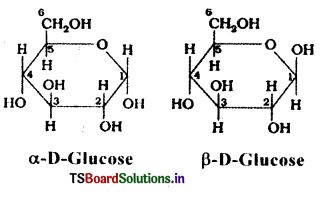
Answer: Anomers are those isomers which differ in orientation of -OH at C-1 (first carbon)
Ex: α-D-glucose and β-D-glucose
Question 4.
What is Zwitter ion? Give an example.
Answer:
Zwitter ion is a molecule or ion containing separate positively and negatively charged groups, yet it is electrically neutral overall.
Ex: In amino acid, the -NH2 (amino) group is basic and -COOH group is acidic. In aqueous solution, the carboxylic group loses a proton and amino group accepts the proton giving rise to a dipolar zwitter ion.

Question 5.
Write the names of three types of RNA.
Answer:
Three types of RNA:
a) m-RNA (messenger RNA)
b) r-RNA (ribosomal RNA )
c) t-RNA (transfer RNA)
Question 6.
Name the vitamin responsible for the coagulation of blood.
Answer:
Vitamin K is responsible for the coagulation of blood.
Question 7.
What is glycogen? How is it different from starch?
Answer:
- Glycogen is a polysaccharide which is stored in animal body (liver, muscles, brain).
- Starch is a polysaccharide which is stored in plants.
- Glycogen is more highly branched than Starch (amylopectin).
Question 8.
What are essential and non-essential amino acids? Give one example for each.
Answer:
Essential Amino acids: These are the amino acids which cannot be synthesised in the body and must be taken in diet.
Ex: Valine, leucine, phenylalanine .
Non-essential amino acids: These are the amino acids which can be synthesised in the body
Ex: Glycine alanine, glutamic acid.
Question 9.
Differentiate between globular and fibrous proteins.
Answer:
| Globular Proteins | Fibrous Proteins |
| 1) Polypeptide chains are arranged as coils. 2) They have spherical shape. 3) They are water soluble. 4) Ex: Insulin, albumins etc., | 1) Polypeptide chains are parallel to each other. 2) They have thread like structure. 3) They are insoluble in water. 4) Ex: Keratin, Myosin etc., |
Question 10.
What is the difference between a nucleoside and a nucleotide?
Answer:
These two are fundamental building blocks of nucleic acids DNA/ RNA
| Nucleoside | Nucleotide |
| 1) Nucleoside = Base + Sugar 2) Nucleosides are primarly structural components. 3) Nucleoside is a unit formed by attachment of a base to C-1 position of sugar. 4) Ex: Adenine + Ribose = adenosine | 1) Nucleotide = Base + Sugar + Phosphoric acid 2) Nucleotides also act as energy units (ATP) 3) Nucleotide is linked to phosphoric acid to C-5 position of sugar. 4) Ex: Adenosine + Phosphoric acid = Adenylic acid |
V. Short Answer Questions
Question 1.
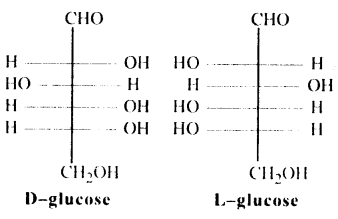
Write a short note on the structure of glucose.
Answer:
Structure & Properties of of glucose :
a) Acylation of glucose with acetic anhydride gives glucose penta acetate.
Hence glucose molecule has 5 -‘OH’ groups.
b) Glucose reacts with hydroxylamine and one molecule of HCN to give monoxime and cyanohydrin respectively. Hence glucose has H one carbonyl group.
c) Glucose reduces Tollen’s reagent to metallic silver and Fehling’s solution to reddish brown Cu2O.
Thus, glucose molecule is oxidised to gluconic acid. Hence glucose molecule contains an aldehydic (-CHO) group.
d) Strong oxidising agents like Cone. HN03, oxidise glucose to gluconic acid and finally to saccharic acid. Hence glucose molecule has a primary alcohol group (-CH2OH).
e) Glucose on prolonged heating with HI gives n-hexane.
Hence glucose has a six carbon chain with linear structure.
f) D- glucose when treated with excess of phenyl hydrazine, glucosazone is formed.
Based on the above observations, two open chain structures are proposed for glucose.
But glucose does not react with SchifTs reagent and sodium bisulphite.
Penta acetate of glucose does not react with hydroxylamine. Thus glucose shows muta rotation.
These properties suggest that glucose has a cyclic structure.
Question 2.
Explain the classification of proteins as primary, secondary, tertiary and quarternary proteins with respect to their structure.
Answer:
Structures of Proteins:
i) Primary structure of protein: The sequence in which various amino acids are arranged in a protein is called its primary structure. Any change in the sequence of amino acids creates different protein.
ii) Secondary structure of protein: it refers to shape in which a long polypeptide chain exists. A protein may assume α-helix structure of β-pleated structure. The a-helix structure results due to regular coiling of polypeptide chain.
Ex: Keratin in hair, nails, wood and myosin in nucleus
In β-pleated sheet structure, all peptide chairts are stretched to nearly maximum extension They are arranged side by side and held together by intramolecular hydrogen bonding.
Ex: Silk has β-pleated structure.
iii) Tertiary structure of proteins The tertiary structure of proteins represent overall folding of the polypeptide chain i.e., further folding of the secondary structure.
It gives rise to two major molecular shapes (i) Fibrous and (ii) Globular.
The main forces which stabilise 2° and 3° of proteins are hydrogen bonds, disulphide linkage. Van der waals forces and electrostatic force of attraction.
iv) Quaternary structure: Some of the proteins are composed of two or more polypeptide chains known as subunits. The spatial arrangement of these subunits with respect to each other is known as quaternary structure.
Question 3.
Explain the denaturation of proteins.
Answer:
Denatu ration: When a protein in its native form, is subjected to physical change such as change in temperature, or chemical change like change in pH, the hydrogen bonds are disturbed.
The protein globules unfold, helix get uncoiled and protein loses its biological activity.
This is called denaturation of proteins. Secondary and tertiary structures are destroyed but the primary structure remains as such.Ex: Curdling of milk, Coagulation of egg by boiling etc.,
Question 4.
What are enzymes?Give examples.
Answer:
Enzymes are biological catalysts. Each biological system requires a different enzyme. Enzymes are specific and efficient in their action. They are required in only small quantity and work at optimum temperature (310K) and pH (7.4) under one atmospheric pressure. Chemically, they are globular proteins. However some enzymes are also associated with some non-protein components called the co-factors for their activity.
Ex: Invertase, zymase, Diastase, Maltase, Urease, Pepsin
Question 5.
Write notes on vitamins.
Answer:
Vitamins are essential organic compounds required in small quantities for the normal growth and metabolic functioning of the body. Since most of the vitamins cannot be synthesized by the body, they must be obtained through diet or supplements.
Vitamins are designated by A, B, C, D, E, K. Vitamin B is sub divided into B1, B2, B6, B12
Vitamins are classified into two groups depending on their solubility in water or fat.
- Fat soluble vitamins: Vitamins which are soluble in fat and oils but insoluble in water belong to this group. Such vitamins are A,D,E ,K. They are stored in liver and adipose tissues.
- Water soluble vitamins: B group vitamins and vitamin C are soluble in water. Water soluble vitamins must be supplied regularly in diet because they are readily excreted in urine and cannot be stored (except vitamin B12) in our body.
Vitamin – Sources – Deficiency diseases
| SI. No. | Name of Vitamins | Sources | Deficiency diseases |
| 1) | Vitamin A (Retinol) | Fish liver oil, carrots, butter and milk | Night blindness, Xerophthalmia (hardening or cornea of eye) |
| 2) | Vitamin D (Calciferol) | Exposure to Sunlight, fish and egg yolk | Rickets (bone deformities in children) and osteo-malacia (soft bones and joint pain in adults) |
| 3) | Vitamin E (Tocopherol) | Vegetable oils like wheat germ oil, Sunflower oil, etc., | Increased fragility of RBC’s and muscular weakness. |
| 4) | Vitamin K | Green leafy vegetables | Increased blood clotting time. |
| 5) | Vitamin C (Ascorbic acid) | Citrus fruits, amla and green leafy vegetables | Scurvy (bleeding gums) |
| 6) | Vitamin B1 (Thiamine) | Yeast, milk, green vegetables and cereals | Beri beri (loss of appetite, retarded growth) |
| 7) | Vitamin B2 (Riboflavin) | Milk, eggwhite, liver, kidney | Cheilosis (cracking at comers of mouth and lips), digestive disorder and burning sensation of the skin |
| 8) | Vitamin B6 (Pyridoxine) | Yeast, Milk, egg yolk, cereals and grams | Convulsions/Fits (rapid, involuntary muscle contraction) |
| 9) | Vitamin B12 | Meat, fish, egg, curd | Pernicious anaemia (RBC deficient in haemoglobin) |
Question 6.
What are hormones? Give one example for each.
- steroid hormones
- Polypeptide hormones and
- amino acid derivatives.
Answer:
Hormones : Hormones are biomolecules that act as intercellular messengers.
They transfer biological information from one group of cells to distant tissues (or) organs.
These are produced by endocrine glands in the body and are poured directly in the blood stream which transports them to the site of action.
They are basically two types (i) Animal hormones (ii) Plant hormones
- Steroid hormones are lipid-soluble hormones derived from cholesterol.
Ex: Testosterone (male sex hormone), Estrogen (female sex hormones) - Polypeptide hormones are made up of chains of amino acids (peptides/proteins).
Ex: Insulin (regulates blood glucose), endorphins. - Amino acid derivatives are derived from tyrosine or tryptophan.
Ex: Epinephrine and norepinephrine.
Question 7.
Give the dietary sources of the following vitamins and name the diseases caused by their deficiency (a) A (b) D (c) E and (d) K
Answer:
| SI. No. | Name of Vitamins | Sources | Deficiency diseases |
| 1) | Vitamin A (Retinol) | Fish liver oil, carrots, butter and milk | Night blindness, Xerophthalmia (hardening or cornea of eye) |
| 2) | Vitamin D (Calciferol) | Exposure to Sunlight, fish and egg yolk | Rickets (bone deformities in children) and osteo-malacia (soft bones and joint pain in adults) |
| 3) | Vitamin E (Tocopherol) | Vegetable oils like wheat germ oil, Sunflower oil, etc., | Increased fragility of RBC’s and muscular weakness. |
| 4) | Vitamin K | Green leafy vegetables | Increased blood clotting time. |
Question 8.
Write the importance of carbohydrates.
Answer:
Carbohydrates are essential biomolecules needed for the life of both plants and animals. Honey is an instant source of energy. Carbohydrates are used as storage molecules as starch in plants and glycogen in animals. Cell wall of bacteria and plants is madeup of cellulose. Wood and cotton fibre contain cellulose. D-ribose and 2-deoxy-D-ribose are present in nucleic acids. “Streptomycin” is a carbohydrate antibiotic. Other antibiotics of this family are kenamycins, neomycins and gentamycins. Antigenic carbohydrates are synthesised to fight against cancer.
Question 9.
Write about polysaccharides with starch and cellulose as examples.
Answer:
Polysaccharides: These carbohydrates give large number of monosaccharides on hydrolysis. They are joined together by glycosidic linkages. They are the most common carbohydrates in nature. They mainly act as the food storage or structural materials.
Ex: Starch, cellulose .
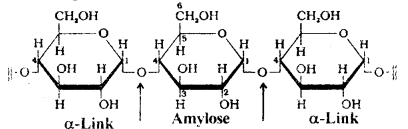
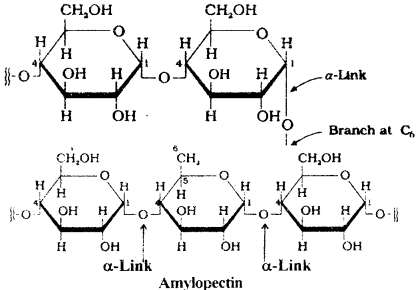
i) Starch: Starch is the main storage polysaccharide of plants. It is the most important dietary source for human beings. High content of starch is found in cereals, roots, tubers and some vegetables. It is a polymer of a-D-glucose and it consists of Amylose and Amylopectin.
Amylose is water soluble component which constitutes about 15-20% of starch. Chemically amylose is a long unbranched chain with 200-1000 a-D-(+)-glucose units held by C-1 to C-4 glycosidic linkage.
Amylopectin is insoluble in water and constitutes about 80-85% of starch. It is a branched chain polymer of α-D-glucose units in which chain is formed by C1-C4 glycosidic linkage whereas branching occurs by C1-C6 glycosidic linkage.
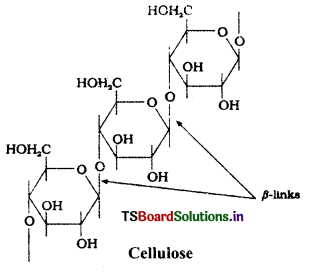
ii) Cellulose: Cellulose occurs exclusively in plants and it is the most abundant organic substance in plant kingdom. It is a predominant constituent of cell wall of plant cells. Cellulose is a straight chain polysaccharide composed only of P-D-glucose units which are joined by glycosidic linkage between C-1 of one glucose unit and C-4 of the next glucose unit.
Question 10.
Write short notes on Sucrose.
Answer:
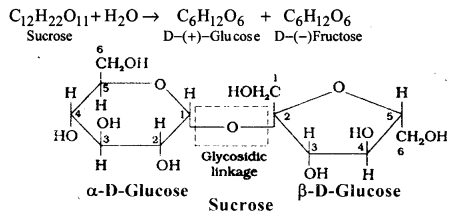
- Sucrose is a naturally occuring disaccharide sugar (C12H22O11) composed of glucose and fructose. It is commonly known as table sugar or cane sugar.
- It is white, odorless, crystalline solid
- It is found in sweet fruits, but commercially extracted from sugarcane.
- It is used as sweetener, perservatives (Jams & Jellyes), baking
- Sucrose is a non reducing sugar because the reducing groups of glucose and fructose are involved in glycosidic bond formation.
- Sucrose is dextrorotatory but after hydrolysis it is leavorotatory because
the laevorotation of fructose (-92.4°) is more than dextrorotation of glucose (+52.5°). - Hydrolysis of sucrose brings about a change in specific rotation, from dextro (+) to laevo(-) hence it is known as invert sugar.
- Sucrose on hydrolysis gives equimolar mixture of D-(+)-glucose and D-(-) fructose.
VI. Long Answer Questions
Question 1.
Explain the classification of carbohydrates with examples.
Answer:
Classification of Carbohydrates
I) Classification based on number of units of Saccharides:
a) Monosaccharides: These are the simple carbohydrates that cannot be broken further into smaller units on hydrolysis Ex; Glucose and fructose.
b) Disaccharides: These carbohydrates give 2 units of monosaccharides on hydrolysis.
Ex; Sucrose, lactose
c) Oligosaccharides: These carbohydrates give 2-10 units of monosaccharides on hydrolysis.
Ex; Raffinose(which gives glucose, fructose and galactose on hydrolysis)
d) Polysaccharides; These carbohydrates give large number of monosaccharides on hydrolysis.
Ex: Starch, cellulose
Different types of Monosaccharides:
| Carbon atoms | General term | Aldehyde | Ketone |
| 3 | Triose | Aldotriose | Ketotriose |
| 4 | Tetrose | Aldotetrose | Ketotetrose |
| 5 | Pentose | Aldopentose | Ketopentose |
| 6 | Hexose | Aldohexose | Ketohexose |
| 7 | Heptose | Aldoheptose | Ketoheptose |
II) Classification based on functional group: If a carbohydrate contains an aldehyde group, it is known as aldose and if it contains a Keto group, it is known as a ketose.
Question 2.
Write notes on (a) enzymes and (b) vitamins
Answer:
(a) Enzymes: Enzymes are biological catalysts. Each biological system requires a different enzyme. Enzymes are specific and efficient in their action. They are required in only small quantity and work at optimum temperature (310K) and pH (7.4) under one atmospheric pressure. Chemically, they are globular proteins. However some enzymes are also associated with some non-protein components called the co-factors for their activity.
Ex: Invertase, zymase, Diastase, Maltase, Urease, Pepsin .
Invertase converts Sucrose into Glucose and Fructose
(b) Vitamins are essential organic compounds required in small quantities for the normal growth and metabolic functioning of the body. Since most of the vitamins cannot be synthesized by the body, they must be obtained through diet or supplements.
Vitamins are designated by A,B,C,D,E,K. Vitamin B is sub divided into B1, B2, B6, B12. Vitamins are classified into two groups depending on their solubility in water or fat.
- Fat soluble vitamins: Vitamins which are soluble in fat and oils but insoluble in water belong
to this group. Such vitamins are A,D,E ,K. They are stored in liver and adipose tissues. - Water soluble vitamins: B group vitamins and vitamin C are soluble in water. Water soluble vitamins must be supplied regularly in diet because they are readily excreted in urine and cannot be stored (except vitamin B12) in our body.
Question 3.
Explain the structure and functions of DNA and RNA.
Answer:
NUCLEIC ACIDS (DNA & RNA): Nucleic acids are long chain biopolymers of nucleotides
with a polyphosphate ester chain. They consists of a base (a pentose sugar) and phosphate group DNA and RNA – Structure and Functions 1. 1. DNA (Deoxyribonucleic Acid):
- Structure of DNA: It is made up of repeating units called nucleotides.
- Each nucleotide contains: Deoxyribose sugar,Phosphate group, Nitrogen base
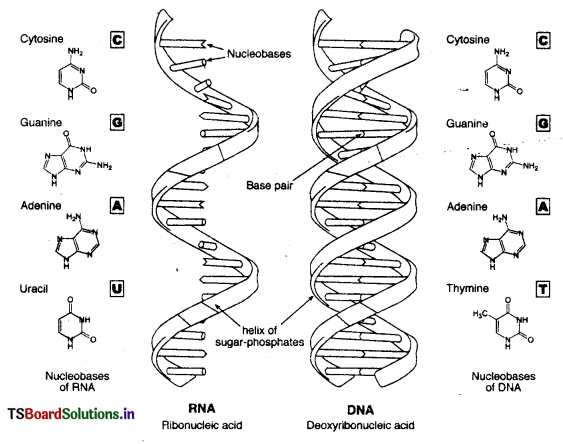
- Nitrogen bases in DNA: Adenine (A),Thymine (T),Guanine (G),Cytosine (C)
- DNA has a double helical structure with two antiparallel strands.
- Base pairing: A pairs with T, G pairs with C
Functions of DNA:
- Stores hereditary/genetic information.
- Controls cell activities through protein synthesis.
- Transfers genetic traits from parents to offspring.
- Undergoes replication before cell division.
2. RNA(RibonucIeic Acid)
Structure of RNA: It is usually single stranded.
Each nucleotide contains: Ribose sugar,Phosphate group,Nitrogen base Nitrogen bases in RNA:Adenine (A),Uracil (U),Guanine (G),Cytosine (C) In RNA, Uracil replaces Thymine.
Functions of RNA:
- Helps in protein synthesis.
- Carries genetic message from DNA to ribosomes.
- Forms ribosomes and helps amino acid transport.
Structural differences between RNA and DNA
Question 4.
Write notes on the functions of major hormones in the human body.
Answer:
Hormones help to maintain the balance of biological activities in the body.
- Insulin keeps the blood glucose level with in the limit.
- Growth hormones and sex hormones play role in growth and development.
- Hormones released by gonads are responsible for development of secondary sexual characters.
- Adrenal cortex release glucocorticoids and mineralocorticoids.
- The glucocorticoids modulate inflammatory reactions and are involved in reaction to stress.
- The mineralocorticoids control the level of excretion of water and salt by the kidney.
VII. Star Objective Questions
Question 1.
Which of the following reactions of glucose can be explained only by its cyclic structure?
1) Glucose forms pentaacetate
2) Glucose reacts with hydroxylamine to form an oxime
3) Pentaacetate of glucose does not react with hydroxylamine
4) Glucose is oxidised by nitric acid to gluconic acid
Answer:
3) Pentaacetate of glucose does not react with hydroxylamine
Question 2.
Which of the following statement is not true about glucose?
1) It is an aldohexose
2) On heating with HI it forms n-hexane
3) It is present in furanose form
4) It does not give 2,4-DNP test
Answer:
3) It is present in furanose form
Question 3.
Sucrose (cane sugar) is a disaccharide. One molecule of sucrose on hydrolysis gives ______
1) 2 molecules of glucose
2) 2 molecules of glucose +1 molecule of fructose
3) 1 molecule of glucose + 1 molecule of fructose
4) 2 molecules of fructose
Answer:
3) 1 molecule of glucose + 1 molecule of fructose
Question 4.
Sucrose on hydrolysis gives
1) β-D-glucose + α-D-fructose
2) α-D-glucose + β-D-glucose
3) α-D-glucose + β-D-fructose
4) α-D-fructose + β-D-fructose
Answer:
3) α-D-glucose + β-D-fructose
Question 5.
Which one of the following sets of monosaccharides forms sucrose?
1) α-D-galactopyranose and α-D-glucopyranose
2) α-D-glucopyranose and β-D-fructofuranose
3) β-D-glucopyrauose and α-D-fructofuranose
4) α-D-glucopyranose and β-D-fructopyranose
Answer:
2) α-D-glucopyranose and β-D-fructofuranose
Question 6.
Which of the following does not exhibit the phenomea of mutarotation?
1) (+) Sucrose
2) (+) Lactose
3) (+) Maltose
4) (-) Fructose
Answer:
1) (+) Sucrose
Question 7.
Which one of the following statements is not true regarding (+) lactose?
1) (+) lactose is a β-glycoside formed by the union of a molecule of D-(+)- glucose and a molecule of D-(+)-galactose
2) (+) lactose is a reducing sugar and does not exhibit mutarotation
3) (+) lactose, C<sub>12</sub>H<sub>22</sub>O<sub>11</sub>, contains 80-H groups
4) On hydrolysis (+) lactose gives equal amount of D-(+)- glucose and D-(+)- galactose
Answer:
2) (+) lactose is a reducing sugar and does not exhibit mutarotation
Question 8.
The hormone that helps in the conversion of glucose to glycogen is
1) cortisone
2) bile acids
3) adrenaline
4) insulin
Answer:
4) insulin
Question 9.
Glycogen is a branched chain polymer of a-D-glucose units in which chain is formed by C1 – C4 glycosidic linkage whereas branching occurs by the formation of C1- C6 glycosidic linkage. Structure of glycogen is similar to
1) Amy lose
2) Amylopectin
3) Cellulose
4) Glucose
Answer:
2) Amylopectin
Question 10.
Which of the following polymer is stored in the liver of animals?
1)Amylose
2) Cellulose
3) Amylopectin
4) Glycogen
Answer:
4) Glycogen
Question 11.
Dinucleotide is obtained by joining two nucleotides together by phosphodiester linkage. Between which carbon atoms of pentose sugars of nucleotides are these linkage present?
1) 5′ and 3′
2) 1′ and 5′
3) 5′ and 5′
4) 3′ and 3′
Answer:
1) 5′ and 3′
Question 12.
Each polypeptide in a protein has aminoacids linked with each other in a specific sequence. This sequence of amino acids is said to be
1) primary structure of proteins.
2) secondary structure of proteins.
3) tertiary structure of proteins.
4) quaternary structure of proteins.
Answer:
1) primary structure of proteins.
Question 13.
Proteins are found to have two different types of secondary structures viz. a-helix and P-pleated sheet structure, a-helix structure of protein is stabilised by :
1) Peptide bonds
2) van der Waals forces
3) Hydrogen bonds
4) Dipole-dipole interactions
Answer:
4) Dipole-dipole interactions
Question 14.
Nucleic acids are the polymers of _______
1) Nucleosides
2) Nucleotides
3) Bases
4) Sugars
Answer:
2) Nucleotides
Question 15.
DNA and RNA contain four bases each. Which of the following bases is not present in RNA?
1) Adenine
2) Uracil
3) Thymine
4) Cytosine
Answer:
3) Thymine
Question 16.
Which of the following is a basic amino acid?
1) Serine
2) Alanine
3) Tyrosine
4) Lysine
Answer:
4) Lysine
Question 17.
The nonessential amino acid among the following is
1) lysine
2) valine
3) leucine
4) alanine
Answer:
4) alanine
Question 18.
Which of the following compounds can form a zwitter ion?
1) Aniline
2) Acetanilide
3) Benzoic acid
4) Glycine
Answer:
4) Glycine
Question 19.
Which of the following B group vitamins can be stored in our body?
1) Vitamin B<sub>1</sub>
2) Vitamin B<sub>2</sub>
3) Vitamin B<sub>6</sub>
4) Vitamin B<sub>12</sub>
Answer:
4) Vitamin B<sub>12</sub>
Question 20.
Which one of the following vitamins is water-soluble?
1) Vitamin-B
2) Vitamin-E
3) Vitamin-K
4) Vitamin-A
Answer:
1) Vitamin-B
Question 21.
The RBC deficiency is deficiency disease of
1) Vitamin B<sub>2</sub>
2) Vitamin B<sub>12</sub>
3) Vitamin B<sub>6</sub>
4) Vitamin B<sub>1</sub>
Answer:
2) Vitamin B<sub>12</sub>
Question 22.
Vitamin-B<sub>12</sub> contains
1) Zn(II)
2) Ca(Il)
3) Fe(II)
4) Co(II)
Answer:
4) Co(II)
Question 23.
Which of the following acids is a vitamin?
1) Aspartic acid
2) Ascorbic acid
3) Adipic acid
4) Saccharic acid
Answer:
2) Ascorbic acid
Question 24.
Which of the following bases is not present in DNA?
1) Adenine
2) Thymine
3) Cytosine
4) Uracil
Answer:
4) Uracil
Question 25.
RNA and DNA are chiral molecules, their chirality is due to
1) L-sugar component
2) Chiral bases
3) Chiral phosphate ester units
4) D-sugar component
Answer:
4) D-sugar component
Question 26.
The segment of DNA which acts as the instrumental manual for the synthesis of the protein is
1) nucleotide
2) ribose
3) gene
4) nucleoside
Answer:
3) gene
Question 27.
Which of the following hormones contains iodine?
1) Insulin
2) Testosterone
3) Adrenaline
4) Thyroxine
Answer:
4) Thyroxine