
Referring to the AP Inter 2nd Year Maths Study Material Chapter 3 Matrices Exercise 3d Solutions makes it easier to understand complex problems.
AP Inter 2nd Year Maths Matrices Solutions Exercise 3d
I.
Question 1.
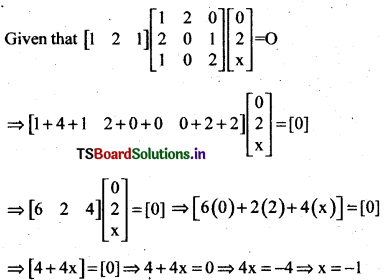
For what values of x : \(\left[\begin{array}{lll}
1 & 2 & 1
\end{array}\right]\left[\begin{array}{lll}
1 & 2 & 0 \\
2 & 0 & 1 \\
1 & 0 & 2
\end{array}\right]\left[\begin{array}{l}
0 \\
2 \\
x
\end{array}\right]\) = 0
Solution:

Question 2.
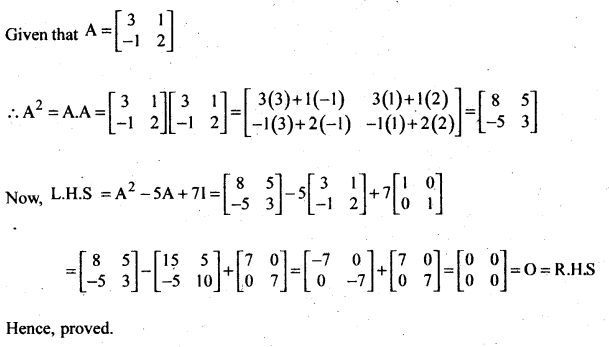
If A = \(\left[\begin{array}{cc}
3 & 1 \\
-1 & 2
\end{array}\right]\), show that A2 – 5A + 7I = 0
Solution:
Question 3.
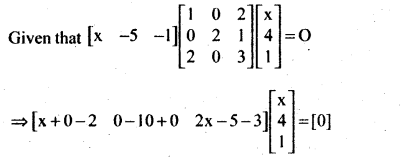
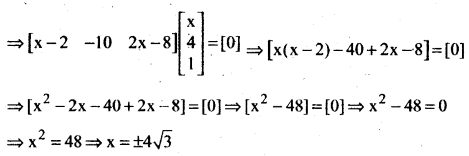
Find x, if \(\left[\begin{array}{lll}
x & -5 & -1
\end{array}\right]\left[\begin{array}{lll}
1 & 0 & 2 \\
0 & 2 & 1 \\
2 & 0 & 3
\end{array}\right]\left[\begin{array}{l}
x \\
4 \\
1
\end{array}\right]\) = 0
Solution:
II.
Question 1.
If A and B are symmetric matrices, prove that AB – BA is a skew symmetric matrix.
Solution:
Given that A and B are symmetric matrices. Then A’ =A and B’ =B
Now (AB – BA)’ = (AB)’ – (BA) [∵ (A – B)’ = A’ – B’]
= B’A’ – A’B’ [∵ (AB) = B’A’] = BA – AB [∵ B’ = B and A’= A] = -(AB – BA)
∴ (AB – BA) = -(AB – BA).
Thus, AB – BA is a skew symmetric matrix.
Question 2.
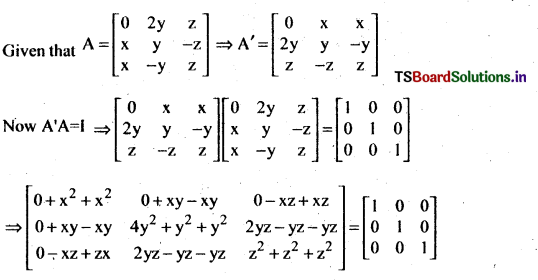
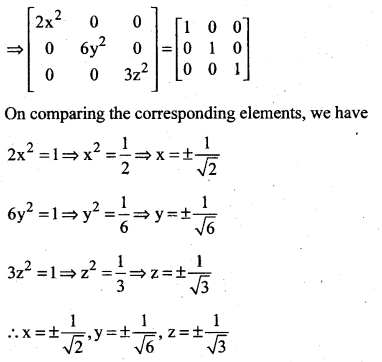
Find the values of x, y, z if the matrix A = \(\left[\begin{array}{ccc}
0 & 2 y & z \\
x & y & -z \\
x & -y & z
\end{array}\right]\) satisfy the equation A’A = I
Solution:
Question 3.
Find the matrix X so that X\(\left[\begin{array}{lll}
1 & 2 & 3 \\
4 & 5 & 6
\end{array}\right]=\left[\begin{array}{ccc}
-7 & -8 & -9 \\
2 & 4 & 6
\end{array}\right]\)
Solution:
Given that X\(\left[\begin{array}{lll}
1 & 2 & 3 \\
4 & 5 & 6
\end{array}\right]=\left[\begin{array}{ccc}
-7 & -8 & -9 \\
2 & 4 & 6
\end{array}\right]\)
The order of the matrix on R.H.S. is 2×3 and that of L.H.S is 2×3 .
So, X has to be a 2×2 matrix. Let X = \(\left[\begin{array}{ll}
\mathrm{a} & \mathrm{c} \\
\mathrm{~b} & \mathrm{~d}
\end{array}\right]\)
∴ \(\left[\begin{array}{ll}
a & c \\
b & d
\end{array}\right]\left[\begin{array}{lll}
1 & 2 & 3 \\
4 & 5 & 6
\end{array}\right]=\left[\begin{array}{ccc}
-7 & -8 & -9 \\
2 & 4 & 6
\end{array}\right]\) ⇒ \(\left[\begin{array}{ccc}
\mathrm{a}+4 \mathrm{c} & 2 \mathrm{a}+5 \mathrm{c} & 3 \mathrm{a}+6 \mathrm{c} \\
\mathrm{~b}+4 \mathrm{~d} & 2 \mathrm{~b}+5 \mathrm{~d} & 3 \mathrm{~b}+6 \mathrm{~d}
\end{array}\right]=\left[\begin{array}{ccc}
-7 & -8 & -9 \\
2 & 4 & 6
\end{array}\right]\)
Equating the corresponding elements of the two matrices, we have:
a + 4c = -7…..(1)
2a + 5c = – 8 …………. (2)
3a + 6c = -9 …………. (3)
b + 4d = 2 ….(4)
2b + 5d = 4 …. (5)
3b + 6d = 6 …………. (6)
Solving (1) and (2) we get a,c
(1) ⇒ a + 4c = – 7 ⇒ a = – 7 – 4c
(2) ⇒2a + 5c = – 8
⇒ 2(- 7 – 4c) + 5c = -8 ⇒ -14 – 8c + 5c = -8 ⇒ -3c = 6 ⇒ c = -2
∴ a = -7-4(-2) = -7 + 8 = 1 ⇒ a = 1
Solving (4) and (5) we get b, d
(4) ⇒ b + 4d = 2 ⇒ b = 2 – 4d
(5) ⇒ 2b + 5d = 4 ⇒ 2(2 – 4d) + 5d = 4
⇒ 4 – 8d + 5d = 4 ⇒ -3d = 0 ⇒ d = 0
∴ b = 2 – 4d = 2 – 4(0) = 2 ⇒ b = 2
Thus, a = 1, b = 2, c = -2 and d = 0
Hence, the required matrix X = \(\left[\begin{array}{cc}
1 & -2 \\
2 & 0
\end{array}\right]\)
III.
Question 1.
Show that the matrix B’AB k symmetric or skew symmetric according as A is symmetric or skew symmetric.
Solution:
We suppose that A is a symmetric matrix, then A’ = A (1)
Consider ( B’AB)’ = [B'(AB)]’ = (AB)'(B’)’ [: (AB)’ B’A’]
= B’A'(B)[∵ (B’)’ = B]
= B'(A’B)= B'(AB)[ using(1)]
∴ (B’AB)’ = B’AB
Thus, if A is symmetric matrix, then B’AB is a symmetric matrix.
Now, we suppose that A is a skew symmetric matrix, then A’ = -A ……….. (2)
Consider, (B’AB)’ = [B'(AB)]’ = (AB)'( B’)’ = (B’A’)B = B'(-A )B [Using (2)] = -B’AB
∴ (B’AB)’ = -B’AB
Thus, if A is a skew symmetric matrix, then B’AB is a skew symmetric matrix.
Hence, if A is symmetric or skew symmetric matrix, then B’AB is symmetric or skew symmetric accordingly.
Question 2.
A manufacturer produces three products x, y, z which he sells in two markets. Annual sales are indicated below:

(a) If unit sale prices of x, y and z are ₹ 2.50, ₹ 1.50 and ₹ 1.00, respectively, find the total revenue in each market with the help of matrix algebra.
(b) If the unit costs of the above three commodities are ₹ 2.00, ₹ 1.00 and 50 paise respectively. Find the gross profit.
Solution:
(a) The unit sale prices of x, y and z are ₹ 2.50, ₹ 1.50 and ₹ 1.00 respectively.
Consequently, the total revenue in market I can be represented in the form of a matrix as:
\(\left[\begin{array}{lll}
10000 & 2000 & 18000
\end{array}\right]\left[\begin{array}{l}
2.50 \\
1.50 \\
1.00
\end{array}\right]\) = 10000 × 2.50 + 2000 × 1.50 + 18000 × 1.00
= 25000 + 3000 + 18000 = 46000
The total revenue in market II can be represented in the form of a matrix as:
\(\left[\begin{array}{lll}
6000 & 20000 & 8000
\end{array}\right]\left[\begin{array}{l}
2.50 \\
1.50 \\
1.00
\end{array}\right]\) = 6000 × 2.50 + 20000 × 1.50 + 8000 × 1.00
= 15000 + 30000 + 8000 = 53000
Thus, the total revenue in market I is ₹ 46000 and the total revenue in market.II is ₹ 53000.
(b) The unit costs of x, y and z are ₹ 2.00, ₹ 1.00 and 50 paise respectively.
Consequently, the total cost prices of all the products in market I can be represented in the form of a matrix as:
\(\left[\begin{array}{lll}
10000 & 2000 & 18000
\end{array}\right]\left[\begin{array}{l}
2.00 \\
1.00 \\
0.50
\end{array}\right]\) = 10000 × 2.00 + 2000 × 1.00 + 18000 × 0.50
= 20000 + 2000 + 9000 = 31000
Since the total revenue in market I is ₹ 46000,
the gross profit in this market in ₹ is 46000 – 31000=15000
The total cost prices of all the products in market II can be represented in the form of a matrix as:
\(\) = 6000 × 2.00 + 20000 × 1.00 + 8000 × 0.50
= 12000 + 20000 + 4000 = 36000
Since the total revenue in market I is ₹ 53000 , the gross profit in this market in ₹ is 53000 – 36000 = 17000
Thus, the gross profit in market I is ₹ 15000 and in market II is ₹ 17000