
Referring to the AP Inter 2nd Year Maths Study Material Chapter 1 Relations and Functions Exercise 1b Solutions makes it easier to understand complex problems.
AP Inter 2nd Year Maths Relations and Functions Solutions Exercise 1b
I.
Question 1.
Check the injectivity and surjectivity of the function f : N → N given by f (x) = x2
Solutions:
f : N → N; f (x) = x2
∴ f is injective, (one-one)
∴ f is not surjective(onto)
(i) f(x1) = f(x2) ⇒ x12 = x22 ⇒ x1 = x2
(ii) For 2 ∈ N we can’t find in x in N such that f(x) = x2 = 2
Aliter: We know N= {1, 2, 3, ….} and f (x) = x2
(i) f(1) = 12 = 1; f(2) = 22 = 4; f(3) = 32 = 9;
∴ f = {(1, 1), (2, 4), (3, 9), ….} ………….. (1)
Here, distinct elements of the domain N have distinct images.
∴ f is injective.
ii) From(1), Range off = {1, 4, 9, ….}
(set of all second elements in the ordered pairs)
But codomain N= {1, 2, 3, 4, ….}
Thus, Range set ≠ Codomain N.
∴ f is not surjective
Given function f is injective but not surjective.

Question 2.
Check the injectivity and surjectivity of the function f : Z → Z given by f (x) = x2
Solution:
f : Z → Z; f (x) = x2
(i) f(x1) = f(x2) ⇒ x12 = x12 ⇒ x1= ±x2
(ii) For 2 ∈ Z we can’t find in x in Z such that f(x) = x2 = 2
Aliter: Now f(1) = 12 = 1; f(-1) = (-1)2 = 1;
Thus, distinct elements 1, -1 of the domain Z have the same image 1.
∴ f is not injective,
ii) Range off = {0, 1, 4, 9, , …}
But codomain Z= {…-3, -2, -1, 0, 1, 1.5 2, 3, 4, ….};
Thus, Range set ≠ Codomain Z.
∴ f is not surjective
Given function f is not injective and not surjective.
Question 3.
Check the injectivity and surjectivity of the function f : R → R given by f (x) = x2
i) f: R → R given by f (x) = x2
f(1) = 12 = 1; f(-1) = (-1)2 = 1;
Here, distinct elements 1, -1 of the domain R have the same image 1.
∴ f is not injective.
ii) For -2 ∈ R we can’t find in x in R such that f(x) = x2 = -2
∴ f is not surjective
Given function f is not injective and not surjective.
Question 4.
Check the injectivity and surjectivity of the function f : N → N given by f (x) = x3
Solution:
f: N → N; f (x) = x3
(i) f (x1) = f (x2) ⇒ x13 = x23 ⇒ x1 = x2
∴ f is injective.
(ii) For 2 ∈ N we can’t find in x in N such that f(x) = x3 = 2
∴ f is not surjective
Aliter: We know N= {1, 2, 3, 4, ….} and f(x) = x3
i) f(1) = 13 = 1; f(2) = 23 = 8; f(3) = 33 = 27;
∴ f{(1, 1), (2, 8), (3, 27), …………} ………….. (1)
Here, distinct elements of the domain N have distinct images.
∴ f is injective.
ii) From (1) Range of f contains only the cube values = {1, 8, 27, ….}
But codomain N = {1, 2, 3, 4, ….}
Thus, Range set ≠ Codomain N.
∴ f is not surjective
Given function f is injective but not surjective.
Question 5.
Check the injectivity and surjectivity of the function f: Z → Z given by f (x) = x3
Solution:
f : Z → Z; f(x) = x3
(i) f(x1) = f(x2) = x13 = x23 = x1 = x2
∴ f is injective.
(ii)For 2 ∈ Z we can’t find in x in Z such that f(x) = x3 = 2
∴ f is not swje1ctive
Question 6.
Prove that the Greatest Integer Function f : R → R, given by f (x) = [x], is neither one-one nor onto, where [x] denotes the greatest integer less than or equal to x.
Solution:
f: R → R is given by f(x) = [x]= Greatest integer ≤ x
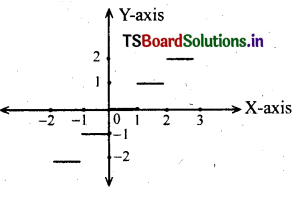
Now,f(0) = [0] = 0; f(1) = [1] = 1;
f(1.2) = [1.2] = 1, f(2) = [2] = 2;
f(-o.5) = [-0.5] = -1; f(-1.1) = [-1.1] = -2;
(i) Thus, we have f(1) = 1, f(1.2) = 1.
Thus distinct elements R have the same image.
∴ f is not one-one.
(ii) Thus, we see that the range contains only the integers f={…., -2, -1, 0, 1, 2, 3, ….}= Z
Thus, Range Z ≠ Codomain R.
∴ f is not onto.
∴ The greatest integer function is neither one-one nor onto.
Question 7.
Show that the Modulus Function f : R → R, given by f (x) = | x |, is neither one- one nor onto, where | x | is x, if x is positive or 0 and | x | is – x, if x is negative.
Solution:
f: R → R is given as f(x) = |x| = 
(i) f(-1) = |-1| = 1 and f(1) = |1| = 1
Thus distinct elements -1, 1 of the domain R have the same image 1.
∴ f is not one-one.
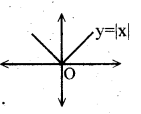
(ii) Range of |x| is [0, ∞]; [ This range donot contain any negative reals)
Thus, range ≠ codomain R
∴ f is not onto.
∴ The modulus function is neither one-one nor onto.
Question 8.
Show that the Signum Function f : R → R, given by
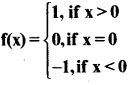
Solution:
(i) From the given function we have f(1) = 1 and f(2) = 1 [∵ f(x) = 1 if x > 1]
Thus distinct elements of R have the same image.
∴ f is not one-one.
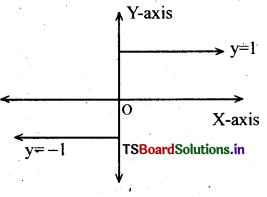
(ii) From the given function f we see that the Range of f(x)is {1, 0, -1}.But codomain is R.
Thus, range ≠ codomain R
∴ f is not onto.
∴ The signum function is neither one-one nor onto.
Question 9.
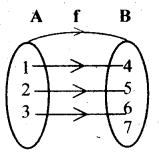
Let A = {1, 2, 3}, B = {4, 5, 6, 7} and let f = {(1, 4), (2, 5), (3, 6)} be a function from A to B. Show that f is one-one.
Solution:
Given that A = {1, 2, 3} , B = {4, 5, 6, 7}
f: A → B is defined as f = {(1, 4), (2, 5), (3, 6)}
∴ f(1) = 4, f(2) = 5, f(3) = 6
Thus, distinct elements of A have distinct images in B under f.
∴ f is one-one.
Question 10.
Define One-one (Injective) function
Solution:
One-one (Injective) function : A function f: A → B is said to be a one one function if x1, x2 ∈ A
be such that f(x1)= f(x1) ⇒ x1= x2
Question 11.
Define onto(Surjective) function
Solution:
Onto(Surjective) function: A function f: A → B is said to be an onto function if its
Range equals to Codomain. [f(A)= B] (or) .
A function f: A → B is an onto function if ∀ y ∈ B ∃ x ∈ A such that f(x) = y
Question 12.
Define bijective function.
Solution:
Bijective function : A function which is both one-one and onto then f is called bijective.
II.
Question 1.
Show that the function f: R → R„ defined by f(x) = \(\frac{1}{x}\) is one-one and onto, where R* is the set of all non-zero real numbers. Is the result true, if the domain R* is replaced by N with co-domain being same as R*?
Solution:
a) When f: R* → R* is given as f(x) = —. Let x1, x2 ∈ R*
(i) f(x1) = f(x2) ⇒ \(\frac{1}{x_1}=\frac{1}{x_2}\) ⇒ x1 = x2
∴ f is one-one.
(ii) Given that f(x) = \(\frac{1}{x}\) …………. (1)
Let f(x) = y ⇒ y = \(\frac{1}{x}\) ⇒ x = \(\frac{1}{y}\), exists ∀ y ≠ 0 [ as y ∈ R*, set of non-zero reals]
∴ f is onto.
Verification: From (1), f (x) = \(\frac{1}{x}\) = \(\frac{1}{\left(\frac{1}{y}\right)}\) = y
∴ Given function f is one-one and onto.
b) We take g: N → R* as g(x) = \(\frac{1}{x}\). Let x1, x2 ∈ N
(i) g(x1) = g(x2) ⇒ \(\frac{1}{x_1}=\frac{1}{x_2}\) ⇒ x1 = x2
∴ g is one-one.
(ii) For some 1.5 ∈ R* (codomain) there is no x in N such that
g(x) = \(\frac{1}{1.5}\) {∵ \(\frac{1}{1.5}\) is not a natural}
∴ the other function g is one-one but not onto.
Question 2.
State whether the function f : R → R defined by f (x) = 3 – 4x is one-one, onto or bijective. Justify your answer.
Solution:
f: R. → R is defined as f(x) = 3 – 4x. Let x1, x2 ∈ R
(i) f(x1) = f(x2) ⇒ 3 – 4x1 = 3 – 4x2 ⇒ -4x1 = -4x2 ⇒ x1 = x2
∴ f is one-one.
(ii) Given that f (x) = 3 – 4x (1); Put f(x) = y
⇒ y = 3 – 4x ⇒ 4x = 3 – y ⇒ x = \(\frac{3-y}{4}\) exists ∀ y ∈ R( codomain)
∴ f is onto.
Justification: From (1), f(x) = \(\mathrm{f}\left(\frac{3-\mathrm{y}}{4}\right)=3-4\left(\frac{3-\mathrm{y}}{4}\right)\) = 3 – (3 – y) = y
Hence, f is both one-one and onto hence bijective.
Question 3.
State whether the function f : R → R defined by f (x) = 1 + x2 is one-one, onto or bijective. Justify your answer.
Solution:
f: R → R is defined as f (x) = 1 + x2. Let x1, x2 ∈ R
(i) Take two elements 1, -1 in the domain
Now f(1) = 1 + 12 = 2; f(-1) = 1 + (-1) = 1 + 1 = 2;
Two distinct elements in the domain have the same image.
∴ f is not one-one.
(ii) From the given function f (x) = 1 + x2 it can be seen that Range of f is always positive.
So negative elements in the codomain R like -2 do not have any preimage in the
domain R such that f(x) = 1 + x2
∴ f is not onto.
Hence, f is neither one-one nor onto.
Question 4.
Let A and B be sets. Show that f: A × B → B × A such that f (a, b) = (b, a) is bijective function.
Solution:
f : A × B → B × A is defined as(a, b) = (b, a).
Let (a1, b1), (a2, b2) ∈ A × B
(i) f(a1, b1)= f(a2, b3) (b1, a1) = (b2, a2)
⇒ (b2, a2) = (b1, a1) (a1, b1)=(a2, b2)
∴ f is one—one.
(ii) ∀(b, a) ∈ B × A there exist (a, b) ∈ A × B such that f(a, b) = (b, a)
∴ f is onto.
Here, f is both one-one and onto hence bijective.
Question 5.
Let f : N → N be defined by
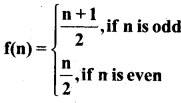
for all n ∈ N
State whether the function f is bijective. Justify your answer.
Solution:
Case i: For odd n = 1, 3, 5, …. we have f(n) = \(\frac{\mathrm{n}+1}{2}\)
∴ f(1) = \(\frac{1+1}{2}\) = 1; f(3) = \(\frac{3+1}{2}\) = 2; f(5) = \(\frac{5+1}{2}\) = 3;
⇒ f = {(1, 1), (3, 2), (5, 3), …………} ……. (1)
Case ii: For even n = 2, 4, 6, …. we have f(n) = \(\frac{\mathrm{n}}{2}\)
∴ f(2) = \(\frac{2}{2}\) = 1; f(4) = \(\frac{4}{2}\) = 2; f(6) = \(\frac{6}{2}\) = 3; ⇒ {(2, 1), (4, 2), (6, 3), }….. (2)
From (1) and (2) we get f= {(1, 1), (2, 1), (3, 2), (4, 2), (5, 3), (6, 3), ….} (3)
a) From (3), we have f(1) = 1 and f(2) = 1
Thus distinct elements 1, 2 of the domain N have the same image 1.
∴ f is not one-one
b) From (3) the range set = {1, 1, 2, 2, 3, 3, } = {1, 2, 3, ….}
⇒ Range of = {1, 2, 3, }= codomain N
∴ f is onto.
∴ f is onto but not one-one. Hence, f is not a bijective function.
Question 6.
Let A = R – {3} and B = R – {1}. Consider the function f: A → B defined by f(x) = \(\left(\frac{x-2}{x-3}\right)\) Is f one-one and onto? Justify your answer.
Solution:
Given that f: A-+B is defined as f (x) = \(\left(\frac{x-2}{x-3}\right)\) for A = R -{3}, B = R -{1}
a) Take x1, x2 ∈ A such that f(x1) = f(x2) ⇒ \(\frac{x_1-2}{x_1-3}=\frac{x_2-2}{x_2-3}\) ⇒ (x1 -2)(x2 – 3) = (x2 – 2)(x1 – 3)
⇒ x1x2 – 3x1 – 2x2 + 6 = x1x2 – 3x2 – 2x1 + 6
⇒ -3x1 – 2x2 = -3x2 – 2x1
⇒ 3x1 – 2x1 = 3x2 – 2x2
⇒ x1 = x2
∴ f is one-one.
b) Given that f(x) = \(\left(\frac{x-2}{x-3}\right)\) …………. (1). Put f(x) = y
⇒ y = \(\left(\frac{x-2}{x-3}\right)\) ⇒ x – 2 = xy – 3y ⇒ x(1 – y) = -3y + 2 ⇒ x = \(\frac{2-3 y}{1-y}\) exists ∀ y ∈ B = R-{1}
∴ f is onto.