
Reviewing AP Inter 2nd Year Accounts Study Material Chapter 7 Single Entry Accounting System Questions and Answers can help students prepare confidently for exams.
AP Inter 2nd Year Accountancy 7th Lesson Single Entry Accounting System Questions and Answers
I. Fill in the blanks
Question 1.
Accounting records that are not strictly maintained according to the double entry system are known as ____
Answer:
Accounts from Incomplete Records
Question 2.
The system in which only one aspect of a transaction is recorded is called the ___ system.
Answer:
Single Entry
Question 3.
In the single entry system, generally only ____ accounts are maintained.
Answer:
Personal
Question 4.
A ____ book is commonly kept to record all cash receipts and payments.
Answer:
Cash
Question 5.
The difference between total assets and total liabilities is known as ___
Answer:
Capital
Question 6.
The statement that shows assets and liabilities prepared under single entry system is called a ___
Answer:
Statement of Affairs
II. Very Short Answer Questions
Question 1.
What is meant by accounts from Incomplete records ?
Answer:
- Accounts from incomplete records are those accounting records that are not maintained under the double entry system.
- Generally, only a few records such as personal accounts and the cash book are kept in this method.
Question 2.
Define accounts from incomplete records.
Answer:
Accounts from incomplete records refer to a system of accounting in which the principles of the double entry system are not completely followed, and only one aspect of certain transactions is recorded.
Question 3.
What are the uses of Incomplete records ?
Answer:
The uses of incomplete records are as follows :
- It provides a simple way of recording business transactions.
- It is more economical than the double entry system.
- It is appropriate for small-scale businesses.
- It can be understood easily even by people with limited accounting knowledge.

Question 4.
Give two main differences between a statement of affairs and a balance sheet.
Answer:
| Statement of Affairs | Balance Sheet |
| 1. It is prepared using incomplete records. | 1. It is prepared using ledger balances. |
| 2. It is not considered fully dependable. | 2. It is regarded as a dependable financial statement. |
III. Short Answer Questions
Question 1.
Write briefly the salient features of Incomplete records.
Answer:
The important features are:
- It is a non-systematic method of maintaining accounts.
- Generally, only personal accounts are maintained.
- Real and nominal accounts are usually not maintained.
- A cash book is maintained to record cash transactions.
- It is mainly followed by small business owners and traders.
Question 2.
How to ascertain profit under Incomplete records ?
Answer:
- Profit can be determined by using the Statement of Affairs Method (also called the Capital Comparison Method).
Formula:
Profit = Closing Capital + Drawings – Additional Capital – Opening Capital - The opening and closing capital are calculated from the Statement of Affairs prepared at the beginning and at the end of the accounting year.
Question 3.
Write in brief the limitations of Incomplete records of book keeping.
Answer:
The major limitations are:
- It is not a systematic method of accounting.
- A trial balance cannot be prepared.
- Errors and frauds are difficult to identify.
- The exact financial position of the business cannot be determined.
- The accounts are not considered dependable by outsiders.
Question 4.
Write any differences between double entry system and single entry system.
Answer:
| Double Entry System | Single Entry System |
| 1. It is a complete method of bookkeeping. | 1. It is an incomplete method of book keeping. |
| 2. Every transaction is recorded with both debit and credit aspects. | 2. Only one aspect of a transaction is generally recorded. |
| 3. A trial balance can be prepared. | 3. A trial balance cannot be prepared. |
| 4. It helps in determining profit accurately. | 4. Profit can only be estimated. |
IV. Long Answer Questions
Question 1.
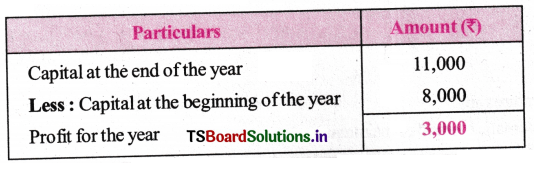
From the following, find the profit earned by a trader.
- Capital at the beginning of the year ₹ 8,000
- Capital at the end of the year ₹ 11,000
Solution:
Question 2.
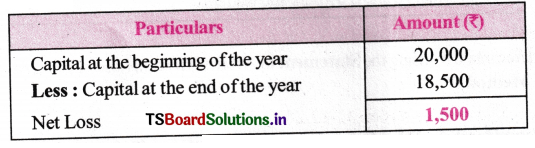
Calculate the profit or loss of a concern.
- Capital at the beginning of the year ₹ 20,000
- Capital at the end of the year ₹ 18,500
Solution:
Question 3.
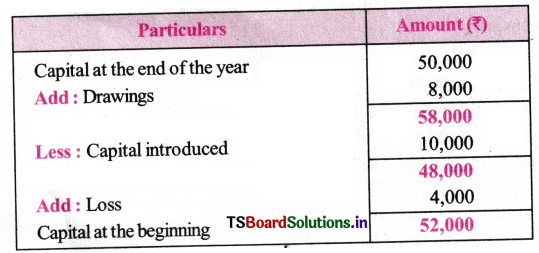
Calculate the missing figure (Opening Capital).
- Capital at the end ₹ 50,000
- Drawings ₹ 8,000
- Capital introduced ₹ 10,000
- Loss ₹ 4,000
Solution:
Question 4.
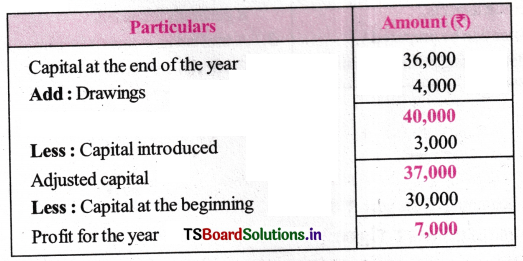
Find out the profit from the following data.
- Capital at the beginning ₹ 30,000
- Drawings during the year ₹ 4,000
- Capital at the end ₹ 36,000
- Capital introduced during the year ₹ 3,000
Solution:
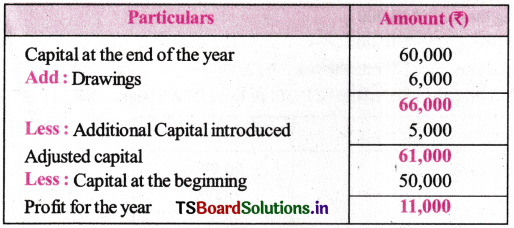
Question 5.
Find out the profit from the following data.
- Capital at the beginning ₹ 50,000
- Capital at the end ₹ 60,000
Solution:
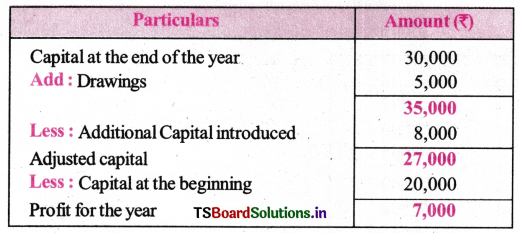
Question 6.
Ascertain the profit earned by a trader who keeps his books under the single entry system.
- Excess of assets over liabilities as on 31 -12-2025 : ₹ 30,000
- Additional capital introduced during the year: ₹ 8,000
- Drawings during the year: ₹ 5,000
- Capital as on 01 -01 -2025 : ₹ 20,000
Solution:
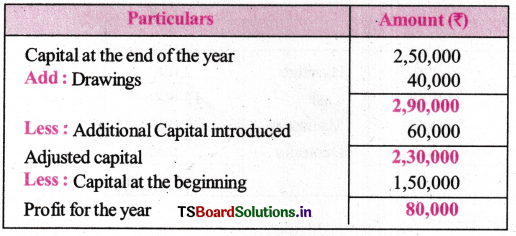
Question 7.
Prepare the Statement of Profit or Loss from the following information.
- Capital at the end of the year: ₹ 2,50,000
- Capital at the beginning of the year: ₹ 1,50,000
- Drawings made during the period: ₹ 40,000
- Additional capital introduced: ₹ 60,000
Solution:
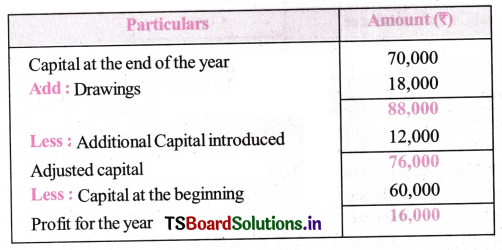
Question 8.
Mr. Srinivas maintains his books under the single entry system. He gives the following ‘information.
- Capital on 01 -04-2024 : ₹ 60,000
- Drawings during the year: ₹ 18,000
- Capital as on 31 -03-2025 : ₹ 70,000
- Additional capital introduced during the year: ₹ 12,000
you are requested to Prepare a Statement of Profit or Loss for the year ended 31 -03-2025.
Solution:
Question 9.
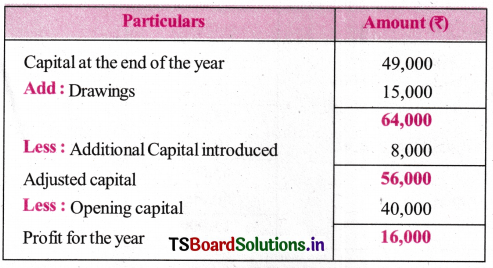
Mr. Padmanabham commenced business on 1st April 2024 with a capital of ₹ 40,000. On 31st March 2025 his position was as follows :
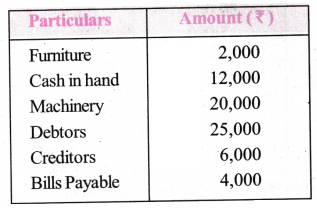
During the year, he withdrew ₹ 15,000 for personal use and introduced additional capital ₹ 8,000. You are required to find out the profit or loss made by Mr. Padmanabham during the year.
Solution:
Statement of Affairs (31-03-2025)
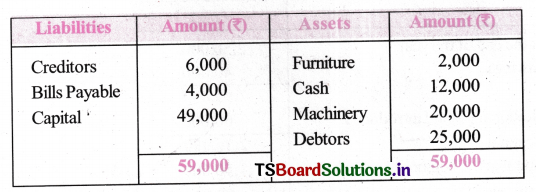
Closing Capital = ₹ 49,000
Statement of Profit or Loss
Question 10.
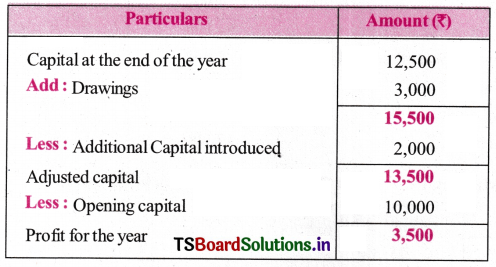
Mr. Shanmukha maintains his books on the single entry system. He gives you the following information:
- Capital on 01-04-2024 : ₹ 10,000
- Capital on 31-03-2025 : ₹ 12,500
- Drawings : ₹ 3,000
- Additional capital introduced: ₹ 2,000
You are required to calculate the profit that Shanmukha earned during the year.
Solution:
Calculate the profit
Question 11.
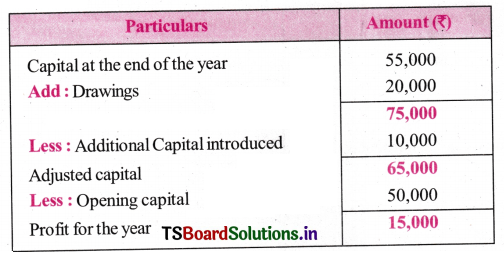
Ms. Naveena maintains her books on the single entry system. She gives you the following information.
- Capital on 01-01-2024 ₹ 50,000
- Drawings during the year ₹ 20,000
- Capital on 31-12-2024 ₹ 55,000
- Fresh capital introduced during the year ₹ 10,000
Prepare the Statement of Profit or Loss for the year.
Solution:
Question 12.
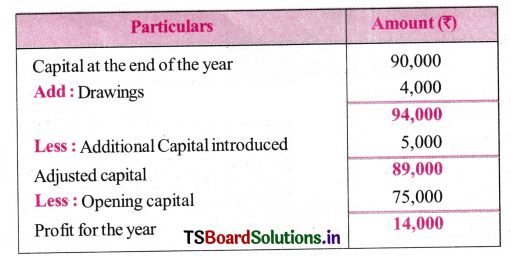
Mr. Konda keeps books in the single entry system. Find the profit from the following particulars:
- Capital on 31-03-2025 ₹ 90,000
- Capital on 01-04-2024 ₹ 75,000
- Additional capital introduced during 2024-25 : ₹ 5,000
- Drawings made during the year: ₹ 4,000
Solution:
Question 13.
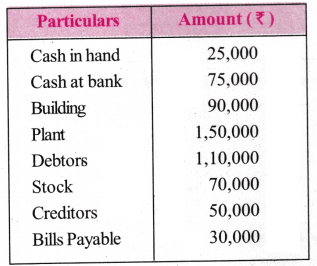
From the following details ascertain Radhika’s capital as on 01-01-2025.
Solution:
Total Assets = ₹ 5,20,000
Total Liabilities = ₹ 80,000
Capital = Assets – Liabilities
Capital = 5,20,000 – 80,000 Capital = ₹ 4,40,000
Question 14.
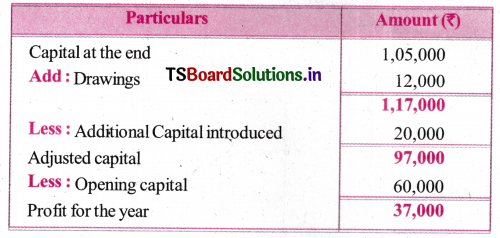
Mr. Rama Krishna started his ready-made garments business on 1st April 2024 with a capital of ₹ 60,000. He did not maintain his books according to the double entry system. During the year:
- Additional capital introduced = ₹ 20,000
- Drawings = ₹ 12,000
On 31st March 2025, his assets and liabilities were
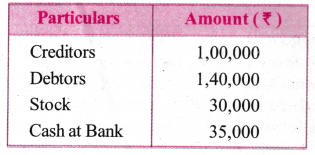
Find the profit or loss for the year.
Solution:
Statement of Affairs (31-03-2025)
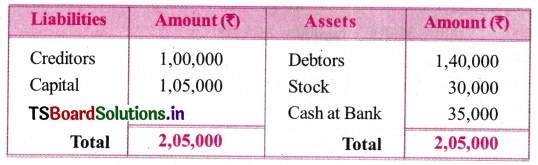
Closing Capital = ₹ 1,05,000
Statement of Profit or Loss
Question 15.
Mr. Apparao keeps his books by the single entry system. He started business on 1st January 2025 with ₹ 30,000 as capital. On 31st December 2025, his position was as follows : Assets : Cash in hand ₹ 1,000; Cash at bank ₹ 2,000; Furniture ₹ 3,000; Plant ₹ 15,000; Sundry Debtors ₹ 7,000; Stock ₹ 12,000; Bills Receivable ₹ 2,000.
Liabilities : Sundry Creditors ₹ 6,000; Bills Payable ₹ 1,000; Outstanding Expenses ₹ 1,000. You are required to ascertain the profit or loss made by Mr. Apparao during the year ended 31st December 2025.
Find the profit or loss.
Solution:
Statement of Affairs (31-12-2025)
Total Assets = ₹ 42,000
Total Liabilities = ₹ 8,000
Closing Capital = 42,000 – 8,000 = ₹ 34,000
Profit = Closing Capital – Opening Capital
Profit = 34,000 – 30,000 = ₹ 4,000
Question 16.
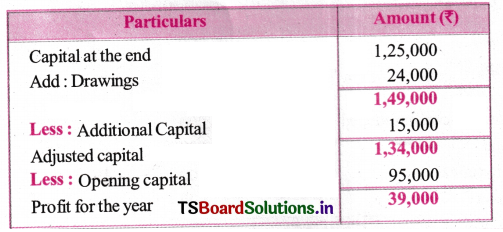
Mr. Brahmaiah keeps his books on the single entry system. His position on 31st December 2024 was as follows: Cash at Bank ₹ 5,000; Stock ₹ 25,000; Debtors ₹ 35,000; Machinery ₹ 60,000 and Creditors ₹ 30,000. His position on 31st December 2025 was as follows : Cash at Bank ₹ 8,000; Stock ₹ 30,000; Debtors ₹ 50,000; Machinery ₹ 65,000 and Creditors ₹ 28,000. During the year he introduced ₹ 15,000 as further capital and withdrew ₹ 2,000 per month for personal use.
You are required to ascertain the profit or loss made by Mr. Brahmaiah for the year ended 31st December 2025.
Solution:
Capital on 31 -12-2024
Assets = 5,000 + 25,000 + 35,000 + 60,000 = 1,25,000
Liabilities = 30,000
Opening Capital = 1,25,000 – 30,000 = 95,000
Capital on 31 -12-2025
Assets = 8,000 + 30,000 + 50,000 + 65,000 = 1,53,000
Liabilities = 28,000
Closing Capital = 1,53,000 – 28,000 = 1,25,000
Drawings = 2,000 × 12 = 24,000
Statement of Profit
Question 17.
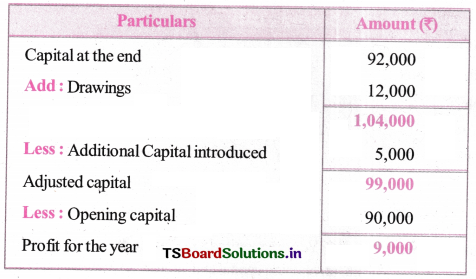
From the following particulars from the books of M/s Deepti, prepare a Statement of Profit or Loss for the year ended 31st December 2025.
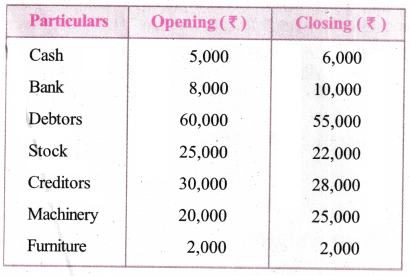
The proprietor withdrew at the rate of ₹ 1,000 per month for personal use and she introduced ₹ 5,000 as fresh capital during the year.
Solution:
Opening Capital:
Assets = 5,000 + 8,000 + 60,000 + 25,000 + 20,000 + 2,000 = 1,20,000
Liabilities = 30,000
Opening Capital = 1,20,000 – 30,000 = 90,000
Closing Capital:
Assets = 6,000 + 10,000 + 55,000 + 22,000 + 25,000 + 2,000 = 1,20,000
Liabilities = 28,000
Closing Capital = 1,20,000 – 28,000 = 92,000 Drawings = 1,000 × 12 = 12,000
Statement of profit
Question 18.
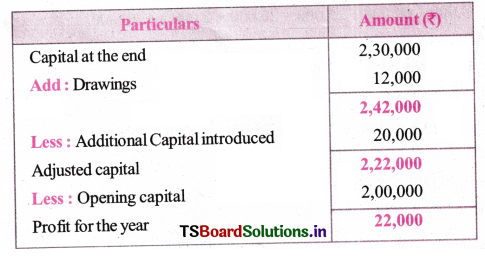
Mr. Sudhakar keeps his books by the single entry system. His position on 31st December 2024 was as follows : Cash at Bank ₹ 10,000; Stock ₹ 50,000; Debtors ₹ 80,000; Machinery ₹ 1,20,000 and Creditors ₹ 60,000. His position on 31st December 2025 was as follows : Cash at Bank ₹ 15,000; Stock ₹ 70,000; Debtors ₹ 1,00,000; Machinery ₹ 1,10,000 and Creditors ₹ 65,000. During the year the trader introduced ₹ 20,000 as additional capital and withdrew ₹ 1,000 per month for personal use. You are required ascertain the profit or loss made by the trader for the year ended 31st December 2025.
Solution:
Opening Capital:
Assets = 10,000 + 50,000 + 80,000 + 1,20,000 = 2,60,000
Liabilities = 60,000
Opening Capital = 2,00,000
Closing Capital:
Assets = 15,000 + 70,000 + 1,00,000 + 1,10,000 = 2,95,000
Liabilities = 65,000
Closing Capital = 2,30,000
Drawings = 1,000 × 12 = 12,000
Statement of Profit
Question 19.
The assets and liabilities of Mr. Shyam on 01-01-2025 and 31-12-2025 were as follows:
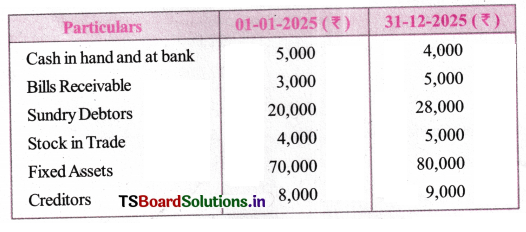
Drawings during the year were ₹ 16,000. You are required to calculate the profit for the year after charging interest on capital at 5% p.a. on opening capital and interest on drawings at 6% p.a.
Solution:
Statement of Affàirs method:
1. Calculate Opening Capital (01-01-2025):
Assets :
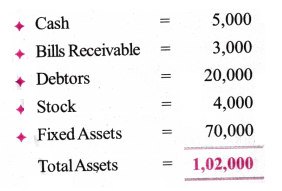
Liabilities:
- Creditors = 8,000
- Opening Capital = 1,02,000 – 8,000 = ₹ 94,000
2. Calculate closing Capital (31-12-2025):
Assets :
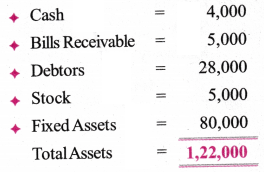
Liabilities:
- Creditors = 9,000
- Opening Capital = 1,22,000 – 9,000 = ₹ 1,13,000
3. Calculate Profit before Adjustments:
Profit = Closing Capital – Opening Capital + Drawings
= 1,13,000 – 94,000+ 16,000 = ₹ 35,000
4. Adjust for Interest:
Interest on Capital (5%) = 5% of 94,000 = ₹ 4,700 (Expense → subtract)
Interest on Drawings (6%) = 6% of 16,000 = ₹ 960 (Income → add)
5. Final Profit:
Adjusted Profit = 35,000 – 4,700 + 960 = ₹ 31,260
Final Answer: Profit for the year = ₹ 31,260
Question 20.
Mr. Kishore starts his business with ₹ 40,000 in cash as his capital on 1st April 2024. At the end of the year, his position was as follows : Creditors ₹ 10,000; Debtors ₹ 8,000; Cash at Bank ₹ 18,000; Stock ₹ 12,000; and Machinery ₹ 20,000. During the year, he withdrew ₹ 1,500 every month. On 1st October 2024, he introduced a further capital of ₹ 10,000. You are required to ascertain the profit or loss made by him during the year ended 31st March 2025 after Machinery to be depreciated at 10%, and a reserve of 2% to be raised against Debtors. Also prepare a Statement of Affairs as at 31st March 2025.
Solution:
1. Closing Statement of Affairs (as on 31-03-2025):
Adjustments first:
- Depreciation on Machinery = 10% of 20,000 = 2,000
Adjusted Machinery = 20,000 – 2,000 = 18,000 - Reserve for Doubtful Debts = 2% of 8,000 = 160
Adjusted Debtors = 8,000 – 160 = 7,840
Statement of Affairs (31-03-2025)
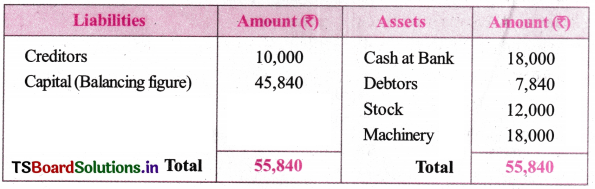
2. Calculation of Profit:
Step-1: Opening Capital = ₹ 40,000
Step-2 : Closing Capital = ₹ 45,840
Step-3 : Adjust Drawings and Additional
Capital Drawings = 1,500 × 12 = 18,000
Assitional Capital = 10,000
Step-4: Profit Calculation
Profit = Closing Capital – Opening Capital + Drawings – Additional Capital
= 45,840 – 40,000 + 18,000 – 10,000 = ₹ 13,840
Final Answers:
- Profit for the year = ₹ 13,840
- Closing Capital = ₹ 45,840